
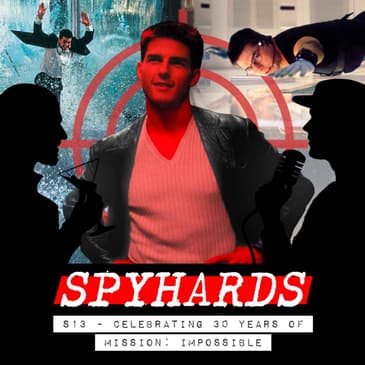


Agents Scott and Cam, along with guest operatives Jesse Alexander, TV writer, producer & showrunner, and Griffin Schiller from the FilmSpeak YouTube channel, perform close up magic with floppy disks while discussing the impact and legacy of Tom Cruise and Brian DePalma's 1996 blockbuster Mission: Impossible.
Make sure to visit and subscribe to Jesse's Substack, The Scribblers Toolbox.
Check out FilmSpeak on YouTube! You can also follow Griffin on X, Instagram and Threads.
Make your opinions about the NOC List known. Leave us a voicemail on Speakpipe or send us an email now!
Become a SpyHards Patron and gain access to top secret "Agents in the Field" bonus episodes, movie commentaries and more!
Social media: @spyhards
Purchase the latest exclusive SpyHards merch at Redbubble.
View the NOC List and the Disavowed List at Letterboxd.com/spyhards
Podcast artwork by Hannah Hughes.
Theme music by Doug Astley.
Hosted on Acast. See acast.com/privacy for more information.
[00:00:00] This show is nominated for a 2026 Golden Lobes Podcast Award. Get in!
[00:00:06] Hello and welcome to SpyHards Podcast. I'm Agent Scott.
[00:00:47] And I'm Cam the Provocateur, sweating profusely at the sight of a rat. Well, I would probably do the same if I saw a rat, but to be fair, I don't think I would have had the same reaction to him in that vent. How do you feel about that? I don't like rats. In fact, just the other day, I was walking down the street and there was this woman just screaming, screaming. And at first I thought she was just, you know, a little unstable. A big fan of Mission Impossible.
[00:01:14] Well, that too, but I thought she was maybe a little unstable. And then I walked a little past her into an alley and there was a rat the size of like, you know, like Andre the Giant's shoe. And I was like, oh, I get it. I get it. I mean, firstly, that's victim blaming, Cam. You can't be doing that. Not again. Not again. But no, I would have just, you know, I would have had the same response if that jumped out at me. Okay. All right. Well, it's nice to know that I'm not going to be the one to put you in the vents next time we go on a mission. That is not my role. I'm the guy in the van.
[00:01:44] You look like a guy in a van. Wait. Maybe you don't. Pull up. Pull up. I think that's the problem. But moving on swiftly from troubled times to better times, the 1990s. Cam, what are we talking about this week? We are celebrating 30 years of Brian De Palma's Mission Impossible, a movie that's had a huge impact not only on this podcast, but just on, I think, both of our lives.
[00:02:13] And so it's going to be great to look back at this movie. We've got some experts joining us to give some great insights into what makes this movie so special. Yeah, I often chew chewing gum and then stick it on things to see if it explodes. You're still waiting. That might be the case, Cam, but at least my watch has a TV built into it. Oh, okay. Well, you see, I'm more like the Dick Tracy, so I'm like the old timey radio. I'm going retro. Yeah, I mean, you do seem like a Dick Tracy kind of guy.
[00:02:41] But yes, we are celebrating Mission Impossible. We're going big with this. We know you guys love a round table. We haven't done one in a minute. So we thought we'd come back, assemble a team of experts, just like the IMF, to talk about 1996's Mission Impossible, directed by Brian De Palma. And it is the film that began a franchise that we are still talking about today. Its impact on the spy movie canon is immeasurable.
[00:03:10] So I think without further ado, let's get to it. Mission Impossible 1996, light that fuse. This podcast may self-destruct in 90 minutes or so, but before it does, we need to talk about what we're celebrating this week.
[00:03:28] You know, your mission folks at home, should you choose to accept it is to revisit the exploding aquarium restaurant with us, to dangle from the ceiling in Langley, to get some gum on your windscreen. And talk about a very confused looking John Voight, which is something that hasn't changed in nigh on 30 years. And that is, you know, we're celebrating 30 years of Mission Impossible this week. What a film. But we can't celebrate it alone.
[00:03:57] You see, we're assembling an IMF team worthy of Langley itself, quite frankly. Joining us, firstly, he's a film critic, a spy movie enthusiast, and quite possibly the internet's last surviving defender of Spectre. Maybe. Maybe. Maybe. I'll go to bat for it. Sure, why not? Yeah, yeah. He is the host and creator of the FilmSpeak YouTube channel. It is the one and only Mr. Griffin Schiller. Hello, Griffin. Welcome back.
[00:04:26] Hey, gents. Great to be back. Thank you for having me. I'm glad to be talking about like a film, not to give too much away, but a film that like I actually really like. Because the past few times I think I've been on, we've talked about absolute garbage. Spectre, you know, notwithstanding. But this one, but you know, even Spectre has its issues. So it's just nice. It's nice to be on talking about something that I love. And I broke out the goods for you today. Tom Cruise as Austin Powers, the t-shirt. Such a deep cut.
[00:04:55] You know, are you saying that Ava, your last film wasn't like a home run? I'm gonna be 100% honest with you. I forgot the name of Ava as soon as we finished that conversation. I just dumped it from my memory. I was like, you know what? See you later. Hmm. Well, well, we need to complete this IMF. This lovely leather bound book in front of me has one more face in it.
[00:05:15] Joining us is a writer, a producer, whose espionage dossier includes the likes of Alias, Agent X, Citadel, and of course shows like The Saint, Heroes, and Star Trek Discovery. Meaning he might be the closest thing to an actual IMF agent we've ever had on the show? Hmm. I think so. It's the one and only Jesse Alexander. Jesse, welcome aboard. Hi.
[00:05:40] Thank you very much for having me be part of this and hopefully I can deliver some insight and content that makes it worthy of the bandwidth that I'm taking up here. But it's exciting to be able to talk about the, what we're going to talk about Tom Cruise and the mission movies. Well, you're quite a unique entity, I think, just in general. We love you.
[00:06:07] But also in the sense of like your contributions to spy television. I mentioned it in the intro that you've got a lot of fingers at a lot of spy pies or spies. Yeah. Yeah. Yeah, that's all it, you know, that stuff has always been something that I've been interested in. And, you know, going into the way back machine, I was a huge fan of a show called Wild Wild West.
[00:06:29] That was really my version of James Bond, which was an amazing TV show in the US with Robert Conrad where he essentially played like James Bond in the old west and had all kinds of gadgets and gimmicks and was doing sort of crazy espionage stuff. So I've always been into that stuff. Always read spy fiction, watch spy movies. And in college, I actually studied espionage and military aviation and political history, you know, stuff.
[00:06:58] So I had quite a deep knowledge about the real world stuff about spies and how all that stuff worked. And, you know, the Walker spy case and the, you know, Philby and all those kinds of things. And it really served me well when I got into TV working on Alias with with JJ. I had a deep knowledge of that stuff.
[00:07:25] And I will say I wrote a significant portion of all the set pieces that are in Alias, which was, I think, maybe almost 100 episodes. I can't quite remember. But myself and Alex Kurtzman and Bob Orsi and Rick Orsi, Bob's brother, were really the heart and soul of the spy elements on that show. We actually just watched the first episode of Alias on the Patreon. I'd never watched it in my life, strangely enough.
[00:07:55] And I'm now hooked on the show. So I know spoilers, please, for Alias. I don't know what happens yet. I will be making my way through the show. It's pretty insane. And, you know, definitely if you do stick with it, you know, I actually worked on the pilot with JJ on all those set pieces and all those actions. Like how did she get out of a chair and like all that kind of stuff that's in that, you know, all those gags and everything.
[00:08:21] So, yeah, I think we did a pretty good job on that show of really keeping it emotionally grounded with Sydney and also trying never to get too stuck in getting too far ahead of our skis and always entertaining ourselves and trying to make things cool.
[00:08:47] And JJ's approach to pushing, not necessarily just the budget, but the filmmaking techniques that allowed us to shoot the Disney back lot or Disney lot for going around the world, filming a lot of our action set pieces in the underground tunnels under the Disney studio and reforming the parking garage into shooting ranges.
[00:09:13] And, you know, corners of the of the smoking lounge into a Prague park. And so we really tried to to put a lot on screen with very little money. Well, speaking of putting a lot on screen, Cam, I did already say we've all sort of mentioned it, but what are we? Tell us really what we're doing this week. Break it down for us. We are celebrating the 30th anniversary of Brian De Palma's Mission Impossible.
[00:09:41] Tom Cruise's debut as a producer overseeing a major motion picture that is going to lead to many more major motion pictures for him. And I kind of want to do a little icebreaker, throw it around the room. When I say the word Mission Impossible, what is the first image that comes to everyone's mind? And we're going to get used to this format. Listeners are home, people watching online. We're going to go around the room. So for me, I'm going to start us with Griffin. When I say Mission Impossible, what comes to mind?
[00:10:09] I mean, it's got to be the him dangling from the ceiling in the CIA building in Langley. I mean, that is just that's the iconic shot. I think that cemented the identity of what Mission Impossible was because and I'm sure we'll talk about it later on. But like up until that point in the film, it was just like a lot of like smoke and mirrors, a lot of just like spy craft stuff. But like that was the stunt. And then every subsequent film built off from it.
[00:10:38] But it just it was such a striking image the way De Palma crafted it. I'm sure we will talk about that. But so I don't want to get into it too much, but it is to me. That's that's where my mind immediately goes. What about you, Jesse?
[00:10:51] Yeah, I think it's hard not to him hanging over the the the floor, which was such an iconic cinematic cinematic graphic image that had incredible balance. And then Tom's physicality and intensity, which comes through even in like the wide shots and the medium shot.
[00:11:15] Just, you know, it was so it was so impactful. It just is so attached to to him, spy set pieces and that movie. Cam? Yeah, I mean, I think that that's the most enduring image is him dangling in the vault, you know, almost landing on the floor. That's like the big moment and the one they call back to over the future of the series.
[00:11:38] But I feel like there was a point before that image became so unbelievably locked in amber where maybe like I remember one of the shots that was really heavily marked was the moment where he pulls off the mask. And I feel like in some ways, especially earlier on, what stood out to me about Mission Impossible was a couple of things. It was the masks being pulled off and like the reveal of that. And also just the shot of the fuse being lit. Oh, for sure. I feel like that became.
[00:12:05] Yeah, like that fuse being lit and the way they've played with that over the course of the series. Those are kind of like the low key ones. But I do think they were very important to giving that franchise an identity outside of just more spy stuff. And also sort of a visual language that it then developed over the years and the iterations. I mean, James Bond has 60 years worth of films to look back on now. And you know what the gun barrel means. You know what the dots in Doctor No mean, even though they come back in subsequent films.
[00:12:34] Like it's weird how those little like on the screen dots play such a big part in Bond. I mean, Griffin, you've got Bond artwork around. Oh, yeah. But you probably find the dots somewhere in that artwork. Yeah. I will just jump in to say I didn't know we could talk about the whole franchise when we say Mission Impossible because for me it would be the fuse. I thought it was like only on the De Palma movie. But for me, it's the fuse if we were going for the whole franchise. Yeah, that's such a good point. Yeah, yeah.
[00:13:00] Well, I think then I would actually personally I would go with the Langley heist. So it's interesting that there's sort of a two for two here. But all of this goes back to 1996 with Brian De Palma. And I want to go back first to sort of those that perhaps remember the time a little bit more. And I'll show my age as I really wasn't all that aware of the film coming out. And I didn't see it until around about 98, 99 in preparation for Mission Impossible 2 because I really wanted to see that film.
[00:13:30] So I'll recuse myself from this part of the conversation. I know, I know Mission Impossible 2 is not everyone's favorite. But as a metal fan in that age, it was very much up my alley. The film itself wasn't. But the smoke and mirrors around the film I was very much into. Scott was taking a look around. I certainly was. I mean, Cam, I'll throw it to you your way. Were you sort of aware of the buildup for Mission Impossible? So, yes.
[00:13:59] But the brand Mission Impossible meant nothing to me at that point in my life. I was a teenager. I would have been 15. And that is really the tipping point for me becoming a huge movie fan. And the summer of 1996, I should say, is always going to really jump out to me because it felt like such a huge summer. You had Independence Day. You had Twister. I was a huge Arnold Schwarzenegger fan. And his follow-up to True Lies was coming out that summer, Eraser.
[00:14:28] Not a movie necessarily that people hold in high regard. But it meant something at that point. Another movie, very, very noisy that people probably don't think of now, was Striptease. The promotional blitz for Demi Moore's Striptease was a huge thing. And you had Nutty Professor as well with Eddie Murphy. It was just like this endless string. Cable guy, Jim Carrey, his follow-up to his big streak. That summer was massive.
[00:14:56] So, Mission Impossible really became another one of the movies. And I remember seeing the commercials and seeing the shot particularly of the helicopter rotor about to pierce Tom Cruise's throat. And kind of going, oh, it's another TV adaptation. Okay. And just not really caring because there was a lot of those at that point. I saw it at home on video when it came out and enjoyed it but was completely baffled by the story, you know, the plot of the film.
[00:15:25] Which sounds, I think, ludicrous now. But at the time, it was a very common feeling which was, I like the set pieces but I don't understand this movie. I think that might be something we come back to in terms of the plot. We'll dive into a bit. But Jesse, I want to come to you. What are your memories casting your mind back to 96 to build up to Mission Impossible? Were you a fan of the TV show? Yeah. Look, I'm probably the oldest person here. I'll be 59 in June.
[00:15:52] So, I actually grew up with the show in reruns on TV. So, I was very familiar with the brand and the franchise and was looking forward to the movie. You know, had been somewhat of a De Palma fan. I must admit that Independence Day was more my jam that summer. I was, you know, I'm a big Roland and Dean fan of those lunatics.
[00:16:22] And, yeah, I was psyched for it and looking forward to it. But just because this is, I don't know how many people are listening to this podcast. I thought it was slow at the time. I thought the movie was slow. So, it wasn't necessarily a full win for me when I saw it that first time. But it certainly had a massive impact. And then, Griffin, what about yourself?
[00:16:50] Any memories of it coming out or sort of your, maybe your initial response to the film? Yeah, yeah. I definitely didn't see it when it first came out because I was born in 95. So, I'm 30. So, I was barely one. You know? The door's there if you want to leave now. It's fine. Barely boring. So, you know. But I do remember, I actually can't remember if this was my first one or if MI3 was my first one.
[00:17:17] Because I remember a lot of the fanfare surrounding MI3, specifically after MI2 and kind of going back to the roots, I guess, if you will, of what Mission Impossible was. I think I was like in fifth grade or whatever, or maybe even sixth grade. And I had classmates that saw it and were like excited about it. So, I do remember seeing MI3 and falling in love with that film.
[00:17:41] But I can't remember if that was what ignited me to go back and want to re-watch the first film or if I saw the first film going into the third one. Either way, because I was so young, I was watching it and I just didn't get it. I thought it was like really, really hard to follow. I wasn't, again, because I was so young, I wasn't really familiar with De Palma at the time and everything that he would become, that he is known for in filmmaking.
[00:18:07] But I was, it was a film that like I, over the years since that initial viewing, I just continually revisited because of how drawn I was to just kind of getting it. To figuring out all the pieces. To picking up little details that perhaps you didn't notice on that first viewing. And I do think, you know, now 30 years on, that is, you know, that's where it shines.
[00:18:33] Like it is, it is a movie that is almost designed to reward repeat viewings because of how it almost invites you to participate in the spy craft itself. You know, kind of piggybacking off of De Palma's just knack for voyeurism and whatnot. So, yeah, it's, it's a movie that I, that I've had a very long relationship with. It's one that I'm always very excited to go back and revisit.
[00:18:59] But yeah, that initial viewing, I think for many of us, I'm sure, like, like I remember even my parents, they were like, well, this is just like, it's, they liked it, but they were just like, it's kind of like hard to wrap your head around. I think on that initial viewing and based on the reception at the time, it seems like that was the common consensus as well. Well, I think it's also just quite interesting. I didn't really plan this in terms of ages of this discussion, but it seems to be sort of a decade between all of us, really, in a sense.
[00:19:27] So I was, I was, when this came out, I was 10. And by the time I watched it, I was probably about 12. And I think my reaction to it, preparing for Mission Impossible 2 was, this is quite slow. This isn't James Bond. This isn't GoldenEye. Yeah. And that was my sort of benchmark for a spy movie in 98, 97 was Tomorrow Never Dies and GoldenEye. Oh, yeah. Far, faster films. Yeah. That's a great point, actually, because yes, you had GoldenEye the year before. And so Bond had been relaunched.
[00:19:56] And as a Bond fan, there was a certain energy level you expected from something that looked like Bond. Bond and Mission Impossible for, you know, now we have so many different spy franchises that we can focus on, you know, Bourne, you know, and obviously Bond. And then there's all these attempts to start new stuff like Kingsman. But at the time it was like, well, if it's a big blockbuster spy film, it better be like Bond. And you're also getting the mission, not the mission films, you're also getting the Austin Powers quite soon as well.
[00:20:25] By the time I saw it. Yeah. Like that, the lampooning had begun already. Yeah, that 90s, like aughts era, it was kind of a bit of another like spy craze, like similar, different from the 60s, but just like a post-Cold War spy craze. And I think you see that reflected in a lot of those films. And then Bourne, obviously more of a post-9-11 sort of thing. But yeah, I think what I, like with Mission, like you talk about like having Bond and Goldeneye specifically as like the comparison point, right?
[00:20:55] You're just sort of like, well, this is everything that that movie is not. And that kind of took you by surprise. I think in hindsight, that's what I love about this movie is that it is denying you everything that you expect out of a Bond film. It is in so many ways the anti-Bond film. And when you compare that to what, you know, you know, McQuarrie and what Cruz have kind of crafted in the latter entries, which is very, very, very clearly riffing on a specific era of Bond.
[00:21:21] And it was nice that there was this, this more like grounded, you know, sleazy interpretation of espionage that I feel like hewed closer to what a life in that, that, that line of work actually resembled versus, you know, the more glamorous globe-trotting nature of a James Bond. I don't imagine they're all hanging off of ceilings, the real life spies out there. Well, that's true, yeah.
[00:21:48] I doubt they're watching, to be fair, so they can't really correct us. Can I jump in on one thing? Go ahead, Jesse. You know, I am thinking about it because I do think that that, you know, Mission One, I think you're, it's interesting that you brought up Goldeneye because I hadn't realized it had come out the year before, which I really like Goldeneye. And for me, that was a great sort of James Bond movie. And I think it's important to think about Mission One in the context, or with the people who made it, with, you know, De Palma, Towne on the script.
[00:22:19] Kepp was pretty young still, I think, in his career when he wrote that. But I think Towne was involved in the writing of The Parallax View, and De Palma wrote, or directed Blowout, and was, as you mentioned, very voyeuristic.
[00:22:34] And coming out of that age of the, you know, moving into the 70s filmmakers that were still dealing with the betrayal of Watergate, and the church committee, and the concept of individuals and conspiracies, and lone gunmen.
[00:22:56] And I think it's really important just to remember that it was really driving, you know, the art of those filmmakers when they were telling that story and conveying that tone in that movie. That, you know, De Palma's approach to a spy movie supported by Towne is very different than, and I can't even remember who directed Goldeneye and what that would be.
[00:23:22] So it really is an interesting, it's kind of a throwback, honestly. Yeah. You know, that Mission One is a throwback to some of those movies that came out in the 70s that were, you know, Parallax View, Conversation. There's another one that is amazing with Jeff Bridges that I just watched, that great conspiracy movie.
[00:23:44] But it sort of bridges that gap between old generation spy, conspiracy, new generation stunt show, I think is really important. Because Mission One really is a cinematic masterpiece. The craftsmanship in, you know, De Palma's direction, choices of shots, and Paul Hirsch editing is incredible.
[00:24:11] Well, and you mentioned, you know, David Koepp, who'd come off of Jurassic Park. And you definitely see this is a walk towards where blockbusters are going, where CG is becoming more and more important to the process. And you see that in Mission, but this is also the summer, as we mentioned, Independence Day and Twister. Twister in particular was a big, you know, effect showcase at the time. It is interesting just looking at sort of the legacy of Mission, and that's, I guess, what we're going to be talking about for the next 60 minutes or so.
[00:24:37] So, but I think all of us could all agree that whilst we may have had a bumpy start with this film, we've all come to appreciate it in our own unique ways, which we'll talk about. I had this written down in my notes as a grower, not a shower, which is probably not what De Palma would have liked to have been called. But hey ho, I'll take it anyway.
[00:24:58] One thing that this film always gets rebutted with in online conversations, and I put it down in our notes because I wanted to talk about it, is the story, perhaps the pacing, but most importantly, the twist. Now, for those who have not been paying too much attention, the villain of this film, spoilers, is Jim Phelps. And Jim Phelps was the leader of the IMF back in the television show.
[00:25:24] And for many people who were fans of the television show first and foremostly, it felt like a bit of a betrayal to them. Personally, I had no stakes in it, as I mentioned that I was coming in fresh. It means nothing to me, but the way I always justify it is if they wrote a new Bond film, put M in it, and then made M the villain. And it's like... Which they wanted to do. Which they didn't want to do. But they didn't because of blowback and other reasons.
[00:25:52] So I want to throw it out to the room about your thoughts on the Jim Phelps twist and if that sort of stood out to you. And I'll throw it to Jesse first because you said you were a fan of the show. So what did that mean to you? Yeah, I think that kind of stuff is very overblown. And certainly on the internet that's looking for conflict and service and nonsense. Because the show is dead. Like, I don't even... It was just... That's an irrelevant argument. Like, that was a dead brand. You know, that was not...
[00:26:22] No one was like, Jim Phelps! How could they do this to Jim Phelps? Like, I don't give a shit about that. Anyone who gives a shit about that is probably full of shit. Like, it's more... Again, it goes back to sort of what I was talking about. It's a detective trope, right? The guy that hires you. The guy that you trust. Your police captain is the guy that betrays you. It's the hero's journey. It's the young, naive person who believes this thing. Seeing it's Chinatown, Jake, right?
[00:26:51] That the system is against you. And I think that that is, you know, very much what they were doing then. That, you know, you can't trust the system. And you can't trust this world that you're a part of. And loyalties and things. So I do not ascribe to that, you know, Jim Phelps rage being real.
[00:27:16] And was certainly would have been, you know, one of my go-tos if you're, as a writer, if you were looking to hand off the franchise to somebody new and to reinvent it and to use something that was embedded in the IP, but build it anew. So I thought that was great. And well done by them. Again, this is one of those things that you either have to feel or don't.
[00:27:45] Do Cam or Griffin have anything to say about the Jim Phelps twist? Does it particularly irk you or for it? What are your thoughts? No, no, no. Similar to Jesse, I think it's brilliant. I mean, I think it is, yeah, similar to what you were saying about, you know, it being just like the classic, like detective trope, the Chinatown sort of disillusionment thing. I just think it's like a really interesting direction to take a character who has spent his entire life in service of his government and to, for the Cold War to kind of end the way
[00:28:15] it did and him kind of trying to figure out what to do next with, with the life that he has and maybe feeling a bit burnt by his government. Like, yeah, it makes sense that this guy would probably crack in and try and figure out how to continue his own missions, continue being a spy on his own terms. It just, you know, just this uncertainty of identity and this perhaps just like being
[00:28:41] frustrated that he didn't, he's not getting the chance to, to add like the American dream that perhaps he was promised that the next generation is like, I don't know. So it is, it's, it's just a really, it's a really compelling thing to do with that character. This guy pining for the glory days and then casting an actor like, you know, Jon Voight in that role, knowing kind of what we know about him now, I think makes that casting actually extra interesting.
[00:29:11] It just adds some, some, another layer of just like, oh, like on top of, you know, Jon Voight being a tremendous actor, I do think his offscreen persona of being this guy pining for the glory days, right? Of trying to go back to a certain period of time where, where, where he, you know, feels like he recognizes his surroundings a bit more. You, you see that in this character. So it's very pressy and all that.
[00:29:37] It just, it kind of spoke to how I think De Palma is able to read people similar to like the Tom Cruise casting. I know Tom Cruise was a producer on the film and was, it was involved way before De Palma got involved, but there is something about the way that De Palma uses Cruise throughout the film and the, the persona he presents versus perhaps what is underneath that, that, that persona.
[00:30:03] I think it's, I don't know, it makes for some interesting dynamics in those two together in scenes. I think my only, my only issue with the whole Phelps thing is that I don't, I don't think it, it's not really a pull the rug out from under you sort of thing that I, that I think the movie thinks it's going for. It is a bit, you could see it coming a bit. And then I also think it happens a bit too early because there's, there's a whole chunk of the, the rest of the film yet.
[00:30:32] And it kind of, I don't want to say it sucks all the oxygen out of the room, but it, but it does. I don't know. It, it lessens the tension a little bit, but what I do like that you get out of it is, is seeing how Ethan is the way, uh, you know, De Palma and his editor were cutting through, um, we're, we're cutting the film. I like how you see Ethan's, um, processing of, of the reveal and like what he's thinking versus what he's saying in a given scene.
[00:31:00] And I think that's really rewarding, um, upon repeat viewings. And it, it kind of, it, it allows me to stomach a, what I think to be a pretty early reveal, um, uh, a bit more so. And I think that's a, that's a really important thing to sort of jump off from, because we're going to talk about the plot that we used to talk about it. We've also briefly mentioned things that have worked for us. To some people, this could be quite a labyrinthian plot to approach, especially if you're quite
[00:31:27] young or it's your first spy movie, or if you're not familiar with the tropes of the, of the sort of genre. Um, and just, I'll throw in my thoughts, then, then, then throw it out. One thing I sort of thought back on my, in my own thoughts, obviously having a rough time at the first time I watched it and then coming back now with six, seven years of this show in my head, hundreds of spy movies, hundreds of plot twists. Twists. I'm kind of familiar now, I would say.
[00:31:52] And coming back to it, I, like, I have an idea about twists and I just think, yes, this is dense and it can be. You talk about that cross cutting sequence where he's talking to, to, to Phelps and thinking something else in a sense. And I could see someone who's just got off a tick tock and is watching this on Paramount plus being completely confused by that sequence because, but that's the thing. This film requires you to pay a bit of attention. And that's rough for people.
[00:32:21] I imagine in 1996, perhaps it's a bit rougher now, but I think with all spy stories, you know, there's no spoon feeding here. There should be some confusion. There should be some misdirects. But the important question for me, holistically, is at the end, is there a catharsis? Is there a moment where it comes together and you go, ah, it all makes sense now. And this film absolutely does that. I picked out when I was going through, I was just looking at moments because I knew the twists. I was looking at things that hinted of it.
[00:32:50] And you could watch, for instance, during the Prague sequence, you can see Phelps on the camera, turn the gun on himself just a little bit. You could just see his hand just coming in. And if you knew he's wearing the gloves because you saw the shot, you know he's doing that. You can see the other IMF team in the room. Like, they are there. The details are there. It's just up to you to pick up on them. And I just think that's really beautifully done by De Palma and Kruse and the rest of the team.
[00:33:18] So looking at it now, yes, I think it's a masterpiece, but I can understand why some people do find it a little bit unapproachable, especially on the first viewing. Cam, what do you think? Well, it's funny because, you know, a lot of those details you're talking about, I kept thinking about Alfred Hitchcock and the way that, like, his movies, there's a lot of intention behind the details. And that type of filmmaking is happening here in 1996 with Brian De Palma directing the movie.
[00:33:46] That is not how they would be making Mission Impossible films when you move into the modern era, right? Like, when you're making The Final Reckoning and Dead Reckoning Part 1, it is a little more of the Marvel approach of we'll find it in the editing room. And, you know, it's a different way of making movies now. And I think when you go back to a movie like Mission Impossible, maybe to some it feels outdated now. Maybe they watch this movie and go, this feels like an old movie.
[00:34:14] The way that, you know, when I was a teenager, you'd watch something from, like, the 1970s or 80s and be like, this is old. And now I feel ridiculous for having ever said that. But at that age, a movie made like six years before you were aware of it felt like it was ancient. I remember seeing Die Hard and being like, this is an old action movie. And I saw it when I was probably like 13. So it was probably like six years old. You know what I mean? It just, if it existed before I was conscious of it, it felt old. And I feel like now this movie probably has a bit of that.
[00:34:44] But those details and the type of filmmaking, they feel very much of a time. But in a way, it's the reason that I keep going back to it. Why do I keep going back to North by Northwest? It's that same reason. It's the craftsmanship and you sitting there going like, this is like a painting. It's somewhat timeless, even if it does seem of its era. Yeah, yeah. There's a reason why I say Notorious is my personal favorite spy movie of all time. Yeah. Well, there's many reasons and I could get into that, but that's a different episode.
[00:35:14] Griffin, I can hear you in the background murmuring. I feel like you've got something to say. What do you think? No, I just think that you're, I agree. You're really speaking to, I think, the endurance of this film. Like, yeah, there's all the, you know, the spy techno jargon and the plot stuff. Like the email sort of thing that feels like very, very 90s pre-Y2K. Like all that stuff. I mean, even the knock list. Like we all now know what the knock list is.
[00:35:43] But I think at that point in time, people are throwing words around like that. You're just like, I don't know what the fuck that is. And then, but to your point, I think why it's effective is that it's almost a case of, it doesn't really matter what those details are. You just feel the vibes of it. You feel the urgency. You feel like, okay, I don't, like, it's, you understand just like trying to unravel the conspiracy at the center of it.
[00:36:09] And like, yeah, you may on first or even second viewing, you may not be able to figure out how all the pieces fit together. But you get the gist of it. And that feeling of wanting to understand how all the pieces work together is why it's such a rewarding film on rewatch. So like, yeah, even like me at a young age, like I not understanding all this stuff and watching this movie.
[00:36:32] Going back to what I was saying, I think why I was drawn to rewatch the film was because of just trying to unravel all of the secrets and the characters and the details and whatnot. Even though, you know, like I think I was able to get like the vibe of it all. It's like, it's just a very, it's a very atmospheric film. And I think that is more important to it than all of these like, you know, little technical things. The, the, the, the McGuffin or whatever. I think that's really true.
[00:37:02] You know, I did watch it again last night and was really impressed by a couple things. One is it really does play fair with the mystery. You know, as you were saying, it's all there. If you're watching it, you can, you can actually see that he's doing the gun. You see the whole team there. It does break POV from crews in a way that gives import to certain events. It's, you know, the way that it, that it bifurcates the screen at times.
[00:37:30] So it really, I think it is playing, it is playing fair with its mystery in a way that is, you do not see in the new movies because they do not have a mystery. They are based on stunts that Tom has put together and then they stitch together a plot from it. And, and for, you know, for me, I don't, I don't love that necessarily. I love those, you know, I love going to those movies, but they don't resonate for me.
[00:37:59] And I, I don't respect their storytelling because there isn't any in, in, in the, in the Macquarie era cruise movies. But another thing too, that's really interesting, Griffin, that I did notice about this one is they do a really good job. A couple of things. They do a really good job of selling the exposition of the stakes of the knock list. Yes. Yeah.
[00:38:25] They do a really good job of clarifying like what that list is. They repeat it multiple times in the, in the earlier part of the story. So it is something you can hold onto as the threat and the danger, as you're seeing these knocks essentially being killed off and being in jeopardy. So you're able to connect in your lizard brain, the threat of this list coming out with the danger it is to people. Yeah. Period.
[00:38:54] That so that you have the stakes of the story. And then for me, I do love movies with jargon in them that you don't understand because all that matters is that the characters understand them as professionals. And it's what you see in the ocean movies is they're just doing shit. Right. And you're, you're there to watch these professionals execute their, their, their plans and their, and their techniques.
[00:39:23] And there is for sure, you know, something that I always call pseudo knowledge that you like to get from a movie where you think you're learning about spy craft and like, oh, I could be a spy now. And I, you know, watch them and, you know, learn how to do that. I think that is something that's valuable. That's a, that's a part of what makes spy fiction fun. And I think they, they balance that well. And then there was one more thing that I was just thinking about in terms of, oh yeah.
[00:39:52] And it's something, again, I've seen this movie so many times because again, just stealing stuff, right. For all the stuff that I've worked on and they do a great job of setting up what the plan is, what they have to do. Intercutting with them, you know, potentially doing the plan. And then the plan goes to hell and everything blows up and nothing works the way it was supposed to work.
[00:40:13] But you've established that they have the tools and expertise that they were going to use in that plan that then they need to use in a different way, potentially to, to, to get out of the situation. And I think that it does a really good job of, of, of, you know, obviously I don't think they invented that trope, but it's certainly something that we did on alias in almost every episode. And you certainly see a lot of in other movies. Yeah. Yeah. So.
[00:40:40] Well, I kept thinking of watching this, like it takes me back to like more heist films, which are about you having confidence in the characters and that they know what they're doing. You go back to the sting, you know, with Newman and Redford, you don't know their entire scheme. The fun is watching them know exactly what it is and then surprise you at the end. And I think there is a little bit of a hint that that's what De Palma wants to do with this movie.
[00:41:04] The whole scene with Tom Cruise doing closeup magic with the disc, that's there to basically demonstrate that Tom Cruise knows exactly what's going on, where the disc is and how he can play the situation. The audience doesn't get it. They are with Jean Reno going, how's this guy doing this? But that's kind of the trick of the movie. And that's why it's fun. Well, and even going off of that, like you mentioned that scene, I think that he's that character in this film. I mean, my God, you compare him to like what he is in the final reckoning.
[00:41:33] It's like it's a completely different person. But what I like about him in this is that he has the confidence to sell something, even if he does not know exactly what it is. Like he's a gambler, I think, which is really interesting in that first movie. Like you even, when they go to the trash and they pick up the real Nockless, he's able to sell Luther, or not Luther, Krieger.
[00:41:57] The lie there, I think it's really, he's like, you can almost get a sigh, he almost has like a bit of a sigh of relief with Luther where he's just sort of like, well, that was a close one. I got to like trust you with this because I don't, this whole thing is kind of like flying off the rails. And the way that he is, yeah, kind of like operating on instinct and the fly and then also just surveying things and then making informed decisions based off of that, I think is so interesting for that character.
[00:42:26] Like even the way he sort of winds up playing Claire. Like he's, he obviously is a bit dubious of her at first, but then I think kind of falls into a little bit of a trust way. He's like, okay, we're kind of on the same side here, but then something else happens. And then the Phelps reveal happens and he has to still play the parts of the Ethan that he was before to Claire so as not to tip his hand.
[00:42:50] So there's like a lot of just really interesting psychological moves being made from the characters in this part. And I think Ethan in, in this film is really interesting because he is like the whole movie is just about the, the wearing, wearing masks and being able to, to sell yourself in, in an environment.
[00:43:10] It really takes the whole, you know, the, the most iconic thing from that television series and makes it a pretty core component of the film and the whole deception aspect of it. And, and, and him as a character, I, I think is, is constantly having to, to present a, in, in, in a certain way. And, and yeah, I don't know.
[00:43:32] I just, I just found that, that whole thing really, really compelling and specifically the, the psychological component of it, the way you can see Ethan's mind functioning from, from scene to scene and the way he has to pivot.
[00:44:13] I love that. Being exposed to an extraordinary, you know, world. And it is another layer to his already extraordinary world that he didn't even know exists. And then a big piece of it for me was how he, he really, in that first prog scene, he's all about the disc and all about the mission. Right. Right.
[00:44:37] And then they've, that has morphed into him only really caring about his team and caring about people and caring about humans. And with, with that perspective of a lot of this stuff that we've seen in the later movies, it made me kind of appreciate how, you know what, actually they set that up because they show how his whole team was wiped out and all these people betrayed him.
[00:45:02] And, and, and how that loyalty and human connection is the thing that really matters to the modern Ethan. And, and, and even, you know, Tom's body, right? It was a different kind of physique that you could get away with in 96. I'm not sure if he even had his teeth fixed yet in, in that movie. Right.
[00:45:19] But he, it really, that character and Tom are different and in the later movies and it, it's okay because it's set up that he is the boy in this movie. He is kind of the avatar for that boy spy fan watching a movie exposed to these other layers of adulthood and maturity that you need to understand. And then he's, you know, grown into something different. Yeah.
[00:45:49] That just makes me think about Tom Cruise too, as a performer at that point, like Tom Cruise was coming up as like the cocky, like hotshot character. You see it in Top Gun, but one of the important parts too, was that he was often having these strong mentor figures in like movies, like the color of money or cocktail movie. That's not as successful, but that was kind of law. It's amazing. That was one of the things about Tom Cruise was he was the hotshot.
[00:46:16] And here you really get to see kind of that transition of, you get that kind of, you know, almost like temperamental young kind of too big for his britches type of character in Ethan Hunt. But you also see more of that transition towards where Tom Cruise is going to go farther down the road where he becomes more of that mentor figure and stuff like Top Gun Maverick.
[00:47:05] Yeah. He's kind of a, he's kind of a sleaze in this movie. Like you get the, you get the sense that he was perhaps sleeping with Phelps's younger wife, right? Like they had this kind of like relationship going on here and that was his mentor. And then his mentor understands that and then kind of like uses that against him. There is like a, there's a cockiness. There's an arrogance to, to his, his actions.
[00:47:26] Um, but I think the thing, it kind of going back to the mask thing to me, Ethan Hunt in this film is like someone who comes from, cause they mentioned that his, his family has like a farm and everything. It's like, okay, so you are a guy who came from like middle America. You have like a working class background and this was your way out. This was your way to see the world and to experience all these things.
[00:47:49] And so you create this character of Ethan Hunt that, you know, I think there were, there are glimpses where you see like, I think between him and Luther, you get, you get a glimpse of the real him, uh, the, uh, attachment, the loyalty thing. I think that, that feels like who that guy really is. But this facade that he presents, like you see it with, in his interactions with Max, he's really flirtatious. He's really, um, yeah, I don't know.
[00:48:14] He, he's, he's not, he's not afraid to utilize his charm and sexuality in ways that I, I, I, I think were a bit, um, yeah, like, like provocative. It's so like, I don't know, to me it's that, that's what's, what's really interesting about that is just like seeing how Ethan has crafted. You get the sense that Ethan has crafted this persona and then how the events of this film kind of challenge that persona.
[00:48:38] And it challenges perhaps what he thinks spy craft is in the way that he has to operate, um, with, within that, within that world. And then the Tom Cruise element of it, you get this, like he's, he's a conventionally leading, attractive leading man. Um, and he can do that very well, but I think as a, as an actor, there, there's something else underneath him that, that, that is a bit, um, adventurous, a bit, a bit, uh, I'll just say freaky for lack of a better word. Uh, it's why he's so great in eyes wide shut.
[00:49:08] Um, I, I think Kubrick understood how to utilize that, that darkness, uh, underneath and you see De Palma do the same thing here. Um, so yeah, that, that's always a aspect of this film that I, that I loved and is perfectly in line with, um, you know, De Palma and, in the way that he, I think views, uh, the world and, and, and the, the, the, the underbelly of, of societies, the seediness of stuff. Can I just jump in really could just hit two, I got to Griffin. That was so insightful.
[00:49:36] And there's two pieces of it that I want to comment on. I loved, because I never thought about it that before that the backstory that you built, the idea that he kind of escaped this life and created this persona and went to this other world. I think that's very insightful. Um, and, and just as sort of a Hollywood share, that is something you see in Hollywood, right?
[00:50:00] I, so everybody outside of Hollywood has this vision of it and, and comes to town believing it is this thing. And then very often creates a persona that they then, uh, of who they need to be to pass in Hollywood and be this Hollywood person. I've been very lucky that a lot of my, my core friend group coming up in town were all people that grew up here and they have a completely different attitude, perspective, and persona.
[00:50:28] Because for them, it's just a job. It's just their hometown. It's just a company town. But there's this fantasy that people outside the, the business and the city have that, that is false. So very often you see people come to town and create these personas for themselves that, um, sort of, uh, are exactly what you're talking about. So there's a meta level that I'm going to be deconstructing a lot, uh, based on what you said, Griffin.
[00:50:56] The other piece of it is I've been lucky enough to meet Tom a few times because, um, I helped out a little on mission, JJ's mission and, you know, went to parties and stuff. So he is that intense guy.
[00:51:08] It is, he is one of those people that you meet and he, I think he might be five, five or five, six, like, and I'm short, I'm five, six and he's small, but he has that intensity and that persona and that wildness that is still very visible in this movie.
[00:51:27] And, and, and sometimes you do get to see it, but it's exactly what you were saying that those good directors know how to capture it and know how to pull it out and apply it, apply it to the character. Um, uh, so that was cool. Well, you know, kind of tying into that, we interviewed Paul Hirsch a while back on the podcast who of course edited this film and had worked with De Palma a number of times.
[00:51:50] And one detail that always sticks with me is this is Tom Cruise's, as we've talked about first real producer role on a film. And one of the things Paul Hirsch noted was that Tom really wasn't around the editing room very much. Like this was very much him trusting Brian De Palma to make the film. So Griffin, when you talk about this kind of examination of Tom Cruise, Brian De Palma had the freedom to do that. It sounds like Tom Cruise was like, you're the director.
[00:52:17] I'm just going to be hands off because I'm kind of finding my comfort zone. I do not get the sense that's the case as the franchise evolves. And Tom Cruise is a much more active, I think, creative driver as to what the story is and how he's going to be depicted in the movies. Yeah. Yeah. For sure. For sure. On the mission movies, I'm sure that's true.
[00:52:37] I think he is pretty well known, though, for unless shit goes bad, mummy, that he stays out of the process and lets the director, you know, do their thing when it's a director that he trusts. Yeah. I'd be remiss if I didn't move us on to the next subject about the film, because we're talking about espionage. We're talking about the future films.
[00:53:00] And I think one thing is really important to touch on with Mission Impossible 1996 is the evolution of the franchise in a sense, but also how this is perhaps the most spy of any of these films. This is the closest to a classical spy thriller you're ever going to get. And I think like, is that to a detriment of the series? I think the box office would show that maybe it isn't. And, you know, I wrote down in my notes, it's more suspense than storytelling.
[00:53:29] And I think that's for the better of the film. Hitchcock has already come up in the conversation. I suppose I want to put the question out, you know, do you all think and agree that this is a far more spy focused plot? And do you feel like the series perhaps has lost something in the way over the years by moving more towards a sort of more fast and furious and less John the car, if you know what I mean? We'll go with you, Griffin. Yeah. Yeah. Shit. Yeah. I. I.
[00:53:57] Um, I definitely some, some, my, uh, my preferred missions, I think are this one, three, five, uh, which are the more conspiracy spy based ones. I, I love, I mean, fallout fallout to me is like the, it's, it's just a masterclass in, in, in action. And, and, and there's a simplicity to the story. And so like that fallout is so weird. Cause it's almost, it's this different beast entirely that just happens to be mission impossible film.
[00:54:27] But, um, Oh, four, four, four as well for ghost protocol is also a very like conspire, maybe more so than, than five. But, uh, yeah, I, I miss, yeah, I do. I do miss the, uh, the, the more, um, you know, cloak and dagger sort of, uh, intrigue, uh, aspect of the, the thrilling aspect of espionage that, that I think these films used to have.
[00:54:51] Um, because that, that's, I mean, that's, that's, that's, that's what's engaging about spy crap, that, that, about spy medium, uh, or media in general is, uh, the, the way you can string the audience along just based on like these, these ideas and, and the, the, with, with holding of information. Um, and the way that the protagonist navigates all, all of that. Um, and, and then eventually culminating in the, these, these reveals and whatnot. Yeah.
[00:55:21] Like there's, I don't know, it is something I miss. I, I, just because not a lot of movies like really have that anymore, even like movies within the spy genre. I think the last one that really had that was like black bag, which was just solely like, you know, Soderbergh doing an exercise and, and, and like traditional, um, espionage thriller stuff.
[00:55:40] So, uh, while there's, well, I think some of the, the, the, the middle films in the series managed to, to find a good balance between high stakes action and, um, thrills and, and whatnot. It's still not to the degree of, of what this movie was doing. And part of me wonders if that is really like the, the diploma of it all, right? Like, it's just like, that's kind of his thing. Like he, he was this guy, he was like really, he really excelled at making like psychosexual thrillers.
[00:56:09] And what better way to make something like that than in the world of espionage where that is just like, I mean, it's just like a haven for that kind of thing. Um, and, and like, yeah, like the, the, the, I don't know, the, the obscuring of truth and, and the, the manipulation and, and stuff like that. Like, it's just, it's a perfect playground for someone like that.
[00:56:31] So, uh, yeah, there is, there is something that has been lost along the way, but then I will say like with something like MI3, I really appreciated how that film kind of went back to the TV roots of the, of the series. Like that, that almost felt like, like, I know people always talk about it feeling like it, like an episode of 24, an episode of alias, but it's like, that's, that's really fucking cool. Like, that's cool because you are, you're, you're, you're bringing it back to where it all sort of began.
[00:56:58] Um, and you're, you're giving people like this prime time, like blockbuster action, um, like, you know, two hours of, of, of television to an extent. And that, uh, that, that feels true to the series in a different way. What, while still having like stuff like the rabbit's foot that is like the MacGuffin or, or whatever. And, and like the, the mystery surrounding that, like, I don't know, that's. I mean, I'll, I'll, I'll jump in and agree in a sense, because one of the mission statements, if you'll forgive the pun.
[00:57:27] One of, of this series was to have different directors, auto directors and stuff leading the charge of each film, having a tonality change, having a visual change. And you get that one, two, three, four, Brad Bird in there doing his own version. And then five to eight becomes kind of a one singular palette in a way, because it's one director. And I think that is something lost. And I have gone on record saying, I think that is, is perhaps a shame, but I want to focus on the here and now.
[00:57:57] And the mission that we have. But I think Jesse, you are prime candidate for this question, because you, you have had your hand in all sorts of espionage television. You've loved the genre for a very long time. Looking at the mission franchise, looking at this film in particular, do you think it is particularly spy focused? Is that a detriment or a positive to the film? And do you think it's lost it over the years, the franchise? Yeah, well, I think it's just evolved and it's just different.
[00:58:21] And, you know, I think De Palma and I think Robert Town, we have to talk about who wrote the screenplay, apparently, you know, was part of it. That, you know, they had a very different aesthetic and take on what a spy movie would be. And I think these movies are designed for audiences as well. So, and so it's just evolved over time to be different based on who the creative forces are behind it and who the audiences are. And I think that's appropriate.
[00:58:49] And I don't necessarily think it's a bad thing that that's changed because there's certainly tons of amazing, you know, whether I love that show Black Doves, whether it's Slow Horses, whether, you know, there's plenty of like more spy based, you know, thoughtful explorations of the espionage genre that you can, that you can watch.
[00:59:08] So the thing that I do miss that I, and it's why I don't love the Macquarie movies is I do miss there being a story and I do miss it playing, you know, fair with a mystery. And I don't think that I don't understand or connect with the villains in those movies. And I hate the retconning of Ethan's what Ethan cares about. The flashbacks are ridiculous in those movies. I don't understand. Like, well, it doesn't make any, I just don't get it.
[00:59:36] It, I understand how you, why you sell that and why you say that stuff out loud to try to get your movie made and convince yourself that there's some depth to it, but I don't think it's real. I think it's just BS. So I miss that part of the craft, but then I, you know, love the different types of craft in the Ethan movies. And I think it does.
[01:00:01] You see it in, even in the prog scene, you see the rapport of the team and the joking with Jack and the making like that. That's been consistent in all the movies. And certainly JJ leaned into that. And I think JJ did a good job with three, I think, right. That was his first one of, of being again, as he does being a bridge between the old and the new.
[01:00:22] That there is a lot of De Palma in some of the moments and certainly the closeups and certainly the aesthetic very often in that movie. And he does have that banter with the team and, and the, the care has carried through and is the arguably the only human piece of, of the Macquarie era mission movies.
[01:00:47] It being able to see human beings who care, who care about each other, talking about to each other in a fun way. And that is something that was established in that, you know, prog sequence and with Ethan's first team. And also by the end with him and Luther sitting at the bar together, you get that sense too. Yeah, that's absolutely. Going back to the team thing, because I think that's so true. One of the things that I really liked about the films up until the more recent one that I think this movie is, you're absolutely right.
[01:01:15] You understand the team dynamic right from the jump and how they are with each other. Outside of Luther, who's just kind of like the mainstay of like, I mean, he's like, he's like one of Ethan's like best friends. It makes sense that he would be along for the journey. I liked that they changed up the team with each mission because I think it offered them an opportunity to explore different dynamics, have characters that challenged one another in, in ways that perhaps they hadn't been challenged for,
[01:01:42] or perhaps ways that we have, we as an audience have not seen them challenged before. And that's, that's what made it exciting. Like you're always going to have your, your Q or your, your Luther or whoever. I mean, Luther's not quite Q, but he is like the tech guy for all intents and purposes. Um, so I'm fine with that. And then also having like an anchor so that Ethan kind of has like a, you know, someone that, that he understands and works with. And that allows us to get a bit more of his interiority while have confronting him with new dynamics.
[01:02:10] Um, that was really, I mean, they established that in that first film and they, they continued it on for a little bit, but then, yeah, they just kind of fell in the cycle of reusing the same cast of characters. And I, uh, yeah, there, there was, there was something, there was definitely something lost there for sure. I just want to just drive in for those who are just listening to this. Uh, I I'm watching Jesse react to Griffin's points. And I think I might have just started a bromance between the two of you. Cause I think you two are in Spatico and it's really great to see like a harmony there for two people who have just met.
[01:02:40] Um, there's like a harmony of, of thoughts on this film. And I think like, um, Jesse, did you have anything? You set, you set me up just to build it, build it up there because you know, when you are building these things and building these ensembles, the characters serve different roles. Right. So as you said, yes, it's someone that Ethan knows and has had a history with a Luther character. And then, and then Luther can call out Ethan because he's built that trust. Right.
[01:03:07] And so you have that, that character that's been with the story the whole time who can bring out those pieces of Ethan and challenge Ethan in certain ways and be loyal to Ethan, you know, despite some of the reversals they've had in the past. And then what's very important too, is, is having those new characters who come in to be part of the team that on some way are avatars for the audience. Right. Stanley always said everybody's comic, every, every comic book is somebody's first comic book. Right.
[01:03:36] So every mission movie is somebody's first mission movie. So there needs to be a character that is coming into that world that not, hasn't necessarily been part of that world before, or part of that team who can introduce people to that world in, in, in a way that it doesn't, isn't as much exposition heavy, but is integrated into it. And, and then, and can also make the audience that loves it, get to see those characters learning
[01:04:05] about this world. And, oh, wait till you see what Tom does now. Cause we've seen him do this in all the other movies and, and you get to see these, these reactions. And, um, I would plug, um, you know, I'm a huge Brad Bird fan and, uh, um, his, in his commentary on the Incredibles that you can hear on YouTube that he does is amazing about how he talks about reactions and things like that. And it's on display in, in ghost protocol.
[01:04:34] And I think that the ghost protocol commentary is pretty good as well. Just talking about the, um, behind the scenes crafting of the story and working with the ensemble. Well, then I, I, I'd be remiss if we didn't sort of go and talk about Brian DeFarmer a little bit more. And also the team behind the film, we've mentioned the screenwriters, but, um, as I say, I liked the fact that these mission films, especially the first few had a directorial stamp on them. Um, I'll throw it out to the room. Maybe we'll start with Cam.
[01:05:03] What is, what is De Palma bringing to this film? What is his gift to this film? Oh boy. I mean, what isn't he bringing? This is pretty much all of Brian De Palma's obsessions, both on a technical level and a thematic level, all of the conspiracy elements, um, all you get like kind of the sexual kink aspect with whatever's going on between Phelps and Tom Cruise and the Emmanuel Bière character.
[01:05:28] Um, you have black lingerie, a staple of De Palma right at the start of this movie, split diopter shots and sequences that are so impeccably constructed visually that they play as silent films. And you get that with the whole Langley heist. Um, this is just pure De Palma. And to me, it's funny when you, we were talking about did the franchise losing kind of the spy focus take away from it?
[01:05:57] I've always wondered what, you know, the great what if of if this had stuck to its guns, this franchise and been a really director focused stylist focused franchise because John Woo, I'm not a big fan of Mission Impossible 2 as we've talked about, but I do appreciate that they said, John Woo, do your thing with this. Let's see what it is. J.J. Abrams, do your thing with it. And Christopher McQuarrie, I think, Fallout, a movie I'm incredibly enthusiastic about, but
[01:06:26] he doesn't have the stylistic chops at all that you get with like De Palma or even John Woo. And so that is a part of it to me when I watch the De Palma in this movie. I mean, this fits in the De Palma box set. Obviously it's in the Mission Impossible one, but you could make the De Palma box set and it's just an evolution of where he's going. And we were talking about the Phelps twist earlier and so much of De Palma, a lot of
[01:06:52] his movies are impacted, as Jesse said, by Watergate and what was going on in America in the 1970s. And I feel like the twist with Phelps, the reason it works within the context of De Palma is that if it's Kittredge, for example, behind it, what does it mean? I think it has to hurt. And I think whether De Palma really cared that much about the TV show at all or not, I don't know how he actually felt about the character of Phelps.
[01:07:19] But by making Phelps the rat in this, he gave you a twist that hurt and it hurt the characters. And also to a degree, there was an impact felt on the audience because it's not the sort of thing you should just go, oh, the new character who I just met, who I don't really know that well from an actor I'm not that familiar with is the bad guy. OK, whatever. Jesse, what do you think? Yeah, I think I think everything that Cam said is exactly right. You know, this is a De Palma movie.
[01:07:47] You know, I'm a huge fan of the Dutch Dutch angles and using that to convey emotion, mood, tone, vibe. And, you know, I think the close ups are awesome. And the voyeuristic, you know, camera is perfectly it is legit for the genre and his auteur way of making movies.
[01:08:12] You know, the the, you know, kind of creepy ask way the women are treated is De Palma appropriate. Um, I think he this is wacky insight. So he has a lot of the close ups right in mission one. And when JJ did mission three, he had all these close ups that were just very similar. And the studio was freaking out. Like, what are these close ups? This is to TV. This isn't a movie. This is TV.
[01:08:41] And JJ really had to sell them on the power of the close up to connect the audience with the characters and convey emotion. So for for sure, this movie is I think that's why it is a cinematic classic, because there is such a craftsman behind it. I was part of that group of guys in L.A. that went to the New Beverly and the New Art in the
[01:09:09] nineties to all the John Woo movies when they were dropping, like every other person that is, you know, McQuarrie or Favreau or any of these people. Now we were all young people going to see those John Woo movies and love John Woo because he had that visionary aesthetic and why mission two was such a heartbreaker because it really didn't have that, um, you know, that kind of style or even melodrama that, that we had
[01:09:35] expected from Woo that, um, that, that would have elevated it. And I do think that, you know, JJ and Bird, uh, you know, Bird with, because protocol really brought their own, um, aesthetic to those movies, which is for me. Yeah. I think they work really well and, um, their mission movies, but they, they also feel, you
[01:10:00] know, made by an individual, you know, and, and, and lean into the, the strengths and the vision of those directors where for me, again, McQuarrie fan, right. I love, you know, where the gun I thought was amazing and, um, and, and usual suspects, but I wish McQuarrie had been maybe potentially more assertive as a, as a, as a filmmaker or
[01:10:25] director when he got engaged with the property so that maybe his original style or vision. I don't know if that's really fair to say, because usual suspects is very, has a lot in common with his mission movies and the usual suspect story, as far as I understand it, right. It is. They fixed it in post, right. With, with, with the Kaiser so as a twist. So again, I guess he is doing what he did on usual suspects, right.
[01:10:53] Where you're, you're building these great moments and these interesting characters and cool dialogue, and then you're sort of stitching it together later. So, um, I guess that, and then thinking of Cruz, right. As that creative force growing into being a man and a, and a visionary and a powerful filmmaker in his own right, you know, crafting those films as the, as the creative force behind them. So I think that it's cool to think about the movies that way.
[01:11:22] Griffin, anything for yourself? Yeah. I mean, I think, I mean, I've, I've kind of talked about just like the way that De Palma builds the, um, the spy world, the, the, the, the, the, the less glamorous side of it. I mean, that feels very him. I mean, I'd be remiss if I didn't mention, mention the, uh, the scene with Kittredge, which I think is, is probably still to this day, the best scene in the entire series. It's just the way he ramps up intensity, the use of the Dutch angles and for effect.
[01:11:51] I mean, obviously it's a, it's a stylistic choice, but it's like very, very effective. It really builds intensity. Um, I mean, Kittredge is just an asshole in that entire scene. And I think it's, it's, it's great to see him up against Cruz who's, who's having this kind of disillusionment, uh, of the agency, um, as he's being framed and whatnot. And, and I mean, even Danny Elfman score the way that kind of like escalates into this weird, just kind of like, I don't know, I don't know, just like ejection of, uh, of,
[01:12:20] uh, intensity and the use of the gum on the fish tank. It just, that, that whole scene is quintessential De Palma. And I, I, I love it so, so much. Um, but I think like he, you know, going back to the whole idea of masks, like this, this movie being this big mask reveal about what the agency actually is and having crew, uh, uh, Ethan come to, to understand that throughout the course of the film. I think De Palma really understood that.
[01:12:49] And he, he structured the film like an extended mask reveal, if you will, you know, he's building, you know, ultimately to the literal, you know, mask off moment at the end. Uh, but aside from that, I, I think the, uh, he understood that the entire appeal of just espionage in general, uh, is, is like, uh, the deception, the, the Sutterfuge, the performances, the artifice, the, the mind games, the, the psychosexual nature of it all.
[01:13:16] Um, and he distills all these things into one movie. Uh, it's, it's just a perfect encapsulation of the, the thrilling aspects of, of spycraft and the way that he paints the spies like thieves in a, in a sense feels very, um, feels very De Palma. Uh, and also I don't think there's been anything there. There wasn't really anything like that up until that point in time. I mean, like, like definitely there was a more realistic interpretation of espionage prior
[01:13:45] to that, but the, but the decision to paint these as, as guys who, who are using the skills the government taught them in order to do their own thing, uh, you know, you know, steal some money off of the side. There, there's no real loyalty, uh, to, to country or, or whoever really just kind of to each other. That's, I mean, that those, that's, that's kind of a band of thieves, if you will. And I thought that was a, that was a smart way of, um, interpreting, uh, spies post cold war in Phelps's inability to adapt to that.
[01:14:15] Uh, or, or, or, or, or I guess just like, yeah, like him coming from a different era and believing, uh, you know, something else in the way that that kind of rubs up against with, with these new hot shots who just are just like, yeah, whatever. We're just kind of here doing our thing. Um, that felt really, um, felt really De Palma. I mean, I, I think the other thing, I had a couple of notes here about this, the, uh, the ending, I, I think the ending, I, I don't know if it was just me, but it felt kind of,
[01:14:42] um, it feels like it's, it, it, there is this, the way I interpret it. And maybe it's just because of the way that I, I, I view De Palma as a filmmaker or whatever is, uh, you know, Luther kind of like, I understand why Luther would return to the agency because that's like the space that he knows and everything like that. And he's just like, ah, yeah, I gotta, I'm going to go back in it, you know, you know, clear my consciousness and everything. I'm a, I'm a independent worker. Maybe I can do some good in, in the agency or whatnot.
[01:15:11] But the thing that I love is that Ethan now knowing what he knows, uh, and understanding that he doesn't want to work for an agency that is in direct opposition to his moral code. He kind of walks away. Um, which, which is brilliant. I was like, I was like, oh, that's, that's really cool. Um, but then at the end they get him back in and he's just like, but this is the only thing I'm good at. And so there is this, like, there is this like doomsday prophecy of like, you are in
[01:15:39] danger of becoming the Jim Phelps later down the line. Um, and I, I don't know there, there, there's, there's something cynical just about the, the idea of like these guys, like they come in with the best intentions. They, they want to try and shake up the agency. They have their own moral codes and then they eventually succumb to just like the, the confines of the institution there, there within. And I, I, I don't know. That's, that's why I've, I've always, I always wish that somewhere later down the line,
[01:16:08] uh, Ethan broke bad a little bit. I know it's kind of out of character, but it, but it just does feel like that's the direction De Palma maybe would have gotten in. And that would have been an interesting direction for sure. I mean, they toyed around with it in some of the later movies, but, uh, yeah, I don't know that, that, that, that was, I, I always, I've always appreciated that, that ending. Um, it doesn't, you know, it's nothing like flashy or whatnot, but it is, uh, it feels very De Palma to me.
[01:16:34] It's a, it's a cynical movie because those guys were cynical filmmakers. There's coming out of a very cynical era. So I think that, that is absolutely, uh, what it is. Yeah. And we should note too, like this was kind of De Palma's big, I don't want to say final hurrah, but this was like, uh, he was never going to match this again because you'll look at what comes after. Look, I love femme fatale.
[01:17:01] Um, snake eyes has a big cult around it, but he never had a movie like this again. This was his last big hit. Yeah. And a lot of that is the secret sauce, right? It's working with town, working with crews, working with IP that puts you in a box. Like there, there are a lot of, uh, a lot of pieces that aligned to help him, uh, to help him, you know, do, do potentially his best work.
[01:17:28] You know, there's certainly other types of it, but this is pretty incredible in the way that he's able to deliver what makes him special along with these big set pieces in a way that I don't think you see in his other movies. Yeah, it is. It is in a lot of ways, the culmination of everything that he's been doing. Cause like we look at film like blowout is a masterpiece. It's, it's, it's incredible, but like your, your average person isn't going to go watch blowout. I mean, you're sitting, your average cinephile will, because it's like, you know, required
[01:17:56] viewing and whatnot, but, um, there, there's not the, there's nothing there that's really going to like sell, sell the concept to a broader audience. So something like mission where it is spycrafted, it is, uh, easily accessible to your average person. And then he's able to get in there and do his thing. Uh, yeah. I mean, it's, I totally agree at what it is like the, the, the big hurrah for him and the culmination of, of a lot of his work. Yeah. Well, then we need to talk about spectacle.
[01:18:24] I think is the next thing we've, we've mentioned some of our scenes and I think Griffin, you kind of queued it up because we hadn't said much about that restaurant aquarium scene, which I think is, I think is truly one of the, if not the defining moments of mission. I think Langley heist is probably up there too, but if we're going to take away the Langley item, we'll take that off the table. I want everyone to pick a favorite sequence from the film and it's going to be potluck who I give this to first and gets the first pick. And then by the end, we have to stretch a little bit more to get to that point.
[01:18:52] So I'm going to go with Cam first. You get the first pick apart from Langley, cause we all love the Langley sequence. What's your, what's the next best thing in mission impossible 1996? Well, when you take away the best, what's next? Um, um, you know what? I'm going to show some love. I'm going to, I feel like there's a lot people could say about the opening, but I'm going to talk about the channel sequence on the train, a sequence that I think might look
[01:19:19] to some, maybe a little outdated now, just technologically versus what they could do, say in fallout. But this sequence to me is still fantastic. The way it's choreographed, the way that like De Palma's overcoming a lot of hurdles that would make a sequence like this age poorly. And there are no shortage of movies from this time period or going into the two thousands that you watch them now and you go, huh? And I see no shortage of reels on like Facebook of like, can you believe we watched this in
[01:19:49] the year 2000? And it's like a clip from like the mummy returns. You know what I mean? Um, to me, the effects hold up pretty well in this, but there's like also like a physicality to the sequence that I love. They've obviously built up a lot of tension with everything going on, on the train with Max and you have Kittredge moving in, but then to have Tom Cruise on the top of that train, the way they deal with like him doing like the slow crawl across the top of the channel, it feels like, or not the channel, but the train itself.
[01:20:17] You feel like the danger inherent in every moment. And one of my favorite bits, little details is the letting go of like his jacket and then his tie and the way they fly past John Voight. And there's a physicality. It doesn't look like CG clothes flying by. It feels real. I can tell intellectually that there's some, you know, green screening going on, but I
[01:20:43] believe it because it feels like Tom Cruise is pasted to the top of a train and that big red light green light moment when he jumps on the helicopter. I mean, it's still works like gangbusters for me. Is it necessarily at the top with the smile? You son of a bitch from Jaws? No, but it's also one that to me is in a hall of fame. Just to ask you, didn't they do like a practical thing with the helicopter in the tunnel? Yeah, they did.
[01:21:12] Like you could see some seams, but like they did. There's like a transitional piece to it where they actually flew the helicopter, I think, into the tunnel, like for real and to that before they really had to hand it over to the CG stuff that I think, you know, helps make it a compelling set piece. Yeah. And I mean, yes, I can see a moment like you can at one point see Krieger in the chopper and it looks a little bit like Kirk and Scotty in the shuttle in Star Trek, the motion picture. Yeah.
[01:21:39] When they're circling the Enterprise, you can kind of see that like almost like two dimensional, you know, cardboard standup Krieger, but I don't care. There's enough movement and De Palma knows how to direct a sequence like this to every inch of his life and he pulls it off. And there's also a little bit in this scene of something that the mission films would lose later on, specifically in the Reckoning. Yeah, I was literally going to say, yeah, compare this to Dead Reckoning. It's just... Whimsy. Yeah.
[01:22:09] Whimsy is gone. Like you've got the train conductor, like just the emoting, just the, oh my God, he's going to get hit by a helicopter. Like that, you don't find that in Dead or Final Reckoning. Yeah. Yeah. Yeah. I mean, even just comparing the train set pieces, the one in Dead Reckoning to this one and the one in Dead Reckoning does not look nearly... Intellectually, I know what they're doing is impressive. Yeah. I know Tom hanging off of these things.
[01:22:36] It's like the way they constructed the inside of the train and were manipulated. Like I'm aware of that, but the feeling I get watching that versus the feeling I get watching this train sequence, even like them fighting on top of him and Gabriel fighting on top of the train versus Tom Cruise fighting Jon Voight on top of this train. It's just, there's a, it's missing a, I don't know, like a tangibility, like a feel, like a feel. Like I just, I'm not buying it.
[01:23:04] Like verisimilitude, I guess is the right word to be pretentious. I do think, and it's something we're seeing a lot on online. And I just was having this conversation with my son who's in film school about how high key so many movies are in TV that they're just so bright and the lights are on all the time. And a lot of that is put on, you know, digital and all that kind of stuff. But I do think that, you know, lighting is one of the most time consuming pieces of the filmmaking, filmmaking process.
[01:23:33] Having come from shows like Hannibal, where we spent a lot of time on lighting and American Gods, where we spent so much time on lighting, it just eats up your days. And I think that that is something that I actually am a fan of Dead Reckoning, which was the first of the two parters, I think. Right. I actually like that movie. Me too. I think it's pretty effective, even though I think, again, the retconning of Ethan's past is fucking terrible. And Gabriel, again, I don't get it, but I like a lot of it.
[01:24:00] But it just is not, I don't know how well it's lit, honestly, in that train set piece. I like that set piece. You know, I love the Uncharted 2, I think, game has a huge train set piece, which so many of us have all been trying to copy for years. And it was fun to actually see a version of that. But I think so much of this movie holds, of Mission One holds up in these set pieces because
[01:24:27] of the cinematic art that was brought to those set pieces, like the train and the aquarium and obviously the vault. Well, Jesse, you're here, won't you say, what's your pick then for the next best scene? For me, it would be the aquarium. I think the aquarium, I liked the vault, you know, but honestly, I wasn't as vault crazy as so many people were.
[01:24:51] I loved the cinema of the aquarium, the graphic of it, the revelations that Tom was going through in the confidence in Kitridge, even though that you really felt that Tom was effed. And then suddenly starting to realize, oh, the gum, the gum, the gum, the gum, the glass, the glass, like being able to, all that stuff had been set up and primed for you.
[01:25:17] And the way it was shot, the slow-mo when he's coming out of the water, you know, in a kind of John Woo, you know, way is probably maybe inspired some of John Woo. I don't know. But seeing that slow-mo in the water and the coverage in the set piece is tight in a way that now everything has to be wide, you know, in set pieces.
[01:25:45] For me, that one is the most evocative of what I would really like in a spy movie, where you are grounded in the real world in an interesting, exotic place. They're like, oh, that would be cool to go to Prague and go to that aquarium. What if all the water came out? That's great. And it's like humanly possible, right?
[01:26:08] There's rules of physics and story that are on display that are connected to reality in that set piece. And the cinema of it, I think, is terrific. Yeah. Didn't Tom Cruise say this was like the most stressful stunt he ever had to pull off? Yeah. Because the physical, just the water landing on him and he had to get out. Guys, you can't believe anything they say. Come on. Yeah. Anything that you guys read when they're talking is not something that you know.
[01:26:38] Oh, Tom really revealed himself about how he felt. It's like, give me a break. Don't dispel this for me, Jesse. I've had this built up in my head for years. Okay. That's funny. It's fine. Well, it's a beautiful pick. It's a beautiful pick. I'll take last position. Griffin, why don't you go next? Yeah. Outside of the aquarium set piece, which I think is... I like that set piece. I won't spend too much time on this, but I love that set piece.
[01:27:03] And I think it's as engaging as any action set piece for the same reason I love the poker scenes in Casino Royale. Because they are shot intensely. They're shot almost like an action scene. The way that they build the tension and they ramp it up in the cutting. And then the use of close-ups and whatnot. It's just, it's masterful. It is so effective. But I actually really like the, after the Phelps reveal, the conversation that he has with Phelps.
[01:27:31] Where Phelps is telling him the lie and feeding him all this information because he thinks that he can pull a fast one on Ethan. And then the intercutting between, you know, what Ethan is thinking and how he's piecing it all together versus what his actual responses are. It's just a really clever way of conveying the deception that Ethan is kind of going through. It's these two guys who are having a conversation with each other, talking about two very different things.
[01:28:00] And yeah, like it feels... I mean, that scene also kind of reminds me of stuff like you get in like a Casino Royale poker scene. You've got two men who are playing their cards close to the chest. But you have the knowledge of the one guy who is holding all the cards. And so the drama, I guess, comes from when he's going to use that information in order to get one over on the other guy. It's just, it's a really similar to that aquarium scene.
[01:28:28] It's a really effective dialogue scene that, you know, is utilizing the language of cinema in order to, I don't know, just build up tension and stakes and stuff. Just to lean into that for 10 seconds before we move on, that language of cinema, it's exactly right. And it's so wonderful when you see it on display in this movie about how he's conveying information visually.
[01:28:57] And it was one of the most annoying things working in television on anything is that they would not, the people that we worked for would not treat it as a visual medium. And you see a lot of talk now like, well, Netflix is telling all their, you know, creators that they need to write it for a second screen. And I can't believe they're doing that. It's like that was TV. Everything has to be written for people folding their laundry.
[01:29:24] So it was incredibly hard and it's brutal in alias. And if, however you stick with it, you'll probably see a creep of it is that there was more and more and more verbal exposition that, that it comes out. And it's something that we've had to do in all these genre shows and it kills the genre shows because the more you explain the stuff verbally, the more you realize this is stupid bullshit. This is fucking terrible.
[01:29:52] And the only way to sell this kind of stuff is to track the characters emotionally and use, use the cinematic visual art form to convey the best version of that ridiculous plot as you can. So the audience needs to project the best version on it instead of having it be explicit. And I thought Dead Reckoning for me did a pretty good job of conveying exposition. I thought it did a good job of that.
[01:30:23] And it's just, sorry to jump in there, but I tend to treat these as therapy and revisit old wars. Well, I'll sign off in the sequence I actually was going to pick and no one picked. So I'm actually quite happy I'm left with it, which is the initial mission, the Prague mission that falls apart. I mean, I do have some questions about the skills of some of the team. Kristen Scott Thomas, great to see in the film.
[01:30:50] She leans into someone being stabbed and then gets herself killed in the process. Interesting take on it. And it's, you know, I also just want to talk about, first of all, our guest next week. We haven't mentioned, but next week we're sitting down with Rolf Saxon, Mr. William Dunlow himself, talking about Mission 1 and Mission 8. So we'll be giving you a bit more of Mission Impossible next week. Stay tuned for that. We've had Ingeborg Adaptkin 8 on the show before. He played Hannah in that sequence.
[01:31:19] She told us all about the amount of money they spent on those glasses to just go change color because they did that in real life, which is quite cool. So go check that out in the back catalog. But for me, that sequence, the reason it works for me is it just feels like the walls are literally coming in, especially towards the end on Ethan. Everything is going wrong. And he hasn't experienced that until that point. You see the cocky Ethan, the Ethan that's chewing gum at the back of the room asking for a coffee machine, you know, just chewing the fat with his boss and his team.
[01:31:48] And then it's actually landing. The weight of this mission is landing on him. And then he goes off to meet Kittredge at the aquarium. And I always go back to No Way Out, 1987 No Way Out, Kevin Costner film, as an exercise in being in a small location and having it feel like it's actually getting smaller by the minute. And this is exactly what that Prague sequence does for me.
[01:32:10] Yeah. And I think like the casting of, no offense to Inga Barga, who I wasn't familiar with at the time, but I think the casting of Kristen Scott Thomas and Emilio Estevez is brilliant because you go in with a sense of like, well, these are big stars. This is obviously the team. And we didn't have the level of obsessive attention to detail we have nowadays with the internet and making all these kind of facts known right up front as to who's in the movie and for what percent. How long did they shoot? Oh, they showed up for a couple of days.
[01:32:39] Oh, that's all reported online, all that sort of stuff. Whereas like I sitting down to watch this movie and I guess it was probably 1997 when it hit video. Didn't think Emilio Estevez would be checking out so violently so quickly. Yeah. Yeah. And just to Scott, just to support you on that set piece. I think that is the template that certainly we would use on all our every espionage thing I've ever worked on and certainly what they've carried through in the mission movies. They fail every mission.
[01:33:09] Right. He never gets anything that he's going there to get. Right. And yet you're setting up that they all have expertise, that there's a geography, that there's specific rules and roles that they're supposed to execute. And then the fun is seeing it unravel where very often someone would think the fun is seeing them pull it off. The fun is seeing them succeed. And it's like, no, the fun is seeing how they improvise and overcome. And it's interesting. It's very, it's kind of the opposite of the oceans movies.
[01:33:39] Right. Where they don't tell you anything about what the guys are going to be doing. You just see them doing it and pulling it off. And that is the fun. Right. Right. It's just a, it's a very different style of, of essentially heist. Yeah. Yeah. Yeah. It's the, it's the heist where everything goes wrong and they have to, they have to improvise their way out of it versus just like the perfect heist that. That's every, isn't that every set piece in every Tom movie? Yeah. It's like the, he never fucking gets anything. Yeah. He never gets what he came after. Yeah.
[01:34:08] He just doubles down and he's always wrong. Right. About what he thought was happening. We interrupt this program to bring you a special report. Agents, we don't expect you to talk. We expect you to buy a subscription to our Patreon. Eee. That's right. Over on the SpyHards Patreon, we're covering all your favorite spy TV shows, as well as popular films from the most iconic secret agent actors of all time.
[01:34:36] Cam, why don't you share some intel on our latest assignment? Well, Scott, given that we're joined this week by Jesse Alexander, who worked on the TV series Alias, it seems like a perfect time to tackle the 2001 pilot to the much loved Jennifer Garner Spy series. Does this JJ Abrams series launch still pack a punch? Tune in and find out. So accept your mission and help support your favorite spy movie podcast at patreon.com slash spyhards.
[01:35:05] But before we activate the fourth protocol, let's get back to the Spy Jinx. One thing I want to do before I get to sort of quickfire wrap ups is we've been very complimentary of the film. And there are, of course, a downside and a critique to everything. If everyone has one they'd like to bring up, I will start us off by saying I think one of the weaknesses is if there are any weaknesses to this film, apart from perhaps the plot being Labyrinthian that we spoke about,
[01:35:31] is I think that Emmanuel Biar's Claire gets maybe a sort of shorthand with this one. I think there is a lot of depth that could have been mined from the character. I think that it isn't. And I'm not sure the casting was necessarily right for that role. Cam, you talk about the casting for another role. I feel like in different hands it could have been different or it could have been in a different script. Looking at it from a different perspective could have been different. But I don't think she ever really connected.
[01:36:01] Where I think I was supposed to feel a tension inside of Ethan. Like he was like somehow pulled in different directions with her. I never really felt that. I felt like she was just sort of a thing he had to get over, leg over or not, to get to the next point of the plot. They never had it. The women don't have anything to do. They're just zeros. It's disgusting that that is really John Boyd's wife, whatever.
[01:36:26] Like there's so much diploma, Robert Towne, you know, legacy. Yeah. Misogyny is a rough word to throw around. Right. But that whole generation of filmmakers did not understand women as people. Yeah. And humans. And they were objects to be, you know, looked at or dominated. Or again, I don't think I'm being a dick saying that.
[01:36:55] It's pretty clear in the oeuvre of De Palma that that's who he was. And sometimes it works better than others. And they're terrible. Those female characters are fucking terrible in this. And again, like you're talking about the casting. I don't know how appropriate it is because they don't have anything to do.
[01:37:17] And I guarantee you they were not directed in a way that had them understand what the fuck they were doing there in those scenes and what their relationships were and what their motivations were. Yeah.
[01:38:06] And that was my critique of the film.
[01:38:30] Um, you know, this is also like an international actress coming into this movie. How much assistance was she getting and kind of transitioning into blockbuster Hollywood cinema? I feel like not much. And, you know, it's unfortunately a kind of poor result for her.
[01:38:47] Yeah. Yeah. No, I, I definitely, I definitely agree by and large with that. The one thing that I do think it, it weirdly like kind of works in favor for the Phelps character who is kind of misogynistic towards like women and, and his wife in general, even like some going so far as to just like exploit her in order to exploit her sexuality in order to get what he wants and then kind of ditches her at the end.
[01:39:11] So like it, it works in relation to, to him, but on the whole, like, yeah, like some of the earlier scenes between, um, her and Ethan. I mean, Ethan's pretty, uh, brutal towards her a lot of times as well. Um, so you get some of that diploma misogyny throughout and Robert Town, uh, you know, misogyny in there, uh, which yeah, hasn't, hasn't aged the best.
[01:39:35] Um, I, I'm trying to think of like the other like issues I think I have with the film. I mean, I, yeah, I, I mean, that's, that's, that's a, that's a glaring one. I mean, the, the, I, yeah, I don't, I don't know. I, that, that, that it really is like the, I think maybe the, the, the big one for me. I can't really, I can't really think of.
[01:39:58] I think the pacing, just the pacing is out of, is it, it, it was, uh, it's a film slightly out of time, right? It's more appropriate for the seventies of winter kills conversation, parallax view, those kinds of conspiracy throwers that 96 blockbuster in a theater.
[01:40:17] Um, we weren't as, you know, incapable of focusing as we are now, but we were on our way. Yeah. Right. And, and, and it felt slow, man, that movie felt slow in the theater in 96. It, especially when you had had a golden eye or an independence day or all the other movies that you mentioned.
[01:40:38] And that it, that is a failing of not necessarily of the film, but just the fact that it, it was out of its era. Right. Because, you know, with a different, different perspective or different pace or a glass of wine in your home theater, you know, it, it's an amazing masterpiece. But as a, with the expectation of summer blockbuster, the pacing of that movie is, it, you know, doesn't work.
[01:41:07] Luckily it has the recency effect of the third act big set piece, but the, but the beginning is very deliberately paced. Yeah. Yeah. Definitely. It takes a minute to get on its wavelength for sure. And I, yeah, I mean, you mentioned the golden, I think, yeah, coming off the heels of that. Absolutely. Yeah. I, the other thing I just remember, I, cause I mentioned it earlier, the Phelps reveal, I think the Phelps reveal happens a bit too early. I think maybe built like creating some sense of uncertainty.
[01:41:34] It's just one of those things where it's like Phelps returns. And then it's just kind of like immediately the rug is just like, there, there's no real dramatic tension as to what's going to happen with that character. I felt like there needed to maybe be something where like Ethan is, is kind of unsure whether or not he's, uh, I, I don't know whether or not he's the bad guy or he's behind it all, but it just kind of immediately Ethan goes to, Oh, you're the mastermind behind the whole thing.
[01:42:00] And I understand why, uh, he would think that. Um, but like the movie doesn't really try. I don't know. It is one of those things that just, it just happens a bit too early for my liking. And then, uh, removes a little bit of the dramatic tent, uh, tension from, from the finale. But, uh, you know, I mean, the Emmanuel beer thing is like my glaring one, but I will say like related to what Griffin's saying.
[01:42:23] One, one moment that has bugged me more and more as I've sat with this movie and I've seen it so many times, but watching it last night, the nightmare moment where Ethan is, you know, sending off emails and staying up late hacking in, as you can only do in the 1990s. And suddenly like this specter of Phelps walks into the room and then it's the Emmanuel beer character. I always felt like this doesn't quite feel right.
[01:42:51] Like there's a level of kind of grittiness they're going for of real world espionage to a degree. Yes. It has some fanciful twists to it, but like the nightmare stuff is very De Palma, but does it belong in this movie? I think it could. I think, I think it's a cutting issue because I think the transition out of the dream to Emmanuel, I think, cause I think it works and it should work, but I just think that they, they, the cut is, they needed to show him either.
[01:43:21] Slumped or asleep or something that, that more to help sell it. Like a hand on his shoulder maybe or something. And you get close to it, but I honestly, I think it's an editorial issue that, that, that could have been addressed that, that would sell it because it is appropriate in that it is De Palma. Is your selling, this is Ethan's loss of mentorship.
[01:43:46] His certainly feeling at that moment or wanting to sell to the audience, his sense of guilt for failing his father. You know, certainly he, that's how Phelps is presented. So I think it's an editorial issue, but you're not wrong that it doesn't totally work. Okay. I think we've mostly exercised this, but I want to throw a couple of quick fire questions at everyone.
[01:44:11] We've spoken about Goldeneye and we've spoken about the nineties in terms of spy movies, but if we're going to put two of the sort of behemoths of this decade, which is Goldeneye and Mission Impossible up against each other, which one would you be picking to rewatch? We'll go around the room, start with Griffin, Goldeneye or Mission Impossible 96? Yeah, it's Goldeneye. I mean, I got Goldeneye is like one of the best Bond movies in the series, but Bond's my franchise too.
[01:44:37] And I've had a longer, well, maybe not, no, yeah, I, well, yeah, maybe about a little bit longer relationship with that, that film, just given the video game and everything that I have with Mission. But I mean, I think Goldeneye is about as perfect of a Bond film or perfect of a action spy film as you can get. So, and it's just endlessly rewatchable. So as much as I love what De Palma does in this movie, it is one of those ones that you kind of have to be in the mood for.
[01:45:08] Whereas Goldeneye, I think gives you all of the post cold war, you know, spy stuff, but in a way that's, that's a bit more exhilarating. Uh, the characters pop off the page, uh, or pop off the screen. And yeah, I don't, I don't know. Yeah, it's, uh, yeah, it's Goldeneye. Jesse, what about you? Goldeneye for sure. You know, just as an entertaining movie, I've seen that movie a lot.
[01:45:33] I, I have terrible ADD and one of the ways I cope and help myself be in the chair is I'll have a TV in the background with a movie that I'm familiar with on just to help me lock in and mark time. And, and then be able to look up and see something interesting. I've had Goldeneye, you know, as many times as I've had Ghost Protocol. You know, I, I think those movies are very, very satisfying and entertaining and rewatchable and not deep.
[01:46:00] Or, or, you know, don't require your attention or critical thinking in the way that Mission One does. Okay. Cam, what about you? It's a lot closer than some might think. Um, I think I would give the edge to Goldeneye, which is pretty much one of the perfect James Bond films. The thing about this movie is if I'm craving something that feels more auteur driven, I'm going to run to Mission Impossible. And that happens. There'd be an evening where I'd be like, you know what?
[01:46:30] I want to watch something that has a little more maybe substance, at least stylistically, where there's something to dig into. And it's going to be Mission. Um, but I would say if I have to choose one, Goldeneye. I think, uh, I won't belabor it. I think I'm the same. Uh, but that also, Goldeneye was what brought me to the Bond game and the Spy Movie game. So it, it has a lot to answer for me in terms of nostalgia. The other question is, uh, in terms of this mission is where does this mission sit for you in your rankings?
[01:46:59] I'm not asking you to give us all your rankings, but is it your favorite Mission movie? Does it sit in the middle somewhere? Uh, I'll start us off. For me, it is number two. Griffin, what about you? I think it's my number two as well. I was going to pull up my list real quick just to make sure, but I'm pretty, I'm pretty sure it's number two unless, uh, unless I look and it's, it's different. But yeah, I think it's the same boat. I don't want to give mine away because it might spoil a future episode, which is also a spoiler in itself by saying it.
[01:47:29] Um, Jesse, what about you? I, I, I, you know, am slightly biased. So I, I, I think my favorite actually, this is weird guys. And it's an overshare, but I just am a ghost protocol fan because I, I love the guys who made it. I know what they did to make it. I know the whole story behind it.
[01:47:53] And I think it is really comfort food and fun and does have a story in it that is, um, trackable and a villain in it that is, is trackable and doesn't try to play off of retconning a lot of stuff. And I love, I do love JJ's, um, three, I think, I think is great. You know, Alex and Bob wrote that for him who are guys that had written on alias. A lot of the gags are alias gags.
[01:48:23] I helped out on a few things and I love the way that JJ brought his, um, JJ always believes that you need to track the characters emotionally. The genre stuff and the set pieces stuff, it's going to be great. It's going to be crazy, but we need to be connected to the characters and we need to be emotionally grounded in them. And I think he did a, did a good job of that in, in three. And again, reinventing a franchise and bringing that back, uh, is something that he has done.
[01:48:51] Um, and I think he did that well in sort of some of the De Palma styling that he brought to three in some, in some places. So I think mission one is my third, uh, favorite of this, of these. And then I would go to dead reckoning as four, honestly, which is weird. Probably. I, I actually, it's not that weird at all. I really liked that movie. I, I, I would pick it over final reckoning for sure.
[01:49:20] Uh, I, I would say for myself, number three is also mission impossible three. I have a real soft spot for that film. So you're, you and the team, fantastic film. I just, I, I, I constantly throw praise in that film for being the most character driven mission we ever had. Yeah. Yeah. And JJ had always been obsessed with opening a movie with a party and you see it in Cloverfield. And I, I did, did it with him on something else. And so it was really funny to see him do that.
[01:49:47] It was something that he thought was just such a great way to establish a character. And I love the way he does it with the lip reading I thought was so fun. And it helped the audience be part of like, we know Tom's really a spy, but she doesn't even know. And there's so many great things in that movie. Uh, Cap, this is actually my favorite mission impossible film. Wow. Um, it's the one that I consistently feel compelled to go back to again and again.
[01:50:15] And we're going to talk at the point in the podcast, we have not reviewed Fallout onwards. Um, and so, so far, like this is the one that I consistently rewatch. Whereas even ones going forward that I love, I've only watched like two or three times. This movie I go back to again and again and again. And it has like, there's a mysterious element to it. Thanks to De Palma that just draws me back again and again.
[01:50:42] I come for like the technique, but there's something about it that just pulls me in every time. So this is my favorite. I think it is, you know, some may say like they like the stunts more in Fallout or Dead Reckoning or whatever. But like, this is the most interesting mission impossible movie to me. Yeah. Yeah. It's cinema. This, this one is cinema, right? This is, this is, this is a fucking shitty thing to say considering my friends made the other ones. This is a real movie, right?
[01:51:10] It was made by a real director, written by a real writer. And that, again, I'm just saying that to be silly. But it is an important cinematic work that, that, um, that pushed the limits of, of, of the craft and established tropes that have been copied moving forward. I think then all I can do is end on one final question for everyone. And that is, we're now looking down the barrel of 30 years since this film came out.
[01:51:40] What is this film's legacy? Uh, it's a big question. You can answer however you'd like to answer it. I'll go to Cam first. I mean, the shot of him dangling at Langley, that's a big part of the legacy. That shot is still being used in, uh, the final reckoning. I guess though its legacy is launching a new spy franchise, which is not easy to do. And one that will continue to endure in some fashion, um, cinematically. Exactly.
[01:52:09] And the character of Ethan Hunt being a figure that is going to really play a major role in pop culture. Um, it's so tough because I feel like if you were to ask me this question, uh, say we were celebrating this anniversary and Fallout had just come out last summer. We'd be like, oh boy, things are looking great. Whereas now we sit at a point where everything feels at a crossroads with this franchise. And so I look at this movie as this is the launch to something very, very successful.
[01:52:38] Where it goes from here, I don't know. But this franchise did matter and does matter. Griffin. Yeah. Yeah.
[01:52:45] I mean, I guess that's really the thing is that it is the, um, just being the, the, yeah, the, the start of this, um, you know, long running, uh, you know, I, I guess, yeah, I'll say iconic, iconic franchise, which, um, kind of, I, I, I think it's interesting in, and I talked a little bit about this earlier and how it, these films kind of chart the course of, of Tom Cruise, uh, in the different eras of Tom Cruise.
[01:53:13] And the, the fact that they baked so much of who Cruise was at that point in time into this film, I think laid the foundation for that trend to then continue. Whether or not it's intentional or just kind of a byproduct of the way Tom is, I don't want to say reinventing himself, but just, uh, you know, indulging different sides of his, his persona or acting persona. Um, yeah, I don't know.
[01:53:41] These movies to me, um, in this being the one that kicked it off, they, they, they serve as a interesting, uh, time capsule for, for Tom Cruise and, and, and, and his, uh, life as, as this, this, uh, you know, spectacular performer. So, uh, maybe that, you know. I think for me, I'll, I'll, I'll throw it to Jesse at the end if you don't mind. I'll, I'll let you have the final say on that one.
[01:54:06] For me, the only thing I'll add in is this film added to the, the canon of spy movies. It didn't take from, it gave to, and there aren't many by the time you get to 1996 that were doing that. You go back to 1940s, there are films that are beginning to build things that were turned into James Bond, but there aren't many after 96 that added to it. You think about maybe the Bourne Identity is the next big one along the way.
[01:54:35] Um, you know, you've got like Mission Impossible 2. They're doing, you know, skits about it with, um, Ben Stiller or whoever it was and all sorts of stuff. Like it, it, it impacted film beyond just spy movies, beyond this little like corner of film that we like to talk about. And that all started here and it may not be everyone's cup of tea. This might be the Mission Impossible fans, Mission Impossible movie, but that's absolutely okay.
[01:55:01] Because once you get into it through maybe dipping your toes in through Fallout or Dead Reckoning or Ghost Protocol, you can come back to this and find out what the purest version is. And I think that's what Mission Impossible 1996 is. Yeah, I would say that, you know, you're circling something there for me, which is previous to this. And dude, I'm old. I don't remember anything. So I could be way off, right?
[01:55:27] But for me, when I think about it, spy movies was James Bond, period. Like there wasn't really anything else, you know, that, that was remarkable or had an impact or was a franchise. Or if you thought of a spy movie, you thought of James Bond, right? And then this, this came out and it added a new element and sort of showed, I'll use the word Hollywood,
[01:55:54] that there was more, there were more spy movies that could be franchises and successful than just James Bond. And whether it was the Broccoli's or whomever, James Bond was really gated in terms of a release schedule and in terms of how, how it got done. And then the idea like, oh fuck, we can make our own spy movies. Like we can make our own spy blockbusters that it sort of opened up the idea that you could make spy movies,
[01:56:23] that it was okay, that you had permission as an executive to greenlight a spy movie that wasn't James Bond. And then it also added the elevator element of pitch element of mission impossible to the lexicon of Hollywood. It's like mission impossible, but they drive, they're the street racers, fast enough, furious, right? Like you could say, you could use the shorthand of mission impossible versus the shorthand of James Bond, right?
[01:56:52] Because James Bond was so, such a unicorn that it was never helpful if you were trying to sell an espionage project. But mission impossible, it would give you more, oh, I get it. Oh, I see there are all those different characters and oh, it's not, it would help you sell stuff. So I think it opened the gates to audiences getting a lot more spy content cinematically and on television. Yeah.
[01:57:21] And it's fascinating to me to think that the born identity was only six years after this movie because they feel so worlds apart. But you're right, like mission impossible being successful and mission impossible to being even more successful opened up the gates in 2002. It's one of the biggest spy launch years period on record. Yeah. What else? Just because I can't remember what else came out then. You had triple X was also competing in that arena. Yeah. I know. Xander Cage.
[01:57:50] You had, I think that Undercover Brother, there was like spy spoofs started to come out in the wake of Austin Powers. Yeah, Die Another Day, the last Brosnan film. Die Another Day. Born Identity. Yeah. There's a couple even like smaller ones too in 2002. And I can't, I can't remember if Spartan was like 2002, but it was like something, there was a few of those, those types of movies as well that year. Yeah. Was the, uh, the Ben Affleck, uh, uh, uh, uh, which, what am I thinking of? The Jack Ryan. Yeah.
[01:58:19] The Jack, was that that year too or no? Yeah. Some of all fears. I think that was 2003 maybe. No, no. But it's 2002. It was 2002. Okay. Right. There you go. There you go. Yeah. Yeah. So that was a crazy. That might be the end of the boom. Yeah. In many ways. Yeah. There hasn't been a big boom like that since. No, no. The post skyfall feels like that, that boom that, or that second wave of that. Cause so much was taking from, from skyfall after that film came out. I feel.
[01:58:48] Well, I often with these round table episodes, I don't know how to finish the conversation because I feel like we've just run the length of the film talking about the film. And I, and I somehow don't think we've done it justice. Maybe that's just my own sense of, uh, uh, inferiority, but I'm glad to have been surrounded by, uh, the expertise of both yourself, Griffin and yourself, Jesse. Thank you both very much for coming on.
[01:59:13] I hope you both feel like you've excised a little bit of mission love here and you, you, you shared some mission impossible stories with us. I hope you've had a good time talking about it. Yeah, I did. I did. I loved it. Absolutely. Um, I'll ask the question, uh, Griffin, I'll go to you first. So if people want to hear more from you, I mean, you'll be tagged in all of us stuff this week. You can, there'll be links in the show notes below to go and find your YouTube channel, but where can people find you online and what can they expect from film speak? Yeah, you can, uh, head on over to, uh, the film speak channel on YouTube.
[01:59:42] Uh, you can follow me on Twitter at Griff Schiller. Um, what can, what's the, what's the next video we have coming out right now? I know we are doing a bond video, uh, towards the end of the month. I think some sort of editor, well, when first light comes out, we're going to cover first light for sure. But, um, I think we're going to talk about, uh, Jacob Elordi as a bond casting and just like why that's intriguing.
[02:00:05] The idea of, of, of, of, uh, injecting, uh, some, some youth into the bond franchise and how that could reinvigorate things. Uh, we've got that coming out. But, uh, you know, Mandalorian and Grogu is coming out. So we'll be covering that and, and everything. So yeah, just, just head on over there. We've got some great, uh, videos on the channel if you haven't seen them already. Um, and you've got some mission videos on there too. If you want to keep the mission flavor going. Literally, literally did a video on Mission Impossible 1, which is, which was basically my talking voice for this.
[02:00:35] So, uh, so there's that. I, I have two very long ones on, uh, The Final Reckoning and Dead Reckoning. Cause I, I didn't care for those films too much, but you know what? That's okay. Uh, and, uh, and yeah, we got a bunch of bond videos as well. So just head on over there and check it out. They have no human villain. There's no human villain, which is a disaster. I know. It's so stupid. It was like Jerry Bruckheimer. I had, JJ and I had a meeting with Jerry Bruckheimer. He's like, you gotta have a human villain. There has to be a human villain. It's like, what the frick? And Gabriel, really?
[02:01:05] It's not. Yeah, it was, it was a disaster. I think you two are going to have your own spin-off video about, uh, Dead Reckoning and Final Reckoning. Oh God. We'll host another channel. We'll just let you two talk. I like Dead Reckoning. I like it. I do too. Uh, and Jesse, all about yourself. I mean, obviously I spoke about your credits going into it. What are you working on at the moment? What are you, what are you up to? Uh, honestly, I'm just screwing around.
[02:01:29] Um, I do have a sub stack where I post things that I'm thinking about and it's mainly, it's a way to help me process the world. Uh, scribble jerk.com is my free sub stack where you can, can go and look at stupid stuff that I say or I'm doing or thinking about if you're interested. But that's really, uh, that's really it.
[02:01:51] Uh, you know, I, I've been doing my gig for over 30 years and, and trying to figure out what's next as the industry emulates and trying to, you know, build new things and feel, figure out what the next generation and, you know, types of storytelling are, are going to look like. So, um, um, into that stuff. And I talk about it on that sub stack, but don't think you're going to learn much other than that.
[02:02:21] Psychotic. Well, I, it's been a pleasure. I'm, I, I urge you all to stick around for next week as we speak to Rolf Sachsen and, and gents, thank you both for coming on the show. Thank you very much. Yeah. Thank you for having me. Yeah. Thanks, Scott. Thanks, Cam. That was great. Griffin. Great to meet you. Yeah. Great to meet you as well. Yeah. There you go, folks. The fuse has been lit. It has blown up in our face, but we're okay with it.
[02:02:47] We're like Looney Tunes characters with like the soot all over our faces and just like a cigar or something. It's just like, just, yeah. And just two blinking white eyes. Yes, indeed. Indeed. Indeed. But yeah, I hope you all enjoyed that discussion about 1996 is mission impossible. We covered it on the show a couple of years ago now, but you don't often turn 30. So it's always good to celebrate. Yeah. And I think like mission impossible, it's a movie that made the knock list.
[02:03:13] And I know one of the interesting things about the mission impossible franchise is that fans have very different rankings for the series. And, you know, we've heard about that a lot when we did rogue nation, for example. But for me, the first film, the Brian De Palma film has always been, I mean, I talk about it in the round table. It's kind of like the most special mission impossible movie for me. And I would say it's my favorite. Well, we did talk about that in the episode in terms of where we rank it.
[02:03:39] So, you know, and I'm sure at home, you've all got your rankings on where you put this mission film. I'm sure I'll be talking about it online this week. But let us know. Drop us an email. Mail at spyharts.com. Is this your favorite? This will be up on YouTube as well. This will be up on all podcast players. On Spotify, you can leave comments now. Let us know what you think of mission impossible. Well, 1996, but the fuse did blow up in our face. However, the mission continues, Cam. What are we doing next week? Boy does it.
[02:04:06] We are joined by actor Rolf Saxon, who's going to join us to talk about the character of Dunlow, who appears, of course, in a very tragic role in Mission Impossible, but returns many years later in Mission Impossible, the final reckoning, where we get finally some closure to what seemed like a very grim end to the Dunlow character at the directions of Henry Czerny in Mission Impossible. And some people tend to forget this, but he was also in Tomorrow Never Dies.
[02:04:35] There is a little bit of Tomorrow Never Dies stories in there too. Not as in-depth as perhaps his time with Mission Impossible, but we'll get into that. And weirdly, there is some time spent with the Teletubbies. Teletubbies, Saving Private Ryan, there's all sorts of stuff. But it's time for Tubby Bye-Bye, folks. We have to sign off until next week. Thank you all for tuning in. I hope you enjoyed this celebration of Mission Impossible 1996. Join us next week as we sit down with Mr. Rolf Saxon.
[02:05:02] We can finally put an end to the story. What happened to the knife? What was it like coming back to Mission? And where was he all this time? All these questions will be answered and more. Join us next week. And if you don't already, come and support us over on Patreon. Pay us money. We'd like that, but we'd also help paying the bills. That's all really it's for, is to help pay the bills to keep spyhards on the air. Because every year it costs more and more and more to run a podcast, specifically an independent one.
[02:05:30] Like ourselves, we're not funded by some major brokers or some shadow organizations. It's just us. That's right. And if you hop over there, there are bonus episodes on some Tom Cruise films. We've done A Few Good Men. We've done War of the Worlds. Am I forgetting anything, Scott? I mean, there could be all, oh, Risky Business. There could always be more too. I mean, Tom Cruise is an actor. We'll look at a lot of his work. Well, we also did the first episode of Mission Impossible, the TV show. Of course. That's right. Yeah, yeah, yeah.
[02:05:59] So that's all to play for. Come and find out more about that. Patreon.com slash spyhards. And join the mission this week with us on social media. You can find us across all of the platforms. All the ones you hate. We're there too. Facebook, Instagram, X, TikTok. I can't stop. Friendster. ICQ. MSN Messenger. What else have you got? Hot or not. Adult Friend Finder.
[02:06:29] Oh, and we're also on the chat rooms at the beginning of Mission Impossible 1996. You'll find us in the Bible studies chat room. Just type Book of Job and we'll be there. But weirdly, we spell it J-O-B-E. We're really confused. That's probably how we ended up in the Christian studies room, I think, actually, to be fair. Very confused. But join us next week. And thank you all for tuning in.
[02:06:56] But until next week, you'll find Cam and I walking the streets of Vienna trying to count how many fish they murdered in that aquarium scene. This podcast is part of Podomity, the UK's podcast comedy network. Why not laugh at what else we've got? Visit Podomity.com.