
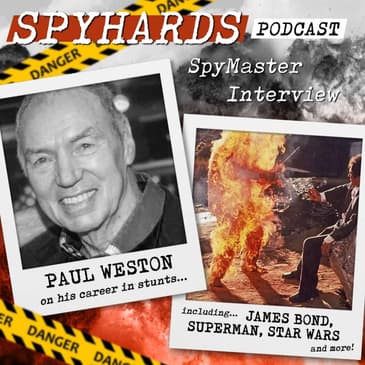
Agents Scott and Cam welcome veteran stuntman and stunt coordinator Paul Weston to the show to reveal the secrets behind creating the action in the Roger Moore and Timothy Dalton Bond eras. He also shares stories about working on Top Secret, Spies Like Us, Return of the Jedi and much more!
You can purchase Paul's book, Falling Into Film: A Stuntman's Early Adventures, on Amazon!
Become a SpyHards Patron and gain access to top secret "Agents in the Field" bonus episodes, movie commentaries and more!
Make your opinions about the NOC List known. Leave us a voicemail on Speakpipe or send us an email now!
Purchase the latest exclusive SpyHards merch at Redbubble.
Social media: @spyhards
View the NOC List and the Disavowed List at Letterboxd.com/spyhards
Podcast artwork by Hannah Hughes.
Theme music by Doug Astley.
Hosted on Acast. See acast.com/privacy for more information.
[00:00:00] This show is nominated for a 2026 Golden Lobes Podcast Award. Get in!
[00:00:06] Welcome to SpyHards Podcast, I'm Agent Scott.
[00:00:45] And I'm Cam the Provocateur, taking a header into the Sarlacc Pit. I think you look better down there to be honest with you. He's digesting me for thousands of years and I'm looking better for it. Don't worry, you'll get your own spin-off in 30 years time and no one will like it. Oh, that's unfortunate. Oh boy. Yeah, that truly is, that truly is. And speaking of fortune and perhaps unfortunate, I mean we made a promise what you were gonna get this week about a jewel in a Hitchcock film,
[00:01:15] but that's not what you just clicked play on. No, no, we are taking away that jewel out of your hands, but we're giving you something even shinier. I hinted at it up front. We are talking to legendary stuntman Paul Weston who appeared in, among other things, Return of the Jedi, he appeared in Bond films, Superman, Aliens, Top Secret, The Pink Panther Strikes Again, and so, so, so much more.
[00:01:43] Yes, originally we scheduled this to come out in a few weeks time, but once we finalized the interview, we just thought it was so much fun. We wanted to give it to you now. We didn't want you to wait for it. So, I think without further ado, the man's got a new book out. We're here to talk about it. Falling into film, A Stuntman's Early Adventures from Paul Weston. Let's get it from the man himself, Mr. Paul Weston. And Cam, roll that interview.
[00:02:12] Folks, joining us on the show today is a man whose career spans from the golden age of television, right through to the modern blockbuster cinema, from doubling Roger Moore in Octopussy to performing a 16-foot cable car jumpers, Jaws in Moonraker, coordinating the action and living daylights in License to Kill. He's worked in Bond, Star Wars, Indiana Jones, Superman. He's doubled Robert Redford. He's worked with Christopher Reeve. He's been directed by Charlie Chaplin. I cannot overstate this man's credits enough.
[00:02:40] And now he's telling those stories in his new book, Falling into Film, A Stuntman's Early Adventures. Joining us on the show, the one and only Paul Weston. Hi, sir. How are you? I'm fine. Thank you very much for the invite. It's a pleasure that you're out there enjoying what we've done over the years. For me, over 60 years, but you're enjoying our work, which is wonderful. It's an interesting thing when you actually go and piece it together,
[00:03:07] because you've influenced so many spheres of things that I love. Not just Bond, but I mentioned it. You know, Superman is a big thing for me. I love the original Christopher Reeve Superman films. I didn't even know until I was doing the research for this that you did the doubling for Christopher Reeve in that. Just how many things you've influenced in my life alone and extrapolate that to the world. It's crazy. Yeah, it just amazes us as performers.
[00:03:32] We've just carried on in our lives and been fortunate enough to be able to work on these iconic movies that turned out to be iconic. At the time, we just, you know, we're doing a job and that was it. But yeah, I've been very lucky. Yeah, so like you say, there was like no sense of at the time how big all these franchises would become. But you must like sit there and look at your filmography now and be like, oh my God, I've done every major franchise that to this day endures.
[00:04:03] Yes, yeah, yeah. I'm just so lucky. And as you say, you just didn't realize in those days that it was going to become what it is, especially that memorabilia. I remember standing by, I did Superman 1, 2 and 3. I coordinated 2 and 3 with Superman double. I had my costume and we finished the movies and I was moving from one house to another.
[00:04:30] And I had a skip outside my house, taking all the stuff from the loft and trying stuff out. And I stood by this yellow skip, I'll never forget it, holding my Superman costume and my red boots. And I thought, whenever am I going to wear red boots again? And I threw them in the skip. Oh. Yeah. I mean, I also on aliens, I had my aliens costume.
[00:04:58] I didn't have the head. I had everything else. And I had them in plastic, black plastic bags. And over the years, somehow they disappear. I don't know where they go. But all I had left, I had the pipes, I had the tail, I had the gloves and the feet. All I had left was the costume underneath.
[00:05:23] And the prop store guy for me, Stephen, said, have you got any alien stuff? And I said, well, all I've got is the suit. And he said, I said, most of the whole, the rest of it. He said, if you'd have had it complete, he said, one is just sold in America for $150,000. I thought, Jesus. And mine was the originals, you know. I mean, it was aliens original.
[00:05:52] Not alien, but aliens. Right. And, you know, when you look at all of this iconic work of the past, we should note, you're still doing things. Because you showed up in The Batman not too long ago. Or you worked in the MCU on The Eternals. So it's like, you know, it's not just this collection of greatest hits. You are still vibrant and out there. Yeah. Last year, I worked on with Tom Cruise's latest film that's not out yet. But Judy, I think it's going to be called.
[00:06:20] So, yeah, we had a wonderful time of, you know, about 35 of us all having a good old fashioned punch up, a good fight. You know. So that was great. So, yeah, working with Tom Cruise was wonderful. He's a lovely guy. And the last one I did, I think they're doing a remake of the, what was it? The Thomas Crown Affair. Right. The Michael B. Jordan film. Right. Yeah.
[00:06:49] So, yeah, that was working last year. I haven't done much here this year. I've been doing signings and other stuff. Well, it's early days yet. There's plenty of time left this year to see what you can jump or fall into or punch around. You know, and I, when I was just, you know, I mentioned in the intro, I mentioned your book, Falling Into Film, which is out now for everyone to pick up a copy.
[00:07:15] And I was going through sort of your backstory because it's the first book of two. And it's sort of like your story of getting into film and television. And the first sort of 20 or so years of it. Yeah. And I actually had this question listed at the end, but it feels sort of necessary to bring it up now. What inspired you to tell the story in your book now? What prompted you to actually put a memoir together? Well, people have been asking me for years, you know, when you're going to make it, write your book, when you're going to do it.
[00:07:45] And I put it off and put it off. And I didn't want it to be a book of, you know, just there I was 60 feet on fire and I was going to fall. I didn't want it to make just to be a stunt book, you know, about stunts I've done. And, you know, I wanted it to be about my life and the early years about growing up during the Second World War and in the 50s and 60s.
[00:08:10] I really just wrote for my grandchildren to explain to them what it was like during the war and poverty, which they, lucky enough, don't suffer from. So it was just an insight for them to see what I went through when I was a kid and what it was like.
[00:08:34] It was a bit rough and raw and I thought it'll never be in the book. But everyone that read it said, you've got to put it in the book. It's not just your stories, it's history. This is what, you know, people of your age went through. So I was asked to keep it in. And I really enjoyed the 50s and the 60s, you know, rock and roll in the 60s.
[00:09:03] Swing in London, you know, was I knew it was a special time. The swing in the 60s, the costume, the clothes and the music. It was and I was a fashion model at that time. So it was really enjoyable. Well, you're sort of one thing I want to do in this chat is tell some of those stories. But obviously, I want to keep some in the books. People go pick it up as well. So we'll we'll leave some there.
[00:09:31] But I want to sort of get that first story of you going from as a young man living through the war. And then you get into modeling in the 60s and then you fall into film. As it were, you start working in television and things like that. How did you go from modeling to basically understudying for Roger Moore? That was just down to my agent. I was a fashion model. I was doing photographic and fashion.
[00:10:01] And my agent said I got a different agent. I was, in fact, Michael Caine's agent. And she sent me to understudy Roger Moore on the Saints series. Roger wanted to direct an episode. So he had to look through the camera and place himself. So he needed somebody to play his part with the other actors so that he could direct us.
[00:10:28] So I turned up at Elstree Studios, never been into Elstree before or a big studio. So there I was and met Roger Moore, who to me was, you know, he was my idol. He was Ivanhoe. And so, yeah, I was a little in awe of him. But he was so lovely. He was so relaxing to be around. He was joking.
[00:10:59] He said, look, here's the script. He said, you don't have to learn it, but I'll direct you where I want to be. And I said, yep, fine. And so I played his part with the other actors for that particular episode. He had a stand-in and stunt guy who was with him all the time, but he didn't want to do the dialogue with the other actors. So that's why I was there.
[00:11:29] And at the end of the episode, he thanked me and he said, what are you doing? I said, well, nothing. I'll do a bit of fashion. And he said, why don't you stick around and do some extra work? So I said, yes. And I stood in at the end of that episode. I stood in the middle of the stage. It was a sound stage at Elstree Studios. And I looked around and I thought to myself, this is what I want to do for the rest of my life.
[00:11:58] And it's exactly what I've done. And I'm as keen today about making films as I was then and just being part of the creation of Celluloid, really. Well, was there any like in that moment sense of like, I'd like to become an actor? Or were you like, just like, I need to find something? Yes. I just wanted to be part of it.
[00:12:25] So I did extra work and standing work. And I joined the FAA, which was the Film Artists Association. So I could then work on big major movies like Those Magnificent Men in Their Flying Machines and different movies I worked on.
[00:12:48] And so I just started getting more and more experience what to do behind the camera and in front of a camera, playing parts. Because as soon as you walk in front of a camera, you're acting and you've got no choice. It's how well you act is up to you to put as much into the industry and your art, if you like. So, yeah, I learned.
[00:13:14] I learned and watching the stuntmen perform, the way they performed, how they set out their boxes to fall into. I learned from directors, you know, camera angles, watching what they did and how they did, where they put the camera. So, yeah, it was an early learning curve for me.
[00:13:41] Although there was no sort of scores for stunts, there was no academy or anything that you could learn from. So I learned as I went along. And on the saint, I played a little part and got thrown into a cabinet by one of the stunt guys. And they said, oh, that's good. Could you double for the guy on the next episode? I said, yes. How much?
[00:14:09] Because we were like three pounds, 10 shillings a day. And if you did a bit of special action, you get five pounds or 10 pounds. It depends what it was. But there was no organization in those days as from the British stunt side. In 66, they started sort of to get together socially, the stunt guys. But we were paying, they were collecting our money from cash.
[00:14:38] You know, you'd queue up with the extras and you'd get your money. And it was cash. And all the guys, that's all they wanted. They didn't want to have to pay tax on this or that. So they just, you know, cash was good for them. But from my point of view and a few of us, we wanted to get established and get contracts and become, you know, an entity as a stunt performers.
[00:15:05] They were, you know, there was a few that were really well known and they would go away and do Zulu and movies like that. And they were good stuntmen. But they weren't organized. We had no insurance. And when I started, we had no pads at all. So you might be in a dressing room and a guy come, the first assistant or a stunt guy come in and say, who wants to fall down some stairs? And you go, how much? So, yeah.
[00:15:35] And you went out there and you fell down the stairs. My first back pad was a piece of foam back carpet. It cut to my shape of my back, a bit of string through it. And that was luxury, falling down iron stairs. That was all the pads we had. I mean, it was newspaper, cardboard. Wow.
[00:15:58] Well, it's interesting because, you know, you go and you mentioned in the book, you go to school, do a little bit for acting, a little bit for modeling, go to learn those trades. But there's no real school for stuntmen in a sense. It's really a hands on. You learn to fall by falling. Yes. At what point did you go, actually, stunt work is the one for me. You've got that itch and it's going to be scratched. Like, what was that moment?
[00:16:25] I think I was very physical at the time. And so when I was an engineer working in the factories, I was a blacksmith striker. So you're wielding a seven and a 14 pound hammer hitting hot metal. So I was I was quite chunky. I was quite solid. And I started weightlifting. And so I was in good, good shape.
[00:16:53] And I was six foot tall, dark. So most of the heroes were that sort of shape and height. Right. So I used to get a lot of standing work. And when I was watching the stunt guys doing their stuff, I thought, you know, I'd like to be that physical.
[00:17:18] So I watched them and and I would practice, you know, sort of doing tucks and rolls and things. But you then, you know, falling downstairs, you know, you just learn how to to to fall downstairs, whether it's concrete or iron stairs. The biggest problem is when you're doing stair falls is is your ankles because you can put a back pad on or elbows if you've got them.
[00:17:47] But the thing that swings around and hits is your ankles on the railings as you turn because you like to get as many turns in as possible. So, yeah, you learn where to pad and what to pad and use whatever you can to to make it as comfortable as possible so you can get up and do it again. Were you ever nervous about any of the early experiences or were you just excited to learn? Yes. Yeah.
[00:18:15] Your adrenaline pumps pumps up and you you're excited about doing that, you know, a stunt. And the trouble is, I remember one time I was doubling for Tom Selleck on Lassiter and he's a cat burglar and he's got to climb up the building in the Strand in London. And I know all my hand holes where I was going to climb up.
[00:18:44] The bottom half of the building was modern. So they were supposed to be 1939. So they were shooting straight down because I had a balaclava on. You couldn't tell me to tell it wasn't Tom. So I set it up. I said, yes, you can shoot from the top. I know my hand holes. I had a cherry picker take me up halfway up the building and then I knew exactly where I was going to climb.
[00:19:11] And it was a night shot. So at six o'clock, I went back there again and it was getting dark and they set the cameras up looking straight down. And there was gargoyles in the foreground and you could see me starting climbing up the building. So ready to shoot it. I was in the cherry picker basket being lifted up into the position.
[00:19:39] And I was with Pat Clayton, who was a first assistant, a lovely guy, very experienced. I was so excited about jumping on this building and climbing that I was standing on the basket before we got to the building. He said, hold on, hold on, get down, get down. I said, what? He said, who are you doing this for? And he was absolutely right.
[00:20:03] I was just for me to get on that building and climb the excitement of it was dangerous because I had no boxes underneath or no safety, no wires or anything. But it made me realize that, you know, that amount of adrenaline can be dangerous. You know, you have to learn how to control it. And that was a good lesson for me. And from then on, I always controlled my adrenaline.
[00:20:33] You're excited about doing the job, but you have to calm down and say why you're doing it and how best you can do it. Not just you, but for the camera. And he dropped me off at the building. I climbed up and went right past the camera. And I was so pleased that it worked as a shot.
[00:20:56] But it was a good lesson for me to, as a young stunt performer, to control my excitement and adrenaline. Well, you talk about adrenaline and you also mentioned your ankles before, which brings me to an interesting point in your career to that point, which is, I think, probably your biggest film before things like Bond turn up. And that is A Bridge Too Far, which is an incredible piece of cinema.
[00:21:22] If people haven't seen it, I would recommend anyone go and watch that film. But, you know, of course, we'll talk about Robert Redford in a second. But there's also you shoot the parachuting scene. And I remember reading in the book, you know, quite not your worst injury in the book. There are certainly some worst injuries in there that you've suffered. But quite a fateful day on that set with a parachute, I do believe. Yes. Yeah, it was.
[00:21:46] We didn't think we were going to do it, but they had the Dutch team, the parachute team ready to do it. And so we just sat in our dressing room waiting, our caravan, waiting for the rest of the day. We weren't going to be called. And then suddenly we were called and they were dragged out onto the set and told that, yes, we would be doing it.
[00:22:14] And it was it's difficult to explain the photographs in the book do help to explain that you're 120 foot crane and you're hanging 100 feet up on a cable with a 15 foot ring around on the end of the crane with a parachute on little hooks, 24 hooks around it.
[00:22:41] And what's going to happen is that you're hanging on the wires and the guidelines and the center of the chute is going to be dropped. And these little clips are going to go clink. And the weight of your body is going to open the chute from 100 feet. And that's what you hope.
[00:23:06] Because it's, you know, if it doesn't get enough air in it, that parish, you're going to hit the ground very hard, which I did on the first take and stung my feet. And I thought, well, that's it. It's over. But then they said, we'd like to go again. And they had 18 cameras on it and they just wanted to get as much footage of the parachute shop, the parachutists.
[00:23:36] We had 1500 extras in the field pulling down parachutes. It was a massive, massive scene that day. And I had 18 cameras behind me, well, in front of me, and I had to drop down in front of them. And the parachute was sort of not malfunctioning, but the wind was so much at 100 feet up, it started candling.
[00:24:05] And if it didn't open properly, I was going to hit the floor. I just didn't want to be maimed. I didn't mind. I mean, I came to terms hanging up there that I may die, but I didn't want to be maimed. And either I was going to be OK or that was it. So, yes, you do come to terms with something like that and your mortality, which I did up hanging up there.
[00:24:37] And lucky enough, I was OK. I damaged my heels and I thought I'd broken my back, but I was fine. So, yeah, it was it's the full stories in the book. But it's it was a painful job to do. And lucky enough, that was they only did it twice.
[00:25:00] And I asked why the the Dutch team weren't doing the jump. And the production manager said, well, they wanted eight thousand pounds a drop and they wanted to redo the rig. And he just didn't have time to do it. He said that he was paying us five fifty pounds a drop. So we got fifty pounds a drop. Value for money is what you're offering.
[00:25:31] It was a fifty pound. Even those days, it was an adjustment, but it wasn't worth, you know, I mean, would have should have been much more than that. Wow. The other reason I bring up a bridge too far is because talking about the scale, you mentioned the all the extras in the background of the parachuting scene. But you're also with an all star cast that that film is absolutely stacked from top to bottom. And you have the privilege, although he's not as well known at that point as he will go on to become.
[00:26:00] But being doubling for Robert Redford. And of course, he has that great boat crossing sequence. And one thing I sort of blown away from that I didn't actually notice in the film, but I went back and revisited is that you are following him up into those sort of gun battalions on the bridge. Were there so you're his you're his buddy basically in that scene? Yes, that was my job. The time he was there that I've joined the sun coordinator said that, you know, I had to look after him.
[00:26:27] So I was with Robert Redford all the time in the boats and on the bridge. So I was looking, I was shifting the barbed wire out of his way and just made sure he was safe. And I remember we were about to take the Nijmegen bridge and there was a little group of us, maybe a dozen or so. And I was his buddy.
[00:26:54] So I was next to him and we what we had to do was film dropping on the steps before we go up onto the bridge. And we dropped onto the steps and they said, cut, said, OK. And Robert Redford turned to me and said, what's your character's name? I hadn't been a character. I've been with him all the time. I didn't. They didn't give me a character. So I said, oh, Harry, hoping that his name wasn't Harry.
[00:27:25] So he said, OK, Harry. And so we said, turn over and now we're going to take the bridge. And he sat there and he looked around. He looked at me. He said, OK, Harry, let's do this. And we jumped up. He just assessed the situation. I wish I could assess a situation like him. So we followed him. We would have followed him into hell.
[00:27:54] I mean, if you think about being younger and working in the movies, you can't think of any better scene partners as a younger actor than Robert Redford. Yeah, they were all young guys, the youngest guys at the time. Elliot Gould was so funny. I've worked with him several times since.
[00:28:15] But on that, we all had to have a haircut because it was 1945, 44, 45. And we had to have short haircuts. And because when Elliot turned up, he's got his fizzy hair, which was almost an afro. It was like massive.
[00:28:40] So Richard Attenborough said to him, I'm sorry, Poppet, but you've got to have your haircut. He said, no, I don't. He said, yes, yes. He said, can I have a half cut? And he said, yes, OK. So he goes into the hairdressing wagon, came out with his hair half cut right down the middle. One half. He was so funny. He's a lovely man.
[00:29:10] As I say, I've worked with him several times since. Well, I think, yeah, you come back to, I think, The Lady Vanishes as well a couple more times. I want to come to that. But I'm feeling the gravitational pull of 007. We've already mentioned Roger Moore. And maybe before we get to the quote unquote official films, one thing I did enjoy reading about in your book and just seeing that you were involved with it is Casino Royale 1967, which is an interesting chapter in any Bond book.
[00:29:39] And you are involved in that big casino brawl at the end. Yes. Yeah. We it just went on and on. It was chaos. Absolute chaos. So I couldn't believe I think they had six directors. Everyone, they were changing all the time. And there was a horse galloping around in the casino when the fight starts as cowboys and Indians come.
[00:30:08] Indians come through the roof on parachutes, firing arrows. The cowboys galloping around. Now, we're all in tuxedos. We're all running around as casino players. And this is just chaos. And this is just chaos. There's bubbles going everywhere. It was just total chaos.
[00:30:32] At one time, my first sort of stunt bit was I was dressed as an Indian dancing around a teepee. And the teepee was on fire. And so we're sort of going, oh, I, oh, I, oh, I, oh, I, oh, I, oh, I, oh, I, oh. And our backsides catch on fire. So my backside's on fire and we're still dancing on.
[00:31:00] It was absolute chaos. But great fun. And we, you know, we had a good time on it and we earned a lot of money because it just carried on. It's kind of ironic that it won't be the last time that you're set on fire on a James Bond film either. No, no. I remember the second one, yes. Yeah, the second one has a little bit more heat to it, I think. Yes, yeah, it's that one. Yes. That's the one. Yes, License to Kill. Yeah, that's right.
[00:31:30] And I want to ask just, I would assume like you would see the movies that you'd worked on. Do you have any memories of actually watching Casino Royale at the time? Yes, yeah. I would, yes, I found it funny because I knew Dinny and Nosher Powell who were playing the ginger Scotsman. And so I know all the crew. So, yes, it was funny for me to watch.
[00:31:58] And obviously you're looking out for yourself running around in the chaos. And I remember two guys and they had two cowboys swinging on ropes across the casino backwards and forwards. And two of them went right across and smashed in the middle and hit each other. And one stayed up and the other one just fell down. And it was Bill Reid who hit the other guy.
[00:32:26] And he climbed down a rope. He said, I knew he was in trouble the moment I hit him. He was spark out, went bomb, straight down. So, yes, it was chaos. And watching it back was good fun for us to watch.
[00:32:47] Trying to make sense of it is another matter with Woody Allen and David Nibben and lovely David Nibben. And I mean, I've worked with him since. And he was a lovely man. So, yeah, one time I was learning all the time.
[00:33:09] And I watched a stuntman supposed to be thrown over the bar into the mirror behind and smashed the mirror. And they set it all up. And he had a mini trampoline. He had to run and jump on the mini trampoline and dive over the bar as though somebody's thrown him. They got the picking up in one shot. Now he's got to be thrown over the top.
[00:33:32] And I don't know whether the trampoline, it's only a mini trampoline, two foot square. And he ran up, hit it and went straight head first into the bar. He didn't get any height at all. So I thought, you rehearse off set, make sure, you know, you can do it before you display it on the screen or on the set.
[00:33:58] To be fair, that feels very much in keeping with Casino Royale 67 is face planting a bar. Yes, it was. Yeah, it was a great movie to work on. And as I say, the action that was going on, it was all around you. You know, you could see guys falling down and beds coming down the stairs.
[00:34:25] And I was learning all the time, watching the others doing. Sometimes you think, I wouldn't have done it that way. Because, you know, they've come off sort of hurting themselves. Well, I was going to ask, you know, you mentioned there was multiple directors going on in Casino Royale. At this point, like, you know, when I look at your filmography, you've worked with a lot of the greatest directors who've ever lived.
[00:34:50] Like, at what point did you really become aware of, like, the importance of a really strong director on these projects? I think even from the probably from the Saint onwards, really, the Baron, Vandal and the Hopkirk, the Avengers, those directors are really on a tight schedule. And they have to shoot it.
[00:35:19] And you saw, you know, the directors who've done their homework. And the biggest thing is doing your homework, knowing what you're trying to achieve within that 10 days. How many setups you think you'll have each day? Do your storyboards. Make sure you know exactly what you're going to achieve in that time.
[00:35:46] So, yes, I learned a lot from watching them being under pressure and then working on, you know, bigger movies where they don't have that pressure. They, you know, you see the director walking around with a cheery looking for better shots or whatever and a little bit more laid back.
[00:36:12] So, yes, if you've got the budget and the time, you can be, you know, the best director ever. If you've got the direction inside you, the capability of bringing performances out and getting the best angles to capture that performance. But whereas on, you know, tighter budget movies, you just shoot the schedule.
[00:36:39] You get the best performance you can out of the people, the actors. But you're all the time. You've got the pressure of shooting the schedule. You've got to get out. So, yeah, I've been on movies that have gone on, you know, sort of over budget and over time. But it's it's there's many reasons why that is.
[00:37:04] But a lot of the time it's the director not being in control of his ability to be able to control the budget and the actors. Sometimes the actors play up and you have to compromise a little. So, yeah, a director job is most difficult to be.
[00:37:29] You have to be a diplomat and you have to be firm, but you have to know when to be firm and when to coax a performance, which they, you know, you learn as you go along. You learn as Hitchcock used to say, he never directs a movie. He casts a movie.
[00:37:53] So he was a director that knew exactly what he wanted and he knew the actors that would give that performance for him. So he didn't he was on their backs all the time, you know, talking, telling them what to do. He was shooting their performances.
[00:38:14] Whereas, you know, you get other directors that Charlie Chaplin on Countess from Hong Kong with Marlon Brando and Sue B. Loren. He had written the script probably 30 years before.
[00:38:33] So he was his baby and he was telling Marlon Brando how to say the words, which, you know, Brando didn't appreciate at all. But, you know, Charlie Chaplin wanted it a certain way. Whereas, you know, Brando was a bit a different type of actor. So, yeah, they didn't get on a lot.
[00:39:00] And in one of their lovemaking scenes, Sophie and Marlon Brando, she was laying back and apparently he tilted her head back and looked down at her, looked into her eyes and he said, do you know you've got black hairs up your nostrils? So they didn't get on too well. He was a bit sharp.
[00:39:28] But I had a great time on it because, as you see in the book, I danced with Charlie Chaplin, which I was just amazed at. I mean, as a kid, he was the silent hero. I mean, he was the one, you know, he was a comedy genius. So, yes, I was an extra on the movie and I was dancing.
[00:39:54] It was set on the Queen Mary, the old Queen Mary ballroom and they fall in love dancing on the dance floor. But it was set at Pinewood Studios, a massive stage of Pinewood Studios. And there must have been 100 extras sitting around the ballroom and about 50 couples dancing with Marlon and Sophie in the middle.
[00:40:19] And so we were rehearsing, going round, just waltzing. And the music was playing on this particular rehearsal. The music was playing and we were coming down towards the camera and Charlie Chaplin stood out in front of us and put up his hands and stopped us. I thought he's going to sack me because I wasn't the greatest waltzer in the world. But he put his arm around both of us and he said, dance with me.
[00:40:48] And off we went and he guided us and he danced with us and he was humming to his music, obviously. But he was 77 at the time and very light on his feet. And he was smiling and he guided us around, waltzing around Marlon and Sophie. And when we came back in front of the camera, he said, when you get to here, I'm going to bring the camera in past you. Is that OK?
[00:41:18] I said, yes, sir. Yes. But yeah, he was so lovely, a gentleman, very soft. But yes, it was just a magical moment for the time. We were the envy of everybody. But to dance with Charlie Chaplin was something I will always treasure. That is definitely a career highlight. You must have felt in that moment like it's all downhill from here. Yes. Where do you go?
[00:41:48] Yeah. But the next one was the Beatles. I sang with the Beatles on Help. You beat me to the question about Help. I mean, that's again, another seminal film of the 1960s. How do you end up singing a tune with the Beatles? Yes. I was an extra again. In those days, you just get a call and say, you know, be at a pub in the West End.
[00:42:17] And you were a pub client. You're just standing by drinking. And in those days, we were drinking real pints. I mean, they were poor pints. We were in a real pub. No fake, you know, tea coming out, whatever.
[00:42:38] So, yeah, we were just a few of us in the bar and the Beatles run in and they're looking for a ferocious tiger that has swallowed Ringo's ring. And so they looked around and they said it's in the cellar of the pub. So they lift up the flap. And sure enough, this ferocious tiger is supposed to be there at the bottom there. And it's growling.
[00:43:02] And Ringo said, the only way we can calm it down is to sing its favorite lullaby. So we had to all go off and learn with the Beatles. We had to learn this lullaby. And there I was singing with the Beatles. I thought they were singing a bit flat, but I didn't say anything. But they certainly wasn't singing in the same key as I was. But they were fine. They were really good fun.
[00:43:29] And they were how Dick Lester, the director, put it together. I don't know, because they didn't do two lines the same or any of the scenes. And then one afternoon, Peter Sellers turned up, came in because he knew Richard Lester from the Goon films that he shot with them running and jumping standing still.
[00:43:56] So, yeah, Sellers came in and then it was chaos with Sellers and them just clowning around. But it was a great experience to be with them. And little did I know I would be stunt coordinating with director Richard Lester on the Superman 2 and 3 Ritz.
[00:44:19] And I would go on to be a stuntman on Peter Sellers' Pink Panthers films. Yeah, well, actually, that was one of the credits that jumped out to me. We actually, on our show, covered Pink Panther Strikes Again, which has a lot of spy elements. And you were, of course, like a dancer at the Queen of Hearts Club. Yes. Oh, God, yes.
[00:44:42] Yeah, that was funny to see, you know, 20 stuntmen all in makeup and it's a gay club. And we got to dance with each other. So, yeah, I finished up. I was dancing with Big Armstrong and you're arm wrestling to see who's going to lead because you don't want to be the lead. So, yeah, you're seeing who's going to lead in the dance.
[00:45:08] So, yeah, it was a funny, funny setup. There was a bit of a scuffle during the, we were dancing around doing the take and there's a scuffle. So, we said, what's going on? Two of the stuntmen are going to have a fight. So, they broke them up and I finished up dancing with one of the guys just to get them away from the other one. I said, what's going on? What happened?
[00:45:35] He said, well, I was dancing with Romo, who's one of our stunt guys, and he was a very hard man, Romo. Lovely guy, but you didn't cross Romo at all. And he said, I was dancing with Romo and he moves very well. And I said to him, Romo, you really do, you dance very well, don't you? He said, yes. He said, he was Italian. He said, yes.
[00:46:05] He said, myself and my sister were Southern England tango champions. He said, no, really? He said, aye. He said, Romo? He said, yeah. He said, oh, I'm getting all kind of aroused. And he went, so you can cut that bit out if you don't need it. But it's, yeah.
[00:46:31] So, yeah, that was a fight in the gay club. So, oh, boy. But, yeah, it was funny because we finished up. Then Romo and Dini Pau and Nosher were dressed as policemen, and they come in and we all have a fight. Well, it was breakaway furniture all on the tiers and the tables and the chairs all around the dance floor.
[00:47:00] So, as soon as Coluso starts the fight, he ducks out and then we have our fight. And we love a punch up. So, you do a routine. You work out who you're going to fight and how you're going to fight them. And as soon as he ducks out, it was, okay, you're starting. And we started and we didn't stop.
[00:47:29] There was a piece of wood that was bigger than that anywhere. We were smashing chairs over each other. As soon as you finish your fight with somebody, you grab somebody else and off you went again. But, yeah, it was a good, good. Sellers and, who was it? The director, Blake Edwards. Yeah. And the first assistant just walked off the set and left us to it. And we just smashed the place up. But it was really good fun.
[00:47:59] And they're, you know, they're the fights that you do enjoy with the rest of your stuntmen. Well, I think it's time to answer the Bond question. And there is a question that I didn't quite get answered in the book or maybe I didn't see the line. But you first talk about Moonraker as really your big first Bond film. But on IMDb and other sources, you're credited all the way back to You Only Live Twice. Yes. On The Majesty's Live and Let Die. So what's the story there?
[00:48:29] I was around on them. And I saw the guys coming down the volcano set. And Bob Simmons was always saying to me, OK, love, I'll get you. You know, he was always promising me that he would because I'd met him on the TV series. And he knew I wanted to be a stuntman. And he was always saying, yeah, I'll get you on the next one. Don't worry. So I was around.
[00:48:57] But I wasn't never featured on any of those early ones. And yet IMDb keep putting me in for them. And it wasn't me. I wasn't on them. So I can't claim those movies. But I've asked people to help me try to get it down. I don't know how to get them off. I mean, the fact you were around those sets at the time, it must have felt almost like a joke.
[00:49:26] Or like, how long do I have to wait until I can actually get into a Bond film? Yes. Yeah, it was like that. And, you know, he had his own team. And I knew most of them. But I wasn't part of that team at that time. So, yeah, I would help out. But I was never in the films. Well, you know, you step into the Bond films and you step into some very big shoes, which is Jaws.
[00:49:55] And one of the moments that is often talked about with Moonraker, we're not talking about the space scenes or anything like that. It's Jaws' death-defying jump between the cable cars. And I read your sort of breakdown of it in the book. And it's quite fascinating how you put it together and sort of jumping off the rafters, basically, of the studio to get that leap across. But you would think that's all done by wires watching the film. Not that you see the wires, but there's actually a human being making that jump. And you did that. That's a crazy feat.
[00:50:26] Yeah. But in those days, we didn't have wires. We couldn't use them because you couldn't get rid of them. There was no roller scope or green screen or anything. These days, you can have five wires on you as thick as that. And they just get rid of them. But we had no wires, no safety nets and things like that. It was either you had a row of boxes on the floor in case anything went wrong.
[00:50:57] But, yeah, it was up to you to make sure it worked. In other words, you'd have a nasty fall. Well, I think also there's a moment in the story that speaks to your improvisational skills because you realised very quickly that you don't quite have Jaws' mouthpiece, shall we say. Sticking some tinfoil. Was it an orange in your mouth? Something like that? I was about to do the jump.
[00:51:24] I worked out that if I went up 10 feet, I could jump down onto a mini trampoline and get across 16 feet as long as I hid it straight. So I set it up, strapped the mini trampoline on top of the cable car and I was jumping from above the cables down onto it. And I was getting ready to go. I had the costume on and everything.
[00:51:53] And I think it was Ernie Day was directing second unit and he shouted up, Paul, have you got the teeth? I said, no, I haven't got any teeth. I've got my own teeth. He said, we've got to have Jaws teeth. I said, well, no one's given me Jaws teeth. So they checked and they were in Paris somewhere munching on a bagel. So I didn't have any teeth. So I said, OK. And I shouted to the prop guy.
[00:52:22] I said, get me a quarter of an orange peel and some silver paper from a cigarette pack. So they said, yeah. So they handed me, they had to go up onto the gantry and I handed it down to me. And I got the silver paper, wrapped it over the top of the quarter of an orange peel and put it in my mouth. But I've got caps and you imagine it was like putting a battery in your mouth. It was like shh.
[00:52:53] So I said, ready. And I put them in and I waited and I waited. And I took them out. I said, what's the problem? I said, there's no problem. We're running the cameras. We're just waiting for you to jump. I said, give me an action, just a loud action. So I put them back in again and did the jump. But lucky enough, I hit it straight because I've only got, you've only got, well, it's not even two feet.
[00:53:23] It's about 18 inches of rubber that you've got to hit and you've got to hit it in the center. If you hit it slightly off, it will show you one side or the other. So from that height, I had to make sure that my feet were actually in the center of it and facing the right way to make the 16 foot jump. And I did stub my tail on the girders on the other side.
[00:53:51] But yeah, I made the jump and lucky enough, we got it in one. So I didn't have to do that again. Well, you know, you've talked about how when you're doing stunts, there is a performance component because you are doubling, you know, an actor who's giving a performance. When you're stepping into, as Scott said, the very large shoes of Jaws, Richard Keel is a very big guy.
[00:54:17] And is there an element of, I need to not only make this jump work, but I also need to do it in a way where it kind of conveys his physicality because it'd be very different than someone say my size. Yes. Yeah. So we had the people doubling for Bond and the girl on the other side crouching down and we had a small, I think there was smaller people. So when I landed, I would look, you know, that much bigger than them.
[00:54:46] And also going through the air, I wanted it to make as though he was, you know, it was him, his physicality of his movement. So I was aware of that. I couldn't just, you know, do a lovely flying through the air. I had to do it in his character, which I think worked OK. It looked like him.
[00:55:14] So, yes. But I was glad to have done it once and that's all. And I want to ask, too, with Moonraker about the weightless scenes because, you know, that's you've done some cable work with Superman as well. But, you know, what was the Moonraker weightless material like to film? It was painful because we had real laser packs on our backs with the costume and the helmet.
[00:55:44] And you've got a flying harness on that goes two straps under your crutch, which can cut off the blood to your head. So, I mean, circulation. So, yes, it was very painful. Just hanging there and being dragged along. We were on rails and moving across together and firing these lasers. And a couple of guys fainted up there.
[00:56:10] You could see their bodies just go, oh, and they would get them down, give them a rest. But it was quite painful. And there was no way we could, we tried putting straps from your waist down under your feet and standing on something, a platform on your feet. But that was so painful as well. So nothing really worked apart from just, you know, suffering, really.
[00:56:37] You just had to take the weight and just do the job. You know, I was coming out of the shuttle at one time. And then Derek Meddings, who was directing that unit, gave me a couple of close-ups where I was getting killed as the good guys.
[00:57:04] Then he said to me, go to the end of the studio and get on that platform in the villains' uniforms. He said, you'll be the first one coming out of the space station. Because he had in foreground here, he had the space station model and the arm sticking out. And that corresponded with the platform that you could see at the other end of the set.
[00:57:33] And that was me, that big. So it just gave reality to the size of the space station to see us coming out and start firing at ourselves, really. So, yeah, I shot myself a few times, I think. But, yeah, and it was Black Velvet. The whole 007 stage was covered in Black Velvet.
[00:58:00] It must have cost a fortune from, you know, 30 or 40 feet up to the ground, the whole site. No expense spared when it comes to a Bond production? No, no, no. No. No. But you're finally in the fold now with Moonraker. You've got that. I mean, you could say Casino Royale 67 was your first Bond film. But some people would probably argue the toss on that one. But you stick around. You're in subsequent films. And the one I wanted to make mention of is Octopussy.
[00:58:28] Because a lot of people think about Octopussy, they think about the frivolity, the joy of that film. But one of the sequences you're involved with in that film has a bit more of a harrowing backstory to how you got involved. And it's not really too much. I imagine that's coming in book two. But I wanted to talk about your sort of memory of working on Octopussy and specifically the train sequence. Yes. Yeah.
[00:58:50] I got it because Roger's normal stunt double, Martin Grace, it was a very good double for him and a very good stunt performer. He was doubling for the main unit was shooting in Paris and Roger was in Paris. And so Martin was going to do all the stuff on the train.
[00:59:15] He did a bit on top of the train with one of the twins where Kabir Bedi is behind them. They did one shot there. And then he was on the side of the train looking through the window as he's going along at 30, 35 miles an hour. And there are posts and there's bushes. And he was leaning out too far.
[00:59:45] He was looking in the window and had his backside out as he looked through the window. And he hit a post at 30 odd miles an hour and smashed his pelvis, his hip and his pelvis. How he hung on, I don't know. He was a strong guy anyway, but he hung on like a rag. I saw the footage afterwards. He just hung on with one hand.
[01:00:13] If he had come off, he would have been killed. But he was strong enough to hold on. So he went off to a hospital and a few days I went to see him in the hospital. And then a few days later, I got a call to if I would take over his job, which I did. So I became a Roger's double and I had a Roger wig on.
[01:00:41] And yeah, it was great working with Arthur Worcester, the second unit director in the team. They were a great crew and very professional. So I was happy to work with them. Although, you know, Arthur was, you know, sort of shocked that Martin had been hurt. But, you know, the film must go on. You just get up and do it again and carry on.
[01:01:11] So, yeah, I took over and I did all the hanging on the side of the train. I came up with the idea. I said to Arthur, it'd be good if he's, as he's going along, hanging on, going alongside the train, if he slips and you have a low angle camera and you see his feet hitting the stones and the sleepers. I said, yeah, good idea. So we set it all up and I got into position.
[01:01:40] We're doing 30 miles an hour and I slip. And then my feet, my toes start hitting the pebbles and the rocks. And my toes were black and blue. I thought, don't volunteer anymore. That was painful. But it was a good shot. You can see it in the movie. And you can see me on the side ducking backwards and forwards between the bushes.
[01:02:05] But then we had to climb inside and that's when he gets chased and he gets into a gorilla suit. And Kabir Betty tries to cut his head off. And you see Roger just disappear out of the trap door in the flap in the top of the garage. And then I took over from the outside and we had the low camera on my back.
[01:02:35] So that as I came up and lifted the flap up, I got my back to the camera and we're going towards the bridge. And I get out, sit on the side, see how far the bridge is, how fast it's coming at me. And if I can stand up and then duck under the bridge. And the bridge was literally only two feet so above the train. So and it diminished as it went round because it was a curved bridge.
[01:03:02] So I had to get under, you know, get down as quick as I could. And we did it once. And I had a guy sitting on the side of the behind the bush on the side of the railway cutting there. And he had a walkie talkie and I had mine. And I said, when my carriage gets level with you, you just say now. And I'll lift the flap up, get up.
[01:03:30] And if I've got time, I'll get under the bridge. If not, I'll get back inside. So we did it once. And he said now, and I lifted the lid, got out. I had plenty of time. So I dropped it down and ducked under the bridge. And I said to Arthur, I can get this closer. Can we go back and do it again? He said, yeah. So he says, it's up to you. So we went back to number one train going at 35 miles an hour.
[01:03:57] I said to the assistant, give me a call. So we were going towards the bridge. And the assistant said now. So I counted one, two. Lift the upper flap. Yeah, I had time. Just got underneath it. I said, Arthur, this is Bond. I've got to do this closer. He said, well, it's up to you. We've got the shot.
[01:04:25] I said, no, I think I could do it closer. So we go back to number one, start again. And we're going 35 miles an hour at the bridge. He says, now get it. I go one, two, three, four. Lift up the lid. Get up. Oh, my God. It's coming at me so fast. And you can see it on the film. I don't have time to shut the flap. I just duck underneath the bridge.
[01:04:52] And I felt the brick go over the wig. Just touch the brick book. And that was stupid. I mean, we'd already had the shot. But because this was Bond and I wanted to do a good job. So, yeah, it worked and got away with that. So a little bit further up the track, there's about two foot six above the train.
[01:05:18] There's a nine inch pipe that goes across the top of the track itself. So each time I've been just laying down and going under the bridge, the pipe. And I said to the crew, I said, if John Glenn, the director, sees this, he's going to want me to dive over it. And sure enough, two days later, they rushes. I get a phone call, Paul, about that pipe.
[01:05:45] I said, OK, yeah, I'll have a go at it. So I put a low camera strapped to the top of the carriage. And the carriage is obviously shaped. So now what you've got to remember is that I'm on the top of the train that's travelling at 30, 35 miles an hour. And the pipe is coming at me at 35 miles an hour. I'm just standing still on the train.
[01:06:14] All I've got to do is take a couple of steps, jump up in the air. So allowing the pipe to go underneath me. So if I jump too soon, I'm going to come down on the pipe. It's going to knock me off the top of the train. If I leave it too late, it's going to knock my feet. And, you know, it's not going to be good. So I said to the crew, I said, look, if I fancy this, I'll do it.
[01:06:41] But I may chicken out and just see how the timing goes. And sure enough, we got up to speed. And lucky enough, the smoke of the engine was above me. So I could see the pipe coming at me. And I just took a couple of paces, leapt up into the air. And you can see on the film, it just goes underneath me. And I hit the biggest problem was bouncing once I landed because of the shape of it.
[01:07:10] I had no safety nets or anything to stop me. I just had to spread my body, arms and legs so I didn't bounce off. I just bounced slightly to one side. And then we cut to Roger, sort of landing in the studio. So, yeah, it was nice jobs to have done. And they both worked. So I was pleased with them. And so were the production. The reason I... Oh, go ahead.
[01:07:40] No, it's when we got back to the studio. I was dressed, obviously, as Roger. And we brought two carriages from Peterborough down to Pinewood Studios and put them in the studio. And put a rolling road underneath, a track underneath that made it look like... So when he's hanging there, it looks like he's going along with a bit of smoke. And it's... He puts him in the middle of the action.
[01:08:07] So at one point, he's got to climb up the side of the octopus truck. So Roger's sitting in his chair. He was a lovely man. Sitting in his chair, cross-legged, smoked no cigar. And John Glenn said, Paul, show that low-angle camera. Wanted him to climb up, get on top. So he said, Paul, show Roger what you did.
[01:08:34] So I climbed up, got on the top, disappeared. And Roger said, do you want me to look back down to the camera? And John said, oh, no, no, just climb straight up and get on the top. So he said, well, Paul could do that. And I was in the studio. And I did it. He had no ego about having to, you know, do something. But he was a lovely man.
[01:09:05] Do you want another story? I mean, we're going to be going for stories for a while. But I wanted to sort of take a beat for a second. Because something you said earlier sort of stood out to me about sort of making your peace with being a stuntman and how that can involve danger. And you mentioned, of course, your colleague on Octopussy. And just talking about some of those stunts you did in those films before we even talk about things like the fire and License to Kill and stuff like that.
[01:09:33] How do you and did you deal with that sort of fear? Because no one wants to perish. And that is a very tough thing to take your life into your hands every single day. How did you deal with that? I think you deal with it professionally. You have to look at it professionally. If I'm coordinating or if I'm doing the job myself, I try to have hindsight.
[01:10:02] Now, if I set up a car crash, it's one car coming this way, another car going that way. Timing of that has got to be right. Where we put the cameras, how we shoot it. Are the cars correctly equipped out so that if anything happened, the drivers would be safe? And then I set it all up where I'm going to put the cameras.
[01:10:30] And then I look at it again and go, what if? What if the car blew a tire and spun? What would I how would I cover this side? If it went that side, what would how could I save the people? Or would I put is anybody in danger? What if the guy had a heart attack or the accelerator was stuck?
[01:10:59] You go through all these things in your mind and you cut it down as best you can to cover every possibility of something going wrong. And once you've done that, you just trust that you've got it right. And you make sure all the cameras fully understand what you what's going to happen, where the vehicles are going to be, where the people are jumping out the way, the vehicles are going to be.
[01:11:30] So, yeah, it's it's a lot of preparation and a lot of understanding of what happens to a car if it's going up a pipe ramp and it's got to turn over and it's got to go in like I did at one time in a tunnel.
[01:11:50] If I wanted to go into the tunnel, I've got to put the pipe ramp seven degrees off to the right. Because the weight of the car is going to take it over and it will straighten up. So you have to know your equipment, you know, have to know what's going to happen to the vehicle once it's hit that ramp.
[01:12:16] If the guy gets it right, this is what's going to happen. If he gets it wrong, what's going to happen? So, yes, it's a lot of responsibility. You'd much rather do it yourself. If you're doing a fall or crash or you get knocked down, you can't tell somebody how to do it. If they're doubling for somebody, you've got to explain to them what you want.
[01:12:44] And people have different ways of doing things like they run and take off on the left foot or on the right foot. Or if they're going to get knocked down, do they want to go over the right shoulder or the left shoulder? You're comfortable with one way or the other. And you can perform better if you know your body and how to get the best out of the shot. So, yeah, it's difficult.
[01:13:15] You have to assess all your individually when you're doing a stunt. If you're going to be on fire, if you're going to do a knockdown, you come to terms with the fact that if you're not happy with it, you don't do it. I've only ever been afraid once in my life. And it scared me. I mean, it really scared me.
[01:13:41] I was doing a job for a TV series. I think it was the one. I can't remember which one it was. It was I was doubling for an actor who is in a three story building in Billingsgate before they actually tore it down. They were all condemned buildings.
[01:14:06] So I turned up in the afternoon and they said that we can't get in the building because it's all locked up. But this is the thing. You've got to come out that window on the third floor, get across to that window. Then to that window, they're about two or three feet apart. So you can reach across. And then you've got to drop down onto the windowsill, which is a little bit wider.
[01:14:33] And I had a head hold that I knew I could put in there. And then I jumped down onto a bigger windowsill and then jumped down into about eight feet onto cobbles and go down the street. It was a night shot. I thought it's going to look great. We can. I don't need any boxes because I can do it and we can shoot down. You can see me going down, down and down and jumping, going down the cobbles.
[01:15:06] So I inexperienced at that time. I was doing another job during the day and this was a night shot. So I just went there and said, yeah, I'll do this and do that. I got to there. They opened up the building. They set the cameras up by the time I got there. So everything was ready. And I went into the building and to make it look like a French building, they put shutters on the outside of the windows.
[01:15:34] And now I couldn't just get round. I somehow duck under the shutters and get past the shutters. And then there was a ledge that I looked from the bottom, looking up, looked about four inches wide underneath the windows. And I thought, well, I can get my toes on those and I can. It would be OK. I thought I knew what I was doing. I went there on the night time.
[01:16:04] The building was empty. I had a lamp inside one of the windows and I went in and looked out the window to see where I was going to climb. The four inch ledge that I thought would be OK was only two inches and it had concrete on the top. So the rain could run off. So I had really nothing to put my toes onto.
[01:16:30] And then I had to reach around and get the other window. I thought this could this I could die. You know, if if I don't come up with a way of doing this. Either I've got to say, no, I can't do the shot. It's got to be different or I'm just chicken out. And which would ruin my career or I've got to go ahead and attempt it.
[01:16:59] And I sat on a little box in the middle of that room and it was like watching myself. I zoomed out and I was sitting there and I was in a blue funk. I just terrified if I say yes, I could die. If I say no, it's going to ruin my career. And I thought to myself, if I'm going to if I was advising somebody else what to do, what would I tell them?
[01:17:25] And I thought if I could just get my fingertips on something, I could get across the windows and with my toes on it crumbling two inches. It would help. I could I could do this. And I said to them, I'm sorry, guys, I do need a baton across the top of the windows. And lucky enough, we had a cherry picker there and they put an inch baton over the top of the windows.
[01:17:56] And I could actually get my fingertips on it and I could take a bit of my weight and get get across. But I was it really terrified me that I hadn't done my own homework. And I put myself in that position. And I was it really terrified me. I thought I'm never going to be in that position again.
[01:18:20] And lucky enough, I when we did the shot, I was able to get underneath the one of the shutters and get my fingertips on this baton. And I got across, dropped down onto one window, then the other and then down in the street and run away.
[01:18:40] But it was a great lesson for me to never assess a job without going up and having to look at it, you know, from the ground or not doing enough research to make sure that I can perform what I'm saying. You know, I could perform. But I did it and it worked. I was doubling for Eddie Albert Jr.
[01:19:08] And I think it was one of those Alfred Hitchcock presents program. Right. And so, yeah, that was a good lesson to learn. And, you know, make sure you know what you're doing and just don't be overconfident. Say, yeah, I can do this. I can do that. Make sure you can do it. And you have to know when to say no.
[01:19:35] When the director says, like, when I would say, I want you to drop 25 feet onto the ground. You just say no. Whereas other people, you know, would be convinced, talked into doing stuff that, you know, is dangerous. You have to know when to say no. And be able to walk away and take it.
[01:20:03] We interrupt this program to bring you a special report. Agents, where are you? Why do you hide? Follow that Patreon trail and make SpyHards your guide. That's right. From spy TV reviews covering the antics of George Smiley, Jack Bauer, and the slow horses to reviews of non-spy movies from your favorite spy actors. There's no more secrets over on our Patreon.
[01:20:30] But Cam, tell the listeners about this week's top secret broadcast.
[01:21:02] Scott, I am glad you asked. But before Nick Knack runs out of Tabasco! Resume the spy jinx. I think that will bring us beautifully into when you take a step into coordinating, which is several films. But if we're talking from a Bond mentality, it's Living Daylights and License to Kill, the Dalton era, as it were. Now, you also perform stunts in both. You're in the intro sequence in Living Daylights.
[01:21:30] You even have a line, which I want to ask you about, because you're actually a Bond acting debut for you there. And of course, we mentioned the flames and the suit in License to Kill. But what sort of made you want to take that step into stunt coordination? And what did you enjoy about doing that, Rob, before we maybe get into the Bond specifically? Well, I was almost forced into it because of Martin's accident on octopacy.
[01:22:00] I was coordinating the second unit. And then before Bob Simmons came back and they all came back from India, I was coordinating. And so when Bob Simmons, who was the stunt coordinator and supervisor, I worked with him on the sequence in the Indian Palace.
[01:22:26] So I was aware of doing, you know, being a stunt coordinator as such, albeit on a smaller scale, to take on, you know, a full scale Bond was a bit daunting. I did, you know, you question yourself, am I up to it? Am I ready for it? To take that sort of responsibility. And yes, I look forward to it. And I thought, yes, I can do this.
[01:22:58] Barbara and Cubby and, you know, I'd worked with on octopacy and got to know them. So they trusted me. And so I was, you know, quite happy to do it. Well, when it comes to actually coordinating the stunts in Bond, you look at your first film, Living Daylights. There's a lot of big stunts throughout that film. But what was like maybe for you, like the biggest challenge in working on that film? There were so many.
[01:23:27] I mean, we were doing the opening sequence. We had four minutes to make Timothy Dorton the next Bond. Yeah. We talked over with Timothy and we said, yeah, you've got four minutes. If they don't believe him, believe him at the end of that four minutes, the opening sequence, that he is Bond, you know, he's in trouble.
[01:23:49] So he wanted to do as much of the action as I would let him safely do stuff. But we had good drivers. We had good doubles for him. I had Remy Julien's two boys jumping after my debut as a Bond actor. I do my line.
[01:24:19] He had to run down the hill and jump onto the Jeep that was going underneath. He couldn't see it. So they had to run backwards all the time to get the timing so that he was still in full running mode to leap and land on the top of the Jeep. He did it one time. He was just a bit too fast and he hit the windscreen. Oh, my God. But they did it.
[01:24:48] So we had good stunt doubles for him and we had mechanical legs sticking out of the top of the Jeep sometimes when he was a bit dangerous on the bend. So my problem was how much do I allow Timothy Dalton to do the action? I didn't know him as a person, but I knew him as an actor.
[01:25:17] I watched him as an actor. I knew he was a very good actor. He was physical. He assured me that he was fit and to do it. And so I said, OK, I can wire you on the top. Once you're on the top of that Jeep, you're supposed to crawl along and then get the knife out and open the top up and have a fight with the villain inside. If I wired him on top of the Jeep so he couldn't move, it would be safe. He wouldn't fall off.
[01:25:45] But if the Jeep turns over at any time on the bend or whatever, he would be crushed. So it was between a rock and a hard place. So I said, OK, I'll trust him. And I put handholds on the top of the canvas so he could pull himself along.
[01:26:06] I had a board on the other side of the Jeep that I was laying on and I was wired onto the Jeep. And so he could actually pull himself along and do the cutting and start to put his head in.
[01:26:25] But as we were going down the rock itself, down the roads, he every now and again would put his leg over as though he's sliding from side to side. And I would whack his leg and make sure he got back up. He didn't get too brave. But he was very good. He was courageous to do what he did. But he wanted to be known as Bond. He wanted to prove that he could be a good Bond.
[01:26:54] And I think he turned out to be a good Bond. So, yes, it was a lot of decision to make how much of the action he did. And I give him all the credit. When we were interviewed afterwards in other movies, the other movies, they said, Mr. Dalton, do you do your own stunts? And he said, no, I do the action and Paul does the stunts.
[01:27:23] So it was a nice way of saying it. Whereas I've been with Roger and they've said, Mr. Moore, do you do your own stunts? And he says, yes. And I do my own lying. So, yeah, it was always a fun thing with Roger. But, yeah, Timothy, you know, turned out.
[01:27:46] I think that four minutes did show that he was ruthless enough and he was going to be a sharper Bond than Roger. Timothy wanted to make it as hard. He wanted to do what Daniel Craig did with it. Yeah. He wanted he said, you know, if I get kicked in the leg, I want to limp for two scenes. If I get a bloody nose, I want it to be red. But I said, I don't think Cubby's going to go, you know, go for that.
[01:28:15] And sure enough, he did. He said, no, you know, following Roger in the middle of a fight at the end of the fight, he brushes his hair back and he's fine. He's fine. It's fantasy. You know, you don't want to necessarily at that stage coming from the sort of comedy that Roger put into it to into a born identity, you know, smashing faces in windows and things like that.
[01:28:41] So, yeah, it was a tricky balancing act between the two going from one softer Bond to a much more vicious, vicious Bond. In your career, is that something you've experienced more and more as actors who want to be more involved in stunts? Yes. And they can be because, you know, the health and safety won't let them do it unless they've got four or five wires on them.
[01:29:09] Or, yeah, I mean, some of them are capable of doing, you know, good fights and it's all choreographed. And so no one gets hurt. But when you get wired against, you know, you get kicked against the wall, then the stuntman does it first and then you put the actor into the action. But, you know, you don't hurt them.
[01:29:34] So, yeah, you know, people say to me what, you know, has the industry changed? And it has with CGI and everything. But the stuntman still needs to set it up. And when you see Star Wars and you see all the bodies being blown up and flying around, there are guys in those suits on wires. Whereas, you know, in the early days, you didn't have any wires.
[01:30:00] You just had to throw yourself back or fall over a balcony or get, you know, kicked over a balcony. So in the early days, we had air rams and we used to do wired wires if we could get away with it. But it would be a hand pull. You would be wired on your back and the cable would go up off the set and you'd have three guys jumping down, pulling you back.
[01:30:30] So it was, yeah, it was all very mechanical, but safe, you know. Right. Well, on the other side of the coin for your stunt coordination work on Bond is License to Kill. I feel like we've been dancing into the fire with that. Sorry, I had to do it. It was right there. That scene where you're standing in for Robert Davy as Sanchez Bond sets you on fire.
[01:30:57] There's a great breakdown online, I think, from the behind the scenes features on the DVD. I think you were talking about it a little bit with some of the team. But just for you being in that suit in that moment, what's going through your head when you're basically on fire? Well, on that particular, as you know, I wasn't, I booked somebody else to do it. And the day before he said, if I leave tonight, I can get another job. So I said, all right, just leave your bottle.
[01:31:26] He had a three minute air bottle. So I said, leave. I had fire suits. I didn't have the gloves with me, but I used his gloves and the air bottle. So I had a face mask and everything. So once you're set up, I had three minutes of air to do the fire job.
[01:31:52] And I had to inform everybody that now it wasn't going to be that guy. It was going to be me. And this is what I wanted to achieve. So we rehearse it. You rehearse it first with everybody there watching without any gear on. And you say, right, you touch me. I'm on fire. I fall down. I scream. I wave my arms around. I fall on my knees. Get up again.
[01:32:21] Feel the side of the truck. And now because I won't be able to see anything to the flame, I can work my way along the truck. And then on the floor, I had some rocks along the pipe that was going to bring up a flame bar was going to come up behind me once I've fallen into it. And then you cut to the big explosion. So you rehearse all that and you make sure that everybody knows exactly what you're doing.
[01:32:48] And the way we tell everybody that you need to be put out is you lay flat on the floor and put your arms out. And then they come in. I've seen, you know, people have bad accidents. You can't run away from fire. If it's on you, you've got to have somebody put it out or you've got to have a means of doing it. You're rolling over, but sometimes that doesn't put it out. You've got to trust your team.
[01:33:17] And when you start feeling you're burning and you stay as long as you can and then you lay flat on the floor, put your arms out and then they come in with the CO2 and put you out. So for this particular one, I was in the caravan and I'm in the costume. I've got three minutes of air. So as soon as you put the mask on, you have to go on air because I knew it's going to be too long just to hold your breath.
[01:33:47] And so I was at a little tube coming up under the costume and into my mouth. So I go on air and I figure I've got three minutes. There'll be a minute by the time the costume tuck everything in and make it look like Robert Darby. Then they put the wig on the top of that. I walk onto the set.
[01:34:14] It's going to be a minute and a half coming up for two minutes. If they gel me up, I'll have about a minute to play with. And I didn't want to be on fire any longer than 30 seconds because 30 seconds on a full burn, that's heavy.
[01:34:34] I had two fire suits on and the costume on top of that and the underwear soaked in gel. So I covered all the possibilities. So they get me out of the trailer. I get onto the set and I'm on air. And I figured I've got about, it took a bit longer than I thought.
[01:35:03] So I thought I still got, you know, 45 seconds. And they gelled me up, put all the rubber solution on that catches on fire. And they said, turn over and hold it, hold it. There's a problem with the camera. So now I'm inside. I can't see anything. I can see a little scratch out through one of the glass covers you've got over your mask.
[01:35:30] And I can see Timothy Dalton sitting on the rock. He looked very apprehensive. So he's got to be there close enough to light me and then get out quick. And I could just see him. And they said, OK, we're ready, we're ready. And they said, light him. And I felt the touch on my back. And woof, all I could see was flame. Just coloured red flame.
[01:36:01] And there were nothing. I didn't have any air left. So I still had to go through it. I went, fell on my knees, got up, touched the side of the truck, went down. I know I can hear the roaring. It was just roaring, the noise. And then my feet hit the rocks. And I could feel the rocks and the pipe. And I fell forward. And then they brought up the flame behind me. And then they cut it.
[01:36:31] And I was there, arms outstretched. And they came and put me out and took the mask off. I was gasping by them. Because you're using up so much energy inside and oxygen. So, yeah, they put me out. And I just, you know, it was wonderful to get that fresh air. But that's when I was burning. The heat of the heat transference through the costume
[01:36:57] and through the fire suits, my back, the first, the top top fire suit just burnt out completely on the back. So the heat was still going through. And I was, they was coming up shaking my hand. I said, yeah, great job. Yeah. But I was like, oh, ouch. Just to just go feel the burn. But yeah, it was a good shot, you know, sequence to do.
[01:37:24] And from a personal point of view, a good fire job that was safe. Yeah. I mean, it's incredibly effective. You know, I remember watching it when I was young. And to this day, I'm blown away every time I see it. So props to you. That's incredible work. Now, I want to move us on because you finished the Dalton era. And then you're away from Bond for a bit. But you come back for Skyfall, the 50th anniversary film.
[01:37:54] If you could talk about just returning to the Bond, you know, to the Bond films and what your work was in Skyfall. I think Skyfall, I was just, it's when the tube hits the, goes through the, crashes through the ceilings. I was on the outside. We were just running around.
[01:38:20] And one scene where I was in the car, driving past us, he's running down the road. And then around the entrance, I think that was about it. But it was good to be back on it. Well, how did it work in terms of you being brought back to, you know, an Eon production at that point? No, it's Barbara. I mean, I always got on very well with Barbara. And, you know, directors change, actors change.
[01:38:49] So they can be as loyal as they, you know, they can be as a production company. But, you know, different things move on and change and crews change. So you just got to accept that you're not going to do every Bond that comes up because you've done one. So, yeah, you know, being asked back as a, you know, is very nice.
[01:39:16] And as I say, I've got on very well with Barbara and Cubby over the years. He was a lovely man. And, of course, you come back in Spectre as Blofeld's chauffeur, which a nice little acting moment. It was, but it finished up on the cutting room floor. Yes, yes. It was, yeah, to drive a brand new Rolls Royce. It was a nice experience.
[01:39:45] But, yeah, it was, I was the, and it was lovely to be introduced to Wolf. The director introduced me and he said, this is Paul. He's part of the franchise. He's a part of the Broccoli family. So it was lovely to be introduced that way. I was sort of reflecting on your work in Bond.
[01:40:13] And obviously we've missed a bunch of stories here. There are so many things you've touched upon on the Bond franchise and films we haven't even spoken about. But one thing I think looking at it as a holistic piece is quite interesting is from when you've come on officially in Moonbreaker through to the Daniel Craig year. I know obviously it's not as a coordinator, but you're still working on those films through that image. The stunts have gotten better and better, but also safer and safer. And it's nice to see that.
[01:40:41] I mean, it has to be partly your influence being part of this family, but going on to be a coordinator in the Dalton era. There has to be some sort of mirror going on here because it's just nice to see your work going through the years and the stunts have just gotten better. Yes. Yes. And you praise that and you want them to be better. You want them to be safer.
[01:41:03] And we were doing stupid things and, you know, because we didn't have any other choice. We had to do it. There was no health and safety. We had no insurance. We had no insurance. But we were trying to do the best we could physically. We create with our bodies, you know, actors, you know, do it with dialogue and movement and whatever. If you're doubling somebody, you're playing his part.
[01:41:32] As you say, with an explosion or right out until you get knocked down by the car, you're still playing that character. If you're doubling somebody. So you're acting. As soon as you get in front of a camera, you are an actor. And for the first time in all the years, in the last couple of years, we've made acting as part of the curriculum for a stunt performer.
[01:42:02] Whereas, you know, we came from extras, so we knew what it was like to be in front of a camera and be given little parts. I went to drama school for three years to learn acting so that when I did get a part, I could do something with it and understand what I was doing and what the other actors are doing.
[01:42:24] So, yes, now it is part of being is a part of the training as a stunt performer. You have to do 36 hours of acting classes. And my daughter is one of the tutors. So she teaches them acting. And they love it. You know, they really do.
[01:42:49] They start on a Monday, all terrified as I was when I started drama school. But but she said by Friday, they love it. They want to do more. And it's just been a heavy standing in the background. You're still acting. You've got to be part of that scene. If you're looking the other way or it's, you know, changing the focus of attention, then, you know, you're not acting. You're not acting part of that scene.
[01:43:18] And that's what they learn is to be actors on that step on that stage as part of that scene. And it's a great lesson. It's a great thing to to be able to do comfortably and correctly. Now, I I want to sort of move us on to a bit of a quick fire round as we begin to wrap up the conversations. There's a lot of films I want to briefly touch on some spy movies we haven't spoken about. But there's one question that remains for James Bond for me.
[01:43:47] And that comes from I was speaking to a member of your family on Reddit of all places. And I asked them what was a good story that they love hearing. And they told me to ask you about Roger Moore and the egg. Yes, yes, indeed. Yes, it was on Octopussy. I was stunt coordinating the the the main unit at that time.
[01:44:12] And it was the sequence where Roger Moore is in the we've got the set on the stage and Roger Moore. It's of the Indian Palace. Yes. And Octopussy's room is one on one balcony and Roger's on another. So he's got to go from his room, cross the balconies, step across about a two foot six gap and get into her bedroom.
[01:44:39] So we had a low angle camera and I put some crash mats down. So it's only about 12 feet up, but he's actually safe. It's quite wide enough for the balcony is the only bit was stepping up, stepping across. And so we set it all up and we were ready to go. And I said to in the morning, I said to the director, John Glenn, I said, as he's stepping
[01:45:07] across, wouldn't it be good if we had some birds that flew up in front of the camera? You've got a low angle camera and you're watching them step across. If birds went up in front of the camera and it would frighten Roger and it would, you know, frighten Bond and it would frighten the audience, make him jump. He said, great idea. He said, you're the pigeon wrangler. So he said, set it up for this afternoon. I said, OK.
[01:45:34] So I said to the props guy, can you get me a dozen pigeons? They said, yeah, OK. It was like, can you get me a bottle of water? Where'd you get a dozen pigeons in by the afternoon? But they know people and they said, yeah, it's no problem. So after lunch, we had two cages of pigeons that set up and I had a box underneath the
[01:46:01] camera looking up so that I was right under the camera and I was going to let the birds go up in front of the camera. So we were all ready. So I was on my box. Roger got onto his position, got up onto the balcony and he was about to turn over and he said, oh, hold it. Stop. Stop. He said, I'm sorry. So I've got to go to the loo. Yeah, OK. OK. So gets down and off he goes.
[01:46:28] About five, seven minutes later, he comes back up, gets up onto the balcony, says, yeah, I'm ready now. OK. So I get onto the box and they give me a pigeon under one arm, pigeon under the other arm, pigeon the right hand, pigeon the left hand. So I'm now four pigeons, pigeon, pigeon, pigeon. So I nod to John Glenn. I'm ready. Said, OK, roll cameras and action.
[01:46:57] And then Roger starts to come across, creeps across. And I've got to watch him. Just as he steps from one balcony to the other, I go woof. And the pigeons go flying up and all the feathers go up and there's dust and feathers. And out of the feathers comes an egg. Hits me on top of the head. Spits and runs all down my face. Roger was in hysterics. The crew were in hysterics. He'd gone. He said, he apologized afterwards.
[01:47:26] But I couldn't resist the gag. He said, I got up there. I saw you standing on that box with four pigeons. He said, I thought, egg. And he'd gone all the way over to the canteen to get a raw egg. He's got two, in fact. Me on his top one. And he set the gag up. And that was Roger. It was anything for a laugh. Keep the crew happy. I'm very glad I asked about that question now.
[01:47:56] A lot of egg hijinks on Octopussy with Fabergé eggs and apparently eggs falling on the stuntman. Yeah. It was good fun. Well, I need to just talk about a couple of films. I'll pass over to my esteemed colleague for one as well. But, you know, outside of Bond, we love spy movies here. And one film you did work on, which we're fans of, is Spies Like Us. You were stunts and stunt coordinator on that film, working with the likes of Chevy Chase and Dan Aykroyd.
[01:48:24] But any memories of that set particularly? Anything stand out to you when you cast your mind back to Spies Like Us? It was, yeah. I mean, because it was John Landis directing. And it was after the court case had gone over. And so we was up in Norway and he asked me into his caravan and explained how it happened and what happened.
[01:48:50] And just to prove to me that he wasn't a lunatic director and that I was safe to work with him. So, yeah, I got that story from him and the other two producers. They told me exactly what they were worried that, you know, I would, you know, be afraid of he would be, you know, sort of outrageous and ask for something stupid.
[01:49:18] But he didn't. So it was, yes, I knew of his work and I'd worked with him on American Werewolf in London. So I knew of him and knew him. So I was happy to go ahead and do the movie. So, yeah, we was in Norway. It was like 11 or 12 below.
[01:49:43] We was, you know, six feet of snow outside the doors. And so it was it was a challenge in terms of getting to locations. We had some crazy horses that we had to train to to to to work in that, you know, they don't like working in that sort of weather either.
[01:50:09] So I remember one time that we were on top of a mountain and there's a beautiful scene behind it in an old tree. It was a lovely shot. And the girl is standing by the horse and trying to get a close up of her talking to Dan. And but all is a horse's head and her.
[01:50:38] She's holding the head. And the horse was so cold. It kept moving. It was like I remember Landers going over and saying, could you stand still to the horse? Said he hadn't read the script. He doesn't know. So and it just couldn't stand still. So, yeah, you get you have to deal with those things and and the weather.
[01:51:07] And we had one of the Canadian actors come flying off a horse. A horse took off because, you know, we had very loud machine guns that we were using. And they were very loud. And one of the horses reared up and the actor fell off. But they, you know, they weren't the greatest riders anyway. So but they were friends and they were actors.
[01:51:33] And, you know, all actors can ride and swim and dive and fall and climb. According to them anyway. Yes. Yeah. Just to get a job. So, yeah, we had some good locations and great fun. Yes.
[01:51:51] Some good nights as well with Dan on the harmonica and Cherry and singing, getting up on stage and performing. They were wonderful. Wow. Really good fun to be to be with and to be around. I was doubling for Dan Eckroyd and I had to double for Chevy Chase.
[01:52:17] But, yeah, we shot up in Norway and we went straight from sort of 1115 below straight to Bozzazat, which was like 130 degrees in the desert. So, yeah, it was it was quite a temperature change for us.
[01:52:39] And lucky enough, I'd done all of my storyboards that I wanted to to to get on the second unit. And so when we got down there, I was I knew exactly what I was doing and who was doing what job. You know, I had.
[01:52:57] And 15 race racing camels and about 30 horses chasing the ambulance at Chevy and Dan are driving. So racing camels are amazing. They've got such a strange loop, a loop about them.
[01:53:21] And so I put them in front when I was doing a tracking thing through a body, which is like a riverbed. And I thought, well, I put the camels in first so that we've got the Moroccans riding the camels. And then when they get tired, I'll bring the horses in behind. But I couldn't get the camels to leave. They were as fast as the horses. And in the end, I had to stop it and say, get rid of the camels.
[01:53:50] I want to see some horses. So, yeah, it was great fun until one morning I looked up in the great Atlas Mountains is right on the horizon. And there was clouds over the horizon and we were in a riverbed. And I'd asked the guy who was passing. He's going for a four-hour walk to the market.
[01:54:19] So he's coming from his village somewhere underneath the mountains to Wazizat. And I said to him through a translator, has this ever flooded? And he said, yeah, it used to be a raving torrent 16 years ago. But it hasn't rained for about six years. So now it's dried up. So I said, oh.
[01:54:45] Then two days later, we were shooting in the body. And one of the electricians said, look at this, guys. And it was like a little stream coming down in the cracks in the dried up riverbed. So he said, you better get these cables up. And then two hours later, it was like a step much wider.
[01:55:11] And suddenly we realized that it was raining up there, but it was going to be a torrent down here. So we had to get all the equipment. I had horses. I had horses. And then we had to get all the trucks, everything, an armory truck, everything in the body, which we had to then get up the embankment, which was two hours drive from Wazizat.
[01:55:38] So we had to get up and get back before the storm hit. And when it hit, we managed to get everybody out except the Chapman Crane that got stuck down there. And it was a raging torrent. And it took four hours to get back to the hotel.
[01:56:00] You could make a film about just getting the crew out of that riverbed and back to the hotel. But it was a good, fun movie to work on. And we found a little village and there was no running water. People lived there and there had an oven in the sand oven or a baker's oven in the middle of these mud huts.
[01:56:32] No sanitation, no water or anything. They have to go everywhere to get it. And I thought, God, this is amazing. I'll never come back here again. Two years later, I was back there with Living Daylights in the same village, which is amazing. You wouldn't think it. Miles from anywhere. Wow. But yeah, that was a good movie to work on. And the crew were very good.
[01:57:00] And as was, as I say, Landis shot every storyboard that I'd written. So yeah, I was pleased with that film. Okay. Well, speaking of your comedy work, I want to jump over to a movie we actually talked about very recently, actually, on the show. We also interviewed one of the directors, David Zucker. And that movie is Top Secret. You played the character of Croissant.
[01:57:29] If you had any stories from the set of that movie. No, it was just, yeah, just, just fun. I mean, it was just fun to be there and to play these characters. You know, Croissant, Chocolat Mousse. And just, they were funny characters.
[01:57:46] And when he first knocked on the door, they wanted this little man to look at the thing. So what I did was, I had a teeter board, a seesaw. So I stood him on the seesaw and put some weights on one end of it.
[01:58:09] And so when they knocked on the door, we lifted him up so he could look out as though he was like seven foot tall. And he looked out and he shut the door. And then we put him down and just swung the thing out. And you open the door and he's like four foot six. So, yeah, that was a gag. It was nice to set something like that up. But it was, yeah, just a fun, fun movie to do.
[01:58:37] Especially, and we did the stuff outside as well, running around. I know my niece was a stunt girl, Tina. She was the back end of a cow running around with boots, with wellies on. And it just, it was just a crazy movie, but a lovely atmosphere.
[01:59:01] You know, the director was good and funny and the actors were all, knew exactly what was needed. And they put the comedy into it. They enjoyed it. Yeah. And Val Kilmer's first major film as well as a lead. Yeah. Yeah. Very good. As they all were. You've had very good luck with some of your smaller acting roles.
[01:59:29] Because, of course, you get to do that. Croissant is very memorable. Just that character when he pops up in the screen is very fun. But then, you know, just what, like the year before that, you're playing V'dain in Return of the Jedi. A character who spawns an action figure. Continues to this day. People love the Nicktu species. So, you know, from what I'd read that that set was, it didn't fare too well for you in terms of your health. You had an injury on the set, right? Yes. Yeah.
[01:59:59] I was playing V'dain. I wasn't, I was supposed to be doubling for Harrison later in case we needed it. But the stunt callator, Dunrand Randall, said, I need somebody to play V'dain. And nobody volunteered. So I said, oh, I'll do it. I'm not working until, you know, I'm needed for Harrison. Harrison.
[02:00:28] So I get, we get into costume and it's very heavy and you can hardly breathe inside. It's all rubber. So it's about 110 in the desert. And you, if you've got to move around at all, it's very tiring and you're sweating a lot.
[02:00:53] So I get into costume and we get on to the fight with Landau Chorizium. So we do the fight and I've got a photograph of the first, first photograph they put out on Star Wars of the action was myself and Billy Dee Williams struggling in the fight. Yeah.
[02:01:21] And they put it out as the official photo and it was a rehearsal. I didn't have my glove on. So I've got a human hand holding here. He's holding it. And everything else is rubber. And that was a rehearsal photo that they put out. So, yeah, once you put all the gloves on and everything, you are sealed inside.
[02:01:46] So they used to open up the mouth and put little fans to cool us down and also long straws. So they kept giving us water all the time. So when it came to the actual explosion, I'd already been playing a couple of characters on the deck before we did the shooting down at the skiffs.
[02:02:13] So you put on different characters and I can't remember quite honestly which characters they were. Vazim, I think, and another one. But my main character was Vardane, the skiff pilot. So we set up, we've done all the firing down towards the skiffs. Now we're on the skiffs doing the explosion.
[02:02:43] And what's going to happen is that I'm fighting Billy Dee Williams. The explosion goes off. I fall with him over the side of the skiff. He's on the cable and he holds on the cables. And I hang on to him for a bit and he shrugs. And then I fall 12 feet down onto the side of the sarlacc pit and roll into the sarlacc pit hole, which is about eight feet square.
[02:03:11] So we get ready, turn over and the action. And they do a little puff with Billy and we did the close up of going to fall. Now we have to do it for real with Billy Dee Williams' stunt double, Julius Le Fleur, who's a L.A. stuntman. So he's a big guy, Julius.
[02:03:41] So we decide I wanted to put two cables on, one on me and one on him and me on a quick release. And I'd go down full on my own. But the stunt coordinator said, no, there'll be one cable on him. And I've made this harness special. And you can, it's a thick cable. So it'll be safe. I said, OK. OK, so I put handholds onto his costume.
[02:04:08] And now on the explosion, we've both got a fall over the side. And he is on the cable. And I hurled onto his body. So we do a rehearsal and everything seems all right. We go again, turn over and action. The explosion goes off. As we both go off the side of the skiff. I felt a jerk on his body. And then I see the cable start. Everything went in slow motion.
[02:04:36] So as it does sometimes when your adrenaline is pumping so fast that I think, you know, everything slows down around you. And I watched him. And he reached up to try to grab the cable as it came off. And there was a bit of metal on the end of the cable. And it cut through his hand. And I could see the blood go. And we both went backwards. And now instead of me falling 12 feet, we're both going back. And I'm falling about 20 feet.
[02:05:06] And he's on top of me. And he was a big guy. And the sarlacc pit was made up of scaffolding all the way around, about 40 feet across, like a cone going down. Then there was plywood put all the way around it. And then there was four inches of foam put all around it and then covered with sand. But the foam grabs you.
[02:05:30] So as soon as my right foot hit the foam, it held it. Now my body is twisting with him on top of me. And I felt it break. And it went. I thought, oh, I broke my leg. So now we're rolling, just turning over to go in the sarlacc pit. And I think to myself, if I can see my toes and they're pointing up, it's only one bone. If it's the other way, it's two bones. That's bad.
[02:05:59] And as we went into the sarlacc pit, I threw my leg up and my toes were pointing up. I thought, oh, that's good. It's just one bone. And I really did. And it was like, yeah, that's okay. So it was just one bone. And I was, and so I was still around. It was stuck around. I was in plaster. They put me in plaster. So I was still at the hotel.
[02:06:25] And if Harrison wasn't working, we'd ask the people on the set if they wanted anything from the town. So he would drive me down. I was on crutches. And he would drive me down to Yuma. We was in Arizona. Yuma, Arizona. And we'd go into the shops, picking up, you know, toiletries for whatever, whoever wants it.
[02:06:51] And I remember in one shop, the girls were going and said to him, you're Harrison Ford, aren't you? He said, no, no, no, I'm not. He said, that's Harrison over there. And he pointed at me on crutches. He said, I'm a stunt double. But, you know, he was funny. He was a lovely man. He always said that, he said, if this all folds up tomorrow and I don't get another job, I'm a good carpenter. I'll make a living.
[02:07:21] And he was like that. He was very nice. I think he's done all right for himself since. He's been busy. Yes. Yeah. Yeah. So, yeah, that was a lovely movie to work on, apart from breaking my leg. Um, uh, but as I say, it was a character and, uh, I get to go around the world signing for fans. They love him. So.
[02:07:49] Well, I've got two questions to wrap us up. And one is about the book. We've spoken about it. We've spoken about some of the stories. We've not spoken about some of the stories. There's a lot in here. You can go and find folks. What can we expect from book two? Because this is, of course, book one. What, what, what have you got in store for us? You can, you, on the last page, you'll see what's in store. And that's, um, yeah, it'll be, uh, Raiders of the Lost Ark. Uh, for your eyes only.
[02:08:19] American Werewolf in London. Um, Star Wars Return of the Jedi. Uh, Octopussy. Uh, Superman 2. Uh, uh, 3. Superman 3. And I will tell stories about, I used, I was lucky enough to, to start writing music in LA. Um, and I became friends with Sammy Davis Jr. And so I used to go up to his house every Wednesday to watch a movie.
[02:08:46] And on the Sundays, I used to go up to the Playboy Mansion with, um, Hugh Hefner and, uh, Sunday lunch. And, uh, uh, it was, um, Easter, Easter bunny parties he used to have and pajama parties. Um, and I went, I was up there to watch, uh, Frank Bruno fight Tyson.
[02:09:12] So I was the only, um, the only one that was, uh, only Englishman there cheering on. Yeah. Well, okay. So there's a lot to look forward to. And I will, of course, be day one copying that. And we'll have links in the show notes below if you want to grab a copy of the book now. Now, folks, this has been a great chat. And my final question is now going to you, Paul. We've had over a hundred interviews in the last six years of this show.
[02:09:41] Every interview has ended with this question. And we've spoken to people you've worked with, directors you've worked with, like John Glenn and David Zucker. They've all answered this question. So there's no pressure, but everyone's paying attention to what you're about to say. Also, Robert Davy, we should note as well. Robert Davy has also answered this question. And you've been him. So, you know, we'll see what it says. But we love spy movies here. We've talked a lot about spy movies on this episode. Paul, we want to know from you, what is your favorite spy movie of all time?
[02:10:11] Spy movie? I love the man who came in from the cold. Yeah. I love that one. And I love as a spy movie. I loved from Russia with love. Yeah. Because it was a an actual story that was, you know, of the period of the Cold War.
[02:10:40] And it was more realistic. And that's why I love Living Daylights. It's relevant. Not Living Daylights. Licence to Kill. Because it was a rough, hard, truth, you know, a story that could possibly be true. And is in ways. But yes, I mean, I do love a spy movie.
[02:11:09] I love the intrigue. I love twists in spy movies. And if you've got a good twist at the end of a, you know, a plot, then you've got a really good spy movie. And I love them all. I mean, you can't fault your answers. And, you know, two of the best ones you picked there from Russia with love, I think is probably the best spy movie of all the Bond films ever made.
[02:11:36] And Spy who came in from the cold is an absolute classic. So no one's going to quibble with your choices. And I think even talking to Licence to Kill's history, Cam and I are off to Mexico later this year. And we're going to go stand in that lift where Dalton stood and cocked his gun. We're just going to stand there for some reason because we're weird like that. I'll put you in touch with Alexandro, who played Perez. Yes, yes, yes, yes. He'd love to show you around.
[02:12:05] Oh, well, that sounds fantastic. We'll make that happen. A personal tour from the man himself. There you go. Paul, thank you for your time. I know everyone listening has thoroughly enjoyed this chat and I can't wait for book two. It's a pleasure. And thank you guys for what you do for the industry and for Bond. Thank you. Oh, no, it's our pleasure. Thank you. Thank you. There you go, folks.
[02:12:35] That was Paul Weston. A name that you have mentioned, listeners, in the past that we should speak to. And well, here we are. Yeah, this was incredible. Just from the film geek perspective of, you know, young Cam growing up talking to the person that was doubling Jaws in Moonraker. We talked about the Skiff Guard in Return of the Jedi. That was like a five-year-old Cam dream come true.
[02:13:01] And there was tons of amazing stories here about all these productions that have really shaped not just my life as a pop culture addict, but so many people out there. Addict? Let's be honest. You're an addict at a certain point. I suppose like... You don't have a spy movie podcast happening every week if you're not a pop culture addict in some way. Wow. I didn't realize I was in need of detox. You have a problem, Scott. A huge problem. I do have a problem.
[02:13:30] I am a spy movie addict. Yes, you are. But I think you all are too listening. And you know, it was a wonderful discussion with Paul. And you know, all you had to do was sit back and listen. We barely had to ask many questions. Paul made it easy for us. He's got so many stories. And I feel like we also barely scratched the surface. That's how I felt too. And so maybe when he puts out a second edition of the book with the continuing story, maybe we get him back and talk about some of these other projects.
[02:13:58] Because, you know, I know that there's probably people who listened to this and said, how did you not ask about Raiders of the Lost Ark? And it's like, well, because we really wanted to give you guys, you know, the Bond stories. And there was other things in there. Of course, we want to tackle. But there, I mean, this man's ability to recall stories from his life is incredible. If you sat me down and said, you know, Cam, can you tell me about, you know, the first five years in your job?
[02:14:24] I'd be like, ah, boy, I could maybe name names of people who were there. But of specific stories aligned with that time period, I would struggle. And just like this man's ability to basically have almost like a photographic memory for events as they happened within these specific productions. You know, we ask him about Pink Panther Strikes Again. That could have been viewed as kind of like a small production that he did, you know, mixed in with big things. But it's like, no, he could recall who was there, the stories attached to it.
[02:14:54] And that was the case with like pretty much every production. Spies Like Us, look at all the stories we got out of that one. Yeah, it's one of those things. And if you look back on some of our historical interviews in the past, we would perhaps mention some films and people's filmographies and they would just glaze over. And before we put the video versions out, obviously now the video version of this is on YouTube. But before we did that, Cam and I would often be like looking at each other in panic because the guests we've just asked a question to has realized they don't have any stories about the film we've asked them.
[02:15:24] Yeah. And so you have to kind of pivot. But I felt like it was it was a layup, if we want to use a sports metaphor when it comes to Paul. All I had to do was mention the name of the film he worked on and it was just unloading all these stories. And also, I will also add, Paul's done interviews before, but he's often asked about Jedi. He's often asked about Superman. He's often asked about Bond. He's never asked about Top Secret or Spies Like Us. No, no.
[02:15:54] And even Pink Panther is probably not one he's asked about either too much. No, maybe a bit less than the other two. But those two specifically, for me, I just felt like those were stories that he's probably never even told before. Yeah. Yeah. And so there was so much fun, too, with that story about Spies Like Us of going to that small little village and being like, wow, what a unique place, you know, kind of at the opposite end of the earth from where I live. I'll never be back here. And then to be back with living daylights.
[02:16:22] I have to see if I can piece that together and find if they're both on film and get a picture or something. That would be interesting to do. Yeah. Yeah. But like, it's stories like that to me that, I mean, make the Spymaster interview so special because that's the sort of thing, a little detail you would never think of. But kind of like the life of a traveling film person. Yeah. Like a career well worked. Yeah. He has and he's still working now. It's not like one of those ones where he's looking back.
[02:16:50] He was in some big films just last year. So all the power to you, Paul. And thank you for sharing the stories. I mean, we could sit here for another 10 minutes and talk about our favorite moments. I think you guys just heard it. It was two hours of favorite moments. Yeah. Yeah, exactly. This was just like a, you know, film nerds dream come true. This interview. So huge thanks to Paul for being, you know, so willing to tell us these incredible stories. Like we get asked a lot to do. Someone's got a book out. Come on the show. Talk about the book.
[02:17:20] I usually say no to most of them. With Paul, I knew there would be some interesting stories beyond Bond and we found some of them along the way. And in the process, I read the book and I will give it my whole hearted endorsement. I think you guys should go pick up a coffee. If you like film history, if you like stunts history, if you like sort of looking at the evolution of British filmmaking and Hollywood filmmaking from the 60s to now, it is a very useful resource to read.
[02:17:49] So, I mean, there are links in the show notes below. Go grab a copy. I think you will enjoy it. Definitely. Definitely. But Cam, we made a promise last week and I think it's time we deliver. Yes. Next week, we promise the 1969 Alfred Hitchcock film Topaz with a very special guest. This is going to be a lot of fun. It's worth the wait, folks. It's worth the wait. Yeah. Sometimes it's like a fine wine.
[02:18:18] It just needed to age one more week and then it's just you could stick your nose right in that glass. So stick your nose in that glass next week with us as we experience Alfred Hitchcock's Topaz. That is actually perfect for that film. It is, right? Yeah, yeah, yeah. Yeah. Come and join us next week as we talk about Topaz. And if you liked what you heard this week as we spoke with the one and only Paul Weston, please consider joining us over on our Patreon.
[02:18:48] Please, please, please, please. And I ask because not because we're in need of finances in the sense of I want to, you know, have a lavish lifestyle. It's because running a podcast nowadays costs money. And every little bit of help we can get from yourselves helps goes back into the show, goes back into the software we have to use, the equipment we have to buy. I just bought a new ring light for our YouTube video so I don't look like I'm side lit anymore and you can see my gap in my teeth.
[02:19:18] Like I wanted to eradicate that. And now my teeth look nice and white, which is lovely for you who is not watching this right now on YouTube. And I need to buy a new ring light because I look like a goblin in these videos. I'm not sure the ring light is going to fix that gap. No, no. So come and find us over on Patreon, patreon.com slash spyhards.
[02:19:42] There is a link in the show notes below, probably not far down from when you already clicked on the link to go and buy a copy of Paul's great book. And come and find us on social media. We'll be talking about Paul Weston's adventures all this week. You can find us on social media at spyhards. That's S-P-Y-H-A-R-D-S. Wherever you get your social medias. But until next time, folks, you'll find me force feeding Cam with huge slices of orange and some tinfoil.
[02:20:09] This podcast is part of Podomity, the UK's podcast comedy network. Why not laugh at what else we've got? Visit podomity.com.