
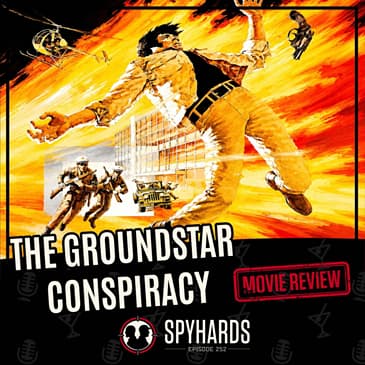


Agents Scott and Cam run screaming from a top secret space research lab with George Peppard while tackling the 1972 paranoid spy thriller The Groundstar Conspiracy.
Directed by Lamont Johnson. Starring George Peppard, Michael Sarrazin, Christine Belford, Cliff Potts, James Olson, Tim O'Connor and James McEachin.
You can stream The Groundstar Conspiracy on YouTube!
Let us know your opinions about the NOC List. Leave us a voicemail on Speakpipe or send us an email now!
Become a SpyHards Patron and gain access to top secret "Agents in the Field" bonus episodes, movie commentaries and more!
Social media: @spyhards
Purchase the latest exclusive SpyHards merch at Redbubble.
View the NOC List and the Disavowed List at Letterboxd.com/spyhards
Podcast artwork by Michael Overton.
Theme music by Doug Astley.
Hosted on Acast. See acast.com/privacy for more information.
[00:00:38] Welcome to SpyHards - A Spy Movie Podcast, I'm Agent Scott. And I'm Cam the Provocateur. Scott, I should let you know though, I'm a closet Greek. Oh, a closet case maybe, but Greek. I mean, you have got a bit of like color on your skin, you've got like a little olive tone to you, maybe you are Cypriot. Many people in my life have told me I have sort of Mediterranean skin tones, which I don't even know what that means. I'm not saying, I'm not putting those words in your mouth,
[00:01:04] but I've been told that all my life. And people often mistake me for various things. So, um, maybe I am a closet Greek. Who knew? Whereas, much like this film, you're as Canadian as they come. That's the actual reality, yes. Well, let's get to it Cam, what are we talking about? We are talking about the Groundstar Conspiracy from 1972, starring George Pappard.
[00:01:28] Uh, yeah. There's a lot to talk about here. I've got a lot to say about a film that doesn't have a lot to say. Yeah. What a fascinating film. It's 90 minutes long, uh, easily available on YouTube. Um, sat down with sort of the expectations of, well, the reality folks. Sometimes when we tackle these YouTube specials, I take a lot of notes, but I'm like, you know, the notes that I think are
[00:01:55] important to mention on the show, I put an asterisk next to them. A lot of the notes are just sort of like plot details so I can read it through the next day or a couple of days later, be able to jog my memories to the entire flow of the film. Sure. But it's the asterisk ones that you go, those are the ones that are juicy. Those are the ones that are fun or have some insight. Maybe they talk about a theme. Maybe they just point out something absolutely crazy in the movie. And there have been cases with spy hard specials in the past where there are, uh, you know, not too many
[00:02:24] asterisks is on the page, shall we say. And so that's always kind of this weird little like low key anxiety I have going into some of these forgotten spy films. And, um, that was not the case when I got to the end of the ground star conspiracy. I mean, I have a full two pages of notes, but a lot of it isn't interesting to read back. Like, it's like, what is this? Why is this? Who is this? Where is this? When is this? Why is this? Who is this? Where is this? In a,
[00:02:53] a circle. Um, it's a conspiracy, Cam. My notes are a conspiracy. Indeed. Indeed. And let's dive into it because there's a lot to untangle or is there? I don't know. I mean, it does not a lot for 90 minutes. And then at the end it goes, Oh, here's the plot. And then leaves. Don't ask questions. There's another spy movie on our list that you have not seen that I have, uh, going way
[00:03:19] back to destination Tokyo times. Okay. And, um, that's how I'm going to now mark time. Pre-Tokyo, post-Tokyo. That's right. That's right. After Tokyo. So PT and AT. That's right. That's right. Um, that I remember watching years ago and spending the maybe 95% of the runtime going, is this a spy movie? Is this a spy movie? Oh, I did that a lot here.
[00:03:46] And then getting to the very end and being like, Oh, Oh, okay. I, I, okay. Hang on. Let's just talk about that off the top because this is Spy Hearts podcast. If you've clicked play on this, if be it the YouTube version or the audio version, is this a spy movie? What's your justification for it? Because like I, George Pappard's character definitely works for some sort of shadowy government organization. Yeah.
[00:04:12] Yeah. But it's never defined. No, I think what it is is because it is listed as a spy movie. When you look up lists online, it has the conspiracy element, which is so strong in a lot of seventies spy slash paranoid thrillers. And we often do kind of blur the lines. We did parallax view, for example. And I think if that's related, then so is this. Yeah. Um, well, we're talking about now it's too late, so it doesn't matter. Yeah. But it does have that sort of like question mark hanging over it for much of the film. And I
[00:04:42] would say the twist at the end pushes it into the sort of, uh, like sleeper agent kind of camp. So I would say it does count. It's loose, but you know what, if we're going to tackle men in black back in the day, then this is more than applicable. I mean, it's hard to judge us by decisions we made seven years ago, but I understand your point. Uh, or, um, okay. Better example, kiss of the dragon. Another one we did on the show, you know, sometimes like the threads are a little loose, but I would say these,
[00:05:09] this movie probably has more in terms of sort of intrigue and trade craft, even to a degree, even if it's accidental. Yeah. Yeah. Then some of the ones that are more, quote unquote, legit spy films. Sure. And, you know, let us know in the comments on social media or on YouTube. What do you think? Is this a spy movie? Should we be tackling it? I'd be keen to hear your thoughts. It's too late. It's too late. You've already clicked play folks. You're sucked into the vortex now.
[00:05:38] But, uh, speaking of the ground star conspiracy, here is your synopsis. And let's see if it mentions the word spy at any point. Okay. The ground star conspiracy. Only if you like gripping suspense and surprise endings. Really? So they were selling the surprise ending right up front. It's also on the poster. I was looking at the poster earlier. It's one of my notes. It's a fantastic bit of artwork. Uh, it's a, it's one of my favorite posters I think I've ever seen.
[00:06:07] Uh, I may actually try and get a print of it just because of how cool it looks. But yeah, in the top left hand corner, it's like only if you like gripping suspense and a surprise ending. So, you know, going into it that there's a twist, which maybe is fun. Yeah. I don't know. Do you, it's like knowing the what's in the box scene at the beginning of the film. Yeah. I mean, I know that Quentin Tarantino is a fan of this movie for that ending, which he felt like redeemed everything that had come before it.
[00:06:37] We'll get to that. Yeah. A break-in and sabotage attempt occurs at a top secret research institute and the culprit is cornered and captured. The problem is that he's badly injured and claims to have lost his memory entirely. A cat and mouse game ensues between investigator Tuxen and the mystery intruder Wells and the people who sent him on the mission. Yeah. Yeah. Yeah. I mean, he's an investigator. Does that mean he's a spy?
[00:07:06] Well, there's like, it's the level of bugging people in this film. Like the idea of like the surveillance state. Yeah. But the Daily Mail did that. They're not spies. That's true. That's true. But, you know, it's the fact that like... Oh, look, I've just been served notice. Oh, that's nice. Oh, I'm being sued. There's a lot more in terms of like when we tackle any movie dealing... Well, not any movie, but a lot of the movies dealing with say like, you know, CIA shadowy operations and things like this.
[00:07:33] It's all the tactics that we're seeing the George Pappard character take part in here. Sure. I just think like it's... I suppose it's the tactics are in the hands of someone though, isn't it? Like if you get someone to do all the things James Bond does... Yeah. ...but they happen to work for the post office, are they a spy? Well, that's quite true. But well, actually, yes, it's like North by Northwest. They're obviously living the life of a spy. Which we all wish we were.
[00:08:03] We all wish we were. But it doesn't say anything about spies in the synopsis. So we will dive into it as we are wont to do. I have a connection to this. I've seen a few George Pappard films in my time. And I've seen a little bit of The A-Team. But apart from that, he's somewhat of an unknown entity. I don't know anyone else in the cast of this film. But Cam, do you have any connections? None whatsoever. This was one that I added to the list when it popped up on some sort of breakdown of 70s spy films or something like that.
[00:08:32] And I don't have that much of a connection to George Pappard outside of The A-Team. I was a huge A-Team fan as a kid. I had some of the figures and I loved watching that show. I remember my friend and I playing A-Team in the backyard as kids. Who were you? That is an excellent question. I think I was Murdoch. But it's kind of a blur. Which one was Murdoch? You know, Mad Murdoch. The crazy one. Oh, as in? Dwight Schultz. Red Alert. Yeah.
[00:09:03] Yeah, yeah, yeah. I feel like that's who I was because I didn't think Face was cool. I didn't want to be Hannibal, which was the George Pappard character. Other than the line, I love it when a plan comes together. I probably wanted to say that, but I was willing to give that one up. And I don't know that I was a very good B.A. Baracus as a... Well, ever. Well, funnily enough, I used to think I was B.A. Baracus, but then my brown face fell out of style and I just had to...
[00:09:33] Well, I mean, we have to drug you to get you on every single plane. So maybe that is accurate. No, I don't actually need to be drugged, Cam. Why are you doing that? Stop drugging me, please. Yeah, so I feel like as a kid, Dwight Schultz's character is the fun one. You get to be crazy, right? It's the radical. It's the rogue element. It's the unknown. The excitement. I get it. I don't know enough about the A-team to pick. So pick one for me.
[00:10:03] I think you want to be Hannibal. I really do. I think you want to be the Hannibal. Because you know what Hannibal's line is? I just said it. I love it when a plan comes together. And if there's ever anyone I know who wants plans, it's you. What are you trying to say there, Cam? What are you getting at? Huh? That you're not the fun one. Okay. We've had this chat too. You're the George Pappard of the group. Hey, I was in Ground Star Conspiracy, baby.
[00:10:33] Look at me fly. Oh my God. It's funny because now that we do these on video, I can't make jokes. And you're wearing the toupee right now of George Pappard. I should have brought a cigar with me or something and just lit it up right there. That would have been good. But no, you're right. I probably do. I was always like the Red Ranger. I was always like the leader of the pack. That was always me. Yep. Yeah. Okay. Well, I always liked Raphael. Of course I did.
[00:11:06] I wasn't. Power Rangers fell into my like mid teenage years. So that wasn't something I was pursuing. I still like Power Rangers. I'm almost 40. I remember watching the shows from time to time, but I was too old to be playing Power Rangers at that point. Which is a shame really, because we're going to do the rest of this interview. This episode, I should say, with like flight talking like the Power Rangers. So everything's just going to be like this now. Oh God. Okay. That's a joke that only plays on the video. That was good Scott. That's right. Good podcasting, buddy. Yeah. Yeah.
[00:11:35] But George Pappard, I mean, I've seen him in Breakfast at Tiffany's, but I feel like he was... He's great in that. I feel like he was like one of those leading men that they went to when someone more famous turned them down. And I think even George Pappard would probably say that. Because you look at the films he winds up in, he's not winding up in like the A-level films other than something like Breakfast at Tiffany's. Because we did Operation Crossbow again, which was not, you know, like one of the biggest of the big men on a mission movies.
[00:12:04] You mean the Sophia Loren film, right? Yes, I do. Yes, I do. I feel like it's... And I don't mean this to be dismissive of George Pappard. There's a lot of actors I love who are not the top tier movie stars. But I feel like in his life at that point, it was probably like Paul Newman turned us down. So we want to get George Pappard. I could buy that. Yeah. But, you know, a lot of people make a living off of the dregs of other people. Just look at every podcaster ever.
[00:12:34] And some of them are great. You know, there's a lot of actors I love from the golden days who were not Cary Grant or Jimmy Stewart. Mm-hmm. I mean, who remembers them? But, you know. Oh, boy. Oh, no. Oh, no. Sorry, Victor Mature. Whoever you are. Oh, jeez. Oh, jeez. That joke wasn't very mature. Sure. This is why people don't listen to us anymore, Cam, because I make silly jokes. This has to be a serious spy. This is a serious spy movie, Cam.
[00:13:04] We have to be very serious right now. That's right. You need to be more Hannibal, less Murdoch. Right. Okay. Oh, wait. Oh, wait. You're going to be the funny one now, because that would be a change. That's right. That's right. Oh, team Cam hashtag out there, folks. Oh, okay. All right. We're bringing that back. A divide. Is that what we want here? We want people in camps. Okay. Right. Fine. Well, Team Scott, let me hear you. Comment down below. That was very quiet.
[00:13:32] After you said, did you notice you said Team Scott, and I just let it be silence? The problem is I edit the video, so I'm going to put like cheers into the background or something like that, and just like, just applause. Just applause. Well, every time I talk, it will end in applause, and every time you talk, it will end in booing. When in reality, in the background, there was just a sad, failed trombone. Yeah, but we both experienced that. That's why we're podcasters again. Well, yeah, that's true. Okay. Let's get into the Ground Star Conspiracy, Cam.
[00:14:00] Can you tell us how this conspiracy began? So this was based on a novel by British author Leslie P. Davies, whose specialty was work that used sci-fi, horror, and mystery, sort of a pulp author. And he wrote a book in 1968 called The Alien. And this is a very loose adaptation of that book, but it's kind of like that classic case
[00:14:26] of an author who at that time was, you know, cranking out novels. But in 2026, Wikipedia is not your friend when it comes to finding out the details of these novels. I'm sure maybe you could find an out-of-print copy somewhere and educate yourself. I did not have the time nor the resources to do such a thing. So the book was called The Alien. Everything I read about this movie... See, he doesn't care about you folks. This is why you should all be Team Scott. Oh boy.
[00:14:54] Everything I've read about the movie, they say it's a very loose adaptation of that book. Okay. So, he was not someone whose work was adapted very much. He had two of his novels, The Artificial Man and The Psychogeist, or just Psychogeist, I should say, adapted into a 1968 William Castle sci-fi spy film called Project X, which I've added to our list. I like the idea of anything sci-fi spy. Right? Or spy-fi.
[00:15:21] And William Castle was like one of the great showmen who would do these like horror films where he would have like nurses working in the lobby for when you passed out due to the intensity of the film. Things like that. Like crazy marketing schemes. I was going to say, that feels more like a marketing thing. Like we'll have medical assistants standing by for when you're dragged out of the theater. Yeah, he would do things like that. Or that you'd have to take your blood pressure before you went into the movie. Things like that. Okay. That's cute. Yeah, exactly.
[00:15:48] So, I don't know about Project X, but we'll check it out at some point down the road. Um, and the same year as Project X, um, one of his stories, Paper Dolls, was featured on the TV show Journey to the Unknown. And, uh, Ground Star Conspiracy is the only other work adapted for the screen. Um, after that it was nothing. Now, the rights were, uh, grabbed by Hal Roach Jr., who was a producer, but his father was the legendary comedy producer, Hal Roach, who had worked with Harold Lloyd, Laurel and
[00:16:16] Hardy, the Our Gang team. One of the big voices in silent comedy back in the day. I just loved your delivery of that. It's like, here's a story about Hal Roach Jr. and his father, who was called Hal Roach. I'm like, well, I knew that. I could guess. I could extrapolate. Yes, yes, yes. Well, uh, Hal Roach Jr.'s career was not as auspicious as his father's. So there's no Junior Junior? There might be, but he's not a mega producer.
[00:16:45] He's not got a Wikipedia page. No, no. But, uh, so those rights were snapped up and developed for a while, because that's 1968. They grabbed it basically right as it was being published, or just before, and it just took a few years because, well, I'll get to that in a second, what happened with this movie. So, in 19, uh, well, shortly after that, late 60s, early 70s, they hire a writer named Douglas Hayes to write this film.
[00:17:13] And he is also a director, so they actually hired him to write and direct the film. And if you note the movie, the opening credits, it says, written by Matthew Howard. Matthew Howard does not exist. That is Douglas Hayes. He was, uh, producing this film under a pseudonym, or writing this film under a pseudonym, for reasons we'll get to in a second. So, California-born writer-director, as I said, started performing double duties, um,
[00:17:41] behind the camera on TV shows like the, uh, Your Jewelers Showcase. He was writing, uh, B-Westerns and historical adventures. Now, his debut film writing effort was Drums of Tahiti, which I'm sure has aged very well. Um, and then he was writing and directing episodes of The Adventures of Rin Tin Tin. He directed some episodes of Twilight Zone. And in 1964, one of his big films was writing and directing the Anne Margaret drama, Kitten with a Whip.
[00:18:09] And that leads, shortly after, into writing Ice Station Zebra. Scott's eyes widen. Mmm. A much better film. Right. So, he's, uh, yeah, writes that film. Then he does TV. This guy was huge in TV. You go through it, it's just like a sea of TV credits. Well, they say it adds 10 pounds. Because, basically, after Ground Star, or sorry, because, like, shortly after Ice Station Zebra,
[00:18:36] I should say, um, he just goes back to TV for quite a while. Like, four years. And then comes back with this movie. And, as I said, under the pseudonym, he's also noted later in his career, he was the creator of the North and South miniseries in the mid-80s, which I've never seen, but was a massive deal in its time. In sort of the, in league with things like, you know, um, Roots back in the day. These miniseries that, like, everyone was watching.
[00:19:03] So, what happens is, this movie is set up, um, they're going to call it The Alien. That's the title it's going to be shooting under. With Douglas Hayes writing and directing. The cast for that movie, Robert Stack, Genevieve Bourjol, and David Jansen. Now, David Jansen, for those that don't remember necessarily, was a star of TV's The Fugitive. So, okay. That's the cast for this film.
[00:19:30] But then what happened was, Bourjol dropped out before shooting. Which led to... It's this woman! She can't keep a roll! She wasn't, she didn't, uh, depart on her own volition from Star Trek Voyager, Scott. What, you meant to say Red Alert? You, I, you did it first! Red Alert, there you go. There you go. You were setting up something that people didn't know what you were talking about. I know, I know. I wanted to sort of, like, spoil it.
[00:19:54] But, uh, for those who didn't know, Genevieve Bourjol was originally the, uh, lead of Star Trek Voyager. And she lasted about a week, and then quit. Yeah, and you can see, uh, footage of that online. Uh, it's a very different energy than Kate Mulgrew, that's for sure. Far more reserved. And, uh, I think we got the correct actor in the role. What was the character's name? It wasn't Catherine. It was something else. Um, I, I think it was similar, though.
[00:20:23] It was similar, but yeah, it was, uh, Kate Mulgrew coming on board. They changed the name to Catherine. Oh, I, I'm not going to look it up, because I don't think people care. Yeah, probably not. But, um, so, Bourjol had dropped out, which led to delays that affected the rest of the cast being able to participate. So they all left. And then, uh, Hayes abandons the director's chair. And so at this point now, they need to bring someone in to take this on. They've still got a screenplay that Hayes had written.
[00:20:52] And so they bring in, uh, director Lamont Johnson, who was California born, like, uh, Douglas Hayes. And he was a director and actor, and got his start in front of the camera in the early 50s on TV and in B-War movies. He also did one episode of the Lone Wolf TV series. Okay, I just did, I, I suppressed a joke earlier. Yeah. Because I was trying to be serious, and you've just set me up again, and I just need to make it. Okay. Every single time you say a B something, Yeah.
[00:21:22] I think about Bs. Okay, like, for the last seven years I've been doing it. And you talk about B movies, and I think about Bs. And then you said a B Western. And I was like, oh, what, the good, the bad, and the stingy? Um, and then you said, like, what was it? You just said a B what movie? War movies. A B-War movie. I mean, I don't know. Name your war movie. Uh, saving private... I can't think of a B pun for Ryan. Really selling that joke. Yeah. There's the comic relief of SpyHard's podcast. Team Scott, right?
[00:21:59] Yeah, you're okay. Yeah, you got me there. If I was doing a tally on screen, it would be one cam Scott zero at that point. That's, uh, yeah, 15 love. Well done. So, yes, one episode of Lone Wolf, the TV series. Scott, I thought you'd be jumping more for that one, having, uh, tackled the Lone Wolf. Oh, it's that guy? Yeah. Oh, okay. Yeah, it was a TV spinoff. Yeah, all right. I, I'm not as, uh, I'm not as in love with the Lone Wolf as I am with my own joke.
[00:22:27] So, uh, Johnson started directing in 1955, where he did 25 episodes of matinee theater, which is, this is the classic days where you're proving yourself in, you know, these sort of, uh, um, episodic TV formats where it's like live TV. Oh, yeah. Uh, yeah. Yeah. So he did that. He did 10 episodes. Yes, there's another one. Yeah. There's a whole bunch. There's so many of them. So many. That was just like the thing, wasn't it? Because it was a way of doing something that you couldn't get in the theater.
[00:22:55] And also you could just like change your like material every single week. Yeah. Yeah. Yeah. Yeah. Uh, and then also recycle the cast. Cause you could have like some actors that return or you don't, you could just bring in a whole new cast. It didn't matter. Um, yeah, it was like, it was kind of like that. I kind of like the idea. It's like putting on a show every week. It's like, we've got to like bring in, you know, new actors. It's. Yeah. It's like, it's, it's what the actors probably enjoy. That sort of, it's a one-time thing.
[00:23:23] And, uh, yeah, I can, I can see it being popular. It wouldn't fly now. Maybe we should bring it back. Yeah. That sounds right. That sounds exactly what the world needs right now is one hour live TV. Cam and Scott's matinee theater. It crashes and burns. I can't, I can't wait to, to be on, uh, you know, ITV4 or I don't know, like whatever the worst channel is you can think of in Canada.
[00:23:52] I don't even know channels anymore. Like I don't watch like, um, you know, like cable television. I don't know. It's a, it's a, it's a B channel. It is a B channel. So Lamont Johnson also, um, was in, uh, directed, I should say 10 episodes of Steve Canyon, which was something the name jumped out. And I was like, what is this? And it's about a problem solving air force commander kind of like in a way, almost like a Jack Reacher kind of idea, but he's an air force commander who goes place to place
[00:24:21] helping people. So it's, it's the cowboy thing, but as an air force commander instead. Definitely. And I'm glad you said cowboy because he also worked on have gun will travel, which was one of the big Western shows thing. It's like a guy goes town to town. Yep. He worked on Peter gun as well, which, you know, the classic score that people know better than the actual show.
[00:24:43] Uh, and this guy was a TV veteran, just wall to wall TV and made his film debut, uh, debut, uh, many years actually after he'd started directing TV with the 1967 George Maharas thriller, A Covenant with Death. And this film was his followup to the 1971 Western starring Kirk Douglas and Johnny Cash titled A Gunfight.
[00:25:13] I mean, that's enticing. Yeah. Johnny Cash. I, I mean, it makes sense that he's in a Western, but I, I've never come across a movie he's been in. And it's sort of semi young Johnny Cash. If Johnny Cash was ever young. Uh, yeah. Yeah. Uh, 71. He's not that young. I mean, Bob Dylan was starring in a Western in the seventies. So that makes sense. Yeah. Sixthies. The, the, the Beatles were in one of them was at least in a war film, I think off top of my head. It was a John.
[00:25:42] I was in a war film. Really? Maybe it was a B war film. Um, I'd say if Kirk Douglas is in it, it's probably a bigger deal, but I Scott, I'm letting that joke die. I'm letting that joke die. I know. I know. But I wanted to get some honey from it. This is not how you build buzz for the podcast. Oh, two nil. Oh my God. I'm drowning. I'm dying out here.
[00:26:10] Uh, Lamont, uh, Lamont Johnson's final credit is notable because this guy worked for a long time. He ended his career in the year 2000 with an episode of Felicity, which takes us right into the modern, you know, fairly modern era. Right. And all time high. That's right. That's right. So the working titles for this film were the plastic man, which was the one they were primarily going to be pushing that they thought was, which I like. Yeah. I liked the plastic man. Do you think it was a copyright thing because of plastic man in DC comics?
[00:26:40] I didn't even know that existed until you just said that. Oh, really? He's basically the Mr. Fantastic of, uh, DC. Okay. Yeah. I don't think he's as ubiquitous as Mr. Fantastic. Although in that time period, maybe he was. Maybe? Maybe. I don't know. Uh, the other title was The Alien, you know, after the book. Yeah. Yeah. It sounds too sci-fi. The Ground Star Conspiracy is a fine title.
[00:27:06] The thing is, this is kind of a sci-fi movie, but it's not enough of a sci-fi movie to call it The Alien. It's also not enough of a spy movie to say it's the Ground Star Conspiracy either. Well, quite true. Quite true. So The Plastic Man's probably the middle ground. Yeah, I think so. Now, British actress Carol White was originally cast as the female lead of this movie, and she's someone who doesn't have, like, a huge, you know, body of work to her.
[00:27:33] But she played a schoolgirl in The 39 Steps from 1959, I noticed, in the scene where the lead character, Hani, is, like, giving a school lecture. Do you remember that? I remember that, yes. I wish I hadn't remembered that. Yep. Yeah. She was in an episode of The Avengers, and she also played Sheila Dale, the saboteur, in Carry On Teacher. I've seen it. Yeah. Oh, you have seen Carry On Teacher? I've seen all the Carry On films. Yeah. I'm British.
[00:28:02] And how does that one measure up? I don't remember. I watched them when I was very young. Right. It's definitely a B Carry On film. Okay. Okay. Okay. So, they, basically, Carol White shot scenes for this movie. She shot for, like, a week or two. Wait. And then... Did she get bejeweled? Well, she quit due to commitments to the British drama Maid. She bejeweled it.
[00:28:31] She did. They could not hold down a female lead for the Ground Star Conspiracy. Good Lord. It's like they read the script and were like, nah. Yeah. And Maid, apparently, was a, like, critical and box office absolute disaster. So, she didn't make it. Oh, I say, if you say it was a good thing, I was going to say, she made the right choice. But that wasn't the case. My joke doesn't work. No, she didn't make the right choice.
[00:29:01] This joke doesn't work anymore. No, no. We've made it worse. Right. There we go. There we go. I don't know. Like, should she have stayed with this movie? Maybe. I mean... I don't know. It hasn't had a history. No, and I would say, like, the actress in this film has not gone on to be, like, an all-timer. Like, she's done work. Nor is it a very good part. Like, basically, she disappears in the third act. Oh, Scott, I have so much to say about this character when we get to the review. Okay.
[00:29:31] So much. Um, allegedly, Candace Bergen and Tuesday Weld were people that they were looking at for this movie, but they were too expensive. That was something I saw on Wikipedia. I can kind of believe it, though, if they're trying to replace. And Candace Bergen, in particular, feels like a pretty good fit for, especially, like, replacing Genevieve Bourgeau. But, uh, yeah. If anything, I've actually yet to see Genevieve Bourgeau in anything. I just keep missing her. She's like a bus. Yeah, yeah, yeah.
[00:30:01] I don't know. It's weird. I think it's because there was a film we tackled ages ago, whether it was on the Patreon here, that she was meant to be in and left. So she has a history of doing this. She does. And I've seen her in a number of 70s films. Very, very good actress. But just obviously, if she was maybe feeling like things weren't vibing, she just was out. I get it, man. Life's too short. If you don't feel like you want to do something, don't do it. Yeah, exactly. So I'll see you later, folks.
[00:30:32] Well, maybe, um, maybe she was like someone who was like, if I don't feel this material, I'm going to give a bad performance. So, like, why is this something I would do to them or to myself? Yeah, I get it. I get it. Yeah. The top three for the year. Number one was The Godfather. Number two was The Poseidon Adventure. And number three, What's Up Doc? The box office on this movie, who the hell knows? It seems that no one knows. It's a conspiracy.
[00:31:00] It's a conspiracy to hide the low numbers on the Ground Star Conspiracy. Mm-hmm. Mm-hmm. Mm-hmm. Good year, though. Yeah, yeah. Oh, 1972 is a great year for movies. But, um, you know, it's, it's like right in the middle of that kind of, and leading, I guess, into also just that paranoid thriller era. So, like, this movie definitely feels of a piece with a lot of other movies. Yeah, you've got, like, Parallax down the road. You've got, uh, Condor a couple of years later.
[00:31:27] But you've also, like, got the big change coming in a couple of years' time. You've got Jaws shopping and then Star Wars. It's... Things are going to change. It's the death throes of the sort of single star, low budget, just drama. Like, you need big, big, big spectacle soon. Well, when, you know, we were talking about Genevieve Bujol, I was thinking of the movie Coma, which was directed by Michael Crichton.
[00:31:53] And, um, it's a, like, the thing is, when we talk about Condor or Parallax, that is top-tier paranoid thrillers. Like, the best of the best, right? Yeah. But, like, a movie like Coma is a good one. It's not great, but it's good. And it's about a conspiracy happening within a hospital. And it has some sci-fi elements to it, for sure. And it's about, you know, Genevieve Bujol, like, investigating these things along the way. And there's some incredible imagery. It has a great sense of atmosphere. But you would not say it's a top-tier movie. And I feel like...
[00:32:23] Is it one of all us to tackle? Or is it... No. No, it's not spy-related at all. Okay. Yeah, investigative. But it's the kind of movie I feel like Ground Star is probably trying to be a little more like. Where I don't think they were tackling this thinking they were making... I don't know. Everyone goes in with the best of intentions, hopefully. But, like, I don't know with just, like, the choices they had, you know, behind the camera. That this was going to be a Condor, for example. Or a Parallax. Well, both hadn't happened yet. So they were just trying to make their best film.
[00:32:52] But, like, I think you had, like, Scorpio the following year. Yeah. Like, this is of its time. It feels like kind of the rough drafts before you get the masterpieces. Yeah. Before they iterate upon it and turn into something like Condor. But you need things like this. Or conversation. Yeah. You need things like this to lay the foundation. Definitely. Definitely. So, yeah, that's the story of Ground Star Conspiracy. I wish there was some fun postscripts on this movie.
[00:33:19] But I feel like this movie was barely released considering the absent box office or budget or anything like that. Yeah. Well, it just goes to show that there's multiple versions of this on YouTube that our review will be stacked up against. And no one's claiming copyright. There was a version released by Kino Lorber a few years back. But I guess that's because the rights were cheap. Right.
[00:33:44] And I want to just note for anyone who watched the YouTube link or is going to watch the YouTube link that I post with this episode. It cuts off very abruptly at the end of the movie. There are two versions on YouTube. There are two, but the other one's a lesser quality. And so I'm going to say that where it cuts off is the ending. So don't worry about it. Yeah. It's just it removes the credits, but it also removes the title sequence as well. Yes. Yes. So just be aware of that.
[00:34:12] But it isn't like going to take away the film. You're not losing like a quippy final line or some sort of great resolution. It is the ending. It's just a fast cut to, you know, the next video. I can only assume there was some sort of copyrighted music that people put in that online didn't want to get flagged for that. So they just put it as the film. Probably. Yeah. But that is a conspiracy we can't answer. Mm hmm. Mm hmm. What we can answer is the ground star. You've been talking a lot, Cam. Rest easy. Thank you.
[00:34:42] I'm here. Hashtag Team Scott. This is one of those films where like on paper you think it's got everything going for it. George Papad in the lead. I think the story is interesting. I think the hook is good. I think the twist is interesting. I think. And it's also 90 minutes. Like for me, on paper, this should work. And then I watch it and I'm just constantly frustrated. It's just it's inability to basically get to its own point.
[00:35:10] It just goes around the beats around the bush for a while as a good start, quite interesting hook. And then it gets lost in a second act with a love story that no one cares about. And it comes back at the end with a ton of exposition in the last five minutes to justify its own existence. And I just think like either this needs to be longer so they could flesh it out or they needed to actually put some information in throughout. Because I think the most frustrating thing I found is the film takes pride in being withholding.
[00:35:40] Yeah. And don't get me wrong. Keep me some of your plot away from the audience is good to sort of spoon feed it out bit by bit dribs and drabs to pull them along. It's a mystery. I'm intrigued. I want to know more. What is the ground star? What is all this stuff? But it doesn't give you anything. And you've got a lead who turns out to be the enemy. And you've got a second lead who's boring as fuck. Hey, that's a Star Trek veteran right there. Is it? Yeah, yeah.
[00:36:10] Michael Sarazin was in the episode The Quickening from Deep Space Nine. Hashtag Red Alert. Okay. Well, there you go. Star Trek veteran and boring as all hell. And the love affair is also unfortunately up with a lady who has nothing to do and is clearly not that bothered by it. Who cannot put a performance in to save her life. Uh-huh. She's also just not in a good film. So I don't blame her that much. She's not being directed to anything particularly memorable. I have so much to say about this character.
[00:36:39] Like, I want a separate section of this podcast to talk about the character. Yeah, yeah, yeah. That's your... You tackle her. That's fine. Okay. But what I'm saying is... The entire film was a frustration for me. Because it, like, could have been at least mediocre. It could have at least been entertaining. It refuses to be any of these things. And the fact that it decides to withhold everything from you until the very end goes from, this is interesting, to screw you.
[00:37:06] And I'm at the end, sat there with my arms folded, saying, can we just get on with it now? Yeah. And that isn't and should not be how one experiences a film. And also, like, I would say that when the big twist or the reveal happens... Yeah. It's not... It doesn't end in a way where you go, like, well, it took them a long time, but boy, oh boy, did the fireworks go off when that reveal happened. Oh, it did. It's, like, just sort of washed over. Like, it's brushed apart. This is it.
[00:37:37] Like, there's your nugget. You talk about, like, the twist at the end of... One, a film we always go back to, but no way out. And I apologise for referencing it a lot, but it's because it's a film that does a twist good. And you can go and watch no... I think it's better than this. Yes. And you can go back and you can see nuggets throughout. I know there are no nuggets here. I think they purposely chose to have no nuggets. This is the anti-KFC. This is just no good.
[00:38:05] And you will watch it and be frustrated if you were to ever have to experience this film again. Well, you know, you referenced Seven earlier and, like, the big ending of that film. But it's, like, when that final big twist happens, it communicates everything about the journeys of those characters. How, you know, Kevin Spacey's character was, like... His entire plan comes to total, like, completion by the end of the film. You know, and in a way that's, like, haunting. It sticks with you.
[00:38:34] This movie has a reveal that's supposed to be shocking in the same way. But you just sit there and go, like, wait, what? And you start backtracking going, wait, does any of this movie make sense? I don't know that it does. No. And I bet, like, now I know this is based on the book. I can bet there were actually a lot more bits of information along the way that you can go back and go, oh! Oh, that's what that means. That's what that means. And, yes, I suppose you could point out to the fact that the amnesiac lead can't remember anything.
[00:39:04] Because, actually, spoiler alert, he didn't do the stuff in the first place because he's not the same person. That's your twist. Okay. Interesting. But, like, there should be more there. Like, there should have been someone who knew him from his life. There are ways to make this more interesting. But the twist goes from what would be something where you go, like, wow, to actually more just, like, being slapped in the face with a fish. Oh, okay. Thanks. We're talking about amnesia. Let's talk about Jason Bourne.
[00:39:33] It's all over my notes. Yeah. Who doesn't know who he is. And so you find nuggets of information along the way from people he maybe had professional connections to. There's some personal connections as you go through the series as well that brings it out of him. And so it feels like a journey for the character. Whereas, like, this guy, he kind of learns nothing. He wanders around in a fog for 90 minutes or 89 minutes and then has the information dropped in his lap at the end. Yeah.
[00:40:01] Like, you think of, you think of, like, Matt Damon and getting that information. That makes a lot more sense, as you said, because it's, like, spoon-fed out and he learns things along the way. And he's active as well. And he's active. Yeah. Like, this guy, I'm sure he's a good actor in other things. Sure. Deep Space Nine. Deep Space Nine. The Quickening, folks. Go watch that. Or don't. I don't remember the episode. It's the one where everyone has the plague. It's the Dr. Bashir episode where, like, everyone's dying of a plague.
[00:40:30] It's not a great episode. Is that the one where they're on, like, the planet and it's the Jem'Hadar has infected the planet, right? I think so, yeah. Yeah, okay. Okay. I'm losing people with Jem'Hadar talk, but maybe I lost them already with Ground Star Conspiracy talk. Who knows? Maybe. Maybe. But, yeah, like, this whole film lives and breathes on the hook. And I'll go back to the thing I pointed out earlier. I'm going to open up my browser and read you the synopsis again. The top line. The Ground Star Conspiracy. Only if you like gripping suspense and surprise endings.
[00:41:00] They're 50%, right? Well, where's the suspense? Exactly. 50% right. The ending part. Okay, sure. But there's no suspense. Yeah, the ending is a surprise. Yeah. But, like, is it a surprise? Like, you come home from a day at work and your dog's shat on the carpet? Like, is it that sort of surprise? Well, it's like the Hitchcock's, you know, sense of suspense, right? Which is the, you know, the bomb under a table. If you don't know there's a bomb there and it just goes off, that's a surprise. Which is true, what they're saying.
[00:41:30] That's a surprise, you know, twist or reveal. Mm-hmm. But if you know, you know, that there's a bomb under the table and you're waiting to see when it's going to go off, that's suspense. That's perfect. That pulls you in.
[00:42:11] That's what this movie doesn't get. Like, yeah, it did. But it reminded me of, like, Bo Derek in 10, the scene of the woman, like, frolicking on the beach. And I'm like, okay, like, this seems very silly. But it's like, this is the tormented backstory we're supposed to piece together. And when you get it, you're like, yeah, I think this was kind of a one plus one equals two. Well, like, you go back to Jason Bourne. And I want to throw it to your thoughts in a second.
[00:42:36] But, like, Jason Bourne not only is getting flashbacks of the mission that caused him to get amnesia, but other things he's done in his life. Yeah. In the first three films. He's also got people in the office in Treadstone talking about what he has done and acknowledging the actual story going on behind the scenes. So you as an audience are like, you know that Jason Bourne was an operative. He's lost his memory and now he's trying to make amends. This all computes. It's actually told to you very well, very simply, very early on in Bourne Identity.
[00:43:05] This film doesn't tell you what happens until the very end. There is no signs pointing towards it. And you go to that Greek thing you mentioned. That's actually an interesting note that I underlined. With Jason Bourne, they're showing you, like, him doing the assassination on the boat, falling into the water, washing up. Like, you understand what the flashbacks mean. Until you get the lady to explain that he's talking Greek. Or you happen to be someone who speaks Greek. You're watching this film like he's babbling about nothing.
[00:43:35] Yeah. Like, it means nothing to me. Yeah. So how am I supposed to connect to that? How am I supposed to know that this isn't just a fanciful vision of someone who has just had, like, multiple electrotherapy sessions. And waterboarding. And waterboarding. Versus someone who's having their memories reassert themselves. Yeah. Like, coming to the surface. Mm-hmm. Yeah. And it's like, if you're going to do these, like, kind of dream images of, like, you know, we see, like, the ruins and we see this woman frolicking like Bo Derek.
[00:44:04] And it's like, you know, make them at least surreal and interesting visually. Where it's like, oh, like, you know, David Lynch is the lazy comparison because he wouldn't really make a movie like this. But, oh, Scott's waving his hand. I can help you. I can make it like a Spy Hearts one. Sure. Long kiss goodnight. Yeah. Yeah. Thank you. Yeah. The Rennie Harlan interview we just did recently. Yeah.
[00:44:30] You look at, like, how Geena Davis's other self is coming forward and the way that that is presented visually. And it's so interesting. Whereas, like, as I said, Lamont Johnson is almost entirely a TV director. And I just feel like was not bringing a lot of visual imagination to these dream sequences, which could have been haunting and stuck with you. Where you feel like you're seeing puzzle pieces. But you want to feel like you're seeing puzzle pieces and trying to figure out how they're connected. I wasn't. I was just like, yeah, yeah, yeah. Okay.
[00:45:00] You know, like, just tell me what's going on. I've spoken for too long. Yeah. Back to you. You know what? I'm in the same kind of boat as you are. This movie was frustrating. And a lot of it just turns into exposition throughout the movie. Or characters being purposely withholding, as you said. And I like a good paranoid thriller. You know, especially ones where it seems like nothing's happening.
[00:45:27] But they have that kind of ratcheting sense of kind of, like, building tension. Where you're almost like... I love, like, 70s conspiracy thrillers that dare to be almost boring in the early chapters. Where it's like, what am I watching? Where is this going? And then as the movie keeps going, you get pulled more and more into the movie. That's what you hope for. At least in a good version of that. You know, a great one, I think, kind of grabs you quicker. But I'm down for, like, the slow burn. But this movie just never...
[00:45:56] It never boils. It never ignites. Yeah. You're just sitting there and you're like, okay. And at first, I'm loving the atmosphere. I think, like, it looks pretty cool. The first 20 minutes are really cool. Like, the fact when the thing goes off and you've got George Pappard investigating and interrogating this guy. I loved all that. I thought we were going somewhere. And then it decides to change the POV from George Pappard to Deep Space Nine Guy. Yeah. And it just loses all of its pace.
[00:46:24] Its pulse basically flatlines. If it were a person, I would be shocking its chest. Yeah, exactly. And I think, like, you just completely lose that kind of mounting tension you get in a good conspiracy thriller. And so then it's like, okay, well, okay. Maybe the conspiracy angle isn't working, which is a problem when your movie is called The Ground Star Conspiracy. But let's just focus on characters. Because maybe the movie cares more about characters than, you know, the ins and outs of this conspiracy. Oh, wait.
[00:46:55] The characters are one dimensional at best. One of them is an amnesiac who doesn't know anything and doesn't even seem... Oh, he forgot how to make love to a woman, Cam. Don't forget. Oh, I could be your first again. Oh, my God. No, no, no. Please don't do this. And then the next morning, well, we know one thing. It wasn't your first time. Yeah, buddy. He must have felt very good about himself in that moment. Oh, he was high-fiving nobody.
[00:47:25] Oh, yeah. Oh, yeah. Yeah. The cameraman was getting a high-five. But it's like, that's all you really get. Like, the character's not actively trying to seek out his identity, as we said. And so you're just kind of, like, waiting for this movie to get to the end. And you're not dealing with characters who are interesting at all. No. The only one who's dynamic is George Pappard's character. Mm-hmm. Which is alike. And that's because he's the antagonist.
[00:47:54] Like, he is this guy who says at one point, you know, he'd like to have bugs in, like, every bedroom in, like, America. You know, like, his whole idea is... I do have bugs in my bedroom, but it's not the kind you want. That's why you've got, like, red welts all over your body. Yeah, exactly. I'm very itchy right now. See, you can't do that because of the video. The joke's ruined. It's ruined. It's all under the shirt, folks, don't worry. Yeah. But those listening to the podcast are just laughing in the aisles right now. They're like, that's another point for Cam. Hashtag Team Cam.
[00:48:23] But, yeah, it's like he says, like, he just wants everyone... I think he says at one point, you know, in the spotlight, naked. Like, he wants to know everything about every person. And I think that's actually a really interesting angle on a character. It feels actually very timely. Because, you know, you go back to, you know, a movie like The Dark Knight in 2008, which was all about the idea of surveillance on people and, like, the surveillance state. I mean, that's something that's common in sci-fi.
[00:48:50] But it's even more so now in the age of cell phones and, you know, just cameras everywhere. So, like, in a way, this movie could have aged very well having an antagonist who that's his primary drive. Because you could say, hey, he got what he wanted in the long run. This movie was ahead of its time. But that's also not really tied into what he's doing in the movie and what, like, the resolution is. The problem is we're getting into our dislikes. And, like, one thing for me...
[00:49:19] Maybe we just do it because it's just sort of digesting into the conversation. We're here. Let's just... I think, like, you want to talk about the woman. And I think I'm going to end in that. The woman. What's her name, Scott? What's her name? Who cares? I don't even think she remembers. It's Mrs. Devin. We hear that over and over and over. Right. I'll come back to old Devin over there. So, this film has no interest in interrogating its own ideas. Yeah. It sets up some very interesting things. That whole conversation about surveillance is a really interesting conversation.
[00:49:47] As you said, very prescient, very relevant right now, very on the pulse. Yeah. And probably, like, way ahead of its time in 1972. But it has no interest in actually interrogating the character of George Pappard or say, like, well, this is the flip side of that. This is where that shouldn't be. Yeah. It's just like, oh, no, this guy's a dick. And I can think of a movie that does interrogate it. That's The Conversation. The Coppola film. And that's two years later. And so, it's like, even the comeuppance for this guy is, like, getting punched in the face
[00:50:17] and being like, well, you know, I had that coming. But he's still out there. I'll take a few punches in the face for the safety of America. Yeah, yeah. Yeah. He's still out there doing what he does, which is also, like, pretty scary that this guy's out there doing this sort of stuff. But there's no sense of the movie leaving you with that sense of dread or, like, oh, my God, there's people like, you know, George Pappard's character out there. You don't get that feeling. And to that point, and to tie on to, I think, the thing you want to talk about, it is the Mrs. Devon character.
[00:50:47] Now, there is an idea in here. If you do the whole film school analysis of this film, this film is about identity in a lot of ways. Like, it's a guy claiming his identity back. But also, this character, Mrs. Devon, is set up as someone who's lost her identity. Her husband's died. Her family has died. She's inherited this estate. She is wanton. She is listless. She has nothing to do. And this man, covered in ketchup, falls into her life and keeps falling into her life and
[00:51:17] other things. And she just loves the fact that she's needed. And she says it at one point, like, you know, I want to help you. And I think she feels fulfilled by helping someone else. Okay. Okay. Now we're cooking on gas. Let's keep going. No, she's gone. On top of that, give me some character traits of her. Are you asking me to list them? Yeah. She's easily impressed in bed.
[00:51:44] I mean, to me, one of the main things I wrote was this woman really likes wine. Because anytime a man walks into her apartment or house, she's like, do you want some wine? I can get some wine. Well, like the ketchup guy, Mr. Deep Space Nine, first busts in and kind of causes her a few weeks of pain. Yeah. And then like just turns up five months later. And she's like, do you want some wine? Like, don't mind the fact that this guy just burst into your house.
[00:52:11] It's basically like, I mean, this is stranger danger personified. She never saw him post-surgery. All she saw was the ketchup guy. This could be anyone. And he's busted to her house. And she's like, oh, you know, now you're here. We also have like George Pappard's colleague, played by Cliff Potts, Mosley, like show up at her house at one point. She's like, do you want some wine? Yeah. She brings up wine like three or four times.
[00:52:36] And I'm like, okay, well, it's interesting if this woman is grief stricken and is dealing with that self-medicating with alcohol. If the movie acknowledged this. Like there's a self-destruction to her or something like that. That would be like, you know, a scene of her like walking into the ocean or something like that. Like there are things you could do to evoke that sense without spending too much time, without too much shoe leather. But it has no interest in interrogating any of these ideas. No.
[00:53:02] And I mean, it almost becomes comedic of like every time someone walks into a place, do you want wine? I can get some wine. I got some wine over here. And I'm like, is this someone who's like an alcoholic or is this the 1970s? Where it's just like, hey. Everyone's an alcoholic. We're just drinking, man. Good times every day. I don't know. I don't know my wine, but the fact that she can like tell like terrible Greek wine from other wines means she's probably had a few glasses of plonk in her life. Yeah. Yeah. No kidding.
[00:53:29] The fact that she, that's how one of the ways they figure out his like Greek identity is like her coming up with a wine idea. It's like, oh my God. Is that the secret name for this film? The Greek identity? The Greek identity or the wine idea? Either one works. Either one works. Okay. Let's talk about some good things. I just, I will get back to maybe Cam wants to riff more about Mrs. Devon. I think, I think George Papad puts in a performance. I think he comes like- A performance. Not even a good performance.
[00:54:00] He's arrived. I think some of the scenes at the beginning where he's like taking charge is pretty cool. And he's playing this like sick bastard pretty well. Like he's very cold, very calculating. There's not really any sign of empathy from him. Nope. And there's like moments where he's showing like videos of them to having sex to his superiors and just being very cold and calculated about it. That's not a George Papad I've seen in the past. I've seen him more in like Breakfast at Tiffany's where he's more the, you know, the lead matinee idol. So this is a different thing for George.
[00:54:30] And I think it's nice to see him do it. It's a nice shape. No, I mean, I liked it too. And up front, I was saying like George Papad, I feel like was often kind of the second choice for a lot of movies. He had much more personality here than he did, I think in Operation Crossbow. Yeah. Where it was a little more generic action guy and he was pretty forgettable. Here, it was a character that you actively disliked over the course of the film, which means I had strong feelings about his performance. Yeah. Because his character is pretty loathsome in a lot of ways.
[00:54:59] And he's not a violent character. It's not the classic we see him going around killing people or doing heinous things. It's his philosophy on life and just how cold and calculating he is. The way he will just torture someone. And you can see it doesn't bother him in the slightest. He is a complete sociopath. And so I found like him interesting. And if this were a movie that was like a character analysis of him, that would actually be pretty compelling. I felt like. Yeah. Yeah.
[00:55:28] I could buy into that. But the film stops paying attention to him about 30 minutes in. Yeah. Yeah. And you get that resolution, but it's not the most satisfying of resolutions with him. It's not a character driven resolution. It's a plot driven resolution. There's nothing. He doesn't. George Propard's character doesn't learn anything by the end of the film. He's not humbled by the experience. He's going to go on doing what he's doing. Yeah. I mean, like he's just out there, which in its own way is that paranoid thriller idea. Very 17. He's like the end of Scorpio.
[00:55:58] Everyone gets killed. Like, yeah, I get it. I get it. He's still out there. But there's a way of like punctuating that he's still out there in a way that has or leaves an impact. And I don't think the movie does that. No, no. I want to talk about the locations. That was my big like. And it's like, well, I want to talk just about the visual look of the movie because I actually think this is a great looking movie a lot of the time. And it was shot by Michael Reed, who was the cinematographer on Honor Majesty's Secret Service. Ah.
[00:56:27] Which is one of the best looking Bond films. He was a very accomplished cinematographer. But, you know, this movie is shot in Vancouver and areas around Vancouver. Burnaby, for example. Yeah, this needs to be like your area because. This is my area. But I'll get to the specifics of my own life in a second. But let's just say like the locations look really cool and ominous. You know, when we see. The Burnaby College or University or whatever it was like, that's a great place to shoot. Like, it's a very interesting set.
[00:56:54] I mean, it feels very 70s with sort of the granite and the architecture is all there. I think of Clockwork Orange does something similar from a university here in the UK that I actually attended. Brunel used a lot of that there. It's just kind of cool to see it there. But like it just goes to show how cool location shooting can be. And we're living in this world now where people are using green screens and the volume and all that sort of stuff. And you could do a lot to evoke locations. Yep. But you can't beat being there. Yeah.
[00:57:24] Well, that's the thing. It's like the brutalist architecture of that campus looks fantastic. And the way they convey that as a location for a secret space science center. It seems ominous. It seems dark. It seems unforgiving. Foreboding. And yeah, like it's hiding something. And it speaks to the antagonist. You know, it is that like the George Puppert character is this blunt, brutal character. And that comes through with his environments as well.
[00:57:52] Like there's visual storytelling going on here that's actually really impressive. And the way they use their locations and the way they shoot them. Because it's always very ominous. And I mean, this is where I went to university. I spent a lot of time there. I genuinely thought this is what you said it was as well. Like, yeah. When you said Barnaby. When I looked at Barnaby. Yeah. Sorry, Barnaby. I have been to Vancouver, folks. But the specific name of that, it's got a name of a person as a name of the university. Isn't it? Something like that. Which is, well, it's Simon Fraser University. Yeah. Right. Yeah.
[00:58:22] Yeah. Thank you. I was correct. Yeah, you're right. Yeah, yeah. Yeah, yeah. And when I read that, I was like, wait, I swear that was Cam's University. So that is, I mean, for you, a cool connection. It must be cool to see some of the places I'm sure you were familiar with in a film. I mean, it's changed very little, really. It mostly looks the same. Next time you come to Vancouver, we'll go do a tour of Ground Star. And you can see all the, I mean, incredibly specific locations. All the, you know, the water, like, kind of, like, thing that you walk across with the stones. That's all still there. Everything is really still there.
[00:58:52] I mean, the first tour was Ballistic X vs. Sever. The second tour is Ground Star Conspiracy. Man, you guys have it going on in Vancouver. Isn't that the fun, though, that we get the ones that are just, like, the trashiest or the, like, dumbest ones? Yeah, absolutely dregs. Yeah. Did you send this film to anyone else that you went to uni with? Because I'll be interested to see, like, if it actually is interesting to people. No, I should send it to my dad because he went to Simon Fraser as well. But it's like, the location is still a lot like that. And we actually talked about it a little bit when we did the X-Files pilot as well.
[00:59:22] Right. Which had a brief location shoot there as well. But they really make the most of it. And they make it look cool and otherworldly. But it's like, they also go to, like, English Bay. And that's the scenes of them on, like, by the water, you know, on the beach. And, like, again, it's pretty distinctly Vancouver. Is that near the marina? It's near the ferry terminal, which you wouldn't have been to. Like the north side, like going up the coast, right? Yeah. Yeah. Okay, yeah.
[00:59:51] I roughly know where it was because I thought I could see, like, the entrance to the bay in the background. Right. Yeah. So there's, like, that. But, you know, there's, like, something you were fascinated with when you were in Vancouver, which is the sulfur refinement area plant or whatever it is, which I don't even think about having been born here ever. But you were just fascinated by every day we were taking the sea bus across the water. I just need to, like, for people who are watching the YouTube version, they will see some pictures of the sulfur for context.
[01:00:20] But for those listening, I'll just describe it because you love hearing my voice. So to travel around Vancouver, Cam and I had to take a thing called the sea bus, which connects North Van, where he is, to Vancouver downtown proper. And we took that a lot. Yeah. And it's also a working bay. Like, there are a lot of ships coming in and out and lots of freight going through it. And one thing that they have a lot of deposits of, apparently, is sulfur. So there's in the water, there is this, like, jetty.
[01:00:47] And there is a gigantic mound, bigger than the boat itself, of bright, vibrant yellow sulfur. And for me, it stuck out like a sore thumb. It's a color of, it's a color that doesn't feel natural. It's like neon. It's neon yellow. And so, like, for me, I was like, what on earth is that giant pile? But I would see it every day. And then, so, I knew this was set in Vancouver. But as soon as I saw the sulfur, I'm like, ah, I'm home, baby. Yeah. Wow.
[01:01:14] And I don't want to make my like just that this is all shot in Vancouver. No, because I would have to do that, like, every third film. Exactly. It's more about the way it's depicted. The way it is showcased in the movie and that it visually feels like an interesting world. And also kind of like a time capsule of Vancouver 50 years ago. Like, it isn't, like, a lot of it that's shot now, like, it was, like, in the middle of the outback somewhere. Just, like, wild fields and roads.
[01:01:39] I'm sure that is all now condominiums and developed into all sorts of, like, McDonald's and things like that. Like, that land doesn't exist anymore. Yeah. Well, like, when they're in Simon Fraser, the exteriors are pretty much the same. But when they're inside, like, the classrooms and the offices, like, the paint job is very 70s. Sure. I mean more like, you know, it shows, like, we watch a lot of Vegas films. We talk about Vegas a lot because we love that, too.
[01:02:03] And we've seen multiple films over the years, even like Diamonds Are Forever connecting it back to spy movies, where you see the evolution of Las Vegas. And it is fun to see an evolution of Vancouver, a place you live in and I've seen. Like, I can understand why it's alike. But more holistically, I think this is a very stunning looking film at times. Like, there are even, like, some loving shots from a helicopter and stuff like that. I do question when they're chasing Deep Space Nine guy from a helicopter because I have worked with helicopters and they're very loud. Yeah.
[01:02:32] You can't be subtle in those things. No, I feel like a lot of the action in this is not top tier. But I like that at least it's visually going for something interesting. Like, there's a moment at the start, which I couldn't tell if I liked or disliked, but it was the escape from the facility set to this crazy jazz music. Like, and it's like this very, like, quick cut, almost like montage-like sequence of him escaping where I was like, well, what the hell was that?
[01:03:00] But at the same time being like, that's a visually different way of showing an escape from a top secret facility that I've never really seen anything like this before. So I appreciate that the movie was trying to showcase, like, a visual imagination throughout. Because, I mean, nowadays, how often do we watch movies where everything looks blah? So when something like The Odyssey comes out, you're like, oh, my God, movies can look great. There's color in this film. Oh, my God.
[01:03:28] Yeah, and here we have a movie that I think even at the time of its release would have been regarded as a lower tier release than some of the other big films. You were going to say B tier, weren't you? No, I wasn't. No, I wasn't. Because B movies didn't really exist in the 70s. But not in the same way for sure. But, you know, like, this wouldn't have been, like, the big splashy. This isn't The Godfather hitting the theaters. Nor does it profess to be. And I'll jump on your point with my last night.
[01:03:54] I'll just say, like, just say quickly that, like, the thing is, this is, like, a lower tier release that still looks fantastic. Yeah. It looks like a movie. Well, like, it has aspirations to look like something. You look at the Bourne Identity TV movie is one I always think about that didn't have any right looking as good as it did. Yep. And I urge people to go and check that out. Like, it didn't make the Noculus because it wasn't really in contention for it. But, like, it is a very good looking TV movie. And they use their locations very well. And that is the key. Like, if you're going to go on location and you can use it well. You talk about Ballistic X vs. Severa film.
[01:04:24] We started the year off. Another Vancouver film. It does not make Vancouver look good. Unfortunately, it has this, like, dyed blue color palette to everything. Maybe the train yards kind of look cool. But that's very small scale. Yeah. Whereas this, like, this is quite grandiose. And, of course, as you say, it's got the Honor of Majesty's cinematographer. So that makes sense. But you mentioned the sound. Hmm. Hmm. I was actually quite impressed with the score with this. It was different. It was a bit jarring at times.
[01:04:53] But, like, it felt different. It felt anachronistic to what we see at this time. And I'll also add, I don't often talk about sound design. But I think it had an interesting sound design going on. There were moments where they would have, like, a buzz or a beep or, like, a tone to make you feel uneasy. Especially when you're in sort of the ground star complexes. And I liked that addition. It felt like something that the director had added or perhaps the sound editor or something had been like, let's try here.
[01:05:20] Let's try and give it something because it's lacking everywhere else. Yeah. That score by Paul Hoffert I was so mixed on where at times I'm like, well, this is a unique energy. And other times I'm like, I don't know what's going on right now. But you are right. Like, it's different. It doesn't feel like it's playing it safe. So, it's at least, again, they're taking a choice. Like, they're making a choice. They're trying for something. Whether it works for you or not, it's not something that feels kind of lazy and phoned in. No.
[01:05:50] No, I agree. But that's me for likes. Do you have anything else? No, that really does sum up my likes on the film, I think. We interrupt this program to bring you a special report. Agents, we don't expect you to talk. We expect you to buy a subscription to our Patreon. Eee. That's right. Over on the SpyHards Patreon, we're covering all your favorite spy TV shows as well as popular films from the most iconic secret agent actors of all time.
[01:06:19] Cam, why don't you share some intel on our latest assignment? Scott, you know what a key component of Halloween is? Masks. And so for this special on the small screen for the month of October, we thought, who better than the people who mastered masks? That's right, the IMF. We are going to take a look at the 1970 Mission Impossible episode, Phantoms, in which the crew brings to life the dead. Does it all work out? Well, we're going to find out. So tune in.
[01:06:49] So accept your mission and help support your favorite spy movie podcast at patreon.com slash spyhards. But before we activate the fourth protocol, let's get back to the Spy Jinks. Well, the problem is we've also done a lot of our dislikes. Oh, I got more. I got a big one. Huge one. Okay, well then the floor is yours, sir. Okay, we've talked about the twist not working, right?
[01:07:19] But why the twist? Why did they do it, Scott? I think because they've written themselves into a corner? No, no, no, no. Why did the George Pappard character go through all of these motions to put this into action? Oh, you want me to actually tell you why? Yeah. Okay, so he wanted to root out the mole in the organization. So he did that. Well, I think that's it. It's not in the organization.
[01:07:49] The organization, there is a member of it, but it's the senator. He wants to take out Senator Stanton, played by James Olsen in this film. Yeah, who tries to escape in the car at the end. Yeah. Yeah, yeah. So you've got Senator Stanton, plus there's also Carl Mosley, who's kind of George Pappard's, I don't know, colleague, that's also gone bad as well. Yeah. But the senator is considered the big fish in this movie. He's barely in the movie.
[01:08:19] He's not even a character. Which I think is very much of that 70s style, where it's about people in power. Yes. I'm not forgiving the film. I'm just trying to like, you asked me to sort of try and justify the plot. That's kind of where I'm coming from. It doesn't need to necessarily, like you can say it's the senator and a lot of that is filled in.
[01:08:42] Like you understand why it does need to be concrete evidence, because it is a senator, because we've all seen politics and we know that people like that can very easily, very easily get away with all kinds of ludicrous actions. That's very true. But like, there's something about this like senator character where like, if he's that important, you want to know something, you want to have a sense of who the character is.
[01:09:03] And he's such a nothing that you realize this is what I was like sitting on the hook for, for 90 minutes was to find out this entire like plot was about catching a nondescript senator I've spent no time with. Okay. Well, I think that speaks to the failing of the twist anyway, where like it completely comes out the left field. The result of it doesn't really matter. The twist itself is a failure. It does not work.
[01:09:31] A good twist needs to have things that like you can go back and point it out. Like they set it up. This has no setup. And I don't think it has a payoff. Yeah. Yeah. And it's like also failing. You get the colleague played by Cliff Potts, Carl Mosley, who's given more to do. He's more of a character. His hair is magnificent. I am as a follically challenged man. I was well gel. Yeah. Yeah.
[01:09:59] I mean, like it's a very distinct look this man has. And he wears a white cowboy hat as well. That's again, choices. Committed. I call that committed. Committed. But again, he's not a character that really particularly grabs you outside of the visual look of him. And so it's a lot of shoe leather in the service of revealing two characters you don't care about. No, but like, okay, I'll ask you a question here.
[01:10:25] It's in my like notes section, but I guess I have no other dislikes to talk about really. Yeah. So let's just talk about this for a second. How do you make that twist work? I think you just have to spend more time with those characters or feel somewhat invested into who they are. I think you also need to have someone else know what was happening and talk about it. I think it needs to be a reveal to the character, not necessarily to the audience. Yeah. Or that something is afoot.
[01:10:52] Because the fact that like, even in the last scene before he, George Pappard reveals the twist. The Deep Space Nine guy is trying to convince you, the audience, and George Pappard that it was actually him. That's very true. Yeah. So maybe they need to drop some more hints. Maybe they do. Scott, I just found out something really interesting about this movie. Okay. Just suddenly making the connections. Because we've been talking about what was going on in America at the time. You know, Watergate is the sort of thing that looms, right?
[01:11:23] Watergate was four days before the release of this movie. Oof. Talk about prescient. Right? So like, that's actually really interesting because that energy is in this movie. So maybe that's actually a like for the movie in a sense that it's tapping into something that's going to be very, you know, a real trend in movies going forward. The pessimism. But I wonder if it's like, the fact that it doesn't feel as focused is also because it's not reacting to anything.
[01:11:54] Whereas the movies that would come after are very much reacting to Watergate. Because this is based on a book from the 60s, it's really not talking about anything other than the story. Yeah. I think that's a very fair thing to say. And I think we've already pointed out that the films that would iterate upon this theme do it better. Yeah. Oh, definitely. And they, at that point, are made by filmmakers who are angry about what's happened and are focused on like, I'm going to use this film as a way of commenting about my feelings about my country right now.
[01:12:24] Yeah. Anything else to mention or dislike before we go to notes and knock? I don't think so. No. I like it. It kind of like sums it up, really. I think pretty nicely that, you know, I was really annoyed by that twist. I got to say, like finding out the senator was what I was on the hook for. And so it's like, I guess the only other dislike I could have is that I feel like when it comes to sort of set pieces, they just don't deliver. And they shoot action differently in this time period. That's fine.
[01:12:51] But when you get like the ambulance escape, for example, it's pretty flat stuff. Yeah. Yeah. There's no drama. We all know where it's going. Yeah. I've only got one note in this question. And it's a conversation, which is a film that's better in a couple of years' time. So George Papad's character talks about security. He talks about having a camera in everyone's bedroom or bugging everyone's phone and putting everyone's naked light and all that stuff.
[01:13:21] What are your thoughts on personal freedoms and security? I'm serious. Like, I think this is something people should be talking about. I think we're slowly marching into a world where we're just giving up more and more of our civil liberties for this veiled idea of safety. Yeah. And I just worry a lot about what we're doing.
[01:13:44] I mean, just the other day, iMessage, Apple, started a function with ChatGPT where you can, you have to enroll. It's not automatic chat iPhone users. So don't worry, you're not going to be doing this automatically. But you can enroll in a scheme where you can add iMessage to ChatGPT. Yeah. So you can get iMessage to reply to your messages for you. What a great time save. Here's the problem.
[01:14:11] When you do that, ChatGPT has access to all of your messages, including all of the responses. So every single person you've ever iMessaged has then basically had all their data given up by you. And that's just a small microcosm of a macrocosm out there that is personal liberties being infringed. And I just found it interesting that the film has no interest in talking about it. So why don't we talk about it for a couple of minutes? Well, I think the scary thing is how normalized it is.
[01:14:39] Where we all just, we'll even laugh to our friends, you know? Like, you'll be having a conversation about, I don't know, the movie Condorman. And then suddenly you look at your phone on any social media and suddenly you're being blanketed with things related to Condorman. Sorry, that's me. Exactly. You know? And it's like the kind of thing that's actually quite scary. Yeah. But we've just kind of turned it into a joke, which is probably what, you know, the higher powers want. Which is like, hey, this is just normal. We, you know, are used to this.
[01:15:09] You know, like even like my workplace in the last two years, we were, you know, a company that ran for many, many years. Just okay. Just fine. And suddenly we have cameras everywhere. Everywhere. And it's like, suddenly you just become more aware of like you are being watched potentially at all times of the day. And I would assume it's to cut down on things like theft. Sure. Which, you know. Exactly. Yes.
[01:15:37] But I would love to know the numbers as to how big a deal this was. Because I know also that this was something in the past that was not considered to be, you know, occasionally they'd catch someone for something. But it was not considered this, you know, people raiding the store on a regular basis. You know what I mean? Yeah, yeah, yeah. And I don't think like, I'm not professing that SpyHards podcast turns some sort of like political hotbed of discussion or anything like that. It's more just talking about our personal things. And we've been talking about spy movies a long time.
[01:16:07] We have opinions on this sort of stuff. Yeah, yeah. And surveillance being the big topic for me. And, you know, they say London is the city with the most amount of cameras in the world. And I see that. I do believe it. For me, I was going through my Facebook recently. Like it's basically a deactivated Facebook at this point. There's no picture on it. The name's incorrect. Like I did it purposely to obscure the old account. But I don't want to shut it down. It's got a lot of history in it, a lot of old photos.
[01:16:36] I could archive and then shut it down. But, you know, there's stuff that I want to keep. Like we didn't get a choice in MySpace. It just got deleted. Yeah. No one will ever know who my top eight are. Right. Right. But I found some like pictures in there, like a video I took in high school that I'm not going to say it's racy or anything like that. But the humor probably wouldn't land half as much as it did now. Right. But I'm 38. I don't care anymore. Yeah. But imagine being 18 right now. I know.
[01:17:05] There's a camera in your face constantly. Every mistake you make is documented and discussed online. I was out kissing girls at parties in my teens, making all kinds of mistakes with all kinds of people shouldn't have been doing. But that's like the things you do to learn. You go out and get blind drunk and vomit on the floor. You go out and pass out on a train that takes you to the wrong destination. That was fine. Now, you just can't do it.
[01:17:33] And so you can't expose yourself to the idea of being fragile or making a mistake. Everything you do is scrutinized. And that scares the shit out of me. Well, and I think also it's the sense that like all of this was implemented for the purpose of we're going to cut down on crime. That's it. It's for your safety. Exactly. It's for your safety because crime is out of control. And it's like, well, actually crime rates have dropped over the years. But okay, sure thing. It has not made people less anxious.
[01:18:03] It's only enhanced anxieties. Like I know people who are parents who are, I think, more anxious than my parents were. About, you know. I was allowed to go out and play on my bike and just mess around. Go climb trees, fall off, break your arm. Doesn't matter. It's fine. Go play in the woods. It's fine. You know. Now, everyone's indoors, insular, worried about going outside. Like social activity has taken an all time low in Gen Alpha. They're not talking to each other in person anymore.
[01:18:30] And like Bill Gates, the day of recording this. And people might have different opinions on Bill Gates. Like I'm not going to get into that. This is not what this discussion is. But talking about like a generation of kids talking to other AIs to make friends. What on earth is that? That. I know. I know. That's worrying. It's like, I don't want to be the aging person that's raging against technology because that happens every generation. Right? Like the world changes. I use ChatGPT for like bits and bobs.
[01:19:00] They help me organize things. It has a function. Large language models can be useful. But it's a reliance. Yeah. I mean, look at the last hundred years ago. Like, you know, the world's changed a lot in a hundred years. And a hundred years is barely anything. And so the idea that the world's going to change over the course of my lifetime is completely makes sense to me. Sure. But I do question that it doesn't seem to be improving people's lives in a lot of ways. I will say this.
[01:19:27] I think it's very helpful in the sense that like people used to go missing in far larger numbers. Sure. It just couldn't be found. And nowadays things like surveillance and, you know, cell phone tracking, things like that have helped stop that or at least recover people quicker or what have you. Give families, you know, solace quicker than they would have in the past. Closure. So things like that are positives. But at what cost as well? Because when we talk about larger. Yeah.
[01:19:56] Larger societal trends and what have you. Yeah. Yeah. Like, again, and this is not the Secrets of Spies podcast. This is not intellectual conversation. You don't come here for intellectual conversations, folks. I just wanted to have a little chat about it because it's an interesting topic. And the reason I wanted to close this conversation off with it is because what we just discussed in the last 10 minutes had more content than the entire 90 minutes of this film. Yes. This movie does not have any real like depth in terms of what it's talking about.
[01:20:26] Or anything to say. No. I did have a couple funny final notes. Thank you. To acknowledge, you know, to kind of take us out on a lighter note. But one thing, Wells, the character who's, you know, all of his ID goes back to January 17th. He has no life before January 17th. Well, that's my sister's birthday. So there you go. Janine gets a shout out in a spy film. You said it was funny. No, the next one's funny.
[01:20:56] This one is just more. Minus one point for Cam. Thank you. So the other one was we see a scene when Wells, after, as you said, being covered in ketchup, you know, burned alive, basically, is in surgery. And we have George Pappard in the surgery theater looking over him, like kind of hanging over. Right? Yeah. And I thought, I wonder if he's eating junior mints. Don't drop that in. Something cured that, man.
[01:21:25] Something from above. I did not make the Seinfeld reference. Thank you for that. I was actually thinking more about a film that we talked about a while back now, which is Destination Tokyo. And Cary Grant overlooking the appendicitis and appendectomy surgery. But I think that I think the Frasier, sort of Frasier, Seinfeld reference is better. Yeah. I don't think Seinfeld, sorry, I don't think Frasier would be eating junior mints.
[01:21:52] I can imagine George Pappard popping junior mints and being like, oh, very refreshing. Yeah. Smell my breath. Smell it now. Well, something we have to do now, it is. The Knocklist needs to see official classics of the Spy Hearts podcast.
[01:22:21] The world's leading spy movie podcast. Cam, what do you think? No. In the realms of conspiracy thrillers, this is not one, I think, worthy of inclusion on the Knocklist. And Parallax View made it on. Condor made it on. I can think of a couple others that have a pretty good chance of making it on in the future. And this one falls pretty short. Yeah, it's no conspiracy on this one. It's a no from me too. I'll make it easy.
[01:22:47] It disappointed me in all factors, apart from George Pappard's really cool leather jacket. This ground star falls a little short of the skies. So did that pun. It's more ground than star. It should be grounded. Yeah, no kidding. Two no's. Not making the Knocklist. The dossier on the ground star conspiracy is complete and filed as classified. And that's your lot, folks. That was George Pappard. And that's us signing out. You want some wine, Scott?
[01:23:17] No! There you go, folks. That was the ground star conspiracy. It didn't quite shake the ground from beneath us. But hey, what a ride it was anyway. It was indeed. It was nice to visit my old campus. And I'll leave it at that. I guess we went George Prepared for it? Right. Prepared? George Prepared? A ground star was not born.
[01:23:51] It definitely did run aground. But it was very shallow. See, this is why I said last week, don't worry about the visual change, folks. We're still two idiots talking about spy movies because we just made like a bunch of random jokes about the star is born. That's right. Last week we were talking about Doomsday for some reason. Who knows? Yeah. Yeah, exactly. That's why you tuned in. That's why you're here.
[01:24:18] But another week, another mission. Hopefully it isn't ground star. Cam, what are we talking about next week? We are celebrating the spooky season. It's Halloween. Oh! And so in the past we've obviously looked at The Invisible Agent as well as Possession. And so we are going to look at a sequel this time. Oh! The sequel to Megan.
[01:24:43] We're going to take a look at 2025's Megan 2.0, which, yeah, it's a spy film. Yeah. It's a spy film. It's a spy film. It's a spy film. It is. So, you know, it's a franchise that obviously was very much on the upswing. And so it's going to be really interesting to look at what is, I think, turned out to be a very polarizing follow-up.
[01:25:11] And then what happened was the person making that swing let go of the golf club. It flew across the shooting range and hit another person in the face. And they died. Which is a very bold thing for someone who hasn't watched the movie yet to say. I'm just going by the response. I have no idea. I'm curious, to be fair. I am Megan curious. Let's see how it goes. And, like, if you're a bit confused as to why we're doing a sequel, just to remind you of kind of the rules and how we do this on SpyHards.
[01:25:40] If a franchise has, like, a film, not an episode, a film, that is a spy movie, but usually it isn't spy movies, a good example would be Cars 2. Yep. Cars 2. Home Alone 3. Even Die Hard, the fifth one in Russia. Oh, sorry. 5. 5, yeah. 5, yeah. A Good Day to Die Hard. So we'll be covering those films, but we're not going to do Cars 1 and 2, Die Hard's 1 through 4.
[01:26:07] Although I have heard arguments about 4 before online, but we'll leave that there. Sure. Yeah, so we'll do that. So with Megan 2.0, we're going to take a look at it. Join us next week as we head into the spooky season. Bring your pumpkin spice lattes and your jumpers. As we sit down with Megan and do a funky dance. That's right. And sing a ballad. Let's all go viral on TikTok. Why not, everyone? Why not? Why not? If you like what you heard on this episode, if you couldn't get enough of the Ground Star
[01:26:36] conspiracy and you want more... That's something no one has ever said. I know. Don't come to the Patreon because there's none. There's none there. But there's other stuff you might enjoy if you didn't like the Ground Star conspiracy, like us. Lots of bonus episodes over there. You can get over 100 bonus reviews of films that are not spy movies, but by your favorite spy movie actors. Do we have any George Papards over there? Are we George prepared?
[01:27:04] No, we are not George prepared. But you know what? We're talking about like 1970s movies. And we've talked about like The Sting. We've talked about The French Connection. You know, there is gritty 70s stuff going on over on the Patreon mixed in with all the other, you know, great content. And also, we're gritty and Cam is definitely in his 70s. That's right. I look like George Papard. I look like George Pappard. No, no, no. I'll keep it in.
[01:27:33] I look like George Papard now. Okay. Dead? Yes. That's where I'm at right now these days. Oh, okay. So I wasn't sure if he was dead or not. And that was a comment. Yeah. Sorry, Papard family. Hope you're doing well. Yeah. Come and join us on Patreon. Patreon.com slash SpyHards. There's a link in the show notes below. Join us over on social media at SpyHards wherever you get your social media. Come admire our new look on social media. New look. Same spy jinx. That's right. That's right.
[01:28:00] But until next time, folks, remember hashtag Team Scott. Hashtag Team Scott. This podcast is part of Podomity, the UK's podcast comedy network. Why not laugh at what else we've got? Visit Podomity.com.