
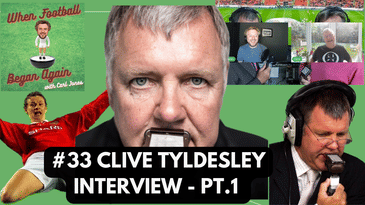

Host Carl Jones is joined by the voice of ITV football for almost two decades - a job in which he called some of the biggest moments in domestic, European and international football - the incomparable Clive Tyldesley.
From his beginnings as a journalist and later regional commentator for Granada Television in the 1980s to becoming the late, great Brian Moore's successor just in time for one of the most unforgettable final few minutes of the 1999 Champions League final and beyond, this first part is a whistle stop journey through Clive's early life and career.
There's tales of reporting on matches involving some of the greatest names in the history of the game, including Clough, Fergie and Bill Shankly. He gives his views on what makes good commentary and what doesn't, talks about his favourite broadcasters and reveals what it was like to be a commentator at the BBC during the height of Motty vs Davies in the commentary box.
I also ask Clive what goes through his head in the moments football history is happening before his very eyes, which includes a deep dive into those incredible moments back in 1999 and his commentary that will forever be indelibly linked to that unforgettable comeback.
We also reveal who you voted as the Premier League era's greatest ever Bulgarian player. It was a closer run thing than you'd imagine...
Make sure you hit subscribe to get part two next week where we cover his time at international tournaments, commentating on England's defeat to Iceland and being the voice of the FIFA franchise. All that and much more!
CONTAINS STRONG LANGUAGE
You can buy Clive's beautiful commentary charts here: https://www.commentarycharts.com/
Enjoyed the show? Please subscribe, leave us a 5* review and pass the pod to anyone who you think will enjoy it.
You can also find us on social media where we'll have Twitter polls, highlights from the show and nostalgic clips from yesteryear. You can now also buy me a coffee/beer! If you can afford to and want to make a small contribution to the running costs of the show, visit https://www.buymeacoffee.com/whenfootballbeganagain
Listen: https://podfollow.com/when-football-began-again
YouTube: @whenfootballbeganagainpod
Instagram: whenfootybeganagainpod
Facebook: @WhenFootyBeganAgainPod
Twitter: @WFBApod
TikTok: whenfootballbegan
Buy Me A Beer: https://www.buymeacoffee.com/whenfootballbeganagain
You can also get in touch via whenfootballbeganagain@gmail.com with your own memories - we'll share as many as we can in future episodes.
Hosted on Acast. See acast.com/privacy for more information.
[00:00:00] I'm pretty lucky that night, isn't I?
[00:00:02] And Solschar is one that breaks the card and all rule of commentary.
[00:00:07] I've waved the winner across the finishing line before the finishing line has arrived.
[00:00:12] By a minute go down the other end, equalise, it goes through extra time, penalties,
[00:00:17] they win the shootout because they're German and they will win the shootout
[00:00:20] and there is an effigy of me hanging from the Arndale centre before midnight.
[00:00:25] So yeah, you need a little bit of luck.
[00:00:27] Hello and welcome to When Football Began Again, the podcast that takes a nostalgic look
[00:00:33] at the Premier League era.
[00:00:35] Today's show is the penultimate episode in the series
[00:00:38] and the first in a two-part special of my chat with Clive Tildsley,
[00:00:44] the voice of ITV football for the best part of two decades.
[00:00:47] He's called some of the biggest moments this century
[00:00:51] in English football, European football and international football.
[00:00:56] He is an absolute legend of the game.
[00:00:59] I am so delighted to have him on and we're going to get to that interview in a moment.
[00:01:04] First off, if you are new to the show, you are welcome here.
[00:01:08] Thank you for finding us.
[00:01:09] I really hope you enjoyed today's show.
[00:01:11] There is a massive archive of lots of fantastic episodes
[00:01:14] and if you hang around at the end, I will summarise kind of what this show is about
[00:01:18] and point out some of the real highlights in there.
[00:01:21] But we're going to get straight on to Clive today.
[00:01:24] This interview came about because I sent an email by the pool back in August
[00:01:29] when I was in France.
[00:01:31] I emailed Clive Tildsley and got an email back fairly instantaneously.
[00:01:36] He'd watched a video of my stand-up online
[00:01:38] and was very generous about what he saw and said he'd love to have a chat with me.
[00:01:42] I just had the slight problem that I needed to get home
[00:01:45] a week later before scheduling this in.
[00:01:48] So this was recorded in early September.
[00:01:51] He's in preparation to commentate on the opening round of fixtures
[00:01:56] on the Champions League stage for CBS and Paramount
[00:02:00] and he is in great spirits I think.
[00:02:04] Obviously Clive has spoken quite publicly and quite openly
[00:02:09] about how disappointed he was to be let go by ITV
[00:02:13] as their main commentator a couple of years ago.
[00:02:16] Since then, he's been on talk sport.
[00:02:18] He's working with CBS and Paramount.
[00:02:20] He remains one of the most recognisable voices in football.
[00:02:24] I'm sure you'll agree.
[00:02:25] And I've listened to one or two of his interviews as well
[00:02:28] and he is a lot of fun in all of those.
[00:02:31] It's no different here.
[00:02:32] Normally when I interview a guest like this,
[00:02:34] especially someone of Clive's profile,
[00:02:36] I'm really, really respectful of their time
[00:02:38] and say, you know, we'll try and get the interview done in an hour or so.
[00:02:42] Clive was just so generous.
[00:02:44] He's like, don't worry about it.
[00:02:45] I've got a glass of wine.
[00:02:46] I've got as long as you need.
[00:02:48] Which is how the interview turned into two hours.
[00:02:51] I'm calling this part one slash glass one.
[00:02:55] Clive is enjoying a glass of red wine.
[00:02:57] If you're watching this on YouTube, if you are listening along,
[00:03:00] you can just melt into his voice.
[00:03:03] I think it is so recognisable and quite comforting.
[00:03:07] And there are periods of this interview
[00:03:09] where I am just sat just in awe of the great man himself
[00:03:14] telling his stories and telling his tales of an incredible career.
[00:03:17] So in this first part, we cover the early part of his career.
[00:03:21] Some of the legends of the game that he worked with.
[00:03:24] We cover how he came to be at ITV,
[00:03:27] his time at the BBC and really being third in line
[00:03:32] to John Motson and Barry Davis.
[00:03:34] He's got a lot of opinions on what commentary should be
[00:03:38] and maybe where it's going.
[00:03:40] He compares it a lot to stand-up comedy.
[00:03:42] He's a big stand-up comedy fan and we chat about that as well.
[00:03:45] It's a wide-ranging chat.
[00:03:47] He pretty much starts off as well by keeping me on my toes
[00:03:50] about the very concept of this podcast.
[00:03:53] So do keep an ear out for that.
[00:03:55] And also just to say that when I first contacted him about this,
[00:03:58] I wanted to do the deserted island matches format,
[00:04:01] which if you're familiar with the show,
[00:04:03] you will know that I've done that with quite a few big names now.
[00:04:06] Clive didn't want to do that and in retrospect,
[00:04:09] I'm really, really pleased he didn't.
[00:04:11] I think that our conversation wouldn't have been as long
[00:04:14] and it wouldn't have been as interesting quite frankly.
[00:04:16] Clive does not like picking favourites,
[00:04:18] as you'll discover over the two parts of this interview.
[00:04:22] There are a few times where I try and tempt it out of him,
[00:04:25] but we don't always get there.
[00:04:27] So that is another interesting little side plot
[00:04:29] that we explain away quite early on.
[00:04:31] But here it is, my chat with Clive Tildesley, part one.
[00:04:35] Enjoy.
[00:04:39] Hello and welcome to When Football Began Again,
[00:04:42] the podcast that takes a nostalgic look at the Premier League era.
[00:04:46] Joining me today is a man who is fast approaching his half-century
[00:04:50] of an incredible career in football.
[00:04:53] He has called some of the biggest moments at World Cup finals,
[00:04:57] European championships, moments of personal pride
[00:05:00] on various games across the years
[00:05:03] and perhaps most famously of all,
[00:05:06] across Champions Leagues for ITV,
[00:05:08] including two very memorable finals for Liverpool and Manchester United.
[00:05:12] All of that and more coming up very shortly,
[00:05:14] but welcome to the show, Clive Tildesley.
[00:05:16] Thank you for joining me. How are you?
[00:05:18] I can't straight away.
[00:05:20] Nostalgic about the Premier League era?
[00:05:22] How can you get nostalgic about something which has barely begun?
[00:05:26] I'm 137 years old, you know?
[00:05:30] Football didn't begin in 1992.
[00:05:34] It's one of the things that I hate about Premier League statistics, you know?
[00:05:39] So let's sort of disregard the existence of Jimmy Greaves
[00:05:44] and George Best and lots of other wonderful footballers.
[00:05:48] But certainly football changed in 1992
[00:05:52] because it coincides pretty much with the start of Champions League 2.
[00:05:57] It coincides exactly that summer
[00:06:00] with the advent of Sky Sports in our lives.
[00:06:03] So I can understand why 1992 onwards is a separate chapter,
[00:06:09] but I think it's still a little too clean and crisp
[00:06:13] and new to be getting nostalgic about, sorry.
[00:06:16] Yeah, no, I'm glad you brought that up
[00:06:18] and we are going to go back a little bit further in 1992 in a moment.
[00:06:21] But yeah, I think that's true
[00:06:23] and this podcast is a nod to that as an era
[00:06:26] where it did seem that people set the charts back to zero again
[00:06:30] when very clearly the Premier League would not be anything like a successful
[00:06:35] if it wasn't for that rich, rich history of English football.
[00:06:38] We definitely acknowledge that on the show as well.
[00:06:41] I mean, Clive, I don't want to start off too sycophantically,
[00:06:44] but when I first started this podcast,
[00:06:46] I wrote down a list of my dream guests.
[00:06:48] Your name was on it.
[00:06:49] I'm absolutely delighted to have you on the show.
[00:06:52] I was initially going to...
[00:06:53] The fee was really, really low then.
[00:06:55] I mean, we needed...
[00:06:57] The Saudis have arrived on the scene now
[00:07:00] and, Carl, you've got to be matching their kind of offers
[00:07:04] before I can even consider coming...
[00:07:07] Obviously this estate goes on for many miles.
[00:07:10] I have acres of acres.
[00:07:11] I have three golf courses, I think.
[00:07:13] So listen, 50,000 pounds is a lot of money
[00:07:17] and I thank you for it.
[00:07:19] We agree cash yet,
[00:07:21] but it really is a mates' right, that, if we're honest.
[00:07:24] It's on its way
[00:07:26] and in another 30 years' time
[00:07:28] when someone is launching a podcast
[00:07:30] about the first 30 years of the Saudi League,
[00:07:32] we'll know that the game has truly gone.
[00:07:34] But in the meantime...
[00:07:35] We're talking about the Saudi...
[00:07:39] The first 200 million pound transfer, remember that?
[00:07:42] Was it salad? Yeah, it was salad.
[00:07:44] It was the first 200.
[00:07:45] Wow, God.
[00:07:46] Seems like tennis now.
[00:07:48] But I was going to send you off to my deserted island.
[00:07:51] Now, in pre-production, you and I discussed this
[00:07:53] and you have an aversion to kind of picking favourite goals,
[00:07:56] favourite matches and things
[00:07:57] and you've got, I think, really solid reasons for that
[00:07:59] and I think that's a great place to start.
[00:08:01] What is it about picking your favourites
[00:08:03] that maybe doesn't quite chime with you
[00:08:05] and your love of football?
[00:08:07] Well, two things really.
[00:08:09] One, we are slaves to our audience
[00:08:12] or we should be, you know, as communicators
[00:08:15] never mind commentators.
[00:08:17] We're lucky this is the job that I always wanted to do.
[00:08:20] I guess, you know, roughly what you're doing
[00:08:22] stand up and this kind of thing
[00:08:24] would have been some kind of sort of childhood dream.
[00:08:27] Certainly this was for me.
[00:08:30] So part of the good fortune is to recognise
[00:08:33] that your job, and that's what it is now
[00:08:36] is to serve your audience.
[00:08:38] It is to connect with people
[00:08:40] and any kind of broadcast
[00:08:43] the first question should be,
[00:08:45] what does the audience want from you?
[00:08:47] What is your role in this?
[00:08:49] And so I become a small part of their memories
[00:08:53] of a football match,
[00:08:56] something that actually has to which
[00:08:59] they have a huge emotional attachment.
[00:09:01] I mean, if the political party or religion
[00:09:04] could mobilise the feelings of human beings
[00:09:08] in the way that football is able to do it
[00:09:10] would be a very, very dangerous entity.
[00:09:13] So I recognise that it's up to the audience
[00:09:16] to decide what's good, bad and indifferent
[00:09:19] about me or football.
[00:09:21] And secondly, I think football really belongs
[00:09:24] in its moment.
[00:09:25] I mean, I am now a veteran apparently
[00:09:29] of the industry.
[00:09:31] I did do my first television commentary in 1989
[00:09:34] and there are people already going,
[00:09:36] was there a 1989?
[00:09:38] Wow, was there something before 2000?
[00:09:40] Before the Premier League even, yeah.
[00:09:42] So I have been doing it for a long time
[00:09:44] and so I have commentated on a lot of matches,
[00:09:48] a lot of memorable matches,
[00:09:51] matches which would be memorable to people
[00:09:53] that you won't be aware of, Carl.
[00:09:56] And I think each of those matches
[00:09:58] has to be the most important game
[00:10:01] of that moment.
[00:10:03] For me as the professional,
[00:10:05] it really is take every game as it comes
[00:10:07] and give 110%.
[00:10:09] But once that matches over
[00:10:11] and therefore the commentary is over,
[00:10:13] it's kind of gone.
[00:10:15] It's not gone in so much that you can get nostalgic about it,
[00:10:19] you can get angry about it,
[00:10:21] you can get drunk over it.
[00:10:23] It's still there in the memory bank
[00:10:26] but the game actually moves on to the next,
[00:10:28] there's always a next game.
[00:10:30] And I say without starting to sound like
[00:10:34] some failed football manager,
[00:10:36] the next game is the most important
[00:10:38] and as a professional,
[00:10:40] as somebody who takes a living from this game,
[00:10:42] I really do believe that football belongs to this moment.
[00:10:45] So you can't compare best with
[00:10:48] Erling Haaland or whoever.
[00:10:50] One played then and the other plays now.
[00:10:54] You can't compare Allison with Erling Haaland.
[00:10:57] They play at different ends of the field
[00:10:59] and that's part of the joy and the wonder
[00:11:01] and the glory of football.
[00:11:03] We start all these debates, greatest players,
[00:11:05] your greatest ever top number 11.
[00:11:07] Well, a lot of those players probably played
[00:11:10] before you were born and you probably speak to
[00:11:12] somebody in your family who gave you a top number of hotspots
[00:11:15] who will put forward somebody who you will argue strongly against
[00:11:18] even though you never saw him play.
[00:11:21] But that is football.
[00:11:24] It's one of those very few things in our life.
[00:11:27] I think along with music,
[00:11:29] maybe tragedy is sadly,
[00:11:32] where were you?
[00:11:34] Where were you the night's first one in Amsterdam?
[00:11:37] Everybody kind of remembers where they were
[00:11:40] and as part of that memory, thankfully,
[00:11:43] is sometimes what the commentator said.
[00:11:46] Yeah, absolutely.
[00:11:48] Your commentary is definitely woven
[00:11:50] into some of those moments we'll come to a little bit later.
[00:11:52] Before we do that, let's go a little bit before 1992.
[00:11:55] Let's go back to your childhood
[00:11:58] as a Manchester United fan,
[00:12:00] your first match in 1959
[00:12:02] and your first match as a professional football
[00:12:06] industry professional in 1975.
[00:12:09] How long in between that timeline
[00:12:12] did you kind of discover that maybe football
[00:12:14] and maybe most specifically broadcasting
[00:12:17] was the career choice you really wanted to follow?
[00:12:20] I'm an only child and parents of only children
[00:12:23] are not particularly trustworthy historians.
[00:12:27] I mean, parents get so do-ey-eyed about their children
[00:12:31] at full stop and have you seen,
[00:12:33] would you like to see some photographs
[00:12:35] of my children when they were young?
[00:12:37] Surely you must.
[00:12:38] No, I don't really want to see about, but I will.
[00:12:40] So we kind of humor everybody
[00:12:43] and part of having to humor my mum in particular
[00:12:46] is her telling people that I used to chase
[00:12:48] a football around the back garden
[00:12:50] and commentate, well, yeah,
[00:12:52] of course every kid did.
[00:12:54] But the difference with this strange only child
[00:12:57] was he meant it.
[00:12:59] He knew that he wasn't going to be good enough
[00:13:01] to kick that football around, you know,
[00:13:04] a back garden in Salford or East Manchester
[00:13:08] with 50,000, 60,000 people watching on.
[00:13:11] But I very quickly became entranced
[00:13:15] by watching football on television,
[00:13:18] listening to football on the radio,
[00:13:20] some of it illicitly.
[00:13:22] I was a border at school and so I had to sort of break
[00:13:24] the rules in order to listen to games.
[00:13:27] My dad took me, my dad was the United Fan.
[00:13:29] I'm from Burry.
[00:13:30] When I was born we lived in a 70-touch house
[00:13:33] and our neighbours were Dave and Glendis Russell.
[00:13:36] Dave Russell was the manager of Burry at the time.
[00:13:38] We lived next tour to the football manager
[00:13:40] of our local team.
[00:13:42] My mum went to Giggle Lane before I was born
[00:13:44] when she was pregnant.
[00:13:45] I should have been a Burry fan
[00:13:47] but my dad was the United Fan
[00:13:49] and the United had best Lord Charlton
[00:13:52] and Burry had John McGrath, you know.
[00:13:55] They're actually a championship level team at that time.
[00:14:00] It's difficult to imagine really
[00:14:02] because I can't remember, even I can't remember Munich
[00:14:06] but I was around Merseyside at the time
[00:14:09] while I was at Heisel and around the time of Hillsborough
[00:14:12] and that went something like that happens.
[00:14:15] Football pulls on your heartstrings anyway
[00:14:17] but something so catastrophic and tragic
[00:14:21] of that nature happens.
[00:14:23] It does inevitably heighten the emotions
[00:14:25] and I think my dad was a fan of that Busby Babes team
[00:14:29] and so his connection and attachment to the club
[00:14:33] he was always going to take his only child to Old Trufford
[00:14:36] and as you say, 1959, four and a half, five years of age
[00:14:40] he was already taking me to Gaines.
[00:14:42] Yeah, and so coming out of university
[00:14:45] your career begins at Radio Trent.
[00:14:48] You are immediately covering a Nottingham Forest side
[00:14:51] who are just a few years away from becoming
[00:14:53] double European champions.
[00:14:55] After that you move to Radio City in Liverpool
[00:14:58] where you're covering Liverpool and Everton
[00:15:00] during their pomp in the 80s.
[00:15:02] I mean, I make that as Bill Shankley, Bob Paisley,
[00:15:05] Howard Kendall, Cluffy, all kind of
[00:15:07] either at their peak or approaching their peak.
[00:15:10] I know you've got a lot of last in friendships
[00:15:12] with a lot of the players
[00:15:13] who are the same ages at that time.
[00:15:15] How was it dealing with those kind of powerhouses
[00:15:17] and senior figures in the footballing world
[00:15:19] and did that really kind of test your metal
[00:15:22] as a young reporter?
[00:15:24] Absolutely, I mean again one of the reasons
[00:15:27] that football belongs in its moment is
[00:15:30] the football culture was different
[00:15:33] in the 70s to what it was in the 80s
[00:15:35] to what it was in the 90s.
[00:15:36] There has been a gradual evolution
[00:15:39] in so many areas to be a rookie reporter
[00:15:42] around initially Brian Clough was
[00:15:45] if you're like my first manager.
[00:15:47] I covered Nottingham Forest home and away
[00:15:49] they were a mid-table championship side
[00:15:51] when I started covering them
[00:15:54] but as you say they were the same players
[00:15:56] virtually the same team were three years away
[00:15:59] from becoming European champions
[00:16:01] which will never ever happen again, nothing like that.
[00:16:03] I mean, Lutentown is extraordinary today
[00:16:05] but Nottingham Forest from mid-table championship side
[00:16:08] to retaining effectively the Champions League
[00:16:11] is an incredible journey
[00:16:13] and of course it needed an incredible manager
[00:16:16] to make that happen.
[00:16:18] So being around him was a trial
[00:16:22] he was drinking, that's not an observation
[00:16:25] that's a fact, you know alcohol was the only match
[00:16:28] that he couldn't win and so he was unpredictable
[00:16:31] he was in a sense not a well man
[00:16:34] but again in the late 1970s
[00:16:36] a drink problem wasn't recognised
[00:16:38] as a condition of the kind that it is now
[00:16:41] I only had 18 months in Nottingham around that team
[00:16:43] but I did become very close to them
[00:16:45] as you say I was the same age as the players
[00:16:47] I travelled with them
[00:16:49] I travelled on the official team transport
[00:16:52] either coach or train
[00:16:54] I did on Merseyside
[00:16:56] I moved to Merseyside in 1977
[00:16:59] and Liverpool won the Champions League in 77
[00:17:02] they were the best club team in the world
[00:17:04] I travelled on the team bus
[00:17:06] you know I went
[00:17:08] if they were playing in London I went down on the Friday
[00:17:10] on the team bus
[00:17:12] stayed in the team hotel
[00:17:14] as did the commentary for Merseyside BBC
[00:17:16] I did the reporter for the Liverpool Echo
[00:17:18] and the Liverpool Daily Post
[00:17:20] that was the nature of
[00:17:22] the bond between
[00:17:24] particularly the local media
[00:17:26] and the football club
[00:17:28] and again we're talking about how football has changed
[00:17:31] and maybe the biggest single change
[00:17:33] in my time is the
[00:17:35] the way the football in this media
[00:17:37] have grown apart
[00:17:39] during the course of my career
[00:17:41] but yeah because it was so close
[00:17:43] if you stepped out of line
[00:17:45] or you did something which upset somebody
[00:17:48] in the camp
[00:17:50] I've had the two biggest relicings of my life
[00:17:52] from Charlotte Ferguson
[00:17:54] then it was very intimidating
[00:17:56] it was a bit scary both from the point of view
[00:17:58] of being shouted at
[00:18:00] which probably would not happen today
[00:18:02] and should not happen today
[00:18:04] I mean there was an element of bullying
[00:18:06] certainly verbal bullying
[00:18:08] going on but also from
[00:18:10] you know just from your professional
[00:18:12] survival retaining that
[00:18:14] trust and that strong
[00:18:16] and that special relationship which is so rare
[00:18:18] in modern media because
[00:18:20] the modern journalist and reporter
[00:18:22] accommodated doesn't get that close
[00:18:24] to the dressing room
[00:18:26] it was a bit of a juggling act but
[00:18:28] I look back on
[00:18:30] the most relationships
[00:18:32] of the close-ish relationships
[00:18:34] I had with Bill Shankly
[00:18:36] with Brian Clough
[00:18:38] with Charlotte Ferguson
[00:18:40] with Kenny Dugleish
[00:18:42] with Graham Sooners to this day
[00:18:44] with certainly the last two
[00:18:46] and I've learnt so much
[00:18:48] from being around those
[00:18:50] men that
[00:18:52] exclusively men probably in my time
[00:18:54] in my life I have covered women's football
[00:18:56] but not a lot
[00:18:58] of them are people
[00:19:00] and their achievements
[00:19:02] are extraordinary partly because
[00:19:04] they are each of them quite a unique
[00:19:06] personality
[00:19:08] and being around them
[00:19:10] having their trust and confidence
[00:19:12] having conversations with them
[00:19:14] rather than interviews
[00:19:16] there's the old biblical story about David
[00:19:18] at the feet of the elders
[00:19:20] and I think probably for the first
[00:19:22] 10-15 years of my career
[00:19:24] that's where I was really
[00:19:26] was anybody I could go back and spend some more time with
[00:19:28] now it would be Shankly
[00:19:30] I arrived on Merseyside in 77
[00:19:32] he stepped down
[00:19:34] or pushed or jumped
[00:19:36] whatever it was one of the great mysteries
[00:19:38] of Liverpool's history
[00:19:40] in 74 but he was around
[00:19:42] and fit and well
[00:19:44] he used to live next to Everton's training ground
[00:19:46] and actually go there most days
[00:19:48] for cup of tea and a bit of a walk
[00:19:50] and a bit of a trot and he did an awful lot
[00:19:52] of football forums and so on
[00:19:54] and he wanted to go and pick Bill up
[00:19:56] I just loved being in his company
[00:19:58] I couldn't get enough of him
[00:20:00] maybe one or two people
[00:20:02] in the media who had him in his prime
[00:20:04] as manager
[00:20:06] I kind of heard all the stories I hadn't
[00:20:08] I couldn't get enough
[00:20:10] of Bill Shankly's company
[00:20:12] and how lucky am I now
[00:20:14] to be able to say that
[00:20:16] and to be able to recount some of those
[00:20:18] wondrous tales
[00:20:20] of a man who was
[00:20:22] a kind of Presbyterian
[00:20:24] preacher
[00:20:26] if he'd been a politician
[00:20:28] he'd have won landslide majorities
[00:20:30] he just had you in the palm
[00:20:32] of his hand when he was talking
[00:20:34] You move to ITV in 1989
[00:20:36] comes about your first TV commentary
[00:20:38] is Manchester City 5
[00:20:40] Manchester United 1
[00:20:42] and I think you've spoken about before
[00:20:44] how you long shook off the shackles
[00:20:46] of Manchester United by that point
[00:20:48] you're very much in commentator mode
[00:20:50] that must feel like another huge leap
[00:20:52] in your career doing a TV commentary
[00:20:54] what do you remember about that day
[00:20:56] and obviously you've done
[00:20:58] quite a lot of radio commentary at that point as well
[00:21:00] so what are those principal differences
[00:21:02] of making that move from radio to TV commentary
[00:21:04] Well, you know that
[00:21:06] that was me sort of putting my flag
[00:21:08] at the top of the mountain really
[00:21:10] just doing a television commentary
[00:21:12] which recorded highlights and regional
[00:21:14] it was a Grenada had a
[00:21:16] their own highlights program
[00:21:18] City fans can still recite
[00:21:20] some of the words from the commentary of that day
[00:21:22] it was a surprise result obviously
[00:21:24] Ferguson and I were getting beaten 5-1
[00:21:26] it was a strange day
[00:21:28] so much that yeah, it was a dream come true
[00:21:30] quite literally
[00:21:32] and there was a bit of skirmish
[00:21:34] at the plat lane end and the referee
[00:21:36] took both teams off the field after about three minutes
[00:21:40] my commentary debut
[00:21:42] was going to come off 87 minutes
[00:21:44] sure but fortunately
[00:21:46] the great imagester Constabulary managed to restore peace
[00:21:48] and the two teams came back out
[00:21:50] and played a famous game
[00:21:52] I think, I mean to answer the second question
[00:21:54] which is probably the interesting one
[00:21:56] and I do speak quite a lot to
[00:21:58] either young
[00:22:00] budding commentators some
[00:22:02] fairly well established commentators have asked me to do some mentoring work
[00:22:04] and I speak quite a lot
[00:22:06] to media undergraduates
[00:22:08] the biggest single difference between radio and television commentary
[00:22:10] is you're just not as important in television
[00:22:12] and you've got to get your vein ahead around that
[00:22:14] straight away
[00:22:16] television is a visual medium
[00:22:18] and you are the backing track
[00:22:20] you know, you are the soundtrack to the movie
[00:22:22] and there have been some great
[00:22:24] movie soundtracks down the years
[00:22:26] but nobody goes to the cinema
[00:22:28] to hear the soundtrack
[00:22:30] you go to see the movie
[00:22:32] and the television commentary
[00:22:34] can only really spoil your enjoyment
[00:22:36] I don't think he or she can truly enhance
[00:22:38] your enjoyment of a television game
[00:22:40] whereas radio commentary
[00:22:42] can't really inspire your eyes
[00:22:44] I think probably
[00:22:46] some of the commentators that made the biggest impact on me
[00:22:48] initially were radio commentators
[00:22:50] because you know, some of the finest
[00:22:52] BBC Radio commentaries
[00:22:54] Brian Moore
[00:22:56] who was the late great Brian Moore
[00:22:58] who was my predecessor ITV
[00:23:00] a wonderful man and very kind to me
[00:23:02] was a very, very good BBC radio
[00:23:04] commentator
[00:23:06] in his day
[00:23:08] and I think it is really, really important
[00:23:10] television commentator to try to recognize it's not about you, mate. You know,
[00:23:15] it really is about the action and I think football, it doesn't need dramatizing, it is very dramatic.
[00:23:21] I mean there are really undramatic football matches of course there are and there's nothing
[00:23:26] worse than a commentator trying to convince you that this is really something very special
[00:23:30] whether you're watching when you can tell it's not. But if you're fortunate enough,
[00:23:35] I mean you know as a stand-up comedian, you can only ever be as good as your material and sometimes
[00:23:42] only as good as your audience because they provide you with some of your materials. So if I've got
[00:23:47] great material to work with as a football commentator at a high quality and dramatic game and that
[00:23:54] audience that's there provide me with an atmosphere to go with that then really if
[00:24:02] if I fuck up it hates you know it is the single biggest crime because I can only spoil it for the
[00:24:09] people at home who have turned on their television or logged into whatever screen they're watching it on
[00:24:18] and are trusting you to you know to walk them through this and not get in the way of their
[00:24:24] enjoyment. And so I think I think it is a very basic thing but it's something that
[00:24:30] I don't think you can tell a young broadcaster communicator enough broadcast to your audience
[00:24:36] that the and the bigger the game the more you need to do that. The clue is in the word broadcast
[00:24:44] it is this is not a narrow niche thing it's not about you it's it's it's about the action
[00:24:52] and just trying to amplify and embroider it and explain it from time to time provide the
[00:24:57] right words. I'm a huge believer that you know we work with the same vocabulary that George Orwell
[00:25:04] and Graham Greene worked with once upon a time we're not necessarily going to use the same adjectives
[00:25:09] and the same words some commentators do but most commentators for me are short of the right
[00:25:16] the right words that they actually parrot a lot of the same phrases that I parroted as an early
[00:25:23] commentator that the same cliches from the 70s and 80s are alive and well today
[00:25:29] which is a terrible indictment of by profession. You touched upon Brian Moore there as well being
[00:25:34] one of your mentors and I mean he of course was a broadcaster a commentator who had that
[00:25:43] incredible warmth that I think just touched an audience I certainly remember listening to
[00:25:48] Brian Moore's commentaries towards the end of his career and just just falling in love with
[00:25:52] his voice. What was he like to work with how important was he in terms of your your career at ITV?
[00:26:00] He I had a mentor I didn't choose him he chose me he was ITV's lead boxing commentator at the
[00:26:08] time Reg Guttridge he just saw something in me that he liked and he thought he could improve
[00:26:14] and I probably if if I know whatever I know about commentary maybe 90% of it came from Reg
[00:26:24] what I learned from Brian and in many respects when ITV brought me back that initial commentary
[00:26:31] that I did for Bernardo television back in 1989 I worked in regional TV for a while for them
[00:26:38] I worked on the Satan Grievesy show you know I was sort of lent out for network ITV usage
[00:26:44] but in 1992 the famous summer of 1992 ITV lost all the television rights they had
[00:26:53] I was actually doing some rugby league commentary at the time for ITV and we lost that too
[00:26:57] we I still talk about we even though they shafted me but in 1992 I managed to tunnel out
[00:27:04] during the European Championships to the BBC which really was a dream come true
[00:27:10] and I worked there for four years and they were very four very enlightening years but I
[00:27:14] they were also the years that Barry Davis and John Watson were in their pumps so
[00:27:20] you know I was I was only ever running for bronze in that particular race and
[00:27:24] and in 1996 after four years there ITV since that Brian was getting signals that he might
[00:27:32] soon retire and so they asked me to come back and understood in that they managed to acquire the
[00:27:38] Champions League rights at the time which is quite exciting for ITV and so they needed more than
[00:27:42] one commentator and some very very good and famous commentators including Martin Tyler
[00:27:49] Alan Parry one or two others have kind of been hanging around as number two and ITV waiting
[00:27:54] for Brian to retire and it eventually given up and I saw I arrived at a really good time
[00:28:00] because after the 98 World Cup finally did retire and so for those two years you know in a sense
[00:28:07] I always liked him I always always liked him but I was kind of a rival you know when we went to
[00:28:13] that last World Cup of his in France in 98 I thought I might get the ITV semi-final I was
[00:28:19] you know I felt that I was quite an experienced commentator by then by all means Brian would
[00:28:22] do the final and I was kind of disappointed when I didn't get the semi but it's only really
[00:28:28] with the passage of time and in many ways I didn't really know what a great man he was until I sat
[00:28:35] in a coal church in Kent at his funeral and it was only then that I knew that he was a great
[00:28:45] socialist he was a great Christian a great charity man that he had a background in Kent where he
[00:28:54] had got a scholarship to quite a well-known public school and had been treated as a bit of an outsider
[00:29:00] there's been victim of a lot of snobbery and bullying and this the shaping of this man
[00:29:08] that I kind of looked at from a bit of a distance I suppose there's a bit of a rival I was I never
[00:29:14] was a rival to him but I thought I was and realized actually the stature of the man
[00:29:20] that I thought that I could succeed and probably it was around about then that
[00:29:27] the full scale of trying to move into Brian Moore's shoes hit me because you mentioned the word warmth
[00:29:36] and I think it's the greatest single quality that a mass broadcaster can have I think
[00:29:43] ITV had been very very fortunate with some of their real A-list presenters you know Declan Donnelly
[00:29:51] and Dermot O'Leary Bradley Walsh all of whom you know main drop I know they seem like good guys
[00:30:00] from the distance through the screen they are good guys that you would love their company
[00:30:04] but you feel like you know them and you feel like you would like to have a client
[00:30:08] with those guys and you did with Brian Moore and if you can build up that kind of connection
[00:30:15] with an audience where they come to trust and actually like you and then I think you really
[00:30:22] are starting to make progress in this business and it takes time of course it does
[00:30:29] I'm probably one of my kind of big grumbles at the moment about moving people on when
[00:30:34] they reach a certain age is that in actual fact they're just starting to reach the pinnacle of
[00:30:40] their relationship with this mass audience many of whom by the way are their age you know we almost
[00:30:46] sort of forget that you know television viewers like your folks and whatever they count too you
[00:30:52] know and there's no good reason why somebody of my age cannot be contemporary in their thinking
[00:30:56] and and their approach and their attitudes and particularly in the way they view communication
[00:31:02] but until you've done the yards and and and done the number of games that Brian had done
[00:31:08] and built that relationship with the audience then you can't possibly earn their trust and
[00:31:15] their love in a way that somebody like Brian Moore did somebody like you know we lost Mottie
[00:31:22] this year that the very famous BBC television comment mainly TV BBC
[00:31:29] commentators each associated with their sports the Dan Mascals and the Murray Walkers and the
[00:31:35] Brian Johnston's and the Bill McLaren's you know that Peter O'Sullivan I mean people of my generation
[00:31:45] knew those people never met them but they knew them and they knew them in an intimate way
[00:31:52] that maybe that's a slightly dated thing now because people consume their media in a slightly
[00:31:57] different way than then actually all gathering like a family around the TV but huge sporting events
[00:32:03] still get multi generations around a television set to watch together and the commentator is still
[00:32:10] part of that story not as big a part as they used to be but they are still a part of that story
[00:32:16] and so that relationship which Brian had which I could never get anywhere near I thought that
[00:32:20] was good but I didn't realise what the secret of this is and the secret is to build that trust
[00:32:28] and friendship with people you'll never meet. Two men that you mentioned Barry Davis and John
[00:32:33] Mottson so obviously joined that spell at the BBC and famously they were two men who had
[00:32:38] massive mutual professional respect it was rumoured they may be kept their slight distance
[00:32:43] to quite different men. I think they can't stay I think they always kind of I mean they were
[00:32:48] rivals and I'm always amused by the idea of the football manager who says come in for a drink
[00:32:54] afterwards you know they shake hands on the touch line at 25 plus four and you'll come in for a
[00:33:00] drink afterwards. I'll be fucking big as five no I won't no I mean quite apart from the
[00:33:05] thing and you don't really want them to come in then anyway it is it's a competitive business
[00:33:10] but away from that if they meet at an LMA dinner or something then there is a communion
[00:33:16] then they're going to be hugging each other but not on the match day not in the days when
[00:33:20] they are professionally competing against each other and John and Barry were professionally
[00:33:25] competing and I think it became a big deal you know it became a matter of kind of national
[00:33:31] discussion as to which of them was the better and which of them would be selected to commentate
[00:33:37] on the Cup final. I was in the USA with the BBC team in 1994 the World Cup final when Barry
[00:33:43] got the final you know John was told in the final week that he was going home after the
[00:33:50] after the semi-final and that was that was a big deal that was the that was the lead story and
[00:33:55] whatever mail online or whatever not not who was playing in the final the fact that Barry had been
[00:34:00] chosen ahead of Motty it was that big I think now that there is so much live football out there
[00:34:08] I mean I've had not not many times but I've had times when I've been sat at home watching a game on
[00:34:15] TV and my wife's looked at Twitter and said you're getting terrible stick here
[00:34:22] it's not me I'm there I've never worked for that company which it may be a compliment
[00:34:28] a veiled compliment but it may not but it there is there are so many of us out there now
[00:34:33] and I think the reason for instance that Peter Drury is so popular at the moment and
[00:34:38] and I'm really really pleased for him because he's distinctive you know when you're listening to Peter
[00:34:44] um I mean I hope it doesn't sound bitchy but I'm afraid it's an observation
[00:34:49] I'm afraid a lot of you we don't know who it who it is and it doesn't really matter
[00:34:54] because you're not making that big an impact I know I'm not suggesting the commentator should go
[00:34:59] out of the way because it's not me as I said a little bit earlier it's not me me it's it is about
[00:35:05] serving the audience but you still got to come with a bit of your own personality but a bit of humor
[00:35:11] yeah you know a few words something to remember a big moment by it regs my mentor always said
[00:35:19] that the big goals deserve something better than great amazing fantastic wonderful I want to
[00:35:24] hear you come up with tomorrow morning's headline within 30 seconds of the goal being scored you
[00:35:30] know editorialize why why is that goal so special yeah and um well I listen I I don't want to sound
[00:35:39] like some old far who doesn't think anything is any good anymore I've never been happier in my
[00:35:43] life Carl I like 2023 I think there are things I don't like about it but the same's true of you
[00:35:50] um but I like a lot of what's you know happening in the world today and I'm fortunate you know
[00:35:57] sort of very happily married and kids are healthy and I've still got a career and lots and lots of
[00:36:02] memories and so on and so forth and and all these golf courses and stuff so I am a happy man
[00:36:08] but I care about communication and I care about commentary and I think it can be better than it is
[00:36:18] there are commentators who are getting regular work who I don't hear improving and I can only
[00:36:23] believe that he she they are not giving enough thought to how they might improve maybe not
[00:36:30] even listening back to themselves and being self critical then they certainly haven't got a
[00:36:34] red scotridge in their life I used to get a phone call from in the next morning that after a
[00:36:40] a match and it wasn't over in two minutes and it's love you know cruel to be kind
[00:36:46] and uh but that's how I learned that's how I got better hopefully yeah of course what better than
[00:36:52] to to learn from your peers those that have perhaps got that more experience but you must
[00:36:57] listen to other comics and 100% and be in awe of some and then there'll be comics who are
[00:37:07] really successful and privately quietly grumpily you're thinking I mean comedy I'm a huge supporter
[00:37:19] of comedy and the right of comedy to exist there are very few things that I would march on parliament
[00:37:25] in support of but but the freedom of comedy is really really important I think to to how we live
[00:37:34] because there's a line in my book that about the things that we wish we hadn't said I sometimes
[00:37:40] tell us more about ourselves than anything else and you know I think good comedy is edgy I like
[00:37:48] Daniel Sloss for instance but I can understand why it's a bit too much for some people and
[00:37:54] uncertain people just not finding funny at all it is uncomfortable humor and I don't need all
[00:38:01] my humor to be like that but I think the light and shade in comedy is really really important
[00:38:09] so that when something like Bad Sisters is as popular as it's been in the last year
[00:38:16] I mean it's wickedly dark and we are laughing at things that we really shouldn't be laughing at
[00:38:24] but the characters are so beautifully created and the dialogue is so well written and the
[00:38:30] acting is so strong that almost without realizing we're watching an absolute masterpiece you've got
[00:38:36] to be asking questions of your audience in order to be a little bit different from the next guy that's
[00:38:42] that's coming on at an open mic session and actually commentators have you can't just turn
[00:38:48] up and do it it there's more to it than that it's you're underselling the privilege and the
[00:38:55] opportunity that you've got and the material you're working with if you don't give some thought
[00:39:01] and some retrospective thought to how and how you performed and then listen to other people
[00:39:08] and ask yourself what can I learn from them and I say without trying to make a male online
[00:39:15] headline here that nothing's any good anymore there are some really really good young
[00:39:19] commentators out there and I make a point of letting them know when I think they are
[00:39:24] very good and they usually appreciate it but there's a lot that's just the same and it's just
[00:39:29] the same next time and it's the same next time and they do four or five games a week
[00:39:35] and it just makes it sound like you are working at a car park really yeah take the money
[00:39:47] Return to ITV as you mentioned as understudy initially to Brian Moore and then you become
[00:39:53] ITV's lead commentator what a first season it is as ITV's lead commentator as well you are calling
[00:40:00] the shots on Manchester United's famous treble ceiling Champions League win I mean we'll come to
[00:40:07] that unbelievable run in a moment that unbelievable final and what do you remember about that run
[00:40:13] and I suppose those big Champions League nights old Trafford and kind of how soon along that
[00:40:17] did you begin to feel that there's something different happening 25th anniversary and Manchester
[00:40:23] United and Bayern Munich were drawn in the group phase together in 1998-99 strange days obviously
[00:40:31] work quite a lot now with Gary Neville and Roy Keeneb both of them was strangest to me really
[00:40:37] when I was commentating on them it's interesting really having got to know them they were
[00:40:41] both a bit anti-media if the truth is told at the time if one of them was wheeled out for
[00:40:46] a post match interview you know not of somebody a bit nicer because it's still not available you know
[00:40:54] nice but I think well I know because I had conversations with them that in a even though
[00:41:01] we didn't we had no kind of personal friendship or relationship at all at the time there was
[00:41:08] a certain amount of mutual respect and the trust that I got from Charlie Ferguson which
[00:41:15] made that season very special and was partly handed over from the trust that the relationship
[00:41:21] that he had with Brian Moore my predecessor and I think he put in a good word for me I knew
[00:41:26] Stratix or one of Stratix's boys I worked with Jason at Grenada TV I'd actually been to stay at
[00:41:32] the the Don's house in Wormslow once when Jason had been directing a match and we'd
[00:41:37] gone back to the family home and Sir Alex came in as you do you know we're playing
[00:41:42] snooker and the highlights are all we're going to go on this no no no so I always knew that it was
[00:41:49] a professional relationship I always knew that one mistake would be one mistake too many
[00:41:55] but I would like to well I know because he said it he could see the thoroughness in my preparation
[00:42:02] he could see how seriously I took my job how much I wanted to get it right
[00:42:08] and so two things one he respected me as a fellow professional and two he would trust me with
[00:42:12] information because he appreciated that by giving me information A it would make my job a bit easier
[00:42:19] on the night because I would have a better understanding of what he was trying to do
[00:42:23] and because I had a better understanding of what he was trying to do B I would kind of
[00:42:27] not I would still call a ship pass a ship pass but I would have I maybe have a narrative
[00:42:34] that well I think what Phil is trying to do here is this because he told me before a clock
[00:42:39] and when he told me the team and by the way Bex I knew you were playing I knew you were on
[00:42:43] the bench before you did so that kind of trust was in a pretty special but I think it came
[00:42:52] from that well I know because other other managers have said it you know other guys that
[00:42:56] have become friends have said you know we we saw how you prepared we had the conversations with you
[00:43:03] which were always very very professional and we heard your commentaries and you know we felt that
[00:43:10] they were always understanding sympathetic which is different from being a kind of client
[00:43:18] you know there weren't client commentaries that hopefully there was still an objectivity there
[00:43:23] but they appreciated that too as long as it was coming from that stand so
[00:43:27] I was fortunate to build up those kind of relationships which have served me
[00:43:33] royally from right I know you are specifically about that season I don't want to talk about
[00:43:38] specific seasons I'm talking more about the nature of the job that that I had inherited
[00:43:44] from Brian Moore at a time when I could still build relationships with managers and players I
[00:43:53] had a snout in most dressing rooms yeah it might be the kit man it might be a player
[00:44:01] it might be the manager but you know most of the teams in the top division when
[00:44:08] ITV had the Premiership you know when the tactics struck and all that stuff
[00:44:13] which will never live down still call the Wii why not keep calling the Wii call anyway
[00:44:18] I could make a call on a Friday and usually get some insight in claim as to what was going
[00:44:28] to happen on the Saturday and I'm not saying that doesn't happen now because it does
[00:44:34] and I've had it you know I've had it quite recently with managers that I don't know but
[00:44:39] I've built up an understanding with them in the days leading up to the game
[00:44:44] they come to trust me and therefore you get that intel from them which as I say makes your job a
[00:44:52] bit easier and by having a better understanding of the narrative they've got in mind then you actually
[00:44:59] serve the viewer quite well because you're informed you're not guessing what the lineup's
[00:45:05] going to be sometimes the information is a little bit dangerous as I say you know you
[00:45:13] I mean there were occasions when Sralik had told me the team at lunchtime and I would get into
[00:45:20] the dressing room area at Old Trafford at five o'clock knowing that whatever Kino had a hamstring
[00:45:26] and wasn't going to play and some steward on the tunnel would check my badger sitting
[00:45:32] Kino's not playing his ear. No, no, from the old nose. I don't think I've told him
[00:45:40] and it is it is it is very much classified information I just say I've had these two
[00:45:46] I have these two massive roller kings which I think were part of the initiation
[00:45:50] you know if you can take those you can take anything you still there were both his mistake
[00:45:55] and I'm still waiting for an apology from Sralik Ferguson for the two roller kings but
[00:46:00] I I'm not sure they're coming now. Well, he might have gone past that.
[00:46:08] Well it sounds like that journalistic instinct as well of getting that information in all of
[00:46:14] those dressing rooms and so on but yeah I can imagine after you've been on the end of one
[00:46:18] tongue lashing from Alex Ferguson you are keen to avoid another and that kind of
[00:46:25] another actually. Well yeah that's true enough. But the paranoia of the security guard asking
[00:46:32] you. The BBC got one, I got two. There's a moment in that first season in the final
[00:46:39] that obviously those commentary moments that that live forever and as you mentioned a commentator
[00:46:46] being part of the soundtrack to a moment like that but obviously your words will will live
[00:46:50] forever I think 50 years or 100 years from now. Name on the trophy is showing them equalizers.
[00:46:56] Solskjaer has won it. Can Manchester United score they always score a course?
[00:47:02] Pretty lucky that night didn't I? Solskjaer has won it breaks the
[00:47:07] Cardinal rule of commentary. I've waved the winner across the the finishing line before
[00:47:12] the finishing line has arrived by a minute go down the other end equalize it goes to extra time
[00:47:17] penalties they win the shootout because they're German and they will win the shootout
[00:47:22] and there is an effigy of me hanging from the Anvils centre before midnight so yeah
[00:47:27] you need a little bit of luck. I've just started to put together a little
[00:47:33] YouTube series which coming soon folks just analyzing big commentary moments and the
[00:47:40] the most famous piece of commentary of all time is some people on the pitch they think it's
[00:47:45] all over it is now so the 1966 World Cup final Kenneth Wollstone home was the commentator
[00:47:52] and I'm going to be I'm going to make myself so unpopular with the entire world by pointing
[00:48:00] out that immediately before that incredibly vivid inspired piece of commentary and immediately
[00:48:06] after Kenneth was talking gobbledygook and the last thing that he says it's a great quiz
[00:48:14] question what's the last thing that Kenneth Wollstone says before Hurst now some people
[00:48:21] are thinking of the last thing he says is and it's just before the Rotorgerico moment
[00:48:33] and where the light shines down from heaven catches his reflection and he nails it like no
[00:48:39] commentator ever before or after nails it the same brain starts a sentence which he can't complete
[00:48:46] and I swear it that and I'm not absolutely certain we will investigate it in the the
[00:48:53] YouTube analysis that immediately after the goal he says Charlton for no particular reason
[00:49:02] what was to say he's not sure that it was in fact Jeff Hurst so he'll throw a little
[00:49:07] chart then there maybe for the edit just to move it along necessarily so there you are
[00:49:13] but even more interestingly he says it's nearly all over twice in the 45 seconds before he says
[00:49:23] what he says so he actually his mind is actually rehearsing the greatest commentary line of all time
[00:49:30] and weirdly Aguero which I also am going to do some analysis of which is a wonderful piece
[00:49:35] of commentary by Martin Tyler not for the aware all but what he says next which is I swear you'll
[00:49:42] never see anything like this ever again and which is a big fucking call really particularly from
[00:49:48] somebody who's done the number of games that he's done because as Rich used to say to me you're
[00:49:53] editorializing in that moment what is this we've just seen and Martin is telling us we will
[00:49:58] never see anything like this ever again and actually certainly to this day he's right I mean
[00:50:06] which makes that piece of commentary not only very dramatic but journalistically absolutely spot on
[00:50:13] and a wonderful kind of post script to you know a wonderful career that's come to an end this
[00:50:20] year but weirdly about 30 40 seconds before that after Giacomo equalize was it Giacomo score
[00:50:27] didn't he yeah it they have another attack and he says something to the effect of if they come
[00:50:35] because United's finished and I had a plane at Sutherland and that game's over so we now know
[00:50:40] that city have got to score again and they're not going to are they I mean they're going to be
[00:50:44] denied again by Manchester United like always happens and as they come forward he says something
[00:50:49] if they pull this off will it it'll be like nothing we've ever seen before and it's almost
[00:50:54] like that thought process I'm fascinated by things like that I mean the the technicalities of good comedy
[00:51:01] are really really boring aren't they I mean you know timing and the way you introduce themes and
[00:51:07] stories and stuff and actually good commentary preparation for it is really really dull but
[00:51:13] I am fascinated by the thought process that a commentator is going through on the verge of
[00:51:18] delivering something really really special which Martin did there and which Kenneth Wilson did
[00:51:23] all those years ago and you'll see this in the YouTube series both of them actually almost rehearse
[00:51:29] the great line they're about to deliver about 30 seconds before they deliver it
[00:51:35] I mean I've not answered your question because I don't really want to talk about
[00:51:37] the specifics of what I said I did get lucky I think there were apes I took to what happened
[00:51:43] there was one other goal in that game and I got it wrong you know I the bi-munic free kick
[00:51:49] was not deflected I said it was deflected every time I see Schmeichel I said you stood still
[00:51:55] I excused you in the commentary I said it was deflected it wasn't deflected you just stood still
[00:52:01] yeah yeah because and that's even then thrown thrown you in there in the commentary box I mean
[00:52:05] that you've just said something really interesting there as well in terms of the
[00:52:09] analysis of something that happens in a split second this YouTube series sounds absolutely
[00:52:13] fascinating and I'm interested in that comparison with comedy because I can come off stage and go
[00:52:18] I've had a decent one I've had a very good one that was very tricky so as a commentator are you
[00:52:24] absolutely very really happy need to see it back you know um but but what you're saying I saw a
[00:52:34] documentary about Peter Sellers I being there is one of my favorite movies of all time and Peter
[00:52:40] Sellers was just one of those gifted comedians who only needed to walk on stage and look at
[00:52:46] the audience and people would corpse you know please and that it is just extraordinary what
[00:52:52] certain people are able to do the aura that they bring with them the fact that we know
[00:52:56] Tommy Cooper we know you're going to make us laugh so we'll start laughing now yeah and um
[00:53:01] I saw a documentary about Sellers and Steve Coogan was talking about Sellers
[00:53:06] and Steve Coogan could have been talking about accountancy or um you know third
[00:53:11] thermonuclear dynamics the way the serious rather slightly dull and technical nature
[00:53:18] but he was analyzing the brilliance that was that was Sellers because he studied it and that's
[00:53:24] why Coogan you know that's why Coogan can make us laugh because he studied how you make people
[00:53:29] laugh and I study other commentators I if I'm trying to provide some advice for a co-commentator
[00:53:38] someone who just come out of the game or maybe just coming out of the game and want to know about
[00:53:44] broadcasting one of the first things I asked them to do is think of a sport which you like but don't
[00:53:52] know it may be whatever cricket or rugby or golf and think of who it is in television in that sport
[00:54:00] that connects with you about that sport it might be Martin Brundle it might be Lawrence
[00:54:05] to Laleo it might be Radar Riley whoever it is that manages to transcend the gap between what you
[00:54:14] know about that sport and what they know about the sport and is able to tell you in such a way
[00:54:19] that it's easy to digest and here I am now talking like Coogan about commentary about
[00:54:24] broadcasting but that is the essence of the job yeah find somebody that does that
[00:54:30] and then do that yourself because you've been down there in the across the white line in the middle
[00:54:35] where I will never go where Martin Tyler thinks he was a centre forward but he wasn't weak he played
[00:54:40] for Corinthians something Corinthians casuals anyway yeah but all of those guys you know Guy
[00:54:45] Moebury all the guys that that you know and love we've never been down there we've been to
[00:54:51] all the games we've done the World Cup finals but we've never been across the white line
[00:54:56] your job is to come back from across the white line and tell the rest of us how and why football
[00:55:02] matters in women loss yeah and you don't have to play at the very highest level to be able to do that
[00:55:09] Lucy Ward does that brilliantly um Lucy wasn't a great woman footballer let alone playing in whatever
[00:55:16] you know in front of 80 000 people in a World Cup final in the Mara Canal but she can do it
[00:55:22] because she's given some thought to it she's given some thought to the process what do I know about
[00:55:27] football which you don't you know plenty Lucy because you've been involved in football play the game
[00:55:32] to a decent level and how can I come back that and relate it to my uncle Eric Eric and my auntie
[00:55:40] Jesse that is the brilliance that's what Brundle does I can kind of take a leave F1
[00:55:48] but when Brundle talks F1 I'll listen you know because he's able to put it into terms that I can
[00:55:56] digest having never sat behind the wheel at 250 miles an hour with the stopping up my ass you know
[00:56:02] that but but we I don't know how many gifted footballers have met most of them no idea no
[00:56:10] idea how they did it don't know don't know don't even can't even start to tell you
[00:56:14] but and interestingly I think probably the best analysts tend to be players like Gary Neville and
[00:56:21] Jamie Carragher who played to a high level but weren't hugely gifted actually had to graft
[00:56:28] every yard that they they they won on a football field defenders maybe because they had to work
[00:56:36] it out for themselves on the field how they could match somebody who was supremely talented
[00:56:42] quicker brighter smarter more skillful than them how they could compete with them and if you can
[00:56:47] work that out you might just be able to tell you know Carl Jones and Clive Tillsley yeah yeah no
[00:56:55] that's that's a that's a fascinating breakdown of again also how the co-commentator and what the
[00:57:00] co-commentator brings and and you've had some wonderful colleagues and 2005 in the Champions
[00:57:06] League final again another extraordinary moment and without without I mean how aware are you
[00:57:11] are you in fighter pilot mode at that moment of how much are you running on instinct do you think
[00:57:16] and how much are you conscious of what is happening in those seconds as as obviously a huge huge
[00:57:21] call comes up a huge moment that that Martin Tyler Aguero moment when Solskjaer's putting that
[00:57:26] ball in the back of the net how what is going on in your brain can you even begin to analyze
[00:57:31] what is happening in the head of Clive Tillsley at that moment I think sometimes when I particularly
[00:57:40] have been in a rhythm of doing quite a few games I might have a kind of a loose five minutes and
[00:57:45] I'm sure you relate to this exactly the same do you know what I've just delivered those five
[00:57:49] minutes because they were the five minutes I delivered last night in Rotherham or wherever you
[00:57:52] work and it kind of worked then and here we go again it's not good enough is it that's
[00:57:58] not why you're on stage making people laugh because you're just reading from a script which
[00:58:04] has kind of appeared in your head and you know sometimes I consciously open my eyes wider
[00:58:11] and it's it's almost like a concentrate come on come on come back you can be better than this
[00:58:16] watch the game more closely do you know one of the biggest failings of comment again I'm
[00:58:22] suddenly like a right old critic here they don't watch the game what's the game
[00:58:28] I mean it's great to have I know you know I've got loads of information and I use facts
[00:58:32] and figures of course I do but they've got to they've got to illustrate so they've got to be
[00:58:38] relevant you know sometimes you know some above brethren that there should be a crawler going
[00:58:43] across the bottom of the screen I've fucking well done this recess I'm not gonna hear it
[00:58:48] it's watch the game watch the game particularly after a goal watch how it affects the game
[00:58:54] watch it's hugely emotional game football some of the most and I've spoken to
[00:59:00] footballers about this that those minutes when you were one in luck and suddenly you're two one down
[00:59:05] and suddenly you can't run anymore you can't think we've all been in that situation in whatever
[00:59:10] little sport that we play in our lives you know you might be a golfer and you sit around he
[00:59:16] hadn't given the thought kick your head stiller and suddenly you know you hit two shanks in a row
[00:59:21] and you're standing over the ball thinking what what am I going to do next maybe I'll try
[00:59:25] left-handed or something you know something different because suddenly your confidence has
[00:59:30] gone from there to there it happens to the best and so that you know that kind of
[00:59:38] chemical thing that's happening to these people in in a game that's part of your analysis watch it
[00:59:44] you know because that's the wonder of football the momentum swings you know this this c-word
[00:59:50] confidence what the hell is it you know where's like a pressure what is pressure ask yourself you
[00:59:55] know when you're when you are driving to the match and you're driving to the gig ask yourself
[01:00:01] those kind of questions if I'm going to use the word pressure tonight what does it mean
[01:00:05] shall I try and define it a bit better that's how you can improve your work so at the big moments
[01:00:12] hopefully your concentration is so high and so intense that and you've got the guts to
[01:00:20] just wait a moment don't think out loud I mean how many commentators do you hear that yeah it's just
[01:00:27] like a stream of consciousness you know here's the next thought in my head and save it just be
[01:00:33] silent for 15 seconds and then tell us your conclusion you know because we don't really
[01:00:37] need to know you how you've arrived at it just tell us your conclusion and you know the two goals
[01:00:44] that you alluded to in Barcelona at the end of the 1999 Champions League final which is probably
[01:00:51] the most important match of my career what's the very best thing name on the trophy no I'm so sure
[01:00:58] I was wondering it's there's about eight seconds of silence between the goal going in and the
[01:01:03] next thing I say name on the trophy and that again I keep going back to Reg Gautry's you're not
[01:01:11] resting you're thinking that is thinking time think carefully clearly what are you going to say next
[01:01:18] what does this moment deserve we're back to Kugan analyzing sellers aren't we but I mean I think if
[01:01:25] anybody actually cares about communication I think this stuff is interesting and it should be
[01:01:33] interesting certainly to fellow professionals whether you stand up or whether you are I don't
[01:01:39] know maybe just doing presentations in a corporate world or something like that that the whole
[01:01:47] I hear the studio hand to a commentator and the teams come out past the trophy well here they come
[01:01:53] I mean really I mean you've had three days to think what we're going to say when the teams come
[01:01:59] out so here come the teams oh right there they oh yeah you're right the people with the shorts
[01:02:05] yeah there's there the teams well said fantastic I mean even at the start of the second half
[01:02:12] you've had 15 minutes yeah i've got a tea i've a kick cat
[01:02:17] think how are you going to start the next half listen to the studio think how you're going
[01:02:21] to when they hand back to you and the teams are back with us are they really oh my that's
[01:02:27] why we've got back out of that studio so yeah I you know once upon a time I had this is terrible
[01:02:36] really it's all me me me I know but I had an ambition to be a football commentator once upon
[01:02:41] time I asked my mum who's still going strong in 94 by the way so you might have to put up with a
[01:02:46] bit more immediate come because dad made it to 98 and she's 94 so sorry folks I'm hanging around
[01:02:52] the red wine's nearly gone but I've been in it I'm I'm intending to carry on for a bit long
[01:02:58] but I really really wanted to be a commentator and if at some stage in my late teens university
[01:03:05] time maybe even early radio career a shadowy figure sorry I'm not really just I don't believe
[01:03:11] in God but something godlike had appeared and said bad news well good and bad news like
[01:03:17] you're going to be an accountant you're going to be really successful in accounting you've
[01:03:21] got an industrial economics degree it's what your dad always wanted really um but you're not
[01:03:25] going to be a commentator oh okay but there's going to be a reality show and you're going to be in it
[01:03:32] and for 30 seconds in this reality show you are going to be a network television
[01:03:37] commentator to 27 million people you will get 30 seconds of your life as a television commentator
[01:03:44] I try to make every 30 seconds that I do those 30 seconds I fail fucking miserably because I do get
[01:03:54] into a rhythm and I lose that intense concentration that you need to really perform at your best
[01:04:01] you know I do get um like a basical and a little bit functional from time to time because it's my
[01:04:08] job but that doesn't mean I shouldn't strive to make those 30 seconds as precious as 30 seconds
[01:04:15] that I would have had in that imaginary because they are precious to somebody listening or watching
[01:04:21] try your best but try all the time against it we are so lucky to do this job and you're so lucky
[01:04:27] to get the chance to walk out onto a stage within opportunity a scary opportunity and my job
[01:04:33] scary now in the you know the Elon Musk age there's a huge amount of jeopardy involved with
[01:04:38] actually trying to make the job sound a little bit differently and trying to entertain and maybe
[01:04:44] introduce some humor and some comment from time to time yeah I could get cancelled any day now
[01:04:50] and so could you but that doesn't that shouldn't stop us that shouldn't stop us trying to make
[01:04:55] the next 30 seconds of commentary really really good and I say I'm such a bitch but I hear so many
[01:05:05] people will just not try it they know you're not trying you got the job you got the gig
[01:05:10] you know you don't put any value on it you don't put any value on the words or the thought processes
[01:05:16] or the rhythm or the timing it's all important of course it's important um and that's yeah that's
[01:05:23] if anybody ever happens to ask me for the to mentor them I say yes I'll do it and thank you for asking
[01:05:29] you but you're not going to like a lot of it clearly that passion that gets you to the fantastic
[01:05:36] career that you continue to have so that was part one of my chat with Clive Tildesley what a guy
[01:05:44] what an absolute gentleman so much fun talking to him next week's show we cover just about
[01:05:51] get out of his favorite World Cup or favorite World Cup experience even though as you've discovered
[01:05:56] he is averse to sharing favorites of anything England versus Iceland what that was like
[01:06:00] commentating on especially given it was the final game in charge for his great friend
[01:06:05] Roy Hodgson being the voice of FIFA and one or two unusual circumstances that that has
[01:06:12] cropped up over the years as well that is all coming on next week's show so especially if
[01:06:16] you're new here but even if you're not please hit subscribe share it with someone else who
[01:06:21] might enjoy this chat and get them to subscribe as well I really appreciate the numbers are going up
[01:06:26] week on week on week and if you're watching on YouTube finders where you get your podcasts
[01:06:30] and vice versa if you're listening go and find us on the YouTube channel on when football
[01:06:35] began again I would really really appreciate your support there so on last week's show
[01:06:40] 1997-98 our season review we also covered who the Premier League's greatest ever Bulgarian was
[01:06:46] my two guests Andy and Jamie were pretty adamant it was Dimitar Berbetoff the public vote was a
[01:06:52] little closer and indeed Martin Petrov perhaps poied by quite a strong bolt and wanderers following
[01:06:59] online got 34 percent of the votes out of the four players but it was indeed with 36 percent of the
[01:07:05] votes Dimitar Berbetoff your greatest ever Premier League Bulgarian my commiserations to
[01:07:11] still Ian Petrov and Radis Dam Kishichev who didn't quite make the cut so Dimitar Berbetoff goes into
[01:07:18] the Premier League of Nations Hall of Fame I mentioned at the top of the show if you are new here
[01:07:24] thank you for finding us I hope you'll stick around certainly at least till next week when
[01:07:28] my second part with Clive is coming up and I've got a little teaser for that at the end
[01:07:34] of this episode as well but if you haven't discovered what the show you don't know
[01:07:39] what the show is all about we cover the best bits of the Premier League era it's been a controversial
[01:07:44] time there's no doubt about it and especially this week of all weeks and the points deduction on Everton
[01:07:49] the Premier League is as controversial as ever we cover an awful lot more than football post 1992
[01:07:56] there's plenty in the lower leagues and pre-1992 as well but we have season long reviews we have
[01:08:01] interviews with some of the big names who played in the Premier League Ashley Ward Mark Draper
[01:08:06] Danny Wilson as well as interviews with famous faces and names Josh Pugh the comedian Ian McMillan
[01:08:12] the poet and we've also had a count of the Premier League table the all-time Premier League table so
[01:08:18] Barnsley Blackpool Huddersfield Swindon Town Cardiff City all been covered on this show
[01:08:24] in some depth and detail there is so much for you to go and find if you are new to the
[01:08:29] show please do hit subscribe go and have a look and I would love to have you on board ongoing
[01:08:36] as I mentioned at the start of the show this is the penultimate episode of season two next week
[01:08:40] with Clive Tilsey will be the last in the series we will then be resting until the early spring
[01:08:46] I already have some incredible guests and interviews lined up and indeed in the bag
[01:08:52] Jim White of the Telegraph will be on the show talking about his love of Manchester United
[01:08:58] and the books that he's written including about the history of the Premier League
[01:09:03] Jules Warren one of the most familiar faces on Sky Sports he will also be on the show I've recorded
[01:09:09] that too and there is a continuation of the count up of the all-time Premier League tables
[01:09:14] we're going to start with Reading Nex but Sheffield United Brentford these are all teams
[01:09:19] that are in my sights as well and as ever some of the top up and come in and indeed
[01:09:25] rising stars of the stand-up circuit Josh Pugh who was on live at the Apollo
[01:09:29] just earlier this week is also on the show in the back catalog so do go and find that but
[01:09:35] in the meantime all that's left to say is thank you for watching and thank you for listening
[01:09:39] today thank you for supporting the show thank you for the kind comments subscriptions and shares
[01:09:44] I really appreciate it if you've bought me a coffee or buy me a coffee dot com thank you for
[01:09:48] that it's a little bit like leaving a tip for the show all the links that you need to share
[01:09:53] the show are in the description I will see you back here again next week for the last in the series
[01:09:59] and part two slash glass two with Clive Tildesley I'll see you then we are being driven out in
[01:10:06] the desert by this Bedouin guy he's got two young children I would say about 10 and 12 and so
[01:10:11] we're rattling through the desert and it's pretty loud we're shouting at each other a little
[01:10:15] bit just to be heard suddenly the kids are shouting in the back and he turns to me and
[01:10:20] he says in Jordan in the middle of a desert they say you sound like the man from FIFA
[01:10:28] so I turn around to the kids and go it's a very good afternoon from Clarkson they go
[01:10:32] wow the man from FIFA I said I am the man from FIFA