


Alan Francis, as a comedian and actor has performed on the most prestigious stages in the UK, as well as appearances on TV, film and radio. Plus he's also written for stage, screen and radio including his own show on BBC Radio 4. He talks about the differences in doing all three disciplines.
Watch interviews on our YouTube channel. Support our show! Contributions can be made to Steve Gribbin's Ko-fi account or Paul Ricketts JokePit account. You can also email us.
You can watch full interviews with UK comedians on our YouTube channel: https://www.youtube.com/@UshouldvebeenHerelastweek
Give £5, £10 or £20 now and help CALM in their fight against suicide: https://www.justgiving.com/page/podomedy-stay-tuned
Hosted on Acast. See acast.com/privacy for more information.
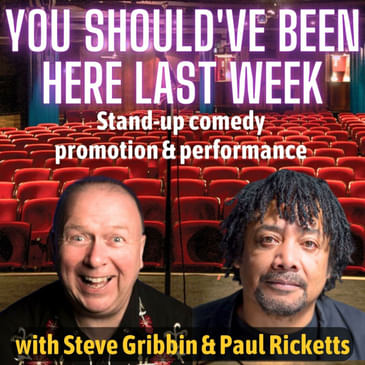
[00:00:32] Welcome to the latest edition of the podcast, You Should Have Been Here Last Week, presented by me, Steve Gribbin and my fellow comedian, Paul Ricketts.
[00:00:41] Hello.
[00:00:42] This is the podcast that peers behind the glittery comedy curtain of the comedy industry and gives us a glimpse of the shenanigans, the controversies and the hot button topics that have set the comedy world alight.
[00:00:54] And today's guest, we're very happy to welcome the stand-up comedian, actor, writer, voiceover artist and bon vivant, the marvellous Mr Alan Francis. Welcome Alan.
[00:01:05] Good afternoon to you gentlemen. Good afternoon Alan.
[00:01:09] I mean, I want to add to that, of course, that you're also a hearts fan.
[00:01:13] Oh yes.
[00:01:14] A chess fan, not the musical, but the actual game.
[00:01:18] Yeah.
[00:01:20] You know, the musical, I give it a whirl, the musical.
[00:01:24] Basically, what got you into stand-up comedy in the first place, Alan? How did you start?
[00:01:29] Well, I studied to be an actor, you know, in Manchester, at the, what was then called the Manchester Poly.
[00:01:36] I was doing a drama course there and it was all a good laugh. I was in the same year as Coogan.
[00:01:46] Steve Coogan, that is. Just in case you were thinking of someone else.
[00:01:51] Dave Coogan.
[00:01:52] Dave Coogan, yeah.
[00:01:53] He now runs the bakery.
[00:01:56] Yeah.
[00:01:57] All right, Dave.
[00:01:58] Yeah.
[00:01:59] I see my fucking landscape.
[00:02:02] Yeah, that landscape of mine is doing well.
[00:02:04] Here's your bread.
[00:02:05] Aha.
[00:02:05] Yeah, yeah.
[00:02:06] Here's your bread.
[00:02:07] Yeah.
[00:02:08] Knowing me, knowing you will tie the logs.
[00:02:13] No.
[00:02:14] Yeah, he, yeah.
[00:02:16] And so, I was lucky enough to get work as an actor fairly straight away when I left college.
[00:02:23] Yeah, I went down to Wales and did a tour of the West Country in Wales and a play, not
[00:02:30] very good play, but it was a good laugh.
[00:02:33] That's not been the way with actors, isn't it?
[00:02:34] You know, you're in some terrible production of something absolutely awful, but it's always
[00:02:38] a good laugh.
[00:02:40] Yeah.
[00:02:40] And then when I moved to London in 89, I sort of just sort of got into stand-up.
[00:02:49] It was really, I met Sean Hughes and he was just used to drink in a pub, a local pub
[00:02:58] in North London.
[00:03:00] And I met him before.
[00:03:01] I didn't know he was a comedian.
[00:03:03] He said he was a comedian.
[00:03:04] I was all right.
[00:03:04] And he gave me, and it was a girl I was seeing at the time, free tickets to go and see his show
[00:03:10] at the Red Rose Club.
[00:03:12] Oh, wow.
[00:03:13] Yeah.
[00:03:14] And so I saw him there and he was brilliant.
[00:03:18] And I can't remember who else was on the bill, but I just, I remember thinking, yeah, I should try this.
[00:03:23] You know, I obviously wasn't, I wasn't in the same league as Sean.
[00:03:28] I mean, he was absolutely fantastic, but I thought some of the other people on the bill, I thought I could be like that.
[00:03:36] I could get on a bill with Sean, I couldn't follow him, but I could maybe go on before him.
[00:03:42] Hmm.
[00:03:43] I thought.
[00:03:44] It's quite unusual for, for actors to go into stand-up, isn't it?
[00:03:49] It is.
[00:03:50] It is because actors always make that mistake of sort of learning their jokes as a script.
[00:03:57] I mean, you must have seen that, you know, when a, some drama student comes down to do a new material night or something,
[00:04:03] and they sort of, they have this sort of script that they've learned.
[00:04:08] And it's awful.
[00:04:09] Because, I mean, the thing about stand-ups is you're in the room.
[00:04:12] That is the biggest difference between an actor and a comedian.
[00:04:15] An actor is in the play.
[00:04:17] You know, that the, you know, if you don't sort of, if you're doing sort of like a Tennessee Williams play or something,
[00:04:24] and there's some people come in late, you don't go, where have you been, mate?
[00:04:27] You know, we started Tennessee, you don't do that when you're doing Tennessee Williams.
[00:04:34] You stay in the play.
[00:04:36] Whereas the comedian does, is allowed to say, where have you been, mate?
[00:04:40] Yeah, this is very true.
[00:04:43] Do you know, by the way, it used to be terrible, Malcolm Hardy used to have a terrible thing at the tunnel.
[00:04:47] He used to say, oh, next actor, actor.
[00:04:51] And that was it.
[00:04:52] They were dead.
[00:04:53] Yeah, that was it, actor.
[00:04:57] I don't think, fuck off.
[00:04:59] I never told, I don't know, a sort of volley of ice cubes.
[00:05:04] Malcolm's club was great up the creek.
[00:05:06] And, but he would do that.
[00:05:07] He would often with, especially with open mics, he would always set them up.
[00:05:12] I'll just be talking to this guy at the bar and he seems confident.
[00:05:16] I don't know why.
[00:05:19] I don't know why he's confident because he looks a bit shit to me.
[00:05:22] Here he is, you know.
[00:05:24] And it's like.
[00:05:28] Oh God.
[00:05:29] It was like Daniel in the lion's den.
[00:05:31] It was.
[00:05:32] Except Daniel who didn't, who wasn't able to take the thorn out of the paw.
[00:05:37] You know, it's like, imagine if Daniel wasn't able to do that.
[00:05:41] He would have just been eaten.
[00:05:43] Yeah.
[00:05:43] So did you do a course or did you just sort of throw yourself into it?
[00:05:47] I threw myself into it.
[00:05:48] I didn't do a course.
[00:05:49] There were courses in those days.
[00:05:51] There weren't many.
[00:05:52] There was one at Jackson's Lane.
[00:05:54] I sort of looked at that, you know, and there was an advert for it somewhere, which I looked at.
[00:06:00] But I didn't do it.
[00:06:02] Mainly because of meanness with money, I think.
[00:06:05] You know, I just thought, I'm not going to fuck.
[00:06:07] You know, I'd rather just go on and die on my ass, which I did do many times.
[00:06:14] And, well, one, actually I got some, the very first gig I ever did in London.
[00:06:19] I'd done a bit in Manchester.
[00:06:21] I'd sort of compared the student union bar there a couple of times and brought on some strange act like Coogan as well.
[00:06:30] John Thompson, who was sort of starting out.
[00:06:34] There was a guy called, you might remember a guy called Attila the Stockbroker.
[00:06:39] Yes, I do.
[00:06:41] Still know him.
[00:06:42] Yeah, he used to do gigs in Manchester at that time.
[00:06:46] Henry Normal doing his poems and stuff like that.
[00:06:49] And there was a student union bar, which I did a bit of MC, but I felt the pressure wasn't on me because I was very much kind of like, these guys are funny.
[00:06:57] I don't have to be funny.
[00:06:58] It was only when I came to London and started to try and do, you know, sets, open spots and stuff that I sort of thought got a bit more nervous about it and thought, fuck, you've actually got to.
[00:07:10] You can't just sort of introduce an act and get away with that.
[00:07:16] And one of the first ones I ever did, there was a guy called Jimbo on, who you must know.
[00:07:20] Yes, yes.
[00:07:22] We have talked about it.
[00:07:23] We have talked about it.
[00:07:24] We must have talked about it.
[00:07:26] Jimbo Beaumont.
[00:07:27] Yeah.
[00:07:27] Jimbo Beaumont.
[00:07:29] You know he's 81 now, Jimbo?
[00:07:31] Yeah, yeah.
[00:07:32] I did a gig with him not that long ago.
[00:07:35] I was doing some new material.
[00:07:37] Jimbo was there.
[00:07:38] It was so lovely to see him.
[00:07:39] I feel so affectionate towards Jimbo now.
[00:07:42] I mean, I didn't so much then.
[00:07:49] It was so lovely to see him because he just taught, he never says the same thing twice, Jimbo.
[00:07:56] He comes on and rambles a load of incoherent nonsense that's not really funny.
[00:08:02] But all the comedians at the back are all pissing themselves laughing.
[00:08:05] They're all laughing.
[00:08:07] And I found myself doing the same again.
[00:08:09] And the woman, there was a woman who was comparing and she lit Jimbo.
[00:08:14] This is just the other way.
[00:08:15] He lit him.
[00:08:16] And I was so disappointed.
[00:08:18] I was like, no, let him carry on, even though the audience were absolutely delighted that he was removed.
[00:08:25] But I was at the back going, oh, let's have more Jimbo.
[00:08:29] But one of the first open mics I did in London was at the Case Head in Crouch End.
[00:08:33] And Jimbo was, I followed Jimbo, which I have to say made it a bit easier.
[00:08:43] Because, you know, I was very nervous about it.
[00:08:45] And then Jimbo went on and I thought, well, whoever follows this is, you know.
[00:08:50] Yeah.
[00:08:51] Oh, God.
[00:08:52] Anyway, Rupert Murdoch could follow Jimbo.
[00:08:58] That would be a good act by Rupert Murdoch.
[00:09:00] Take my wife.
[00:09:01] Yeah, yeah, yeah, exactly.
[00:09:04] So, I mean, you did actually win.
[00:09:06] So you think you're funny, didn't you?
[00:09:08] Yeah.
[00:09:08] Yeah, I did.
[00:09:10] And in those days, because there were fewer stand ups about, you got, if you weren't, it wasn't so much if you were good.
[00:09:16] It's just if you weren't shit, you could get gigs.
[00:09:20] And you would do open spots.
[00:09:22] And a lot of people would say, yeah, that wasn't shit.
[00:09:26] Can you do 20?
[00:09:28] And you would say yes, even though you couldn't.
[00:09:31] And they'd give you a gig and you would do gigs.
[00:09:35] So, so actually between the September of 1990 and by the time Christmas came that year, I was gigging quite a lot and getting better.
[00:09:44] And so the following year, 91, I then sort of was getting fairly competent at it.
[00:09:51] And I went up to Edinburgh just to do open spots really, just to do some gigs because my old man still lived up there.
[00:09:57] So I could stay up there for free.
[00:09:59] Somebody told me about the so you think you're funny and it was Karen Corrin running it.
[00:10:03] And I just went along to the Gilded Bloom where the, it was the counting house, do you know, next to the pear tree.
[00:10:10] Yeah.
[00:10:11] That's where the heat was.
[00:10:14] And it was me and an American comedian called Harmon Leon, who I don't know if you remember him.
[00:10:22] Just juice.
[00:10:23] You remember that he used to go, just juice.
[00:10:27] What?
[00:10:27] No walnuts?
[00:10:29] Just juice?
[00:10:31] What a catchphrase.
[00:10:32] No blueberries?
[00:10:34] What?
[00:10:34] No, just juice?
[00:10:36] That's it?
[00:10:37] And, you know, there was a product at the time called Just Juice.
[00:10:41] Yeah, I was going to say that.
[00:10:43] There you go.
[00:10:45] Who else was on your heat?
[00:10:47] Sorry, who was in the final?
[00:10:48] In my field there was him, Harmon Leon, that was me.
[00:10:51] There was a mainstream Scottish guy, I can't remember his name.
[00:10:54] He was called something like George Cammie.
[00:11:00] Ed Byrne ran a gig at the 13th Note in Glasgow, which I'd done.
[00:11:05] And that's where I first saw George Cammie.
[00:11:07] And George Cammie, he was a mainstream Scottish comedian who would sort of go on and say, I tell you what, you know, my mother-in-law's an eight-fat fucking bitch, you know, and all this.
[00:11:19] And all these students would be sort of looking at him.
[00:11:26] And then he said, oh, I know with you young people it's all politics, isn't it?
[00:11:30] And he goes, ah, it's all politics, that's what you want.
[00:11:33] Anyway, John Major, what a fucking cunt.
[00:11:38] That was his joke.
[00:11:41] And so he was on, and I think I was lucky enough to follow him and my heat at the Clowning House.
[00:11:48] You know, I got on after George Cammie, and he was wearing a suit with kind of sequins in it.
[00:11:55] You know, like real showbiz kind of suit.
[00:11:59] And he sort of came on stage and the audience kind of laughed in a kind of slightly cynical way.
[00:12:05] And he just, he got the mic and went, was that for me or the suit?
[00:12:09] You know.
[00:12:10] It was downhill for me, that was his biggest laugh.
[00:12:13] Yeah.
[00:12:15] So, me and Harmon Leon, that was all you had to do then.
[00:12:19] We turned up and we put our name down.
[00:12:22] The judges were, I remember the judges were, well, Karen was a judge.
[00:12:29] And Kevin Day was one of the judges.
[00:12:32] And Kevin Day was very complimentary to me.
[00:12:34] He said, I really liked your stuff.
[00:12:35] I thought you were really good.
[00:12:36] And so I won the heat.
[00:12:39] And Harmon Leon was second.
[00:12:42] So me and Harmon progressed to, I think there was another heat that we had to do.
[00:12:48] And then I got into the final after the other heat.
[00:12:52] So, and the final, Arthur Smith headlining, that was quite nerve wracking.
[00:12:57] It was Dominic Holland was in my final.
[00:13:00] Martin Davis.
[00:13:01] Yeah.
[00:13:03] No, Dominic, he was just, he was just so sort of, I'm not sure.
[00:13:07] I'm not sure what to, not sure what to do.
[00:13:11] Do I do the same as the heat?
[00:13:12] Yes.
[00:13:13] Do I do the same as the heat or do you stuff?
[00:13:15] What do you think?
[00:13:15] What's your advice?
[00:13:18] Just do what you think is funny.
[00:13:20] No, really, yeah.
[00:13:21] Because, you know, the judges are the same.
[00:13:24] They might just think, you know, it's the same outside.
[00:13:26] You know.
[00:13:28] We should have added that to your, to the roll call of your talents.
[00:13:33] You are a very, very good mimic, aren't you?
[00:13:34] Well, there's one or two I could do.
[00:13:36] I mean, I always loved Dominic Holland because I remember once walking along Oxford Street once
[00:13:41] and he was walking the other way.
[00:13:43] And, um, he was always obsessed with stand up as you do get, but this was in the 90s.
[00:13:50] And he came up to me and went, um, I said, hi, Dominic, how are you doing?
[00:13:53] And the first thing he didn't even say hello.
[00:13:54] He just went, I was at the banana last night.
[00:13:56] And, um, you know, um, this guy, you know, this guy just shouted out.
[00:14:01] He just shouted out in the middle of my set.
[00:14:04] You know what I mean?
[00:14:04] What do you do with that?
[00:14:06] What do you do with that?
[00:14:08] What do you do with that?
[00:14:09] Oh my God.
[00:14:12] Well, anyway, hi, you know, I suppose you some do a heckle put down line.
[00:14:17] I, you know, but yeah, so it was funny because Martin Davis, who I thought was absolutely fantastic
[00:14:25] that night in the final of the So You're Thinking Funny.
[00:14:27] He was, he was, he was really developing his thing where he was sort of had, he would
[00:14:33] have like two or three people in the audience that were, it was like spinning plates or something.
[00:14:39] It was quite a skill, you know, of like, and I just thought he blew the roof off it, to be honest.
[00:14:44] And, uh, Dominic Holland did well.
[00:14:46] Solid job.
[00:14:47] Yeah, solid job.
[00:14:48] Solid.
[00:14:49] And, um, I, and I had a good one.
[00:14:52] I did, it went well.
[00:14:53] I mean, I, you know, it was a great gig.
[00:14:55] I mean, the audience are really up for it and Arthur Smith's a good compiary.
[00:14:59] Um, then they announced the winners in reverse order, you know, a la, uh, the old Miss World thing.
[00:15:06] Um, and third place was, um, Harriet Bowden.
[00:15:10] Do you remember Harriet?
[00:15:11] Yes.
[00:15:12] Of course.
[00:15:13] Yes, I remember Harriet.
[00:15:14] Harriet Bowden was very posh.
[00:15:16] Very posh.
[00:15:18] Englishly.
[00:15:19] And she, you know, I, I, you know, maybe it was my, I don't know.
[00:15:24] I was a bit, maybe I'm just being a bit chauvinist or whatever, but I didn't think that she would be placed, particularly the way she did.
[00:15:32] But I think I can, it was probably important, especially at that time to get more women fucking doing stand up.
[00:15:40] But she, and there was a guy called Little Dave who finished second.
[00:15:44] I remember him.
[00:15:45] And he had these little poems, a bit like a kind of, um, you know, like a, almost like, I mean, he was a Cockney, but he was a bit like John Cooper Clark, which had a Cockney version.
[00:15:55] Yeah.
[00:15:57] And he was quite sort of, you know, his poems were good and relevant and sort of, uh, political satire and stuff.
[00:16:04] So he finished second.
[00:16:05] And I was just thinking, well, you know, fine, you know, either Mark, surely Martin Davis or Dominic have won this.
[00:16:11] But, and I was, my money was on Martin Davis because he, he blew the roof off it.
[00:16:16] But they announced that I was the winner.
[00:16:17] I was quite shocked, quite shocked.
[00:16:20] But, um, so I was quite pleased to have won that against such good opposition.
[00:16:26] You know, I don't know if Martin Davis has ever forgiven me for it, but I think he thought he was, I can tell when he came into the sort of green room after he'd come off stage, you could see on his face that he knew he'd fucking done well.
[00:16:39] We often ask people about this and we've had loads of guests on this podcast.
[00:16:43] We asked them, what do you think about that?
[00:16:46] The proliferation of those sorts of things now in comedy, there's loads and loads and loads of, yeah, competitions.
[00:16:52] Do you think it's a good thing or a bad thing?
[00:16:55] Well, I don't know.
[00:16:57] I think there comes a tipping point where it ceases to be a good thing, doesn't it?
[00:17:00] I mean, I think it's good to encourage, uh, new acts.
[00:17:06] It's, it's, it's good.
[00:17:08] I think having things like funny women is a good idea, you know, to, to encourage that.
[00:17:12] It maybe gets to the point where it's, it's for some clubs and for some promoters, it's a way of just selling tickets without having to pay anyone.
[00:17:21] It can be a bit, you know, maybe I'm being a bit cynical.
[00:17:27] No, I don't think you are being cynical.
[00:17:29] Yeah.
[00:17:29] I think you're spot on because I think there is a bit of that.
[00:17:32] Yeah.
[00:17:33] We'll have a, I mean, cause, but I think generally speaking, I mean, you must remember that.
[00:17:36] I remember every Wednesday, no Faulkner's, um, no Faulkner's, but you know, you shouldn't be in fucking stand up.
[00:17:45] No, you know, he was fucking nuts.
[00:17:48] No, but his Wednesday night, um, was really good because he had this format where it was free for the audience to get in.
[00:17:58] Uh, so there was a decent crowd.
[00:18:01] Uh, there was a headliner who was last week's winner.
[00:18:05] Who got 50 quid.
[00:18:07] And you went on.
[00:18:08] And the thing was, it was quite a good, it was one of the best new act nights around.
[00:18:13] I mean, there weren't many then, were there?
[00:18:14] But it was a really good new act night cause it was quite a busy night.
[00:18:18] And he'd have a good comp here.
[00:18:20] That was a good night.
[00:18:22] Every Wednesday at the comedy cafe.
[00:18:24] It's the first time I ever saw Nick Wilty was there.
[00:18:27] Uh, first time I ever saw Rona Cameron was there.
[00:18:30] And you could tell as soon as she got on stage, you thought she's going somewhere.
[00:18:34] She, cause she's a, she's a woman.
[00:18:37] Uh, and there weren't enough women at that time.
[00:18:40] And she had that kind of comic.
[00:18:43] She had that.
[00:18:44] She had whatever it was.
[00:18:45] You eventually supported her on tour, didn't you?
[00:18:48] I did.
[00:18:49] I went on tour with Rona.
[00:18:50] That was hilarious.
[00:18:53] Um, I mean, I mean, much more hilarious off stage than on.
[00:18:57] Um, you know, certainly from my point of view, I mean, Rona was, Rona was always pretty good, but no, we played, I remember we played gold.
[00:19:07] We played golf together, me and Rona, uh, in the Cotswolds.
[00:19:11] And it was this really posh golf course.
[00:19:16] And it was, it was, um, cause Rona was like, I'm really into golf.
[00:19:20] Let's hope we don't give a golf.
[00:19:21] I was like, okay, let's play golf.
[00:19:23] And, um, we went to this posh golf course, a hundred quid a round, if you weren't a member.
[00:19:30] And, uh, I went up to the guy, I gave him this, cause my father was a member of quite a posh golf club in Edinburgh,
[00:19:36] called the Royal Burgess.
[00:19:38] And I sort of said to this guy, I put on this kind of slightly more, uh, uh, sort of refined Scottish accent.
[00:19:44] And, um, my friend and I were down here from Scotland.
[00:19:48] Um, um, I'm a member of the Royal Burgess in Edinburgh.
[00:19:53] And, uh, we were just wondering if it would be possible to sample your course.
[00:19:59] And this guy, he was sort of taken in by this.
[00:20:03] And he sort of went, he was like, yes, yes, um, absolutely.
[00:20:07] He said, then I tell you what, I can give you a guest fee, uh, the green fee as a guest fee of 25 pounds.
[00:20:15] Instead of a deal.
[00:20:16] Wow.
[00:20:17] And we were like, ah, brilliant.
[00:20:18] So we went out and we were playing the course.
[00:20:20] And Rona's like binging the ball off, you know, 45 degrees into the woods that way.
[00:20:27] And, um, we're, we're slow.
[00:20:33] Let's just say we're slow.
[00:20:34] You know, it takes us, I mean, it should take you about 10 or 15 minutes to play a hole in golf.
[00:20:39] It took us about 35 minutes to play the first.
[00:20:44] And then we were sort of got to the second hole.
[00:20:48] And there were these two posh guys who caught up with us behind us.
[00:20:51] Should have let them through on the second hole, which was only a par three, but we didn't.
[00:20:55] And we played this par three, you know, over the back.
[00:21:02] And eventually the ball went in the fucking hole after about 80 shots.
[00:21:06] And we waved to them and we went on to the next hole.
[00:21:09] And then going up the next hole, they were really, really impatient.
[00:21:14] And, um, I'd gone into the woods and I went to get my ball.
[00:21:18] And this guy, I could hear him shouting, do you mind if we play through?
[00:21:23] You know, and Rona sort of went, what?
[00:21:27] And he went, do you mind if we play through?
[00:21:30] And she went, what the fuck are you talking about?
[00:21:31] And I dropped my club.
[00:21:34] And I was running as fast as I could, you know, across the fairway to try and stop this car crash happening.
[00:21:43] But I failed.
[00:21:45] And as I got there, Rona said to this guy, I feel sorry for your wife having to fuck you, you fucking poor son.
[00:21:52] And I was like, no!
[00:21:56] And it was like...
[00:21:58] And the two guys just went absolutely bright red with Rick Fury and left and walked up.
[00:22:06] They left and left the course and they walked in the direction of the clubhouse.
[00:22:09] Yeah.
[00:22:10] And we sort of finished our round and it took a good few hours for us to get to the 18th green and sort of...
[00:22:17] Yeah, yeah, yeah.
[00:22:18] And, um, I borrowed my clubs from them as well.
[00:22:22] Oh no!
[00:22:23] And I went into this sort of clubhouse and, you know, Rona had been so offensive to those two guys that they hadn't even gone in and complained about her at the clubhouse.
[00:22:34] They just left and got in their cars and gone because that same guy just went, oh, hello.
[00:22:39] Did you enjoy your round?
[00:22:40] Fantastic.
[00:22:41] Yeah.
[00:22:42] Come and play again.
[00:22:44] And we got away with it somehow.
[00:22:46] Jesus.
[00:22:48] Yeah.
[00:22:49] Yeah.
[00:22:49] Rona Cameron.
[00:22:49] That was just one of many, many incidents on tour with Rona.
[00:22:53] You kept on doing the acting.
[00:22:55] Yeah.
[00:22:56] And you've done some pretty impressive...
[00:22:59] Oh, I think, was it National Theatre of Scotland?
[00:23:01] Yeah, the National Theatre of Scotland.
[00:23:03] I've worked with them a couple of times.
[00:23:05] Did, um, a play called The Wonderful World of Disocia, which I did with them, which was a thing that this guy, Anthony Nielsen, who I'd worked with before.
[00:23:15] I'd done shows with him at the Traverse and the Royal Court in London.
[00:23:19] And he was directing this play at the National Theatre of Scotland called The Wonderful World of Disocia, which was a really ambitious kind of play about mental health.
[00:23:30] And the first half of the play was like this crazy kind of Mad Hatter kind of world of surreal kind of madness.
[00:23:40] And, um, you know, we all played different characters in that.
[00:23:43] And it followed this woman through this world.
[00:23:45] And it was her...
[00:23:46] It was meant to be like inside her head as she had some kind of dissociative disorder, mental illness.
[00:23:53] And then the second half of the play was like hyper-realistic, behind a glass screen, with her in a bed and everything really realistic.
[00:24:04] And it was her recovery from it.
[00:24:06] And it was a really effective play.
[00:24:07] And we did that at the Tron in Glasgow is where we opened that.
[00:24:12] Then it went, um, Royal Icy in Edinburgh and then a national tour.
[00:24:18] Um, so yeah, that was good.
[00:24:20] And I worked with them a couple of times after that, the National Theatre of Scotland.
[00:24:23] And, um, um, did Alistair Beaton.
[00:24:27] Do you remember him?
[00:24:28] No.
[00:24:29] Did a play with him.
[00:24:30] Um, yeah, he said, there was a thing called Caledonia, which was about the Darien disaster,
[00:24:36] which was Scotland's attempt to get an overseas empire in the late 18th century.
[00:24:42] Or no, it was late 17th century, 1690s.
[00:24:45] Um, and it was a typical Scotland.
[00:24:48] You know, it's just, everything Scotland does turns to fucking shit.
[00:24:54] You know that disaster is referenced in, um, Roger Monkhouse's act, isn't it?
[00:25:00] Yes.
[00:25:01] He mentions it, doesn't he?
[00:25:02] He talks about the Darien disaster.
[00:25:04] And it's quite funny because most people in the audience have no idea.
[00:25:07] No idea.
[00:25:08] They haven't heard of it.
[00:25:10] You know.
[00:25:11] But yeah, the Darien, Roger's fantastic the way he does.
[00:25:14] He's great.
[00:25:15] He's fantastic.
[00:25:16] He'll talk to some guy from Glasgow in the audience about the Darien disaster, you know,
[00:25:20] and of course you put all your eggs in one basket.
[00:25:26] And the guy's like, what the f- I've never heard of that.
[00:25:30] Who's Darien?
[00:25:31] Did he play for sale?
[00:25:33] No.
[00:25:34] Theater, I've done quite a lot of, not much in the way of film and TV, but, um, yeah,
[00:25:41] theater stuff.
[00:25:42] The, the national down here, the Royal core of where it's at a few times in London.
[00:25:47] And, uh, in the West End, War Horse.
[00:25:49] I was in the West, I was in the production of that.
[00:25:52] West End production.
[00:25:54] Which was great fun, actually.
[00:25:56] You know.
[00:25:56] You've also written plays, haven't you?
[00:25:59] Well, yeah.
[00:26:00] Well, me and Mike Haley wrote a play called Jeffrey Dahmer is Unwell.
[00:26:06] Which we did at the end of the festival.
[00:26:08] And it was, it was a surprise hit at the festival that year.
[00:26:12] And it was a farce.
[00:26:13] It was a bit like a, it was like a Joe Orton style, quite dark farce.
[00:26:19] Um, about, uh, you know, a guy who, about two guys living together.
[00:26:23] And one guy is obsessed with serial killers.
[00:26:25] And the other guy is actually the brother of a serial killer who's in prison.
[00:26:30] And the brother escapes and to hilarious consequences.
[00:26:37] Uh, so, but that we did.
[00:26:40] Yeah, we did that up in Edinburgh, uh, at the festival.
[00:26:43] It was quite successful.
[00:26:44] And then we did it at the Hampstead Theatre in London and the King's Head in Islington,
[00:26:49] not the one in Crouch End.
[00:26:50] We did it there and we sort of toured it about a bit.
[00:26:54] And, um, yeah, that was, that was pretty good fun.
[00:26:56] There was a production of it in America somewhere.
[00:26:59] Um, Mike Haley was telling me about it.
[00:27:02] Um, someone put it on.
[00:27:04] Um, in somewhere really odd and conservative.
[00:27:07] Some, you know, somewhere like Texas or somewhere like that, you know.
[00:27:12] I think it was a student production, University of Houston or something.
[00:27:17] You use that phrase, somewhere odd and conservative, that describes most of America.
[00:27:23] Yes.
[00:27:24] Yeah.
[00:27:24] There's not, there is a conservative place, isn't there?
[00:27:27] Oh, just wondered.
[00:27:28] I mean, which one would you prefer out of comedy and the acting?
[00:27:32] I, I, I, comedy is, is really good in the sense that you feel that you've got freedom.
[00:27:41] Um, and you, you, you can tour about and you can, you can sort of, when you're in a play,
[00:27:48] you're really locked into it for the whole thing.
[00:27:50] And if it's a long run, you can be sort of, you, you, you, you feel sort of like you're, you're totally kind of in their grip, if you like.
[00:28:02] I mean, the advantage of that is, you know, the big difference is you get regular wages if you're in a theatre play or something like that.
[00:28:10] Whereas on the circuit, as you guys know, you were quite often chasing people who don't, haven't paid us.
[00:28:16] Things like that.
[00:28:16] That's a real pain in the arse, that side of it all.
[00:28:20] Yeah.
[00:28:21] Exactly.
[00:28:22] I mean, it depends as well.
[00:28:23] And remember that, uh, Samuel Beckett was like the most demanding director ever.
[00:28:26] And he, if you, uh, said one word or even a comma, you know, in any production, he'd storm into the rehearsal thing.
[00:28:34] Right.
[00:28:35] Start again.
[00:28:36] That was shit.
[00:28:37] Yeah.
[00:28:37] I like that.
[00:28:38] And out of, you know, some directors are like that.
[00:28:41] I know.
[00:28:42] Yeah.
[00:28:42] Some directors are like that and, and, and, and knowing the lines absolutely.
[00:28:46] That's the other thing.
[00:28:47] It's like I was saying before about being, uh, in the play and not being in the room.
[00:28:55] And if you've got, like, I did a play a couple of years ago before COVID.
[00:28:59] Um, and it was a quite a mainstream kind of play.
[00:29:02] It was at a, um, uh, regional rep, uh, thing.
[00:29:08] And it was, I think a way it was called wait until dark.
[00:29:11] There was a film made of it.
[00:29:13] Uh, it was written by the same guy who wrote dial M for murder.
[00:29:17] Um, and so it was like a sort of and it's called wait until dark.
[00:29:23] Audrey Hepburn was in the film version of it.
[00:29:25] Uh, but she wasn't in our, but, but the, but it was one of those things.
[00:29:32] Well, technically it was quite tricky.
[00:29:34] The opening scene was a kind of effect except a sort of two hander, which turned into a three
[00:29:38] hander and it was about 40 odd minutes long.
[00:29:41] And there was a lot of lines to learn between the three of you and a lot of business and
[00:29:46] a lot of sort of props and a lot of stuff.
[00:29:48] And, um, that I found quite stressful compared to standup because you're, you're having to
[00:29:54] remember all this stuff and you're having to do all this.
[00:29:57] And if you did do a performance where some, you know, like a matinee performance where
[00:30:03] you're a bunch of old ladies come in 10, 15 minutes late, you can hear them sort of going,
[00:30:07] excuse me, excuse me, excuse me.
[00:30:12] Say excuse me to every single person as they go along the line.
[00:30:16] You can just say one excuse me for the whole room.
[00:30:19] And then, but you can't, you've got it, you're in the place.
[00:30:23] And it is that, you know, a comedian could get a bit out of that.
[00:30:27] Whereas as an actor, you've got to stay in it.
[00:30:29] And I, and there's nothing worse as well as an actor.
[00:30:33] If you drive, you forget your lines.
[00:30:35] I was working in the, at the Hampstead theater was a, uh, this was ages ago.
[00:30:41] Joe McGann was in this thing that I was doing.
[00:30:43] Uh, it was a thing called take a chance on me.
[00:30:47] And it was like a farce.
[00:30:49] And, uh, there was, uh, uh, there was an old woman Georgina Hale was in it.
[00:30:54] I don't know if she died.
[00:30:55] Yes.
[00:30:56] Yes.
[00:30:56] Yeah.
[00:30:56] Uh, yeah, she was in it and, uh, she was really lovely.
[00:31:00] Actually.
[00:31:00] She had, she had had a fantastic sort of career worked with all sorts of people, you know,
[00:31:06] Alan Bates and people like that.
[00:31:08] Not, not the post office guy.
[00:31:13] She wasn't like, you wouldn't want to stabs love.
[00:31:16] No, she wasn't doing that.
[00:31:19] No, she, she worked with Alan Bates, Molly Reed, Oliver Reed.
[00:31:23] Oh my God.
[00:31:24] But, um, we were doing this play at the Hampstead theater and, uh, there was a guy in it, uh, called, uh, it's a sort of older, it was quite a, quite a posh British actor called, uh, Patrick Pearson.
[00:31:37] And, uh, he dried and, uh, it was an opening scene and it sort of got to his life.
[00:31:44] And he just, you could tell he'd dry because a, he just stopped.
[00:31:49] And then he started saying what wasn't in the script.
[00:31:55] And he started sort of improvising all this stuff and everybody's just sort of on stage.
[00:31:59] Like, and he's improvising all this stuff until eventually he like somehow manages to get the train back on the tracks.
[00:32:06] Yeah.
[00:32:06] And we're, we're cooking on gas again and everything's fine.
[00:32:10] And I was playing a kind of, one of these characters who, like I often used to do when I was younger, where I, I played lots of different people who did different accents, you know, and I'd be always backstage all the time, sort of changing and all this.
[00:32:23] Um, I was getting changed into my next costume.
[00:32:26] Actually, you did.
[00:32:27] It still makes me laugh.
[00:32:29] It might not make you laugh, but I'm sort of there with my pants halfway up my, just over my knees.
[00:32:34] And he's like, he comes in and he puts his hand on my shoulder and goes, I'm so sorry about my drive.
[00:32:40] And I was like, Patrick, I said, it's fine.
[00:32:45] It doesn't matter.
[00:32:46] You know, I don't think the audience noticed and we're, and everything's back to normal.
[00:32:49] And he went, it's just that there's this, there's a fellow sitting in the front row with the most enormous thighs.
[00:32:59] And for some reason, my eyes are lighted on his thigh.
[00:33:06] And it's moved out of my head.
[00:33:09] And I was like, fair enough.
[00:33:11] And then of course, he's put this into my head.
[00:33:14] And then I come back out on the stage to do the next scene.
[00:33:17] And I just glanced down into the guy.
[00:33:20] There's a guy sitting on the front row.
[00:33:23] It was huge, like a massive sort of like morbidly obese fucking guy.
[00:33:29] Yeah.
[00:33:30] Like massive wearing denim hot pants.
[00:33:34] Oh my God.
[00:33:35] And this guy's thighs are absolutely.
[00:33:39] I mean, they're not just, I mean, to say they were enormous is an understatement, right?
[00:33:44] And so of course, as soon as I see that, I'm just like, and I can't stop laughing.
[00:33:49] And I just, because of his ridiculous, because of Patrick's ridiculousness.
[00:33:54] And I, then I ruined the next scene because I'm just laughing.
[00:33:57] And he's all through it.
[00:33:58] He's got enormous thighs.
[00:34:01] Yeah.
[00:34:02] But, so these things that they're, they're quite funny, these sort of things that happen.
[00:34:06] But, and it's, but I think it's because you're, because you have to be so focused and you have to be in the show that people, when things go wrong, you do laugh and fuck up, you know?
[00:34:17] Well, I've got so one story.
[00:34:20] I was working on the Phantom of the Opera.
[00:34:22] Woman comes up at the interval and goes, my husband, who was sat in the front row next to me, I believe he's dead.
[00:34:30] And so I go.
[00:34:38] He's still sitting in the front row, actually.
[00:34:40] Still sitting in the front row.
[00:34:41] Tells Yasseret, goes, feels for a pulse, goes, yes, I'm afraid to inform you, your husband is indeed dead.
[00:34:47] But we'll call for an ambulance and we'll get a wheelchair, put him in the wheelchair, wheel him out.
[00:34:52] No fuss, no commotion.
[00:34:53] Yeah.
[00:34:53] It'll be done with the utmost sensitivity.
[00:34:57] And she goes, well, that's all very well and good, but I've been waiting six months to see this show.
[00:35:03] A lot of money for these tickets.
[00:35:06] Is it okay if we stay and see the second half?
[00:35:10] Oh my God.
[00:35:12] Oh, you're joking.
[00:35:13] That's what he would have wanted.
[00:35:14] I think that's what he would have wanted.
[00:35:18] You're sitting there, what?
[00:35:20] The theatre manager goes, okay then, yeah, we'll just leave him there and we'll do it at the end of the show.
[00:35:24] Oh my God.
[00:35:25] But they had to tell all the performers backstage that there's a dead man sat second from the end on the front row.
[00:35:32] And of course it completely changed the whole show.
[00:35:38] Everyone went on stage, they were all dancing towards and looking at the second half.
[00:35:42] Looking at the dead man.
[00:35:43] What was he like that?
[00:35:45] Yeah.
[00:35:46] He's just there.
[00:35:47] And it's almost, I've watched the performance from the wings going, this is a different energy.
[00:35:52] It's like they're trying to raise the dead.
[00:35:56] Yeah, yeah.
[00:35:56] At the end of the number.
[00:35:57] He was suddenly giving him a number.
[00:35:57] Let's really, if we give it enough welly.
[00:36:01] We might be able to bring him back to life.
[00:36:05] Is he really dead?
[00:36:06] Yes, he is.
[00:36:07] Yeah.
[00:36:07] And we all know that all three of us have played gigs where the whole audience has been like that.
[00:36:12] Yes.
[00:36:12] Yeah, absolutely.
[00:36:15] I mean, I actually know someone was on a train once with Alan Blesdale, the famous playwright from Liverpool.
[00:36:21] And this was in the early days of mobile phone in the mids of 90s.
[00:36:25] And there's a guy on his mobile phone doing that classic sort of, ya, ya, ya, ya, ya, ya, ya, ya, ya, run it up the flagpole.
[00:36:31] And Alan Blesdale said, Alan Blesdale walked the length of the carriage apparently, said, oh, I've got a mobile phone, can I just have a look at yours?
[00:36:38] And he went, yeah.
[00:36:39] And he went, poof.
[00:36:42] Really?
[00:36:42] Yes.
[00:36:43] And it fucking smashed.
[00:36:45] Oh man, and they cost a fortune in them days.
[00:36:48] And then he just walked back to his seat.
[00:36:49] Yeah, he didn't give a fuck.
[00:36:50] He just walked back to his seat.
[00:36:52] The guy who's gone, ahh!
[00:36:54] Yeah, he paid for it.
[00:36:55] Oh God.
[00:36:55] Yeah, yeah.
[00:36:56] We've all wanted to do that in comedy.
[00:36:58] Oh God, yeah.
[00:36:59] My God.
[00:37:00] Yeah, it's like the mobile, it upstages.
[00:37:03] It's like, you know, when you start, you know, that I, when I first noticed that when
[00:37:06] you, you'd meet someone for a drink or something and they'd be like, um, they'd sort of go,
[00:37:13] uh, you know, you'd be talking, you might be telling them, you know, well, my father,
[00:37:17] um, you know, after a long illness, my father is the guy's like, yeah, yeah.
[00:37:23] Yeah.
[00:37:24] After a, you know, you know, my father's been unwell.
[00:37:27] Yeah, yeah, he's been unwell, yeah.
[00:37:29] And after quite a long illness, we've had to, yeah, yeah.
[00:37:33] Just a bit.
[00:37:36] Um, and it's like, look, you know, just, it's like, what the fuck?
[00:37:41] It's like the mobile is more important than actually meeting.
[00:37:45] Well, MC was getting a bloke on the mobile front row.
[00:37:49] MC decides to go, what are you looking at?
[00:37:51] What's happening on your mobile?
[00:37:53] Uh, but it was just this little thing I'm sending to me girlfriend.
[00:37:57] And you know, what are you sending?
[00:37:58] Oh, it's just a picture of me playing table tennis with my penis.
[00:38:01] Go on.
[00:38:02] You can have a look.
[00:38:02] Oh God, really?
[00:38:04] And then MC looked at it and he went, oh my God.
[00:38:11] Well show us then.
[00:38:13] Show us.
[00:38:14] The audience want to see that.
[00:38:15] The audience want to see it.
[00:38:16] And he goes, well, the screen's not big enough for you to really see.
[00:38:19] And they go, oh, so they ended up queuing to get to the front row.
[00:38:23] Really?
[00:38:24] He's showing this bloke playing table tennis with his penis.
[00:38:28] He had a big enough penis to do it.
[00:38:30] Yes.
[00:38:31] He had a big enough penis to do it.
[00:38:33] And yeah, ruined the show.
[00:38:34] Ruined the show.
[00:38:35] You could do backspin.
[00:38:37] It was topspin.
[00:38:39] Few lobs.
[00:38:40] I mean, we're talking about, you know, mobile devices, et cetera.
[00:38:43] I mean, we always ask, um, every guest on, I mean, what do you think about the,
[00:38:47] the influence of social media on, on comedy or, you know, how is it affecting comedy?
[00:38:54] Well, a lot of the young comics, they all say, you know, follow me on Insta.
[00:38:58] Don't they?
[00:38:59] At the end of gigs now.
[00:39:00] Yeah.
[00:39:01] Follow me on Insta.
[00:39:02] I'm on Snapchat.
[00:39:03] I'm on TikTok.
[00:39:05] Um, and you get these people who are TikTok sensation.
[00:39:10] He's a TikTok sensation.
[00:39:13] Yeah.
[00:39:13] I mean, I, I, I did a gig at, um, not particularly big gig.
[00:39:18] One of that, that, um, small one that it's above the Freemasons arms on Longacre.
[00:39:25] You still get paid by check.
[00:39:26] They give you a check.
[00:39:27] I do, don't you?
[00:39:27] I forgot about it.
[00:39:28] It's really weird.
[00:39:29] You know, you put it in the bank and you're like, fucking hell, it's four days to clear.
[00:39:33] And it's like, um, you get, still get paid by check.
[00:39:37] But yeah, I was there and there was a guy on in the middle and he was a TikTok sensation.
[00:39:45] Everybody said, I was a TikTok sensation.
[00:39:48] And, um, he sort of went out and he had like one joke, which got quite a big laugh.
[00:39:56] And then that was it.
[00:39:59] And he sort of went, oh, and he did a few things that sort of the law of diminishing returns.
[00:40:04] And, and then he went, oh, thanks.
[00:40:07] Well, oh, and off he went and he got quite a nice round of applause.
[00:40:10] I think quite a few people in the audience knew who he was because they'd seen him on TikTok and he was a TikTok sensation.
[00:40:18] But I think doing standup is a different thing, isn't it?
[00:40:21] It's a different job in a way.
[00:40:24] Yeah.
[00:40:24] I think if you're a TikTok sensation and you can learn how to do standup, then that's probably a really.
[00:40:29] We've mentioned Jack Skipper, who's a TikTok sensation.
[00:40:33] And, but he's also doing his time and learning how to be a standup.
[00:40:38] And learning how to do standup.
[00:40:39] Yeah.
[00:40:40] Probably is by now a pretty decent one.
[00:40:43] So, uh, it's like the old way that we were talking about before of doing open spots and getting maybe social media is quite a good way for young or not necessarily young, but for new comedians to get some sort of following, get some sort of traction.
[00:40:58] I mean, there was some, there was some other stuff that happened in lockdown.
[00:41:01] Like there was, what was it?
[00:41:03] Was there a woman?
[00:41:04] What was the woman who did the perfect lip syncing thing?
[00:41:08] Oh, to Trump.
[00:41:09] Yeah.
[00:41:09] To Trump.
[00:41:10] Yeah.
[00:41:11] And that, that went really well.
[00:41:14] That was very effective, wasn't it?
[00:41:16] Yeah.
[00:41:16] It had the effect that we all wanted.
[00:41:18] Well, yeah, yeah, yeah.
[00:41:19] It's a, it's certainly.
[00:41:21] Yes.
[00:41:21] He won the popular vote.
[00:41:22] Yeah.
[00:41:24] Yeah.
[00:41:25] So, I mean, like years ago, we, you might, you might go on a car journey to a gig with a comedian who you didn't know that well.
[00:41:38] And you might say, talk about something a little bit controversial, like politics in the Middle East or something like that.
[00:41:44] Yeah.
[00:41:45] And they would say something that you disagreed with.
[00:41:49] And you would say something they disagreed with.
[00:41:51] But because you're both there sitting in the car, you didn't fall out because you kind of say, oh, no, I take your point on that.
[00:42:01] But have you thought about this?
[00:42:02] And, you know, and, you know, at the end of the day, no, you didn't completely lose it.
[00:42:09] But with things like Twitter and Facebook, this turns into a cesspit, doesn't it?
[00:42:17] It's like the argument.
[00:42:18] You end up hating people.
[00:42:20] And they hate you.
[00:42:22] Now, suddenly, because of social media, we, you go into a green room with them and you've got your eyes, oh, I can't talk to him, you know.
[00:42:30] At the end of the day, you've just had an argument on fucking Twitter.
[00:42:34] Yeah.
[00:42:34] I mean, I agree.
[00:42:35] But on a lot of occasions, they were cunts anyway.
[00:42:39] Yes.
[00:42:41] All it did was it just brought it to the boil.
[00:42:44] Yeah, you're right.
[00:42:45] And then you finally know what a complete cunt that person really was.
[00:42:48] Will you miss him in the green room?
[00:42:51] Well, I always found, I always tried, you know, I don't do it anymore.
[00:42:54] I don't argue on Twitter or Facebook.
[00:42:56] But I always tried to sort of say, have you considered perhaps...
[00:43:03] Killing yourself.
[00:43:05] Killing yourself.
[00:43:07] Or, you know, I would try to be polite and say, you know, have you thought about this?
[00:43:12] And they would just say, you know, why don't you fuck off, you cunt?
[00:43:15] You know, it's like, you know, you can't.
[00:43:17] Yeah.
[00:43:18] I know it has diluted.
[00:43:20] It's made the discourse talk.
[00:43:22] There's no nuance, is there?
[00:43:23] Yeah.
[00:43:24] I'm going to say narrative now, now I've used discourse and toxic.
[00:43:27] How long does it take you to turn over material?
[00:43:31] Do you do it religiously after a certain set amount of time or it just happens it evolves?
[00:43:37] Well, it evolves.
[00:43:40] But I have been recently trying to deliberately, you know, to push it over a little bit more.
[00:43:47] I mean, it does evolve.
[00:43:49] And quite a lot of bits, I will think of new bits while I'm actually doing it.
[00:43:58] And that's quite good.
[00:43:59] And quite often I'll have done a gig and I'll come off and say, what was that?
[00:44:03] What was that?
[00:44:04] Because you know when you've done a new bit and you go, what was that?
[00:44:07] What was that bit?
[00:44:09] And yet, sometimes it's just, eventually you get it.
[00:44:12] But I am trying to do it more than I used to.
[00:44:16] I mean, for a long time, I think in the 90s, I probably had a solid 20 minute act that I did from about 1992 to about 2002.
[00:44:30] I think it took me that long to sort of have the confidence to sort of on a Saturday afternoon to think, oh yeah, I could do that and do it that night.
[00:44:41] It took me that long, I think, to have the confidence to do that.
[00:44:46] You know, to actually go out and do stuff that you've just thought of.
[00:44:52] But no, because you, Steve, you're doing quite a lot of topical...
[00:44:58] It's one of those things, I mean, we were going to talk about this.
[00:45:01] At the moment, it's so raw that I don't want to go and revisit my old Trump jokes at the moment.
[00:45:07] I just think, oh shit, what's the fucking point?
[00:45:10] No, it's just awful, isn't it?
[00:45:12] Yeah, we were saying it earlier, that when people comment saying, well, it's good for comedy that Trump gets in.
[00:45:18] Well, it's not really.
[00:45:19] No, it's not.
[00:45:20] They didn't say that.
[00:45:21] Did they say that when Hitler became Chancellor of Germany in 33?
[00:45:25] Oh yeah, it's good.
[00:45:26] At least we've got some material now.
[00:45:29] You know.
[00:45:31] You know, fucking great, you know.
[00:45:33] So I'm going to thank Alan Francis for being our guest today.
[00:45:38] Thank you for turning up.
[00:45:40] Thank you.
[00:45:40] It was lovely to see you guys anyway.
[00:45:43] Yeah, good to see you too, Alan.
[00:45:44] Yeah, fantastic.
[00:45:45] And our paths will cross.
[00:45:47] I look forward to seeing you at Dave Coogan's bakery.
[00:45:50] Yeah, Dave Coogan's bakery, yeah.
[00:45:52] Oh yeah, no, you should try his finger rolls.
[00:45:57] Very nice finger rolls.
[00:45:59] So that was Alan Francis.
[00:46:01] Lovely interview with him.
[00:46:04] People who will be listening or watching this will not realise that that was four hours of interview, which I've now edited down into something a bit more manageable.
[00:46:15] And some of the stuff that's left out.
[00:46:18] Oh God.
[00:46:19] It's really good that it's been left out.
[00:46:21] Yes.
[00:46:24] And we do apologise to Dave Coogan wherever you are.
[00:46:27] I'm really sorry.
[00:46:28] Sorry about that.
[00:46:29] Yeah.
[00:46:30] But he's, he's, he's only got himself to blame.
[00:46:32] Could have been the greatest actor of his time.
[00:46:36] More into bread rolls.
[00:46:37] Yeah.
[00:46:40] So now is to the call to action and to encourage people to take this call to action seriously, which is like, subscribe, follow, share with your friends.
[00:46:52] On our YouTube channel, we have 109 subscribers.
[00:47:00] And what I want to happen is to make 110.
[00:47:03] If we could make 110 subscribers at any point in the next year or so, it would make both of us happy.
[00:47:12] Oh yes.
[00:47:13] Yeah.
[00:47:14] Just, just one of you.
[00:47:15] Come on, come on.
[00:47:15] One of you.
[00:47:16] We just need one of you to get into, cause 109 is a prime number, isn't it?
[00:47:21] It's not divisible by anything.
[00:47:23] Whereas 110, of course, is a much better number.
[00:47:27] So we'll leave this up to you.
[00:47:29] Yeah.
[00:47:30] And viewers, mainly the viewers, cause they're the ones that can actually hit like on YouTube.
[00:47:35] Listeners, why don't you watch us on YouTube as well?
[00:47:40] And for the people who are watching on YouTube, why don't you listen to us?
[00:47:44] Because you know, you don't want to see our faces all the time.
[00:47:48] Yeah.
[00:47:50] So that's it.
[00:47:51] That's the end, isn't it really?
[00:47:52] That's all.
[00:47:53] Yeah.
[00:47:53] We'll say goodbye to everybody.
[00:47:55] Uh, listeners, viewers, anybody, people who don't even care.
[00:47:59] We'll say goodbye to you.
[00:48:00] We'll say goodbye to democracy.
[00:48:02] We'll say goodbye to America and the USA.
[00:48:06] Bye bye.
[00:48:08] Bye bye.
[00:48:09] They said you should have been here last week.
[00:48:12] This show is part of Podomedy, the podcast comedy network.
[00:48:31] We're the best kept secret on Acast.
[00:48:35] Why not laugh at what else we've got?
[00:48:38] Check out Podomedy.com now.