
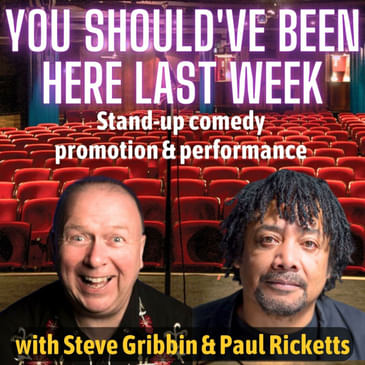


On this award-nominated show - Arthur Smith - UK comedy legend on stage, TV and radio for many decades. Currently narrates BBC's Money for Nothing and star of the brilliant Grumpy Old Men. He has also been a West End playwright - An Evening with Gary Lineker - plus singer, poet, presenter and writer.
#podcast #comedyvideos #interview
Arthur Smith: My first 75 years in Comedy: https://www.youtube.com/watch?v=jwEFDog9kzk
You can watch full interviews with UK comedians on our YouTube channel: https://www.youtube.com/@UshouldvebeenHerelastweek
Give £5, £10 or £20 now and help CALM in their fight against suicide: https://www.justgiving.com/page/podomedy-stay-tuned
Hosted on Acast. See acast.com/privacy for more information.
[00:00:32] and welcome to the latest episode of You Should Have Been Here Last Week, the comedy podcast presented by myself, Steve Gribbin and fellow comedian Paul Ricketts. Morning. That takes a peek behind the glittery curtains of the comedy industry and talks to the movers, the shakers and the wave makers of the comedy world. And today's star guest is a stand-up comedian, author, poet, singer, voiceover, narrator of multiple television shows and the self-styled nightmare of Balaam himself.
[00:01:02] The one and only Arthur Smith. Welcome to the show, Arthur. I'm delighted to be here. This is the greatest moment of my life. I did notice by the way, in your biography you said, the reason that you're the nightmare is I don't do days. Yeah, that's right. Yeah. So thanks for doing the day with us. Well, I'm not even there at the moment now, so it doesn't count. Yeah.
[00:01:30] So even though it's a self-appointed position, right, who's going to be your successor? How's that work out? Well, I mean, I've had a number of people compete against me, but they've all fallen, funnily enough, off the top of skyscrapers. I think my successor will be someone who gives me a big wadja money and then I'll just nominate them.
[00:02:00] Look what I've got here. Can you see that? It's blurred because... Oh, God, what is that then? Is it... Is it the currency? It's 200 million Zimbabwe dollars. Or pounds, possibly. Yeah. 200 million. Yeah. So I think we can guess who the next Mary Ballum's going to be then. Yes.
[00:02:29] Someone from Zimbabwe. Yeah. Well, if you can offer more, I'll let you be there. Are there any comedians that made you, when you were growing up, that made you want to get into comedy? I mean, who were your sort of comedy heroes when you were... Well, I would say I was a huge fan of John Dowling, who... I loved the way that he kind of spoke truth and he really meant it, what I'm saying.
[00:02:59] And he was kind of quite angry and clever. He just did wonderful material. And obviously I always thought Victoria Wood was fantastic. And the next sale, probably, the first time I saw Alexa, I was just bowled over by the way, you know, he wasn't just doing old jokes about things, he was talking about the... talking about what was happening at the time. And it comes in an odd way, Mrs Thatcher was a kind of influencer.
[00:03:30] LAUGHTER Yeah, she had some good routines, didn't she? She did. Because when I started doing stand-up, I mean, I'd done other comedy before then, and I was in a band and whatnot. But when I started doing solo stand-up or in the double act with Phil, that was all around, you know, 1979, 80. So you just... I mean, I think Thatcher coming to power was a great...
[00:03:59] It was a kind of inspiration for the comedy world that grew up at that time. That's about when you started, wasn't it, Steve? Well, I mean, yeah, I was kind of... I think you were part of the first wave, I was probably part of the second wave. So you guys were doing it in 79, 80, and we didn't start until, like, 82, 83. So, yeah.
[00:04:25] I mean, I want to ask, can you actually remember your first ever proper gig as a comedian? Yeah, I did an open spot at the Comedy Store, which was in Meard Street. It was the one... I don't know if it was even called the Comedy Store then, but it was the one where, you know, Alexis Salmon and I got to play.
[00:04:49] And I got there at, you know, 8 o'clock, but it turned out I wasn't on till, like, 2 o'clock. Yeah. And so I obviously got rather drunk. And I went on, I was terribly nervous, and I didn't kind of listen to the audience. I died on the arse, frankly. But then I went, you know, I tried it again a few months later, and that went better.
[00:05:14] And then I started emceeing a lot, which somehow came more easily to me than doing... I didn't really have enough material to do 20 minutes then. But if I was kind of jogging along as the emcee, or compere, as we used to say then... Yeah, so... But me first... Yeah, I died on the arse at me first gig, essentially. A lot of people... Yeah, a lot of people do. But I came back. I thought, I'll give it another try.
[00:05:43] You were doing music before that, as you listened to the Results. No, Results, that was the name of your band, with an exclamation mark, which I think many great bands have an exclamation mark at the end, like Noi, Ultravox. And, yeah, Scar. There's a lot of Scar stuff in it. Yeah, there was a bit. I remember, yeah, we had one about a pimple. LAUGHTER That was all Scar.
[00:06:12] I mean, they were slightly comic, some of them. A foggy morning in London town, a pimple forming, small and round, but that simple pimple was destined to be the biggest damn pimple the world has ever seen. LAUGHTER Yeah, I mean, some of them were quite funny. We did one on my journey through your human body.
[00:06:43] LAUGHTER So that's vaguely sinister, doesn't it? Yeah, it is. LAUGHTER I mean, when did you get into doing the double act with Phil Nice as well, Fiasco John? I'd already, because prior to that, I first went up to the Edinburgh Fringe in 1977, and that was when, as it was then, we were a university review group.
[00:07:11] You know, all the comedy then, there wasn't any stand-up or anything there, and we did a sort of sketch show, and we went up for about five years in a row, and we did a little series on the radio and everything, but then in the early 80s, when the alternative cabaret, as it was known then, started out, I started wanting to be a bit more modern,
[00:07:36] and so me and Phil formed a double act called Fiasco Job Job. I've always wanted to ask you, by the way, is there any meaning behind that? Funny enough, that's what we changed the name of the band to. I think it must have been my idea. I just like the sound of it, because we... And I was always a bit of a Dardoist, so Fiasco seemed appropriate. Yeah.
[00:08:05] And Job Job, because there were two of us. LAUGHTER Yeah, good job there weren't five of you. Phil and I actually did a show in Edinburgh just this last summer. We reunited for a show called Oof, which we're doing against Solo Theatre in April, if anyone wants to come along. Yeah, what dates are they?
[00:08:33] Yeah, I should know that, shouldn't I? LAUGHTER So the 9, 10, 11, I think. OK. But that was about... That was a bit like us reuniting, you know. First we're sort of two old men meet on a bench, but we don't really know who each other are. And then we realise we're in a double act, and reminisce about that, and then Phil suddenly lets loose on me for abandoning blah, blah.
[00:09:01] And then we get together at the end. It's a bit like sort of waiting for God-o meets Morecambe and Wise. LAUGHTER And that's an interesting thing as well, because we often, obviously, when we're asking people about the circuit, as was, but you've noticed that there were loads of double acts, and even occasional triple acts, but, I mean, that's completely disappeared now, hasn't it? Yeah, well, I suppose it's partly financial, isn't it?
[00:09:30] Because, obviously, you only get half the money as a double act, as in most things, obviously. And, yeah, I remember triple acts. I think I played the first ever night at the Banana Cabaret, and there was a triple act on there, one of whom was Hugh Grant. Yeah, so Hugh Grant was in the triple act. Oh, my God. That would be brilliant. If you could find out... You should try and find out who that is. Do you still see yourself as an alternative comic,
[00:09:58] or did you even see yourself as an alternative comic even then? Well, I think I did back then, and I think it sort of meant something then, because it was clearly very different from what the classic comedian was then. I mean, then they all had sort of frilly shirts and suits and did, you know, old jokes, really, and they used to sort of share them around,
[00:10:24] and there was no sense of commenting on the nature of the world or indeed, as it's become more and more now, commenting on the nature of your own mental health or whatever. So it was definitely back then an alternative to the mainstream, but, I mean, I wouldn't... I don't think I'd use it now, because it's... I mean, in the end, it sort of became the mainstream, didn't it? Yeah.
[00:10:54] So the young ones came out, and slowly all those old guys sort of slipped off of the telly about that. And, yeah, I always remember the miners' strike, doing benefits then, doing lots of stuff for the miners' strike. I'm sure probably you did too, Steve. I did, yeah. I was on the picket line outside the Eastern Power Station in January 1985. Oh, yeah.
[00:11:24] I think you were there. I'm sure you were. It's the coldest... It's about minus 13. My actual fingers froze to the fretboard of the guitar, and I couldn't... I had frostbite on my fingers. Yeah. Yeah, and I remember, though, that there, though, the miners, sometimes we were entertaining miners, and they were more used to the old-school stuff, so it... It was a bit awkward, wasn't it? And I do remember sometimes you'd turn up to a miners' welfare club and they'd say,
[00:11:52] right, we've got to have the bingo on, or we'll have to have the raffle on, and not realising that it'll completely break up the evening, but they wouldn't budge on it, would they? Yeah, I still remember even if it was a stripper on at one of them. Oh, God! I did once spend a week in Cuba with Arthur Scargill. No? What were you doing there? Really? I did several series on Radio 4, I presently,
[00:12:22] called Sentimental Journey, where I'd take people away to places that had some significance for them, you know, celebrities. which is... So, you know, I went with Dennis Healy as well, funnily enough, to... over to Italy, where he'd been... During the war, he'd been on the landings of Italy. And anyway, I took Arthur Scargill,
[00:12:51] because he had connections with the Cuban miners and whatnot, and had spent time in Cuba. So... It's quite interesting to you. What was it like? Was he OK? Well... As a person. Well, he was one of these people who's, I mean, not unlike Thatcher herself, who's never, ever wrong about anything. Yeah. Who would not ever concede an inch. And I'm not sure, you know, I think he may have acted slightly inappropriately
[00:13:19] towards the female producer, but let's do it. Ooh! Ooh! Bombshell! Oh! Oh, yeah. Yeah. He was likeable and interesting, obviously. And, you know, he had some tales to tell. I once did a gig of Miner's Benefit, again, with Linda Smith for him, and I didn't realise this, so we did a joint show with me and Linda called Hello Crew World, and one of the sketches was taking the piss out of the Pope,
[00:13:49] the Pope as a sort of cabaret nightclub, and to say, like, hello, love, you know, and then he'd do like a Vegas type song. And Scargill was there, and he walked out, and it turns out he was a Catholic. Oh, yeah. I didn't know. And he got, he really got the hump. And then when he walked out, the whole audience sort of like lost. It was carnage after that. I wonder if Linda, I remember Linda always had that brilliant line,
[00:14:17] if God had wanted us to believe in him, he would have existed. That's a brilliant line, yeah. I always remember Linda, I thought she had the greatest line about the Middle East. She said, see, the problem in the Middle East is somehow or other, our oil has ended up under their sand. Very good. Yeah, yeah. You did a sort of,
[00:14:47] a little piece, this is about 11 years ago, on sexist and racist comedy. And I was reading it on your website, and I was suddenly thinking, well, has anything changed? Has things changed for the better since then? Hmm. I don't know. What do you think? Honestly, I think it's pretty much the same. I mean, you were mentioning Dapper Laughs then, and, oh, yeah,
[00:15:16] a lot of my brothers, I remember, you know, doing a gig with some guy who did sort of rape jokes, and, and, and, yeah, I, yeah, I think, I think, I mean, it's not like, certainly it's better than it used to be 30 years ago or something. Hmm. You're better off asking, women, that question, really. I'm sure there's still, you know, there's still a lot of women Canadians who have to put up this shit, that's for sure.
[00:15:46] Yeah. I mean, I think there's a certain amount of homophobia still, as well, just creeping back again. It's almost like, I mean, I know, I mean, in society as a whole, it seems to be coming back, you know, it, like, a bit more racism, et cetera. You know, you know, we rather naively thought we got rid of all that. Yeah. Yeah. But I like the fact that instead of it being, I mean, it used to be the excuse, let's say, start the noughties, was being transgressive,
[00:16:16] and everyone's going, well, I'm just pushing the boundaries. And, and nowadays it's free speech, which is, I find even more ridiculous. You know, why does racism and sexism have to be under free speech? So woke and everything. Yeah. I mean, yeah. There's endless debates now. There's, yeah, it seems to be, I think it's because of social media and whatnot.
[00:16:43] It's full of people getting really pissed off all the time about things. It's quite distressing in a way, isn't it? It's the intensity of it. Yeah. Because you're supposed to be a grumpy old man. I really don't see you as a grumpy old man at all. Really. I mean, you're quite sort of. I mean, if you put me. I mean, that's a useful thing in standup, isn't it? If you're angry, you generate a kind of energy.
[00:17:12] If you start ranting about stuff. Yeah. That's why Alexi Sayle was so fantastic, wasn't it? Because I'd never, I'm like, you know, I'd never seen anybody express that anger on stage before. It's such a way, you know, they used to deliberately wear the suits and they wouldn't fit in, would they? Yeah. And they'd pent up energy of it. Oh, that's fantastic. It was real anger and it was righteous anger as well. That's why he was so great. Can I just, I wanted to ask you a question about your,
[00:17:41] your many Edinburgh shows, because you've been a real sort of like stalwart of the Edinburgh Fringe, but specifically about the, the Leonard Cohen ones, which I did see. I saw the first one in Edinburgh's. It was fantastic. Well, why, why particular, why Leonard Cohen? Well, it was, it was partly, I'd done a show years before then, called, which I'd called Arthur Smith sings Andy Williams.
[00:18:09] And I've only really picked it as a title at the last moment, just because it's so stupid. Yeah. And I did do a couple of Andy Williams songs, but it wasn't really. And then I thought, well, I've done one Arthur Smith sings. And I thought, well, I know, Arthur, I mean, I've always loved Leonard Cohen as well. So Arthur Smith sings Leonard Cohen. I thought, well, that just seems to promise such a grim evening of entertainment.
[00:18:38] The only way up, the only way is that. And I do faintly resemble him. And, you know, I mean, he himself wasn't a great singer, really. So I discovered that I could do a reasonable attempt to, uh, Leonard Cohen songs. And I kind of, a story around it for the first time. I enjoyed it so much. I did a second one. Do you ever find out whether Leonard Cohen knew about it? Well, yes,
[00:19:07] he did know about it. And in fact, I was down to sort of meet him at Glastonbury. Oh my God. When he was there in, I remember that, I've been, 2010 or something around there. Yeah. Um, he didn't know about it because I got, I discovered by various routes that he knew about it. And he was on, I said, well, I'll come and meet you there. But he was very, he was very old and it wasn't that long before he died. And I, I didn't meet him in the end.
[00:19:37] And that's, that's a wonderful thing though, that, you know, that you know that he, because did anyone tell him about the content of the show? Does that mean he knew what the shows were about? I don't, I don't really know. I think he realized, I was sort of on his side, as it were. Yeah. He died the day before, uh, in 2016, the day before Trump became, uh, the president. Good old men have, what a great sense of time. Yeah. That's what I'll call a heckle.
[00:20:07] Yeah. Fuck you, jump bump. I was at the comedy store once and a woman got up and just puked. Oh. Directly puked onto the floor and it splashed all over me. And I've got a terrible phobia about her, but I had to carry, and she, and then she was carried off. Cause he was just ill, but I had to carry on fighting the urge to be sick myself. In the end, I just got up. Oh, it was horrible. Sorry. We'll probably cut that bit out, Paul.
[00:20:37] I don't know. Why should we leave it? So, so, and also as well, you, you, you do, um, now you're on tour doing a tour of poetry, aren't you as well? Yeah. Yeah. With Claire Ferguson McCarthy. I've always, uh, yeah, I've always loved poetry and I've always written poetry and I often incorporate poetry, not always my own into standup sets. I quite often like to end on,
[00:21:06] there was a poem written in 1650 by John Dryden, the first ever poet laureate, which I always like to end, quite often end a set doing that. So maybe when we get towards the end, they'll do that to finish. I always, when I was, I don't think kids do that anymore, but when I was at school, I learned quite a lot of poems by heart. And I can still do big chunks of, uh,
[00:21:36] you know, the wasteland or the love song, J Alfred Brunfork or Dylan Thomas or Andy Cope. I mean, there was a time on the comedy circuit as well, that it was full of poets, wasn't it? Seedy Wells, Attila the Stockbroker, Little Brother. Yeah. There was loads of them. Yeah. Porky the Poet, yeah. Yeah. Attila's stockbroker's still going, isn't he? He is. He's, yeah, he's still touring the country. Yeah. Yeah,
[00:22:05] I was sad about Seedy Wells though, wasn't he? He died. Yeah. He's relatively young. He was only in his 40s, wasn't he? Yeah. It's a little game I sometimes play. Can you name 10 comedians who've died since we started out? But maybe... Maybe we won't go. Yeah, I think the answer is yes. Because I reckon, because you do poetry, and you sometimes sing, as well as doing straightforward gags,
[00:22:35] it's really hard to pin your style down. In terms of... When you go to a gig, do you actually know what you're going to do until you look at them? Yeah, well, I mean, I've got a big backlog that I can pick out and whatnot. And so, to some extent, I mean, I'm not a great one for crowd work really, I must admit. You know, what's your name? What do you do? What's your name? What do you do? Which, I find that a bit irritating, but everyone does it now,
[00:23:04] of course, so you can't really avoid it. I always remember Tony Allen, the great, great, great Tony Allen, who was another, you know, one of the, he may have even invented the term alternative cabaret. But he famously was in the audience with an American comedian. And he was going on the front line, he said to Tony, so what's your name? What do you do? And Tony Allen said, I'm Tony Allen, I'm a comedian.
[00:23:34] What do you do? Oh, that is fantastic. What's the best heckler you've had? Oh my God. The best heckler? Yeah. Go on, Paul, what's the best one you've had? Well, actually, what I can think about is one actually was winners at Up the Creek, but I'm saying this because I survived it, really.
[00:24:04] I walked on stage and someone just shouted at me, you look like my cab driver. to which I said, I'm sorry, lady, you're strictly a bus pass person. Very good. I know, but yeah, first time I ever performed there. Yeah. I remember a cab, a guy who was on before me, he was even older than me and he wasn't doing very well and suddenly a woman's voice ran out
[00:24:33] from the audience. Excuse me, I think you really need to think about the way your life is going. Oh my God. I got one at the Cosmic Comedy Club once in Fulham and this is one of the funniest ones I've ever had and it was actually not a horrible one but it was just done in such a way. So it's in Fulham so it's quite posh anyway. I don't even remember the material I was doing but there was just a tiny little gap and some really posh bloke just went, that's quite enough of that.
[00:25:08] The whole audience just went, hey! And I thought, yeah, it probably is quite enough of that. It's really well timed. I actually like it if heckles are, you know, they're creative, you know, and they're, I think if you put a bit of effort into it, it's good, you know. Yeah, no, I agree. That's part, you know, that's part of the nature of stand-up, isn't it? You don't have pop-roll or films or, you know, that's one of the great things about stand-up. Anyone can join in in a way. I mean,
[00:25:37] do you think there's less heckling now? Because there seems to be less heckling Well, I have far less heckling, but then, you know, I tend to be playing to older audiences at a seemingly time of day, whereas, you know, when I used to do the comedy store and the last show didn't start till midnight or something, inevitably there were people who were completely pissed who'd really just gone along for the heckling, a bit like, obviously, the Tunnel Club, which we've mentioned. Oh, God, we did, yeah, yeah, yeah.
[00:26:08] I mean, one of the worst heckles I ever got at the comedy store was, it was that late night one, the first one in Maid Street and it was a, it was a very, very posh businessman and I was wearing brown shoes, it was a terrible mistake, but all the way through the actress goes, your shoes, man, your fucking shoes, your shoes. shoes. I couldn't stop him. Well, that is so thing to wear brown shoes. I know, I do apologise, Arthur, I've never done it since.
[00:26:40] So, I mean, we always ask this, I mean, this is one of the questions we ask every guest, I mean, what do you think, where do you see the comedy, the world of comedy, which way is it going and what do you see for the future of comedy? Well, it's a much bigger world than when we started out, isn't it? There's a billion comedians now and, ooh, where's comedy going? Well, where's the world going? Who knows? Yeah, exactly.
[00:27:11] Really, I've got no fucking idea. That's an honest answer. Yeah, I'll take that as an answer. I mean, why not? I mean, it's like, if you're looking for a festival, you know, it's not such a great place to go as it was, I've been getting the fiends, you know, because it's expensive and, well, I know it's a lot of comedy these days, it's people talking about their mental health problems or, it's more individual comedy in a way
[00:27:41] and, you know, it's more self-reflective but perhaps it will explode again into shouting about the world, who knows? Oh, I've got one last question then, because you're obviously one of my most favourite voiceover artists and my particular favourite is, what's the name of the show? I've got it written down here, Money for Nothing. Yes, we love that. Money for Nothing. I just want to know, do you actually
[00:28:11] get the chance to see the shit that they're making before you do the voiceover? Because otherwise, I mean, I just imagine you're going, oh my God, what load of crap that is. Well, yeah, I do get to see it, and yeah, I must admit, occasionally, I mean, we have a sort of bit of a joke version, me and the producers, where I do an alternative version, where I go, what the fuck is it, what, and they pay two grand?
[00:28:44] I wish they'd released that, that would be fantastic. please put that out, because it's, I mean, obviously that's what we're doing, when we're watching it. You know, if I get fired from doing the voiceover, then I'll maybe do that. Oh, fantastic. I have a sort of little suggestion of that in my voice occasionally. You do? Yeah. Yeah. I have, sometimes I have visions of you with a sort of, a bit of a sarcastic look on your face, you know. They're brilliant, the presenters
[00:29:14] and whatnot, and I really enjoy doing it. Shall you have a poem then, from Arthur, then? Yes. Yeah, but this is by John Dryden, and it's a little poem you can say at the end of the day, when you got through the day, you had some good moments, you didn't do anyone any harm, and it was your day. It's called Happy the Man. Happy the Man, and Happy the Man. He who can call today his own, he who's secure within can say,
[00:29:43] Tomorrow do thy worst, for I have lived today, be fair or foul or rain or shine, the joys I have possessed in spite of fate of mine. Not heaven itself upon the past has power, but what has been has been, and I have had my hour. Or rather, my 45 minutes, I think, in this case. Brilliant. Thank you very much, Arthur. That was brilliant. It's a pleasure, boys. Well, thanks very much, Arthur. That was brilliant, mate.
[00:30:13] Cheers. Thanks for coming on. Cheers. So that was Arthur Smith. There's a couple of things I actually wanted to mention about the fact, you know, when he showed his Zimbabwe note, I was going to ask him one, how much is that in real money? Because it's probably about 20p. But, and the other thing is, I've already made money out of Arthur because I worked on his show. Because we didn't talk about his playwriting, and he's won
[00:30:43] Olivier for a night with Gary Lineker, an evening with Gary Lineker, and I worked on that show when it was in the Duchess Theatre. So he's already, I've already got me pound of flesh out of him. The other thing is, because I was going to tell him that I was really pissed off about it because I had an idea for a similar show. My idea was Sex with Bobby Cholton was the name of my show.
[00:31:14] I think that would have been a harder sell. I think so as well. It was a weirder story. I don't think I would have got the Olivier for that. Oh God. It would be very popular in Ireland to score Sex with Jackie Cholton. Well that's in the end, that was part of the plot. Yeah. That a man found a partner that was just as obsessed with
[00:31:43] football as him, but it turned out she was particularly fixated with Bobby Cholton, and in the end he had to be forced to dress as Bobby Cholton in the bedroom, but eventually she moved into the Jackie Cholton zone, and that was the end of their relationship. I think that's good. That sounds a pretty good plot to me actually. You should revive it. No, it's too late now. He beat me to it, didn't he? Arthur beat me
[00:32:13] to it. And also, by the way, not many people would know who Bobby Cholton was anymore, would they? No, they wouldn't. No, they wouldn't. Anyway, it's a very good interview. I enjoyed that immensely. Yes, it's good. And I'm glad he has no idea what's going to happen in the future, because in the end, none of us do. No, but it hasn't stopped quite a few of our guests pontificating on where they think. That question is not what do you think will happen, it's what do you want to happen? Because that's
[00:32:43] often what people say, they're projecting what they want to happen, aren't they? Oh, yeah, or sometimes what have you heard other people said is going to happen and want to pretend it's now your opinion, which is also fine. We don't care what answer you give us, as long as you give us an answer. That's the end. I think the call to action, again, I'm trying to think of more interesting ways to get people to do what we want them to do. So, one of
[00:33:12] of course is to like. If you're watching this on YouTube, please put the like in. The other thing you could possibly do is subscribe. Please subscribe. Please share. Share with lots of people. Do this with the podcast or the visual version. Yeah, share it. Tell your friends. We've actually hit 126 subscribers now. 126.
[00:33:42] Come on. Yeah. So I'm hoping that we could hit what? What title do you, or what number do you think we should hit? What target? 150. Come on. 150. Yeah, come on. Eat your heart out, Elon Musk. Yes, we're basically, yes, the future is going to be ours in terms of social media. Yes. We've probably set up our own channels like Truth Social. Yeah, or whatever he's called. Yeah, there's loads of them other than that. We can interfere
[00:34:12] in the elections of a foreign country. That's what I've always wanted to do that. Well, me too. No, I'm basically going to say nasty things about the New Zealand government. No particular reason. It's just, come on, you people of New Zealand, sort yourselves out. Leave us alone, mate. What have we ever done to you? I know we can't pronounce pin properly, but come on, mate. Yeah, it's usually got too much stuff in
[00:34:42] your car. I want to have New Zealand as well, let's face it. Well, it should be rightfully yours. Yes, it should be. I've called it Old Paul Zealand and... Bobby John Zealand. Yes, that's what we'll call it. I've got a new place, Sex with New Zealand. Oh, that'd be great. With the whole of New Zealand, which is... That'd be a long show.
[00:35:12] Oh, dear. Yes, so I second everything Paul said. Please like, subscribe, share, tell your friends, tell your mum, tell your dad, tell your dog. If you want to get in touch with Elon Musk and tell him how great we are, that would be a good idea. Oh, and comments. Of course, comments are really important. If you want to put any comments about, my God, why are you still doing this? So, thank you for listening and watching and we'll see you in a couple of
[00:35:42] weeks' time. Yes. So, as always, we say bye-bye. Bye-bye. Bye-bye to you all. Bye-bye to you all. They said you should have been here last week. This podcast is part of Podomity,
[00:36:12] the UK's podcast comedy network. Why not laugh at what else we've got? Visit Podomity.com.