
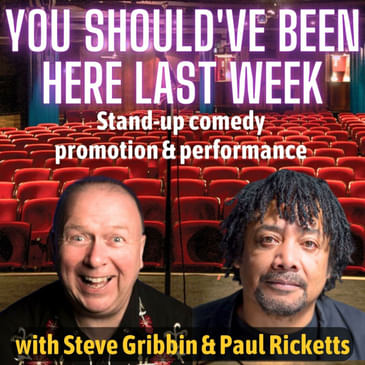


On the award nominated show we have Jeff Innocent, who over along career has been voted British Comedian of the Year, Comic's Comic of the Year and Best Live Club Comedian. But, only after online video clips went viral did he find nationwide recognition. Here he talks to Steve and Paul about how this has impacted his life on and off stage.
#podcast #comedyvideos #interview
Clip of Jeff: https://youtu.be/590gl63lkz4
Contributions can be made to Steve Gribbin's Ko-fi account: https://ko-fi.com/stevegribs77
Or Paul Ricketts JokePit account: https://www.jokepit.com/comedian/paul...
Email: ushouldvebeenherelastweek@gmail.com
You can watch full interviews with UK comedians on our YouTube channel: https://www.youtube.com/@UshouldvebeenHerelastweek
Give £5, £10 or £20 now and help CALM in their fight against suicide: https://www.justgiving.com/page/podomedy-stay-tuned
Hosted on Acast. See acast.com/privacy for more information.
[00:00:32] Hello and welcome to the latest episode of You Should Have Been Here Last Week, the podcast that pulls back the curtain to give you a peek at the unseen side of comedy. This podcast is presented by myself Steve Gribbin and my fellow comedian Paul Ricketts. Hello. And today's episode features a giant of the UK comedy scene, one of the very best stand up comics working today, the wonderful Mr Jeff Innocent. Welcome to the show Jeff.
[00:01:00] Thanks very much. Giant, I haven't heard giant before. You know the one I usually get? Legend. Do you get that one Steve? I do, yeah. Comedy legend. I always think that's only because you're old, isn't it? I always think legend is like somebody that sort of doesn't quite exist, like a mythical creature of yesteryear. So I don't know if legend is complimentary. I always think, look, I haven't finished yet. Yeah. Yeah. Yeah. So how do you fancy vulnerable? I know, venerable.
[00:01:31] Venerable. Venerable. Ha, ha, ha, ha. Venerable. I'm not even quite sure what that means. That's usually meant, is that for people that have respect to be spowed upon them, isn't it? I can't. Yeah. Yeah. I'm quite sure what that means. But yeah, I'll take it all. I'll take it all, Paul. I'm sure there are other people out there calling me all other kinds of things. So... Oh, God. Yeah, definitely. Yeah, I'm gonna start off with a nice, silly one. Um, do you still live in Canning Town?
[00:02:00] Well, I do. Well, actually, more specifically, I live in Custom House, but I'm on the borders. And I say Canning Town to people because usually they haven't heard of Custom House. But yeah, I'm still there. Still there. Can't afford to move. Can't afford to stay. Sounds like the life of most comedians, doesn't it? Can't afford to...
[00:02:21] Yeah, I think so. That precariousness, isn't it? It's funny about that precariousness, because I've been feeling precarious about my job ever since I've been doing it, and I'm still doing it after 27 years. And every year I think, oh, I might not get booked this year, you know? Yeah. But I'm still hanging on in there. It's known as the diary panic, isn't it? When you look at your diary and there's blank spots. And even though they will get filled, you're just like that. Yeah, I know. Every year I do that, Steve. Every year.
[00:02:51] But we've got to ask, I mean, one of the things that we were talking to a lot of the comics about, I mean, and you have had a fantastic sort of last two and a half, three years since the pandemic, basically, where you've become a social media phenomenon, haven't you? No. Isn't it funny? Overnight. Happened in about two months or something, even less than that. Can you talk us through actually the process of how that actually did happen?
[00:03:17] OK. Well, how it worked was my sidekick, Sam Piconi, who's also my tour manager, support at Driver and everything else. He's a whiz kid with social media. So he said, let's put some clips up and start putting clips up and see what happens. And almost immediately, one or two of them went viral. And that's and it all followed on from there. Within a month, my life was my own.
[00:03:47] Honestly, you know, I was able to walk the streets without being known. Now, I have people knocking on the door, knocking on the door to get selfies and say, it is you, isn't it? I was telling people that you're my neighbour. They wouldn't believe me. Can I have a selfie? And it happens so quickly as well. It's not like being on television where I guess your fame is developed over a course of time by being on EastEnders for six months or something. It happens literally overnight.
[00:04:16] Within a month, I would say now I have to probably do about three to six selfies a day, get stopped half a dozen times. And these are the only these are the people that are stopping me. There must be other people. It is remarkable. It takes them getting used to as well. Have you ever turned one down? Or do you just? Well, I don't know. I don't. I don't turn it down because I think that's just part of the job now, really.
[00:04:45] I remember seeing Jerry Sadovich turn down selfies, but I think that goes with his persona, doesn't it? His fans would probably love to be turned down by him for a selfie, wouldn't they? That's just that's Jerry. People just sort of go a bit crazy, get a bit starstruck. So I was in hospital having something to do with my knees and the two nurses doing the x-ray, one of them recognised me during the x-ray process.
[00:05:09] And they both stood around me on the bed to get a selfie while I was lying on the bed in the hospital. It happens like that. Or you'll be on a tube, a packed tube, and someone will see you from the other side and they just climb over people to get to you. Wow. It just happens every day. And I think it's just part of it. It takes some getting used to because also you have to behave yourself in public. You know, you can't kick off.
[00:05:38] And I like to kick off now and again. You know, I'm like a debate. I like a public debate. So you've got to, yeah, you feel like you're in the public eye now. You've got to. Yeah, yeah. You can't seize and argue with people or, you know, you can't do any of the things I normally do or publicly moan about things. You know, I don't really do.
[00:06:03] During the pandemic when we all got stuck in our homes, there was a like, I went through a little bit of a crisis of identity crisis. I didn't really know who I was anymore. I couldn't do comedy. I experienced the same thing as you as I'm sure a lot of comedians did. But one of my, the first video went viral. Another video went viral before that. So that kick started it really.
[00:06:30] So even though I wasn't working, I was watching the views of my video pick up before my very eyes. So even though I wasn't actually working live, I was still out there. My videos were still out there. But I did experience the same thing as you, Paul. Exactly. And I actually didn't even know if comedy was ever coming back. I don't know what got into my head. I just thought, oh, that's it. Comedy is over. We won't be doing that anymore. Yeah. And yeah, suffered very badly like all of us.
[00:06:58] And was very happy that we resumed. I mean, I know that you started, you were a late starter, weren't you? So you're in your 40s when you first started. Yeah, 40, 41. I did a workshop for my 40th birthday with the late Tony Allen. And that's how I started. And then I did my first paid gig when I was 41. So I'm late for everything, a late comer. Do you remember any of the other people on the course with you?
[00:07:24] I'm still in contact with one or two people that are on the course, but they haven't become comedians. I've still got the video of the show, actually. I must have a look at that. And there were a lot of novelty acts in those days. You know, a lot of fresh acts. There was one guy, I think he, one guy, Dennis, he was very talented. And he was an older guy, like my age now, really.
[00:07:51] And his act was, I think he called himself the Dagnum Clog Dancing Society. And he had skis on his, tied to his feet with pairs of clogs tied to the skis. So he did this dance. It was about six different pairs of clogs dancing with bells on. Stuff like that in those days. Ha! Ha! Ha! Ha! Oh, I heard you on here talking to Mark Thomas recently. Oh, well, yeah. Because I'm a big fan of this show, you know. I listen to it all the time.
[00:08:21] And when I'm doing gigs, particularly, it seems to work when I'm coming back from gigs in a car with someone. We listen to it. And Mark Thomas was on talking about odd acts that used to get in the old days. And it reminded me of an act I was comparing in Newcastle. Well, it was very new, comparing that club that used to be there. I can't remember what it's called now. Yeah, the hyena. I think, yeah, hyena. And it was quite a rough stag-do kind of hen party sort of club. And one of the acts was called Dead Elvis.
[00:08:51] And I think it was more of a performance art act, right? So I was comparing and he came out of a coffin. So he had a coffin and he came out like a zombie Elvis. It just wasn't funny at all. And the audience were booing and chucking stuff. So I hurriedly pushed him back in the coffin and closed the door. And I remember this and I'm very proud of this. And I went, there you are. Dead Elvis. Not dead enough for us. Right? And he was in the original chair.
[00:09:21] And, but I didn't know he was locked in the coffin. And I'd locked him in the coffin and he was trying to get out, but I couldn't tell. And he complained to equity. And there was a big article in the stage magazine, stage newspaper about comedy compare George Innocent. So that's how long ago it was. They didn't have my name right. George Innocent. Locked Cabaret Act in coffin. That was the headline. And the Sun newspaper phoned me up to see if they could get a story out of it. Yeah. Wow. Bloody hell.
[00:09:51] I mean, cause you also now, we wanted to talk to you again about, you started off with the comedy course, but you, you've also got one yourself, haven't you? Yeah. I am. I like talking about comedy and, and theories of comedy and practice and stuff. And so I did start running a comedy course quite a few years ago, actually. And I, I've been doing it two, three or four times a year for the last five years.
[00:10:19] And I don't know if any of those people have ever become professional comedians or stars or whatever, but certainly the ambition is very different from when I started. And when I did my workshop, I think I was the only one on the workshop that actually wanted to become a comedian. The rest was just there for fun. Um, as if you go and do Zumba or pottery or something. Whereas now I think most people who come on a course have designs on, on taking it further.
[00:10:48] Um, so it's a very different attitude now. Hmm. Is your course more along the Tony Allen lines? Very much so. Yeah. Yeah. Very much prioritizing comic persona and truth and honesty over joke construction or, or how to write jokes. Very much like to try and encourage people to just find their own funny and what's funny about them.
[00:11:14] I know this can sound at the risk of sounding pretentious, but I prefer people to have that starting point. And, um, well, of course, the thing with that, of course, is that people feel more secure if you're giving them joke writing techniques and strategies and structure. They feel that they're learning something, but I think it probably takes longer my way. But I think, uh, you, you, you sort of, you have a better start starting point if you do it my way. But I enjoy it very much.
[00:11:45] I mean, yeah, I met a couple of your, um, pupils. Um, God, see my memories going now, but, um, uh, the woman of, um, she's got quite a strong cockney voice. Um, she's of Indian descent. She's from Lewisham or around that way. Oh, from Croydon. Yeah, yeah. She's, she's really funny. Indie Indri Madre. Well, she's a, she's a niece of the, uh, the cricket player, the Guyanese cricket player. I don't agree. Is she?
[00:12:14] That's her uncle. Yeah, yeah. Um, yeah, she loved the course. She's a great ambassador for the course. She is. And she's out there. Now here's the main difference as well, though, both of you, as I'm sure you know, um, uh, people now have career plans, don't they? With their comedy, you know, they, they, whereas they know, you know, it's, it's, it's very professional. Everything's really slick and professional and they, they come in.
[00:12:41] Uh, so they have that, but at the same time, I think the fundamental difference now is that when I started, maybe for both of you as well, there weren't open spot clubs. There wasn't an amateur comedy culture. Yeah. You were an amateur comedian, an open spot looking to not be one by doing an open spot on a Saturday night in a club surrounded by professional comedians. Whereas I think now people can work every night.
[00:13:08] They won't get paid, but people can perform every night at the, one of the many, uh, amateur comedy clubs that are open. Um, and, and, and on one hand, that's great. But on the other hand, that obviously doesn't give you the desire to get better necessarily because you can still, you know, carry on playing these clubs no matter how good you are or how bad you are. So on one hand, that's a great thing that people are allowed to perform, uh, in an amateur level.
[00:13:37] But, um, but also it means that people don't, are not striving as much necessarily to, to, to get on the bill as we were in the old days. Well, I think it's become a circuit on its own. It's especially in London. Definitely. And there's people who make money out of putting on nights where no one gets paid. Yeah, there is that to it. Isn't there that same with, um, gong shows and competitions. They're all free, free shows for the promoters, aren't they? Yeah. Yeah.
[00:14:08] Well, that's certainly a big, a big difference from the old days. You know, that that didn't exist. Yeah. The old days, eh? The old days. Come on. I don't think we're earning any more money than the old days though, are we? Uh, no. You know, a weekend at Jonglers is still pretty much a better weekend than you can get now, I think. Yeah, yeah, yeah. I mean, do you think, would you say, I'm not going to go down that nostalgic route, but
[00:14:35] the standard I think of, it seems a bit better now than it was. I mean, they were more strange and weird acts, but. Yeah, I can't work out if we were rubbish and we didn't realise it. You know, I look back at certain acts, including myself, and think, were we any good really? Or, you know, I don't know. Um, but I think the standard overall is better yet, I would say generally, but also it means
[00:15:01] there are so many more people doing it that there's also a lot of people that are terrible doing it as well. Yeah, there's just more people. I mean, one person who did your course told me that he asked you to, um, about audience interaction and you just told him, no, I don't do that. Well, I said, don't do audience interaction. I mean, what, why do you want to think about audience interaction? Um, yeah, I'm really down on crowd work.
[00:15:28] I think it's a curse on, on, on comedy. Crowd work. You know, you can imagine going to see Richard Pryor or Bill Burr or one of your comedy heroes, and they start going, where are you from? What you do for a living? I don't think that would happen, do you? I don't know what this crowd work thing is all about. Crowd work and stalls on stage, mate. It should be banned. This is the thing with crowd work is first of all, and I'm going to need Steve to back me up here because he's been going for longer than me.
[00:15:56] We never used to call it crowd work. I think crowd work was a term in the, in the mainstream entertainment world where do a bit of crowd work to warm the audience up before the actual comedy starts. That's how I always imagined the term crowd work. But when, when we had compares who did what I'd call audience interaction, or riff off the audience or improvise from things, the information they've gleaned from the audience.
[00:16:26] I don't think there are many good, many people that can improvise. I don't think they do improvise. I think they just have a sort of checklist of questions and then quickly try and say something funny. I don't think, you know, they're not like Ross Noble can do it. Russell Hicks can do it. One or two people can do it. But most people who compare and do crowd work, they just don't even know what they're doing. They don't even come up with their own questions. They just turn into the same crowd work comp as everybody else.
[00:16:54] They seem to lose their, their individuality. So, so, but for acts, I'm thinking if you're doing a five or 10 minute open spot, don't start talking to the audience, you know, what were you doing? You know, and it's not about the audience, is it? It's about us. Yes. I always think, you know, I don't care where they're from or what they do for a living. I don't mean that on a personal level. Of course it's nice, but surely they've paid to come and see where we're from and what we do for a living. Yeah. That's what I'm thinking. I do say that to every audience.
[00:17:23] I say that. Look, I don't give a fuck. That's not. There is a trend that's developed with young audiences where I think they go to expect it. So they sit in the front and, but I, I don't, I think yet. Well, the other thing of course is a lot of these, nearly every single one of these compares, only compares the front row. They don't actually compare the whole audience. So they almost immediately lose the audience while they're interacting with people in the front row, who the rest of the audience can't see.
[00:17:53] They can't hear. They don't know what they look like. So it's very rare. I think people like, I mean, there are one or two people that can do it brilliantly. Roger Monk has now that's who they should all go and watch. Yeah. He's a fantastic guy. Roger Monk house can just weave, weave material audience interaction and admin so beautifully.
[00:18:19] And I think that's, that's great audience interaction. You know, that's not, yeah. So, but hardly any of them can do it as well as him. So, you know. You sometimes get a situation on bills as well, don't you, where you've got the compare who does that. And then the next act comes on instead of just, they'll do more comparing. And then the act after that will come on and they'll do another bit. So, you know, I think part of it is fashion and trend.
[00:18:46] Well, I also think part of it is the act's individual anxiety and lack of confidence in their act that they feel that they have to somehow get themselves in by talking to the audience instead of being confident about what they've got to say is the thing that gets them in. Yeah. So I think a lot of it is that really. I mean, there is a great moments that happen though, sometimes where you'll get a heckle or something. I'm not talking about, you know, fuck off your shit. Sure.
[00:19:14] Where it's just that, that's the, one of the best things about live comedy. Sure, yeah, of course. I went to see them. Sure, yeah, of course. The here and now. Yeah. The thing that makes it different than the theatre. Yeah. That anything can happen. Being in the moment. And sure, those things can happen. But I think what happens, of course, is that these compers are trying to force those moments. Mm-hmm.
[00:19:35] And as I've heard you talk about on your podcast before, they're also a lot of the time now playing the phone rather than the room so that they can develop a clip for their social media. I know. I think most of it, I think the problem is asking questions. It's not necessarily talking to them because in a way when you're doing your act, you're talking to them.
[00:19:59] I like to be, I like to think that my act is rather conversational and is like talking to them. But once you start asking questions and waiting, I think that's where it all falls apart. And you see that a lot, don't you? Where you're from. Also, asking questions that other people have come up with. In a sense, I think that where you're from, what you do for a living is somebody else's material. You know, if you can't come up with your own questions, you're crying out loud, you know.
[00:20:28] If you want to ask the audience questions, ask them some other questions. Yeah. How many? And some of these people that are doing this are very good comedians in their own right. But as soon as they start compering, they just become the same as everybody else. And I think what they should be doing is working in a job center, really. They're so obsessed with what people do and where they live, you know. And then the stall thing. Let me get on the stall thing. This is so American. Now, I blame Sean Collins.
[00:20:54] He's their leader of the core, the stall cult. Yeah. And I think what a lot of comedians do, I've seen them do it. And that Dave Chappelle, he's a very bad influence. They'll be talking and then they'll go, right, I've got something really important to talk about now. And then they pull the stall out as if by sitting down. Now, I'm saying it's really important and significant. If you can't just say it where you are, it's not worth saying.
[00:21:21] And I see those stalls being dragged down and you think it's so pretentious. And where's it going to end? You know, I started taking the piss. If I see a stall on the stage and I started going, oh, I'm glad they've got a stall because they stand up for me. You know, it's a bit tiring after a few minutes. You know, particularly someone at my age, all this standing and talking, I'll need a sit down. So, yeah, I'm down on all that. I know it winds people up. I went to the Comedia. They knew I was coming.
[00:21:49] They stuck 10 stalls on stage for a laugh. Oh, very funny. Yeah, yeah, yeah. So I know it winds people up. But, you know, I like to have a moment. Yeah. Well, don't we all? Essentially, that's our job, isn't it really? Rated moaning. Yeah. Getting paid for moaning and you can't beat it. Oh, by the way, what I remember before you, I don't want to interrupt. Mark Thomas, I heard him on here mentioning me in the context of it's good when Jeff Inneson's on a bill
[00:22:19] because I know there'll be some hearing aid batteries I can borrow. Hey? You know what he is, don't you? He's a teddy boy. Have you seen it? He's got a quid and he's got sideburns. Hey? Sort yourself out, Mark Thomas. We're in the 21st century with that rockabilly hairstyle look. Yeah. Always good to be on a bill with Mark because you know there's going to be a bit of brew cream about. Anyway.
[00:22:47] On the subject of moaning, green room etiquette because it's conversations that we've had about green room etiquette. And because you have certain views that it should be a sort of a combative atmosphere. Oh, I do like a bit of banter in the green room. I think, I'm sure it's not just me, but almost walking into the green room is the beginning of the performance for me.
[00:23:11] So I'd probably like to be a bit leery and warm up on people a little bit, you know, a little bit of fun poke people. Whereas some people want to be in their private secret space. Yeah. I once walked behind Robbie Coltrane. This is a true story. He was going up the steps to go into the dressing room and the assembly rooms. And I heard him psyching himself up to walk in the dressing room. He's going, come on, Robbie. Come on, Robbie. Come on. You can do it. Who is this? Robbie Coltrane.
[00:23:42] Really? Wow. He burst into the dressing room and said, hello. But he'd be like psyching himself up to do a performance in the dressing room, you know. Yeah. I mean, I don't think I'm performing in the dressing room, but I think I'm just getting my wits about me and just poking a few people. Because obviously comedians never used to be as sensitive as they are now. Certainly they wouldn't go on stage and reveal their sensitivity as a person or write a whole show around it.
[00:24:11] It was quite about being tough, wasn't it? And resilient. But, but yeah, so I like to have fun in the green room. The only thing I don't like about green rooms is if I'm there too early. Because I'm not driving at the moment. So some of the gigs I do, I have to get there a bit early, earlier than I'd like to. And you're in a green room waiting for the show. And I can lose my mojo a bit if I'm at a gig too early. Yeah. Yeah. Especially if you're just sat in a really dismal green room. It's just sort of...
[00:24:41] They start moaning about if I see bad acts on that can put me off. I tell you who I'm like, who's that Irish footballer who always moans about the other players? I'm like Roy Keane now. Roy Keane or Gordon Ramsay. I walk in and someone will be able to go, what is this? What are they talking about? And I can't help it. I can't. That's one of the reasons why I set up the workshop. Because I'm OCD about a lot of things going on in the circuit. And I thought I could have an influence on this.
[00:25:08] I could maybe have an influence on what they do. And actually, if I died tomorrow, I know that one of my legacies would be an influence on UX and getting them to stop saying hello when they walk on stage. That's one of my big things where I always suggest that the moment you walk on stage is a moment where you can declare your comedy credentials instantly with one sentence. And why waste that on hello?
[00:25:38] Particularly, hello, how are we? I mean, does anyone want to strangle anyone who does that? When acts say, how are we doing, guys? I'd love to be in an audience, you know, and not be known. I'd fantasize about being in an audience and not be known. And heckle, you know. How are we doing? It's none of your fucking business. Just tell us a joke, you know. Yeah. And we know you don't fucking care. You don't care about the response. Yeah, yeah, that's right. Yeah.
[00:26:07] Like it used to be up the creek on Sundays. That's how I would think we could go back soon. Oh my God. Yeah, I know. How are you? What's he got to do with you? Yeah. Do you know my favorite one? And I might have told this one before on podcasts, so forgive me, is when a young guy was doing an open spot and they already knew before he got to the microphone that he wasn't going to be very good, or at least they could smell fear. And his name, his name was Mark Fleischman.
[00:26:34] And I'm in contact with him now, so I'm sure you won't mind me saying this. He denies that it was him. Maybe I've got it wrong. But before he got to the microphone, they were all going, cab for Fleischman, before he'd even got to the microphone. Oh, Jesus Christ. And then, they were ruthless, weren't they? And then, and then he got to the microphone, bless him. And he went, no, no, listen, please. Just give me one minute to prove myself. And then the entire audience went 60, 59, 58. Oh! Oh!
[00:27:05] Yeah, I know. Andy Smart told me a brilliant one once. He was compaering up the creek in the very early days, and it was still quite rough, like it was at the tunnel. And he was dying on his arse as a compaer. And as he, Rich Hall was closing, before he came on the third bit, some bloke, you know that the heckle was like, taxi. Some guy just beckoned him like this. And he just whispered in his ear, he went, taxi. Oh, that's nice. Andy Smart went, thanks very much.
[00:27:34] That's all from me. Please welcome on stage Rich Hall. I put the mic in the stand and walked out the door. Oh, gosh. And got a cab and just fucked up. Oh, dear. Even though we enjoy reminiscing about the extremities of those days, it's a much nicer environment now, the circuit as such, isn't it? It's a much nicer environment to do comedy in. I don't even think they heckle people if they're bad anymore. I hardly ever see heckling.
[00:28:04] Do you? In fact, if I got heckled, I'd get thrown now. I'd think, oh dear, I forgot about all this. You know, and I'm not ready for it now. Yeah, yeah. I mean, I'm going to move on to the fact that you did further education and your MA and BA in cultural studies. Yeah. Yeah. Well, I was about 32 when I did that. So this is the late, late eighties.
[00:28:30] And what it was, was I think typical of generations of working class people who felt a little bit inadequate about not being educated. Actually, certainly as you get older and you're mixing with people who are teachers or whatever, you know, you're living in bed seats in shared housing. So I'm coming into, I'm coming into contact with sort of educated working class people that come down from up north. They're teaching in schools.
[00:28:59] And I've always been into politics, been a little bit bookish, but I've always felt that I never really knew what I was doing or what I should be reading necessarily. And I had always wanted to do something, but I found that course. So it was more about that course than merely going to university.
[00:29:16] It was a fantastic course, like a cultural history course, but with a particular political direction and tradition, which was a, that come from Leavis and the whole idea of the all culture can be studied, you know, not just high culture. Yeah. And, and, and, you know, taking on stuff like history from below, social history, black history, women's history. So really I was doing all that. So I did that for three years.
[00:29:45] And I loved being at university for so, so much that I thought I've got to do the MA, anything that could keep me there. So I did the MA for two years part time, just so that I could carry on going to university and reading books and arguing and debating and writing essays. It was such a fantastic period. And I also think like a real intervention as well into my life that turned my life around completely. Um, um, so that's, yeah, that's what happened there.
[00:30:16] Yeah. Cause I remember I was mentioning talking to you about Stuart Hall and, uh, and you were going, wait a minute. Wait a minute. He said, wait a minute. Well, wait a minute. How do you know who he is? Yeah. He said, I'm not going to continue this conversation until I find out if you've got a degree or not. I've not wasted time talking to fake people. Oh yeah. I'm a bit like that. I'm a bit rigorous. Uh, well, academically, I'm a bit rigorous. I'm not, yeah. You know, sometimes people have an argument. I go, have you actually read anything on this subject?
[00:30:45] And they go, no. I go, well, I'm not really interested in your half ideas. Cause I think if I've done all this academic work, spent five years, rigorous study essays, projects, et cetera. I don't want to have a debate with somebody who merely reads the sun. They're just wasting my time. So it can seem like I'm being a bit arrogant, but it's not. It's, it's, it's just like that. But, um, but I'm very thankful that I had that, that experience. And of course we got paid to go in those days. We had grants. All grown.
[00:31:15] It was a fantastic experience. Yeah. Loved it. Very, one of the greatest five years of my life. That was, I don't know what kind of comedian I would have been without that, but, um, I don't think I could have done it without that. You know, it helps you organize your ideas, at least helps you do that. You're reading more widely, more analysis. So yeah, I think, um, I think it's essential for me. Definitely. Can I just ask a question who, you know, we've talked about how you got into comedy, but when
[00:31:44] you were growing up and watching, uh, you know, TV in the seventies or whatever, I mean, who, who did you admire in the world of comedy? Well, um, I think, um, I think, uh, what a lot of people don't understand, certainly from outside of this country is that standup comedy is just very much part of mainstream British culture, isn't it? Or popular culture. Everyone grows up, certainly in the sixties and seventies. There were standup comedians all the time.
[00:32:10] And I think people who weren't comedians sort of know how jokes work, know how stuff like that. So all of them really, and all the ones we normally like, like Dave Allen or, or, you know, all of those people, I wouldn't say anyone directly influenced me as such, although possibly Alexis Sal is probably a bit influential, but I just think generally, and I was thinking the other day, um, we put on a play at school at Christmas, uh, play with different sketches
[00:32:39] and things and you could do what you wanted. And I, I'd seen a sketch on TV. Uh, I mean, I'm, I'm probably nine or 10 years old and it was a sketch. I think it might've been a Marty Feldman sketch where, um, he's, uh, he's, he's thirsty. He's, he's, he's somebody that's dying of thirst and he's, he's knocking on doors going, Walter, please water. And they kick him out and eventually get someone goes, Walter, please water. And they, um, he gives them his bowl and they give him some water.
[00:33:08] He takes his comb out, dips it in the water. And so that was one of the first things I thought, oh, I love it. I would do that on stage. I did that at one of the school sort of events when I was about nine or 10. So all comedy really influenced me, I would say. Yeah. I was going to move on to, uh, you know, you being the working class David Roddigan because, uh, yeah.
[00:33:34] Oh yeah. Well, I mean, I think David Roddigan comes from a sort of working class background, just a bit provincial, probably from Oxford or somewhere, but yeah, I, um, my first love comedy from when, uh, again, another intervention, you know, in working class people's lives about six, 1969, the whole, uh, skinhead phenomena and its engagement and embracing Jamaican music. Uh, and that, that, and I've been like that ever since really.
[00:34:02] So I also have enjoyed DJing, got a modest sort of record collection. Um, also I was on during lockdown actually while we weren't doing comedy, I had a radio show on conscious FM, Reggae revival music. Yeah. Fantastic. Oh, wow. And it's funny though, because it was the, I had DJed in different contexts before, but never been on the mic and I'd never been a comedian. I was just like a record guy, a selector, you know, and if I was part of a little, I'd play
[00:34:30] a party or whatever. There'd always be someone else on the mic. Um, but this is my first chance to be on the, on the radio, on the mic. And I, um, two things I did that I thought were funny. I kept calling out David Roddigan. I'd play a record. I'm really good if you can hear me, I'm going to come and string up on your front guard and I'm challenging you. I'm calling you out Roddigan. That was one of the things I used to do. But the other thing I used to do, and I don't think they know till this day, is that, you
[00:34:57] know, with pirate radios, people text in, don't they? They text in shout outs or, or even dedications or, or, or requests. I'm used to make loads of them up. So I, during the day before the show, write out a load of different texts. And, um, as all, while I was on air, I was going, yeah, big shout out, going out to the, uh, there was always a Baptiste family in Hackney, you know, Auntie Hortense. So I was doing all that. So I was doing it all through
[00:35:26] the program and the, uh, the people that were running the radio show. I think they must have thought I was amazingly popular suddenly, but I used to love doing that, making up dedications and requests. So that was a lot of fun. Fantastic. Brilliant. But yeah, it was great. Great. And I, I love them to make music particularly and any opportunity to play out as we call it, uh, to DJ. I take even now. So I'm going to say, um, thank you, Jeff, for being on our show. Thanks, man.
[00:36:13] This show is part of Pedomedy, the podcast comedy network. We're the best kept secret on Acast. Why not laugh at what else we've got? Check out Pedomedy.com now. And now. Oh, yeah.