
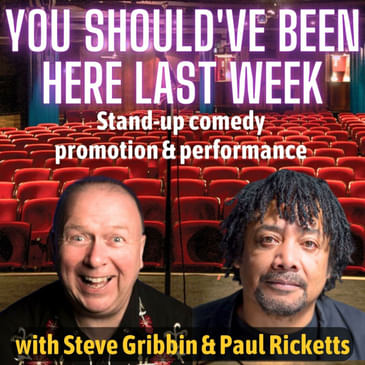


They say doing stand-up is the hardest job - so how hard is promoting a comedy show? In this episode, Steve Gribbin and Paul Ricketts interview performer, writer and promoter Stephen Grant, a Brighton institution with his Krater Comedy Club - now relaunched as the Forge Comedy Club. Plus Paul and Steve discuss the term 'comedy literate' and what the heck does it mean? If you're interested in getting involved or finding out more about live promotion or performance, then this show irreverently pulls back the curtain on the world of professional comedy.
Watch interviews on our YouTube channel. Support our show! Contributions can be made to Steve Gribbin's Ko-fi account or Paul Ricketts JokePit account. You can also email us.
You can watch full interviews with UK comedians on our YouTube channel: https://www.youtube.com/@UshouldvebeenHerelastweek
Give £5, £10 or £20 now and help CALM in their fight against suicide: https://www.justgiving.com/page/podomedy-stay-tuned
Hosted on Acast. See acast.com/privacy for more information.
[00:00:00] You can count the punters on one hand
[00:00:08] But the street they were completely wrapped
[00:00:12] They were filled up to the guddles
[00:00:14] They were chewing down the street
[00:00:16] They said you should have been here last week
[00:00:19] I swear you should have been here last week
[00:00:23] Oh yeah, you should have asked him really to talk about it.
[00:01:40] And we did.
[00:01:41] We should have asked him.
[00:01:42] We can't talk about it.
[00:01:43] If we hadn't asked him about it.
[00:01:44] So yeah, maybe we should do that next time. morning because it is this morning, just for us to say this for our guests, Stephen Grant, who's in Australia, who's speaking to us live from some part of Australia, probably the coast, a Brighton institution, I would say, 20 plus years you ran the Crater Club and now you've started a new one, the Forge, and good afternoon to you, isn't it?
[00:03:02] Yeah, hello. It was good afternoon. It's five past four. It takes minus one where you I think it's keen to point out that a lot of people become comedy promoters and no one will ever admit that because they love comedy but they're not very good at doing it. And so therefore they would love to still be involved in it. They get to know a lot comedians while they desperately try put on my own shows. So before the media came along and so I was doing that, I had a variety of different comedy nights in Brighton. I did but they really know what they're doing comedy and they used to get quite stressed about the fact that it didn't always sell. And what they did is they put the apps from a big agency called Off the Curve that we obviously we know but maybe the listeners don't know and they would have me hosted so
[00:07:04] that I would do that.
[00:07:06] And I was in a month. I thought if I asked for once a fortnight and they just say, well, it looks only once a month, then I would have got what I want. So I asked for once a fortnight. And then I went to see the venue. They took us down the stairs and they took me into a space that didn't have a floor, just had six pillars holding up the ceiling and it was a hole in the ground. And that's where the name of the crater, because
[00:08:20] when the first time I saw it was just a hole like being paid. You know, when you like an open spot and they goes like, we can't give you money, we'll give you a few drinks and some food. Any gig that gave you drinks and food has actually gone up I get from performing and promoting are closer aligns now than they were then. I think back then the buzz I got from performing was literally that, the buzz, that feeling of I've made people laugh, you get off stage, you got that kind of
[00:11:01] fizzy kind of almost that slightly sort of high feeling Yes. Yeah. I you like all comedians who have time free in the day to sit and dwell and and imagine some appalling doom related upshot to their life that was not realistic. Nearly all of my doom based scenarios involved me not being able to
[00:12:21] perform anymore, but still being able to promote doing? Well, basically, I think the whole thing is a simple choice. Which one do you like most? the age difference between you and the people who are watching you are the same. If you're doing a package comedy show, you're selling yourself as a fun night out for people who want to have a fun night out. There's no reason why that doesn't have to include 50 year olds and 60 year olds or 20 year olds and 30 year olds, but that product is always pitched to the
[00:15:01] same people. So that audience stays the same age, but you get older. And it's going to be a two-hour drive. Then you get off stage and then you pack away your guitar and stuff. Then you walk to your car park and you pay your parking, you get in your car and you drive home. And you've got a stage at 11 and you're back in the car for 11.20 and your home. Because they're close on the roadways in the way, you're home at half past one in the morning. And you walk in front door. And instead of being somebody who is buzzing on the adrenaline of showbiz,
[00:16:24] you're a bloke who is looking at promised myself that if I was, if I, if a year in comedy had passed and I wasn't better than I was a year ago, I would probably wind it up and knock it on the head because I'm
[00:17:41] no longer improving. Now, I've revised that plan to make it four years thanks to country.
[00:18:46] form and comedy despite being an industry in a business is an art form and we are all responsible for being better.
[00:18:48] Absolutely true. I mean, what would you say going back to the promoting thing? I mean,
[00:18:58] have you got any tips for anybody that wants to be a promoter? What's your top tip to give
[00:19:03] to anybody that wants to start their own club or and do a gig somewhere where the promoter says, oh yeah, we've got this little bit actually where off the first back before the interval we come out and we do this tambola and then your cart sinks and goes,
[00:20:20] oh, no, no, no, no, no, they really love it, they really love it.
[00:20:24] The second and third acts, we ever really have a really good time. are based on the fundamental tenets of comedy. The fundamental tenets of comedy are as follows. You only hear the comic, you only see the comic, you only face the comic, and you remove every possible distraction that stops any of the above happening. So, no sound leaking, don't make it too hot, don't make it too cold, right? Don't, you know, make sure the
[00:21:42] act is really well lit. And I don't just the experience. Sound the light, the rest of it. Even things like having the doors to the toilet near the stage. You want the bar at the start of the stage as possible, probably not in the side. You want the toilets away from
[00:23:03] it. So if someone goes to the toilet, they could squeeze people onto a misery. Comedy wants a low ceiling so the last days in the site, like they more likely could be that as well. But actually, I think the reason is because they weren't for me like guests.
[00:24:20] They were pretty like cattle. And they got in the Ford's Comedy Club, everything that personally works with me has got one thing in common. And that is, they love comedy. It's literally the thing that gets you to sit down and have a little interview with me before the job start. You don't love comedy. It doesn't matter
[00:25:41] how competent you are, you're not going to do it.
[00:25:43] We'd be like running a music venue, wouldn't it a go at the audience and it's quiet, I'm going to never have a go at the audience. They're the people who turned up. They're the people who turned up. It's not their fault. They turned up. It's the people who didn't turn up as a fault and they're not there to have a go at them. You reward the people who turned up. I always think that the pre they can sit down. They want to have a laugh, but they're not pleased they don't have to chat. And they want a really nice glass of wine, right? And they're quite pleased that the toilet has got to be on it. Right, they're just, they want the night out experience without it being like a fucking festive, you know, they don't want to be
[00:28:23] wrapping in a trench. They don't want one. So that is the way that's going to work. Package comedy will still need to exist in some way, shape or form. And comedy clubs will still continue to thrive. But getting people through the door more and more requires people to have what's effectively a presence that they can review because it allows people to check something before they go out.
[00:29:40] And I honestly believe that all those people
[00:29:42] who have got huge from doing reels and Instagram
[00:29:45] and TikTok and stuff like that, Well, phrase I want to choose this time is comedy literate. Oh, yes. It's often said by promoters when they are trying to entice you to the gig in Bumpfup in the middle of nowhere. And they say, it's great though. I know it takes eight hours to get there by yak, but the audience is very comedy literate,
[00:31:03] you know, or they're ever so comedy you are, I don't remember what this gig is like. The much mentioned, uh, John Gless Paul Smith, which I'm glad it doesn't exist anymore because we have coated it so much in every single episode. John Gless Paul Smith gets a go now, right? Yeah. So to get back to your original point about all they like comedy here at John Gless Paul
[00:32:21] Smith, sometimes they're laughing. You know, well, the odd verse of that though is that I wanted to give it's, I think it was the Glee Club in Nottingham. And this was in the early 2000s. But, and I think there was a spatement at the time that these blokes were all pissed at them and doing a stag nice, and he said, oh, yeah, mate, mate, it's really good.
[00:33:43] He said, we had our, and he, if I had someone shouted house and then we had to stop their act to give the person the price. Oh dear.
[00:35:00] You know what, going back to comedy literature, I mean the opposite of that is comedy illiterates.
[00:35:08] Yeah. So yeah comedy literature is quite snotty terms really. And it means very little, it just means there's under sort of act that needs to have people who know what a joke is. I think most people do don't they? To me it smacks up that attitude where you know you've got people going to see bands and you wonder why they bother because they're just standing there going oh this is shit.
[00:37:31] it was very nice. And every so on, I mean, Jimmy Talmak, you know the story, I did do that. I was at the gig that he was, I had I had ordered some ham sandwiches and I went
[00:37:35] to the toilet when I came back to Gone. And I swear to this day that Jimmy Talmak could
[00:37:40] eat those sandwiches because when I came back to talk to. Put that in the comments section. Anything else that I should say? Yes, of course. Oh, I've talked to something.
[00:39:00] And also make your own set of comedy bingo cards.
[00:39:04] Yeah, so when we say John Guell's Paul Smith next time.