
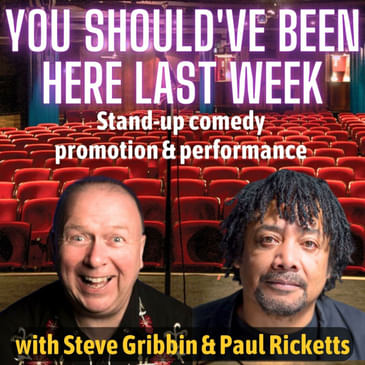


In 1982, Steve started performing at the very beginnings of Alternative Comedy. Initially in double act "Skint Video" and solo from 1994. He's celebrating 40 years in the business - minus 2 for Covid! Steve explains how he continues to wow audiences without losing his enthusiasm and joy in doing comedy!
Get tickets for "Steve Gribbin - 40 Years In The Saddle!", charity celebration gigs at the Comedy Store, London on December 11th, 2024. Book now.
Watch interviews on our YouTube channel. Support our show! Contributions can be made to Steve Gribbin's Ko-fi account or Paul Ricketts JokePit account. You can also email us.
You can watch full interviews with UK comedians on our YouTube channel: https://www.youtube.com/@UshouldvebeenHerelastweek
Give £5, £10 or £20 now and help CALM in their fight against suicide: https://www.justgiving.com/page/podomedy-stay-tuned
Hosted on Acast. See acast.com/privacy for more information.
[00:00:32] Welcome to this episode of You Should Have Been Here Last Week, the podcast that takes a peek behind the comedy curtain at the comedy business and tells you what's going on behind it. Presented by me, Steve Gribbin and fellow comedian, Mr. Paul Ricketts.
[00:00:48] Hello.
[00:00:49] Yeah.
[00:00:50] And we talk to lots of different, different people on every episode. But today's episode is very special because today's special guest is me.
[00:00:59] Yes, it is. It's Steve Gribbin. And basically we're talking to Steve today as we do in every podcast, but it's your 40 year anniversary in the comedy business. Yeah. The place that we call show the detakers, the godforsakers, the 12 dozen bakers, who knows all the great panoply, which you are. You represented one person.
[00:01:28] Yeah, I did. Well, you know what? I've slightly cheated it because it should be 42, but I have actually knocked off two years because of the pandemic. Because as you know, many of us, I would have said about 90% of comics didn't work at all, did they during that period?
[00:01:44] Oh, so you're saying, so if it's 42 years, it's 1982?
[00:01:50] Yeah. It was the day after my 22nd birthday. It was Thursday, the 27th of May, 1982. And it was at the Woolwich Tramp Shed.
[00:02:00] Oh, wow.
[00:02:00] Alas, it's open again, isn't it? It's a comedy venue, but it was closed for many years because it was a Sainsbury's supermarket.
[00:02:09] Yeah, and I was on with Vivian Soad, who was a performance artist who's now married to Martin Soad, who's in The Greatest Show on Legs.
[00:02:19] And she was dressed from head to toe in Archbishop regalia, and she was on roller skates and playing a saxophone.
[00:02:30] But she couldn't do the roller skating properly, so every time she came to introduce somebody, she goes,
[00:02:39] And so some people had to come on and sort of like steadier.
[00:02:43] She came on to think, and there was a guy on there called Oscar McLennan, who was a Scottish comedian, who was very, very intense like that.
[00:02:52] And they spent the last 20 minutes of his act completely naked, but never mentioned it.
[00:03:02] Well, didn't he take his clothes off and people might have noticed that the clothes were being removed?
[00:03:08] Never once said, I'm taking my clothes off. He just took his clothes off.
[00:03:16] That was the wild and wacky world of the early alternative comedy circuit, really.
[00:03:21] There were some strange people on that.
[00:03:24] There was a performance poet on that night called Bette Lynch.
[00:03:28] That wasn't his real name.
[00:03:32] I remember one of the lines of his poems was,
[00:03:36] it was about the Falklands War, it was in the middle of the Falklands War,
[00:03:40] and he's going, don't you call me a fucking moron, don't you realise there's a war on it?
[00:03:50] What were you doing then before you started doing stand-up at the very young age of 22?
[00:03:57] Well, I'd come to London to go to Goldsmiths College,
[00:04:00] so I was doing English literature and drama subsidiary.
[00:04:07] So I got my degree and then I went back to Liverpool,
[00:04:10] was unemployed along with about three million other people.
[00:04:14] Came back to London, I applied to go to Queen Mary College
[00:04:19] to do 20th century European literature.
[00:04:22] And while I was doing that, I was working in a,
[00:04:25] I worked in Peekfreend's Biscuit Factory on the Christmas Pudding Department.
[00:04:30] And if I could, if I could just say,
[00:04:34] please people never eat Christmas pudding, don't eat it.
[00:04:38] I can't tell you, I'll tell you some of the things that go into it.
[00:04:43] Anyway, yeah, people used to, didn't they?
[00:04:46] Why?
[00:04:46] Chewing gum, if it dropped on the floor, they'd just go,
[00:04:49] ah, fuck it.
[00:04:51] And just put it back on the thing.
[00:04:54] And then we had to walk through the bit where they have the twiglets,
[00:04:58] that was the vilest thing I've ever smelt in my life.
[00:05:02] And I'd never eaten twiglets in.
[00:05:03] Anyway, I was doing that.
[00:05:04] Then I worked in a sort of hardware shop.
[00:05:07] So I was doing just odd jobs, really.
[00:05:09] And then I, a friend of mine called John Ivins,
[00:05:12] who was in the original version of Skin Video,
[00:05:15] used to go to the Albany Empire in Deptford.
[00:05:17] And he'd come back and tell me about all these people
[00:05:20] like the Oblivion Boys, Pauline Melville, French and Saunders.
[00:05:26] You know, you'd go every week and you'd say,
[00:05:28] look, there's something going on here, like Alexei Sale.
[00:05:31] And he was saying, no, it's brilliant, it's brilliant,
[00:05:33] you know, you should come.
[00:05:35] And I was going, ah, no, I never bothered.
[00:05:38] And then, I don't know how it happened, but we just,
[00:05:41] he said, look, let's do some comedy together.
[00:05:44] So we, you know, our first incarnation was mainly sketches.
[00:05:50] And we were way ahead of our time because most of the audience
[00:05:53] used to sit there like that.
[00:05:55] Because it was completely unheard of, people doing sketches.
[00:05:58] You know, we were called Skin Video.
[00:06:00] And the idea behind it was that we would do live versions of a video.
[00:06:05] So one of our sketches was about a British soldier,
[00:06:09] the Falklands, who fell in love with a penguin.
[00:06:14] It was terrible.
[00:06:16] And the only, the only reason we got that was because we got hold of,
[00:06:19] we used to go to a joke shop that was in near Euston,
[00:06:23] which isn't there anymore, but you could buy everything there.
[00:06:25] And we got a penguin that you could push along the floor and the penguin,
[00:06:29] its feet went like that.
[00:06:30] Oh, excellent.
[00:06:31] What should we do with this?
[00:06:32] Yeah, it was great.
[00:06:33] It was good for portraying a penguin in love.
[00:06:38] So that's basically, we started off doing sketches.
[00:06:40] The songs came in to sort of break up the sketches.
[00:06:43] And I mean, the real reason I did it initially was to get an equity card
[00:06:47] because I wanted to be an actor more than anything else.
[00:06:50] And in them days, as you probably remember,
[00:06:52] you couldn't get an equity card unless you could prove that you had performed
[00:06:58] in front of a live audience 10 times with verified contracts,
[00:07:05] signed and witnessed by two people.
[00:07:08] I mean, it was a hell of a rigmarole.
[00:07:09] And I did that and I got my equity card.
[00:07:11] But by which time it was like that thing of I'd done it and I'd loved it so much
[00:07:16] to sort of, it burrowed underneath the skin.
[00:07:18] And I thought, nah, I don't want to be an actor anymore.
[00:07:22] Bollocks.
[00:07:24] Basically, that's what happened.
[00:07:25] I was an actor as well.
[00:07:27] I was in a theatre company based in Blackheath.
[00:07:31] And we used to do, oh, this is, I sound like I'm in confession though.
[00:07:35] We used to do a thing called Reminiscence Theatre.
[00:07:37] We should go around old people's homes and interview the old people.
[00:07:41] You know, we turned that into a play about their lives, whatever.
[00:07:45] And actually, the interview bit was really interesting, you know,
[00:07:49] aside from the fact that I've met a lot of racists.
[00:07:51] But, well, I suppose, you know, an hour play about a racist talking about
[00:07:56] what South East London used to be like.
[00:07:58] Yeah.
[00:07:59] I suppose that, yeah, that would put you off.
[00:08:01] No, I mean, there were mainly things like that.
[00:08:03] I mean, we did a show about Christmas once, which was, yeah.
[00:08:06] I mean, I do remember that we did the Labour Party conference in 1983, I think.
[00:08:11] And it was terrible.
[00:08:13] And we were all dressed up in costumes.
[00:08:16] I've even got a photographic.
[00:08:17] I might put that up on Facebook later.
[00:08:19] And Colin Welland, the famous playwright and author of,
[00:08:24] didn't he write Chariots of Fire?
[00:08:26] Yes, he did.
[00:08:26] Yeah, he sat in the front row.
[00:08:28] And one bit we did, which was meant to be funny,
[00:08:30] just sat in the front and just went...
[00:08:34] LAUGHTER
[00:08:37] I mean, still to this day,
[00:08:38] I think that's probably the most devastating heckle I've ever had.
[00:08:42] What, Colin Welland shaking his head in disappointment?
[00:08:45] Yeah, and tutting very loudly, yeah.
[00:08:47] LAUGHTER
[00:08:48] I mean, that's second only to, you know,
[00:08:50] because we were very active in the minor strike.
[00:08:52] And we did a gig outside a power station in January 1984.
[00:08:59] Sorry, 85.
[00:09:01] And that's the worst heckle I've ever had,
[00:09:03] which is like 1,000 police with riot shields just going...
[00:09:08] LAUGHTER
[00:09:10] LAUGHTER
[00:09:13] That was so cold that my actual fingers froze to the fretboard,
[00:09:16] to the guitar.
[00:09:17] I couldn't...
[00:09:18] Wow!
[00:09:18] Yeah, it was horrible.
[00:09:20] Yeah.
[00:09:20] I mean, by that time, I shouldn't have hastened to...
[00:09:22] It wasn't in the theatre company,
[00:09:23] it was actually in the double act, the comedy double act.
[00:09:26] And it was awesome, people like Jeremy Hardy and Mark Steele
[00:09:29] and Dave Cohen and Linda Smith and people like that.
[00:09:32] We all did that, the gig,
[00:09:35] at six o'clock in the morning on the picket line.
[00:09:38] Wow!
[00:09:39] Yeah, I know.
[00:09:41] Jeremy was very, very funny.
[00:09:42] He said, I've been greetings from equity.
[00:09:44] And he said, but can I also, this contravenes equity's,
[00:09:48] you know, guidelines as to performance temperature-wise.
[00:09:53] LAUGHTER
[00:09:55] To which the police just went...
[00:09:59] I mean, I'm surprised we weren't all arrested, you know,
[00:10:02] but there you go.
[00:10:03] Who was the original member of Skint Video?
[00:10:05] What happened to him?
[00:10:06] Well, John Ivins used to live in the same road as me
[00:10:10] when I was in Gospers College.
[00:10:11] He was a...
[00:10:12] He always wanted to be an actor,
[00:10:14] and he got a job in ATC, Actors Theatre Company,
[00:10:18] which is quite a big touring theatre company in the days,
[00:10:21] and he left halfway through.
[00:10:23] And then the other guy joined.
[00:10:25] John Ivins went on to be the head of Maudsley Hospital.
[00:10:31] What a weird...
[00:10:32] The clinical director.
[00:10:32] I know.
[00:10:33] Career switch that is.
[00:10:34] Well, I don't know, you know, because I always think that, you know,
[00:10:38] especially nowadays with lots of people who've got mental health problems,
[00:10:41] I think it probably stood him in good stead, didn't it?
[00:10:44] Mm.
[00:10:44] He actually was involved in the treatment of Paul Merton.
[00:10:49] Really?
[00:10:49] I didn't know Paul Merton received treatment.
[00:10:51] What for?
[00:10:52] He had a bit of a mental health problem, yeah.
[00:10:54] I never knew.
[00:10:56] But luckily another comic sorted him out.
[00:10:59] Yeah, yeah.
[00:11:00] Sat there and listened to him.
[00:11:01] Yeah.
[00:11:02] And then said, can you just shorten this and get to the punchline quicker?
[00:11:05] Give me a red light.
[00:11:06] Give me a red light.
[00:11:08] So that's what he...
[00:11:09] He sort of pissed off in 83, and then Brian Mulligan joined.
[00:11:15] And then we were signed...
[00:11:17] We had a terrible management deal with Feedback Unlimited, they were called.
[00:11:22] And we actually had to buy ourselves out of that.
[00:11:25] And then we signed to Off The Curb Limited in 83.
[00:11:30] And Feedback Unlimited...
[00:11:31] What a terrible name for any agency.
[00:11:34] That you just sat there for hour after hour going,
[00:11:37] well, what you really need to do is this.
[00:11:38] You want to make it.
[00:11:40] I keep telling you.
[00:11:42] Yeah.
[00:11:42] Feedback Unlimited just like...
[00:11:44] Meow.
[00:11:48] Yeah.
[00:11:48] So we signed off the curb with the legend that is Addison Creswell.
[00:11:54] And they had a period of relative, you know, pretty successful about five, six years
[00:12:00] where we toured...
[00:12:01] Did like 50-day tours in the UK and lots of universities, theatres, small theatres.
[00:12:07] And yeah, a bit of telly.
[00:12:10] A bit of telly, as they say.
[00:12:12] I remember seeing you on telly.
[00:12:14] When we have people who talk...
[00:12:16] Guests on the show who talk about that period of time,
[00:12:20] it seems like the gatekeepers that would move acts onto TV and bigger, greater exposure
[00:12:27] were more mental than the acts that they were representing.
[00:12:32] I can't say.
[00:12:33] I mean, they're still active, so I can't say.
[00:12:35] But one particular television producer had it in for us.
[00:12:38] And he wrote a letter, which I've actually got.
[00:12:43] It might come out in my book, actually.
[00:12:46] Sod it.
[00:12:46] Which I'll plug my book there.
[00:12:48] But I am actually writing my autobiography entitled,
[00:12:51] Jimmy Tarbuck stole my sandwiches.
[00:12:53] And that letter's going to be in there.
[00:12:55] And which he wrote.
[00:12:56] He said, I will never put The Greatest Show on Legs skit video.
[00:13:01] And he mentioned two or three other people that he said,
[00:13:03] they will never get on television while I am head of blah, blah.
[00:13:09] So he hated us.
[00:13:10] I mean, ironic that all the acts that he picked up were working class, really.
[00:13:15] Only that.
[00:13:16] Sounds like he failed in many instances, because they all did eventually get on television.
[00:13:21] Yeah.
[00:13:21] I mean, we did about seven or eight teleprograms.
[00:13:24] You know, we did Cabaret at Jean Gleurts, which the one and only time...
[00:13:28] That's the time that we were doing a warm-up for that with Malcolm Hardy.
[00:13:32] And we were banned from junglers for over 10 years,
[00:13:36] because Malcolm Hardy pissed on the stage.
[00:13:39] Oh, my God!
[00:13:44] And afterwards, we came off, and the landlord of the pub went,
[00:13:47] you fucking bastard.
[00:13:49] You pissed on stage, you fucking animal.
[00:13:51] You dirty animal.
[00:13:53] And we were all squashed in there.
[00:13:54] I don't know if we went to the old junglers at Battersea.
[00:13:57] There was a little tiny passageway she went to go down the stairs.
[00:14:00] It was a massive melee of people punching each other and shoving.
[00:14:05] And I was banned from junglers then, all the way through Scooby-Doo.
[00:14:09] We never played there, except for the teleprogram.
[00:14:12] And then I came back, God, late 90s, and did an audition.
[00:14:18] Did a 10-minute spot and got back in again.
[00:14:21] But that was a long time.
[00:14:22] So that was 1988, that was.
[00:14:25] Wow.
[00:14:26] Yeah.
[00:14:27] So then what happened to Brian then?
[00:14:29] I mean, things were going along nicely.
[00:14:31] Tele-exposure.
[00:14:33] Obviously, the odd little bit of Radio 4, I'm guessing.
[00:14:36] Things were pretty good.
[00:14:37] I mean, I suppose that there was a sea-changing comedy about 1990,
[00:14:42] 1991 with Vic Reeves and Bob, who I do like.
[00:14:46] Yeah.
[00:14:47] But political comedy sort of went out of fashion, as it were.
[00:14:51] Yeah.
[00:14:52] And there was a recession on in the early 90s.
[00:14:57] We were both struggling financially because I just brought a house, etc.
[00:15:01] And then Brian just one day said, oh, I'm going to go to teacher training college.
[00:15:05] So he did.
[00:15:07] And that's when we carried on through the early 90s.
[00:15:12] Because we had actually quite a successful radio show on Radio 1 called Songlines with Mark Hurst and Dave Cohen,
[00:15:19] which ran for two series.
[00:15:20] And we had loads of really good guests on, like Tom Robinson and, you know, Phil Jupitus was on it.
[00:15:27] And Corky and the Juice Pigs were on it as well.
[00:15:31] Yeah, it was good.
[00:15:32] But all the while that was going on, we were sort of breaking up.
[00:15:34] It was quite very bittersweet.
[00:15:36] So I sort of did that thing that I was doing solo gigs alongside doing,
[00:15:41] which was really messing with my head.
[00:15:44] And then I went fully solo in 94.
[00:15:46] So it's actually 30 years as a solo act.
[00:15:50] And that was just quite a shock to the system starting again.
[00:15:55] Yeah, it must be.
[00:15:56] Yeah, I didn't have to start at the bottom because people knew who I was.
[00:15:59] But I still had to, yeah, do a lot of 10-minute spots just like, hello, it's me.
[00:16:06] Kevin Day did say to me, he was watching me once when I did Portsmouth.
[00:16:10] He said, listen, just a note for you.
[00:16:14] You should face that way.
[00:16:18] I was always on the left.
[00:16:20] And so I was doing this.
[00:16:21] So I was doing that.
[00:16:22] And I'm thinking, oh, yeah, this is what.
[00:16:25] And then he said, no, no, no, face out front.
[00:16:28] Face out front.
[00:16:28] Yes, you did always stand on, well, audience right from their point of view.
[00:16:33] And you always slightly turned in.
[00:16:35] Yeah, yeah.
[00:16:36] Because I was waiting for, and the other thing was, that was really hard at first.
[00:16:40] Because if you're in a double act, I was in there for 12 years, you suddenly realise, I've got to keep speaking.
[00:16:47] There's no bits we, because I, Brian used to go on these sort of little rants and I'd just go around the back of the amp and just go, be having a sneaky drink or, you know.
[00:16:57] And then I thought, I can't do that now.
[00:17:01] It's just tiny little things that take a bit of getting used to, you know.
[00:17:06] You know, I re-signed to Off the Curb as well.
[00:17:09] And then had a bit more telly and stuff like that.
[00:17:13] How long did it take you to feel fully comfortable being a solo act?
[00:17:18] I think it was about three or four years, really.
[00:17:22] But I say three.
[00:17:23] And I went to Edinburgh in 95.
[00:17:30] And I think that was a mistake.
[00:17:32] Because I'd only been solo a year.
[00:17:34] And the show was all over the place.
[00:17:36] It was a bit of a mess.
[00:17:39] And I should have waited.
[00:17:41] I went in 97 and had a much better time.
[00:17:43] Probably the best show that I've done there, which is a show called I'm Turning Into My Dad, which is very successful and got really good reviews.
[00:17:50] By which time I'd been going, you know, four years.
[00:17:52] And I was a bit, I knew what I was doing then.
[00:17:55] Yeah.
[00:17:55] You know.
[00:17:57] Yeah.
[00:17:57] So about four years.
[00:17:58] When you first went solo, was it mainly stand-up or was it still immediately stand-up and songs?
[00:18:05] It was, yeah, it was always a mixture of both.
[00:18:09] I mean, a big help for me because I was always a member of the show that was on at the comedy store every Tuesday night called The Cutting Edge Show.
[00:18:17] So I joined in about 92.
[00:18:21] And that really helped me, helped me to write material.
[00:18:24] It was a real spur to write stuff because people used to turn up, you know, like people like Mark Thomas and Kevin Day.
[00:18:33] And if you turned up and you said, oh, I haven't written anything this week, they just, you get that look.
[00:18:38] So you think, oh, shit.
[00:18:39] So it really thought, that was the sort of making of me really because I thought I've got to come in with new things every single week.
[00:18:48] I mean, it was very, very supportive but very competitive as well at the same time.
[00:18:53] Yes, it must have been.
[00:18:55] Sometimes there used to be spats between people saying, well, I thought of that.
[00:18:59] And then people go, well, I actually thought of the premise and you wouldn't have, you wouldn't have got to the punchline if I hadn't.
[00:19:04] So there was a bit of, so there were a few shared jokes from that.
[00:19:11] Well, I'm going to do it.
[00:19:13] Actually, I mean, I did write an Oasis parody and for years somebody else who was a member of that team was going out in his own set doing it.
[00:19:23] Oh, my God.
[00:19:24] Because he contributed to it.
[00:19:26] But I said, well, actually, it was my idea.
[00:19:29] I didn't care.
[00:19:30] Was this when you started your writing routine?
[00:19:34] Because lots of people will say, well, Steve, he's amazing, constantly coming up with new material.
[00:19:39] How does he do it?
[00:19:40] And you have a sort of pretty disciplined routine about writing.
[00:19:46] I make a note of all the week's news.
[00:19:48] I actually sit down there and I write it all down.
[00:19:51] And then if anything jumps out at me, I'll write an idea for that.
[00:19:57] And while you're doing that, other ideas will occur to you.
[00:20:00] In fact, and then what I do is I've got subjects.
[00:20:04] Elon Musk goes to space.
[00:20:06] Space.
[00:20:06] So on the left-hand side, I'll write down Elon Musk.
[00:20:10] And on the other side, I'll write down space.
[00:20:12] And then I'll write things about Elon Musk and then things to do with space travel, et cetera, and see if there's any crossover.
[00:20:20] You can get a joke.
[00:20:21] I mean, it's really funny because I've been doing that for years, but Sarah Millican told me this is exactly what she does.
[00:20:26] So if she's got something about shops and something about ferrets, she has a column.
[00:20:34] And it's quite an interesting way of doing it.
[00:20:37] And it does happen that while you're doing that, you'll say, oh, yeah, something else will occur.
[00:20:42] So I try and do it every day, really, if I can.
[00:20:46] But obviously, other things get in the way, don't they?
[00:20:50] Yeah.
[00:20:50] I mean, I always remember you saying that you listen to the Today Show on Radio 4 every morning.
[00:21:01] And just to keep up to date with the news.
[00:21:06] And that, I would assume, was part of your routine.
[00:21:09] So you go, okay, so that's an interesting subject.
[00:21:11] Oh, my God, something like that.
[00:21:13] I mean, nowadays, it's changed.
[00:21:15] I mean, I do, obviously, most of it online.
[00:21:18] I'll go to the major stories.
[00:21:20] And if it's on my phone, it comes up as a thing.
[00:21:23] I'll look at that.
[00:21:24] And, you know, just what really tickles me.
[00:21:29] Or if I think I can make something funny out of it.
[00:21:32] You know.
[00:21:33] I mean, that's at the back of my mind.
[00:21:34] I still consider myself to be a political comedian.
[00:21:38] But I'll never do that thing of just going, it's got to be funny first in my mind for me.
[00:21:44] You know, I don't want to be.
[00:21:46] Actually, people get the wrong idea about the early alternative circuit.
[00:21:50] It was mainly people.
[00:21:51] There was a few people doing that.
[00:21:53] But a lot of it was like really sort of weird, eclectic sort of like misfits and people that couldn't do anything else.
[00:22:01] You know, you had loads of weird people.
[00:22:03] There was very few people that were, you know, everything was about Thatcher.
[00:22:08] Yeah.
[00:22:09] People say that because Ben Elton used to go, Thatcher.
[00:22:12] Yeah.
[00:22:12] But he was one of the few.
[00:22:14] I mean, Alexi Sale was not like that at all.
[00:22:16] Alexi Sale was actually quite surreal.
[00:22:19] Yeah.
[00:22:20] You know.
[00:22:21] And very, yeah, obviously he used to go, I'm a Marxist-Leninist and all the rest of it.
[00:22:26] But I mean, he's the reason I got into comedy.
[00:22:28] As I saw him at the Albany Empire in Depth.
[00:22:32] We supported him.
[00:22:33] And he just blew me away.
[00:22:34] There's one particular moment where somebody heckled him and went, Fuck off your shit.
[00:22:39] And he actually climbed up the thing.
[00:22:42] It was quite high up.
[00:22:44] Like, it was like 10 foot off the ground.
[00:22:46] And they were sat in a box.
[00:22:48] And he climbed up like that.
[00:22:49] And everyone's, the crowd are going mad.
[00:22:50] And he just went like this.
[00:22:52] Screamed.
[00:22:52] He went, I'm sorry, mate.
[00:22:54] What was that?
[00:22:59] And the guy just sort of shit himself went, uh, oh, fuck it.
[00:23:04] It's one of the best things I've ever seen.
[00:23:06] It's fantastic.
[00:23:07] Are you a news obsessive?
[00:23:11] Has the job made you a news obsessive?
[00:23:12] Or would you have been this without doing comedy?
[00:23:16] Yeah, that's actually a really good question.
[00:23:19] I probably was.
[00:23:21] But it's intensified it, you know.
[00:23:24] Um, but in a way, there's, I mean, I think a lot of, um, topical comedians would tell you this.
[00:23:29] Um, there's a good side and a bad side.
[00:23:31] The good side is that, you know, obviously you're paying attention to stuff that's happening.
[00:23:35] But the bad side is that sometimes you think, how can I make a joke out of this?
[00:23:40] And it's kind of, you know, there's some things that I, I don't know.
[00:23:44] I think I, I'm one of the people that thinks you can make a joke out of anything, virtually anything.
[00:23:49] But then sometimes it's really hard, isn't it?
[00:23:51] It's particularly what's going on in the world at the moment.
[00:23:54] And, you know, a lot, I know a lot of people on social media.
[00:23:57] So I'm not, I'm deliberately not following the news because it's so depressing.
[00:24:03] Uh, so yeah, I don't know.
[00:24:05] It's made me a news obsessive, but sometimes even I just like, I think I'm going to have a day off today.
[00:24:12] Like, you know, it's grim, really grim.
[00:24:16] Oh, so let's switch subjects.
[00:24:17] So another grim subject, uh, death, uh, in terms of worse gigs.
[00:24:23] Oh, this sounds like a name job, but Ben Elton once said to me that any comic that said that they've never died is a fucking liar.
[00:24:30] Yeah.
[00:24:31] You know, I mean, there's no comic in the world that hasn't had a spectacular deaths, you know?
[00:24:36] I mean, I've, I've had every, every single one.
[00:24:39] Like we, you know, we, we talked about the three levels talking.
[00:24:43] Yeah.
[00:24:44] Silence and violence.
[00:24:46] I've had all of them.
[00:24:48] Uh, once at Glastonbury festival, a guy that was dressed head to toe as Jesus Christ walking.
[00:24:53] And he, he did look like him.
[00:24:55] He had the long hair and, uh, Brian said, uh, you know, it's been 2000 years, you know, wherever you've been.
[00:25:03] And the guy, um, he just sort of like everyone was laughing, but he just walked slowly towards the stage, climbed onto the stage, punched Brian in the face, knocked him to the floor.
[00:25:14] And then got ahold of me and was started slowly strangling me.
[00:25:18] I actually started to black out and, um, there was a sound guy at the edge of the stage.
[00:25:24] He actually was a really nice guy, a fellow Scouser.
[00:25:26] And he just leapt on him.
[00:25:28] This is funny because it's a great visual image.
[00:25:30] He started punching the shit out of Jesus.
[00:25:35] And then, but Jesus like wouldn't let, and then eventually got him off stage and then they threw him out.
[00:25:40] And then the, but the whole crowd going mad, going boom.
[00:25:44] And then he just got up, dusted himself up and then just walked out again.
[00:25:47] Oh yeah.
[00:25:48] And then there was an announcement.
[00:25:49] Ladies and gentlemen, Jesus has left the building.
[00:25:51] And has left the building.
[00:25:53] I mean, I've had, uh, coins thrown at me.
[00:25:56] Um, I mean, one of the worst ones I ever had was, uh, I think I've told you this one before, but it was in a, it's a gig in, um, the same street that the Philharmonic is in, uh, Hope Street.
[00:26:07] Not Hope Street, is it?
[00:26:08] No, uh, where the Phil is.
[00:26:09] And they were building, it was for the architects who built, um, Liverpool one, you know, and they were all posh.
[00:26:17] But I was in, I was underneath the spiral staircase where the waiters had to go and get the orders.
[00:26:26] It was one of the grimmest gigs.
[00:26:28] And then I had that terrible thing where it's a corporate gig and I was getting quite a lot of money, but the woman who was organizing it was at the back.
[00:26:36] And after about 22 minutes, she just went.
[00:26:40] Well, put the hands across the front and get off.
[00:26:42] Yeah.
[00:26:43] The mafia thing.
[00:26:44] And I was just like, yes, I will.
[00:26:49] But then of course you've got the struggle.
[00:26:50] It's a corporate to try and actually get the fucking money out of them, you know, because then they refused to pay because they didn't do the half an hour.
[00:26:58] Yes, but if they tell you to stop, you have to stop.
[00:27:01] They haven't got that fallback then.
[00:27:03] That's why the whole thing is you do your time, no matter how bad it is, until, yeah, until they tell you to stop.
[00:27:12] And then that means you get the money.
[00:27:13] I did actually get the money in the end because I was with Off The Curb and they just, you know, they lent on them, et cetera.
[00:27:18] But it took about four months to get the money.
[00:27:21] So, yeah, I've had gigs where it's just been, you know, absolute silence.
[00:27:28] You walk off to your own footsteps.
[00:27:31] That's a tough one to take.
[00:27:33] Yeah.
[00:27:34] But I always was told by, Jeff Boyce told me a good one that it, because, you know, we used to do a lot of work for Jonglers.
[00:27:40] They used to watch the videos back in Jonglers HQ on a Monday morning.
[00:27:45] And he said, no matter what you're doing, he said, you might be dying the biggest death that everyone's ever died.
[00:27:51] Smile and look like you're having a brilliant time because they watch it with the sound down.
[00:27:56] Yeah.
[00:27:59] I was going to say, what an awful job that must be if you're working at Jonglers.
[00:28:05] Yeah, you've got to watch all the footage from every single gig.
[00:28:09] Yeah.
[00:28:10] Oh.
[00:28:11] No, they just fast forwarded.
[00:28:13] They'd only stop it if there was like a terrible incident, you know.
[00:28:18] I mean, one of the best deaths I ever saw.
[00:28:20] I think I've told you this story before.
[00:28:21] I mean, I don't think you'd mind me telling this story.
[00:28:23] But Dave Fulton at Christmas at Nottingham Jonglers about, I don't know, 2007.
[00:28:29] And he sat there and they were just like blah, blah, blah, blah, blah, blah, blah, blah.
[00:28:32] And no one was paying any attention.
[00:28:34] So he took the microphone out of the stand and he went and sat on the steps at the sides of the stage
[00:28:38] and just started going, silent night.
[00:28:42] LAUGHTER
[00:28:45] He sang it the whole way through.
[00:28:47] No one listened.
[00:28:48] And he put the mic on the floor and he just walked off.
[00:28:51] And they still carried blah, blah, blah, blah, blah.
[00:28:53] Me and the other comedians were in the booth just absolutely fucking pissing ourselves.
[00:28:59] And he just walked off.
[00:29:00] And they didn't even know he'd been on.
[00:29:03] LAUGHTER
[00:29:06] So, yeah, there's been many.
[00:29:08] Many in Manifold.
[00:29:09] But it's like that thing of Mark Hirst used to say that they said it was character building.
[00:29:16] So, yeah, but what character you're trying to build?
[00:29:18] A bitter and twisted monster.
[00:29:20] LAUGHTER
[00:29:22] I mean, you know, everybody goes through it.
[00:29:25] It's one of those things.
[00:29:26] It's just around the corner as well.
[00:29:27] You never know, do you?
[00:29:28] Yeah, always, always just waiting for you.
[00:29:31] 40 years in the business.
[00:29:33] I mean, that's a long time.
[00:29:36] And especially when you think there's comedians that you bump into who say to you in car journeys,
[00:29:41] well, if I've not made it and been on TV and got my own show
[00:29:45] and then gone on to a chat show within five years,
[00:29:48] then basically I'm just not going to do this.
[00:29:50] I'll go back to just my daddy's business and working in media.
[00:29:57] I don't really need to do this.
[00:30:01] And sometimes they actually do do that.
[00:30:03] They don't make it after five years.
[00:30:05] You never see them again.
[00:30:07] So how could you stick it for that long?
[00:30:10] Yeah, that's an interesting question.
[00:30:12] I often ask myself that myself.
[00:30:15] Because I still love doing it.
[00:30:17] You know, I really, really enjoy it.
[00:30:19] It's everything else surrounding it that gets harder the older you get,
[00:30:24] like the travel, the admin.
[00:30:27] The admin seems to be never-ending, doesn't it?
[00:30:30] You know, one, chasing gigs, two, invoicing, three.
[00:30:35] Chasing the invoices.
[00:30:37] Yeah.
[00:30:38] Chasing payments.
[00:30:40] Yeah.
[00:30:41] That's a large part of it.
[00:30:43] But then that's all, you know, it's all part and parcel of it.
[00:30:46] You have to accept the whole thing.
[00:30:48] And the actual being on stage and performing the gigs, I still love it.
[00:30:52] I mean, I still get a kick out of watching other acts as well.
[00:30:55] I mean, last Saturday I did Oxford.
[00:30:57] I did The Glee.
[00:30:59] And Fumbia Amatea was on.
[00:31:01] And Two St. Douglas.
[00:31:02] And they were both really, really good.
[00:31:05] And Bethany Black was compere and she was really good.
[00:31:07] I mean, I just, sometimes it's, you know, you almost forget that you're an actor.
[00:31:12] So I've still got that element of it.
[00:31:15] If I enjoy something, I forget that.
[00:31:17] I just get lost in enjoying it.
[00:31:19] Yeah, so that basically answers your question.
[00:31:22] I'm still getting a really massive kick out of doing it, you know.
[00:31:25] Yeah, but what's the kick?
[00:31:27] What's the kick?
[00:31:29] There's no, you know, thinking of something at four o'clock in the afternoon and getting it.
[00:31:34] I mean, that's still a brilliant, I think, you know, thinking of an idea.
[00:31:37] I mean, that goes back to when I was an actor in a theatre company.
[00:31:41] I was the, you'll appreciate this, I used to be the equity rep.
[00:31:47] And I used to be the one saying, you know, and it was run by a woman called Pam Schweitzer.
[00:31:55] And she had a, she owned the theatre company.
[00:32:00] She was always going, right, okay, we haven't got this scene right now.
[00:32:04] Let's go on till 10 o'clock tonight.
[00:32:07] And I'd be going, no, no.
[00:32:10] If we're going on till 10 tonight, we want some more money, you know.
[00:32:15] And I always found with that as well, I hated being given director's notes.
[00:32:19] I hated that.
[00:32:20] I hated it, you know.
[00:32:21] And so nobody's giving you director's notes.
[00:32:23] If you're a comedian, you can go, you know, you have to take responsibility.
[00:32:27] So you have an idea at four o'clock.
[00:32:29] You think, oh, that'd be funny, you know.
[00:32:30] Yeah, something to do with a moose.
[00:32:32] And then you go on and you say it.
[00:32:34] And then it works.
[00:32:36] It's an amazing feeling.
[00:32:38] But conversely, of course, it just goes, yeah.
[00:32:41] It's your fault, isn't it?
[00:32:43] So it's incredibly liberating that, I think.
[00:32:46] You know, you're in charge of your own destiny, aren't you?
[00:32:49] It's all down to you.
[00:32:50] It's quite freeing and self-indulgent as well.
[00:32:55] It's my, it's down to you.
[00:32:56] You've got to take responsibility for it.
[00:32:58] And, you know, I have freely admit that I've thought what I thought was a good idea.
[00:33:02] As soon as it left my mouth on stage, I thought, what the fuck were you thinking?
[00:33:07] Yeah.
[00:33:10] The first time I ever went on stage was, was it in Lithamstowns in 1974, I think it was.
[00:33:19] I was only about 13.
[00:33:20] And I entered the talent competition.
[00:33:23] And I got beat, by the way, by a man playing the spoons.
[00:33:29] That shows you the 70s, doesn't it?
[00:33:31] But I do remember that feeling of, oh, oh God, everyone's looking at me.
[00:33:36] And I was terrified because I suddenly, and the lights and your mouth goes dry.
[00:33:40] And, you know, obviously you become habituated that if you do it a lot.
[00:33:45] But people don't, I mean, actors always talk, you've probably had the same conversations and I couldn't do what you do.
[00:33:50] It's too terrifying because they can't stand the fact that there's no fourth wall.
[00:33:56] And that people can give you immediate feedback.
[00:33:58] So, you know, you know, as soon as you've done something, if it's going to be serviceable.
[00:34:05] And although I will put a caveat in that, sometimes you've got, and I don't know why this is, it's one of those unfathomable things.
[00:34:13] You'll do something once and it goes like a bomb.
[00:34:16] It's like, bing, and you think, oh, this is it.
[00:34:19] Next gig, same thing.
[00:34:21] Yeah.
[00:34:23] And there's no, there's no bloody rhyme nor reason.
[00:34:26] I don't know what the reason is.
[00:34:27] I don't know.
[00:34:27] And then sometimes you persist in doing it, don't you?
[00:34:31] Yes.
[00:34:31] It's the one hit wonder syndrome.
[00:34:34] Is that some jokes are like, I'm trying to think of one hit wonder.
[00:34:40] Shut up your face.
[00:34:41] It's just, it's only going to work that one time.
[00:34:45] Yeah, exactly.
[00:34:46] Eventually, after about 10 gigs, it's like you have to take the joke around the back and say, get into the black bin bag.
[00:34:55] I'm going to drop you in the canal.
[00:34:57] Bye.
[00:34:57] I love you.
[00:34:58] And then you just, I don't know what it is.
[00:35:01] I mean, sometimes, I mean, for me especially as well, I mean, not just the song thing, but the topicality of something.
[00:35:07] The context of things is constantly changing.
[00:35:11] Yeah.
[00:35:11] So, you know, if I were to do a joke now about Joe Biden being a doddery, you know, having Alzheimer's, et cetera.
[00:35:21] Not that I would have done it.
[00:35:22] I wouldn't have dealt with it quite that.
[00:35:23] But I couldn't do it now because it's got no resonance now.
[00:35:26] It's gone.
[00:35:27] The white top moment when you could have done that has passed, you know, and that happens to me all the time.
[00:35:33] We're just thinking, can I still do?
[00:35:35] No, not really, you know.
[00:35:36] Well, I mean, it's a good job because I'd still be going on going, hey, what about Thatcher?
[00:35:41] What about John Selwyn Gummer, eh?
[00:35:46] John?
[00:35:47] Who remembers John Selwyn Gummer?
[00:35:49] I mean, obviously I do, but not with any pleasure.
[00:35:54] Well, neither does his daughter that he fed the burger to.
[00:35:58] Oh, my God.
[00:35:59] Yes, of course.
[00:36:00] To prove there was no such thing as mad cow disease.
[00:36:03] Yeah.
[00:36:05] Thank you, Daddy.
[00:36:10] I mean, the music.
[00:36:12] You formed a band.
[00:36:14] You've released albums.
[00:36:15] Yeah.
[00:36:16] Still doing it.
[00:36:17] Still doing that.
[00:36:18] Yeah.
[00:36:18] That's another side of it, you know, because I was in bands all the time when I was from about the age of 14 in Liverpool.
[00:36:26] I was in several bands.
[00:36:29] I was in a really dour sort of indie band called Terminal Beach.
[00:36:36] And we did sound a bit like The Cure.
[00:36:40] Yeah.
[00:36:41] I mean, I love music, obviously, and that's a big element of it.
[00:36:44] There's not many musical acts on the circuit, really.
[00:36:47] There's only about 10.
[00:36:49] Yeah.
[00:36:49] So music's a large part of what I do, really.
[00:36:52] Yeah.
[00:36:53] So what would you have liked to have done?
[00:36:55] I mean, obviously, you've done the music.
[00:36:57] You've even done a bit of acting.
[00:36:59] And you've done the comedy.
[00:37:00] But what if none of these things had reached any fruition at all?
[00:37:05] What's your other career?
[00:37:07] Would it have been talking about modern European literature, teaching it?
[00:37:11] Yeah.
[00:37:11] This is terrible, but I was a very precocious kid.
[00:37:14] And people used to say to me when I was about 9 or 10, what would you like to be when you grow up?
[00:37:20] And I used to say I'd like to be an author.
[00:37:23] And I think I would like to have been a novelist, really.
[00:37:26] I still might do.
[00:37:27] I still might do.
[00:37:28] It's taken me long enough to write this.
[00:37:30] I've been writing the autobiography now for about three years.
[00:37:32] But I keep adding to it, adding to it, and then thinking, nah, this is no good.
[00:37:38] And then scrapping it and then starting again.
[00:37:40] Normally, we ask about changes in the business.
[00:37:44] What have you noticed after all this time?
[00:37:48] Yeah.
[00:37:48] Well, one, the standard, I think, you know, we had Mark Thomas on saying this.
[00:37:54] The standard is so much higher now.
[00:37:56] You know, people are starting from a much higher base.
[00:38:00] It's the level of professionalism, et cetera, et cetera.
[00:38:04] Also, I mean, so when I started off, obviously, there was lots of weird and wonderful and wacky sort of people.
[00:38:13] And there's still a place for that, but not in the mainstream.
[00:38:16] So the mainstream has become, has taken over from, you know, the old light entertainment.
[00:38:22] And that's more, less risk averse, as it were.
[00:38:25] It's quite a healthy position, the live comedy circuit.
[00:38:28] There seems to be more gigs than ever springing up.
[00:38:31] And, you know, there's still some people doing really, really funny stuff.
[00:38:38] But I don't know.
[00:38:39] I don't know.
[00:38:39] No, I'm not going to go into that.
[00:38:41] It was much better with our lad.
[00:38:44] We're all observational comedy around here.
[00:38:46] Because I've got this thing that I don't, you know, when people go, oh, I only like X type of comedy me.
[00:38:52] I hate everything else.
[00:38:54] I think, oh, that's fucking stupid.
[00:38:56] Isn't this like saying, I only like heavy metal and everything else is shit, which people do.
[00:39:01] We do know people who say that.
[00:39:03] Yeah.
[00:39:04] I mean, I'm with you on that, that anyone in all the various styles, the people who do it very well, you know, transcend that.
[00:39:12] And you just go, yeah, that's wonderful.
[00:39:13] That's funny.
[00:39:13] Why can't you be allowed to like Harry Hill and Mark Thomas at the same time, who are completely vastly polar opposites?
[00:39:22] So, yes, that has changed.
[00:39:24] I mean, there's a little bit of me sometimes thinking that a little bit of homophobia and sexism has crept back onto the circuit, you know, by other means.
[00:39:35] Yeah.
[00:39:35] Which is a shame.
[00:39:37] By comics suddenly finding an excuse for it is being unleashed.
[00:39:42] Yes.
[00:39:43] Oh, well, I can't say that.
[00:39:45] You could say that.
[00:39:46] I couldn't possibly.
[00:39:47] I can say that, especially when they start talking about Bernard Manning as if he's the god of the unleashed comic.
[00:39:55] Yeah.
[00:39:56] I mean, I met him once and unsurprisingly, he was a complete and utter twat.
[00:40:01] But the timing of that twat, what twatty timing?
[00:40:04] You can't beat that twat's timing.
[00:40:07] He could insult you, but you go, yeah, the timing was good though, wasn't it?
[00:40:13] He went, you bastard.
[00:40:16] There's a pause between you and the battle.
[00:40:18] Oh, it was fantastic.
[00:40:19] And the thing is, the black people in the audience, they were getting insulted, but they were going, the timing.
[00:40:24] The timing?
[00:40:25] Oh.
[00:40:25] Oh, you know, I've never been so insulted in my life.
[00:40:28] So beautifully.
[00:40:34] Oh, God.
[00:40:35] Yeah.
[00:40:36] So that was a very long-winded answer to the question.
[00:40:38] Yeah.
[00:40:39] Any advice to any younger comics?
[00:40:42] They don't even have to be younger.
[00:40:44] New.
[00:40:44] Yeah.
[00:40:44] New comics.
[00:40:45] How they could last so long?
[00:40:49] Develop a thick skin, I think.
[00:40:51] Don't take it personally.
[00:40:54] And we talk about this the other day.
[00:40:55] I mean, that because as a comic, it's you on stage and you feel like you're invested,
[00:41:02] even though it's an act, we're all performing an act.
[00:41:04] You know, we're not being completely ourselves when we go on stage.
[00:41:08] It's a version of ourselves.
[00:41:09] But you can take it personally if the audience don't like you or it doesn't go wrong and then beat yourself up.
[00:41:15] I mean, I think even Adam Blue said, just get back on.
[00:41:19] If you have a bad gig, get back on the horse.
[00:41:20] Do another one.
[00:41:23] And gig as much.
[00:41:24] To very young and new comics, they say, just do as many gigs as you can, as you possibly can.
[00:41:30] And don't take it personally.
[00:41:32] Don't, you know, it's not a judgment on you.
[00:41:35] It is.
[00:41:36] It is a judgment on you.
[00:41:38] Well, I know.
[00:41:39] I know.
[00:41:40] But you've got to learn to say, fuck it, you know.
[00:41:44] You can't.
[00:41:44] Because otherwise, because that actually does happen.
[00:41:46] You and I both know examples of people that have, that it's got to them.
[00:41:52] And they just sort of went, oh, that's it.
[00:41:53] Fuck it.
[00:41:54] And then you just don't see them anymore.
[00:41:57] It does happen.
[00:41:58] People get burnt out and decide to give up for no reason.
[00:42:02] Well, I wish it would happen more.
[00:42:05] Yeah, I bet the young comics do as well.
[00:42:07] Well, yeah.
[00:42:08] Well, I agree.
[00:42:10] More, you know, more burnout.
[00:42:12] More people getting out the industry.
[00:42:14] More gigs for the rest of us.
[00:42:17] I'm not going anywhere.
[00:42:18] So, 40 years.
[00:42:19] Here's to another 40.
[00:42:21] There's going to be a celebration.
[00:42:22] Do you want to talk about it?
[00:42:24] There is, yeah.
[00:42:25] Yeah.
[00:42:25] At Hot Water Comedy Club in Liverpool, there's a show called Steve Gribbin, 40 Years in the Saddle.
[00:42:32] And it's a gala evening in aid of Asthma and Lung UK, which is charity very dear to my heart because my dad died of it.
[00:42:39] And it's got a great bill.
[00:42:42] Gary Delaney, Tez Ilyas, Justin Morehouse, Mick Ferry, Phil Chapman, Nina Gilligan, Deliso Ciponda, me and Katie Tracy.
[00:42:49] That's nine comics.
[00:42:50] And the tickets are only 10 quid.
[00:42:52] And all the proceeds go to Asthma and Lung UK.
[00:42:55] And that is on Monday, the 21st of October.
[00:42:58] And it's an early start, 7.30 start.
[00:43:01] Yeah.
[00:43:02] And is there another one?
[00:43:04] Part two, yes.
[00:43:05] That is on Wednesday, the 11th of December at the Comedy Store in London, which features Harry Hill, Jack Dee, Angela Barnes, Carrie Godleyman, Ria Lena, Nina Benjamin, Chris McCausland and me.
[00:43:22] That's a hell of a bill.
[00:43:24] That's in aid of the Alzheimer's Society.
[00:43:28] And that's selling extremely well at the moment.
[00:43:30] So get your tickets now.
[00:43:31] Yeah.
[00:43:32] I mean, in fact, I need to get a ticket because it's for a charity.
[00:43:36] Obviously, I'm going to be buying a ticket.
[00:43:39] Yes.
[00:43:40] Not even me can get a free ticket.
[00:43:43] Sorry about that.
[00:43:44] Even Sharon's buying a ticket.
[00:43:46] That's my wife.
[00:43:46] She's buying a ticket as well.
[00:43:48] Is she?
[00:43:48] Yeah.
[00:43:50] Oh.
[00:43:52] I'm hard.
[00:43:53] I'm hard.
[00:43:53] She would have insisted, though.
[00:43:54] She would have insisted.
[00:43:55] Sure.
[00:43:56] Yeah.
[00:43:56] So, yeah.
[00:43:57] So they've been plugged.
[00:43:59] We have one other thing to plug before we finish this particularly special episode.
[00:44:03] We've been nominated for an award, haven't we?
[00:44:08] Nominated.
[00:44:10] For independent podcast awards for Best Feen Tune, which I obviously am biased.
[00:44:19] But you wrote it.
[00:44:20] Yeah.
[00:44:21] Well, I did.
[00:44:22] The words, other lyrics, and a tune.
[00:44:25] Yeah.
[00:44:25] Sung the food tune.
[00:44:26] Wrote the food tune.
[00:44:31] And it's catchy as fuck.
[00:44:32] I think it's brilliant.
[00:44:33] Yes, it is.
[00:44:33] Lots of people have...
[00:44:34] Jeff Innocent said he loves it.
[00:44:37] Yeah.
[00:44:37] He loves that tune.
[00:44:38] I like the fact that people compare it to Chas and Dave, Only Fools and Horses, One Foot
[00:44:44] in the Grave.
[00:44:45] One Foot in the Grave.
[00:44:46] I think it's very One Foot in the Grave, isn't it?
[00:44:48] Yeah.
[00:44:49] It's a pastiche, I have to say.
[00:44:51] It's a derivative song.
[00:44:53] Yeah.
[00:44:54] Yeah, but it does the job, doesn't it?
[00:44:56] Yeah, but I've heard the other one in the competition, and theirs is derivative as well.
[00:45:00] And us, the bit lines better.
[00:45:02] Yeah.
[00:45:03] Well, the proof will be next Wednesday, the 23rd of October, when we're going to a big
[00:45:10] do, aren't we?
[00:45:11] Yes.
[00:45:11] So you will find out, listener and viewer, if we've won.
[00:45:17] We might not be on the next episode, but in a future episode, you will find out if we've
[00:45:23] won.
[00:45:24] We should record the next episode on the night of the party, at the party, when we're really
[00:45:29] pissed.
[00:45:30] If we've won.
[00:45:32] Yeah.
[00:45:32] Which is like a big bottle of champagne just going...
[00:45:36] No, I mean, it's full of podcasters.
[00:45:39] I mean, there's no comedians.
[00:45:42] There's a few there, but it's going to be mainly podcasters.
[00:45:44] And the name of this podcast isn't, you should have downloaded this last week.
[00:45:49] It's...
[00:45:51] I don't particularly care about other podcasters.
[00:45:54] I should do.
[00:45:55] I should do.
[00:45:56] I should be...
[00:45:56] Anyway, we'll go there, and we'll do our sorts of connecting, sort of what they call
[00:46:02] it when you're supposed to go there and schmooze and say hi.
[00:46:05] What's your thing about?
[00:46:07] Networking.
[00:46:08] Networking.
[00:46:09] Yeah.
[00:46:09] Yeah.
[00:46:09] We'll do that.
[00:46:10] Well, we have a little name badge on as well.
[00:46:12] We should print up our own t-shirts and wear them.
[00:46:15] Oh, God.
[00:46:17] See you next week.
[00:46:19] Oh, God.
[00:46:20] I mean, some people might do.
[00:46:22] You never know.
[00:46:23] I'm sure someone's going to go up there and get an award and then sell merchandise as
[00:46:28] they're doing it.
[00:46:29] And even...
[00:46:30] If we do win, I'm going to say what I'm going to say now.
[00:46:33] If you like this podcast, please like and subscribe.
[00:46:39] Follow.
[00:46:40] You should do.
[00:46:40] Yes.
[00:46:41] I do all those things.
[00:46:42] If you want to send us money, there are links in the description on YouTube.
[00:46:48] I'm going to put them in the actual...
[00:46:50] In the podcast link or description as well.
[00:46:54] What else can we say?
[00:46:55] Congratulations for surviving 40 years.
[00:46:58] Yeah.
[00:46:59] I know.
[00:47:00] It's...
[00:47:00] Yeah.
[00:47:00] I've got PTSD.
[00:47:02] Yeah.
[00:47:03] Do you know what?
[00:47:04] I don't know whether this is going to be too iffy, but I did prepare a thing that I
[00:47:09] wanted to say at the end.
[00:47:12] No, but it's based on the speech of Rutger Hauer at the end of Blade Runner, which I think
[00:47:21] is one of the best speeches in cinema history.
[00:47:22] It's fantastic.
[00:47:24] But I'm going to say this, right?
[00:47:26] I've seen things you punters wouldn't believe.
[00:47:29] Attacks by hecklers on fire in the arse end of Oldham.
[00:47:33] I watch curtains glitter near the barely attended fringe gig at Cannon Gate.
[00:47:37] All those moments will be lost in time.
[00:47:41] But they won't be lost in time.
[00:47:42] They'll be screenshotted by other comedians and posted on Instagram like tears backstage.
[00:47:47] As many a comedian used to say as they're about to go on at Bo Jonglers, time to die.
[00:47:56] On your anniversary special interview.
[00:47:59] Thank you for being on the show.
[00:48:01] Thank you for having me.
[00:48:03] That's okay.
[00:48:05] We must have you on again.
[00:48:07] Yeah, I hope so.
[00:48:08] Yeah, yeah.
[00:48:27] This show is part of Podomedy, the podcast comedy network.
[00:48:32] We're the best kept secret on Acast.
[00:48:36] Why not laugh at what else we've got?
[00:48:39] Check out Podomedy.com now.