
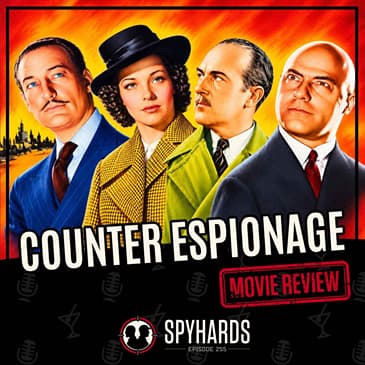


Agents Scott and Cam hit the sandwich table in search of intel while tackling the 1942 Lone Wolf WWII spy adventure Counter-Espionage.
Directed by Edward Dmytryk. Starring Warren William, Eric Blore, Hillary Brooke, Thurston Hall, Fred Kelsey, Forrest Tucker, Matthew Boulton, Kurt Katch, Morton Lowry, Leslie Denison and Billy Bevan.
You can stream next week's movie, Thunderbirds are Go, on Archive.org.
Television Spy can be streamed on YouTube.
Let us know your opinions about the NOC List. Leave us a voicemail on Speakpipe or send us an email now!
Become a SpyHards Patron and gain access to top secret "Agents in the Field" bonus episodes, movie commentaries and more!
Social media: @spyhards
Purchase the latest exclusive SpyHards merch at Redbubble.
View the NOC List and the Disavowed List at Letterboxd.com/spyhards
Podcast artwork by Michael Overton.
Theme music by Doug Astley.
Hosted on Acast. See acast.com/privacy for more information.
[00:00:38] Hello and welcome to SpyHards Podcast, I'm Agent Scott. And I'm Cam the Provocateur, and Scott, what do you propose we do about our stupidity? I think we've been working on it for many years and we've yet to come up with a successful plan. That's the real mission of SpyHards, forget tackling every spy movie ever made, it's figuring out what to do with our collected stupidity. It truly is an impossible mission. We've been dangling for years trying to figure this one out.
[00:01:06] Just, someone help us! Oh! Yeah, it is a... Well, I mean, if you go very meta-textual for a second, perhaps our entire mission is quite stupid in the first place. But we have fun doing it. Like, the stupid people of the world do. They have fun being stupid. Well, exactly. You know, and as you said, like, it's almost impossible because even while doing research on this week's film, I was like uncovering multiple more like spy B-movies.
[00:01:36] Mm-hmm. And I'm like, well, we're gonna get to a point where we have no Bonds, no Borns, no missions, no Jack Ryans, no, uh, Knight, uh, Kingsman, I should say. Uh, we'll have nothing else. Um, but we will have a sea of one hour B-movies from the 1940s. I mean, I wouldn't be all that fussed if, um, if Warren William is in all of them. Um, I mean, that would be fine with me. Yeah.
[00:02:06] It's, it perfectly works for me. And you almost mentioned the film in your list of films there that I, I get like a trigger. I get triggered when you say it. So don't mention that film. Oh, okay. Um, perhaps night and day is what I was referring to. Yeah. Um, yeah, yeah, yeah. But, um, it's funny because, uh, even while doing research on this movie, I found one, Scott, that as soon as I say the title, you're going to be like, can we do that next week, please? Oh, I need to hear this. Come on.
[00:02:31] The film is called Television Spy and it's about the theft of television technology. By the Nazis, I imagine. I think it is. Yeah. It's a World War II era one. Those slippery Nazis. Oh, they just get up to all kinds of no good, don't they? Like, tell me, when you hear Television Spy, how much do you want to just watch that movie now? Immediately. I want to stop this recording. In fact, guys, if you're watching this, turn this off and go and watch Television Spy. I'm sure it's on YouTube.
[00:03:01] We'll have a link in the show notes. You can click it now. Go. So that is one that you may see pop up on the main feed sooner than one would naturally or, you know, properly expect for the most obscure of spyby movies. I think it really just speaks to our ability to keep going, that we can talk about films like this. And I don't mean to blow smoke. It's not what I mean. It's more of a sense of like, we hear you guys. We see you online.
[00:03:29] We see the messages on YouTube, all this sort of stuff. You know, when are you going to tackle the Kingsman? When are you going to tackle Johnny English? When are you going to tackle Jack Ryan? Or, you know, there's a bunch of Austin Powers, for God's sake. We haven't done them. We're waiting because there are so many other films. Yeah. Yeah. Like, I don't know what the release order is on this, but there's like a, in our sites, whether it's come out already or it is soon to come out, there's a 1983 spy movie called Daniel with Timothy Hutton. Yeah. Right? I've never heard of this thing.
[00:03:59] And if you look at the reviews online, nor is anyone else. Yeah. Like, we need to do Daniel. Well, speak for yourself. Well, it's a young Tim Hutton. I don't know. He's quite approachable. He's quite cute. Um, but yeah, like we could run and do all those big things, but then you all have to just listen to like Daniel and television spy every week. And it would be your fault. That's right. Yeah. We would wind up in some sort of horrible hell for the listeners would be. We'd be happy.
[00:04:29] Honestly, we'd be thrilled to be tackling these movies week to week. But like, as a listener, I would pity you all listening week after week to episodes on Daniel, television spy, um, and God knows what else. Which could be great films. We don't know. Like they could be good. No, list films. We don't know. That's the magic of these sort of weird spy hard specials. It's the special sauce in our stupidity. Are we a sandwich? Are we a stupid sandwich? A stupidity sandwich?
[00:04:58] Isn't that like a Gordon Ramsay thing with like a two bits of bread and there's like, you're a stupid sandwich. I think so. Yeah. Yeah. This will now be on the screen of, uh, of me as a stupid sandwich. Congratulations. But I mean, that maybe leads us into this week's film because this is a movie where secret plans are smuggled underneath sandwiches. Yes, they are. And they look like okay sandwiches. I think it was cheese plowman's. Uh, I've never heard of what cheese plowman's is. So I'll take your word for it. It's cheese and pickle basically.
[00:05:28] Oh, that's an interesting combination. Okay. Cheese and pickle? By itself. Well, no, that in itself. No, that would be a typical hamburger or whatever else, but it's just having that by itself. Like nothing else? No meat? Oh, I don't mean like dill pickle. I mean like, uh, Branson pickle or piccalily or something like that. Like, or piccalily is not the same, but, uh, yeah. Okay. Well, next time you come here, we're getting your cheese plowman's. Everyone listening, cheese plowman fans, let me hear you. Yeah, this does not sound like a great reason to buy a ticket to the UK.
[00:05:58] Hey, look, I know we get like raked over the coals for having bad food. And I can't say cheese plowman's will help that argument. I was going to say. But it exists. Something quite nice about a cheese sandwich when you go to a pub and they have like a giant bap with a slice of cheese as big as your head and also a slice of onion as big as your head. And you're just like, yeah, this is kind of all right right now. Okay. Well, there you go. I mean, cheese and onion, baby. What's wrong with it?
[00:06:26] I don't know what our like go to comfort sandwiches over here. I think it's just like the standards. We don't have anything special. Yeah. Well, you'll just be like, I mean, there's literally a subway five minutes from your house. Yeah. Or less. Yeah. Yeah. I mean, I wasn't really timing it and no one really sprints to a subway. So I mean, I do speak for yourself. Okay. He wants them foot logs, baby. Well, we found out recently that they're not, they're actually like 11 inches or whatever. Yeah.
[00:06:56] I mean, people always exaggerate the size, right? Oh, subway. Subway. Classic subway. The shame it feels secretly. Just obviously I'm guessing the CEOs of Subway are all men because they just can't be honest about the size. Quite true. Allegedly. Allegedly. Don't even look at the six inch. They don't want you to know. Nobody looks at my six inch can. That's a, that's a real problem.
[00:07:25] Um, anyway, spy movies. Yeah. Spy movies. Um, we'll get to this week's mission shortly before that, though, we need to look back on the last couple of missions we've had. Uh, and we've had an interesting batch of films. Most recently, the man who knew too little cam. Have we had any correspondence? We have, we have. Over on the Patreon, first up, we have Paul Starling, who says,
[00:07:52] Hi, Cam and Scott. It's been a few years since I last watched this movie, but if I'm not misremembering, I found it amusing but not laugh out loud funny, and definitely worth watching Bill Murray do his laconic shtick. The concept is clever, but the in-jokes and references are too obvious to be funny. Plot-wise, I think it's a missed opportunity. Anyway, keep up the Splendiferous podcast, and thank you for your homage to Patrick Stewart, which we'll get to in a second.
[00:08:19] Yeah, we'll talk about that in just a second. Well, thank you, Paul, for the lovely words. I'm sure there'll be more words about Patrick Stewart in just a second. Uh, nice to see this film has fans. I think a few people have come out of the woodwork as fans of this film since us putting out our posts about it. I also think that, well, I hope that the John Amiel, the director of the film's interviews, helped with that a little bit, too. Uh, we've had a couple of comments over on Instagram about the film, Cam. Would you like to hear it?
[00:08:42] Let's do it. Uh, Matthew Thompson, 49, says, love this movie. I was the only one in the cinema when I went to watch it. Oh. I think that speaks to some of the difficulties this film had. Yep, yep. And this one is from S-T-P-O-N-I-T. I'm going to go with St. Ponit. Uh, sorry, St. Ponit, if I've, uh, come upon your name incorrectly. Mm-hmm. Okay. It says, I love this movie. It's really too bad the Aston Martin was in the shop, though.
[00:09:12] Yeah. That's true. Yeah, yeah, yeah. Great observation. Yeah. I mean, it goes very British with its cars, doesn't it? It does, yeah, yeah. I mean, it's going to... And its humor. And its humor. It's going to that, yeah, classic espionage, and it makes sense why it wasn't a huge hit at the box office. It's the kind of thing that, uh, you know, 16-year-old Cam, he wanted, like, like, 60s Bond craziness, not subtle spy stuff. But you're talking 67, right? Exactly. Yes.
[00:09:41] You wanted multiple Bill Murrays. Multiple. Keep them coming. Um, I, I, there's a version of this podcast where I prepared for it better and knew that joke was coming and wrote the Casino Royale song lyrics out to, like, Bill Murray instead. Right. Where is Herb Alpert when I need him? He's in Casino Royale. I need his Tijuana brass right now. Who doesn't? We all do. We all do.
[00:10:10] Any more, uh, for The Man Who Knew Too Little? We, of course, had an email from Space Odds, who wrote in about The Man Who Knew Too Little. He says,
[00:10:47] Fantastic episode. I'll see you next time. 90s London certainly gives me nostalgia, but the color scheme in some shots looked unconventional for mainstream comedy. The supporting cast is splendid, and my only beef is that Wilson doesn't exclaim his famous catchphrase when he realizes he's in possession of the case he wanted to avoid. Having said that, one of the film's biggest drawbacks is Bill Murray.
[00:11:15] Yes, he is certainly being subtle in the comedic moments, but the man has made a career, till that point, primarily playing smartasses, and here he is playing in arts. I just cannot see him in such a role. It's clear by 1997 that Murray was just biding time, a far cry from when he wanted to be seen as more than just a funny guy, as evidenced in 1984's The Razor's Edge, a passion project of his that he only got made thanks to starring in Ghostbusters. Who was also biding time was Joanne Wally,
[00:11:44] and here almost plays a parody of her famous role, that of Christine Keeler in Scandal. I'm glad that I actually took the time to watch this film, but at times it almost felt as a leftover film from yesteryear. And depending on your point of view, this is both a plus and a minus. Space Odds. I mean, I can't blame you for having a verbose response to the film Space Odds, because we spoke about it for an hour and a half. That's right. Boy, did we, Scott. We stretched the limits of how much one could talk about The Man Who Knew Too Little.
[00:12:14] In fact, we beat the runtime, I think, of the movie. I think so. I think so. We proved how little we know. Well, you're back to that stupidity mention that I made up front. Indeed, indeed, indeed. Well, thank you, Space Odds. Thank you, everyone else, for sending a message about The Man Who Knew Too Little. I'll bring us to a close in a second, but we also had an emergency podcast. Emergency pod. I shouldn't make a jokey thing, because I was leaning into a sad topic for a second there. But Patrick Stewart, Sir Patrick Stewart, passed away a couple of weeks ago.
[00:12:41] And we were in the middle of recording an episode at the time it was announced. And we decided to do a sort of an impromptu special for him. Yeah. And it's been very well received. I think we had a couple of notes on that one, too. We had some comments about the Patrick Stewart episode over on the Patreon. Martin Greenman just thanked us for doing it. He said, thank you for this, guys. E.R. Olsen on the Patreon also chimed in and said, this was such a beautiful tribute. Thank you for this.
[00:13:09] I'm in awe that you crafted such a thoughtful, heartfelt discussion and tribute to him so quickly. Well, I mean, Scott, that's about as good a compliment as you can get. Because you're right. Like, it was something that we were in the midst of our World War Z review when the news dropped. And basically, we finished that one, took a half-hour lunch break, and then came back and did that Patrick Stewart tribute.
[00:13:35] And I'm glad that our sort of, in a way, almost like shock and sort of heartfelt openness about Patrick Stewart and what he meant to us communicated well. Because it could have been a little, like, scattershot or messy. But I'm glad to hear from those of you out there that you got something out of it. Yeah. I mean, it was clearly a moment that affected a lot of people, including ourselves.
[00:14:01] And as the host of this show, we thought it was important to show you a little bit of how we felt about something. Yeah. And you all know that Star Trek is tied into our DNA. We can't escape the gravitational pull of the USS Enterprise. So having Patrick pass away was a moment. But I'm glad that I got to share that moment with all of you. Yeah, exactly. Yeah. But speaking of sharing moments, speaking of groups, of teams, of packs. Uh-oh.
[00:14:31] Uh-oh. It's time to give me your best towel, folks. The Wolf Pack is back. Jack. And those are the facts. Um, what are we talking about this week? We are tackling 1942's Counter Espionage. Uh, the, I mean, we tackled The Lone Wolf Spy Hunt some time ago from the film from 1939.
[00:14:57] That's part, that was the first in an ongoing series of films starring Warren William as the title character. Um, and this is the seventh film in the series. Um, but it is the, uh, well, it's the second spy film. Uh, the rest are unrelated to espionage. The Lone Wolf Spy Trilogy. Yes, because the final one, uh, final entry in the Warren William series is, uh, one called, um, Passport to Suez.
[00:15:26] That one is also a spy film, and that would be the ninth entry. So is there, like, there's a continuity in this film series, because in this film they mention he's in Scotland. But at the last thing we saw him, he wasn't in Scotland. No, honestly, so, like, I, I know I said I was going to watch, like, all of the ones in between, but it's a lot. It's, like, five or six movies. Oh, he's already pulling back, folks. I am pulling back. Honestly, though, like, I really enjoyed my experience, like, going through the first and second one. We both had a good time with the first Wolf. Yeah.
[00:15:56] Wolf, uh, Lone Wolf film. Yeah, and I'll leave my thoughts on this one just for a second. Um, but, um, I really enjoyed the first two experiences. I didn't like the second film as much as the first. Uh, it was more of just a, like, um, stealing, like, kind of like a family pearl necklace. Right. Uh, from a vault. And it, it just felt like it didn't have the invention the first one had, where he had, like, the surrealist ball and things like that. Yeah. The dynamics between him and the, the love interest and then the daughter. All that kind of stuff was stripped away in the second one. Mm-hmm.
[00:16:25] It was more of him and the butler character that we see a lot, Jameson, who we see a lot of in this film as well. Um, and it just didn't quite have the set pieces or the big moments that stood out for me, but it was fun enough. Um, and I'm more than willing to watch the other ones. It just was time this, this past, like, chunk of time. So, um, you know, I, I do look forward to going back, but I would be pretty suspect about there being actual continuity.
[00:16:51] My suspicion is if you watch the one before this one, there's no acknowledgement of him coming to London or anything like that. That's fair enough. And I think there is, uh, there is some changing of the, the law of the world of the lone wolf in this film. The whole daughter thing is completely, like, tossed aside, yeah. And, and then they said he's not married. And yet in the first film, he's a widower. Yeah, that's right. Yeah. So like, that's the thing. It's like nowadays people are incredibly obsessive about the continuity of ongoing series.
[00:17:21] You know, you look at like the MCU, it's like leaping over, you know, all over the place to try to explain things. Um, which is very common nowadays, but in those days it was more like, Hey, it's another lone wolf film. Here's like the actor you like playing this character. And, you know, the way films are released back then, you don't have home video. So you may never see installments three, four, and five or something like that. You know, they play for like a week or so, be gone. And that's that.
[00:17:50] And you may catch up every few installments. So they're not going to have anything that would require you to rely on previous films. Well, let's get into it. Counter espionage. Here is your synopsis. Wolfpack is back causing mass destruction. Oh, wait, sorry. You can rap that. Oh, it is a rap. Okay. I was like, wow. It's, it's a Wolfpack rap from WCW. Uh, I was going to keep going. I was like, they are ahead of their time. Oh yeah. Yeah. Cause mass destruction. I thought that that's beautiful.
[00:18:19] I could keep going about the bad boys are wrestling, but I didn't have time to rewrite the lyrics. Maybe I will later. Who knows? Uh, no, here's the actual synopsis. You can rewrite it for the passport to Suez episode. Okay. All right. Yeah. Uh, that's a challenge, but you're the one with like a rapping career. Shouldn't you be the one doing the rap? It's way funnier if you do it now. Yeah, it is funnier if I do it now. Okay. I like a challenge. Okay. Join us for the next Wolf, Lone Wolf film. And, uh, I'll bring you a rap. Cam has to drop a beat for me though.
[00:18:48] I wish they had the word Lone Wolf in the title because it is a little confusing. I think for listeners just to see counter espionage on their feeds and connect it because most of the films in this series have Lone Wolf in the title. Yeah. Uh, and I remember I did a post when we did the first Lone Wolf film and I was trying to track them all together and there's no like continuity and there's no like, even the titles don't work together. The posters don't work together. It's a shame. Yeah. And then you get the, all the silent films and everything with different actors and yeah,
[00:19:17] you know, the early talk yeast with different actors and it just gets very confusing. Yeah, exactly. But counter espionage, the Lone Wolf turns spy to make Nazis turn pale. Oh, that's good. You know what? They knew how to write a tagline in those days. I'm not finished. It's even better. Oh. And the cops turn green with envy. Money in the bank.
[00:19:43] I just, I mean, I'm all about counter espionage at this point and it finishes off with the Lone Wolf tracks down Nazi spies in London during German bombings. Yeah. I would have said during the Blitz, but yeah. I would have said the same. I wonder if it's because they feel like maybe people outside of North America aren't familiar with the term, the Blitz. I don't know. Outside of North America? Or sorry, within North America. Yeah. You're in it. Do you think people know what the Blitz is in North America? Definitely now. Would they have at the time that's written?
[00:20:12] I think what was going on in the war was more ubiquitous during the war than it is now. Surely. But would they have referred to it by that name? That's fair. I don't know. I don't know either. Because it's not like they called it World War II back then. We need to find a portal in the middle of an alleyway so we can go back in time, like Good Night, Sweetheart, and ask around. Don't take me back there, Scott. Check out the Patreon, folks. Good Night, Sweetheart, the British comedy from the 90s.
[00:20:41] Cam has watched an episode or two and he was not a fan. Nope. Nope. I'm good. I quite like it. But anyway. Anyway. So that's the Lone Wolf. That is counter espionage. We've got a lot to talk about. Cam, can you tell us how we got another Lone Wolf spy movie? Well, the latest in a long series. Just print in money at this point. Yeah. Go back to our Lone Wolf spy hunt episode and I give you a little bit of a backstory. I dare you. Go back.
[00:21:11] It's a fun episode. It is. But, you know, I give a bit of a backstory to the character and he was, you know, he'd existed since the silent era and was relaunched in the wake of the Thin Man series, which is really popular. And so every studio wanted their own kind of like caper mystery sort of series going, you know, that they could crank out really quickly. The movies are about, you know, an hour and change. And, you know, they were making like two or three a year. You're cranking out that six inch really quickly.
[00:21:42] And they were based on the novels of Louis Joseph Vance, who was an American novelist and wrote eight Lone Wolf spy novels. So this one is not based on a novel. This is definitely at a certain point just running in its own direction with the character. There is no basis of this. No. Apart from just the character. No, when we did Lone Wolf spy hunt, that one was sort of loosely adapted from a book. The Lone Wolf's daughter, wasn't it? I think that was the book. That's right. Yeah. Yeah.
[00:22:09] But I think by the time you get to, you know, film number seven in the Warren Williams series, it's like, OK, we are now. I mean, honestly, it's what's relevant. World War Two is relevant. So we want to make World War Two Lone Wolf films. So there's probably not a book to run to. It's just quite. I mean, we won't get into the thoughts too much, but it's just quite confident in how it presents itself as a Lone Wolf story. I just assumed there was a background because of someone who had written for this story.
[00:22:39] But I guess it was just a writer understanding the character and putting him in that world. Yeah. And I think for people who didn't hear the Lone Wolf spy hunt episode, A, I don't really know why you're popping in for this one. But counter espionage, the title may just stand on its own. So, you know, just for those that don't know, like the books were built around a character, Michael Lanyard, the Lone Wolf, who was once upon a time like the most notorious, you know, kind of jewel thief around.
[00:23:04] And he went straight and uses his kind of thieving powers to help people now. But he's always kind of like on the line with the law where they're never quite sure if he's flipped back to his previous sort of modus operandi or whether he is actually on their side. So that's sort of like the, you know, succinct backstory to who the character is and what the kind of the gimmick is. It's funny that it has lasted this long. Yeah. This sort of will they won't they thing.
[00:23:32] The cops are like, oh, he's retired. Oh, he's done it again. Well, oh, he's on our side, actually. I'd say this film is smart in the sense that it transports him to London where they don't necessarily know him. Where was the last one? I don't know. The previous one. I don't know. I haven't seen it. No, no. I mean, I mean, the one we did. Oh, that was in America. OK, right. Yeah. OK, that's fine. So it's like if they take him to a different location, then the, you know, the law enforcement
[00:24:02] in that area wouldn't know necessarily his reputation, which you can bring that back. But if you're doing, you're right, like movie number, you know, six, seven, whatever in America. Whose side is he on? Whose side is he on? Yeah. A spy on whose side? Actually, I want to see J.W. Pepper versus the lone wolf. We practically saw J.W. Pepper versus the lone wolf in this film. We did, actually. Now you say that. He has got a little bit of that sudden gentleman about him.
[00:24:31] Although I'd say it was more New York cop. Cliche. More New York, actually, I say it. But still, like it's larger than life, perhaps. And kind of a buffoon. Yeah. Like us. Exactly. So the screenplay for this movie was written by actually one person, which is kind of rare at that time. Usually it's like two or three people. But Aubrey Wisberg, who is an English novelist, journalist and screenwriter.
[00:24:56] And his debut film was the 1942 World War II thriller, Submarine Raider. And he went right into this movie. Great title. I know, right? They knew how to title a movie in those days. When Cam goes to subway, he is a submarine raider. Yeah. I mean, you were saying in the 80s, we've got a movie called Daniel. In the 1940s, they were like Submarine Raider. What's that? What's that one that was called No Time to Die? Oh, Tank Force?
[00:25:27] Tank Force or something like that. Like, yeah, just cool sounding names. Like you want a ticket stub that says Tank Force on it. And you know they can put that title up on a poster with an exclamation mark at the end. And no one's going like, what is that film about? No. Like, it's tanks. And they're forcing shit up. Yeah. That's exactly what's happening. They're submarines and they're raiding. Exactly. Yeah, yeah, yeah. So, Wisberg basically lived in B-movie mania.
[00:25:56] This guy was just... I live in B-movie mania. Oh, this guy was writing war films, adventures, horror, skin flicks. He was someone who was just doing it all. What's a skin flick? Kind of. They weren't allowed to show nudity in those days. But like, he would be doing films where there was a lot of women showing, you know, long legs. You know, that guy. Oh, oh, some belly button. They're showing a film? Like, there's like a movie called Problem Girls. You should just search the poster right now.
[00:26:26] Scott, you do that while I talk. It's called Problem Girls from the 19... I think it was the 50s. The poster's incredible. But he was writing like movies called like Escape in the Fog. The man from Planet X. Son of Sinbad. That kind of thing. Problem Girls. Why do so many rich girls go so wrong? And how would you describe that poster? Naughty. It is naughty, right? There's some other taglines I also quite like. Um, Problem Girls.
[00:26:56] Secret reform school for delinquent rich girls. See what makes them Problem Girls. Mm-hmm. Mm-hmm. Uh, yeah. Okay. It feels a little like hot for teacher here in this, um... Okay. Yeah. Yeah. I think skin flicks is a good term to describe a movie like that. I look in a couple of stills. Yeah. There's a little skin and it's a flick. Yeah. Yeah. So, you know, that's the kind of stuff this guy's writing. His final film.
[00:27:24] Actually a movie that's pretty famous, um, if you kind of know your film history. His final film was Hercules Goes Bananas, aka Hercules in New York. Arnold Schwarzenegger's debut film. No way. Yeah. Which I actually did over on the Arnie Geddon podcast. No. No. No. No plug in your other podcasts. But it was a absolutely crazy, crazy bad movie. Okay. Um, and he went by the name, um, um, Arnold Strong in that one.
[00:27:53] Cause they were like Schwarzenegger. Get the hell out of there with, you know, that. Well, uh, yeah. What are we going to call this guy? I mean, uh, Arnold, uh, you know, he's big. Uh, he's got some muscle. Uh, he's strong. He's strong. Arnold Strong. That's you. There you go. That's how it happened. It pairs them up with like a comedian whose name I think was Arnold Stang. And so they were like, it's Stang meets Strong. That was their like marketing gimmick. It's like a proto, uh, The Rock and whatever that guy's in it. Kevin Hart. Kevin Hart. Yeah.
[00:28:23] I mean, I've never heard of Arnold Stang. So it was not a very successful campaign, but. He clearly didn't have any Stanging power. Not if you see the movie, you'll understand why. It's a terrible, terrible, terrible movie, but also very funny to watch. Um, so that was this writer's final film. I'll watch it right after Problem Girls. There was a connection from counter espionage to Arnold Schwarzenegger's debut. Which you had to find. I mean, I was very happy when I found it.
[00:28:52] You'd have to hand in your Arnold card. Right. A strong card. Yeah. Yeah. Yeah. But like this guy wrote something like a hundred movies or something. All of them, like pretty forgettable. Like if I want, if I was going to be a writer in Hollywood, I want to have done it then. Yeah. Cause you're just like cranking them out. Yeah. Like Subway sandwiches. Just like, just firing those bad boys off. Uh huh. Uh huh. And people are making like 10 a year and you're like, yeah, cool. Oh, you don't want to buy that one? All right. I'll make 10 more. Yeah.
[00:29:19] And all you have to do is basically like get the, get the title and you can just go from there. When you have something like submarine Raider, it kind of writes itself to a degree. The man from planet X. Okay. Well, I guess I have an idea as to what that's about. I don't know. What is that about? I mean, it's a man from planet X. There you go. Well, now you put it that way. Yeah, exactly. So, um, the director of this film, actually someone of note, um, Edward Dimitrik, who was
[00:29:45] a San Francisco born director, started out as a assistant editor on the 1929 rom-com, The Dance of Life. Um, he also worked as an assistant editor on the 1933, uh, Marx Brothers classic, Duck Soup. So that is a major film that he was working on. He was also kind of like at the same time working as a primary editor. Um, and he, his debut as just sole editor was the 1930 comedy Only Saps Work, which I thought was a pretty funny 1930s title.
[00:30:15] What? I hurt my feelings. Yeah. Uh, and he was editing until the end of the 30s. Um, most notably, um, near the end of his editing, uh, run was the, uh, 1939 classic Love Affair, which was a huge film in its time and was remade as an affair to remember with Cary Grant, remade again in the 90s with Warren Beatty and Annette Bening. Um, so one of those big kind of romantic classics of the past, but directing, this is where this guy really makes his name.
[00:30:44] Um, so he starts directing with the 1935 B-movie Western, The Hawk. And then he does Television Spy in 39. And he's like just a consistent working director. He's doing all sorts of studio fare. Um, he had actually directed the previous entry in this franchise, Secrets of the Lone Wolf. Um, and this film was actually his follow-up to the 1941 crime thriller Confessions of Boston Blackie. And I did a little bit of research on this.
[00:31:14] The Boston Blackie series was kind of a thing. So there was multiple installments in this featuring this character. Um, more of just like a crime series. But, uh, Dimitri would go on to become someone who was like a pretty trusted studio hand. And in 1945, for example, he was doing the John Wayne film Back to Baton. In 1947, he directed the movie Crossfire, which was nominated for Best Picture. He did the Humphrey Bogart classic, The Kane Mutiny in the 1950s.
[00:31:42] Uh, in the 1960s, he did the spy film Mirage. And in 68, he did the Sean Connery Western Chilocco. So he was someone who you would never say he was a top-tier director. But he was someone at a certain point was very much trusted to handle, you know, A films with major stars. What was the year of the Connery? 68. So during his, after his Bond run? Yeah, basically after You Only Live Twice, he goes off and does a Western with, I think it's Bridget Bardot.
[00:32:12] Yeah. It's not one I ever see on sort of the Sean Connery, uh, compilations. You know, there was a video store here once upon a time called, uh, Schlockbuster. Um, they somehow got away with that title just fine. It was the coolest video store ever where it was all decorated inside with, like, it had, um, you know, the big android from, um, The Day the Earth Stood Still. It had just, like, trick mirrors all over. It had, like, monster stuff. It was just, like, a really cool hangout place.
[00:32:41] And they specialized in cult movies. And they did have new releases, but if you want to find anything obscure in, you know, sci-fi or horror or anything like that, you went there. And I remember, like, that's how I saw The Hills Have Eyes Part 2, the Wes Craven film, which is, uh, at the time was not readily available because it's a piece of trash. But I would go there to find those types of movies. Yeah. And they went out of business, unfortunately, just due to rent increases in the area.
[00:33:11] Couldn't afford to stay. And so they sold off all of their, um, you know, all of their films. Sure. And I went and bought a ton of stuff, including a copy of Shilako that I have on my shelf and I've never watched. Do you know where it is right now on your shelf? Yeah, it's to my right now. Yeah. Go and get it. Okay. I want to see it. Okay. And for those of you listening to the audio version, you will now hear me vamp while Cam walks across the room.
[00:33:39] The reason I'm doing this is for him, firstly, to prove that he has a copy. And secondly, he can get the joy of showing it off. And he's back. Okay. There it is. And there it is. And you know what? It doesn't look awful. No, no. I don't think it's considered an awful movie. I think it's considered a middle of the road movie. I think the title is awful. Yeah, but it was so common with Westerns at that point to have titles like that. Because, you know, it's like things like go off the John Waynes.
[00:34:05] You know, you got Rio Bravo, Rio Lobo, El Dorado, all those kinds of titles. So Shilako kind of fits that mold. I don't think I'd run to see Shilako. But, you know, let us know, folks. Comment sections or wherever you're listening. Are you a Shilako fan? Or do you think it's a load of Shilak-O? Shilako? It's one I would, like, happily pitch for, you know, Agents in the Field. Shilako. Oh, that's what I was going for. Oh, that's good. That's good. It's one I would happily pitch for Agents in the Field.
[00:34:34] But I just don't know that anyone is familiar with the movie. I mean, the idea of Agents in the Field, it's our Patreon, by the way, folks. Yeah. Is to give people films that they want to hear us talk about. Exactly. Yeah. So that's why I've never pitched it. We should do, like, a run of Bond's other films, though. Yeah. Like, there's so many. Everyone wants us to tackle, like, folks. Sure. Or gold. Or, like, the Roger Moore films. Or the man who haunted himself. What's the other one he did?
[00:35:04] The racing one. Oh, Cannonball Run. Cannonball Run. Yeah. Yeah. They want us to do all those. Well, we could. Yeah, definitely. If, like, people genuinely want to hear that, we'll do it. It's just... Or Zardoz. Well, that one's a pretty big name movie, though. No, no, I know. But, like, I've never seen it. It'd be interesting to look at it. Oh, you've never seen it? I've never seen it. Oh, wow. Okay. Okay. Is it like an experience? Oh, it's an experience. All right. Is it one of those films that they assumed everyone would be high for? Yes.
[00:35:34] Yeah. Okay. Yeah. Yeah. I would say so. Yeah. It's John Borman who did Exorcist 2, which we tackled on the show. Which we tackled, yeah. And that movie was like a hallucination at times. A fever dream. Yeah. Take that to the nth degree. And that is Zardoz. I mean, I've seen his outfit and I've seen the moving stone heads. That's all I can really say about the film. But I'd be interested. Okay. Well, yeah.
[00:35:58] Maybe when we run out of main spy movies and we just have the B stuff left, we just start tackling adjacent films every other week just to keep ourselves interested. Maybe we do. Maybe we do. Yeah. 10 years from now. 10 years. So, oh God, how old am I at that point? Oh my God. You're going to cross into your 50s before we even get to half of this list. Oh, Jesus. Okay. Well, that's depressing. So, this movie was also known as The Lone Wolf in Scotland Yard.
[00:36:28] A title that I kind of wished I'd kept. I kind of like that. You get the lone wolf thing and also you get the Scotland Yard thing, which I like. Yeah. I mean, I would guess that that was what it was called on your side of the pond. Yeah. Sure. Maybe the phrase Scotland Yard. I'm going to use the word ubiquitous again. I'm sorry. But like, it does not have the cultural penetration in North America. Like, I know what Scotland Yard is, obviously. But like. I think it kind of does, though, because of all these like detective stories. Like Sherlock Holmes and stuff like that would refer to it.
[00:36:57] Always refers to Scotland Yard. Yeah. Yeah. So, I would think it was. And it's very old establishments. It's the 18th century, I think. Yeah. 18th century. 19th century. It also would have kept the naming convention with the series going. And it does break at this point. Lone Wolf in. Lone Wolf does. Yeah. Like, the films to come really break that complete thing. Like, they're just kind of going as these individual titles. Maybe they were like, when you get to part 7, 8, 9, we don't want to like bog the audience down.
[00:37:26] We want them to think they're seeing something original. Just Facebook. Drop the the. Yeah. Yeah. So, yeah. And so, there was some like casting differences, I think, from Lone Wolf, which you may have noticed. The Spy Hunt film we tackled. Eric Bloor had taken over the role of Jameson. Yeah. In the second film. So, the one I saw. I had heard this. Yeah. Yeah. He took it over in The Lone Wolf Strikes and was with the series from that point forward.
[00:37:54] And I believe he even goes past Warren William and he's with one of the actors to come. After Warren William. So, like, Eric Bloor really, like, owned the role of Jameson for a long time. I won't get into it, but I think he's a delight. Did he have, like... Actually, it's not him. But I kept thinking of Denholm Elliott in Indiana Jones and the Last Crusade. I'm like... He feels like him. Is he channeling Eric Bloor? That's entirely possible.
[00:38:19] I mean, I have a note about a very popular comedy series actually just using this as its foundation. I'd never noticed until now. I'll come back to it in my notes. Oh, interesting. And actually, Eric Bloor for... You know, this is a bit of an obscure one. But, like, he was actually the voice of Mr. Toad in the Wind in the Willows segment of The Adventures of Ichabod and Mr. Toad, the Disney classic. Hmm. Okay. So, you know, those who've been to Disneyland and gone on Mr. Toad's Wild Ride, Eric Bloor,
[00:38:49] that's Mr. Toad. Did he record the lines for that too? Um, I honestly don't... I mean, probably because it would have been 1959, I think, when that ride was built. Right, but that ride still... Is that ride still in service from 1959? Yeah. That's crazy. No, that's common. A lot of the rides... Pretty much all the rides... I've never been to a Signal Disney place, so I don't... Yeah. I don't have that foundation. But surely, like, ride safety's changed in the 60, 70 years since then?
[00:39:19] They update it. They update the safety. But no, I mean, it's a pretty safe ride. It's just a dark ride. It's very slow. But, no, pretty much all the rides that Walt Disney himself created are still in the park. What's the oldest? The teacups? Well, it would have been the first day stuff. So you would have had the teacups. The Jungle Cruise wasn't quite operating, but it was in the midst of opening. The other one with the actors at the front that are actually taking you on a Jungle Cruise and stuff. That's right. Yeah.
[00:39:47] Autopia, the cars that drive around in Tomorrowland. That was there. I think Peter Pan's Adventure. That was there. What's the lone wolf ride? You're blindfolded and you have to wander the streets and figure out smells. Yeah, but the blindfold is, like, weirdly over your nose as well. Yeah. Like, the way they did it in this film, and half of his eyes are uncovered. But, yeah. Yeah, that's true.
[00:40:14] And so the other note I had, like, the financial information on the seventh lone wolf film is completely gone. How dare you? I know, right? Your research fails us again. I know. You know, that's the problem with these, like, B-movies of the 40s and 50s or whatever, is that, like, the financial stuff is just gone. Gone. Yeah, it's a shame. Yeah. Like, now we obsess over everything, but... But it's also, like, okay, so, like, this movie, the top three for the year. Number one is Bambi. Number two is Mrs. Miniver, which won the Best Picture that year.
[00:40:43] And number three is Yankee Doodle Dandy, the Jimmy Cagney patriotic musical. I was going to say patriotic western, patriotic musical. But, like, the thing is, like, this lone wolf film could have been attached to any of those. Like, because it's a B-movie, so it'd be playing before the main feature. So then tell me, of those three movies, like, okay, well, how much money did Lone Wolf make? Well, like, what's the... I mean, this is a very boring question that you'll have to listen to us talk about for five minutes. But, like, what's the value share in that scenario? I don't know.
[00:41:12] Like, say you're buying a ticket to go and see Bambi, which a lot of people did this year because big hit. I'm sure if you adjusted Bambi for inflation, it's a, you know, see you later avatar. Actually, no, that's Snow White. Snow White's the one that's... Yeah, you know it better than me. I won't question that. But I just mean, like, if the B-movie is counter-espionage to Bambi... What a double, by the way.
[00:41:40] You get the highest of counter-espionage and then Bambi's mum dies and you're like, oh! No! I didn't expect to feel anything today. Yeah, I wonder, like, how much kickback Lone Wolf gets versus Bambi. Like, I would... You know, that's a really interesting topic I don't know anything about. So it'd be worth reading about. Just, like, the financial world of B-movies in that time period. How it worked down. We have a couple of people who listen to the show who are, like, film historians and do dig into this a little bit.
[00:42:09] So I'd be keen to hear you, folks. Like, drop us an email, mail at spyhards.com. Like, do you know how this was broken down? I actually would be interested to read it. Or point me in the direction of an article or something that's been written about it. I'd love to... I'd actually genuinely like to know how this was done. I wonder if it's, like, a 25% thing or something? It's got to be, like, a financial incentive. I think 25% is too low. Maybe 40, 60 or something of the money that's meant to go to the film. Because obviously some of the ticket revenue goes to the theaters that play in the films. Yeah. Distributors and other bits and bobs.
[00:42:39] But there's a reason these movies were always filmed so cheaply. Yeah. Because they'd want to recoup that money. The budgets are less. Yeah. Yeah. So it's like your A-picture is going to make the lion's share of the money. And I wonder also, again, neither of us... Or Cam was, of course, there. But he was there at the birth of the earth. Eric Bloor and I grew up together. Let the bodies hit the Bloor. I'd be interested to know if you always got the same B-movie.
[00:43:10] Like, you go and see Bambi, and they have, like, three programmers that they just randomly pick. Like, I know, obviously, changing film reels is a pain in the ass. Yeah. But, like, the film reels weren't that... There was a few canisters and that sort of thing. It was a job, but there was a person doing it as a job. So it wasn't that big of a deal. I wonder if, like, you actually... If you saw Bambi twice in a row, would you get the same B-movie? I think it would depend over what time period. Yeah, I don't know. Like, maybe it's, like, a different day you get a different one or something.
[00:43:37] That's, like, an interesting way of getting people back in as well. My guess would be it would be, like, a time-based thing. So they'd be attached for, like, a week or so. Maybe two weeks. Sure, but they used to also play, like, newsreels. And the newsreels would obviously get changed every day. And the cartoons as well. That's another aspect. So, yeah, I wonder if you always got the same B-movie. Because you never see the posters saying, Bambi and counter-espionage. It's Bambi. And then there's a poster of counter-espionage next to it. Yeah.
[00:44:04] What I love is actually when Warner Brothers was putting out a lot of their noir films of, you know, the 1940s, they would include the cartoon and the newsreel that were attached during the, like, initial run. Oh, were they? That's good. Like, the DVDs and stuff. Yeah. Yeah. They wouldn't have the, you know, the B-movie because a lot of the times it was a rights issue there. But they would feature, like, the other elements of what you would have seen at that time period if you went to the movies.
[00:44:30] And I'm guessing you could just skip it on the DVD buttons if you wanted to and get straight to the film. Well, it's in the special features. So you can basically play it as a, you know, night at the movies kind of thing. I like that. See, the magic of home video has just disappeared now. I know. They really just, like, do not try with, like, I mean, boutique releases, they really do try. Yeah. But any of these, just, you know, Avengers Doomsday when that comes out will literally just be a commentary track,
[00:44:58] like, a behind-the-scenes thing of everyone dancing because that's what's funny for blooper reels now. And, I don't know, the EPK? I was going to say the EPK, the electronic press kit would be featured. And you said commentary? Even that's less and less likely. Really? Yeah. I thought that was kind of like a given. Most directors have to do a commentary. I think a lot at this point just abstain from them. I mean, most of Disney's, most of Marvel's ones would be like, yeah, half this film was made before we got here. I'm a director.
[00:45:26] No, they would just be all positive. Oh, oh, there'd be no content to it. Like, you compare that to the Criterion, James Bond commentary tracks. Like, that's what a commentary track should be, where they not necessarily tell you where the bodies are buried, but they give you content in that commentary track. Or just like the earlier days of, like, physical media, where it's like, you know, like the Thing commentary with Kurt Russell and John Carpenter is like classic,
[00:45:52] or the Evil Dead ones are classic, or, you know, the Armageddon one. Or you get the ones that are super insightful. I also kind of enjoy the ones where they put filmmakers who are clearly uncomfortable doing commentaries in front of a microphone like Tim Burton's Batman commentaries. What happens with those? It's a lot of, um, yeah. So this is Jack in his makeup.
[00:46:20] That, uh, yeah. It was the exasperation at the end of it. Yeah. You could just tell he didn't want to do them. Okay. There's also a Coen Brothers one for, uh, the man who wasn't there that's equally painful. I, but I've been led to believe over the years that they make them painful. Yeah, they probably did on purpose. Okay. But Spielberg doesn't do them. Fair. If we ever get asked to do a commentary track, which I'm hoping will happen, it's one of the things I have is like a bucket list thing for us,
[00:46:49] is getting asked to do a commentary track on an obscure spy movie that's getting a boutique release. That's kind of like a, I want to get that email. It's like validation for us at some point. Yeah. Um, I think it will happen at one day. I'm pretty positive that we'll, we'll get that. Um, I mean, I don't know if I'll necessarily like the film, but, uh, but like, I, I, uh, I quite look forward to doing that. It'll be very well researched. What film do you think would be the most likely, uh, that we'd wind up with? Remo Williams, Condor Man. Condor Man's the one that jumps out to me.
[00:47:19] Condor Man, I think we're genuine experts at this point. I think so. I, verifiable experts on that film. I think like, I, I mean, my, my credits read, uh, Scott Hardy, uh, BSC. Okay. Um, it should say BSC, C-O-N-D-O-R-M-E-N. Yeah. Yeah. Uh, but is that, is that the background on Count the Respionage? That's all I got. Yeah.
[00:47:47] I mean, these types of movies, it's not like a sea of, um, behind the scenes making of, they probably shot it in like, Ooh, two weeks. On the same little like stage, just running back and forth different angles. And that's fine. Wait, wait, wait. They weren't in London? I'm sorry. Oh my God. I'm sorry. I'm shattered. The fog, the fog was fake. Oh, no, no, no. No. I'm sorry. Illusion shattered. You're in blitz shock. I am.
[00:48:18] I've been mutilated. You have been mutilated. I mean, it suits you. Um, let's talk about the lone wolf. The wolf pack is back. Let's hear it folks. Oh, you failed for the wolf pack. You should have said the wolf pack is back, Jack. Why would I say that? Cause then you get to like have the multiple rhyme. I don't want, I'm talking about the wolf pack is back. I'm cool, man. I need to add the word Jack. You know, you cats don't need that. Howl at me boys and girls. Let's talk the wolf pack. Let's talk the lone wolf.
[00:48:47] I freaking love this film. I am. Preface. I love the first one. And there were a couple of tweaks I would have made. And I think they've made them. And so I now have, there are some problems. It isn't a perfect film and we'll get to that, but I cannot help by just being charmed for the hour and 10 minutes or so. This film was on it. It moves at a clip. It is fun. It's funny. It has some actual twists.
[00:49:15] I didn't necessarily see coming or there weren't all that obvious. And I think most importantly, you know, you're talking about the lone wolf. You're talking about Warren William, Michael Lanyard, my man. He is an absolute dynamo. And I cannot take my eyes off him. He is just so charming. He's like a, it's like Cary Grant before Cary Grant existed in my mind. And I know there were people doing the same thing at this time. And Cary Grant also existed at this time. Yep. But I just, he has that magnetism for me.
[00:49:44] I think he is really a leading man that is just magnetic. Yeah. And it's like he's someone who was doing major movies, you know, in the past. But it's like, clearly at this point, he's getting a lot older. I mean, the shoe polish in his hair is pretty evident, even in black and white. You leave him alone. It's pretty obvious. But as, as follically challenged men, let's not put down other men. I'm wearing shoe polish in my hair right now. And yet you're wearing a hat.
[00:50:14] I've just ruined a hat. I just keep ruining hats. Anyways. It's an expensive hobby. I keep wearing top hats as well. You're mutilating them. Mutilating them. But, no, it's like, you know, it's interesting because he has, like, all these skills. But he is an older guy. And you can tell it's probably at a point where they don't want to, like, cast him in, like,
[00:50:42] even though in those days they'd still cast, like, a, you know, 70-year-old opposite a 20-year-old woman. But, like, it's, you know, you've got, like, actors like Cary Grant and Jimmy Stewart out there at this point. And it's like, okay, we're going to cast those guys. And so, like, Warren William finds a place to be a star in these B movies. Mm-hmm. But he's got all this charm and charisma that he has built over his career in bigger movies that he's bringing here. And it's, like, really invaluable to, I think, this series. Yeah.
[00:51:10] I wonder how they'll get on. It's not that we'll have to experience because we're only going to be watching the Williams Lanyard films. Yeah. Well, I wonder. Well? Well, there's only three spy movies, right? No, no. There is actually a Lone Wolf spy film from 1919. Oh. So at some point we will circle back and probably do that one. I can hear them all subscribing right now, folks. I know. Just five-star review. You know how it is, folks.
[00:51:40] Up, tick, up, vote, whatever you want to do. Thumbs up, whatever it is. Subscribe. Tell your friends. I don't know. Join the Patreon just to get that 1919 Michael Lanyard film. Yeah. Yeah. I know. I know. There's a reason we started with these. Hmm. I like doing the older films. But, yeah, I'm not quite sure I have quite the comedy factor. Yeah. No. I agree. But, yeah, I have a lot to say about this film, but it is perfectly charming.
[00:52:06] And if you want to spend – if you're looking for a sort of a World War II caper, look no further. Right. Yeah, I enjoyed this movie a lot as well. And as I said, like, I was a little bumpy on The Lone Wolf Strikes. It's charming. It has the same strengths all of them have had so far, which is it's just Warren William being charming and being ahead of the ball the whole time, other characters bumbling around.
[00:52:31] You know, you get the two cops in this movie that are, you know, in London from America. And the one that's the J.W. Pepper analog we were talking about, that character, he shows up in The Lone Wolf Strikes. So – Okay. I wonder if there was some connective tissue there. Yeah. Yeah, so that character and the other one joins a bit later. But they are regulars in the series at this point. Detective Wesley Dickens was the character's name. Yeah.
[00:53:00] Played by Fred Kelsey. And look up his career, Scott. It's so long. So long. He goes back to the silent era and he's, like, working constantly. But, like, you see, like, the characters like this are popping up and they just, like, create these movies that are just charm factories. And I think, like, the shift in location, even though it's not a shift in actual filming location, is, you know, effective. Adding the World War II element is effective.
[00:53:29] It gives it almost like a more of a seriousness in some ways. You know, when you're – as I said, the second film is about, like, a, you know, a family pearl necklace that goes missing. And the stakes to that feel a lot smaller than what's going on here. And I think, like, this movie benefits from that. The one thing I would say – well, maybe I'll save it for dislike. But I would say, like, there's elements of, like, just kind of the story of this one that I think maybe hold it back a little bit.
[00:53:55] But I think I do prefer the first entry because of the fact you had the romantic lead as well as – the daughter added a lot despite the fact, you know, normally you think a kid would detract. I thought that kid added a lot. And I also really liked Rita Hayworth as sort of the femme fatale character. Like, I think supporting character-wise, that's the stronger movie. But I like the shift in location and I had a ton of fun with this one.
[00:54:23] I mean, I felt like the first one was a bit sort of disparate and it was like throwing everything against the screen to see what sticks. Like, you've got the crazy ex-girlfriend and the crazy daughter and the weird plot and then the eccentric stuff and then the ball and all that. Yeah. A lot going on. I feel like they've refined the formula a lot by this point. They know it's about Michael Lanyard and the world revolves around him.
[00:54:48] They strip away all of the additional baggage like the daughter and the widow and all that sort of stuff. Like, it is really his story. And they figure Jameson works because they double down on Jameson in this. Yeah. I think it's for the betterment of the film. But yeah, I think I have a better time with this out of the two, but I enjoy them both. Yeah. No, I'm in the same boat. I think I would just put the other one a little higher.
[00:55:11] But I will say this much, like, in terms of like, this is Spy Hard's podcast and the spy element in Lone Wolf Spy Hunt was pretty, as we said, you could rewrite it in about 10 minutes. Yeah. This is baked in. This is baked in fully. This is a spy film featuring a lone wolf. Yeah. Yeah. Well, let's talk about likes. I mean, I think we always have to put our thumbs up. Oh, that's funny how he actually said thumbs up when he did it too.
[00:55:40] Yeah. I want to look that up after this recording and see if people actually used to say thumbs up because it feels very much of its time. Yeah. I might start saying it. That was the character of Harvey, who I love the way they set up this Harvey character to be very important. And he's like kidnapped immediately and then just like sits and hangs out in the villain's lair for the rest of the movie. Yeah. Doesn't even try to escape at any point. He's just like, guess I'm here now. Nope. Where's like the gallantry? Where's like the heroism there?
[00:56:10] He's just like, no, I'm just going to stay in the. I quite like this rope. But what I what I laughed so hard at was. So like a couple people know Michael Lanyard is working to expose German spies in London, but the police and all that don't know. Should we go back and explain the plot? Yeah, go for it. Okay. Cam, jump back in with your bit in a second. The general idea is Michael Lanyard is a is a is a or the lone wolf is a thief.
[00:56:39] He robs safes. Yes. It's a code cracker, I suppose. And he often finds himself on the side of. Apparently doing something wrong, but it turns out he's doing it for the right reasons. At this time, you meet him stealing alleged plans for a I had to write it down. A beam detector plan. A beam detector. I was so sure what beams they're detecting, but that's OK. That's OK. That's a MacGuffin. I'm OK with MacGuffins. I love them.
[00:57:08] And so he gets embroiled in this plot that he's stolen the plans. But we find out that Nazi spies are also trying to get the plans. And they think Michael Lanyard is a baddie and is going to sell them the plans. He does goes for the machinations and eventually leads the police to the Nazis to arrest the Nazis and gives them the wrong plans. It also sends up all of their plans back in Germany. So it wastes a lot of time. Good stuff. A lot of fun. But that's the general idea. Yeah. My favorite moment involving Harvey, though, was at the end.
[00:57:38] And this speaks very much to the 1940s. So the lone wolf is in the Nazi lair. And, you know, the police are going to arrest Michael Lanyard. And the female lead, Pamela Hart, the character's name, played by Hilary Brooke, is like, excuse me. Returning to Spyheart's favorite. Yeah, that's right. Yeah. Is like, yeah, she's in The Man Who Knew Too Much, the remake with Jimmy Stewart. And she's the mystic in Ministry of Fear. That's right. Yeah. Yeah. So she's basically like, excuse me, excuse me.
[00:58:05] He's actually working for my father to expose German spies. They completely ignore her. And then the Harvey character goes, it's true. I saw the paperwork. I can vouch for that. They're like, oh, really, Harvey? Okay. Well, I guess Michael Lanyard is working for us now. 1940s. The real counter-espionage was to suppress the suffragette movement. That's what the Nazis were trying to do. I laughed so hard at that. I laughed so hard.
[00:58:34] I actually couldn't say I noticed that. Oh, no. That's clearly your unconscious bias seeping through camp. Clearly. No, but I did love that. But I think we can't talk about Lex without talking a little bit more about Michael Lanyard, without talking about Warren William. And I think he's an actor I would like to see more of. I mean, I understand what you're saying. Obviously, he's a bit older in this and that. But they shoot around it. You never feel like he isn't a vital part of this film. No. Although he's not that old.
[00:59:04] He's really not. What is he in this film? He would be 48. 48? He's about your age, right? Is that right? No. 46. He's a year older than me. Holy crap. Wow. What? What? What? What? What? Like that is a, I mean, he's living through war. I mean. Different life. Different life.
[00:59:31] I mean, I would say that like people aged quicker back then because I do not look like Michael Lanyard. I mean, you had buildings falling on you, apparently. It's true. Yeah. Yeah. But, you know, you can see the original movie, The Wolfman. He's in that. But it's like, yeah, you go back to like the 1930s and he's like in some major movies like Imitation of Life was a huge movie. He was Julius Caesar in the earlier version of Cleopatra.
[01:00:00] He was in like big movies of their time. It's just that like at a certain point, he moves a little more into these B movies. Although it's like I was saying how he's getting older. He was not older by any sort of actual age number. No. I mean, his back might have been shot by this point, but he could still be doing action scenes. I mean, Tom Cruise is still doing something these days. Digging. Doing a lot of digging these days. That's true. Yeah. Boy. Yeah. He died six years after this movie.
[01:00:29] Wow. Yeah. So the next one is not that far away from now then. No, he died at the age of 53. And, you know, his final film was only a few more. He did what? One, two, three, four, five movies after this. Okay. Yeah. Yeah. I mean, the man lived hard, I guess. Died of multiple myeloma. So. Right. Right. But he is a cracker of a lead.
[01:00:56] And I'm glad we get to spend more time with his version of the lone wolf. Me too. And I would like to just like kind of loop in Eric Bloor here into the conversation. Sure. Because I think Warren William is just like a charm machine in this movie. But the pairing of him and Eric Bloor is perfection. And, you know, I can say like they realized that in the lone wolf strikes when I saw that movie. And it was like, okay, clearly they realized their strongest elements.
[01:01:24] And, you know, between now and the next one, I will watch more of the films. And there's only one in between this movie and the last one. Okay. So it's easy for me to watch a couple more. But like Eric Bloor is such a unique performance in that when you see it, I think you'll go, well, I've seen this before. And it's because Eric Bloor did this type of character countless times. Like the guy's got a huge filmography.
[01:01:50] Chances are you've stumbled across him doing that kind of character in other things. I feel like I've seen him before in something. Exactly. And also, I mean, the fact that like when you watch Indiana Jones and the Last Crusade, it's impossible, I think, now to not see the kind of the rewritten version of the Denholm Elliott character, Marcus Brody. The kind of bumbling, kind of intelligent. Yeah. Because he's not like that in Raiders.
[01:02:16] It's a point of contention for a lot of Indiana Jones fans that Marcus Brody was rewritten from the first film to the third to be bumbling. He's very quite serious, actually, in the first film. And then the third film, he's much more of a comic character. And there's a lot of Eric Bloor energy coming off of him. Well, it's also like people get more confident with their characters as time goes by. So maybe he was channeling a little bit of that. But I can see it. Absolutely. A hundred percent.
[01:02:41] And I just think like Eric Bloor was such a prolific comic actor that I'm sure his influence has been felt, but maybe not as noisily as like if you mentioned Jerry Lewis. Yes. People go, oh, of course, Jerry Lewis. But you mentioned Eric Bloor. People go, who? Even though the man's had an impact. He did certainly have an impact on this film. I think they're a great double act. And they make this film move, the two of them. The rest of the cast I could take or leave at times.
[01:03:10] It's actually one of my detractions of this film. But those two hit so hard that you don't mind. And I just love like their byplay. Like I think of the scene where they go into the like the bunker area where people are hanging out and they're like serving the sandwiches and whatever. But like Eric Bloor looks in the direction of this like, you know, young woman, the female lead Pamela Hart and is like, ah. Ah, and the lone wolf is just like, oh, my God, Jameson, like hold it together.
[01:03:41] Yeah. See what you're looking at, though. And he's like, food. Food. He really wanted that cheese and onion sandwich. He was very excited about those sandwiches. He really wanted a good subway. You should have taken him to your local subway. I should have. But what I liked about the, you know, the version of Jameson we're seeing here, because Jameson was really fun in Lone Wolf Spy Hunt. Different actor, but he was fun. Yeah, different actor. A bit more of a reserved character, I would have said.
[01:04:10] And not given as much to do. But what I liked was that like this Jameson is in a way bumbling, but in the other very competent. Like when he's needed in a pinch, he delivers. Well, I think like this is more him playing bumbling. Whereas before maybe he was. But like he acts that way, but he actually is quite almost as switched on as the lone wolf himself. He is an accomplice, too. He is the Robin to the Batman here.
[01:04:37] I love the bit where Lanyard tells him to go just basically busy himself for an afternoon. And he's like exhausted trying to figure out ways to keep himself busy. In London town little places. I know. I know. But he goes to like the movies. And I don't know if you caught. This is going back to some Spy Hearts lore, I suppose. But I mentioned in this episode as well. Do we have lore? Well, I mentioned how like, you know, this series was inspired by the popularity of the Thin Man.
[01:05:07] And all these studios were launching their own, you know, kind of mystery B-movie series. And one of the ones which I mentioned in our previous Lone Wolf episode was called Ellery Queen. And that was an ongoing series. And when Jameson goes to the movies in this film, he's going to see Ellery Queen and the Murder Ring. So sort of like paying homage to kind of, I guess, a competitor in some ways. That's kind of cute. Yeah. In his own little way. Yeah. Have you seen any of the Ellery Rings?
[01:05:37] No, I haven't. Maybe I'll add. I'll look into. I think I've looked into a few of these studio B-movie mystery series. And I've added some to our list. I'm sure people just exploded with applause when they heard that listening to the podcast. But there's a few along the way. And, you know, even ones like, you know, the Charlie Chan and Mr. Moto series fall into that, unfortunately. Which we're trying our best not to look at. Yeah. I think there's like one or two.
[01:06:03] Maybe we do like a racism month where we do a couple of those in like Leonard Part 6. Or that one where the woman goes undercover as like a black person in the Civil War. I can't remember the name of it. Oh, yeah. But we've stumbled across it a couple of times and been like, let's not do that one right now. Let's leave that. Let's leave that for when everyone's left us. Exactly. Yeah. Yeah. That's the atom bomb you drop at the end of the podcast run. Yeah.
[01:06:32] Not anytime soon. I was just going to mention Hilary Brooke as well. I think she is. I don't think it's powerful to some of the female performances in the first Lone Wolf film that we watched. Yeah. But she is a good. She's good in this film. Yeah. She's also, you know, easy on the eyes. She puts in a good time. I'm happy she's there. I mean, Ida Lupino and Rita Hayworth are tough acts to go up against. Yeah. But I did think she was capable. She's like been very good.
[01:07:01] There's a movie called The Enchanted Cottage. I really recommend that sort of a fantasy romance. And she appears in that. It's a supporting role, but very good film. But yeah, it's like one of those actresses who worked quite a bit, but doesn't have like a. There's not a lot of like huge titles to her name that feature her in incredibly prominent roles. No, that's fair enough. But, you know, she certainly stands out in Ministry of Fear.
[01:07:31] Yeah. Yeah. I also honestly really liked Dickens, played by Fred Kelsey, who we mentioned earlier. He has some like genuinely fun moments where it's like, I think my favorite bit is actually when Jameson is in that same area I mentioned, like that bunker area. And the cops show up and they're like, okay, everyone stop. We got to find the lone wolf. And he sneaks past, but they're like, okay, Jameson is here somewhere. And then Dickens walks up to this guy in a mustache.
[01:08:01] And it's clearly, clearly Jameson wearing a fake mustache. And he's like, oh, I'm sorry, sir. And Jameson sneaks past. And then he's like this long delay. And then wait a second. Wait a second. Like he nailed that moment. And he does that a couple of times. He is fun in this. I find him a little bit, I think it taps into that little bit of that JW energy that rubs me the wrong way sometimes. Sure. But that's fun. Yeah. That's fine.
[01:08:29] But it's also like a type that's been worn into the ground as well. Even in that time period is very common. But I thought he was very funny. Yeah. Anything else to add on likes, Cam? Change of atmosphere. I think like, as you said, like the shift to the, you know, the backlot London locations. It just, it adds a lot. There's a certain energy to London at that time. Yeah. And watching him blindfolded, walking the streets, like trying to follow his nose to the enemy location.
[01:08:58] And you're bumping into like the, um, um, the chestnut vendor, um, who I believe was played by a silent comedian at the time. Who's very popular. Um, I think Kurt Catch was his name. Um, you know, you're running into like these kind of figures along the way. It just adds so much feel. Plus they work in a lot of, I'm assuming was real life footage of the Blitz. Oh, yeah. Well, it's one thing I know. They actually do have like actual newsreels of Blitz footage in here, which is sometimes people do like cheap.
[01:09:28] Out and put like cardboard planes and bombing sounds. But like, they actually did use real footage in this. Yeah. So like all of that gives it a vibe that's very different than the other films. So I appreciated that. Um, I also appreciate the villain popped a little bit more. Um, the, uh, the character of, um, I'm sorry. It was Kurt Catch played the villain. Sorry. It was, uh, someone else played the, um, the Clyde Cook. It's another hard, you know, C slash K sound, uh, name. So Clyde Cook played the, uh, the hot chestnuts vendor.
[01:09:58] Um, and it was, uh, Kurt Catch played the villain, Gustav, uh, Sol Sol. I honestly thought like he's, he's playing this sort of like very silly Nazi villain, but he does it well. He's fun. He does it well and in a memorable way. And it actually reminded me a lot of, uh, Peter Lorre. Yeah. Uh, there's kind of a creepy energy to him. And if we're talking about the man who knew too much, you know, 10 years before this or whatever it was, um, it gave me, uh, Lorre vibes.
[01:10:29] Yeah. I thought so too. And, you know, these types of movies, you're often not getting the best of the best in terms of your actor power playing the villains. And so sometimes they're really forgettable. Um, but this guy wasn't, I thought he was actually really good. I don't think his material was all that good, but like, I think he took what he had and enhanced it. Yeah. I agree. Yeah. Um, I do have to ask her about that. I noted down the nut vendor. Yeah. The chestnut vendor. Was that a surprise to you? The, that they're selling chestnuts?
[01:10:59] Yeah. Is that, is that a thing in North America particularly? Okay. It's not a thing here, but there's the song chestnuts roasting on an open fire. So I know that. Well, that's more about families roasting them, but yeah. Okay. So that's my connection. I think did, um, oh, Mel Torme sing that song at one point? Maybe. I think like there was, uh, a bit about that on night court back in the day. So I was familiar with it. Uh, wait, I mean, you still get like, uh, roasted nut vendors in London now, even in the summertime, but it's mostly winter.
[01:11:29] Um, I used to get them quite a lot as a kid. They're quite comforting. What do they taste like? Uh, I have had chestnuts. I don't think I can tell you what chestnuts taste like off the top of my head. Sometimes it's hazelnuts as well. Okay. Um, and it's usually like sweetened, I think with like sugar or something like that. I think that's the main thing. So they, so they're hot and sweet. Uh, yeah, they're quite, I, I, we used to, whenever I used to go to central London as a kid, we'd always get them. Okay. It's, it's just like the snack you'd get. Did the vendors look like Clyde Cook? Yes. A hundred percent.
[01:11:58] That's the uniform. Exactly. It just runs in the family. The entire Cook family have been, uh, cooking nuts. For generations. They just, they just love nuts. There's a special brand in the, in the supermarkets with his photo on them. Exactly. We interrupt this program to bring you a special report. Agents, where are you? Why do you hide?
[01:12:25] Follow that Patreon trail and make SpyHards your guide. That's right. From spy TV reviews covering the antics of George Smiley, Jack Bauer, and the slow horses to reviews of non-spy movies from your favorite spy actors. There's no more secrets over on our Patreon. But Cam, tell the listeners about this week's top secret broadcast.
[01:12:48] Well, Scott, this week we are wrapping up Patrick Stewart month by taking a look at the 1998 TV movie, Safe House. Which features the legendary actor as an agent pulled out of retirement back into the field for one last job. Will this film achieve the desired cloak and dagger thrills? Tune in and find out.
[01:13:10] So deactivate Ghost Protocol and visit patreon.com slash spyhards to truly do things angel style. But before we close, Channel D, on with the Spy Jinks. Right, let's go to dislikes and critiques. A couple of them I've got, I mean, I don't think the supporting cast are all that successful. Yeah. Compared to like the cavalcade of characters in the first Lone Wolf film.
[01:13:39] That's a slight downgrade here. They've dialed it in and been like, no, this is a Michael Lanyard film. It should be about Michael Lanyard. Which I think is the correct way. But like, I don't think the most of the surrounding characters, like all the henchmen and stuff, are all a bit forgettable. And there's nothing really there. Well, you've got like the Kent character. You know, Kurt, a.k.a. Kent. Played by Morton Lowry. Who's a crucial character. He's like the turncoat.
[01:14:06] And you want that character to be someone you remember. But he just feels like someone who would have shown up in a billion of these movies. I think he just gets like randomly shot as well. Like it's not really anything particularly. It's a good moment though. Because that's the one where the villain shows that he's willing to kill his own people. And so he shoots him in the back. So I like that moment. But like, yeah, you've got the Kurt character. Kurt slash Kent. The Harvey character I mentioned earlier. Played by Leslie Dennison. Again, very generic.
[01:14:36] There's also Forrest Tucker shows up as one of the main villains. And, you know, he's also completely forgettable. Who is he? He's the one that knocks Harvey out with a wrench at the start of the movie and pops up throughout. He's disguised as like a military police or something. Oh, yeah. He's a ARP. Is he? I can't remember. Yeah, I couldn't. I was going to ask you those letters because I didn't know what any of them meant.
[01:15:05] There's different things going on. So you've got... I have to sort of see it to really remember. There's like the W's on the helmets. So they're wardens. They're air raid wardens. So they were often people who couldn't serve. Yeah. In the military through age or infirmness or anything like that would do warden jobs or medical jobs. Or I saw like women were wearing ones that said W as well. Like the woman who's driving the ambulance. Precisely.
[01:15:33] Who's kissing the guy while she's driving. Yeah. Which, hey, she found a new boyfriend, I guess. Yeah. They seem very happy. I like that little weird moment where they're just like kissing in the car. And it's like, oh. And he's basically hooking his daughter up with the policeman. Yeah. And you know that like a week later they were married and had seven kids. Married with two kids. Yeah. I went to seven. Well, yeah. I mean, they got busy. One day. One kid per day by the sounds of it. Basically. Yeah.
[01:16:04] Yeah. I liked a bit of that. But that's... The W is warden. So air raid wardens and that sort of stuff. So they would be up... They'd often be up on rooftops. Or they would be dealing with like fires on the ground and stuff like that. And it's like those characters populate the movie. And in a sense, they actually give the movie a lot of its atmosphere as well. Because they're everywhere throughout the film. Yeah. And... But as you said, to your point, like very few of them are really that memorable.
[01:16:33] Except for maybe George, right? I will say the actual warden pops. Yeah. Is it George? Yeah. George Barrow played by Billy Bevan. Yeah. Who shows up at the end with nitroglycerin slash... Slash whatever that was in the jar. Iodine. Iodine. Remind me to run into a room with iodine sometime soon and see what happens. And tell everyone it's nitroglycerin. Yeah. And they'll be like... They probably won't even know what nitroglycerin is. Probably not nowadays. No? No.
[01:17:03] I'll just be like, can you drink it? Yeah. No? Okay. Not bothered. A dislike from you? So... This one is an improvement in terms of being a spy film. 100% from the previous one. But these are also pitched as mystery movies. Uh-huh. And I would say the mystery element of this one is... Is there a mystery to it? It kind of unravels Michael Lanyard's Lone Wolf as being...
[01:17:32] We know he's on the side of it because we're following him. He's our lead character. But they do... They don't quite tell us immediately that he is working for the good guys. No. But it's like... There's... By the time you get to the end of the film, there's nothing to really unravel. No. Um... Even like the Kent character, who in a different movie, um... Would be kind of the surprise as to who was the secret mole all along. Yeah. He's revealed very quickly. And so... He's like one of the first, I think. Yeah.
[01:18:01] So I feel like the only thing that's really any sort of mystery to the movie is the location of the base, which... I mean, when we find it... It's not that dramatic when they get it, though, is it? It's just like a... Yeah. I mean, I like the name, the Cafe of the Blue Parrot. That's pretty fun. But... Also, it's like... That's where we're recording from. We should, like, create Cafe of the Blue. You need to build that. That's in London. Why do I have to do it? Because it's in London. There's so many... There's so many anglophiles in North America.
[01:18:28] You should do it and just say that it's like a proper London thing. You need to find where it would actually be located and build the... Put your life savings into the Cafe of the Blue Parrot. I just want a place where, like, there's bombs going off outside and the band keeps playing. Sure. The... The... I mean, I think they might have all been Nazis. But the balls on them, I was like, yeah, fair enough. I mean, you can arrange that with your nitroglycerin. No one's leaving. Keep dancing, everyone. Keep dancing. That's iodine, sir. Wait till you find out.
[01:18:58] I'll throw it. I will say, also... Oh, no, go on. Well, just like, to me, like, that's kind of something where when your main mystery is just finding the location of an arbitrarily named cafe, I could say, like, as a mystery movie, this one does kind of fall short of the other ones. I think that's fair. I think there could have been more to that. It was just having more fun. Yeah. Yeah. I will say, I mean, I'm glad it was 90 minutes or 70 minutes, sorry. Mm-hmm.
[01:19:28] I actually wouldn't have minded it being longer. I rarely say that. That's the beauty of these types of movies or universal horror movies, which is that, like, they are these, like, you know, B movies that are 60 to 70 minutes long and they're so easily watchable. Yeah. But they also kind of feel like comfort food anyway. Exactly. Like films that rule. Yeah. Yeah. We understand the cinematic language being deployed. It's comforting being in a setting that we've watched films set in all of our lives.
[01:19:59] And you haven't got to explain everything. Okay. You might have not known what an air raid warden was, but you understood that's probably what he was doing. And I mean, you know, when Halloween rolls around, I love watching my, pulling out my box set of universal horror Blu-rays. I could easily sit and just watch these as comfort food as well. Yeah. Like they have that same kind of pleasure to them. I mean, they should put out like a box set of the Lone Wolf series. Where is the Lone Wolf box set? I bet the rights are just so all over the place. It's just not worth doing. I don't know about that.
[01:20:28] Like I think all of the Warren William ones could easily be put out by Columbia. But it's just like, I don't, I'm sure it's just demand. They're like, no one wants these. Who owns Columbia now? Sony. Yeah. Yeah. I think so. Yeah. And I'm sure Sony is looking at like, hmm, what should we invest our time and money into? A remastered box set of Lone Wolf films that will sell a dozen, maybe? Two copies at least. Yeah.
[01:20:58] Two copies. But then we've got to come up with like different coding for different regions. Yeah. I mean, maybe that's the commentary tracks we do. I mean, that would be nice, but we'd have to watch them all. I would not find that a displeasure. Yeah. I've got some interesting notes to talk about. Let's do that. Okay. There is something that we haven't talked about in this film.
[01:21:25] I don't want to say cameo because it's a performance, but by an actor that completely surprised me. You're about Lloyd Bridges? Lloyd fucking Bridges is in this film. I'm talking Lloyd Bridges today. I picked the wrong day to stop huffing glue Lloyd Bridges, which is where I know him from best, but he's been in lots of stuff, including the Naked Gun films? Not Naked Gun. Hot Charts. Hot Charts. Yep. That's probably the only thing I know him from. Or comedies, really. Seinfeld. Seinfeld. Yeah.
[01:21:56] He plays a waiter in the club you mentioned earlier, and he plays a Nazi and kind of gets a few lines. And very young. Very young. I had to do a double take though. I was like, that can't be Lloyd Bridges, right? And then he came back and I'm like, that is him. Take a second and go to his filmography on IMDb and look at how many movies he made in 1942. Okay. It's astonishing. But he actually did pop up in 1941's The Lone Wolf Takes a Chance. So this is actually his second lone wolf appearance.
[01:22:25] But he's uncredited in the film. And yeah, it's like, I mean, Lloyd Bridges was just because, especially those Hot Shots movies and his Seinfeld appearance, beloved by my generation just for his comic work. But one of those actors that was working forever in Hollywood. Just unbelievable. What year did this come out? 42? Yeah, 42. Oh my Lord. It's unbelievable. Countless. Yeah. One, two, three, four, five, six, seven, eight. I mean.
[01:22:55] I've already lost count. Yeah. Jeff Bridges and his brother Beau Bridges were brought up very well with the money that Lloyd Bridges was making just off 42 alone. I mean, in the same year he's doing, he did Submarine Raider. Yep. So that gives me a reason to watch that. I wonder if he appears in any other spy movies. Maybe The Underground Agent, 1942. I wonder what that is. Oh, can you highlight that one and I'll add it to the list? Well, it's definitely one of ours.
[01:23:23] Lee Graham and Johnny Davis are US government agents aided by Leslie Brooks aside to prevent German spies involved in a telephone tapping scheme from infiltrating a California war defense plant. Love it. It sounds both wonderful and boring at the same time. You all at home are not excited by this, but we are. Well, maybe you've all just been beaten down now by years of spy hearts that you actually all enjoy this. So we've gotten rid of the riffraff who don't enjoy it.
[01:23:51] I think people are missing out if they're not watching these movies with us. It's so short. Like, you can watch three of these and watch like Mission Impossible Final Reckoning. Although, I do have a question for you. How is this movie available to you? It was on YouTube for free. Was it? Okay. Counter Espionage? Oh, I couldn't find it on YouTube. I swear I watched it. I'll send you a link if you want. Oh, well, it's too late now. But I just... It'll be in the show notes if it's still available when this comes out. Yeah.
[01:24:18] I paid for the rental just off Apple and it was a good quality transfer. Oh, the video I watched was perfect. Yeah. I'd say it was DVD quality. Well, and that's the thing. I think people might dismiss these movies thinking they look like absolute garbage. And we have tackled a couple that looked like absolute garbage. But not the case with this one. No. I've got one other note. I think I'll finish this on that. So what else have you got? I'm trying to like see because I think we've gone through pretty much...
[01:24:45] Oh, I did like that these are the days where when you're in trouble and the police are chasing you and you've got to make a quick getaway, you can just do a light jog down the street and you're safe. Yeah. There's no other policeman around. It's fine. Do you think Warren William had the Samuel L. Jackson rule of like, I don't run? By this point. Yeah. Yeah. The land wolf never runs. That's true. He bounds. He leaps.
[01:25:12] I also had the fact that like, it kind of ties back to what we were talking about earlier, but we've seen sandwiches, basically smuggle plans inside of them in Topaz underneath. So if you're underneath in this film, what else will we see sandwiches used for in future spy films? I mean, I can give you a techie DNA answer if you want. Okay. Maybe they encode the data in the molecules of the bread.
[01:25:42] So when you zoom in on the DNA and it says like, Russian spies or something like that. I think they should do a comedy. Beam detector. Beam detector. God. I thought it was about like steel girders or something about like constructing buildings. I don't know. There's also the fun technology of like sending a photo. Oh, you thought as in like steel beam. I thought like beams of light. Well, that's where I shifted to at a certain point. But like, I was like, eh. And then like the photo sender as well was amazing technology. That was great.
[01:26:12] Like they were so happy with that. And now we're just like, yeah, I mean, I just do that on my iPhone. But like, that must have been pretty damn cool. I remember there was a band back in the new metal era called Motograder. And they were called that because they created an instrument called the Motograder that they would play in concert. And it looked like a Motograder. It did. What did a Motograder sound like?
[01:26:36] Like, um, sort of like, uh, heavy cables being hit. Okay. Yeah. Like it had a unique sound for sure. The band only put out one album. I liked it. But, uh, you know, it was their thing briefly. The world didn't. Yeah. Was it called Blitz Shock? They all wore like tribal paint in concert, which at the time you're like, cool. And now you're like, well, well, well, guys.
[01:27:04] And actually, um, the lead singer of that became the, uh, the headline or the front man of Five Finger Death Punch, which is a very successful band. Yeah. Still going, I think. Yeah. Yeah. But anyways, I was going to say with the sandwiches, they need to do in a comedy spy film. They're inside the sandwich and someone eats them. Just, just eats the sandwich. Eats the sandwich with the plans. Yeah. We could do that. Yeah. When we write the spy comedy of all spy comedies. Sure. I think we've seen enough of bad ones. That's true.
[01:27:33] That's true. Mm. Mm. I have one last note, which is more of a conversation point and then we'll get to the knock list. So one thing I sort of noticed whilst watching this film is the similarities to the Pink Panther series. Sure. Yeah. Not as like overtly comedic, but just as sort of the charm and sort of like the light tone.
[01:27:56] And especially like, I'm talking more like David Niven, Pink Panther, the Pink Panther, Diamond, and like him getting it and stuff like that side of cool thief. Yeah. And I wonder if one is feeding into the other. That would not surprise me if they're looking at movies of this. I mean, Blake Edwards would have been of his generation. So would have been probably watching movies like this when he's younger.
[01:28:22] Um, and just the idea of taking that and sort of expanding on the kind of the comedy of that. Moral upstanding thief. Yeah. Yeah. And playing with like the comedy and like the, the original Pink Panther is much more of like a French farce. Yeah. Um, and then pushing that into like the physical comedy heights. Blowing it up to, yeah. Yeah. Turning up to 11, as they say. Yeah. Hmm. It's a great formula. I just wondered. I think it still works. I'm surprised we don't have more comedies like that.
[01:28:51] Where's that Eddie Murphy, Pink Panther? When are we getting that? But look at all the like, um, kind of heist characters, these charming heist figures we've seen. You know, Thomas Crown Affair has been remade twice. One coming up. Pierce Brosnan, of course. Um, we saw Sean Connery in Entrapment. Like these types of figures are kind of a staple of movies. Mm-hmm. And you know, when they're, when you lock in the right charismatic actor, they're fantastic. Very easy to watch, just like this was.
[01:29:20] But it's time for... The Noclist. The Noclist. The Noclist. The Noclist. The Noclist. The Noclist. The Noclist. The Noclist. You need to pick a side. The Noclist. Need to see official classics of the Spy Hearts canon. Can counter-espionage? Counter the trend of the lone wolf and make it on the Noclist. Let's find out, Cam. Uh, no. No, I don't think this is a Noclist film. No. I... Well, you know, you can make the argument, okay?
[01:29:50] But like, I just think like this is sort of, as you said, like comfort food watching. Mm-hmm. But I don't know that it hits the heights of spy entertainment. Like, is this superior to something like The Bourne Identity? No. No. No. I mean, it's doing a different thing to The Bourne Identity. It is. It is. That's a tough thing to compare. But you know what I mean. But like, but you can compare this to like the Hitchcocks of the time. Yeah. Like, some of those are comedies. And they do tension much better than this. Yeah.
[01:30:18] And I think like, you know, this is just kind of like low stakes fun stuff. You know, when you see the villain just racing to grab a chair at the end, you're like, yeah, this is sort of a fitting end for this movie. But I think they're like playful and fun. But I just don't know that I would say that these are essential spy viewing. No. And I, much as I joke about it, I agree. I think it is something that I would urge you all so far to watch The Lone Wolf series. I think it's been really fun to check these films out.
[01:30:46] And I hope some people listening or watching along with the show are tuning into the films. And we've helped a few people discover The Lone Wolf. If that is all we do with these films by the end of the day, I'm happy. Yeah. And they're all available on YouTube. So it's easy to access like all of them. Yeah. You know, they're all there. But it did not strike today. Did not strike. But this is a fun movie.
[01:31:14] This is a genuinely fun movie that I do recommend. Seek it out, folks. It's not neat to see. It's not one I'd recommend for people who are first time spy movie watchers. But if you're looking for a bit of spy jinx, this is exactly what you want. Yeah. It was funny. At one point I was watching it. I'm in the early sections. And my girlfriend, Sue, from the next room says, it sounds like you're watching something very old. I was like, well. I wonder what that sounds like to her. Like, what is that sound? I think it's the it's a mix.
[01:31:43] It's like the talking, the language used. How quick. Everyone's talking those transatlantic accents. First off. They're like, quick, quick, quick. And the fact that they're trying to separate, like, these characters are American. These characters are from London. I'm like, everyone's using these transatlantic accents. They all sound practically the same. But no, I think it's like how fast people are talking and plus the audio recording quality. That's fair. That's fair. But there you go. Two knows as such counter espionage is not making the knock list.
[01:32:11] The dossier on the film is complete and far less classified. And that is our second mission with the lone wolf. The wolf back. I wish there was more. Signing out. I do wish there was more. I would like to see it return, maybe. One day. Who knows? Like, there's a new film. Would you turn it down? I wouldn't. I mean, no, definitely not. But I don't know that we're going to see the lone wolf back on the big screen. I mean, they're desperate for content these days, Cam. Who knows? Maybe a TV series would be more likely. Perhaps.
[01:32:43] There you go, folks. That was counter espionage. The second lone wolf spy movie. What an adventure once again. Yes, that's right. And I'm looking forward to the third and final we'll tackle. Passport to Suez. Probably in the new year. But the lone wolf has me in his claws. Because I have, since recording that episode, watched three more lone wolf films. And they all as charming as the last? They're all fun.
[01:33:12] I've enjoyed every single one I've watched. Yeah. You are maybe the founding member of the Wolfpack, Cameron. Or the last surviving one. Well. We'll see how the downloads are for this episode. You guys let us know if you remember the Wolfpack or not. And you do that with your fingers. Yeah. Please. Please. But there you have it, folks. Thanks for tuning in. Thanks for being a member of the Wolfpack. I'm hoping you had a good time with the second Lone Wolf adventure. We certainly did. But the question goes to you, Cam. What are we talking about next week?
[01:33:42] I'm glad you said the word adventure, Scott. Because next week's film is adventure in all caps. We are kicking off a franchise. I think one that people are going to be interested in. And we are going to take a look at the 1966 marionette film, Thunderbirds Are Go. That's right. It's Thunderbirds time. It's finally happening. You've been requesting it for years.
[01:34:11] We are diving into the world of super marionation. And I will say, Cam, stop calling them marionettes. They're super marionettes. They're real people. Oh, okay. They're Thunderbirds. Okay. That's what they are. Don't worry. Next week, we have a very special guest joining us, too, from a very special podcast. You will know who we're talking about next week. Get excited, folks. We are diving headfirst into a jumble of puppet. We're getting our hands full of Thunderbird.
[01:34:40] We're caught in the strings. We are caught in the strings. We are go. We are go, indeed. No exclamation mark. No exclamation mark, which is a thing we'll come back to next week. Yeah. Join us next week as we take a look at 1966's Thunderbirds Are Go. Celebrating its anniversary this year as well. Also, Cam's first sort of introduction to Thunderbirds. Yes. And also, it is available for free on archive.org. There is a link in the show notes for you to watch the movie. Yep.
[01:35:08] So you can get all your homework done ahead of next week as well as we take a look at Thunderbirds Are Go. Thank you all for tuning in this week. If you like what you heard on the show, don't believe the hype. Don't believe what you read online. It's actually not that hard to live right now. It's actually really cheap. So if you want to spend a little bit more money, come and join us over on the Patreon. Patreon.com slash spyhards. Don't worry about that loaf of bread. You don't need it. Yeah. We do.
[01:35:36] Look what bread did to the lead character in Les Miserables. You don't want that. Right. You don't want to be chased for the rest of your life. No. Russell Crowe. It's very imposing. My name is Javert. I could do his Les Mis for hours. It's a very funny take on Javert. Yeah. Come and join us on Patreon. Patreon.com slash spyhards. There will be more than one Les Mis joke, I'm pretty sure, in our back catalog.
[01:36:05] Emphasis on lame. And miserable. That one wrote itself. And come and join us over on social media at spyhards, S-P-Y-H-A-R-D-S, wherever you get your social media. But until next time, folks, you'll find me hungrily looking across the room. And that woman's ample sandwich collection.
[01:36:32] This podcast is part of Podomity, the UK's podcast comedy network. Why not laugh at what else we've got? Visit podomity.com.