
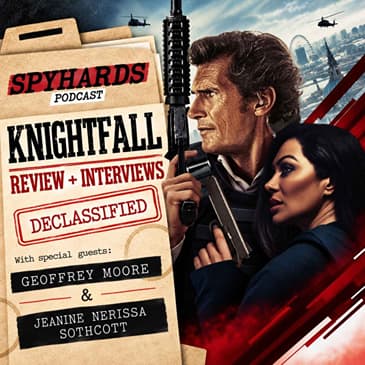


Agents Scott and Cam watch out for Rambo-style deathtraps while delivering an exclusive DECLASSIFIED review of the new spy action thriller Knightfall. Also, Scott gets top secret intel from stars Geoffrey Moore and Jeanine Nerissa Sothcott about the making of the film.
Knightfall is available now on VOD.
Directed by Ben Fortune. Starring Ian Ogilvy, Jeanine Nerissa Sothcott, Geoffrey Moore, Robert Cavanah, Rupert Holliday-Evans, Nick Moran and Michael Paré.
Make your opinions about the NOC List known. Leave us a voicemail on Speakpipe or send us an email now!
Become a SpyHards Patron and gain access to top secret "Agents in the Field" bonus episodes, movie commentaries and more!
Social media: @spyhards
Purchase the latest exclusive SpyHards merch at Redbubble.
View the NOC List and the Disavowed List at Letterboxd.com/spyhards
Podcast artwork by Hannah Hughes.
Theme music by Doug Astley.
Hosted on Acast. See acast.com/privacy for more information.
[00:00:00] This September, podcasts across the Podomedy Network are supporting CALM's Stay Tuned campaign. Podcasts can be good company, but sometimes people need somewhere to turn. CALM provides free, anonymous support for anyone struggling with suicidal thoughts or affected by suicide. If you can help, £12.20 can cover the cost of answering a potentially life-saving call. You'll find the link to give in the show notes. Thank you for supporting CALM.
[00:00:28] Hello, welcome to SpyHards Podcast. I'm Agent Scott.
[00:01:11] And I'm Cam the Provocateur, dicing carrots and red peppers. You'd need to. You need your fibre, Cam. Boy, do I, Scott. Boy, do I. You really do. You really do. We've got an interesting film to look at this week. A bit of a different take, a bit of a different avenue for us, perhaps? Mm-hmm. That's right. Yeah, yeah.
[00:01:32] We are taking a look at the brand new spy movie, Nightfall, which is interesting for a number of reasons. But I think the main element that I think is getting attention is the fact that it stars Jeffrey Moore, the son of Roger Moore. Yeah, that's right. That's right. And we had Deborah Moore on earlier this year as well.
[00:01:57] So, you know, it's an interesting kind of one-two of having interviews with both siblings in one year. I mean, I don't know what's next. Look out, Neil Connery. Oh, Sean. Isn't it? Yeah. Yeah. It's Jason is the one we want, isn't it? Neil Connery is dead. What are you going to do? Look, that's not who I meant. Operation Kid Brother is a very important film to me. And so it's actually, that's who I was referring to, Scott.
[00:02:25] Okay. You really want Neil Connery. That's fine. I do. Listen, we have discovered that we could perform miracles over the last six years. So maybe we could rustle this one up for you. But if not, hey, Jason, what are you up to? Let's have a chat. Yeah. Yeah. And we should note this film, Nightfall, is being put out by Shogun Films in association with Saban Films.
[00:02:47] And Saban Films, for those who maybe can't immediately recognize that name, anyone who grew up watching Power Rangers will recognize the name Saban. Yeah. And I certainly did. And I was going to do this review in video style with like fight talking. Yeah. So like Nightfall, let's talk about it. Or we have to do the, what do you think, Scott? And do the exaggerated shrug. Oh, of course, because you have no mouth. So you have to just like really oversell everything. Exactly.
[00:03:15] We can certainly do that. But we're going to get to the review in a minute. We have a treat coming for you first. But just to give you a little bit of a taste of the film, here is the synopsis for the film. Let's take a look. Nightfall. Nowhere to run. Except home. Yeah. MI5 weapons tech Ross Knight finds herself unexpectedly called into a Black Ops mission headed up by her field agent boyfriend, Hugh.
[00:03:42] When the mission goes fatally wrong, Ross finds herself on the run with a target on her back and must turn to the only man she can trust, her estranged father, legendary retired spy catcher, Charles Knight. Yes. Played by Ian Ogilvie, notably. MVP of the film. But we'll get to that. Yup. Yup. Yup. Yup. Yup. Yup. We'll get to that. But the treat I said we'd lined up for you is actually, I got the opportunity to sit down with the two leads of the film, I would say.
[00:04:12] One Jeffrey Moore and one Janine Nerissa Sothcott earlier this week. And I think what we'll do is we'll throw to that interview first, talk all about the film, and then we'll come back and we'll see you on the other side. So here it is, Janine and Jeffrey. Joining me on SpyHards today are the stars of the brand new spy action thriller Nightfall. I am joined by Janine Nerissa Sothcott and Jeffrey Moore. Hello both. How are you? Hi, we're really good. Oh, I'm good. How are you, Jaffa?
[00:04:42] I'm fantastic. Thank you. Thank you. Thank you for having us. It's a pleasure. It's a pleasure to talk Nightfall. I mean, congratulations both on the film. Thank you. I've got a lot of questions and not a lot of time, so I'm going to just fire from the hip here and we'll see how we go. I think that's the best thing to do. What was it about the story of Nightfall that attracted you both to want to come and make this film? Ladies first. Oh, well, for me,
[00:05:11] when I read the script, I thought it was just amazing. What a lovely acting part for me. I always look and I think, right, if there's fighting and driving, I'm doing it. And so I always look through. Oh, great. I can kick ass and I can drive. I'm doing this. So I was really excited for that. I was excited because I did a movie with, you know, a few years ago in 2020. And we didn't really get to have because I was playing a cop. I didn't really get to have a good scene with him. It was just like throwing a few lines at the end for me.
[00:05:40] And it was, you know, I really did want to do something with him. So when this script came in and it was a sort of a vehicle for myself and Ian, when Jonathan read it, he was like, wow, now this would be great. He's been dying to work with Jaffa for so many years and was waiting for this special, like a special film that he thought that Jaffa would be great in. And he was right. And he thought, no, Jeffrey, this is the one for Jeffrey.
[00:06:09] So I was so excited when, you know, because I was desperate to work with Jeffrey, but just not in the sort of films that we'd been doing before. So this was just perfect. And yourself, Jeffrey? I mean, Janine's just, just turned that into the male side. Well, for me, it's just, I wanted to work with Janine. I've had the hearts of her forever.
[00:06:35] Johnny, Johnny has been, you know, he's been, well, first and foremost, I have worked in this has been quite a while, but I've worked on quite a few films. And he's, as a producer, he's the first on set and the last one to leave, make sure that everyone's fed before he feeds his tummy. And it was such a pleasure working with him.
[00:06:55] And the distinction between, you know, a character versus a friend, when I see a friend who is married to a friend, and when it comes to work, not giving priority and making it very professional. So I knew that this, this wasn't going to be, you know, the school teacher's daughter, and I'm going to get a ruler across my hand. It was very, very professional, very straight. And I, I personally went to the last page of the script.
[00:07:24] And if I wasn't dead, I was in, I was in. It's nice to know that's what your benchmark is. If you survive the film, Jeffrey, Jeffrey's there. Yeah. It's a sort of, you know, it's, it's a hundred, hundred grand a page. So basically, no, but I mean, it was just, just exactly as, as Janine said, you know, it was a part that, yeah, this, this really works.
[00:07:53] Um, and go figure, a spy thriller, why not? I mean, I've, I've sort of grew up on a set where someone's holding a gun. So I felt quite, quite comfortable with that. And I have to say, Janine, I wouldn't want to mess with her in an alley, down an alley, because she sure knows how to throw a kick. Not just down an alley, you know, Jaffa. Might be not a mess of anyone here. I will not cross anyone in this interview. That's fine.
[00:08:21] Well, you mentioned the physicality is something I was going to ask about. There's a lot of that. There's a lot of shooting. There's a lot of fighting in this film. Did you, I mean, preparing for this must've been quite a bit of work for both of you, of course, ladies first, but Janine, what did, what did you put into the preparation for this film? Well, you know, I was working on another movie at the time that, um, I was doing this movie was a sort of a half of it was crossed over for me.
[00:08:45] So, um, one of my fight scenes in the, um, in the marina, it was, it was quite, quite a tough scene. Really. It's pissing it down with rain as well, by the way, and very, very cold, windy and everything. Also the guy that I'm fighting is six foot four and I'm five foot four. Um, so, and the, the sort of the MacGuffin that was the, the case that we were trying to, you know, protect weighed a bloody ton. I wanted to go to the arts department and crucify them.
[00:09:12] I was like, Jesus Christ, could you make this case that I could pick up with a finger? No, it was literally five kgs. So I had to keep swinging it up in the air. And, um, it was, it was, um, sorry, God, I've lost my train of thought now. Oh yes. The training, my training for that was in the men's toilets in the rain at two o'clock in the morning. So we basically did that. Um, we choreographed it, um, probably in about 15 minutes just before we did it.
[00:09:39] So that was the sort of preparation that I had for that. Um, so that wasn't that much, but we, we smashed it, you know, I've done martial arts for years. It was just right. Do this, that, that, and the other. And I've worked with Darren, the stunt guy before. Um, so I can take his lead really well. Um, and all I remember thinking was if I see a size 12 coming towards my face, I better duck. So that was basically the, the lines I was given. And the fight scene with Michael Paré, we did that, um, in a lunch break we had, we were both on another movie before.
[00:10:10] And we did it the next day, um, throughout the night. And we just practiced that really in it. We had an hour to do that, um, the day before. So it, we, we, you know, the fight scenes have to be, you know, these aren't, I'm not Jean-Claude Van Damme and have this, I'm, I'm a woman on the run. I just pick up things to protect myself. And if I find something on the table that I'm cooking, I'm chopping, I've got a knife, I, I slammed that. It's not, it's, it's meant to be sort of a scoffoffle for me.
[00:10:38] I'm, I'm against these assassins. I'm not meant to look perfect. And, you know, when I do get punched and kicked and, you know, that's, that's kind of the whole point. You know, Jonathan always says he hates these movies where women are fighting these guys and they come off brilliantly and they're high kicking and doing all judo and everything, which is pathetic. It's not real, you know? Um, so try to make it look as realistic as possible and gritty. What about yourself, Jeffrey? Uh, well, I said to Johnny, I don't want to fight. Make sure it's the woman that fights. So I just sat and watched.
[00:11:08] I didn't do very much. You've got to protect that face, Jaffa. It's the moneymaker. It's the moneymaker. Well, there was one scene outside and, um, sort of, it was a long shot. We were running and running and running and running and I had the wrong shoes on. Uh, and then I realized that, you know, it's such a long shot. You could have had, you know, anyone sort of just dressed in the same outfits running. It's when you're up close, you know, the stuff that Janine was doing.
[00:11:36] Um, you know, you, you, you think it, if you make it look easy, then, then it can't be that hard. Uh, it can't be that difficult, but it is. If you make it look easy, then there's a lot of work that went into it. And as Janine said, this isn't, uh, you know, Jean-Claude Van Damme. Thank goodness. Um, my limited, you know, sort of, uh, experience, you know, apart from doing a bit of a workout and a couple of sit-ups, I didn't really need to, um, it was far more demanding for Janine.
[00:12:05] Um, you know, because, uh, I just don't want to get scratched. So I made sure that any scene that had anything violence just pushed it towards Janine's way. I think Janine should defend us here. I think the whole, the whole thing of the movie is it's not a stylized type thing. It's, it's gritty and realistic. And, you know, um, we're, we're up against, you know, we, we're compared all the time in, in reviews against these big Hollywood movies.
[00:12:32] And, you know, we're, we're, uh, uh, you know, an independent film company on a much lower budget. And we're, we, you know, we've, we're doing as much as we can with the limitations that we're given and the budget we're given. Which I think is a very unfair comparison to make, frankly, I, I've seen some of that. And I just think it again, talking about budgets is one thing, but also you're going for a more grounded approach to, to action and a more realistic one. I've been in enough fights to know that, that it is not all high kicks and, uh, you know, brushing your hair back at the end of it.
[00:13:01] You're just scrapping, just scrapping. And then you've got someone wins at the end. That's just all it is. Um, it's good to see that. And it's more like you're evoking more the born John Wick style of action than you are, you know, Bond or, you know, mission impossible, something like that. Which I think is far more approachable. Yeah. Not as stylized and more opportunity where opportunity is. That's where you can get in, you know, and, you know, survive. Mm hmm. Precisely. Um, well, that takes me on to another question.
[00:13:31] We mentioned, uh, Ian Ogilvie before, um, and he is sort of missing from this conversation, but this man has a rich history in spy cinema in British cinema as well. What was it like working with Ian and any sort of memories from the set? Ladies first, of course. Um, yeah, I mean, all, all I can say with Ian, he's a, he's a darling. He really is. Um, you know, he's, he's in his eighties. So, I mean, I don't know if you've, um, been around people in their eighties that they're not really like that.
[00:13:59] Um, he makes it, he, he makes himself. You know, I mean, look, he's tied up on a chair, he's doing long hours, he's got lots of lines, he's got, you know, he really does put 100% into it. Um, and he really is a sweetheart as well. So easy to work with and, um, just, just a pleasure to be around. So, I mean, he, and, and looks fucking brilliant. Doesn't he? Doesn't look his age. Well, I thought when he was doing it, I mean, he was going to be my love interest. I couldn't believe it when they said, no, actually, he's your dad. I was like, oh, right. Oh my God, he's my dad.
[00:14:29] Because when I was in Nemesis, I mean, I was playing the wife of Billy Murray, who was 78 at the time. And I think I was 46. So I just assumed, oh, right. Okay. You know, I'm 55. He's, you know, ages. So he'd just be my, and I couldn't believe it when they said he's my dad. I was like, wow. Okay. Um, cause he looks amazing. So he really is the full package, isn't he? Seems to get better with age. Yeah, he is. He looks terrific. And such a delight to work with.
[00:14:55] I mean, I was looking, looking at him and thinking, why did he take over the saint? And, you know, the serendipity of it all, which I found quite, quite loving, quite touching. Uh, he, he, uh, fortunate of the age, because if he were a lot younger, he'd make, he'd make us look, all look terrible. Joking apart, he, he would say, do you mind if we do the lines again? And I was absolutely thrilled.
[00:15:25] I said, yeah, please. He's, cool. When I get to your age, I mean, I think I'm going to have to have, you know, teleprompters everywhere, how he remembers it all. So it was great that we kept on going over the lines because they are some of the stuff it's hard to relate to because whether it's the C-P-4, C-4, B-4, those down by the sort of, all that stuff is very hard to remember because you can't really relate to it. So this is the type of dialogue which you can, but it's a lot of sort of a natural flow.
[00:15:54] So if you miss on the first line and you're not listening to what that person is saying, say it very easy to forget, which you can tell that he's, he's had a lot of experience, obviously. And the fact that he took over the saint, uh, was another, as I said before, it was just, you know, I could see he's got the twinkle in the eye. I can see why he was the return of the saint on TV because he just, he has that twinkle. Well, the name we haven't mentioned yet is your director, Ben Fortune.
[00:16:21] What was Ben bringing to the production and what was it like to work with him? Well, I think we're not, I mean, I'm, I don't really want to discuss, um, that, um, side of things, but, um, we're, we're, uh, a production driven, um, company. Okay. So we're producer driven company. So I think this was a bit more sort of producer run. Sure. Okay. Understood. Well, let's, let's pivot that then. That's actually a very different style of, of creating films is how is that? And you've been on this, this one in particular.
[00:16:52] Sure. Okay. That's fine. Well, that says you've been on many sets. Both of you've been on many sets. What's that like differently in terms of the vibe with this more producer led, more of a collaborative effort to make a film? How, how does that work? Yeah. Um, Jeffrey. Well, it's, it's sort of, uh, it doesn't really, you know, whoever says action, uh, or cut, you know, it's a great, great sort of, I mean, Clint Eastwood working with Tom Hanks.
[00:17:19] It wasn't the sort of, you know, you'd get the clip aboard and it's, you know, scene 22, take nine. So the, in the editing room, it gives order and it's just go ahead. So it's not the actual director thing action. It's more of the flow of it. So whoever's standing next to the camera, uh, when the producer goes over to the director and whispers, boom, boom, boom, boom, boom. It's because, you know, that there's been a lot of collaboration from day one.
[00:17:45] So it really is, you know, the, the, the helmsman on the ship doesn't necessarily make him the captain. Well, you just look at Clint Eastwood as a good example, doing the Eiger sanction. He's filming up that mountain and he's directing it and also starring in it. And he can't yell action whilst he's hanging off of a rope on a mountain. Yeah. Uh, everyone might, you know, chucks in and they make a film. Yeah. I mean, also as well. I mean, I think there's a lot of collaboration with the actors as well.
[00:18:09] I mean, I think mine and Jeffrey should have had a bit more, um, scenes together, like girlfriend scenes. Personally, that's what I think it kind of needed for, um, our chemistry to, to play out a bit. Um, and so I think that, um, looking back on that, I think, you know, it was Jeffrey and myself really that put the two kisses in. Cause I remember when we were in the, I thought it was going to be me too. Cause when I, we were out in the front, I kind of grabbed his face and kissed him. Do you remember we were out in that? Yeah.
[00:18:39] And I, cause I just thought, cause we don't, I, we want, I want to be closer. You know, I was trying to, and, and I, I thought that we could have, we could have done that a bit more. Um, so, you know, maybe in the number two, you know, maybe.
[00:18:57] And also, you know, in the, in the first part as well, we, so we have these two little pecs, which, you know, really, um, you know, probably could have been a little bit more, um, we could have had time to sizzle a bit more on screen would have been nice. Well, that would be the continuity. Um, the fact that it's, you know, uh, fades out, they kiss that kind of thing. I like the idea that it felt necessary. It felt needed. It was natural.
[00:19:27] And for me to grab you and you, you weren't expecting it and vice versa. Yeah. As long as you know that you're actually an item in the, in, in the storyline. If it's your first day shooting, you didn't really read the memo. No. It's sort of, wow. But yeah, um, I, I think that that's, you know, unless it is a, a, as, as Janine, as you just said, that, you know, there's, it would have been a bit more of a backstory between us and this and that. Then, then that would have all been more in writing kiss.
[00:19:56] They get blah, blah, blah. Um, and I think, yeah, I think the way it sort of panned out, I think it made, it's a shame because you can see that I am a concerned, uh, boyfriend. You know, so it's a shame that we didn't have a little bit more of that. Yeah. To give because that's the way I read it. It was, you know, the second I played it, you know, obviously. Yeah. Well, I, I, I hear the ticking of the clock. So I'm going to go with two questions to wrap us up.
[00:20:26] And first and foremost is we talked about British spy cinema. I mean, we, we invented the spy movie in many ways. We, we certainly formatted it. Um, what sort of films were you looking at to inform your performances? For Nightfall. I mean, I, I, I watched so many movies. I watch movies every day.
[00:20:46] I'm watching, you know, um, I think, I think the women that I, I look at, you know, the more the sort of Sarah Connor, um, in the first Terminator, I thought her vulnerability, um, the way she has to go from, you know, working in a, in a cafe and burger joint, whatever, to then sort of kicking ass. I think I was trying to sort of look at her. I mean, I, I love Linda Hamilton.
[00:21:12] Um, so that sort of vein I was looking at, um, you know, Sigourney Weaver in Alien, um, that sort of, you know, trying to be strong, but also thinking to myself, well, actually I'm not that. I am an MI5 agent and I'm in weapons, you know, it's, it's not, I, I go to an office every day. Um, I have to remember that.
[00:21:32] So, um, you know, I was trying to, to look at how I can bring the vulnerability, um, into something that had quite a lot of fighting attached to it. Um, so I think that's what I was channeling while I was doing it. Um, you ever see Austin Powers? I have, sir. Daddy doesn't love me. So I kept looking at my dad's movie.
[00:22:01] To, uh, tell you the truth that it wasn't, um, uh, you know, I liked that the Linda Hamilton, um, I was gonna say the same thing. You stole my act. No, it was, uh, I, I didn't really sort of think of it that way. I just engrossed myself in the actual storyline and said, um, just imagine, you know, put yourself in that, uh, situation.
[00:22:25] Um, and then while you're out there, it says, oh, this reminds me of that scene opposed to breaking it down, looking at it and saying, who shall I role model or who shall I? I mean, it's all in the back of the head. It's all influenced there. You think, where did I get that idea from? And funny enough, you know, you saw something 20 years ago and it's sort of, it generously popped up without it being plagiarism.
[00:22:49] I don't really, um, sort of compare, uh, just a bit like with the music. I don't listen to the radio at all. I just don't want to be influenced and just go with what is stored in the back. But as, as Janine just said, you know, there are loads of films. There's one actor, you know, if I'm playing a cowboy, then I'd go for the, the Clint Eastwood.
[00:23:11] If I was going for, um, for, uh, you know, uh, a spy, I'd go for the, the, the sort of Sean Connery, but this role demanded more of the Roger, more of a caring guy. So it really depends on, on who your character is, because let's face it, you, you're engrossed in your part. Let alone, you can't be thinking of, oh, unless you're directing the movie, this is what I want. This is the flavoring. This is the Pantone, et cetera, et cetera. It's more, um, who you're playing.
[00:23:39] And does that fit if you are to role model that person or be influenced by, but you know, I, listen, um, uh, if you take Linda, I'll take, uh, Arnie. Um, Billy Murray once said to me, um, on, on set, he said to me, well, you know, when you get up in the morning and you look in the mirror, that's what you take to work. And I agree totally with you, Jeffrey, when you say that, you know, you sort of look at things and you see how people do it, but at the end of the day, you're the one doing it.
[00:24:09] And when you look at even films that you've done in the past, and when I look at films I've done in the past, whatever, you have a style of your own. Yeah. And it feeds through every film that you do. It doesn't matter what, if you're playing a victim or a strong character or a, you, you kind of see that you have a style. Just with being you. Um, so I guess, you know, it's great to be compared to a style that is you is.
[00:24:38] I think Nicholson's the classic person who, regardless of what the role, whoever he's playing, he's just that Jack Nicholson. I mean, I wish I were that cool. Janine? You are that cool. Well, I, I, I, I noticed you, you mentioned, um, Sean Connery and, and your father in terms of, of, of mild touchdowns. Which is interesting. Cause I, I'm glad that the film goes away from the obvious. It could just go down the evoking the family name in a way. I'm glad this is not what happens here.
[00:25:08] And I know there's a family connection between yourself and spy hearts because we had your sister on the show a few months ago as well. So, uh, I've completed the, uh, the more children collection here. This is nice. Um, but one final question before I let you both go. And as we talk about spy movies here on spy hearts, every guest we've ever had has been asked this question. No pressure, but no one gets any prompting or prepping for this. We want to know Janine, Jeffrey, what are your favorite spy movies of all time?
[00:25:38] Um, I would have to say, um, what, what, um, made me think of, um, the world differently was probably for your eyes only and Octopussy. I think, you know, 1981 and 1983 were, um, really sort of tough years in my childhood, but also, um, made you think that, you know, there was a different world out there.
[00:26:06] And, um, I, I love those two films and we, I play the piano score for, um, you know, for your eyes only and, um, all time high. I, I, I've got the whole book that I play all the music for and I love it. So I think those two movies. Both wonderful picks, very contrasting as well, which I think is very lovely in terms of tone. Jeffrey yourself. Um, in terms of Bond or just the world of spy everything. Oh, spy.
[00:26:33] I mean, I sort of start with the third man, um, goes creeping up to the, the look, the carries the John look carries. Um, some of them, you really have to pay attention. Tinker Taylor. I mean, if you, if you miss the first line, that's it. But in terms of, um, I love that all the sort of the Gorky park, all those sort of, uh, Russian.
[00:26:58] I thought that that sort of Eastern block that always gave me such an eerie thing, you know, in the, in the Casino Royale, the beginning where it's shot in black and white. And you see it's cold and they're going in. I, I sort of love that era of the sixties minutes because I sort of grew up with it. But in terms of bonds, I think the most spy spy, um, would, would probably be, oh, goodness. Um, so as I look at the Bond movie, I don't really see it as a spy film.
[00:27:27] If you see what I mean. Yeah. I've heard that argument. Uh, it's, um, it's kind of like he is, I mean, a spy that walks into a restaurant, everyone knows who he is. Isn't really undercover. Is he? So, and it's not glamorous life. So this, the beauty of Ian Fleming is his, you know, sitting behind a desk and God, I wish I could have this. This is, you know, I signed up for something and it's completely different. I want to get out there and drive flashy cars. And well, if you're out in the field, it's very different in terms of the Bond movies.
[00:27:54] I would say, um, the spy who loved me would be a favorite of Rogers that, you know, sort of gave the, the, the, the, the female spy and the, and the, and the male spy getting together. And they've got an issue with each other. And when this mission's over, I will kill you. And then they're in bed together. Love it. And, and then, um, in the, in the sort of the Connery era, I would say the, not that it's my favorite, but it's sort of from Russia with love.
[00:28:22] One of those where you really feel that, you know, there are, there are some pretty nasty people out there and you, you've got to do some nasty work to get the job done. Or Queen and country. I just loved as well though, um, that, you know, in, um, in Octopussy, I remember in, in the eighties, you know, I was, um, at school using those, um, pen wells, you know, for the ink. Yeah. And when he got the acid in the thing and he said, Oh, that will, something like that will make a poison pen letter or something like that.
[00:28:50] I just remember the one liners in that was so good. And I always remember when I used to draw up my ink, I used to think, Oh, this is so good. Oh yeah. That'll make your eyes water. Yeah. Yeah. Yeah. And then, you know, all the, you know, just all the, you know, it took you everywhere. These movies, you know, back then going to India tigers and, and all those sorts of things that, you know, I'd been on a plane since I was four years old and going to, cause my mother's from Trinidad. So I was backwards and forwards, but it was, um, you know, I'd never seen a tiger or anything like that.
[00:29:20] It was just, it was just, you know, all these things were new, weren't they? Yeah. And I love cars too. So in for your eyes only with the Citroen 2 CV that, that the car chase for that. And, um, is it, what's her name? Is it Carol BK? Carol BK. Yeah. Um, you know, she was kick ass in it, wasn't she? She was, um, like doing all the action and all that sort of stuff. I, I, you know, they're great. You know, I mean, they're all great. They're all great. They're all great.
[00:29:48] That's a, that's a very good canon of films, uh, to, to go back to, but thank you both for your picks. Excellent stuff. Thank you both for the film. There you go, folks. That was Janine and Jeffrey. I want to thank them both for the time to sit down with us. And I have a couple of things to unpack. Yeah. Um, I think, I mean, it was a lovely chat.
[00:30:16] Uh, there was some interesting hiccups before we get started, but we won't get into that. But I, I, I mean, firstly, I have to say Jeffrey looks and sounds quite a lot like his father. So it is a little bit jarring, like in my periphery when I'm seeing a man who looks very much like Roger, uh, talking to me in my tin cans here, uh, and talking about spy movie. I'm like, speaking of seances, maybe we, I ended up in a parallel universe, but, uh, yeah, that was uncanny. Yeah.
[00:30:44] Well, we talked to Ethan Peck fairly recently on the show at the Star Trek convention. And I mentioned how the resemblance to Gregory Peck is very strong. And so when you're kind of in his presence, there's that, whoa, kind of like second removed awe of like, oh, I am seeing a Hollywood legend in front of me.
[00:31:03] And you get that same sort of sense as well when you're, um, just seeing, I mean, obviously that wasn't in person, but just seeing it on a, you know, zoom screen, uh, seeing Jeffrey Moore there, you're like, whoa, whoa. Yeah. It was, it was an interesting, uh, 20 minutes. And, uh, speaking of, uh, shock and awe, there was a moment in this that I, Cam and I debated whether we would keep in, but I think it's only transparent to show the whole interview. Um, there was clearly a bump in the road for this production.
[00:31:33] Yeah. Yeah. Um, you may have noticed that there was a moment where I asked about the director of the film. Um, and Janine came back and mentioned that it was a producer driven, um, film, which was a surprise to me. Because there was a credited director. Um, we've done some digging since, and we have a little bit more information on what went down. Yeah.
[00:31:56] Uh, it seems like it was originally Ben mole who directed the film code of silence, which was a, um, sort of biopic about the Kray twins. Uh, not the movie legend. We tackled that on the Patreon. Good film. It's a separate film. Yeah. A separate film about the Kray twins. Um, because there was a, um, you know, interview done by producer Jonathan Sothcott, uh, earlier, you know, before I think the production of this had even really started. Uh, and he was saying how excited he was to work with him. Uh, so I think that's what happened.
[00:32:25] And clearly there was some sort of falling out. We don't know any details there, but ultimately like, um, Ben fortune is not a real person. And so it was like, when they're talking about a producer run, you know, film, not necessarily dissimilar to things we see with Eon. Um, they do trust their filmmakers quite a bit, but like, it is a very much, you know, back in the day, Eon called the shots on these movies. Yeah. Um, or what's going on with the Marvel universe now. Yeah.
[00:32:54] With all that previs and stuff like that. It's, it's definitely, um, the way of the world for some people. I think, I think, um, maybe it's poor journalism on my part. Maybe I shouldn't have posed the question, but I was, I wasn't aware of that change until obviously we got into the minutia of it. And it was clear from the responses, I think from both Janine and Jeffrey that they, uh, perhaps didn't quite get the film out of it that they wanted. Um, there was some like pining for things that perhaps didn't pan out in a production.
[00:33:23] There was a lot of peas right there. Well, I think, you know, uh, the fact of the matter is like they are actors. And what they were referring to in that interview was wanting more character. And, you know, the fact that they worked in like the more of the relationship elements between the characters and, you know, that's the kind of thing I think they would want to latch onto. Yeah. So it makes sense that they would want to develop it more in that direction. Um, yeah, that didn't, that didn't necessarily surprise me.
[00:33:50] Um, especially after watching the film, like I could see how they would want more inner life to their characters. Yeah. Yeah. Yeah. And I think, you know, we could get lost in some of the things when we get to the review in just a second. I think it's important at this point just to point out that, you know, this is a producer led production, but it's definitely led by Jonathan at the front. He's definitely very proud of this film. I mean, I went to the premiere of it, uh, in, in London, the Lumiere in South Kensington, uh, with a couple of friends at the show.
[00:34:20] And, um, yeah, I got to see it on the big screen, which is very rare. A lot of people won't get to see this film on the big screen. So that was an interesting, uh, little element there. Um, but it, it, there is clearly a, uh, a passion for it. And obviously there is a tease at the end of the film for a sequel. That's right. There is. Yeah. Yeah. That kind of caught me by surprise. Yeah. I thought it was quite a definite end for that character. It seemed like it, but yeah. But I mean, you know, Roger Moore will return. He will?
[00:34:51] Roger Moore is going to return? I just mean in the sense of like Bond is Teslon basically. So they're kind of evoking that in a way, I think. Yeah. Um, and, but yeah, so like, I, I think we have to calibrate our expectations as well, because it, this is definitely an independent production. This is definitely very like a micro budget compared to what we are used to dealing with on the show. Even if you go back to like, I don't know, destination Tokyo, something we can't tackle a few weeks ago. That is still comparatively.
[00:35:19] If you adjusted that for inflation, millions and millions and millions of pounds more expensive than this film was. Oh, that is mega budget, uh, compared to what this is. Um, this is, I'm trying to think of like more comparable budget wise, probably. Probably not that far off of, I am completely blank on the name of it. Uh, it was something USA and it was about. Invasion USA. Nope. That's the, not the Chuck Norris film.
[00:35:48] The, uh, atomic panic film we tackled. You know what I'm talking about, right? Yeah. Yeah. Yeah. I, it's, it's, it's in our like, uh, rocket attack USA, rocket attack USA. You got, you beat me to it. Yeah. That's it. I remember making the artwork for that. Yeah. Which would have been made by, you know, uh, basically independent filmmakers in its time with a, you know, lower budget trying to make the type of film that are like the 150, 200 million dollar films. Hmm. Yeah. Not that budget then, not that budget then, but you know what I mean?
[00:36:18] No, no, no, no. I think it's an important thing to point out at this stage because it, it, it should temper your expectations. And when we get to the knockouts at the end, and if we talk about perhaps recommending this because this, this film is not getting a, uh, a release in theaters, it's gone straight to, uh, as of a week ago of this episode coming out, uh, straight to digital download basically. So it's available on all PVOD platforms, you know, Apple, Amazon, uh, YouTube, all that sort of stuff. So if, if out the end of this and you think we've recommended it or you think that you want
[00:36:46] to watch it afterwards, you have to go and pay for it there. We'll have links of you, of course, for you to go and check it out. I think the only thing to bring up from the actual premier, which, which did get a smile out of me, I have to say, um, is something about Jeffrey Moore. I just want to talk about. Uh, I mean, there are lots of things to unpack with Jeffrey Moore, but this one in particular, um, he turned up to the premier and I mean, it's actually quite just cool to see him in person. A cookie says hello to him and stuff. That was nice.
[00:37:13] But, um, I noted that he was wearing like quite smart clothes on the top and then combat trousers on the bottom. He was ready for action. He was ready to roll. But like, I then noticed when I watched the film, cause I saw him coming before I watched the film, he's wearing the same combat trousers in the film. Oh, okay. So either that was an attempt to be like, I'm going to wear my wardrobe or he just wore his own combat trousers in this film. Either way, it's hilarious.
[00:37:42] Either one seems possible. It does. It does. Reach out folks. If you're listening and you know, uh, what's the story with Jeffrey Moore's combat trousers? I mean, I'm a fan of a combat trouser or a combat short. Sure. Yeah. Yeah. Yeah. I used to wear them all the time. Uh, not lately, but it used to. I've seen you wear them recently. No, no, I don't think so. Do you not wear those three quarter length with the pockets anymore? Uh, oh, are you saying cargo shorts? Oh, sure. They're the same thing, right?
[00:38:09] Oh, well, I was thinking more like I used to have like camouflage, like cargo, uh, not cargo, but like camouflage, like military pants. Oh no, it was more like, like the ones with the big pockets on the sides. Oh yeah. Yeah. Sure. Sure. Uh, no, I'm not wearing them right now, but. No one wants to see that cam. Sit down. Sit down cam. Right. If you're referring to cargo shorts, uh, less these days, but I used to all the time. Yeah. I still wear them from time to time. I mean, they're not fashionably, uh, well liked anymore, but. Okay.
[00:38:38] I want to bring this up. I have, I'm going to like finally like a plant my flag on the mountain that is a cargo shorts because yes, you're right. They are not fashionable. In fact, they are often mocked for people wearing cargo shorts and I'm like, I feel like the people mocking them don't realize the luxury of those extra pockets. That's great. It is fantastic. I used to go out and like do shopping and not have to carry bags because of the shorts.
[00:39:08] And I'm not talking like grocery shopping. I mean like. I'm just picturing like bananas coming out of your shorts. No, no, no, no, no, no. I'm not talking grocery shopping, but I'm talking like, you know, you'd go out, you'd buy books, you'd buy like DVDs, whatever. And you just like throw them in the pockets and keep on with your day. It was wonderful. It was a wonderful time to be alive. And you know what? I'm with Jeffrey Moore. Bring back cargo shorts for my convenience. I mean, you're a man with your legs out.
[00:39:36] Jeffrey likes the full length, but between you think of the groceries you could bring home. You know, okay. I said not grocery shopping, but minor grocery shopping. You would. Yeah. I mean, I'm not going to send someone out to pick up like the dessert in combat shorts, I think. No. Or cargo shorts. But I appreciate the space. I recall we mentioned Vegas. This is a fun story.
[00:40:01] A friend of ours who will remain nameless for shame is a big fan of American cookies and American confectionery. And he took it upon himself to buy his own literal weight in those things. And I think this was M&M's. I think it was like caramel M&M's. We don't have them here. It was everything. It was. Yeah. Yeah. So he's like, he had two suitcases. They're all full up. He also had like two carry ons all full up. And he's like, I've still got more candy to bring home.
[00:40:28] And so he had to go through the airport security with like stuffed pockets with like massive multi-packs of like caramel M&M's and all kinds of stuff. And obviously he got flagged. And so he gets pulled to one side and he's just like emptying his pockets of the caramel M&M's. And the guys are like, what is this guy doing? What is this guy's problem? But we all had a nice giggle watching it happen. It was amazing to actually watch because yeah, we actually in a rare circumstance, we were all at the airport at the same time because we're all going to different destinations.
[00:40:58] But we all got to witness, or a group of us got to witness this. And it was like the airport security version of Mr. Creosote, where it's like one more mint and everything is going to explode. See, I was thinking more like the clown with the endless tissue. Like he just kept pulling and the M&M's just kept coming out. More and more M&M's. Yeah. God bless you, buddy. That was a sight to see. It was. It was. It was incredible. Yeah.
[00:41:28] But you've all stuck around, folks. You want to hear our thoughts on Nightfall. Let's get to it. We interrupt this program to bring you a special report. Agent, we don't expect you to talk. We expect you to buy a subscription to our Patreon. Eee. That's right. Over on the SpyHards Patreon, we're covering all your favorite spy TV shows, as well as popular films from the most iconic secret agent actors of all time.
[00:41:57] Cam, why don't you share some intel on our latest assignment? Scott, some time ago, you and I coined the term HorseHards as a potential spinoff show where we looked at movies where people, I don't know, rode horses. But you know what? It would be better applied to this week's Patreon episode where we are going to catch up with Slow Horses Season 4. That's right. HorseHards is now relevant once again because we are going back to Slow House to catch up
[00:42:22] with Season 4 and determine whether it stacks up against the previous three seasons. So tune in and horse hard. So deactivate Ghost Protocol and visit patreon.com slash spyhards to truly do things angel style. But before we close, Channel D, on with the SpyJinks. Okay, Cam, let us know. Did Ross, Knight, and the team sweep you away?
[00:42:49] So here's the thing about Nightfall, which as you mentioned up front, this is an independent production that costs about $100,000. You're not going to be carried away thinking that this is a $150 million movie. There's a lot of, you know, the locations are minimal. A lot of this movie is set at night. Nightfall. But, you know, also the fact there are some technical gaffes along the way.
[00:43:17] There was one, like, where a score just came screaming in at one point where I went, whoa. And I actually rewound because I was like, what just happened? So sometimes Scott and I will tackle spy movies that maybe have some shortcomings in the technical avenue and we'll kind of have a field day. But the thing is, like, these are major Hollywood productions we're typically talking about or major British productions that also have, like, far more resources to work with.
[00:43:47] And so, you know, we like to think of it as because we are nobodies, it's just punching up when we're taking on movies like this. But, like, in a movie like this, you can tell that everyone's enthusiasm and energy is in on it. And they're working with what they have to try to create something that is a, you know, fun spy caper. And I think, like, in terms of, like, putting together the sort of the outline of a spy thriller, there's a MacGuffin.
[00:44:15] It's a, you know, obvious one with, like, this sort of bacteria that will cause people to die or the world to be destroyed. The original Rabbit's Tail, basically, or whatever it was called. Rabbit's Foot. Rabbit's Foot, sorry. That was the idea was it was like a biological weapon. Until they retrofitted it into being, like, an AI thing. But, yeah. Yeah. Yeah. So, like, all of the setup stuff is, it's functional in the way that you would say, like, maybe this doesn't live up to the storytelling in, like, a Mission Impossible film.
[00:44:42] Although, depending on the Mission Impossible film these days, am I right? Anyways, you know, but or some top-tier Bond stuff or whatever. But I think it is entirely pretty much the same kind of thing you would hope for in, like, a Jason Statham spy action film. Yeah. You know what I mean? Yeah. Like, so I think it's very functional in that regard. Ian Ogilvie, who plays the father of, I guess, our protagonist, the Ross Knight, is played by Janine Nerissa Sothcott's character,
[00:45:12] is sort of the protagonist who is like a lab rat who's been thrown into a high-stakes espionage game. And her father, Ian Ogilvie's character, Charles Knight, is a very experienced agent. And I found, like, once he entered the picture and you got more of the dynamic with the two of them, and you just got him kind of giving this incredibly casual tour of, like, the inventive ways to kill people and all that sort of stuff. I'm like, this is really fun.
[00:45:42] Yeah. This is what I'm enjoying. Like the mildly incredulous, kind of like, almost M-like disdain for everything. That sort of vibe. Yeah. Yeah, and I feel like the movie in the first half is going for this more, like, almost Bourne-esque, kind of John Wick-esque, high-tension, propulsive sort of action story. I don't think that worked. No.
[00:46:08] But when it actually turned into Charles Knight kind of giving this bemused sort of tour of, let me show you how to take guys down and make it look easy, that's where it got more fun. Yeah, the sort of the old hat coming back in for one last fight sort of thing like that. And yeah, I mean, you could point out, like, it kind of feels like Skyfall in the last act. Like, there is all kinds of stuff like that. Home Alone, whatever you want to talk about. But I think the characters bring it through as well.
[00:46:37] Like, you're not, I don't think you're turning up to Nightfall for its action sequences. No, no. The action choreography is at times, you know, not top tier. Yeah, and I think, like, it's, like, I read there was a Guardian review that they put out on this film. And I think it was, like, obviously there was a bunch of jokes in there that people made about all kinds of stuff. From things I think were really unfair to joke about to things that perhaps were fine to lampoon about the production. And that's absolutely fine.
[00:47:06] But I just, I had myself calibrated to what I expected from this film. I wasn't expecting anything to look glitzy or glammy. I expected it to get to the point. It's 80 minutes, basically, of introducing this character of Ross Knight. Or Rose Knight. Ross Knight. And I think, overall, there are, like, moments of levity. There are moments you can enjoy in this film. I think it's really quite threadbare.
[00:47:35] I think it's really, like, if you stripped away all the bells and whistles away from a Jason Bourne film, you'd see a lot of the sort of skeleton of this film in there. Sure. Which is about all you could, like, they can't add, they haven't got the money to add meat to this. That's fine. Are you providing a bingity, middling end? Which it does. And even a little twist at the end. I will add, though, like, writing dialogue is free. To a degree. And this movie had four writers.
[00:48:05] Yeah. And I go, like, you know, like, I am very forgiving when it comes to, you know, production design or action scenes in a low-budget film. Because those things can cost a lot of money to really pull off. You know? For sure. We were all doing backflips over the Odyssey this summer. Look at the budget of the Odyssey. You know what I mean? Christopher Nolan spared no expense to pull that off. Whereas, like, $100,000 working with actors who may be busy in other productions as well, have, you know, limited time schedules.
[00:48:34] All these sorts of factors can cause a problem. But I do think when it comes to the written page and just writing your dialogue, I think this movie comes up a bit wanting there. There are some interesting decisions made in that department. Yeah. I think, like, just from my perspective, I had an interesting time with this film. I don't think it's necessarily for me.
[00:48:58] I don't think personally I can allow myself to take that hat off and lower my expectations to meet potentially the budget of this film. I am, since the beginning, since day one, a popcorn cinema guy. I've never professed to be, like, into arthouse cinema or anything like that. I struggle to bring down that expectation a little bit. And, like, even with films like Possession, which we tackled a couple of years ago, Threadbare, made-for-nothing film.
[00:49:27] And I did mention that I didn't like that. Like, I would like to see that on a bigger budget. And lo and behold, they're remaking it with, like, Margot Qualley and Jacob Elordi or something like that now, which I'm sure will have a ton of money on screen. Well, I don't think they'll spend huge money. But, yes, it's going to look fantastic, I'm sure. Yeah, the cinematography will be great. All kinds of stuff. I suppose, did I enjoy it is really the question at hand. And I think I can't say I enjoyed it.
[00:49:57] I don't think that's fair. I don't think I can lie. I don't want to do that. I think there are elements within this film I enjoyed. There are moments or bits of performances I enjoyed. It did move at a clip. I can give it all its credit there. But holistically, was it for me? No, not particularly. I think I want more from a film, Geoffrey Moore, even with his combat trousers.
[00:50:26] And so, like, I was a little bit cold to it when I was watching it because I can see the strings. I can see the gaffer tape. I can see it all being pieced together. And I don't like that lack of immersion personally. But if you're one of these people that can do that and can actually take that hat off and be like, no, no, no. It's made for $50,000 or $100,000 or whatever it is. I can just accept it as it is. Then you may have a different reaction to me.
[00:50:55] And it's like, this is also a movie that's going to find its place on streaming services and what have you after its PVOD run. And there is an entire audience for people who, you know, obviously love Bond. They love Bourne. They love Mission Impossible. All this kind of stuff. But you know what? They also like to just flop down and watch, you know, like a straight-to-streaming spy action film. And there's no shortage of those. A Jason Statham bumblebee or whatever it was called. Beekeeper, that sort of stuff. That's theatrical.
[00:51:24] That's a big theatrical film. Sure. No, no. I mean, I'm thinking like movies without Jason Statham. I'm thinking with like, you know, there's a whole world and I don't know the world of sort of lower budget espionage films that go straight to streaming the way I do like action films, for example. There's a lot of things with like Gary Daniels, for example. There's like all the Universal Soldier sequels that have come out in the years since that go straight to streaming but are actually quite popular with a certain segment of, you know, viewing audiences. Sure.
[00:51:58] People generally sit down and watch a lot of, you know, shark, killer shark movies that are, you know, straight to streaming kind of stuff. I don't, at this point we're so bombarded with them. I don't keep up but I used to watch a lot of them. Well, just look at like the Tremors films. I've seen them all. There's like 80 of them. And I've only seen the one and I think that's absolutely fine. But there are people who really like Tremors who will go in and basically watch what is budget filmmaking when it gets to the last couple.
[00:52:26] Or like the Starship Troopers is like five sequels for some reason. Yeah, I've never seen those but I've seen all the Critters films. Yeah. I've seen all the Tremors films. I've seen, you know, several of these kind of leprechaun films. Right. I've seen a lot of these kind of horror franchises that continue into that realm. So it's like I am not looking down on these types of movies. It just depends on what your sort of interest is. And this would not be one.
[00:52:52] Even though I host a spy movie podcast, I don't tend to sit down and watch sort of straight to streaming, you know, spy action films that are kind of like stripped of the elements I enjoy. Because when I watch a spy film, a lot of the movies are the characters that really draw me in. And these movies tend to be very threadbare in that regard. Yeah. And it's kind of more like here's your basic archetypes. Let's focus on giving the audience an action scene every five minutes because that's what's going to hold our attention. This movie is 80 minutes.
[00:53:21] And there's like, you know, a number of action scenes throughout just to kind of keep the audience engaged to a certain sense. Like they know their audience who's tuning in for this probably, you know, like later on an evening and being like, I just want to watch like 90 minutes of spy action. Well, there's your movie. Yeah. And I think this will do very well in, I mean, you said in like past its PVOD window. I agree. I think if people will click on, I mean, you know, Janine Nerissa Southcott is the lead of the film.
[00:53:51] Jeffrey Moore is maybe second or third build. Yeah. But the poster is all about Jeffrey. Right. Yeah. And I think if you, if you saw that and he looks a lot like his dad, if you saw that on like, I don't know, Tubi or some sort of streamer, like one of those just like free streamers with ads or whatever that system is, a lot of people would click it. Yeah.
[00:54:15] And you know what, like Scott, you and I cover a lot of spy B movies from the past on the show and we always enjoy them. Yeah. So it's like, you know, it's just more, I guess, when it comes to the modern era, I'm less interested in these types of movies. But I think like you're right. Like you put, you know, Jeffrey up front and say, oh, it's, you know, the son of Roger Moore in a spy film that sells a certain amount of PVOD sales. It gets a few, a certain number of clicks.
[00:54:44] Ian Ogilvie, I think is the first credited actor in the movie. He's got, you know, quite a reputation in film and TV. So it makes sense he would get the top billing. But I think like his presence goes a long way, a long way to selling the movie. I think like, if we're going to just quickly do like likes and dislikes before we wrap it up. I appreciate the restraint of the film because one thing they could very easily have done with this.
[00:55:11] And I think I, I think I briefly mentioned it in the interview is they could have very easily just done like a Bond spoof. Yeah. And you've got Jeffrey Moore and he just, it's like, okay, Connery. We mentioned it at the start. It's basically Neil Connery pretending to be Sean Connery, pretending to be Bond. That's what that film is with no money. And it's not very well made. With this, you've got Jeffrey Moore in a Jason Bourne, John Wick film. Yeah.
[00:55:39] Like they, they didn't go that obvious route. And I think the film's better for it because I think we all would have probably collectively cringed a bit more if, if it had been Jeffrey Moore, like a view to a kill. Well, yeah, they didn't try to give him those sort of wry quips the way that like Roger Moore would be delivering those in one of his movies. Um, I did think of a view to a kill because this was a movie also where like they'd obviously hired a lot of older actors. Yeah.
[00:56:06] You know, Michael Perry shows up as like a Bourne-esque asset at one point in the movie. Um, and I began to think of like, this sort of has that view to a kill element where all of the agents in this movie are older. Yeah. Yeah. It makes you wonder, uh, if, if Roger had stayed around, would we still be talking about Bond now? Who knows? Who knows? Who, who knows? Who knows? But that like, in terms of my, like, I, you've already spoken about my, like, so maybe you can just talk a bit more about that when you come to it in a second.
[00:56:36] But like, I, I just appreciated the restraint of not going for the low hanging fruit. Um, which they, I mean, maybe they will in the future, this production company could, who knows? But I feel like if we do see Jeffrey Moore return in Nightfall 2 or whatever they want to do, um, I think it will be similar tonally to this. And I think that's better than, than having a Bond spoof. No, a hundred percent agreed. Um, do you think the Nightfall title was a good idea? I think it's confusing. Yeah.
[00:57:06] Um, and I, but I think it was there to evoke Skyfall. A hundred percent. Um, but they made a mistake in a sense because just released was a new Batman animated film called Nightfall, which is an adaptation. This is very hard to Google. Yeah. Yeah. Yeah. It's a, there's a very popular Batman arc in the comics called Nightfall. They've just done part one of an animated film. There's going to be a couple, I think maybe at least a part two to that story. And yeah, you Google Nightfall and you're getting wall to wall Batman.
[00:57:36] Something I'm not against, but frustrating for the filmmakers to get any sort of, you know, SEO. Yeah. Yeah. That, that is, that is a shame. Um, but I guess that just happens sometimes. I think there was, wasn't there just like two films put out called The Runner? Um, one with Gal Gadot and one with Alan Richardson. Yeah. There was also that, um, the Armie Hammer film, which was what Citizen Vigilante was the name of the movie, but its original title was Dark Knight. Oh, come on. And yeah, they were going to call it Dark Knight.
[00:58:04] And then like, I think Warner Brothers was like, um, no. They just told, uh, Armie Hammer to eat it. Yeah. That's right. Literally. Yeah. Allegedly folks. Allegedly. Allegedly. But, um, you know, just for my life, it really is like the Ian Ogilvie stuff. Like the guy can sit in a chair, you know, bound opposite, like one of these thugs that's been
[00:58:32] sent to kill him and just be charming and be fun. And in some ways I was like, this guy is out Roger Mooring, you know, Jeffrey Moore. Like he is like got that kind of calm, quippy, wry British charm throughout every scene in this movie that I'm like, man, this is actually a lot of fun. And I think he actually has good chemistry with Janine Nerissa Southcott's character. Um, you know, I liked the two of them as a father daughter. It worked.
[00:59:00] Uh, and I just was like, you know what? Like they set up a sequel in the, you know, mid credits of this movie. And I'm like, well, I have questions about that character surviving, but on the flip side, I'm like, does that mean that like, uh, the Charles Knight character is more front and center, not held to the back half of a movie? That's probably a good thing for them. Yeah, I think so. I think they would be smart to bring him back if they do go that way. Yeah.
[00:59:26] And also, um, I am always entertained by Rambo traps and you know what? I was saying like, there's certain things people will just tune in to watch. I'll watch like, you know, bad shark attack movies. I will also watch any sequence of like Rambo style traps. There was a lot of Rambo style traps. There was a, there's a, a particularly protracted sequence in the house with a lot of that, uh, for sure. Yeah. The face melting was great. Yeah. Um, didn't expect that. They really went quite hardcore with that brief moment. They did. Yeah. Uh, fair play to them.
[00:59:56] But yeah, I agree. I think the, the Ogilvy factor is if, if there is a, uh, uh, a saving grace of this film, there is a, uh, a cherry on top of this film. It is Ian Ogilvy's performance. If there is a reason for you to tune in, it is for that. Yeah. Um, I, I think like, I've already sort of talked about my dislikes, but have you got anything to add? I'll just say like, when it comes to some of the, like, um, the action choreography and blocking, it's iffy.
[01:00:23] Um, there is like a, you know, broad daylight shootout with Jeffrey Moore towards the end of the film that just, it doesn't, doesn't work. Uh, and I think there, okay. I'll, I'll, I'll say two things that I had issues with. Um, one of them with blocking, which is like, there's a big reveal with Jeffrey Moore's character in a house at the end of the film. Yeah. That is very confusing because I interpret it to be what it was.
[01:00:51] And then we leave that scene and we have characters not clear what just happened. Yeah. Which then made me confused as to what I had just seen to the point where I actually rewound the movie to be like, wait, did I get confused? No, no, I wasn't. It was that the characters were confused because I don't know. I feel like that was an issue. It was, it was probably angles of how it was shot or like the line delivery or something like that. But yeah, that, that did bump me too. I think I was confused in that moment.
[01:01:17] And I think like jumping off of your comment is probably my dislike as well. And, and that is probably more of a note for the filmmakers for the sequel, if they do do a sequel. And I know budgets are budgets and I understand that completely, but there are economic ways of shooting on location. Yeah. And the last 45 minutes of this film take place in basically an estate. Yeah.
[01:01:41] Two houses and some bushes, which I mean, Skyfall's last 30 minutes takes place in an estate and some bushes. So I'm not necessarily complaining about it. But if, if you haven't got the action choreography down necessarily, like if it doesn't look like a John Wick, like if the action's just not tight and you're drawn into it and you, you know, you have to rely on other things. I would look at other locations. Don't, don't feel like you need to do a Mexican standoff in a front room. Right. Yeah.
[01:02:12] Yeah. It is, it is where they chose to do it. It's where the film ended up being. That's absolutely fine. Restrictions are restrictions. I get it. Um, I, if there is a sequel, I hope they just expand their horizons a little bit. Yeah. And one thing I would give in terms of like, uh, advice for a sequel, uh, there is a lot in the first half of this movie and even into the second half about the paranoia about a mole within their organization. And they are referring to characters. I don't know who they are.
[01:02:41] A lot of these characters are not set up. Mm-hmm. Or, or definable. Yeah. Or particularly like, yes. Like there are faceless people behind chairs. Behind chairs? They're hiding behind chairs. They're behind desks. They're hiding, uh, from our review. Yeah. Behind their chair. Um, no, there are people behind desks that mean absolutely nothing. Uh, there's a, there's a guy who sends the team out to try and get Jeffrey Moore and his, and his compatriots, although it turns out to be not quite the case.
[01:03:11] Um, and like, I didn't know who he was. And then another guy turned up at the end who was like the boss at the start. Yeah. And I didn't understand his affiliation to it or where he was. Uh, it's again, I think probably leads back to you saying about the script. It probably just needs a polish. Uh, it probably needed just a little, like, uh, remove some of the confusing bits. Yeah. And I think like, um, ultimately too, that problem is, you know, you have characters talking about individuals.
[01:03:37] We don't have a clear sense as to who they are, which then forces scenes of the actors having to give exposition to explain who everyone is and what everyone's backstory is. And that's not ultimately what you want, especially when you get to the back half of a movie where you're having to explain things because, oh, we didn't set up those characters very well. Yeah. Yeah, for sure. So yeah, you guys can take those notes if you'd like. And, uh, you know, I wish you all the best for, for a sequel. Um, hopefully.
[01:04:03] And I think like ultimately, you know, a lot of people could turn their nose up at a film of this budget, uh, of its scope, but I think it is important for any film industry to have levels to it. I think it's important, uh, for the industry as a whole to have independent films, low budget films, because otherwise we're all just homogenized looking at Marvel stuff. Yep. Exactly. Yeah. Um, so like, was it for us? I don't think so. We'll get to the Noculus in a second, but I'm still glad it exists. Sure.
[01:04:33] Yeah, exactly. And, um, you know what? Who knows what the future holds, but you and I may be back for, uh, the sequel Nightfall 2. Who knows? Who knows? Uh, what's your pitch for the title? I would move away from Nightfall. Um, oh, okay. You think like Bond titles, just go away from like, just call it something else completely, but they'll keep the title. It'll be called Nightfall 2. Something. Hmm. Uh, I don't think there's any- Sun- Sunrise? Nightfall 2? Sunrise? I don't think there's any character names to make puns off of.
[01:05:03] Like, the knight in Nightfall is obviously Charles and Roz Knight. Um, but, uh, plus the double meaning of most of the movies set at night. Um, by the way, that reminds me, a scene I didn't like. What was with the sexual assault, uh, fake cop who showed up? It was clearly like an asset posing as a police officer. That got really weird. Yeah, can't say I was a fan of that. Um, don't really understand. I assume it was because someone had been sent out to try and get her.
[01:05:31] Uh, that's why she was quote-unquote pulled over. Yeah. But, uh, it turned from, uh, let's take out this person to, uh, assault very quickly. Yeah. That was a choice. Maybe cut that in your sequel, folks. I mean, that's just a note from two guys who watch a lot of spy movies. Um, and I was just looking at the, uh... Oh, I got it. Oh, go on. Nightfall 2, The Queen Always Wins. There you go. There you go. Or some variation. A variation of. That's a freebie. Yeah. Yeah. Yeah.
[01:06:01] You can have that. Uh, just put us in the credits as, uh, professional idiots. Yeah. There you go. There you go. Okay. It's time for... Nautilist. Nautilist. Nautilist. Nautilist. Nautilist. The Nautilist. Nautilist. Nautilist. To pick a side. The Nautilist. The Need to See Official Classics of Spy Hearts. I appreciate this is a truncated episode, folks. Perhaps we didn't dive in as much as we could. But, uh, we wanted to bring you the interviews and bring it to you as fresh as we, as we physically could.
[01:06:31] And we're not going to go back to this film. Uh, this is a, you know, declassified review, basically. We're just going to give you the Nautilist now, um, and we'll move on. Um, so Cam, what do you think? Uh, no. No. This does not make the Nautilist. Um, again, we're talking about the essential spy films. This isn't an essential spy film. And I, I think it's one that certain people will come across and, you know, enjoy their time with. But I don't know that it's going to leave a lasting mark. No. I think I'm in the same boat. I think it's, it's a no from me. I think it's a pretty obvious no from us.
[01:07:00] And I think it would be foolhardy to, to dwell on it. Um, but what I will say, like, if you are looking for sort of lower budget, uh, spy movie fair and the premise interests you or some of the stuff we've talked about interests you, go and support them. Go, go and pick up a copy of the film. Like go, go and rent it and have a watch because you're supporting independent productions at the very least in the UK. That's right. Um, and we need more of those. Um, and who knows? We could be looking at Nightfall 2. The Queen Always Wins.
[01:07:32] Could be, could be. Well, thank you all for joining us here on Spy Hearts. The dossier on Nightfall is complete and far as classified. Unfortunately, it's not making the knock list. We hope you've enjoyed the interviews. We hope you've enjoyed your time with us this week talking about Nightfall. Cam, the question goes to you though, sir. What are we talking about next week? We are talking about Mission Impossible. Oh yeah. That's right. Scott is raising his hands in excitement.
[01:07:59] Yes, we are talking about Mission Impossible Fallout. We're going from Nightfall to Fallout. The fall continues as we head into fall. It's getting chilly. Put on a jumper. Will it keep falling? We'll find out. Yeah, I think people have been excited to hear us tackle this Mission Impossible film for a while. And we've taken, I think we took a little break from Mission Impossible. But we are roaring back and we'll be going through right to the end. So it's the Fallout, Dead Reckoning and Final Reckoning journey.
[01:08:29] And we are also just celebrating that amazing interview Tom Cruise gave to British GQ. And so it's time. It's time. It really is time. Join us as we take a look at Mission Impossible Fallout for our 250th review. Can you believe it, folks? I know, right? It's crazy. Like, we literally just today at recording this, we just got nominated for an Independent Podcast Award for Best Film and TV Podcast in our sixth year.
[01:08:58] I think we've been nominated for a British Podcast Comedy Award this year and the Golden Bullet a couple of times, too. I mean, a lot of times the bridesmaid, never the bride, perhaps we'll bring home the gold this time. But just to be in contention with some of these people, especially like the British Comedy Awards and also the Independent Podcast Awards. Like there's the Bond fandom stuff, which is that's fine. But also like this is an official like podcast award. And we had to submit like clips and everything.
[01:09:27] And they had to pick us from like thousands of entries. So to make a short list of six is very gratifying. Don't worry, you haven't got to vote for this one, folks. We're not calling the SpyHards army to action. The judges have already made that decision. We'll just find out in a few weeks' time. So just wish us all the luck in the world for the Independent Podcast Awards. We'll be talking about that on social media as well. But yeah, crazy time for SpyHards. It is indeed. Yeah, yeah. An exciting time. Oh, yeah. Can't you feel that mission music start to swell?
[01:09:56] Oh, I can. We've lit the fuse, baby. Join us next week. We're taking a look at Mission Impossible for that. Thank you all for joining us here on the show. If you want to help support SpyHards, you can join us over on Patreon, patreon.com slash SpyHards. We've got a bunch of bonus episodes over there. We've got film commentaries. We've got reviews of non-spy movies from your favorite spy actors and a ton of spy TV. I think we just put out a review of the Slow Horse Season 4, I think is what we've got coming out. It's coming out this week. The end of this week. Wow. Yeah.
[01:10:27] So look out for that. But we've also been doing School Month. We've been looking at some interesting films over there. 10 Things I Hate About You and To Sell With Love. Big departure from Nightfall, but interesting films. Yeah. Yeah, no, totally. I mean, Back to School Month has been a lot of fun. So I think that may become a perennial thing. It may well do. It may well do. Join us over on the Patreon, folks. There'll be links in the show notes below wherever you're getting this podcast in video or audio form. And if you are an audio listener, have a look at the YouTube. We've been putting the YouTube versions up recently. For the last year now, I think I've been pretty good with getting most of them up.
[01:10:57] And yeah, there are different cuts because me and Cam cut things differently. So it's an interesting... If you're like a real spyhard diehard, you can dive into the weeds and see which version you prefer. Whose editing style do you prefer? The Car Crash just put everything on screen version of mine or the finely tuned Cam? Mine, which has 40% less Scott. Yeah. I noticed this week's episode, the runtime on your version is longer than the runtime on my version. Oh, interesting. Okay.
[01:11:27] I think it's because of the bumpers. So the audio version has different beginnings and ends, whereas YouTube is usually just like the raw video that we recorded, just edited. Right. Very different affair. But like, I'd say go check it out. Or just drop a subscription over on YouTube as well. Find us there. And join us over on social media at SpyHards, S-P-Y-H-A-R-D-S, wherever you get your social media. But that leaves me with one final duty. And that is to take Cam and myself off to Geoffrey Moore's stylist to pick up a pair of those combat trousers.
[01:11:53] This podcast is part of Podomity, the UK's podcast comedy network. Why not laugh at what else we've got? Visit Podomity.com.