
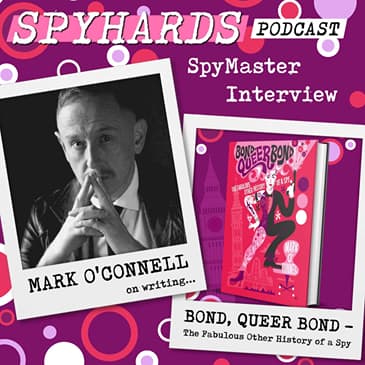


Agents Scott and Cam welcome author Mark O'Connell to the show to discuss his new book, Bond, Queer Bond: The Fabulous Other History of a Spy. He also shares his top five favourite queer spy films, as well as his thoughts on the future of 007 under Amazon!
You can buy Bond, Queer Bond: The Fabulous Other History of a Spy on Amazon. Also, make sure to follow Mark on YouTube or at his website.
Become a SpyHards Patron and gain access to top secret "Agents in the Field" bonus episodes, movie commentaries and more!
Make your opinions about the NOC List known. Leave us a voicemail on Speakpipe or send us an email now!
Purchase the latest exclusive SpyHards merch at Redbubble.
Social media: @spyhards
View the NOC List and the Disavowed List at Letterboxd.com/spyhards
Podcast artwork by Hannah Hughes.
Theme music by Doug Astley.
Hosted on Acast. See acast.com/privacy for more information.
[00:00:40] Scott's Podcast, I'm Agent Scott. And I'm Cam the Provocateur, hanging out in Las Vegas. I mean, we are the last two here. It's a ghost town in Las Vegas these days. Just us and this rat. Yeah, and a scorpion, and we're holding hands. And a scorpion. Ooh, ow, ow, Scott, stop putting it down my shirt. No, I'm just tickling you. Oh, right. I thought it was a scorpion. Silly me.
[00:01:04] Hmm. We have a very special guest joining us this week, returning to the show for his third time and talking about his brand new book. Cam, who do we have joining us? We are joined by Mark O'Connell, the author of Bond, Queer Bond, The Fabulous Other History of a Spy. And Mark was on a long time ago, actually. Long time ago. Yeah, to tackle the movie Thunderball here on SpyHards. And so it's a real joy to have him back. He wrote previously Catching Bullets.
[00:01:34] His memoir about his life with James Bond. And now we have his, you know, well, we'll let Mark explain it, but a very interesting new look at sort of the history of James Bond. Yeah, I think it's an important text to highlight on the show, because not only does it look at sort of the literary history of Bond, but also the film history of James Bond and how it intersects with queer history. And there are some remarkable things that Mark has uncovered in this book.
[00:02:03] Exactly. Yes. And it was a pleasure to read. And I'm sure Mark will have some very eloquent things to say about it in our interview. Far more eloquent than us. So why don't we get right to it? Ladies and gentlemen, Mr. Mark O'Connell. Joining us today is a writer, author, a Bond obsessive and the man behind the fabulous new book, Bond, Queer Bond, The Fabulous Other History of a Spy.
[00:02:25] Mark O'Connell. Mark has spent years digging beneath the surface of 007 and uncovering the queer talents, creatives, influences and stories that have helped shape the world's most famous spy. Mark, welcome back to SpyHards. Hey, guys, how are you doing? It's been a while. Please don't mention Vargas. I'm still not recovered from that. But no, it's good to chat. Good to chat. What does he do? What does he do? I don't know. We just don't know. We're still workplace bullying, as I said at the first moment.
[00:02:53] For the people who are just tuning in for the first time, go back and listen to our Thunderball review. And it spawned a T-shirt. That's all I'll say. I'll leave it there. Which I wear when I'm painting and decorating. That's not a reflection of a T-shirt. It's the one I don't want to wear. He's doing emulsion right now. We've got a lot to talk about, but we are talking about a very excellent book right here.
[00:03:19] And I mean, years ago, I read one of your other novels, Catching Bullets, which is a wonderful piece of work. And I've still got it on my Bond shelf up here. And I think the question that jumped out to me the most when I was putting my things together is moving on from that. Why this book? Why this story? What made you want to write Bond, Queer Bond? I can't. Well, there was a myriad of reasons. The first thing I just did want to do another Bond book.
[00:03:48] It was I did Catching Bullets 2012, 2013, and it's still reverberating. It's still a thing. I still get called the writer of that. And that's great. It's good to have one thing that people are latching on to. But I was kind of getting itchy again. And also, you know, with the end of the broccoli era and the new Amazon era, although that wasn't that kind of curveball me whilst I was writing. But I thought, you know, we're going to go into a new era of Bond, whatever happens.
[00:04:13] So I just thought it's a good timing, not not for sort of sort of promotional reasons or commerce reasons. I just thought, yeah, I'm going to do another book. But also as a gay guy approaching his 50th year, that was last year I approached it. I was quite mindful of the politics in the world and the sort of black storm tempests that are coming for a lot of LGBTQ people.
[00:04:37] And in a lot of parts of America and parts of American life, LGBT stories and access and visibility is being cruelly not just shut down, but it's how it's being shut down. And then I suddenly thought, hang on, James Bond, queer. And I did want to do maybe a little bit of a gay book, a gay book, but I didn't I didn't quite know what it was. And I've actually I was working on a novel as well, which is I can still go back to that.
[00:05:04] But I thought, hang on, hang on. The queer history of Bond. That's so delicious. It's a great premise because, you know, the openly straight James Bond. Why would he have a queer history? And I kind of like that immediately. Then I hit the oh, is there enough? I'm always a bit conscious of, you know, getting over the word count finishing line. And I, you know, I was and then suddenly I realized towards the end of writing it that I was well over it and I have to run backwards and, you know,
[00:05:29] unfread some things and abandon some others. So I was I was sort of conscious of the two worlds and they came together. And there's a bit of a lockdown thought process. I was thinking about it during lockdown, like we all were sort of thinking about things. And then I started doing the research and that's where I went, oh, oh, oh, oh, OK. And the idea of making. I've always said I didn't want to go back and some people are still a bit fearful of the book.
[00:05:57] I'm not going back and I'm right. I'm not I'm not I'm threading James Bond's history and his timeline. I'm not suggesting Bond was ever gay. I'm not suggesting the character is gay or the actors are. I was just aware of the queer history of Bond and how Bond was forged and created as a project, not just the books, not just even the films. Obviously, those two are the big, you know, 50 percent of the book.
[00:06:24] And I just fell into an amazing research rabbit hole and thought there is a lot here after all. So, yeah, it kind of came from there. Wanting to do a Bond book, wanting to do a queer book, bring them together and also shake things up a bit. Because the Internet is made to be rattled. So let's rattle a few feathers and tuxedos.
[00:06:45] So I think like, you know, a lot of Bond fans are aware, for example, like Peter Hunt, you know, was a gay director making Unimagined Secret Service and also an editor who changed the face of action editing. But I'm curious when you're doing that research process, what were the discoveries you made that were the most exciting, the ones that really just like blew up your mind with potential? Oh, there was loads. I mean, Peter Hunt, his was more of a just looking at what he did. Like you say, he did. He didn't just change action cinema. He reinvented a new genre for it.
[00:07:14] And he created a new. James Bond films, a happy fantasy entertainment, but he was helping to create a new type, a new form, a new version of onscreen masculinity. Because until Sean Connery, we had David Niven and Gregory Peck and Charlton Heston. They were the kind of the leads of the day. And suddenly Connery comes along.
[00:07:36] And one of the things Peter Hunt does is just frame him and edit him and protect, you know, just present this new sort of icon of masculinity and sexuality and heroism. But suddenly I realised that Peter Hunt, it was illegal for him to love. So he's cutting and editing James Bond love scenes or action scenes, but he's not able to have love scenes of his own. You know, his own sexuality means his life and his romantic life is illegal. And I thought that, you know, that's interesting.
[00:08:05] And then I found out a lot more about him and his partner and, you know, what he was doing. He was actually quite an out proud gay man. A lot of his gay friends would come to set. It wasn't a secret on set. George Lazom is forever saying how many of his gay entourage were there. All right, George, you know, have our power. But no, a lot of it, when you say what discoveries did I make? It was it was kind of realising the timelines as well.
[00:08:33] So that kind of helped. And I I'd never done a history book before in this way. And I I didn't know how much research is too much research. So I'm I'm just ploughing everything. One of the biggest things, the best discoveries for me weirdly revolves around view to a kill. Maybe they're the best discoveries because I'm a massive Roger Moore, 85 Bond fan. But we all were always told in the press at the time that the onslaught of AIDS in the 80s,
[00:09:02] it changed and, you know, Bond had to clip his wings for 1987 living daylights. Well, the view to a killer to already address the AIDS issue, but behind closed doors. And that's the discoveries I found. And just going to like Facebook memory sites, memory pages of nightclubs in San Francisco and Paris and Fire Island. And I suddenly was like, oh, OK, finding instance moments where Grace Jones at 2 a.m.
[00:09:29] attends a gay nightclub on the night of the view to kill world premiere raises five thousand dollars for an up and coming AIDS charity. It's just trying to, I think at the time, raise money so that people can eat or their dogs can be walked. You know, this was early days of what does what the gay men with AIDS or people, those what do they need? And I thought, that's actually wow, that's quite a thing.
[00:09:51] But so the first film and the first franchise film to make money for AIDS charity and AIDS awareness was a view to kill. And that was off the back of Grace Jones. And there's a whole more there's more queer, queer dressing to that story, particularly. And another one, another thing that really I found quite poignant. It was about wasn't just doing discoveries. It was trying to be trying to join up dots and hopefully dots that were there.
[00:10:17] But one of the things I discovered was that a great scientist called Mathilde Krim was one of the pioneers of AIDS research. She was one of the first people to say, I think we should put, you know, condom machines in universities. And can we stop reusing needles? You know, the stuff that's common now. But she was like, I think we should be more careful about this. And she was a bit of a society Manhattan woman.
[00:10:42] She had a lot of money, but she would be in a pickup truck at night delivering condoms to nightclubs and universities because she cared. But the person that she was married to was a guy called Arthur Krim. And Arthur Krim bankrolled Bond back in 1961. He gave Cubby and Harry Saltzman the deal and the green light when he was head of United Artists to make the film.
[00:11:04] At the end of the 60s, whilst Lazenby is playing gay up a mountain with some Playboy Blofeld bunnies, Arthur Krim brings out Midnight Cowboy and he panics because it's kind of a queer honesty, a queer romance. It ended up winning the Best Picture and it was the first instance of an X-rated movie winning Best Picture. It was an X-rated movie because Arthur Krim panicked about his own film.
[00:11:31] So he made sure that it's like, I don't want to turn people gay. I don't want to upset the Christian folk here. And he regretted that. And I read up a lot about how he then in the early 80s, when his wife is doing this AIDS research and she needs some money. So he pumps some of his own earnings into her AIDS research.
[00:11:51] And without really going through the dockets and the receipts, that would have meant bond revenue, bond earnings went into fund crucial AIDS research. So that actually gets me choked up and I'm trying not to now, but that kind of went, OK, this is where bond isn't just tuxedos and fantasy and two hours of escapism. It's actually serving a societal purpose and progressing things for everyone. You know, it's not just gay people that learn from AIDS research.
[00:12:20] It's the whole of humanity. So that was just two long examples there. But it was that sort of stuff. I sort of sat up and went, oh, gosh, you know, wow. Wow. And then finding out about the tailoring and particularly the Robert McGinnis, the famous Bond poster designer, his works in this room now. He he used to design with other Bond poster designers when they were just artists. He designed like lesbian fiction and what was like pulp fiction.
[00:12:49] And whilst you think, OK, well, you know, a guy's got to draw a guy's got to eat. Yeah, absolutely. But some of those books got picked up by the McCarthy Commission as being, you know, heinous and dangerous to humanity. And it's great publicity for the cover artists, not that they were part of part of the mix. But again, that's the stuff where you'd find out, oh, that book that was banned for being a lesbian novella and a short sort of fantasy fiction was designed by Robert McGinnis.
[00:13:18] You know, just some people that could be tenuous. But I'm like, no, that wasn't just a tacky potboiling romance of a lesbian book. It was one that lesbian communities and, you know, a woman perhaps living in the middle of Utah, she could buy it and keep it hidden and that would give her a connection. So it was it's been a lot of that. That was been a lot of the discoveries rather than just, oh, you know, I never wanted the book to be about,
[00:13:43] oh, did you know that actor was gay or that director was gay or that that seems a bit of a wink wink. I didn't want it to be about coding and paradigms and sort of academic theories. And I try and quite quickly flip that out the water early on. I go, no, no, it's not about that. Yes, I could do a chapter on the, you know, the camp concierge guy in Moonraker, but that would serve no purpose unless there was more of a historical use.
[00:14:09] So, yeah, it's sort of sort of being faithful to Bond history as well. That was because I know people like, oh, I don't know about this book. You know, it won't make you gay if you buy it. It won't make you gay if you even look at a picture of it. But I still think that that's genuinely a thing for some people. That's their lookout, not mine, but I can see it from afar. But if if Bond's history is not all there, is is it really history? You know, so I that was another reason.
[00:14:35] I just wanted to embellish what we already know and with a little bit of a rainbow flourish. I think you've taken me to my next question very seamlessly. So thank you for that. But for me, what really stood out to me about the book and we can talk about some of the anecdotes and things you discovered along the way, which is interesting for me. It's more the thesis of it that really grabbed me because it's not you. You could make a book about, you know, is Bond gay or that sort of thing. And there is a conversation and an academic conversation that could be had there, I'm sure.
[00:15:04] For you, what it seemed that was the important thing is to look how important Bond has been to the queer community, how important the queer community is to Bond and how intrinsically linked they are. And that was what was really just lovely for me to read about this book is just how impactful it has been. And I suppose that leads me to my question, because I'm glad that the book didn't go that way. And I know you say like some people, you won't be gay for reading it, that sort of thing. Absolutely not. I've not turned straight for reading any straight book.
[00:15:33] No, I've read all kinds of books, but then I'm never quite defined anyway. So there you go. But for me, that was the bit that was really impactful was just highlighting, shining a light on just how much there is in terms of the history. Because I love the history of cinema and it's kind of a lot of what's being dug into here. So I suppose to my question, why was this an important story for you to tell?
[00:15:57] There's a slight sense of reclamation, if that's the right word, of just giving those heroes of Bond their flowers. That's that's an American phrase. You're giving them their garlands and their praise. So a bit of reclamation, because, as I say, we are in times where gay history, queer histories are being removed from libraries. And there's this panic about franchises casting a woman or a black person or an Asian person in any role.
[00:16:24] And I'm bad at this, but you see an online fever and you assume it is a fever. Sometimes, no, it's not. It's just a little group of angry people online, you know, tapping away like the monkeys in Superman. But I just I was getting quite annoyed, actually, at the the panic of diversity and people. People to this day, someone a couple of weeks ago said, you know, the Bond thing is not diverse. I went Bond has been diverse since the get go.
[00:16:51] And a lot of straight guys, heterosexual straight guys, same thing. Might not look at how women are presented in Bond films or how people of colour or different ethnic groups. But the women, just as an example, the women of Bond have always had great agency. Yes, Britt Eklund is in a swimming costume and there's a there's a sort of amount of flesh, flesh and tickle, as it were.
[00:17:17] But those films, you know, in Thunderbolt, Fiona Volpe is the head of, you know, the deputy head of Spectre. They're given great roles. And that also sometimes happens. Yes, we have like the Chinese henchmen in Goldfinger. And that, you know, that's kind of a judgment. I wouldn't say it's a racist one. But I was aware of the queer history not being acknowledged. And I don't mean like, you know, why can't you recognize the gays?
[00:17:45] No, I just thought it's it's relevant, you know. And one of the things I like, for example, Lionel Bart. And it wasn't until I spoke to David Arnold, the Bond composer, about Lionel. And I said, can I interview about Lionel Bart? And we did did a couple of chats. And that was one of the moments. There was another one as well where I went, oh, I've got a book here.
[00:18:06] Because a lovely, generous straight guy like David Arnold can say that the whole Bond song genre and template was written by a gay guy that couldn't find love. And that's now what we expect. You know, that sort of trapped bird lament of a Bond song. And I thought, oh, OK, this is it. This is where the juice of it is. I just wanted to present these people's stories.
[00:18:28] And also a little bit of because, you know, when I'm talking about Richard Chopping, the cover designer, I'm then able to talk about the queer timeline of legality in this career. You know, he was there in 1967 when Parliament rubber stamped the decriminalization of homosexuals in England. Scotland waited till 1980, which was another thing. It was like, you know, there was no angle there for Bond. It went 1980. It was illegal to be gay in Scotland till 1980. Wow. OK.
[00:18:58] And there's many countries where it still is. So maybe that's a long answer. Not short there. No, no. I mean, I think that makes sense. And I think one of the things that was really interesting to me when I was reading the book was the way you would look at, like, characters throughout the films. Because this movie is also film history, but also film analysis. You're looking at the Bond films and books and pointing out things.
[00:19:19] And, like, I had never thought about the scene at the start of Thunderball where Bond goes to the funeral and you have the, you know, the specter agent in drag that Bond has the big fight with. In so many movies of the 1960s, that's a punchline. That character is a joke. And dispatch in a way that makes fun of them for being in drag. Whereas it is a very tough fight.
[00:19:44] Like, Connery, you know, Connery's Bond is really having to give his best to take down that specter agent. And I really was like, you know what? That is kind of like a very progressive idea in the 60s. And it's kind of invisible now. Like, you just don't even really think about it as much. Yeah, and that's what I mean about the visibility, you know, the agency of women and a lot of ethnic characters in the Bond films.
[00:20:06] Yeah, well, the Thunderball thing, I'm going to say I got to interview Peaches Christ, who's this great San Francisco drag queen and steeped in movie culture and midnight movie culture. And I urge anyone just to listen. She's got a great podcast called Midnight Mass, where they just look at random films. And I've guessed it in a couple. And really insightful as well. And she gets good names. And so I interviewed her. And she was the one that pointed that out.
[00:20:30] She said, had the stuntman been quite femme and, you know, to use the word sissy, and Sean Connery's, you know, beating the living daylights 22 years earlier out of the widow, that could have been problematic. But because, and this is, I just love the cut, where we go for, I think the actress is Rose Alba. You could be wrong there. And she's playing the demure, almost like Jackie Kennedy at a funeral sort of vibes.
[00:20:59] And then Bond punches the shit out of her. And we cut to Bob Simmons, who's about five times the size of the actress. And he's built like a brickie. And it's brilliant. And I just, I love the artifice of that. And the fact it's, it's not, it's not homophobic. And then I read up on Bob Simmons, his whole experience of doing that scene. And I don't want to give too much away.
[00:21:24] But like a lot of straight guys who are in that situation, he got really protective about his looks. And Terrence Young Connery, and I believe it was Ken Adam, helped drag him up. And he was almost like, no, no, I want that wig. No, I don't, no, that's not, that's not my hair. And he's kind of, suddenly he was immersed and invested in it. And I, you know, this burly, presumably straight guy called Bob Simmons doing that. Again, that's interesting. You're right. It's kind of progressive, quietly progressive.
[00:21:55] And it's still such a great moment. And we did, I say we have drag in every Bond film. And it's not, you know, the female costuming is drag. Sean Connery wore a wig and makeup for most of the film. That's, it's drag. It's, I'm not, drag's not just, you know, long Dolly Parton looks and hair pieces. Drag is just dress up. You know, Blofeld's in drag. That's, it's just specter dress up. It's specter drag. And that was kind of what I wanted to do is also maybe break, I'm not saying my book's
[00:22:20] breaking down barriers, but just, you know, there's, there's a fear of drag now that because unpleasant parties are saying, oh, drag kids, kids are being groomed by drag queens. They're really not. Drag queens don't have enough time or energy to be doing that. And I just thought, yeah, there's been drag in Bond. So that was another chapter to bring in. But no, I appreciate that you picked up on that sort of fundable bitch fight. Yeah. Because there's so many examples of characters that you, you know, examine throughout the
[00:22:49] course of Bond history, but it's just like interesting the way, of course, everyone's focused on say Winton kid. Everyone goes, of course, Winton kid. You know, what is the book going to say about them? But it's those other characters that you maybe don't immediately clock that are the ones that I think are where a lot of the value of the book comes. Yeah. Yeah. Yeah. I mean, as I said, I didn't want it to be like, oh, that character's gay. That, that, that, you know, it's there. It's there if it needs to be. And it's not there if it's not.
[00:23:14] Um, but yeah, it goes back to that sort of sense of reclamation and just, just underlining Bond history. You know, Bond, I, yes, I'm a gay guy and I can say this, but I, I like the fact that the Bond project, both literary and cinematic and some of the sidebar other parts of it have kind of not had to be told to step up and be diverse. You know, it was kind of there from the get go.
[00:23:42] And I think part of that slightly as well, that the Bond films in the sixties weren't just produced in a straight male vacuum. You had, uh, Cubby Broccoli's wife, Dana, uh, Jacqueline Saltzman. They were giving input. There was, there's, you know, a lot of women were part of these films, including, um, the first couple of Bond films were written by a woman, uh, Joanna Harwood. Um, and I used women a lot because it's, you know, Bond gets you up. The Bond films are homophobic. The Bond films are sexist. I'm like, no, they're not. No, they're not.
[00:24:11] People tell me, oh, Fleming, he was homophobic. I went, no, he wasn't. The fifties were homophobic. That's different. Well, I was going to say, it's like that line of like, you know, individuals who are maybe would now be considered a little antiquated, but at the time were quite progressive. You know, you talk about, you know, Cubby Broccoli's fight for the trial of Oscar Wilde and keeping, you know, that there was one line of dialogue alluding to, you know, homosexual, uh, behavior from the character that, you know, the censors and whatever, like no, cut that, cut that.
[00:24:41] You'll be fine. And Cubby fighting for that. Like that's necessary. And, you know, I don't think people in 2026 are like Cubby Broccoli, you know, the great ally, but it's kind of the lens of looking at it in the 1950s, 60s, 70s, et cetera, versus now. Yeah. And I, I, as soon as I, I've always known that, that Cubby kind of, he put his, uh, his finances, his reputation and his momentum into the trials of Oscar Wilde, which is a great film.
[00:25:09] And I'm sure we're all aware of it and it holds up really well. And it's, it's a very good queer film, but it's also a courtroom drama. I think there's about as much flesh as my wrist here. It's not, it's not a fleshy, naughty film, but Cubby, I'm not changing that line. Cause if you change that line, you're changing the whole point of the trial and the film's called the trials of Oscar Wilde. And he dug his heels in and he suffered. The film got downgraded. The Catholic mums censorship group, which were quite a thing for many decades in America. Um, a lot of films were sort of chastised and banned.
[00:25:39] Sometimes it helped, you know, don't see that film folks. It's, it's Sodom and Gomorrah. Oh, I want some Sodom and Gomorrah this weekend. So I'm going to go and watch it. But he then had to, um, find an alternative and find the next money stream and the next creative stream. And that's where the bond thing finally fell into place for him. And I think, well, if he'd not, you know, you've got this straight Italian New Yorker
[00:26:02] putting his name and reputation to defend just a tiny queer detail in a bigger queer film. And then doing that, he needs, he ends up settling into the world of bond and all of that street machismo and caper. I went, that's interesting. So that's partly why the book starts with that. And Barbara Broccoli gave some great thoughts and, and, uh, some help on that, which was a lovely sort of, she's a good guest star in my pre-title sequence.
[00:26:28] Well, and you know, I always think like context is king. And I think that's one thing this book does very well is, is give context to the wider bond world, cinematic literary, even TV, I suppose, in many ways. But one story going back to just the origins of bond and Ian Fleming is the William Plomer story behind all of this, which I, I think I had to go back and reread that section. Cause I just thought like Ian Fleming gets painted as one particular person. I've watched a lot of documentaries about Ian Fleming, mostly terrible.
[00:26:58] And, uh, we won't get into that. GoldenEye is not one to watch, but, um, it was just fascinating to just, I'd never know any of this and how, how influential William was to the literary works that Ian wrote, but also, you know, Ian looking after him, helping him out when he had these difficulties with the law like that. I, I didn't know any of this to go into that book just blew me away. And it just, it doesn't, it's not completely like changing how I see bond, but it gives it a little bit more context.
[00:27:26] Yeah. Yeah, no, I, I mean, William Plomer, um, is I found him fascinating and I did a lot of research around him. I ended up on like, um, Zoopla and Rightmove, which sort of, um, property websites, cause I found where he used to live. So I was able to see photos of where he lived and where he read those manuscripts. And it was an old cottage on the West, on the West Sussex coast here in the UK. And, um, you know, just, and I wouldn't have been able to do this book 10 years ago cause the curation and there's, there's just more online now, including you can go and look
[00:27:55] at someone's house if you get the address, right. And see the photos of it. But yeah, William Plomer, he was this fascinating guy in the twenties and thirties, quite a literary force. He, he had a lot of queer energy. He hung out with Christopher Isherwood in Berlin during the cabaret I am camera times and all that. And, um, and then yes, like you say, he, um, he'd got his collar felt at Paddington train station, 1943, cause he went, he propositioned the wrong sailor.
[00:28:23] Don't think there's such a thing, but legally less sometimes can be. And, um, but, and you know, Fleming and his colleague, let's just say allegedly, arguably got him off the wrap and they started a friendship. And 10 years later, he's the publishing editor at Jonathan Cape and he wants, he's pushing Ian to do this novel that he's writing and presented. And, and there's this great, I read a lot of the letters and I wish I could have quoted
[00:28:48] them more, um, letters between William and Ian and also between Ian and Anne talking about William and some of the publishing people at Jonathan Cape. Uh, and it was, I mean, it would make a delicious sort of duet drama, just Pluma and Fleming having their sort of correspondence course, him in West Sussex or London, uh, Fleming in Jamaica. Um, and they, they massaged each other's egos and, uh, they would, I, you know, I think this
[00:29:18] Moonraker thing, have you ever thought the Bond books like they might make good films? And forget about that for now. And Fleming, Fleming was, Fleming had an ego that had to be massaged. I don't think it was as fragile as he came over. No, it wasn't, it didn't have a fragile ego, but Pluma and him, they kind of, they, it's like almost a holistic relationship. They help each other, um, whilst all the time, and most importantly for, you know, the world of Bond, nurturing these novels.
[00:29:45] And then, and Pluma's quite bereft and lost when Fleming dies, uh, and he becomes a sort of TV voice and, um, commentator of Bond. Uh, and then later, um, well, when Fleming does die, um, Stephen Spender, the gay poet and writer, who's a friend of his, organizes the memorial at, um, in, uh, in Smithfields in London. And, uh, William Pluma delivers the eulogy and I managed to find the eulogy.
[00:30:12] And I went to one of the universities that got a lot of William stuff and it was so brilliantly, beautifully written, you know, I was just thinking, my God, so potentially Cubby Broccoli was sat there, you know, various film people were listening to this and, um, yeah, it's a Pluma's one of the, you've got William Pluma in one chapter and then Richard Chopping in another, and they're very, they're sort of two sides of a gay coin. One's quiet and reserved and one's not quiet and reserved. And that was what I enjoyed finding out that, oh my God, gay people are just like all people. Sometimes they're wild.
[00:30:42] Sometimes they're quiet. Um, you know, who knew? Well, I had a question for you because, you know, you dive into individual books and movies along the way. And I would love to know which book or movie was the richest text and which one was the most frustrating? Oh, that's interesting. Um, well, I was, I was conscious of trying to acknowledge every Bond film and have some piece of queer history in every Bond film.
[00:31:10] I hadn't actually gone through and thought, have I missed anything? Um, hopefully not. One of the books that I really warmed to, and I think it was a, it was a game changing moment for Fleming as well. Uh, and the whole Bond literary, uh, program. And that's from Russia with love. I mean, it's when, and when I realized and did a bit of digging around and realized that, you know, Burgess and McLean, the, the, the gay turncoat spies. And I mean, it's too complicated to go into, but I have this chapter that where Truman Capote
[00:31:38] stays with Fleming for Valentine's weekend in 56. And it's pouring with rain and they just go to Noel Coward's house for, um, cocktails and booze and bitching and stitching. I'm sure. Um, so I, you know, I had to immerse myself in the for much of love novel, because that's what Fleming was writing at the time. And then I found, you know, when he puts in Burgess and McLean, Burgess and McLean that weekend, their story goes through the roof in Moscow.
[00:32:06] And I won't say too much, but then I basically, they present themselves as yes, we were the turncoat traitors that everyone thought we were five years ago. They kind of present themselves in Moscow, but Fleming knew that they were about to do this because he's already got a journalist friend, uh, Richard Henderson, who's got a different, another Bond, um, legacy. He's sent along to try and get the first interview. And he does. So Fleming's tapping away with a hung, hangover from Capote and Coward writing about Burgess and McLean.
[00:32:34] He's also writing Bond being dismissive of the workplace homophobia with those, you know, discussions of gay men and should long haired hippies or something or long, long haired intellectuals. Um, I don't know why that means they're gay. Um, God help Merlin. Um, and that, so yes. So maybe to answer you some from Russia with love's got great queer texture because it's got great Russia texture and that's kind of was quite important.
[00:32:59] And the whole world of spies is very, I think we might go into that a bit later, but the whole world of spies has got a great homosexual DNA and there's probably better ways of saying that, but there's, there's a lot of queer history in spying and in British spying and at the time Bond is being forged. So I'd say for much of love, um, there's also the short story, um, uh, Consum of Solace links to the Capote thing in a way I did not know.
[00:33:27] And I, uh, Nicholas Shakespeare, the bar, the recent Fleming biographer, I had discovered something and I fully acknowledge him, but it's the, there's a whole saga with Capote and he pissed off his friends. Um, and, uh, one of them in her past killed her husband accidentally. That's a very true story and it's a famous story. Um, but Fleming puts that into Consum of Solace. It was like, Oh, okay. So, you know, again, that's interesting in terms of films.
[00:33:54] I don't think there's anything more, more of a queer rich text than the 1971's Diamonds Are Forever. And I'm sure we'll talk about that, but, um, it was, it's just a delicious film and, and it's, it's, it's created in such a straight way as well, but it just falls into a real, and I can say it's a very faggy Bond film and it's, it's glorious for that. Um, in terms of perhaps texts that were less, you know, harder to dig into, um,
[00:34:25] I didn't go so much into the new Bond novels, although I bring in Kim Sherwood, you know, the continuation novels and just cause that was, there was time. I just didn't have time to really go there. And maybe, you know, if we do Bond, queer Bond again, I can do that. Um, but there was, there was, I think there's an instance in particularly in the Bond films where there's, there's a queer history, a queer involvement in every film, um, easily, easily right. You know, from 62 to 2021.
[00:34:53] I was, I was going to ask you about Diamonds Are Forever, but I suspect we may circle back to that film in a bit. Um, it's got a history of me and Cam that, uh, spans the test of our relationship together. So I, I am keen to talk about it with you. I suppose my last question before we perhaps go to that other section and come back on the book a little bit more is what does, I, I, I find myself on the periphery of the queer community personally as for a multitude of
[00:35:21] reasons that we won't get into. Oh, me too. Yeah. But I, I often feel like someone looking in through the, through the window. My question to you is what does Bond mean to the queer community? Um, I get asked that a lot and I, I now have an answer at last. Um, one of the things I wanted to do just to pause for a sec was I wanted this book to be totally accessible to someone that didn't know Bond and what isn't queer isn't gay. I wanted the book to be accessible, you know, so that my mother
[00:35:50] can read it and understand it and she's reading it and getting it. Um, so what does Bond mean to the queer community? Something I've been pondering a lot and it's only recently after writing the book, um, that I, I kind of worked it out. It's, it's lots of things. Um, I could say initially that the gays love a sense production. They love good design. They love, you know, good costuming, good music and a sense of showmanship. And that is, there's a truth in that, but there's more to it
[00:36:19] than that. And it, for, for a lot of gay guys, it, yes, Bond has been their hot idol. I, I've never had that until the new Bond. Um, we'll maybe get onto that. Um, but my mum was always, oh, I think Sean Connery is quite hot. And I'm like, okay, I don't want to hear who my mum thinks is hot really ever. Um, although when I was suddenly watching Thunderball for the book, I went, my God, there's a lot of daddy energy in that. That's the kind of gay phrase for just, you know, everyone's
[00:36:49] kind of putting out a bit, even, um, uh, uh, uh, villain, I forgot his name. Um, uh, Adolfo Celli. He, uh, there's a, he's, he's got daddy vibes as well. The gay guys will know what that means. And then I thought, well, what is, what is the pull for gay people when it comes to Bond? And for me, and maybe that's any way I can properly answer it's, it's the women. Gay, gay men, particularly. And I'm, I, I haven't read this book just for gay men, but it, I am a gay guy and it's a gay guy
[00:37:18] writing about a straight guy. So I'm, I'm conscious of that all the time. It's the women of Bond. As a gay man. And I think I echo a lot of opinions here. We love a strong woman, a flawed woman, a bitch, a victim, you know, um, and the Bond films are just replete with them. Um, and also escapism. We, you know, the Bond films represent great escapism and there is,
[00:37:45] there is a sort of prissiness to a lot of the villains. We, you could do the thing I said I don't do. You could sell is, you know, is that villain a bit gay? Does he fancy Bond? Yes, Lachie fancies Bond in Casino Royale blatantly. Oh, you, you, you work out and you change the shirt and he's not bothered about his girlfriend being, you know, uh, knifed, um, in her lovely yellow dress. And I was like, oh, this is a sheaf gay. I mean, it's, it's there if it has to be. And then
[00:38:09] maybe that justifies why Bond is butt naked for the, um, the, the, uh, torture scene at the end of the film, which I know is in the book. Um, and it was great that they did that. Um, so yeah, I think it's just, I think it's, that's a really good question. I, I think it's the excess as well, the excess of the Bond films. They are, they are hyper real and that, that appeals to a lot of gay
[00:38:35] communities. Yeah. You know, look at the success of American horror story, which has come back. It's, it's full of queer icon cast members, but each show has got such rich production design and rich music and is totally escapist. And I think that you can say Bond, Bond films do that and always have maybe not the best answer, but it's the only one I've got right now. I think the only note I had from my head when I thought about it was just the sense of the Bond
[00:39:01] films and the Bond universe and all that being unapologetic, which is something I think that people who are living their true lives strive to or aim to be as unapologetic for who and what they are. And I think Bond lives to that excess. And I think people can see themselves in that. And that, I mean, just something that jumped out to me really. Yeah. Yeah. Yeah. Yeah. I mean, my mum, when I came out, my mum was a bit confused
[00:39:26] because I had a bedroom wall full of Bond girl posters, you know, Maud Adams, A Few Eyes Only, Carrie Lowell. Carrie Lowell was quite, she was all over my clothes wardrobe, no idea why. But, and I, I wasn't, I wasn't remotely into that. And it wasn't like, oh, doesn't she look fabulous? It's not that either. It's not, it's not, oh, she's, oh, she's so iconic. It's not that. It's just, I don't know, maybe I'm just saying this off the top of my head, but maybe it's because you've got this straight character Bond and all the other elements are
[00:39:56] random and not the opposite of him because you've got the straight female characters, but they're, they're, they're not him. And I think maybe that's a little part of it, but that's going into the academia, which this book doesn't do. It's a lot, it's a lot better written than I've just explained it for the last two minutes. None of us are qualified to be academic here. Don't worry. Yeah. Yeah. Um, well, this is spy hard podcast. We do like talking about Bond, but there is a much wider world to spy movies out there. And we gave you a mission that you chose to
[00:40:25] accept. Uh, when we get authors on the show, we like to give a little mission, which is to talk about their five, uh, favorite spy movies in a different context. So in this context, we challenged you to come up with your five favorite queer spy movies, perhaps the ones most important to queer cinema or, or just ones that are really interesting. And, um, so I think we're going to start with number one over to you, Mark. Right. Well, the first one is a TV drama and that's, it's, I think it's only TV drama yet. Um,
[00:40:53] and it's London Spy 2015 Ben Whishaw drama, uh, five, six parts. Um, and I'll just look at my notes here, uh, directed by Jacob Verbruggen. Um, it kind of also sets up black doves, which is about to come back for a second season that is Ben Whishaw. It was a very different character, but then wishes. And also, you know, shagging his way through London, um, in both projects, but I really loved London spy. I
[00:41:18] found it deeply moving and deeply affecting because it, a lot of gay dramas and a lot of British gay dramas aren't honest. And they're, they're, they're about the issues and the problems rather than the, the texture of real people's lives. And I, I was watching London spy. And whilst it's got this spy world, netherworld undercurrent, which is quite dark and disturbing, not because it's gay, but because it's just spy world is ruthless and horrible. And we're sure kind of, he,
[00:41:48] it's been out for 10 plus years now, but we're sure he has a partner who, well, it's a lover who's just found dead in a suitcase, which echoed a real life, um, moment in London history. And Ben Whishaw, who's his, this, this gay guy that's not in the spy world wants to know why this guy's died. And he investigates it and falls into this sort of rabbit hole of spydom. And I really appreciated it. And I really, I got obsessed by it actually when it first came out because I won't go into full details,
[00:42:13] but there's a great, um, sequence where Ben, Ben Whishaw confronts the mother of the dead guy. And it's played by Charlotte Rampling, who's up to her eyeballs in, in the plot. She's no, um, innocent character. And she talks about, I won't go into it, but she took that gay sex. I've never heard anyone talk about that like that on British television and it's real and it's honest. And that's why I just warmed to London spy. I think it's a great, great drama. And then to go full circle
[00:42:39] with Bon Queer Bond, the first person to give me a nice endorsement quote was Tom Rob Smith, who wrote London spy. I mean, I did go to him because I was obsessed and in love with the drama. And, um, he, he was actually the first person to read it, um, apart from the publishers and it was all great feedback. So London spy would be my first one. Um, yeah. Number two is a film. Hang on. We need to, we need to just give a little bit of thought on that. I mean, we need to react.
[00:43:06] It's interesting. Um, firstly, the context of the director being the first person you sort of sent the manuscript to it's, it's a nice bit of, uh, continuity between the book and this. And I didn't know this actually exists until you said it. I've just added that to our master list to talk about on the show at some point. And, uh, maybe we'll have to get them on. Scott. Also that is on our list to cover over on the Patreon on OSS. There you go. So, um, I actually didn't have a lot of context as to what London spy was other than it was a
[00:43:34] mini series called London spy, which is right up our alley. And so that actually makes it a lot more interesting. And we like, I mean, Ben Whishaw was, was fantastic in black dove season one. That was, I think he was probably the best part of that show. Yeah. So yeah, I'm keen to see season two and also this. Yeah. He, I mean, you've got Mark Gators in it. James Fox is in it. Charlotte Rampling and also, and I won't get the right actor, but, um, Ben Whishaw's dad is played by one of the
[00:43:59] Octopussy Knife Twins. Wow. Oh, I remember thinking, did they share the role? Yeah. Like completely random. And it's like, um, uh, it might be David, um, David or Nicholas, come over to which, but I'm thinking they, they shared the role. Um, so yeah, that's, that's kind of a full circle Octopussy moment. So yeah, you, you should look at it. Um, uh, yeah, it's a, it's, it's quite strong in the spy world and the, you know, the, the gay representation as well. But like I say, it's honest
[00:44:29] and it's also, it starts in Vauxhall, you know, and that it knows what it's doing because Vauxhall's got a massive gay history still does. Um, historically it was, it was where a lot of gay people would hang out, you know, turn of the century and all of that. And Vauxhall pleasure gardens, um, were quite pleasurable for a lot of gay guys in the, uh, the, um, the back in history, but also Vauxhall is where
[00:44:54] MI6 is based. So, so, uh, Tom Rob Smith and London Spy, they just bring the two worlds together brilliantly. And not many people do that. Kim Sherwood's done it in the, um, in the, uh, her Bond novels. She did it, uh, particularly in the second one. And I remember saying to her, well done, because that history is there. Um, so yeah, London Spy, I heavily recommend it. And now I want to watch it again. It's been a while. There you go. That's, that's number one. Number two. Number two is a
[00:45:21] 1984 film called Another Country, uh, directed by a guy called Marek Kanievsky. And it's not a spy film as such, but it's a, it's a very loose presentation of Guy Burgess at a sort of Eton type boarding school. So, and Rupert Everett plays the lead role and he, it was kind of his breakthrough role. He was working his way, you know, through the acting ranks and 1984, you know,
[00:45:49] Rupert Everett becomes this beautiful, I mean, we forget it now. I was too young, but I, he was like, Rupert Everett was like the Timothee Chalamet of British cinema in the eighties. Maybe Rupert Everett wasn't what we called that. Um, but it's based on, um, Julian Mitchell's 1981 play. And it's about Guy Burgess. He's called Guy Bennett in this film, kind of getting a grip and looking at British society. And there's those embers of, you know, he doesn't like British society and, you know,
[00:46:18] setting up that he might be a later traitor for want of a better word. Um, so it's not public school system versus traitor spies. And it was shot at all thought, uh, by, um, uh, Earl Spencer is in it as one of the school kids and Kerry Elwes is in it and Colin Firth, you know, there's a lot of British actors before they were famous in it. Uh, and then later, this isn't one of my titles, but later on, um, uh, Rupert Everett came back and did another film for the same writer called A Different Loyalty
[00:46:46] where he played a skewed version of Kim Philby. So Rupert Everett's had quite the spy sort of history, but another, another country, um, and there's a gay film as well. It was, I remember being deeply affected by it. Again, it, it, it's not a naughty fleshy film, but I remember being obsessed by, um, by public school setups and, and the sixth form guys, um, uh, you know, leaving their dorms at night
[00:47:15] to go into the boathouse and smoke cigarettes with their lover. And I, I was, I was quite obsessed by that. So yeah, another country, um, kind of got under my skin a bit like, um, London spy did. I mean, it's interesting just looking at these very young photos of Colin Firth. I'm just perusing it on IMDB, but then the 14th photo is, uh, someone strapped down being, uh, whipped by a riding crop, uh, one bloke whipping another. So, uh, it certainly looks like it anyway. I was 12 when I saw that. I mean, I don't remember riding crop, riding crop.
[00:47:45] Just that's your evening's homework sorted out there, I think. Yeah, yeah, yeah. Uh, no, that's another great choice. It's on, I just checked, it is on our list by looks of it, I think. Um, but, uh, yeah, that's another one we haven't tackled. So you're, you're putting us to shame now. Come on. Hopefully number three, we've have seen. Oh no. Okay. We haven't. We really haven't. This is it. It's you're teaching us. I like it. Yeah. Well, that's what my bond crib on thesis. I'm trying to, I'm every day is a gay school day.
[00:48:11] Um, uh, no, no, 1967. There's this short 43 minute film called spy on the fly. And it's directed by a guy called Ray Harrison, who has a filmmaking collective. This is very underground. This is very counterpulse. And he has this filmmaking collective. That's basically loads of drag queens and his gay pals in sort of Los Angeles on the West Coast, San Francisco. And their, their film collective is called the gay girls riding club. And there was, there was no horses. This wasn't an equestrian setup. This is not,
[00:48:40] this is not a view to kill or anything, not yet anyway, but it's a, you know, we all know how the bond phenomenon and the spy phenomenon, you know, you, you guys lean into it so much and brilliantly. So, but by 67, it was rampant. It was everywhere. So in 67, um, a very low budget black and white, um, shot film comes out. Uh, and it's a, it's a sort of,
[00:49:04] if you could imagine a drag spoof of bond done as the naked gun and it has a, uh, car chase in San Francisco, uh, nearly 20 years before view to kill does. And this guy just has to go and drag to infiltrate a villain. And it's, it's so low fight. It's ridiculous, but it, and it's a great spoofy bond film and it is, you know, but what's really interesting about it for like,
[00:49:30] say for sort of film history reasons, but also gay history reasons is, um, you, they, this was before you'd get permission to go in places or you'd fill a bar with extras. No, they'd just go into a gay bar and film a chase scene. And you'd see these sort of characters watching it of different ages as well. And you suddenly, you get a window into the, the blacked out gay bars of San Francisco and what was going on in them. And, and guess what? It was men drinking and bitching and smoking cigarettes at the bar. Yeah. Well, that's what was happening at
[00:50:00] the bar. So this film does that. And it's really so ridiculous and, and silly. It's also available on YouTube. The, um, the gay girls riding club did a few films. Uh, they were sort of spoofs of sixties titles, like what did happen to baby Jane and the Roman Springs onto Mrs. Stone. And, um, yeah, and there's an all about evil one as well. Um, so yeah, they're on, they're actually on YouTube legitimately and what I, another reason I go into the, I go into spy on the fly in the book a little
[00:50:29] bit, but last year at the, um, I believe it was at the Academy, uh, in Los Angeles, they had a season called, I think it was summer camp. And this film was showcased along along with others, Doris Fish and Vegas in space, which is linked to the book, um, later on. So yeah, spy on the fly. Another one you haven't seen, uh, it's a silly 40 minute. It's very Looney tunes. At one point the drag queen agent is
[00:50:54] being chased onto a beach and, uh, to assassins turn a corner and she's suddenly twirling an umbrella like bugs, uh, like bugs bunny. I was just like, it's just so ridiculous. Um, yeah. And I, we watched it with friends last year in San Francisco and had quite the hoot. Um, I would say that. Yes. I, it's, it's so obscure that it barely has an IMDB page, but I am very excited to track this down and we will put a link in the show notes. You can all go and watch it immediately after this.
[00:51:19] Yes, absolutely. As you should. Uh, okay. I mean, this is, I mean, in terms of reflections on that, I can't say much other than you're putting us to shame here, but that is fine because as we said earlier, every day is a school day. But also what I think of too, is like that post bond explosion we've seen and tackled so many of the movies that spun off from that Scott. And a lot of them are like the big kind of noisy ones like Flint or helm and what have you, but it also opened up for all these
[00:51:48] other opportunities for people to get movies like this made these interesting films that, you know, it's something that, you know, I think a lot of good genre entertainment does, which is like they call it smuggling where you're taking your ideas, your concepts, you know, Scott and I are big star Trek and sci-fi fans. They bring a lot of concepts. They can't talk about openly. Into the world of sci-fi and fantasy and like basically discuss it there. And that a world where there's something, a demand for spy entertainment, you can get made.
[00:52:17] You could do a lot of those sorts of stories in a way that are very accessible and I think entertaining to an audience. Yeah. Yeah. So, and also it just, this is the thing that a lot of straight audiences then and now don't see that there was no presentation of rear real queer nightlife. You know, it's suddenly a film like, it's nearly 60 years old spy on the fly. It has great relevance and then it has great relevance as a bond spoof because like you say, there was so
[00:52:45] many of them and it, you know, I go into the book and a few others, particularly some of the literary ones. But yeah, look up spy on the fly. It's just ridiculous. And I swear, but a kill rips off the police car chase going down market in San Francisco. And I'm yeah, I think John Glenn, were you watching that film? Yeah. Well, it's also nice to know that Casino Royale 1967 now has a contender for the best bond spoof of the year. Yes. Yeah. Yeah. Yeah. I mean, there's no budget. It's black and white. I think it's silent. They
[00:53:13] almost have a sort of Charlie Chaplin piano. Tinkily piano. Yeah. Which makes it more ridiculous. So it's got a little bit of a jazz. It's got a great, just to give it a context when it's, I think it's maybe Los Angeles or San Francisco, some sort of street scenes and you see a massive billboard vote for governor Reagan. You know, it's got that sort of historical texture, you know, when we look back and see, wow. Okay. Okay. Well, that's three. We're still in our shame seats. Can you save us for four?
[00:53:41] No, no, I'm going to take the shame seats. The shame seats are full now. All right. Okay. I think you should probably, you've definitely seen this one. I couldn't vouch. You might've done it actually. Carry on Spine, 1964. I went back and obviously watched the film. Yes. It's a camp carry on spoof of Bond, but it's so brilliantly done. And it's also like
[00:54:06] the film noir as well. There's a lot of influences and sort of Graham Greene and Fleming. And again, it's, I mean, so this film comes out in 64, which is only, let's just go right. So that's only 18 months if you think about it or two years into the Bond thing, but already you've got the carry on films on their ninth chapter doing this quite intricate, quite thought out Bond spoof. I mean, they got into trouble, Cubby threatened them with the lawyers, so they had to tame it a bit, but they have
[00:54:36] they have the great sort of Renato Frittini spoof poster, which they think they've got away with ultimately. And you have the Ken Adam, there's a great sequence where they're all on a sort of Ken Adam conveyor belt and it's all silly and speeded up. So as it's almost a companion piece to Goldfinger and Alan Hume, the cinematographer of the film later goes on and does, if your eyes only, Octopussy and A View To Kill. Because obviously there's a lot of carry on and Bond crossover connection. So yeah,
[00:55:02] Karen spying would be my sort of fourth entry into the gay annals of Spidem. I did say that right. We just created it, the gay annals of Spidem. Yeah. And it's fine. It's good. I like the title and I like the pick. It's actually the first one on the list I've seen, which is nice. Yes. Although I think I interestingly, Cam hasn't seen it so far. No, it's one that's been talked about a lot on the podcast. And I think like Scott relishes us
[00:55:28] actually tackling it on the show, but I've held off watching it until then. So I can have the first time watch be the episode. It's I mean, I wouldn't say it's quintessential British humor, but I think you need to be calibrated to a certain like the carry ons themselves are our unique entity. So just to get into that mindset, I think your first carry on film should that be carry on spying? I don't know. But it is a very good film. It's not a bad one because the films later become very fleshy and innuendo.
[00:55:58] They start in 58, I think so. Whilst they're beginning to get a bit slutty then they're not slutty smutty. Spying, I think they did a few genre spoofs and the one they did afterwards was carry on Cleo, which is because they're able to use all the abandoned Cleopatra sets at Pinewood, which was perfect for them. So I actually think spying is not a bad gateway carry on because you can
[00:56:23] see it as the the Bond spoof and you know what they're doing. It's not because Americans and carry on films. I've tried. I have tried. Although I tried carry on camping on some San Franciscans and they're like, this is naughty. I'm like, is it? Well, we used to watch it when we were eight. It's just on telly. It still is. Yeah, yeah. Always. Yeah, it always is. Yeah. Yeah. Yeah. I'm looking forward to introducing Cam to carry on spying. Maybe you can pop back on and help us, help help Cam.
[00:56:52] I'd be all over doing a, yeah, carry us spy harding or something. Yeah, we have to do a spy. Carry on spy harding. There we go. Yeah, we got it. Along with the gay annals of cinema history, I think what we just came up with or something. Okay, that's four. Annals. Annals. Yes. Annals. Yeah. Brilliant. Really enunciate the alls. And then the final pick. I struggled to not put this in and then I thought it's the queer bond bauble in the room
[00:57:18] and that's diamonds are forever. It's a big, like I've already said, it's a big rich text and an important source of bond, queer bond. But I also love it. I think it's a stunning piece of kitsch camp cinema, even though it's about a straight middle-aged, you know, slightly dad bond at the time. There's so much in it. I mean, Shelley Bassi, camp queer icon. Yes, tick. The John Barry
[00:57:47] score is such a delicious sort of 1am sort of vice-ridden tease. You know, the whole film gets that sort of front of house artifice of Vegas. It's very easy to just see how everything's decaying and rotten and decrepit and sordid behind the scenes. And the film gets that. And I love Bond films where
[00:58:11] you know what time of day it is. And, you know, Secret Service does that a lot. You know it's dawn and it's dust, not just because you're seeing it, but the story and the mood and the energy of it changes. And I get that with Diamonds Are Forever. I forever feel it's sort of 1am or midnight. And when it's daytime, it's a bit jarring sometimes in that film. And then, you know, Wint and Kid are obvious. We may talk about them a bit more, but everything in it is very straight,
[00:58:39] but it's also extremely queer and camp and delicious. And none of it should work, but it does. You know, you've got Blofeld in drag. You've got two hit men, homicidal killers, as I've always called them, played by two straight guys who weren't quite sure what they were doing. And one of the things I was able to do in Bond, Queer Bond, and it's partly on the back of Bruce Glover, sadly died March last year, 2025. And I thought, oh, I'm gonna, I'm gonna see if Pader Smith is available.
[00:59:09] And I emailed him a slightly heartfelt email saying when I was 11 years old, and this is true. When I was 11 years old, I was only seeing, and I knew I was gay. I was only seeing gay men dying of AIDS in hospital wards or the fever, the disgusting fever about Paul Rock Hudson. And when you're 10, 11 years old, that's, that's chilling. That's your projected future. And then suddenly I watched Diamonds Are Forever.
[00:59:38] And whilst I was, I was very nervous because, and I said this to Pader, I was worried that they would almost look through the screen at me watching with my parents going, you, you're one of us. Yeah. And that's, that's, that's kind of a part of a gay kid's paranoia. The, the, the terror of seeing an AIDS advert when you're 10, 11 years old and your mother going, oh, do you know what this is about? And I was like, but what I'm saying is that Winton kid didn't do that. They were just two gay guys
[01:00:04] who are a couple before the film starts. There are a couple when it ends, they're bitchy, they're real. And as I've got older and met loads of slightly disparate gay couples, I've met loads of Winton kids. You think they're kind of this sort of Batman world cartoon villain creation, but no, no, I've met a lot of incongruous couples like that. And they showed me that actually it might be all right to be gay. You, you will have a future killing Scottish actors in drain pipes in the Nevada desert. You
[01:00:32] know, it's there is hope. Maybe just don't surprise them on a boat. It might not end well. You got to know what Claret. Yeah. Yeah. But yeah, and Pada was brilliant. I, I, I was so impressed by his stance. You know, I was like, I'm not sure if you're a gay couple, but I'm not sure if you're a gay couple. And he initially said, I don't know why would you, why would you, why do you want to talk to me? And I said, because you actually made a difference to queer people and queer representation.
[01:01:02] And I said to him, and this hasn't changed even a year later, there has been no queer couple, gay couple in a franchise film since. The Eternals had a gay couple on site. You, you, you have gay couples, sort of peripheral characters, but not ones with such agency and momentum as Wynton Kidd. And I, I'm forever indebted to what Pada gave me and his, his decency and his anecdotes. And we have Johnny
[01:01:30] Mathis, the gay singer to thank for Wynton Kidd or particularly Pada playing it because he, he was touring with, with Johnny Mathis and, and a lot of gay dancers. He said, I was the straightest one in the tour van. I was the only straight one, but I realised quickly that gay guys weren't a threat. And, and I'm seeing them being beaten up at high school. And I didn't like that. And you know, that's not going to get emotional, but that's, that's important. And that's what, you know,
[01:01:56] the Pada chapter goes into, um, just sort of give him and that, that moment, the flowers it deserves, because those flowers, you know, there has not been that representation since. Right. And I think one of the interesting things about Wynton Kidd is that I've read so many pieces, um, demonising those characters as stereotypes. I have also heard or read an equal number
[01:02:20] of defences of those characters. And so it's interesting how in a way, because they are so polarising or controversial in some ways, it keeps them enduring and fascinating to look at. Yeah. Yeah. There's a great 1995 documentary film called The Celluloid Closet. I think it, there's a ropey version of it out there on YouTube and, um, Harvey Feinstein, get this right, um, narrates it. And he's also interviewed and he's talking about the, the faggy, prissy side characters
[01:02:49] in films like Top Hat. And the assumption is, well, they were a bit of a stereotype and don't you hate them? And I'm not going to do the Feinstein voice, although it is magnificent, but he went, no, no, no, it's, it's about visibility. The little kids, the Kansas 10 year olds, a bit like me being a 10 year old that sees the, you know, the prissy waiter being all knowing and, you know, very gay. Um, that's important. So I know I, um, I love how people gatekeep and gay people gatekeep too. We,
[01:03:17] we gatekeep in our own community. And, um, I don't, you think they're a stereotype of what? Spectre killers? No, no, no, no, no. They're delicious. They're brilliant. Um, and they have the great, greatest dialogue as well. And none of it should work. None of the diamonds are forever should work in the way that they present it. But for me, all of it does. I think it's a, it's a, it's a masterpiece of Bond cinema and early seventies cinema. I, and I will stand on that
[01:03:41] Vegas hill to the day I, um, end up in a pipe in the Nevada desert. I wish, um, I wish I could join you on that fabulous journey. I'm just, uh, I'm not quite the diamonds fan, despite me meeting Cam in Vegas some 14 years ago. Now you'd think, you'd think I'd come to love it. It is just not my, my jam, but I, uh, I do appreciate everything it does. I appreciate it's success and I appreciate, uh, Sean Connery's, uh, to pay. Yeah. Well,
[01:04:09] the whole film is written like a drag dialogue. I mean, Tom Mankiewicz, 27 year old, this straight horny buck, you know, this screenwriting guru. I'm, I'm, I'm a big fan of everything Mankiewicz did and he just knew, he knew how to play with the tone of things. He did it quite brilliantly in Superman a few years later, but the dialogue, there's not one bad bit of dialogue. It's the best dialogue of any Bond film, Diamonds Are Forever. Um, you know, we can't bomb Kansas. No one will hear about it for two weeks. It's that's it's, it's, it's so, um, deliciously barbed.
[01:04:39] I, uh, I, we've been very blessed over the years to speak to a lot of people involved in a film. I'm not as big a fan as other Bond films, you know, uh, Lana Wood, Trina Parks, and of course, Bruce Glover many years ago, one of our first interviews was Bruce and it does, when he passed, it was sort of a reminder for me, not, not only how important it is to capture the history of, of this sort of franchise and cinema history as well, but just how impactful it was. I mean, we still get the odd comment about that interview, despite the fact we didn't really get
[01:05:09] into a lot of sort of the, the queer side of the character, because I think from his perspective, it was a bit more of just an acting job and didn't take it as perhaps to heart as maybe Putter did. Um, but yeah, it was, it's quite remarkable what that film did looking back on it now. Yes, no, totally, totally. And, um, Putter, his wife helped as well a lot with that because he, he, I think he got the script quite late in the day and they were shooting the Nevada scorpion walking off the holding hands scene. And he was like, oh my God, I, they, the script says, um,
[01:05:39] we know they're queer, we know they're gay. And Putter was panicked about it. And his wife said, calm down. As you walk away, just hold Bruce's hand. And that's all you, the audience needs to know for the next two hours. And she's right. She was absolutely right. And so, and she was one of the, uh, one of the things of the book as well is I wanted to get in some of the women and the straight women who've helped the queer history of Bond and, and Putter's wife, um, forgive me for not remembering her name right now, but, and she sadly passed,
[01:06:05] but she was, Putter presents a brilliant character there who really helped him and steered him on that film and said, look, we've got a gay neighbor. Why are you worried? Yeah, but he has, he has pool parties where everyone's in the underwear. And she said, yeah, but doesn't it look like they're having fun? You know? So, um, so yeah, that's, that's, um, yeah, I'm a big, uh, big Putter fan and I'm deeply, deeply indebted to him being involved in the book as well. It's Verna Rose. Yes. Yes. Thank you. We interrupt this program to bring you a special report.
[01:06:36] Agent, we don't expect you to talk. We expect you to buy a subscription to our Patreon. Eee, that's right. Over on the SpyHards Patreon, we're covering all your favorite spy TV shows, as well as popular films from the most iconic secret agent actors of all time. Cam, why don't you share some intel on our latest assignment? Scott, it's a great time to flash back to our September offerings over on the Patreon,
[01:07:03] where over on Agents in the Field, we had Back to School Month where we took a look at 10 Things I Hate About You and 2 Sir With Love. And also over on the small screen, we celebrated the release of Slow Horses Season 6 by taking a look, flashing back again, if you will, to Season 4 of the show and really determining how it stacks up against the first three seasons. A lot to dig into,
[01:07:25] so have at it everyone. So, Tartoon your dial to patreon.com slash spyhards and spice up your podcast feed. But before Nick Nack runs out of Tabasco, resume the spy jinx. Well, if you could just read us back your five, and then for the people watching at home, I can put it up on screen. But take it away.
[01:07:49] Okay, so in no order, London Spy, 2015 TV drama. Another Country, 1984 feature film. Spy on the Fly, 1967, very underground counterpulse 40-minute drag bomb spoof of great, great merit. Carry On Camping, 1964. And then the, as I say, the glittery bauble that is 1971's Diamonds Are Forever.
[01:08:16] A wonderful list. Thank you for bringing it to us. And the film, as I don't like loose threads, the film I was thinking of was Our Man in Havana. Ah, okay. Alex and Guinness, based on the Graham Greene novel. It is a, we've tackled it before, a very interesting film, and one I'd also recommend adjacent, perhaps, to this list. Additional reading. Not from an expert, but additional reading, nonetheless. Well, speaking of reading, let's get back to the book before we start to wrap up the conversation.
[01:08:43] And sort of the last question I have about the book, people would call it the value proposition question in a sense. But what are people, if you want to pick up this book, what are people getting from the book, what we haven't already said already? An enhanced, embellished history. An adjacent sidebar world. I mean, one of the things I'm aware of, that Bond fans and movie fans, we all have our different things.
[01:09:09] Some people are into the music, the fashion, the tailoring, the women, the fight scenes, the physicality of Bond, and even the watches. That's great. We know all the different spin-off groups of the Bond, the wider Bond fan community. And I think, without sounding like some car dealership American ad from the 80s, there's something for everyone's tastes and interests. And I was quite mindful of that. I wanted it to be a broad sweep.
[01:09:38] So I'm trying just to add to the history. One of the things that comes up for so much discussion is Daniel Craig's suits, the Tom Ford suits in his era. Are they too tight? And a lot of people think they are. And that becomes the line. And I said, what if they're not tight? What if Jani Tamim, the costume designer, worked with very gay and progressive and brilliantly outrageous as well, Tom Ford?
[01:10:06] What if they wanted to show off Bond's body? And what if that's what a lot of gay guys were wearing? And suddenly the gym culture of queer culture, which was always there. But when we watched Dr. No, Sean Connery is kind of cute in the chest, the chest fur works. But he's not he's not buff. Another is Timothy Dalton in Licence to Kill. But by the time of Daniel Craig, Casino Royale and his era of films, Bond is gym fit.
[01:10:35] Well, the gays were at the gyms in the 60s and 70s. I'm not saying we were only the ones there. But that queer gym culture then becomes part of Bond. And that is something I look at with Tom Ford, how Tom Ford just showcases and highlights that. And the suits are not tight. You know, they're just. They're tight. No, they're just as they were meant to be. So I want to pulling out a bit there.
[01:10:59] I wanted just to whatever you're into when it comes to Bond, I just wanted to shine a different light. I'm not trying to I'm not taking away the light that you already have, but I'm just shining a different light. You know, the music of Lionel Bart, how the Bond song template was created by this lonely, hedonistic gay man who David Arnold, you know, gave great insight to. The design of Bond. A lot of us are into the artwork and the posters and the covers.
[01:11:25] Well, that you have a gay guy called Richard Chopping to thank for that because he kind of gave Bond that branding and that the symbols of Bond weren't the symbols of Bond until a skull and a gun or some jewels and a fly suggested that duality of death and adventure. And that's that's what you're chopping. So, yeah, I'm it's I'm I'm I'm hoping it's an accessible book for everyone. I've been told it is.
[01:11:50] And people like yourselves who aren't, you know, immersed in queer history and queer culture still got why the book was important. That's that's something a lot of people don't get. Why? Why are you doing this? Is it are you rewriting history? No, no, I'm adding to it. And that's that's different. That's a great great way to say it. The add on, because I think one thing, you know, for Bond fans is they love all the stories of the production histories and all of these things. They've obsessed over them for decades. Right.
[01:12:19] And I feel like your book adds to that overall story. So it's like if you want to understand an expanding, complete history of the world of James Bond production, I think like a book like this is fantastic. And as we've talked about, brings in a lot of people who aren't covered in, say, the Bond archives or whatever else. Yeah. I mean, there's people. Whilst there's a lot of unknown, lesser known gay names, you know, William Plowman, like you brought up so rightly.
[01:12:48] But this is also a story that brings in Andy Warhol. You know, Andy Warhol's part of the Bond project. And in more than one way, Keith Haring, his designer guy. I think Keith Haring is going to be a name again soon. Different projects are coming up about him, although a lot of people do know about him.
[01:13:06] These Liza Minnelli, Judy Garland, as I say, Truman Capote, Divine, who's one of the most important famous American drag queens of the 20th century, used to clash with Richard Chopping. Whilst that didn't perhaps add loads into the Bond thing, their world, you know. And that's one thing I wanted to do is get real texture, whether it's production texture, design texture, film texture, literary texture, but also gay texture.
[01:13:34] I wanted the texture to be real and, again, always accessible. Yeah. We should have accomplished, I think. Thank you. Thank you. Can't say any better than that. I have one final question to start to wrap this up, and it's about the future. And maybe it's a double barrel question, or maybe Cam will save me with a follow-up. But it's interesting because we are recording this a few days before James Bond Day. This episode will drop the day after James Bond Day. And a lot of people are expecting a revelation to come on that day.
[01:14:04] I'm less thinking it will happen, personally. I think they're still figuring things out. And you should let things cook. My question is, I don't want some sort of grand prediction for casting. I think that's not a particularly interesting conversation. What do you, as a man who has been steeped in Bond history since you were day nought, if you're recatching bullets, basically, you were brought up in that world. All kinds of things, just from your family connections we could get into. There is a lot there.
[01:14:32] What do you want to see, uniquely from your perspective, in the future of James Bond? I want to see the announcement actor where everyone goes, what? Oh. And then grabs IMDb because they haven't heard of him. I want the next ear to be surprising because it has to be. I don't mean surprising different. It just got... We shall see.
[01:14:59] I don't need a gay actor to play Bond. That's not my agenda. There was some queer post headline that was looking at my book from an Australian platform. And they did put, should Bond be gay? And oh my God, that was an online bin fire. And it was me just saying, no one's saying that. Bond is going to stay a boringly straight man. Don't worry. He's not going to be as interesting enough to be homosexual. As if that could happen.
[01:15:29] I just want the Bond... I just would... Yeah, there's a few actors in the mix. I've heard different rumours at different times. I think what is fair to say is that different actors have been in the frame and the frame has tightened. And then times, opinions, things have changed and moved on. So that actor was less in the frame. One, I'm really keen to see if he's still in the frame. Because I saw a big famous film for the last 10 years. Oh, he reminds me of a young Sean Connery.
[01:16:01] And I did... I was aware at one point in time that that actor was on some producers' radar. But I think everything's changed. And that's maybe not a bad thing. But I just want to be surprised and excited. And I think I will be. I'm a little apprehensive. You know, it will be a new era. The whole broccoli DNA thing, I'm very tied to. For family, personal and sort of fan reasons.
[01:16:30] But I just hope that Bond... I have this feeling that... My dad said the other day that Bond is like a stick of rock with broccoli written all the way through it. And I went, oh my God, what if you're right? And I want them to prove my dad wrong. And also, actually, the producers of this film are the right producers. You know, Courtney Volante, David Heyman and Amy Pascal. They've got Bond broccoli history or Volante definitely has.
[01:17:00] They're not totally away from what we know already. I'll be interested to see what Villeneuve does. Let's hope we don't get a Glacial Bond film. I'm sure we won't. But I just want to be surprised. And I don't feel it'll be... Well, like you say, this isn't going to be hindsight. And maybe we'll all have Bond's scrambled egg on our face. But I don't think... Monday's not a good media day. And especially when no one's been told anything. Unless it could be an online drop. That's feasible.
[01:17:29] But I think they'll want to do things traditionally. And that involves a press call. I mean, I remember the Brosnan one. Big press day. The Craig one. Big press day. I think they need to prepare for these things. So I don't think the fifth is going to surprise many people. But it's something on everyone's radar. And I think at this point, people are just sort of anticipating eagerly something to happen. Yeah, I mean, I'm very over being asked. It's always an interesting question. I'm saying Sue Pollard. Sigourney Weaver. Anyone.
[01:17:58] We're just casting. Just anyone. Just film it. Just film it. Just film it. Just film it. Will AI Connery? And that's a fear. I have this horrible fear. No, I know. Someone said, who could be the next Bond? And I went, Sean Connery? But no, no. We're not. Save that for animation spin-offs. He had a video game in the 2000s. I think he had his run. Yes. Yeah. But yeah, what do you guys want from an announcement?
[01:18:26] I don't think you could have said it any better than... Well, I think you did say the exact same thing we would say. I don't want to know. I want to be surprised. And I want to be taken aback, really. I was at a Bond event recently. And it was clear who a lot of people didn't want. And I'm not going to say the name in case it ends up being her. Him. Him. But I was like, oh, it's not just me then. Okay. So we're still in tabloid rumor hell.
[01:18:55] And it's still always based on what shows are coming out. Was Slow Horses recently out and had good a PR team? Yes. Look at James Norton. Look at Poldark. It's always about the PR rhythms, not the actual conversations that have been had. This is the line I've been telling people they've been asking me at work and all sorts of things. And like, who do you want to play Bond? The question is, I'm like, the best person for the script. Yes. The right guy. Yeah. Yeah.
[01:19:21] Well, it's like, I remember the turmoil when they announced Heath Ledger as the Joker. And how angry people were. And like, this is ridiculous. They put out the first image. People were even angrier. He looks like the crow. This is never going to work. And like one of the greatest villain performances ever. And he gets it all. So it's like, and like the filmmakers saw in Heath Ledger, this guy is going to do it. And that's what I want.
[01:19:49] It's like the producers, the director, you know, the writers, all that. They look at their actor for Bond and they're like, this guy's got it. And maybe the, maybe all of us are like, really? Yeah. That's exactly. I want, I want there to be an online bin for. I want to not be able to go online for like three days. And that will happen. Even if they get the most perfect person that ticks so many boxes, there will be. No, I don't. I've not heard of him. And the one thing we'll also get, and I'm getting braced for this now is he's too young looking.
[01:20:18] And I'll guarantee he'll be three years older than Connery was in 1961 because men look younger now, you know, men who had 30 in 1960. It's just, you know, the gay aesthetic of looking after yourself has actually become a straight one now. So, so yeah, even I went like, oh, Jack Barton. What? He's too young. No, he's, he's older than Connery was when he started. And I think that'll be a fear for people. I get that, but it's got to go younger for lots of practical longevity reasons, as we know,
[01:20:48] but also we've got to get younger people into Bond. We've got, Bond is not part of the cultural wallpaper of anyone under, I'd say under 40. It's definitely under 30. They've, they've also not grown up with a change of Bond as well. We've had 21, 22 years of Daniel Craig and there hasn't been a change of actor. So audiences don't even feel there can be and that or younger audiences.
[01:21:16] So there's a lot to prove. It is, I can see why it's been such a difficult moment of, and it's been more than a moment, but for the broccoli side of it and also for Amazon. And yeah, I, let's just say, I don't think we'll, we'll know by the time this goes out. Well, Mark, it's been a pleasure. We don't have a book club here at Spy Hearts. We're not really book people, but when a good book comes our way, we always shout it out. So get your copies. Bond, queer, Bond.
[01:21:46] Yeah, we did it in synchronicity. You can hold that up. There we go. That's the YouTube thumbnail sorted. Mine's bigger though. I'm a size queen, but yeah. No, I really, really, really appreciate your support and interest in it as well. Because I don't, didn't always assume there'd be any. That is, you know, because the world is getting a little darker and more dismissive and restrictive. Not you guys, definitely not. But yeah, you sort of think, oh, I'm not sure if everyone's going to be up for discussing this.
[01:22:14] So I really appreciate your engagement and support on it. It's easy because firstly, you're one of the good ones. And secondly, it's a good book. And so it's very easy to recommend. And that is a very easy thing to say. So thank you for the book. Thank you for sitting down with us, Mark. It's been an absolute pleasure. No, absolutely. Thank you guys. Thank you. There you go, folks. That was our chat with Mark O'Connell.
[01:22:41] I want to thank Mark once again for joining us on the show, for giving us a taste of Bond, Queer Bond. It was a delight. It was. And hopefully it's not, you know what, like six more years before Mark's back joining us to tackle some great spy stuff on SpyHards because he's so much fun to have on the show. So funny, so insightful. And so it was a real pleasure just to have him back. And you know what? Gave us some interesting movies to add to our master list to tackle further down the road.
[01:23:09] And there was a couple I checked after the fact that we're on there. One of the ones. The Rupert Everett one is on there. Yeah. Yeah. Another country's on there. Yeah. So I double checked that. And Carry On Spying's on there as well. Yeah, exactly. Yeah. Yeah. Yeah. But I am keen to introduce you to the world of Carry On Spying. I think it'll teach you a little bit about British comedy. And having had exposed you a bit to British comedy over the years, you've been mixed with it. Well, if it's your British comedy, no wonder I'm mixed. Oh. Set up.
[01:23:39] Home run. Oh, there it is. That's the magic you come here to spyhards for. That's right. And thank you, Mark. Thank you for the magic. And yeah, there are links in the show notes below, folks, to find more details out about the book. But that's enough about James Bond. Hmm. Is that a klaxon? Is that a siren I hear in the distance? Maybe someone's shouting a... Cam, what's the word I'm looking for? Hmm. Mayday, perhaps? Ah.
[01:24:10] Yeah, it could be. Could be. Yes, yes. Next week, we are going to tackle the new Apple streaming film, Mayday, starring Ryan Reynolds and Kenneth Branagh. This one kind of took us by surprise. It dropped, and it was a real like, oh, wait, this is a spy movie. Let's get this out before this movie completely disappears down the void of streaming. Yeah. And that is a real problem because, you know, Apple's market share isn't all that great.
[01:24:39] Hmm. Yeah. Folks, don't worry. We got our one in. But these guys are apparently directing the next Star Trek film.
[01:25:09] So we do talk about that too. Of course we do. It's an itch we love to scratch. Join us next week as we talk about 2026's Mayday. Mayday. Hmm. Will it join the knock list? Will it join the ranks of the best spy movies of all time? There's only one way to find out, and that's here with Us 2 Lunatics. Maybe more interesting though, will it set a new high bar for these streaming spy action films? Because I think that's- That's a better question.
[01:25:37] You know, the knock list, well, some make it, some don't. But like, we've had a pretty dire history with streaming spy films, so that's the interesting question for me. How does Mayday compare to those? Can something rise above the parapet of, uh, trudge, of treasury, of, uh, of just pure, uh, that is streaming spy movies? Yeah, I think we said on our Greyman episode that that was probably the high point. It probably was. Kind of.
[01:26:06] Until now? Maybe. We're gonna find out. Let's find out. Let's find out, folks. Join us next week as we take a look at Mayday. Thank you all for tuning in this week. I hope you enjoyed our chat with Mark. We certainly enjoyed recording it and bringing it to you. If you want to hear more from Spy Hearts podcast, come and join us over on our Patreon, patreon.com slash spyhearts. There's links in the show notes below. And this month, it's October. It's spooky season. Cam, what are we talking about? Well, we are going to be talking about Trick or Treat, a real favorite of
[01:26:36] mine, directed by Mike Dougherty, the anthology film. And I believe, Scott, your pick is going to be World War Z. So we'll look at that one as well. Yeah. Just announced it's having a sequel. Yeah. Which I am fascinated about. But I'm also a huge fan of the source material for World War Z. And I have a lot to say about that film. I do, too, actually. I do, too. So tune in. Come and join us, patreon.com slash spyhearts. Come and join us over on social media this week where we're still talking about Mission Impossible Fallout.
[01:27:05] We still can't get enough of those crazy kids in the Mission Impossible series. But we're also talking about Bond, Queer Bond, Mark O'Connell's brand new book. It gets the Spy Hearts thumbs up if that means anything. And it probably doesn't. But it should, dammit. But until next week, folks, you'll find me tickling Cam on the streets of Las Vegas.
[01:27:30] This podcast is part of Podomity, the UK's podcast comedy network. Why not laugh at what else we've got? Visit podomity.com.