
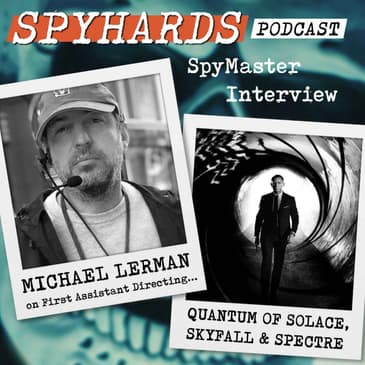


Agents Scott and Cam welcome first assistant director Michael Lerman to the show to reveal top secret intel about the making of the Daniel Craig Bond films Quantum of Solace, Skyfall and Spectre. He also shares stories about working on 1917, Doctor Strange, Garden State, and much more!
Become a SpyHards Patron and gain access to top secret "Agents in the Field" bonus episodes, movie commentaries and more!
Make your opinions about the NOC List known. Leave us a voicemail on Speakpipe or send us an email now!
Purchase the latest exclusive SpyHards merch at Redbubble.
Social media: @spyhards
View the NOC List and the Disavowed List at Letterboxd.com/spyhards
Podcast artwork by Hannah Hughes.
Theme music by Doug Astley.
Hosted on Acast. See acast.com/privacy for more information.
[00:00:00] This September, podcasts across the Podomedy Network are supporting CALM's Stay Tuned campaign. Podcasts can be good company, but sometimes people need somewhere to turn. CALM provides free, anonymous support for anyone struggling with suicidal thoughts or affected by suicide. If you can help, £12.20 can cover the cost of answering a potentially life-saving call. You'll find the link to give in the show notes. Thank you for supporting CALM.
[00:00:28] Hello and welcome to SpyHards - A Spy Movie Podcast. I'm Agent Scott.
[00:01:12] And I'm Cam the Provocateur, ripping around the Italian countryside. I wish you'd stay there. Well, thank you, thank you. It's beautiful! No, I'm actually just hoping you have a really nice time. I thought you just wanted me to leave, period. Okay, well yes, I would love to go there. Cam. It's on my bucket list. Cam, I had to break it to you. We're not recording this together. Oh. You're not in the room with me. Oh. Are you? I'm in the closet, Scott. Hi! Well, there's been theories about that for many years.
[00:01:39] Moving on swiftly, Cam, what on earth are we talking about this week? We are talking to Michael Lerman, the first assistant director on such movies as Quantum of Solace, Skyfall, and Spectre, among others, like 1917. He worked on Doctor Strange. He's been a very busy professional in the film industry for a long time, and he's got some great stories.
[00:02:04] Yeah, we promised this a couple of weeks ago, but then we made a boo-boo and realized that that Star Trek episode probably should have come out first, because it was, you know, Star Trek day and stuff. So here it is, folks. You've been chomping it a bit to hear it, and we're delivering our chat with Michael Lerman. All righty, then.
[00:02:25] Joining us on the show this week, his credits include the likes of 1917, Skyfall, Doctor Strange, its first assistant director extraordinaire, Michael Lerman. Hi, Michael. How are you? Good. How are you, Scott? Thanks for having me. Oh, thank you for being here. It's a pleasure having you on the show. We've got some interesting spy films to dive into. Sure. First, before we get started, I just wanted to thank you both.
[00:02:50] Let me preface this by saying, normally when I work on a movie, I will see it quite a few times in the cinema. I'll try. I, on these movies, at least Skyfall and Spectre, I, you know, get the opportunity to go to a, like, friends and family screening before and talk to Sam, talk to the director and give notes. And then lucky enough to go to the premiere, which is always fun on these films. And then I try to go see it with a paying audience and feel what that's like.
[00:03:18] And then I'll watch it one more time once I can watch it at home on my couch and I can pause it and rewind and analyze things. And then I tend to never see the films again. And I kind of move on and it's kind of my process. All of those screenings, I am not objective. I'm not able to be objective at all. I'm thinking about a million things. I'm really have a hard time sitting back.
[00:03:46] Um, it's also fresh to me usually. Um, so in preparation, when you guys reached out to me in preparation for talking to you today, I went back and I watched Casino, um, which I did not work on, uh, Casino, Quantum, Skyfall and Spectre. Did not get to no time to die, but I will. Um, and it was an incredible experience for me.
[00:04:11] So I want to thank you for the opportunity because I wouldn't have done that if we weren't talking today. And I was able to watch these films in a different light. Um, I'm not saying I was still able to be completely objective, but I learned a lot by watching these films and brought back incredible memories and things I missed and all kinds of things. So thank you. Uh, it's been quite a week.
[00:04:36] Well, I, I, I, I don't want to say you're welcome because it feels a bit of an odd thing to take thanks for, but I'll take it anyway. Please. And I want to get into all those stories you mentioned that have been evoked in your memory, but what was that? So when you finished watching Spectre, what was sort of your impression you were left with? What, how did you feel about the body of work that you did? Um, I don't want to say the body of work I did, but why? Cause I, and I, I mean, I'm including Casino in this as well. Sure.
[00:05:02] First of all, I just want to say in my opinion, all of this is my opinion, obviously Casino is fucking amazing. I loved the movie. I loved watching Casino so much. Um, I think watching these movies now, I even have more of an appreciation for Daniel. I think Daniel is an incredible bond.
[00:05:27] Um, watching these so much in a row like this and watching what he did, um, with the character. And, um, in terms of, I think there's a lot of great stuff in, in all of the movies. Obviously I have my opinions about things that work and don't work and, uh, we can get into all of, you know, the issues there.
[00:05:50] But in general, I mean, it's been such a privilege and an honor to have been a part of these in any shape or form. And it felt great. It felt great watching them. And in general, I'm extremely proud to have been a part of it. Well, I mean, that begs the question, you know, were you a Bond guy before you got the job? Oh yeah. Yeah.
[00:06:12] Um, I grew up, so, um, for your, for your eyes only, I think was the first film I saw in the cinema. So I was in terms of my Bond, you know, I was in the like octopus-y phase, like the films I was seeing in the movie theater. But at the same time as the more stuff was happening, it was the very beginning of VHS, uh, tapes.
[00:06:44] And I think I told this story to Barbara and Michael when I went and met them for the first time and kind of interviewed with Barbara and Michael. Well, the way back when this must've been 1980. Um, they hadn't figured out how to rent videos yet VHS. Like there was no blockbusters or anything yet. And they didn't really have a model, a paradigm on how they were going to rent movies as crazy as this sounds.
[00:07:11] And I remember, so the movie, the video store we rent went to, you had to pay $50, which is a lot of money, $50 for a membership to rent one tape. If you wanted another tape, you had to pay another $50 membership fee. And then you were able to take two tapes home. But when you took the tapes home, you owned them. There was no return date. You could keep them for a, obviously none of this makes fucking sense, but this is what it was.
[00:07:39] So long story short, I had, um, Goldfinger at my house for like four months, like five months. And we had, you know, you had two movies at my house. And so that's what you watched. And my friends would come over and, you know, and we would watch Goldfinger. So Goldfinger will always be my Bond film, I think, um, because of that.
[00:08:04] Uh, and I was eight or nine years old, you know, loving it so much. So yes, um, I've always been a Bond fan. Um, more so I would say the Connery and Roger Moore phase in some ways than the Dalton and Pierce Brosnan phase. Although I did see those movies, but, um, yeah, Roger Moore was the one I grew up with.
[00:08:32] Connery was the one that I watched at home on video. And those were my Bonds. That instantly begs the question. What happened with the 50 bucks? Did you get it back when it was returned? I wish I could tell you. I don't, I don't know. I need to figure this model out because it sounds like we should bring it back. Yeah. Um, so yes, um, I, I never thought in my wildest dreams, I would ever be a part of it, obviously. Um, and it's still amazing to me that, that I have been.
[00:09:02] Well, I want to get us on the journey to getting that first Bond film working on Quantum, but. You know, let's get back to starting in the industry a little bit because you obviously made a choice at some point to work in the film industry and more specifically becoming a first assistant director. What led you down that path? Um, well. Always had been a huge film buff and that's what I did growing up. So a lot of us did.
[00:09:29] Um, but I never thought it was something one could work in like, especially back, you know, in the eighties, like it just wasn't in my comprehension that it was something you could actually go and do. So I, when I went off to school, I studied. Journalism. Journalism. And then I, uh, ended up taking a lot of theater classes. There was no real film classes at my school. Took a lot of theater classes. It was kind of the closest I could get in terms of telling stories.
[00:09:59] So I did that. Um, and then I graduated and have no idea what the hell I was going to do with my life. I didn't want to be a journalist. I didn't want to go into theater. And I was like, okay, now what do I do? So, uh, I stayed in my college town for a while. And then I, I finally, you know, started getting a lot of magazines and film magazines and was like, wait a minute. This is what I, this is what I love. This is what I should do.
[00:10:28] But I didn't have any pathway in. I didn't have the money or the real to really go to grad school. But although that was in my back of my head. So I was like, I'll just move to New York City. I have some friends there and I'll try to PA and figure out what's next. And in my mind at that point, I was going to go on to grad school, I think. And I didn't know what I wanted to do. Like, you know, in the film industry, I was like, I knew I was interested in camera.
[00:10:56] I was interested in, interested in editorial. I was interested in a lot of different aspects, but I didn't really know. So I moved to New York. This is 1996. And I entered a time period in New York City specifically that was amazing in terms of independent films being shot on every corner.
[00:11:23] Like it was so busy with these micro budget or small budget movies, tons of commercials, music videos. It was everywhere. So if you had any kind of head on your shoulders or any kind of common sense, you could and you could get jobs pretty quickly as a PA or an intern, which is what happened. I worked really hard. It was very excited.
[00:11:53] And, you know, as soon as I started getting on set as a PA, I was like, who's that guy over there? The A.D. Didn't even really know what an A.D. was kind of. But I was like that guy. I feel like that's an interesting job and I could do that. Like so. I started moving up the ranks really quickly on these small, low budget things and then started first thing when I didn't really know what I was doing.
[00:12:24] And it was just a very great time to be in your 20s and in New York and working on this kind of stuff. So I learned by doing on these small movies with a bunch of people, lots of kids in our 20s making movies. And then, you know, I lucked into our, you know, I started being picky about the jobs I was doing. And then you started working on more. Prestigy or our tourie kind of small but low budget films.
[00:12:54] And that's how my career began. I knew right away that I was enjoying and getting off on being a first A.D. And what that role does and how you're a part of everything and working closely with the director and a DP and people to tell these stories. So, yeah, that's kind of how I got into it. Monsters Ball was one of those movies that was still kind of a non.
[00:13:20] These were non union, non DGA, small movies. Monsters Ball was one of those movies that was directed by Mark Forrester. That was the first movie I had done with Mark. Mark and I then had a working relationship where I continued to work on Mark's movies. And I believe Quantum of Solace was my fifth movie, I want to say, working with Mark.
[00:13:49] And that led me to the Bond films. And it was my relationship with Mark that led me in. Well, just before we get to Bond, I want to ask a question because you're saying, you know, when you're a P.A., you're looking at the A.D. and going, you know, I could do that. Were there any misconceptions you had about the job that when you were actually doing it, you said, oh, oh, this is more than I realized or this is a challenge I didn't expect? I still have those feelings. Yes.
[00:14:18] No, I mean, it's it's it's one of the great things about the job is it's the job changes. Not only job to job, but moment to moment. So you're always discovering things. Yes. Back in my first. Like, I didn't understand because I was so thrown into it that I was doing my first feature.
[00:14:42] And I remember going to the script supervisor about the background actors, the extras, you know, walking through the shot. I kept going to the script supervisor and asking her about the continuity of the back. I didn't realize that that was my job. Like, I thought it was her job to, like, figure out the continuity of the background and do this. And she finally looked at me and was like, you know, this is your job. You know, this is supposed to do. And I was like, it is.
[00:15:10] So, yeah, I mean, I was when I say I was clueless, I was pretty clueless back then. But no, there's as you know, it's a it's a crazy position. It involves a lot of stress and a lot of responsibility. And you basically are involved in every department as you're making the film on the floor. And there's a lot of surprises.
[00:15:36] But, yes, I didn't quite understand back then at all what I was getting myself into. It just looked like it looked like someone, you know, it looked like somebody in charge who knew what was going on and was talking to the director and the actors and the crew. And I was like, oh, that's kind of seems like a cool position. But no, until you do it, I had no idea what I was getting myself into. I am.
[00:16:03] I remember reading once, if you want to find the AD on the set, the first AD specifically, look for the person with a clipboard, a coffee and looks the most stressed. Yes, I believe that the looks the most stressed is right on point for me. We've been we've been quite fortunate over the years to speak to a few ADs. But for those perhaps tuning in for the first time, and as you said, it's a job that can change from film to film. Could you perhaps pin down a little bit of what are the general duties of someone who is the assistant director?
[00:17:01] Sure. I think that's one of the big things. The caveats. I mean, I look at the job as it is my job to get everything on camera that the director wants to achieve, to achieve his the director's vision within the allocated time that you have. And you're going to be able to achieve that goal.
[00:17:27] And I think that's one of the things that you have to achieve that goal, which is an impossible task and you will fail all the time. And I think that's one of the things that you have to do. And I think that's one of the things that you have to do with the department so that everybody knows what's going on from moment to moment.
[00:17:57] And, yeah, you're yeah, you are like the the floor, you know, person like I'm trying to think everyone uses analogies like, you know, military and now it's our, you know, factory analogies, you know, that you're the foreman or you're the general or you're, you're, you're, you know, running the operation.
[00:18:19] I don't tend to like a lot of these analogies, but it, you know, they, they fit into, you know, it's basically a managerial position in a very creative environment. And, you know, and part of the job is honestly is just getting along with a lot of different personality types that you deal with in any industry. This is pretty particular because you're dealing with the studio.
[00:18:49] You're dealing with directors, you're dealing with actors, and then you're dealing with crew members. And then within the crew members, there's a lot of different, you know, between the hair, makeup and the costume departments versus the grips and then the camera. Every day, you know, everybody is very different. So you really need to be a people person and get along with a lot of different types of people and be very clear in your communication skills.
[00:19:17] But there's a lot more to talk about, but that's, I think, kind of a good, I don't know, synopsis. I'd say so. A man or a person of any, many hats, I should say. I mean, the other thing I always read is you sort of set the tempo a lot of the time. The pace is kind of done by yourselves. And also the environment on set. Both of those things, you are definitely a part of creating what that every day is going to feel like. Yeah.
[00:19:47] Well, let's, you know, you talked about sort of moving to New York, doing your first few films. There's a film I perhaps will ask about later, which is one of your early films, which was, actually, no, it's one of your later films, but it's connected to, I think, your early days, which is Garden State, which we'll come back to. Because that's a special place in my heart, that film. But I feel the gravitational pull of James Bond pulling us in. So let's talk about it. Obviously, 445th film with Mark. How did that all begin, though? Was it a phone call from Mark? How did Bond come to you?
[00:20:17] Yeah, it was Mark. I was getting married. I know, obviously. And so it was in the middle of my, you know, engagement moment and wedding and rehearsal dinner. It was literally in that period. And that's when Mark said that he was up for the Bond movie and wasn't sure if he was going to get it or wanted to do it. So all of those, you take it all with a little bit of a grain of salt.
[00:20:45] Because I also, I love Mark, obviously. I consider him a great friend. But I was like, who's hiring Mark to direct a Bond movie? That doesn't make it. Me? Or, and by the way, even if Mark's going to get the movie, I was like, they're never going to hire me. Like, they'll maybe I'll get an interview for them to be nice and say they're interviewing Mark's guy.
[00:21:07] But then they should probably and will go hire, you know, the 80s who do these types of movies and live in the UK. And so I, oh, while I was a little excited about it, I still didn't think it was real when we had those first conversations. It wasn't until I met Barbara and Michael. This was in LA.
[00:21:31] This was still, I met them, actually, I met Barbara and Michael on the night of my, the night before my rehearsal dinner. It was the night my parents and my wife's parents were meeting for the first time. I literally came from Michael and Barbara's office. I had all this going on.
[00:21:50] But when I met Michael and Barbara and Greg was there as well, Greg Wilson, at Eon in LA, it all of a sudden started becoming very real to me in that meeting. Because at that point, Mark had been hired. And I still thought maybe that this was they were just being nice. But when I walked in the room, first of all, we all clicked. And then second of all, they were just acting like I was doing the movie. Like, you know, it was one of those interviews where it was like, it wasn't an interview.
[00:22:21] It was like, okay, how are we going to do this? And we started talking. And I was the whole time like, is this happening? Like, I'm so, it blew my mind. So that's when it became real. And it still didn't become real. I found out I was really doing it on my honeymoon. It was all this period of, yeah, exciting times. I was also a baby. Like, I know that sounds obnoxious. But I mean, I feel like I was very young. I mean, I was, when I got hired, I was 34.
[00:22:51] You know, I was not. I was still pretty young in the big scheme of things, especially in like AD world. I was curious about like, just the kind of the atmosphere around Quantum of Solace. Was there like a internal pressure to live up to Casino Royale? Because that movie went in with lower expectations, perhaps, than some Bond films, but exploded. And so internally, did you feel that pressure?
[00:23:20] A hundred percent. Yes. Yes. We all, well, first of all, and that was, you know, we had all watched because we were all watching Casino, obviously. And as I said previously, it's amazing. I mean, at the Casino, it was great. It was great then. It's great now. So, yes, there was a tremendous amount of pressure on all of us, on everyone.
[00:23:46] Daniel, I feel, and Barbara and Michael, and then all of us to not only, you know, at the time, you're trying not only to be as good, you know, even better. You know, what can we do? So, of course, you're feeling all of that. And as I know you and probably everyone listening knows the fact that we didn't really have a script. But, and yeah, and we all knew that as well. So, we want to do this, but we don't even, we don't have a blueprint.
[00:24:15] And yet there's a release date that's so close, you can actually, like, see it coming towards you. So, yes, a lot of excitement, a lot of fear, and a lot of pressure to try to do well for the fans and just to make a great movie. Was that a new experience for you at that point in your career going in without a finished script? Because obviously in the more independent world, that's not as much the case. That is definitely not as much the case.
[00:24:43] I'm just trying to think of where I was. I want to say, because I feel like now I've been through this many times. Of course. But I feel then, you're right. This was probably pretty new to me as well. It was definitely new. There was an outline. When I started, there was an outline. And that was it. No pages. Just an outline. And it was, and I scheduled the movie based on this outline. And I definitely had never done that before.
[00:25:15] So, yes. Wow. It must have been quite stressful, I imagine, at times, doing Quantum. I suppose to get into the nitty-gritty of it. But, like, this is, I think, your biggest film at that point, looking at your IMDb? Oh, by far. By far. Yeah. Yes. It was stressful on so many levels. I mean, the great thing, though, was there was a lot of great things.
[00:25:41] One, Barbara and Michael, and just welcoming myself. My wife also, I should say, worked on the movie as well. So my wife was the visual effects producer on the film. We were there as kind of a couple. And they were so, just welcomed us with open arms, not just to the movie, but really into their families.
[00:26:03] I know you've heard this, but, like, because we were coming from Los Angeles, you know, we were at, I was at Michael Wilson's house almost every weekend having dinner with his family. You know, it was, we really became close with them, and they were extremely supportive of us. So that was nice.
[00:26:24] Secondly, I, the second 80s I had, which are really, you know, an extension of myself and so important to my success and the success of the film and all of this, were these two incredible guys who I still consider very close friends of mine.
[00:26:44] Ben Dixon and Toby Hefferman, they had done Casino, they had done, as in the same roles, they had done Bond movies previously, they had been runners and all kinds of things. So I had this support system with them. And then lastly, I, Mark's team, I had done all these movies with.
[00:27:08] Like, so, you know, his DP, Roberto, his editor, his, you know, there was, there was a group of us that Mark had brought on to the film who all knew each other. And we had our shorthand. And we were all kind of in the same boat together, like, how the hell are we here? So, yes, it was terrifying. And yes, there was a lot, but you, there was a lot of support from everyone.
[00:27:33] So it didn't feel like you were, you weren't in the corner, you know, shaking or anything. It was, it was, it was healthy. Sort of. Well, we were quite lucky. This is years ago now, but we had Roberto on the show to talk about Quantum as well. And one of the things he spoke about was just, obviously, there was the sort of frustrations with the script and things like that. And that was evolving. But there was also a certain freedom in the way because you could, you could find things in the shoot. You could, you could stumble upon moments and shots.
[00:28:02] I imagine for a DP, that's fantastic. For a first AD, that sounds like a nightmare. So I, I, I just curious, how did you deal with perhaps the fluctuations and how was that on the set? And do you perhaps recall a moment where you had to make a big pivot? I'm not sure if I remember anything like it on the day of making a big pivot. I think that in general, not just Quantum in every movie.
[00:28:25] I think that finding those moments of surprise and find, it is, that's where a lot of times the magic happens. I think that, I'm just, I might be disagreeing with Roberto maybe, but I don't really care.
[00:28:41] That I think by having a plan, by having, by having a script and having the foundation and having a plan allows you to then let it go and make all these discoveries. Whereas going in without a plan, sure, you can be making discoveries left and right, but you're kind of just making, like throw it against the wall and see what sticks.
[00:29:07] Rather than something that's based in a, in a, in something else. If that makes sense at all. Quantum, by the way, like I know everyone says, we, we went into it with a script. It's not like we went in and we're like, someone was writing on sides. Like, why don't we try this? Like we had a script. It was just because of the writer's strike. I would say incomplete.
[00:29:34] Like it was not, it was a complete script, but it, it needed work. It needed to be polished. It needed some structure. It needed work, but we had something to work with. It just hadn't finished the process yet. If that makes sense. So yeah. So we were still, you know, it's not like we, we had a plan and we had a script. It just all came together. Not in the best way.
[00:30:04] Um, in terms of the pre-production period I'm talking about. Like the, yeah. Well, I'll, I'll, I'll perhaps reframe it a little bit then. I suppose. Is there a moment from going back and rewatching the film as well? I'm just, I imagine it evoked a lot of memories, but was there a particular scene or moment or in the film you recall having to being a big job to coordinate as an AD. The, this is your first big film of this size. Is there a particular moment? I mean, all, almost every day.
[00:30:29] I mean, I go back and, and think about it, but I mean, um, just scheduling it first of all was such a massive undertaking. I had never scheduled anything with such a large second unit, a second unit that's as large as the main unit that's shooting in different countries. We also shot in so many different countries. I mean, I had such a learning curve going into this in terms of how to schedule the thing.
[00:30:56] First of all, um, I love that part of the process, but I had never done anything to this scale. Um, in, in terms of the other thing is on a movies like this, where you're shooting for as long as you are and doing a lot of the sequences that you're shooting at the end, you haven't really prepped yet. Like you're prepping as you go, which is completely normal on a movie of this scale and of this size.
[00:31:25] So, I mean, I remember a meeting at the opera house in Austria, um, after wrap one day or before call, it was probably before call it was a night shoot before call one day sitting at a table and we had the model of the ESO hotel. And I was like, we're not getting up from the table until you tell me where the explosions are going to be happening because we do not have the time for special effects to get in there and plant the thing and whatever.
[00:31:54] And sitting there and like making Mark and Roberto and everyone, I was like, no one's getting up until you, I mean, you had to be forceful at times or be done. And I wasn't used, you know, to these, you know, and, you know, these big sequences as well. I mean, looking back and watching the movie again, you know, the opera sequence, the, um,
[00:32:22] the sequence, um, at the end with the ESO, the hotel and all of the explosions and the fight going on amidst the fire and all these, these were huge endeavors for me to figure out how you're going to do it and organize it on the day, as well as the coordinating on these films, how the second unit and main unit married together and how Daniel is a part of all of those sequences.
[00:32:49] There was also a lot of water work, um, on the boats and, you know, it, it goes on and on and on a bit, a big challenge on these movies from a logistical standpoint is, is the travel and the shooting in all over the world. And it's not like we have a lot of time where we're like, okay, now we'll go to Chile and
[00:33:14] we'll have two weeks of, um, prep and scouts and whatever before we shoot. It's like you're landing. And a lot of times you're like grabbing a camera and, and going that being said in the prep period, I was usually at all of these locations two or three times, probably at least definitely two, if not three times planning out in pre-production.
[00:33:39] Um, and you have a whole team there in advance before you land, obviously getting it all ready, but you, you, you're, you're always moving always. Now, you know, you say you're always moving. There's a lot of stress. Was there any moment in quantum where you did have that moment where you said, I'm making a bond film, like that moment where you were able to just kind of like the stress kind of faded away and you were like, I can't believe I'm here.
[00:34:06] Oh, I mean, all, I want to say every day, but that's a thing. But yeah, I mean, I still remember. Yes. The first day, which was these, you know, a lot of times you'll start kind of small and you'll do these pre-production shoot days almost with maybe not the whole crew and, and, you know, and some of it, and it's great because it gets everyone up to their, you know, up to speed and up to the game.
[00:34:34] And we shot this scene with M and Tanner walking through, I forget the name of the complex in, in London, in the UK, Bob, the Barbican, Barbican Plaza. And it was supposed to be like a part of MI6 or a plaza of MI6, but we were shooting at the Barbican. It was a very quick little scene where they're talking to Bond and walking through it, but we had all these extras.
[00:35:02] And that was my first day firsting Bond. And, and yeah, I still get goosebumps just because it's not what we were shooting, but it was like, look, look where we are and look what we're doing. Actually, the first thing we shot really, but that was a different was the Palio horse race in Siena, but we didn't have Daniel there when we were shooting, we were shooting the real race.
[00:35:26] So we were just shooting the real horses and the real crowd and the real, that then we would insert Daniel into later. But that was actually the first thing I shot. But yes, I mean, the first, I mean, the first, to get back to your point, the first thing I ever did on Bond, and it was never been as good since I flew. This was my first, this is when I met everybody. They flew me to Siena.
[00:35:56] This is in the summer of 2007. They flew me to Siena. We went and watched the Palio horse race. They do the Palio twice. So we just went and observed. I was there. Mark was there. Roberto was there. Barbara and Michael. Callum McDougall, who is an amazing producer.
[00:36:20] And then we said, OK, well, we know we want to start with a car chase in Italy, taking right off from Casino. We don't know who's in the chase or where they're going or what. But we know we want it to be a car chase that he basically is, you know, after the Mr. White moment at the end of Casino. And we just for two weeks flew around Italy looking at cool roads and making up ideas for a car chase. And we were flying.
[00:36:51] And we were flying. I mean, this sounds so obnoxious, but we were flying privately, staying at nice places, having wine at lunch and making up a bond car chase throughout Italy. That's how I started. That was my first thing. And I thought this is the best job in the world. But I don't think it ever got better than that.
[00:37:20] All three movies I did, that was still kind of the pinnacle. And it was amazing. And that was every night just going to bed giddy and calling my wife and being like, I can't believe this is happening. So, yeah, that's that was the real start. And that's where I really got to know Barbara and Michael and Callum was on that trip.
[00:37:45] Dan Bradley, the second unit director, came and joined us at some point in Italy. And also, I believe he wasn't there the first trip. And then they were like, well, Dan Bradley, who's probably going to be shooting most of this, should be here. And I think they flew him out. And then they left and went back in London. And I went and did the same circuit around again with Dan to show him the stuff. So I think I did it twice.
[00:38:14] And I was like, this is amazing. It's a hard life. It's a hard life. Yeah, it never got as good again. Well, you know, that's the AD side of things. But a lot of people might not realize you're actually also in Quantum of Solace. You are a waiter in a certain scene. Yeah, sort of. Blink and you'll miss it. Yes, yes.
[00:38:40] I was at the last minute kind of put in the opera sequence as a waiter and get shot and thrown to the ground. Very, very quick moment. But yes, I get teased about it still to this day. Did you ever stop ADing during that moment of being shot on the film? Or were you wearing both hats simultaneously? No, no, no. I'll never stop ADing. No, I think. I mean, it's ridiculous, I believe.
[00:39:07] I literally, I think I'm sitting there with a, you know, white tux holding a tray of food or glasses or something. And I was literally calling, you know, roll sound. Here we go. And action. And then I start walking with my thing. Yeah, so I didn't stop. Well, the only other question I've got for Quantum before I move us over to Skyfall. And this is a bit of a Bond urban legend that I feel like I might throw you away to see if you have any information about it.
[00:39:35] Are you aware of the background sweeper in Quantum of Solace? Very, very, very much so. And what I don't know is how it actually happened. Obviously, what happened, you know, on shots where sound is going to be a problem, a lot of times when you're not seeing something, you cheat something so that people aren't making noise.
[00:40:05] So a lot of times when you're shooting a restaurant scene or a scene where there's lots of travelers and rolly suitcases or whatever it may be, and you're doing this dialogue. If you're not seeing it, you end up getting the background or the stunt players or whatever to mime their action.
[00:40:23] Now, somehow a shot got snuck in and not only snuck in, got into the final cut of Quantum for a couple of seconds where there is a person sweeping this, the dock with and the broom is a good. I mean, it looks like it's a foot off the ground. I mean, it's not even close. It's sweeping. It's ridiculous.
[00:41:14] It's ridiculous. Hiding something. You know what I mean? And that's why a mistake like that will happen. But I don't really know. The guy might have just been, I don't know, shaking his broom out. I don't know. But yes, it is embarrassing. It will come up on, like, websites of, like, the, you know, the 20th, the 20 worst background acting moments, you know, mistakes in the history of cinema.
[00:41:43] And it would be like, Quantum of Solace, number 12. So, yes, I have seen it. Okay. It was more just, I wanted to know if you were aware of it, Donald. I can't imagine you remember the scene or anything like that. I am aware. Well, okay. That's Quantum. And I feel like for many people, Mark is a good example. He was there, directed the one film, and then moved on to Parsha's Green. You're around for two more films.
[00:42:12] How does that story continue for you? Because Sam Mendes comes in, I imagine, with some new crew. How did that call come to you? It was really, again, due to my relationship with Michael and Barbara, and also my wife. And we really, really bonded on Quantum. And then Skyfall was going to happen a lot sooner than it actually did.
[00:42:39] And they had hired Sam. And so I went in to interview with Sam. Again, you know, you go into this interview. And yes, obviously, I did the last one. But I was like, Sam has worked with some incredible ADs and, you know, has done some incredible movies. So you never go in. And it was similar to Quantum. I walked in and started talking to Sam.
[00:43:04] And he, like, you know, he stopped me about 10 minutes in and was like, just so you know, you have the job. Like, I want to work with you. Like, I want the AD that's done the last one and knows how, because Sam had never done a film like this. Similar to, like, I had never done a film like Quantum. And Sam was like, I want the AD to have had this experience and had this experience with these people. So, yeah, he hired me very quickly. Obviously, I got in the door because of Michael and Barbara.
[00:43:33] And then Sam hired me. And then the movie didn't happen. You know, then the movie, MGM filed for bankruptcy. And they had a good year where it pushed kind of a solid year, which I went and did Men in Black 3 during that time period when that was happening.
[00:43:56] And I look, I think the most important, my opinion, the most important thing about these movies and any movies really are the script is to me is the number one most important thing. People could argue, but I feel like the script is the most important thing. Then I think casting is probably the next important thing. And then the director, the director who a lot of times has a lot to do with the script and casting.
[00:44:22] But then the director, you know, and then everything, you know, kind of after that. And I think one of the reasons why I believe Skyfall is probably works as well as it does is because of that year where MGM went bankrupt or filed for bankruptcy.
[00:44:42] Because they spent that year and just between Purvis and Wade and John Logan and Sam, they just worked on that script. And they spent that year and they just worked on that script.
[00:44:57] And so by the time when it did get back up and running, the script was in really good shape for Skyfall and is very close to the finished product before we even started prep in any, you know, in general. So, yes, I do credit that delay. Who knows what it would be like? It might have been the same or not. But I think it did have an impact.
[00:45:23] It was a great the first thing that happened after that year passed and we realized and they started hiring the crew back. They we had a read. It wasn't a read. It was a pitch, basically, of the movie. We were in Santa Monica in a ballroom at like shutters or somewhere in Santa and somewhere in California.
[00:45:50] And they Barbara and Michael got most of the department heads out to L.A. And most of us had no idea what Skyfall was about. Sam obviously did. And Roger and I'm sorry, Sam and Barbara and Michael. But the rest of us knew nothing. And it was, you know, everyone's there. Roger Deakins is there and Dennis Gassner and the department were all around this table. And John Logan.
[00:46:18] It was the best pitch I've ever. I mean, it was probably an hour. And he basically acted did acted out Skyfall. This is the writer, the screenwriter. He basically acted out Skyfall as a one man show for like an hour and 15 minutes or something. Scene by scene. And that's the first time I heard the story. And he did an incredible job, John Logan.
[00:46:47] Like you could pay admission to go and watch this. And I mean, the end when you find out that Eve is Moneypenny and the new M and the new like it's still I have goosebumps just thinking about it because it was so good. So that was my introduction to the story of Skyfall was that one sit down meeting, not a not reading the screenplay, but but hearing it and watching John perform it kind of.
[00:47:15] Please tell me he did the whole Silva monologue. Okay. Oh, I am sure he did the rats. I am. In fact, I think I remember that. Yes. Now, part of the big release of Skyfall was it being the 50th anniversary film. But, you know, you mentioned it was going to shoot earlier initially. Like, was that something that was going on conversationally behind the scenes about this is our 50th anniversary film?
[00:47:44] Or was that more of a release thing? I don't know. I don't I don't know for sure. By the time that it all came back together again. By then we all knew it was the release date and it was the 50th anniversary. And we talked it was talked about all the time. I don't know in the previous version what would have happened in that scenario. Okay. Well, I want to ask about Sam Mendes because you work with him going forward on 1917 and Empire of Light.
[00:48:14] What was it about him as a director that the two of you clicked so well? So many times it really just comes down to you spend so much time with this person and you're in the trenches, for lack of a better word, with them making decisions and figuring stuff out and having these conversations that you just become close.
[00:48:44] And then you don't. And it's there's nothing like it. It's so good because then you don't even you know what the other person's thinking. You know, you know, like I know what Sam's going to say and I know and I can communicate with a look to Sam and he can communicate with a look to me. And you don't even have to say anything anymore.
[00:49:02] And so when that happens with anybody and it happened with Sam and I that then you 100 percent will just want to keep working with them because it makes the job, you know, easier is the wrong word. But it makes everything just much smoother and you're not learning new personalities. And, you know, it's what I was saying earlier about how you have to manage a lot of people and get along with a lot of people.
[00:49:29] Once you have a relationship like that with someone, that's great. Plus, I, you know, just really respect Sam. I think he's a really he's really great with story. He's really great with actors. And, yeah, I think he's he's fantastic to work with. So he's a great collaborator in that sense. So, yeah, it's been great.
[00:49:55] And, you know, 1917 was a very special film as an 80 to be a part of because it was so it was so different and great in a lot of ways. So I'll always be indebted to Sam for continuing me, continuing working with me over over these years. Well, moving from Quantum to Skyfall, obviously different productions. There was a year resting and gestating, perhaps.
[00:50:26] What was it like for you coming back to Bond for another film? Was it I don't want to say the word easier because I'm sure they were both challenges. But was it a different feeling production? And were there any particular challenges you had to overcome on the set of Skyfall?
[00:50:39] All three of the films that I did felt very different for a variety of reasons, but it never felt it felt you know, it does feel like you're coming home to a certain extent, especially because of of Michael and Barbara and Callum McDougal and Daniel and the forces that are there from the beginning to the end.
[00:51:06] But the films themselves were very different for me, just where I was in my experience and my journey, as well as just the films were also different. You know, Skyfall, Skyfall, we main unit didn't really leave the UK very much. We shot almost, except for Turkey at the end.
[00:51:33] We stayed very close to home on that movie, whereas Quantum, we were all over the place. Spectre, we were also all over the place. Skyfall was part of the reason why Skyfall, a lot of that movie is set in the UK, Scotland, the UK. And, you know, it's more of a UK based story. So right away, that feels different.
[00:52:06] Shanghai got basically we ended up not going to Shanghai at the very last minute. Second unit went there. I mean, they shot plates there and shot some cars driving around there. But really, that work was all shot back in the UK. But that was a last minute decision for cost, for money, you know, thing. And which happens on every movie, no matter how big or small.
[00:52:33] Everyone asks me, of course, what's the difference between working on a Bond movie and working on... And yet you're working on everything's at a bigger scale and all that. But the issues, which are time and money on every production, is still the same issue on the Bond movies. Still the same issue on Marvel movies. It's still the same issue on all these movies. You never have enough time and you never have enough money.
[00:52:58] And figuring out how to make these creative decisions and compromises and challenge... One of them on Skyfall ended up not going to Shanghai. We went to Shanghai. I think I was in Shanghai three times. I, you know, scouting. We had picked locations. We went there with the crew and tech scouted Shanghai. So we were very close.
[00:53:21] And then when we started realizing where our budget was, you know, at the last second, we didn't go. I've really gone off on a tangent here. No, no. In terms of, you know, figuring out how to shoot the opening sequence of Skyfall in terms of the train work. And that sequence was extremely challenging.
[00:53:49] You know, I come in well before the second unit in terms of prep. And I end up, you know, eventually I hand it off to the second unit first AD and it becomes theirs. And I don't want to, you know, go change it. Do whatever you need to do. But until that happens, I'm scheduling the second unit. And I'm working with the director. And I'm, you know, you're scheduling two movies basically at the same time that then have to intersect.
[00:54:18] So I'm intricately involved in even all of the stuff that I'm not necessarily shooting with main unit. That opening sequence was bigger than anything I had done. Or more, I shouldn't say bigger, but more complicated than a lot of stuff I had done on Quantum. So that was a big challenge. Yeah, there's so many.
[00:54:45] I'm just trying to think, you know, figuring out the Skyfall house at the end and the helicopter and the destruction of the house and all of that was a huge challenge. Basically, all of the big sequences are going to be complicated and, you know, but also very exciting. Well, you mentioned the opening sequence. And that is something I had read about was quite a tough one to schedule.
[00:55:12] But what was it scheduled in that was the main trick with it, really, because of getting Daniel on set and doing everything? What was it that there's a reason why you brought up that sequence? Yes. Well, it was hard. I mean, Sam, you know, a lot of directors, Sam being one of them, A, had not had much experience with the second unit.
[00:55:32] And B, I don't want to say doesn't want a second unit, but it's like, you know, they it's tricky how and a lot of times on the Bond movies, the second unit really needs to shoot first. They need to establish the action before you're plugging in Daniel or before you're doing things. And, you know, you're normally in like a car chase sequence, let's say, in general.
[00:55:57] The second unit shoots the car chase first with stunt doubles and then you know exactly what you need and what the car. You also don't actually know what the cars are going to do a lot of times. And sometimes there's happy accidents and there's things. And even though everything's planned, you see the second unit shoots before the main unit a lot. And especially if you're in another country, like it's all scheduled out that way.
[00:56:25] So for that to work, you know, everyone has to really be on the same page about what the director wants and how is the director seeing and approving the footage that they're shooting. And they're not, you know, they're on a different time zone and the technology isn't. So you're not necessarily seeing it live while it's happening. Or even if you can see it live, you're in the middle of directing something else. So it's it was it's always very tricky.
[00:56:54] That sequence in particular was extremely challenging. It was also it wasn't shot all in one place. You know, they were it was two different areas of Turkey, like flights away from each other. You know, it's not like it was all it's, you know, the magic of movies. Obviously, the train line is nowhere close to Istanbul in reality. You know, so all of those things. Yes.
[00:57:19] And we created something on Skyfall called Implant Unit, which was basically a lot of times you schedule it. So in the past, the Bond movies would just send Bond to the second unit and plug him in. And they knew what they were doing and they had shot it. And and main unit was traveling on to like another country and setting up and then Daniel would come and join.
[00:57:45] Well, that was definitely not something Sam and Roger were interested in in doing. So we created this implant unit where. Sam and Roger and myself and Daniel and a couple other key department people would go and implant ourselves into second unit. And that became known as implant unit.
[00:58:10] And I believe implant unit was born in that Turkey sequence, that opening sequence, which was which was great and enjoyable. And it went very smoothly. And I feel like it was it also meant that we Sam could go there and like, you know, we could reshoot something if second unit didn't wasn't exactly what he was thinking.
[00:58:33] Or it really allowed us almost a second chance at certain things and let Sam and Roger really be a part of those sequences. Then sometimes might not have been the case as much. Right. OK, so before we get to Spectre, I just want to ask your reaction to the extremely big popularity of Skyfall being attached to a movie that big. Yeah. Yeah.
[00:59:02] Well, it was it was great. I mean, especially, you know, I'd be lying if Quantum didn't have a little bit of a like wah wah feeling after it. So it was nice to even though, you know, I think there's some great things in Quantum and I'm still very I'm very proud. And think. Mark and everyone did a great job on that film. I think we were dealt the hand that we had and did the best we could with it and watching it again.
[00:59:33] I think there's some great parts of Quantum. But yes, Skyfall was. Yeah, it was a great feeling. And, you know, it was one of those things like I kind of knew like I kind of knew when we were making it. I kind of knew after John Logan did that pitch. I was like, it would be ours to screw up.
[00:59:54] Like it was, you know, it was it was the it almost took Casino and it was like, OK, we're introducing him. We're introducing this yet again, even though it was interviewed so strongly in Casino. And now by introducing Money, Penny and Q and and and a changing of the guard with M.
[01:00:19] It was a really exciting thing because it was it was bringing it back into the bonds. You have this new gritty Daniel Craig bond, but you were bringing it back into the bonds that I grew up with, with all of those other characters and the missions. And it it just felt great. So, yes, it was special to be a part of. It was great to see audiences and the world react positively in general to it.
[01:00:48] And yeah, it was a special, special film, I think. I think Bond fans would agree with you. I think there's a reason why it's I think it may be adjusted for inflation. It wouldn't be. But overall, it's the biggest owner of all time, I think, for Bond. I believe so. Yeah. Yeah. And I would say, you know, you're saying, you know, you're you know, you felt a little bad about Quantum. But the thing is, every Bond film is someone's favorite Bond film. That's one thing we've learned.
[01:01:15] And it's like everyone has their own rankings and Quantum ranks extremely high with people we know, especially. We've had people on the show who rank Quantum as one of the most important ones to them. Yeah. And not just like Bond fans, but filmmakers. Absolutely. There's there's yeah, there's a lot to say about Quantum. Well, OK, then the third Bond film a few years later, you come back for the third slice of the pie, Spectre. Was that through just you've worked with Sammy and you're happy to go back and that's how the conversation started? Yeah.
[01:01:45] Yeah. Who? Yeah. Who wouldn't? Yeah. I'll keep I'll keep going, by the way. If you know Denny's number, Denny's number, I'll. Yes. So I. I'm trying to remember how that I ended up my wife and I ended up moving to the UK after. It was fun. After we had started doing the Bond, everyone just kind of assumed my wife and I like lived
[01:02:13] in the UK and just did UK movies, even though that wasn't the case. So my wife and I just started working on other jobs in the UK. So so we lived there. And at this point. So I'm trying to remember the process because there were times where I would get called in just to talk with Sam at his office. And he'd be like, so, you know, they're talking about me doing another one. And I'd be like. But he was always like, I don't know. Oh, then he'd kind of pitch an idea. And I was always.
[01:02:42] Yeah, let's go. Like, what is that? Yeah. So I heard about it numerous times. I don't even quite remember when it all became real. But yes, we were there. I know we were there. And I think my wife and I knew my wife's done all these movies as well. And my wife and I, we knew we were doing Spectre for a long time before it happened. Like, I do remember, like, you know, we had like a year that we knew it was going to happen before we started work on it.
[01:03:11] So it was a long time coming. And how did sort of the early stages of Spectre differ from Skyfall? Because you have much of the same crew coming back. But did it feel, you know, you said they all felt different. But what was it about Spectre that maybe felt different than Skyfall? Spectre was. Spectre. We had lots of different versions of the script for Spectre. And I think that was probably the main difference. It goes back to what I said before.
[01:03:37] We weren't in a quantum situation where we had like an outline. But we had different, a lot of different ideas. Some of them very different than what ended up being shot. And interesting. But I won't be able to tell you some of them. But there were some very interesting ideas in some of those Spectre scripts. But so it was, so that was different. You know, obviously Sam, it being Sam's second one was very different.
[01:04:07] Because Sam now had the experience of doing the first one. So I think his relationship with the material, his relationship with the franchise was different. And he had a lot of more confidence, I would say, in some ways, coming into Spectre. And yes, Spectre was different because we were going back to go back to a lot of different countries, which we hadn't done as much on Skyfall.
[01:04:36] So yeah, it was different. It's a lot of the same players were there. Obviously, different director of photography. That was a big change between Roger and Hoyta. But yeah, I think the main thing was, again, getting that script solidified and figuring out what the movie wanted to be, first and foremost. But again, yeah, very different feel and experience.
[01:05:05] And yet you do feel like you're back at home at Pinewood Studios as well, you know, with a lot of the same people. So yeah. Well, not that I have much journalistic integrity, but if I did have some, I'd be remiss if I didn't follow up something you just said, which is, of course, the roads not traveled for Spectre. Now, I understand NDAs exist, but is there any vague hints you can give us about some of the things that might have happened?
[01:05:35] I don't know if I can. I can definitely say the origin of Blofeld and who Blofeld was could have been very different and could have even been maybe someone closer to home that you know. But yeah, anything else I think besides that, we can pause for a second. I can tell you a little more.
[01:06:05] But yeah. We'll do that off air at the end. Yeah. Okay. But yes, I mean, it was all exciting. And these are all choices. And, you know, sometimes things are going to work and not. But it was a prep for Spectre was, you know, because of all the countries, that does take a lot of time in prep. You're traveling a lot and trying to figure out, find these locations and figure out how to shoot these big action set pieces in, you know, in Austria and in Italy and in Mexico
[01:06:34] City and in, you know, all of these different places. So you end up on the road a lot figuring out, which, of course, I love and is good. I mean, obviously the thing I'm proudest of and the most fun experience as an AD inspector is the opening sequence in Mexico City.
[01:06:57] Figuring that out and the logistics of that, not just the number of background, but that's a part in that kind of costume. But the one shot deal of it all, the helicopter of it all, the choreography of it all and and shooting it all, you know, in Mexico City and was extremely, extremely challenging and
[01:07:25] extremely satisfying and a complete blast to be a part of. And I, you know, I look at it and of course, I think it's the best part of the film is that is that opening. And yeah, that that will still always be very close to my heart and special being a part of that sequence. Well, it's also impactful in the sense of you've created a tradition in Mexico City. They didn't even do that celebration before and they now do it because you did it for the film. That's nuts.
[01:07:55] It's totally nuts. I do know. Even Cam and I are actually going to Mexico City later this year to check out some of the bits you guys shot at just because of what you did there. Oh, wow. Any recommendations you have for dinner? Let us know. Yeah. No, it was a very special experience. It also 1917 was definitely born out of that sequence. Yeah.
[01:08:21] I don't think we could do what we did with the helicopter nowadays. I feel like it. I mean, it was. It was crazy what we were doing because the helicopter really is doing that stuff and they're really hanging out the side fighting along. I mean, it's crazy. So, yeah, I tear up thinking about it. It was a great, great experience that part of the film.
[01:08:52] Is that perhaps the moment that you also lost the most amount of sleep over when it comes to putting together for Spectre? Because that feels like a lot of cats to wrangle for that particular sequence. Oh, yeah. I don't know, though. I mean, it's the sequences that a lot of times you think are the ones that are going to be extremely hard. It's not that they're not hard.
[01:09:17] You're just prepped for those sequences so much and you have so much of a support team behind you and people. I mean, I had people on the ground in Mexico for months, you know, working that stuff out. But it's always the little scene with two people walking down a sidewalk that something will happen and you're like, what? That you didn't think of or that someone hasn't thought.
[01:09:47] Like some, it always comes out of nowhere. The thing that ends up really taking you off guard. Yes, though. Mexico City, you know, the helicopter, the night before we were doing most of the helicopter work, the helicopter stopped flying.
[01:10:09] And it was it we only had because it was a special Red Bull helicopter that we and it was the one of a kind that could actually do these maneuvers with the one guy, Chuck, who could actually fly it and do these maneuvers. So it's not like we had a backup helicopter. Normally you would have you have backups and backup and things. But this was a one of a kind thing.
[01:10:36] There was no other helicopter and it stopped flying. We had all of those extras. I mean, it was it. It was like the one day the Zuccalo Square was only the day we were going to be able to do. This was the this was the main helicopter day of shooting. And they stayed up all night. These engineers getting that thing going in the morning. I don't think I slept that night, but they got the helicopter up.
[01:11:04] I feel bad because I think some of those guys got no sleep and then had to go do some crazy stuff to get that helicopter up. But yeah, there's there's stuff like that that happens all the time. And you and yeah, sometimes you're in the hands of the gods. But it worked out. Well, you say that you have a hard time watching your films, you know, objectively.
[01:11:29] But when you watch that section of Spectre, do you kind of go, you know, we really nailed that one. Or do you still see like the the things you wish you'd fixed or what have you? I still see the I still I I I still see things is the answer because I know yeah, I'm not going to tell you what they are. But there's definitely things all the time that I am not that could have been better.
[01:11:55] And I know I just watched this, you know, a couple of days ago and I still was seeing those things. That being said. Yeah, I think there's a lot that works extremely well. You know, the you know, the the one or the stitching of the shot together, the opening thing that was, you know, we'd all done that here and there in our careers.
[01:12:23] But nothing I had up to that point, nothing to that extent of it, especially not the opening shot of a Bond film, you know, so it was like there was a making sure that was going to work was key. The original opening sequence, the whole opening was going to be a winner. That was the official because it obviously it stops, you know, actually only like four or five minutes into it, it stops and, you know, it goes into traditional coverage.
[01:12:51] But the original opening, which was different than what we ended up shooting, there was no helicopter. What it was all going to be a winner at one point. But that's all very, yeah, very exciting stuff to work on and to watch when it works in general. And I know it works in general. So it does make me happy and proud to be have been a part of it. As it should, as it should. There's one person we haven't spoken much about.
[01:13:20] We've talked about directors, you know, DPs, Daniel Craig. He's a big part of these films. He's Bond, but he's also I've been told he also likes to get involved in how these films are made. So what was it like working with Daniel? Daniel is amazing. Daniel is works so hard, harder than any anyone.
[01:13:41] I talk about him all the time when I'm working with other not two other actors, but when I'm talking to other actors, sometimes on films, because Daniel, a he's obviously he's in everything. So he's working extremely long hours. And then he goes and he goes to stunt training and he goes and he goes and he works out. And then he goes and he starts working on the script with like it is.
[01:14:10] He's he is just a workhorse and he takes it so seriously. And he's so professional. And, you know, he's 80s dream in terms of that. That sense, because he he he really gave it his all in that role. And I thought, again, I thought watching the movies again recently, I thought he was fantastic. Better than I had remembered.
[01:14:38] It had been a long time since I'd seen it and I was able to watch it a little more objectively. I thought he was he was great. But, you know, people know also he's worked so, you know, he worked so hard and he also unfortunately would have injuries that would impact the schedule and impact what he could and couldn't do at certain times. And both on all three of the movies.
[01:15:06] Spectre being the most where it impacted us, there was a lot of scheduling going on on my end and reshaping the flow of everything to deal with Daniel's variety of injuries. And those injuries only happened, you know, because he was working so hard and he does. It's a Bond movie. I mean, the thing I love about Bond movies, watching them and making them is I mean, it really is true.
[01:15:35] You are trying to do as much as possible for real. And Daniel tries to do everything. I mean, I know we all talk about, you know, obviously Tom Cruise and Mission, which is another crazy. That shit thing about what Tom does on the Mission movies.
[01:15:58] But Daniel is right there, you know, really wanting to do everything himself and pushing his body to the limit. So I think he's amazing and great. And he's very serious and he was very, you know, I don't want to say in character. It's not like he's method or anything, but he's very serious when he's there on set.
[01:16:21] And it's really just making sure he, you know, his movement is so important to him and how he carries himself and the look. And then it's amazing, you know, the couple of times where you can actually hang out socially with Daniel, not on set and not or, you know, once we've wrapped the film. And it's like he's a different person. I mean, he's a very different person.
[01:16:45] He's not like James Bond at all, by the way, the real Daniel, which and I've only seen that real Daniel, you know, handful of times at parties and sitting at a bar or at a restaurant or wherever it's been.
[01:16:59] And I'm always it always takes me a second because it is I'm much more used to hanging around Daniel as James Bond than I am hanging around Daniel Craig, who is a funny, funny, loose guy and very different than his onscreen persona in the films. But I love him. Well, to be fair, so do we.
[01:17:27] So I just want to sort of throw on that a little bit wider before we start to wrap it up. Just a couple of other films you've worked on. I've got a question about Garden State. I just want to throw at you because it's a film I love. This goes way back now. I think pre Bond for you. I know you have a connection to Zach Braff as well, I think. But like Garden State, any memories of working on that? Because it's a it's a cult film now. It still gets talked about. Lots of memories of working on that. Yes, that was 2003.
[01:17:55] And three, I want to say. It sounds right. We shot that film. And yes, we shot Quantum like 2008. So like five years before. Yes. As you mentioned, Zach and I knew each other. Zach and I were PAs together on like music videos and commercials before he started. Before scrubs happened, he was he was always acting.
[01:18:26] But he was making a living by P.A. You know, in New York when I was P.A. And we always remained friends, close friends for a period. And then. He moved to L.A. and started doing scrubs. And so, yes, when Garden State happened, Zach reached out to me and I was very excited.
[01:18:49] We had no idea that anyone was going to ever see that movie. Obviously, Natalie Portman, you know, and it's not like he had cast members in it. But still, we really thought and it and it's not that it's not. But we thought this was going to be a little Sundance movie that was seen by a few select people in a couple of art house cinemas. Not what ended up happening.
[01:19:19] And that's all due to Zach and the soundtrack, which he compiled, which is amazing. And just the zeitgeist of the time and what that movie ended up becoming. But we had no idea. Zach did an amazing job at directing his first film and starring in the film. And really, it was an amazing experience for me because I was collaborating with a friend.
[01:19:51] And Larry, the DP and I, it was us at the monitors because Zach was in front of the camera. So we had a lot. It was an incredibly collaborative process. And Zach was very the pace on that movie because it was a little indie film. And we only had so much time to shoot it. Zach knew right away. He was like, I'm not going to be walking back to the monitors and watching my performance back. I don't have time to be doing that.
[01:20:20] He was like, I'm going to trust you and Larry to tell me when we've got it. So there was a little more pressure than I'm used to. The director was acting and was acting you to give notes and judge and all those things. And he also, day one, first shot. And he told me before he did it. He's like, we're going to do one take. And I'm going to say, check the gate. We're moving on. And he was like, I'm going to.
[01:20:47] He's like, you have to tell me if it's really bad or if there's a real fuck up. But he was doing that for the crew. He was like, I'm going to show people the pace that we're going to work at. And I was like, dude, do more than one take. It's your first take. And he was like, no, I'm going to do it. And he did. He did. And it's in the movie. And it was one take. And he moved on. So, yeah, he did. That movie was really special. And that was another movie that was very special to be a part of.
[01:21:17] And I know means a lot to a lot of people who were of a certain age when that movie came out. And all kinds of people. I'm asked about that movie as much as I'm asked about the Bond movies probably or thereabouts when people want to start having these conversations because it means something to them. So, yes, it was a special movie. And had no idea that it would get a following.
[01:21:47] Well, even now, I think it was last year they had the anniversary concert at the Hollywood Bowl where you had. And you mentioned the soundtrack. It's a seminal soundtrack. I've got it. I listen to it frequently. It's great. And I wish I could have been in L.A. for that show. I do, too. I do, too. Yes. Yes. Every time I hear I'm at a restaurant or wherever I hear it playing, it always, you know, I get a feeling back. That was a special time. And again, I was young.
[01:22:16] I was young. And I don't want to say I was carefree. But it was, you know, it was a different world. We were all having a really good time making that movie. And it was one of those movies where, as I was talking about earlier in my indie days, there was no real studio. There was no real. There weren't really any adults around. It felt like you were a bunch of kids making a story. I mean, it was amazing. Pam Abdi was our producer on that.
[01:22:46] She was the only adult. But she was also probably 32 years old. Like, you know, she was a kid herself. Now Pam is, like, you know, one of the most powerful people. And, you know, she runs Warner Brothers. She's huge. But back then, you know, she was a kid making Garden State. So, yes, very special. Period. I'm glad it means something to you, Scott. Well, thank you for being part of it. As I say, it means a lot to me and I'm sure people listening. So, yeah.
[01:23:17] We interrupt this program to bring you a special report. Agents, we don't expect you to talk. We expect you to buy a subscription to our Patreon. Eee. That's right. Over on the SpyHards Patreon, we're covering all your favorite spy TV shows, as well as popular films from the most iconic secret agent actors of all time. Cam, why don't you share some intel on our latest assignment?
[01:23:43] Scott, one of the key components of a high school education is an introduction to William Shakespeare. Well, we're going to get in that spirit this week when we tackle 1999's 10 Things I Hate About You, based loosely on The Bards, The Taming of the Shrew, and starring Julia Stiles and Heath Ledger. Does this much-loved rom-com still connect? Or is it all just rotten apples? Tune in and find out.
[01:24:07] So accept your mission and help support your favorite spy movie podcast at patreon.com slash spyhards. But before we activate the fourth protocol, let's get back to the Spy Jinks. And I just had a very quick question, kind of putting a few movies under an umbrella, but looking at your job, we've talked about the Bond stuff, which traditionally they like to have as much in-camera as possible. Garden State, same thing, obviously.
[01:24:37] But you've also done a lot of movies like Jurassic Park Fallen Kingdom or The Flash or Doctor Strange. Just how does your job change when you're doing these more effects-driven films? That's a great question. You know, I love the process of figuring that work out so much.
[01:25:00] You know, working on Doctor Strange with the visual effects supervisor, a guy named Steph Ceretti, who's a genius. And figuring out how... Because even though there's so much of the world is computer-generated, everything and anything that the actors are interacting with, you still try to make real. And then you have to figure out how to blend it into the environment that's around.
[01:25:30] So when you're doing these sequences, and the same goes for Jurassic or The Flash or any of these things, there is a methodology that needs to be figured out, a language and a... for the film and for these sequences. And it can get very complicated. And also lots of people have different opinions about, you know, how the best way to do these things.
[01:25:56] And sometimes you're doing innovative stuff that hasn't been done before. Or if it has been done before, you're trying to do it in a different way. Or, you know, no matter what it is. And I've had some... I've had the privilege and the luck to work with some very, very talented visual effects supervisors and departments along the way. And you're also learning so much.
[01:26:26] So I still get a lot out of it. It takes a lot of time. Most of the time, those sequences are pre-vised to a sense of... You know, so they're animated well in advance. And then you're breaking that pre-viz down shot by shot. And then scheduling that pre-viz shot by shot and dividing it up between which department's doing what.
[01:26:52] And in some ways, it takes a lot more time and it's a lot more complicated than just saying, we're going to do it for real and let's figure out how the car is going to go over the bridge. And, you know, all... This is, you know, it's a painstaking process. I enjoy being part of it because there's a lot of creative problem solving going on. And it's...
[01:27:17] And I have a lot of fun being a part of the process of it. But sometimes the pre-viz, which you kind of need to be able to then reverse engineer how you're going to do it. The problem I find with the process, in my opinion, is the creating of the pre-viz itself. Who's actually doing it? Who's in...
[01:27:47] Where's the director's involvement in it? Yeah. Who's in... Because it ends up becoming what you end up doing. Because the train's already left the station and you're figuring... And all of a sudden, rigs are being built and things are being whatever. And if you go back, it's similar to the script, right? Like, if it's like, it's only going to be as good as, in some ways, that pre-viz is.
[01:28:14] And some directors know how to work with pre-viz and enjoy pre-viz and are literally making the movie in pre-viz. And other directors don't like it. Don't really understand it. Somebody else is doing it. And then, you know, you're like, well, wait. Is the nerd that's in the corner of the room over there... Is he the guy that's designing the... And you're like, well, yeah, I guess that guy is. All right. Good for him.
[01:28:44] But... So it can go south, I think. Those type of movies. Depending on how they're created. It's a totally different thing. And it's a totally different skill set. You're also... But you're still... There's still practical effects. There's still stunts. There's still all of that. There's just this whole other layer of stuff that's involved. So I enjoy it.
[01:29:12] And obviously, as a viewer, I don't like to see it. Like when you're watching a movie. And a lot of the movies, it's very hard not to see. And some of that... We could go down a long, dark road here. But some of that, I think, is like... It's very hard to watch a movie with dinosaurs and somehow let your brain think that what you're seeing is real.
[01:29:39] Because you just know those dinosaurs aren't there. Right. So you know it's... So it's automatic. You're already fucked. Because you're like, well, I'm looking at a CG thing. I think, you know... I'm always shocked at how great some of the CG looks when it needs to be photo real and nobody would ever know. So that's when the stuff, to me, looks really good. And you can like...
[01:30:07] I'm like, oh, this remote in my hand is not really here. But it's like, you'd never know. Like, it looks real. So I think CG can look good. I think it's really asking a lot as soon as you get into the fantasy realm, which a lot of CG is used for because our brains know it's not real. So it doesn't look real. So then you're like, okay, it's all fake and I'm watching a cartoon. Right. Unless you've got like James Cameron resources and you watch an Avatar film and go, how did they do that?
[01:30:37] I don't understand. Yes, yes, yes. Yeah. Well, I've got a couple of questions to wrap us up. And I think I'd be remiss if I didn't ask the Bond fan, well, there's three Bond fans here, but another Bond fan who's worked on them. You know, it's gone for a whole change process. You talked about that family atmosphere you had making those films. That's something people I've spoken to throughout the Bond films have said. We're in a new world now with Amazon. I'm not going to ask you the obvious question about who do you want to be Bond. I kind of just want to know
[01:31:07] what sort of tone do you want to see Bond moving in? Or what do you want from the next Bond film as a fan? That's a great question. I feel like you always, you always want what you, I'm just thinking about how I grew up, which is, as I said earlier,
[01:31:32] it's kind of a mixture of Connery and more Roger Moran. I kind of, I don't know if it's possible, and I don't think this is what it will be, but for me as a fan, it's like you kind of want a mixture of those two things. Like you kind of want, so you want the humor, but you want also the, yeah, I don't know if you can have both. I don't know if it'll happen. You know, the grittiness,
[01:32:02] the like more based in reality and the high stakes thing, but still have some of the humor. And also, you know, the world has changed now. So it's, and for the better, obviously, but the same storylines that we grew up with and the way Bond, you know, treated those around him and treated his environment around him, we can't really, it won't work anymore. So it's hard.
[01:32:30] I'm not answering your question. I want what I can't have probably is the answer. I think what's, and I have no idea what's going to happen. I applaud the choice of their director. I think that's made me extremely happy. I trust him as a filmmaker,
[01:32:58] that it's not just going to be a continuation in terms of tone and feel. I think he'll surprise us. And I, you know, I wouldn't be surprised, I guess, if we really go back into Connery world. And if we really go back into Connery world, I think that's okay. And I think that could be a good thing.
[01:33:26] I know I'm all over the place with my answer just now, because I also just said, you can't go back to Connery world. But I think that in terms of tone and feel and things, I think he'll do something really special. So I'm excited for the next chapter. Obviously, I have a hole in my heart that Barbara and Michael are not going to be as involved. Let's see what happens and hope for the best.
[01:33:55] I think that Amazon and the producers involved have made a great choice with a director. And that's really all we know right now. It's all I know right now. And so far, so good. I don't know. I'm excited. Well, you get to go back to being a fan in many ways now. You were a fan the whole time, but you can just go and see it in the theaters. Yes. And I think Bond will, this is just me. You know, I've always thought that Bond will end up being younger
[01:34:25] in the next iteration. I could be wrong. I don't know where that's coming from. That's just a gut feeling. But I would be surprised if we end up with someone younger than people are speculating about. But I have no idea. Especially because we kind of did the old man Bond a little bit in the last one. Like it was sort of, he had retired. Literally, that was the story. So yeah, why not have it at the start? Who knows? And you're quite right to say. But looking back,
[01:34:54] we've missed out so many films here from your career, by the way. I feel really bad that we'd be like Bond, Bond, Bond. And we're better than anything about like 1917 or something like that. You know, but I want to hear from you. What is a film that you've worked on? It might not necessarily have to be something like 1917 that you are most proud of that you think people should be checking out. Yeah. Well, I mean, 1917 has to be talked about and that, if that's the question. I think I'm, you know, my career has been pretty varied
[01:35:24] in terms of things. So I'm, things that I'm proud of, it's like the different stages. You know, I have some of the indie smaller films that I'm very proud of that I did. I think the Bond films I'm very proud to have been a part of. And I think that 1917 is something that I'm, it was a very special movie that you probably, that I'll probably never get a chance to, uh, to work on something like that again. And I think, yeah,
[01:35:54] I think 1917 is, um, as an AD, uh, presented so many exciting challenges and so many opportunities. Um, it definitely had a feeling of collaboration on set that I've never felt before, um, which just is in the nature of those one-shot takes. I mean, it's amazing because it's really
[01:36:23] just a psychological thing. like, but it is amazing what happens when everyone realizes that, like, everything that that camera's pointing at is going to be in the movie, which you think, you're always thinking that all day long every day. You're, I guess, like, I think you're not, I think you, because you know things are edited and you have opportunities to, you know, change so much with the pacing and with, and by cutting
[01:36:53] around things and knowing, like, it just changes everyone's kind of perception when you're doing this one-shot deal. Like, the whole crew was, like, rooting for it to go well and there was an energy on set that was so great and no one obviously wanted to be the one to fuck, you know, to take up. Some of these takes are very long but it was, even when someone did, it was, it was still, like,
[01:37:23] it was still a joyful experience and, you know, we knew, the crew knew, like, there was a general, like, consensus when the shot was going to be the shot that was going to be in the movie. Like, when we got the shot before, well before Sam ever said, check the gate, we're moving on. Like, usually everyone would applaud. Like, there would be a, you know, a huge applause by everyone,
[01:37:53] the cast, the crew, everyone, and then Sam would go back and watch it and watch it and watch it and then, invariably, that would be the one, you know. So it was a, it was a joy to come to work every day. I knew we were making something special and, you know, just watching the first shots be blended together, to be strung together, watching that work
[01:38:22] the first time was like, I was speechless watching. And, you know, I remember I was in Sam's trailer and I was watching it with headphones on and this thing. We were still only like a week and a half into it. Like, we were, it was early days. But I watched the first opening trench walk and the thing and I was just blown. I was like, oh, I don't even remember. I said something stupid to Sam. I was like, it works. It works. And he was like, well, it bloody better work. It does.
[01:38:52] Yeah, it was, it was, that was a great, very special experience. You know, they're all special in their own way. But those, that, the Bonds, some of my early films I worked on mean a lot, mean a lot to me. I know, I know it takes a village for anything like this. Like, it is a, it is a collaborative effort. But these things are part of you and,
[01:39:21] and you should feel that passion for them. I mean, for 1917, and this is anecdotal and there's 8 billion people on this planet, it might not mean anything. But my brother doesn't like films. Just straight up doesn't like films. And he saw the trailer for 1917 and was like, I have to see this. And then at the end, I took him to it and it's the only film I've ever been with him to go and see. He does not care about films. He looked at me and said, that was the best thing I've ever seen in my life. And every single film he's ever seen since, even ones that are even connected to war, he would go, well, it's not 1917,
[01:39:51] is it? And no word of a lie, that's exactly his take on film now. So you have, there's one person on the planet you have definitely influenced as my brother. So congratulations. Wow, that's amazing. That's amazing. Yeah, no, it's special. I went, I didn't know my daughter's high school, like the ninth grade class or something, which was studying World War I, you know, went and saw in 1917. And I read about it like in the school newspaper or the newsletter or whatever.
[01:40:21] And I was like, oh, I should tell them that, you know, if they want me to, and it was the best, going in and talking to that class of 14 year olds or whatever who had just seen 1917 was so great. And just such a great experience, like seeing it through their eyes and talking and explaining to them how we did certain things. And so, yeah, it's nice to, that the film had an impact in that way. It was also a very
[01:40:51] personal film to Sam. And so, yeah, it meant, it meant a lot. It was, it was muddy, man. It was, it was, no, I was going to say, it was hard work. I mean, it was hard work. I got my steps in, like I will never get them in ever again because I, you know, I was, I always try to be by the camera always when I'm ADing is where, where I've been trained and that's just where I feel
[01:41:21] like I need to be. So on a movie like that, I'm walking, like I'm doing the walk the same way the actors, the run or whatever, it is the same. But then, when we get to the end, I would have to run to wherever Sam was, which sometimes, it could be a mile, you know, like it was, I would do this, then I would run to Sam, get his, and sit and talk and get his notes and Roger and get their notes while everyone's resetting up for the next take. And by the time
[01:41:50] that was over, I was back to do it again. And that's how my days were. So I got a workout on that more than, which, you know, it's probably a very good thing. But yeah, it was tiring. It was exhausting. Very fulfilling. Great actors, George and Dean and that were, that movie would not be the same. And I'm not only just talking about their immense talent, I'm talking about their participation
[01:42:20] throughout the prep period and the, these, I mean, they were on set whether they were in the shot or not, but they're always in the shot. But like, they were a part of the prep process. Like, I've never been a part on any movie ever. They prepped just as hard as anyone making that film happen. And if it had been another cast that was showing up, you know, the week before and being like, let's see how my costume fits like that, it would,
[01:42:50] it would not be the same film. So that was very, very great on Sam's casting side of things that he cast with that in mind, I think, that you weren't just casting for the film, you were casting for the production. Right. That makes sense. Well, the final question we have for you, and this is, this is the hot seat question. Okay. So everyone who's ever been on the show has been asked this question, including Bill Pierce, some of the films
[01:43:19] you've worked on. So your answers will be compared to other people's. Just bear that in mind. Okay. We love spy movies. That's our thing here at Spy Hearts. Yes. Michael, what I want to know from you is, what is your favorite spy movie of all time? Okay. My favorite of all time? Favorite. Okay. I don't know if I'm going to be able to name just one. I'm not going to say Goldfinger. We've already, you get five. If you want.
[01:43:51] I don't know if they're going to be that good. Like, I, I can tell you that this, I could be wrong, but a movie that I saw, I don't know what year this movie came out. Sometime in the 80s in the cinema that I consider a spy movie that got me very excited and thinking about movies a different way and it probably doesn't hold up is No Way Out with Kevin Costner. Oh, you know what?
[01:44:21] That one does actually hold up really well. I, like, the turn at the end, like, like, I just, that movie got my juices going as a kid. Um, so I, I, I will have to say that is one of them. I mean, then, you know, you go back to the classics, you know, Three Days of the Condor, like, there's a lot of those type of movies and All the President's Men is not really
[01:44:51] a spy movie, but it kind of is, like, like, those type of movies. I mean, the more recent movies, like, I like Tinker Taylor, Soldier Spy. Yeah, I think, yeah. Is that, is that good? Um, I, I feel like, you know, I thought Argo was a great movie. Again, I don't know if these are, would be classified as spy. 100%. That counts, yeah, 100%.
[01:45:21] I'm glad to hear No Way Out get some love. I mean, we, we're always showing that film some love. It's, it's, it's great, but it is one of those ones that actually gets brought up when we ask this question. Does it? Yeah, it has been mentioned. Yeah. We've been lucky enough to have the director it's a, it's a fantastic film. If people are just listening to this episode and haven't seen it, all three of us endorse it. Wow. I'm going to go watch it again now as well. Um, after I watch, uh, No Time to Die, because I now, I have to finish
[01:45:51] the Daniel, you know what I mean? I have to finish this and I've only seen, uh, No Time to Die once. I've only seen it in the cinema when it came out. Uh, and I will be able to enjoy it, um, at a remove. And so anyway, just watching all the Daniel movies, um, I'm going to have to, uh, watch him die. Uh, yeah. I'm surprised, I'm surprised the Bond film didn't make it into your sort of spy list there at the end. Well, I specifically, I would have said
[01:46:21] Goldfinger just because of my, um, my past with Goldfinger. Uh, uh, but I felt like I'd already, uh, I'd already espoused your love. I've already addressed Goldfinger, but yes, Goldfinger was very, um, close to my heart from all of those repeated videotape, uh, showings as a child. Um, I mean, the trifecta of Goldfinger, No Way Out and Tinker Tailor Soldier Spy, no one's really going to complain about that, are they? Oh, that's good. But I also,
[01:46:51] um, For Your Eyes Only was the first one I saw in the cinema, and so that I, that will always be close to me as well, uh, because I remember being, enjoying it a lot as a, uh, young boy. that mountain climbing sequence still holds up. It's great. Yep. Yep. Uh, well, Michael, it has been an absolute pleasure having you on the show to talk about your time with 007 and beyond. Thank you so much for sharing your stories with us.
[01:47:21] Absolutely. Thanks for having me. There you go, folks. That was Michael Lerman worth the wait. Definitely. and I think it's always great when we can have people on who worked on the Craig era, um, because as we've talked about in the past, like, the stories of the Roger Moore films, of the Connerys, are pretty well known at this point and pretty well documented, whereas, like, the Craig era is still sort of, um, unfolding in some ways, especially now with Amazon taking creative control of,
[01:47:51] um, the Bond franchise, those stories that were kind of, like, closed off during the Broccoli era are going to become, you know, more and more present, uh, in terms of reporting and it's, it's great that, like, you know, Michael, you know, he's still a working professional, so he can't spill all the beans, but had some great insights into just what it was like to be there on set for these crucial Craig films. Well, also, unlike, um, a lot of the older Bond films, the Craig year just hasn't been as explored for multiple reasons,
[01:48:21] including NDA, uh, and people that worked in those films, much like Michael, are still working in the industry, so they're not going to give away all the trade secrets and, and, and, you know, we tried our best to dig for you all to get some bits and there are some bits in there to talk about, which we'll get to. But I, I'm, uh, I'm always glad when we can shine a spotlight on this particular era of Bond because a lot of other podcasts shy or shy away from it really because they just have preferences for other eras or they just don't want to talk about this and I think, I think box office speaks for itself.
[01:48:50] I think the ubiquity of the Bond brand has a lot to do, a lot it owes to the Craig era and I think in decades to come we'll look back on this era of Bond much more fondly than it does get the reputation for now. Yeah, and we've met many people who Craig is their Bond, like that's the Bond that pulled them in and whatever happens going forward, they're going to look back on Daniel Craig as their entry point that was so valuable. And I'll say like, we ask a lot of people what their favorite spy movie is, it's kind of our shtick. Yeah. And the amount of
[01:49:19] filmmakers or people that work in the film industry that say, I don't know, you only live twice or Octopussy versus Casino Royale or Skyfall, it's night and day. Yep, totally. I was going to say, you know, when we were in Vegas, we talked to Jack Quaid who mentioned Casino Royale and Skyfall as like two that he really loved. So, yeah, I understand there is an attraction to things that came before. Nostalgia is a hell of a drug and boy, do I like to inject it into my veins sometimes.
[01:49:50] But you can't dismiss the impact that Craig Gera has had on modern audiences. And speaking of the Craig Gera, I mean, the story that jumped out to me, Cam, and obviously you can jump in with your own thoughts, is just getting into the sort of nitty gritty details of what really happened with Quantum of Solace. Like there's a lot of like story, rumor, innuendo online that there was no script. The case is there was a script, perhaps it wasn't as polished as they would have liked. But yeah, they were working off of a hymn sheet.
[01:50:19] It probably just needed a bit more time in the oven. Well, exactly. Yeah. And there was the writer's strike so they couldn't do the amount of development that was probably crucial to get that movie up to, I think, what the filmmakers themselves probably would have enjoyed. But there's a lot to appreciate in Quantum. And so it is an interesting one. Things that was interesting was hearing just, you know, Michael talk about how Quantum had his maybe favorite time period of working on the Bond films.
[01:50:48] The moment that was just like, unlike anything else, you know, think about it. You are coming from a world of smaller films, you know, brought in by Mark Forrester. And, you know, he didn't expect to even work on this movie because he thought that Eon wouldn't prove him because he just didn't have the experience with movies of this scale, brought into the family. And he's talking about how, like, you know, they're scouting that car chase in Italy off the top of the film. And, you know, it was like a, we are, you know, going to the best restaurants,
[01:51:17] staying in beautiful hotels and scouting out a car chase for a James Bond film. And he said, nothing was ever better than that kind of entry point into the franchise. And you just imagine that experience. And yes, it can be frustrating, I'm sure, that like Quantum wasn't met with the kind of acclaim that Casino Royale was. But an experience like that for Michael just sounds so incredible. Yeah, it's the sort of thing that you will continue to tell stories on for the rest of your career. And lo and behold, he did.
[01:51:48] Yeah, yeah, exactly. Yeah, it's that Bond experience that I think you heard about when you're in film school or whatever, you're learning your trade and you learn about people who worked on the film industry, watching the Bond film industry, I should say. And I wonder if that's something that will be lost now. Hmm, yeah, it's a good question. Good question. Because like the whole like Broccoli's would just go as like a cabal sightseeing around the world, finding the most exclusive places and putting them on screen. They did it for 25 films.
[01:52:17] They made traveling the world look a lot better than it does sometimes. And yeah, I don't know if Amazon's production will be the same. I mean, didn't he make some beautiful films? Time will tell. Well, I mean, when Michael's talking about how he had dinner at like Michael G. Wilson's house every week when they were in the UK, I mean, that sort of like family experience is gone. Yeah. Like, it's just gone. That is not going to be replicated. They might have some muffins at Amazon Studios headquarters.
[01:52:47] Yeah, it is going to be charcuterie. You know, it seems like the people they've got overseeing Bond are, you know, strong people to be in charge of it and we'll judge them, you know, when they put out their first film. Oh, we will. We will. But it doesn't sound like you'll ever have the kind of broccoli atmosphere that you had with these films. It's gone. 100% gone. 100% gone. But I think like on the flip side of everyone dumping on the quality of Quantum or at least the script of Quantum, what we proved here in this discussion also
[01:53:17] is that it gave Skyfall that extra time in the oven and look what we got. Yeah, because you had MGM going through legal difficulties and financing difficulties and it gave Skyfall a lot of time to basically bake in the oven and it led to a movie that I think really connected with people and, you know, just the fact when he talked about, you know, John Logan coming in to pitch Skyfall which he was there for and said
[01:53:45] it was about an hour pitch, you know, just a little over an hour but it was like gave you chills. Like John Logan pitched it so well and he was recreating moments throughout the film. He guided, you know, the filmmakers through what the entire film would be, you know, if he were to write it for them and it's just clear like there was a level of inspiration going on with Skyfall that everyone just, it's that electricity and, you know, Sam Mendes, you know, does that movie. It's a home run,
[01:54:15] huge 50th anniversary success for them and Spectre, a movie that, you know, is maybe a little more polarizing with people, it just doesn't have that electricity but that's a rare thing, right, to achieve that. That magic, it's hard to find. It's hard to find. And I think it speaks to something that we are going to lose in the future which is this two-year cycle that everyone seems to want to cling to that we need to go back to. It just doesn't work in modern Hollywood anymore. People have other projects like Roger Moore was doing bits in between Bond films
[01:54:45] but he wasn't doing multiple films. If we get an actor in Bond moving forward who has some name value, if we get the Jack Lodens of the world, they will be doing films in between. Yeah. And they will be busy and so they're scheduling to take into account and you have to spend time to get this right, I think. I'd rather they spend the time. That's always been my personal take. Yeah, I mean, you know, you'll look at like a mega popular franchise like the, you know, the Spider-Man films with Tom Holland. They're not coming out every two years. No. No.
[01:55:15] And look at how much this recent one did. Yeah. And it's probably gonna be three years or something until the next one. You know, that's just the way it is. Yeah. Because he's gonna want other opportunities. Yeah, absolutely. Anything jumped out to you you want to mention? Well, just, you know, Michael couldn't give the full details but just the, what was going on behind the scenes in terms of the development of Blofeld as the villain in Spectre and, you know, as he said, it was closer to home was where, you know, at a certain point they were developing
[01:55:45] Blofeld to be which, you know, you can read between the lines I think and maybe connect some dots and think about where that would be but it's just, it's a real case of the magnetic allure of we have the rights to Blofeld. We can do Blofeld now but also the, how do we make Blofeld work in, you know, the 2010s? like, how do we do a Blofeld that is going to live up to
[01:56:16] not so much the on-screen performances but so much as the iconography. Yeah, the legend of Blofeld because I think Blofeld's always disappointed ultimately in the films. Yeah, I don't, I mean, the closest I think you get to an actually intimidating Blofeld is when he's not on screen. Yeah, I agree. Like, that's when he's at his best. Like, yeah, from Russia with love. And also, his best material in the Craig era is when he's in shadows at the table. Right? Yeah,
[01:56:46] because it's intimidating. Yeah, so it's like just the fact that like they were trying to workshop where to, like, how to re-envision Blofeld. I can believe there was a lot of like, stress and anxiety of like, how do we do this? Because you want it to connect. You want it to big time. Maybe removing the socks didn't work. Who knows? Um, what I know is, you know, they had the right actor in place. I think it was just a script that let them down. And I think you probably could have
[01:57:15] saved it personally speaking. Um, had you gone with, you know, Michael was alluding to it being closer to home. Uh, I can extrapolate that myself. This is rumored innuendo, but as the theory goes online, as is mentioned in some bomb books, as is mentioned on, I think Ray Fines went on a happy, sad, uh, podcasting, Josh Horowitz's podcast. That's it. Yeah. Happy, sad, confused. Yeah. He said about the idea of him being Blofeld. Um,
[01:57:45] that seems to be, I think, the illusion being made there. And I think, much as I understand Rafe's pull against that, like he didn't want to be the villain necessarily, he wanted to be him. I totally get that, but I think it would have been an interesting spin that we hadn't seen. Unfortunately, Christoph Waltz played a mustache-twirling villain that we've seen. Yeah, yeah, and the kind of adoptive brother thing just didn't connect, yeah. Yeah. Um, but you know, there are many more stories. I hope you
[01:58:15] enjoyed listening to this one. I want to thank Michael for taking the time to sit down with us. I think we're going to do more of these in the future, finding people involved with the Craig production. It's harder to find a lot of the actors, not to find them, they're out there, but a lot of the actors in that were just of a different caliber that we have more trouble booking than some of the earlier films, but we will endeavor to do that. We will try and get you anyone, maybe we'll try and get you Ray Fiennes at one point. I'll ask him about Blofeld myself. He'll be like, I've answered this, leave me alone.
[01:58:44] I was on Josh Horowitz podcast, didn't you hear it? I was like, yeah, sorry. I have a rich multi-decade career, stop picking over this. I'm going to shout at him about the English patient. Oh, geez, oh boy. Do not like that film. But I did like this episode and I hope you all did too. Thank you all for tuning in. Cam, what on earth are we talking about next week? Well, Scott, we've got an exclusive look at a new spy film. It's available to everyone on PVOD.
[01:59:14] It's called Nightfall and we were given an advanced look at the film and also an interview opportunity as well that you can talk about in a second. But we are going to look at this new 2026 action film, spy action film that's going to be on PVOD. Scott, who did you talk to? Yeah, so the film Nightfall, I sat down with the two leads of the film, Janine Narissa Sothcote and a name some of you might be familiar with,
[01:59:44] Geoffrey Moore. That is Roger Moore's son. It was an interesting story online when it broke about a year or so ago that Geoffrey Moore was jumping into the world of spy movies to fill perhaps his father's boots a little bit. but this is not quite the spy movie from the trailer at least of the Roger Moore era. It feels very much more modern take on the spy thriller. So can the Moore Bloodline keep the spy genre going? We will find out next week. Yeah, it's going to be a lot of fun and a little bit off the usual beaten
[02:00:14] track for us, which is actually kind of exciting. Yeah, I mean, it's going to be presented slightly differently to what this episode was and what our usual reviews are. I'll be a quick interview and we'll talk a bit about the film. But yeah, we're going in blind. We haven't seen the film yet. We're going to watch it next week and review it and let you know what we think of it. So join us as we take a look at Nightfall and if you like what you heard on this episode, of course you did, you made it this far. You are the freakazoids like the rest of us and we love you for making it to the end of the episode.
[02:00:44] You're the best and if you want to be even better than the rest, come and join us over on Patreon, patreon.com slash spyhards where you get a bunch of bonus episodes and recently thanks to yours truly you've been getting the episodes earlier too. That's right, yes, yes, the video versions for sure. I get them done a little bit quicker than can because frankly my workflow is impeccable. Also, one of us works weekends the other doesn't. And my
[02:01:13] workflow is impeccable. Sure. Someone likes to plan ahead. Yeah, you can get that on there too. If you're itching to hear our thoughts on nightfall, if you're itching to get stuff ahead of time or you're just itching to get more spyhards in your ears that will probably give you an itch. Join us over on patreon. patreon.com slash spyhards. There'll be a link in the show notes below. And speaking of the show notes below, you can pop down there and find all our social media links. We'll be talking about the Michael Lerman interview all this week. And if I didn't say it before, I want to
[02:01:43] thank Michael once again for coming on the show. Thank you all for listening. But was Ralph Fiennes truly cuckoo for turning down Blofeld? This podcast is part of Podomity, the UK's podcast comedy network. Why not laugh at what else we've got? Visit podomity.com