
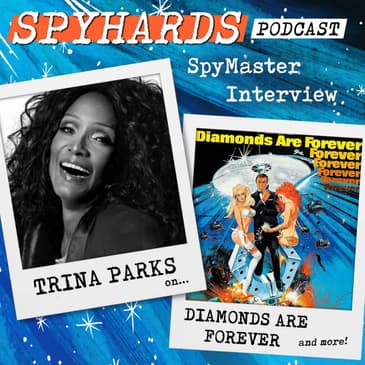


Agents Scott and Cam welcome actress, dancer and choreographer Trina Parks to the show to discuss playing the iconic henchwoman Thumper in 1971's Diamonds Are Forever. She also shares stories about working on The Blues Brothers, a Dean Martin TV special and more!
You can watch Tina's tributes to Katherine Dunham and Martha Graham on YouTube!
Become a SpyHards Patron and gain access to top secret "Agents in the Field" bonus episodes, movie commentaries and more!
Make your opinions about the NOC List known. Leave us a voicemail on Speakpipe or send us an email now!
Purchase the latest exclusive SpyHards merch at Redbubble.
Social media: @spyhards
View the NOC List and the Disavowed List at Letterboxd.com/spyhards
Podcast artwork by Hannah Hughes.
Theme music by Doug Astley.
Hosted on Acast. See acast.com/privacy for more information.
[00:00:38] Welcome to SpyHards Podcast, I'm Agent Scott. And I'm Cam the Provocateur, coming to you live from my retro-futuristic 70s mansion. I love the shag piles, Cam. Damn right. Not as good as the plastic glass bed you have in the other room though. And just the giant rock conveniently located in my living room. I mean, I have a giant rock in my living room too. I thought that's what everyone does these days. If you have that giant rock in your living room, then you can see it.
[00:01:08] Mm-hmm. Are you going to be lounging on it? Depends if it's loungeable. I've seen some giant rocks that one would not wish to lounge upon. It seemed loungeable in the film we're going to talk about, Diamonds Are Forever. Well, our guest certainly lounged upon it. That she did, Scott. That she did. Well, I think it's time. We introduce the guest. We are joined this week by actress Trina Parks, who played Thumper, one of Willard White's henchwomen in Diamonds Are Forever. Yes, we're going to be lounging on it.
[00:01:38] We are continuing our tradition, really, of celebrating Diamonds Are Forever in the month of August. But we're also celebrating Diamonds Are Forever this year in its anniversary year. So we thought, hey, let's go big. Let's bring in Thumper. Without further ado, it's Trina Parks.
[00:01:56] Joining us this week on SpyHards podcast, it's actress, dancer, singer, choreographer Trina Parks. While Bond fans will know her best as the unforgettable Thumper from Diamonds Are Forever, her remarkable career has also seen her on the stage and the screen with legends like Sean Connery, David McCallum, Dean Martin, James Brown and James Earl Jones. Today, we're diving into her extraordinary career, her journey to James Bond and the lasting legacy of one of the most iconic Bond girls of all time, Trina Parks. Welcome to Spy Hearts podcast. Hi, how are you?
[00:02:27] Thank you. I'm just doing fine. The weather is good today. Very nice. Hopefully it will stay that way. And I'm in Atlanta, so it's the up and down weather here. But fortunately, it's doing well. I mean, you're talking to a British guy and a guy from British Columbia. So we know all about inclemental weather. You're in the company here. I've been to both places. I understand.
[00:02:58] I think his is better than mine, I would say. But let's not get into that. Let's talk about you. And I want to get into your Diamonds Are Forever story. I want to get us there. But I think there's some interesting things to talk about along the way. And I think I want to get into sort of your career into show business. I was looking up doing some research. You grew up in Harlem. Brooklyn, your father was a jazz musician. You went to performing arts school. But where did you get that sort of early bug to want to be a performer? Oh, I think I always did.
[00:03:26] But as my father told me, when he took me to the Brooklyn Academy of Music, I was taking ballet classes there. I was about six. And then he wanted me to take piano. And when you sit down with the teacher, it was a female teacher. She would play something.
[00:03:51] And then you'd have to play something after that to see how your tone is and all that with music. And as soon as she started, this is what my father told me. Of course, I don't remember. And I was like five, six, you know. And he said, I got up right away and started dancing. As soon as she started playing, I started dancing. And he said that when he changed the tempo, I just went right along with the tempo.
[00:04:20] And I just was dancing. I've always loved to dance. Just, yeah. So that was a start for me. And thank God he was there with me, encouraged, you know, took me to classes. My mother had passed in my birth. So my father raised me. And my aunts, when he was out of town with the Cab Calloway band, they would, I would stay with my aunts. Yeah.
[00:04:50] So that, but my aunts weren't very much into dance. In fact, even in that time, there wasn't even praise dance in churches or anything. And they were very religious. But after school, I would take class, you know, dance classes. Daddy knew, but I didn't tell my aunts. That's what I was doing.
[00:05:17] But yes, performing has always been in my blood. Yeah. Was there ever like a secondary idea you were pursuing perhaps as a career in case dancing didn't work out? Or were you always just laser focused on dance? Always. My focus was like when I was in PA, performing arts. My major, of course, was dance, the Graham technique.
[00:05:40] And then also I started taking classes at the Catherine Denham School on 42nd Street. And while I was a junior and then a senior. And I, basically, that was my focus of performing then. When I came back from Europe with Denham in 66, I had started to take Broadway auditions.
[00:06:09] Because I did sing. I was a classical singer, actually. I was trained in that. And I started pursuing that through Broadway. I would sing and go to auditions as a singer and dancer. So that was like my second love, you know, as a performer.
[00:06:37] And then into when I was asked to come to L.A. to do the movie Great White Hope, I was asked as a dancer from Donald McHale. Because I was in his company in 65, 66 in Europe. And he was going to choreographed the movie Great White Hope with James Earl Jones. And I had already done a play with James.
[00:07:08] What was the name? Oh, gosh. It just went out of my head. But I did play with James. So I knew him from before. So anyway, that was the start of my getting more into doing my show. I had a manager. After I did the movie, I had a manager who helped me get my show together, my live show.
[00:07:34] And I signed with an agency for the performing arts. And that's what pretty much started my acting career also. Yeah. Well, I feel like there's a story there about James Earl Jones. I was just looking up your filmography. And you mentioned the Great White Hope. But Emperor Jones was the other thing, I think, as well. Emperor Jones. Yeah. I had forgotten it. Yeah. Emperor Jones is what I did before in Europe.
[00:08:04] I mean, before I went to Europe. But getting to work with James Earl Jones and obviously getting to reunite with him. What are your sort of memories of working with James Earl Jones all the way back then? Oh, wonderful. It was great to work with, too. He wasn't a dancer.
[00:08:23] But in parts of the play where we are doing like a dance, sort of a dance movement, where we, it's a section where we're running. He's running from the law. And so Donnie choreographed like a section, like almost like a circle or a hand, holding hands like we were, you know, all together running. And he was right next to me. I was right next to him.
[00:08:51] And he did the movement very well. But Donnie did work with him a little bit before, of course, before we started rehearsing. But he, yeah, he was fun. He was fun to work with. So when you're working with actors who don't have like a dancing background, you know, you're coming in obviously as a very trained dancer and someone who is very good at choreography. How do you help an actor who doesn't understand this very well to be comfortable?
[00:09:21] Well, actually, before that, I started teaching actors movement in an acting school, Kilpatrick Cambridge in L.A. And I see that a lot that do not do any kind of pretty much any kind of movement. They are kind of not secure with their arms. That's the first thing, you know.
[00:09:47] And I was working more with their arms and saying, as you are secure with your acting, you need to be secure with your body, too. I mean, you know your arms are there, you know, and you just need to know with your character, what would your arms do? You know, what would your arms be, you know, just normally do? And then, of course, without the chest area.
[00:10:16] And then we deal with with the legs. I actually wasn't doing a it was a musical. I mean, a TV special. I did again. I mean, I should have had my resume out so I can remember all these names. But I had. He was an actor, a comedian, and he had to do a little movement with me. And I said the same thing to him.
[00:10:46] And, you know, he was saying, well, you know, I'm not a dancer. I said, I know. But you see, you feel you feel your role and you feel your part. And then you just move with it. Of course, we had rehearsals, too. And he, I'm getting the name out in a minute. Then he became more comfortable. I said, you're comfortable. Pretty comfortable with what you're singing or you're acting. Be that way with your body.
[00:11:15] When you're walking down the street, you don't feel like, oh, I've got to put one foot in front of the other. It's just a natural thing. So, I mean, speak for yourself on that one, Trina. When I walk down the street, it's gangly. I'm falling all over myself. It's not great. I am not graceful. Which is weird because I'm a musician sometimes, too. So I should be more graceful.
[00:11:41] But, you know, talking about, I want to get to, because there's going to be a call coming in soon for you for James Bond. But, you know, you're hitting Broadway now. Everything's getting big for you. You're doing more shows. What was it like at that point in your life before Bond came along? Broadway is going well for you. How did that feel, going back to thinking back to that time? Well, actually, yes.
[00:12:03] When I, actually, I was doing, because I was in Los Angeles and my agency for the performing arts, Marty Klein was my agent. And he booked me in several different, you know, specials. So I did a lot of TV specials as a dancer. And then actress, too. The one I did with David Carradine. You know, the horror series. Well, it's not the name later. It's fine. Yeah. I mean, I got it.
[00:12:33] You know, I've got everything in my head. I should have it in front of me. Usually I can remember these things. You know. And they come up after I think. And so a lot of that was, I was just performing, loving to do what I was doing. And then when they, when actually Marty called me about this role, I didn't even know anything about James Bond.
[00:13:01] I didn't know the actor. I didn't know Sir Sean. Nothing about the Bond. I had never seen a Bond movie. But when he explained to me, he was telling me about the character. I liked the character as Thumper, you know, and who she was. And that's how I really, you know, got to know who the Bond franchise was.
[00:13:30] And at that time, there were no cell phones, you know, computers you can look up. And so it was, he just explained to me a little bit about it. And I had, I didn't have a chance really to go and even go to the library and see him, you know, see the movie or anything. But he was very, my agent was very, you know, telling me a lot about it and that I would have an oral interview first.
[00:14:01] Right. So that's how it happened. And I was very happy because I love the character. Well, and I want to get into the character. One thing I'd heard you had said before that you weren't aware of James Bond when you got the phone call, which I mean, I understand now it seems crazy in 2026. But in 1970, I could understand why maybe you didn't know. But did you get any reaction from your friends or your peers when you said, oh, yeah, I'm going to be in the next Bond film? I have no idea. And they're like, oh, my God.
[00:14:30] Oh, well, actually, I didn't really talk about it until I finished the movie that I've always been like that. That after you get it, you sign a contract, maybe. But after you get on that stage, that's when you tell people, well, I'm doing this. So I did a little.
[00:14:53] But actually, when the movie opened in Los Angeles and in New York, I believe it was December in Los Angeles. You might have that information. But it sounds right. Then my friend actually called me. A couple of friends called me, dancer friends, and said they had seen it. And did I know I was the first? Like I said, I had never seen any Bond movies.
[00:15:21] So I said, no, I don't know. Because right after I filmed in Palm Springs when we were shooting, I had to go in about two weeks. I had to go to New York to start the play The Selling of the President. So, you know, I was just doing things right.
[00:15:48] I had no idea about that my character was what it was. I was going to ask, how did they describe the character to you? When they're like, you know, because you said you responded to who the character was. But like, what were they telling you? Well, first, he asked me. He knew I danced. And of course, danced with Miss Dunham's company and all that. So I was a strong dancer.
[00:16:09] And Marty obviously told the director, producers, and everyone knew about my dance career. But he didn't know if I really knew karate. And I did tell him, I said, I learned karate from Catherine Dunham. And she taught Haitian karate, which is la agia, in classes.
[00:16:37] So that was a very, you know, a plus for me, because I did know karate. And you had to know, because I couldn't fight James Bond dancing. That was that. But they wanted that kind of feel. But I had to, you know, I mean, I had to fight him. Right. So like the appeal of the karate was definitely a big part of it. But did they describe like at all, like who the character was? Oh, yeah. Like, did they give you an idea? They did. Yeah. Yes. They, yeah.
[00:17:08] I was the bodyguard for Willard. And I was to Willard always. And I would have to definitely know who's coming in the door. And I didn't know this person. But I was acting like I did know him. So I was sort of trying to play up to him romantically and then catch him off guard.
[00:17:38] So that's, yeah. And you know going in that you're part of a pair with, you know, Bambi and Thumper, obviously. Yeah. Now, what did you sort of envision? Were they describing like who Bambi would be? Were you hoping to like, you know, with the actress they cast, like create a dynamic that would really play on screen? Yes, I did. Now with the first actress, she was a little older.
[00:18:06] And then they, when they, you know, got to play it. And we kind of go, I didn't know her. But, and she didn't know me either. But we got along a little better because we could, you know, because we were almost in the same age group. But she was in her, I think, in her 20s too. But when they, she didn't show up the next day or the day after.
[00:18:35] So then Mary came in. And she was the Olympic. She was in the Olympics at the time. And I think she was about 16. So she was way younger than me. Right. Yeah. But we didn't have that much talk to talk about.
[00:18:53] Actually, I did my scene, went through my scene, all the steps, each section of the scene with Richard, stuntman. And then she came in the next day and was with him. And I didn't come until later.
[00:19:18] So we didn't really get together until maybe the third day that we, you know, really talked. But we both, of course, you know, talked about a character. And I was pretty much the lead, you know, person. You know, you get to, you mentioned what they told you about Thumper, obviously, then getting to shoot the character.
[00:19:42] Did you ever build a backstory for the character in your head or build any more information about her that maybe we didn't see on screen? I always do. I've always. And that was really, because I had taken acting classes way before that. And so I knew what you need to do for the Caribbean though. I knew the basic of it.
[00:20:10] But the background of her character, I definitely did want to know and did know and did ask, of course, even on set with the different times of Sir Hamilton. And I would speak, you know, about the different sections. So it worked. It always worked. You know.
[00:20:38] But I knew that when I was dancing because I, you know, I've done a lot of solo work and you really have to know what your character is. Even in ensemble work, you do. You need to go. But, you know, definitely. And as a soloist. And when you were like helping choreograph the fight in the film, how much time were you given?
[00:21:02] Like, was this something where you had very limited time or were you given lots to kind of figure out and find kind of that comfort place for it? Oh, yeah. We were. I guess I had probably the whole day at least with Richard and doing each section of that scene, what, you know, I would do. And then, again, Mary came in.
[00:21:29] And then the third day we were both together and we both worked with Richard in each section. And, of course, what we would each do. The thing I did was what they wanted. Richard said they wanted the section where I do the kick and the split and the turnaround before I kick Sir Sean.
[00:21:58] That actually was, I was asked to choreograph something for that part. Because Richard said, I'm not a dancer, but I think they want something kind of fancy dancing. Kind of in the character, of course. And so I choreographed, like, two different types of things in for that floor work up until where I called the stalking part.
[00:22:27] And then Sir Hamilton and Sproggly had to see it and, you know, figure out, you know, choose which one they liked or what they liked in it. So, yeah, that was probably at least a half a day with that section. Right. And, you know, obviously this is filmed at the Elrod House in Palm Springs, which is unbelievable. When you walk in there, how much does that help your choreography?
[00:22:56] Because there's so many ways to work the architecture of the room into the sequence. Actually, it was a little, it's not flooded at all. It's very 1960s type, you know, furniture. But they did open it, of course. So we could do our fighting. But when it was a little closer, a couple of furniture was closer in, they had to take that out. But, yeah, it was fine.
[00:23:26] Fine for what we did. Well, I want to get into Sean Connery. Sir Sean Connery, as you say. I had heard a rumor that he actually requested to see you before production began to have a little bit of a chit chat. Tell me a bit more about that. But also just getting to work with Sean. What was he like on set? I want to hear everything. You want to hear, like we say, all the dirt. All the dirt.
[00:23:56] It's good soil. Okay. We like that. It's really good. That's what we say. Yes. I was very honored and surprised. I had received a note saying that Sir Sean, well, he wasn't Sir then, but I called him. Sir Sean wanted to see me because he wasn't going to be on the set until, you know, a few days later. But he wanted to meet me because we never met each other at all.
[00:24:26] He wanted to meet the person that was going to beat him up. And so we had like a little, before I was picked up for my first time to go on the set, we had a little site, you know, European breakfast, you know, in the restaurant there at the hotel.
[00:24:52] And I, that was one time I wish I had, you know, a cell, you know, the cell phone come in very good at that time. Unfortunately, we, I don't have any pictures of that. But, but he was very nice and he said he wanted to meet me because we actually couldn't and wouldn't really be able to talk that much after he came on the set.
[00:25:15] You know, it's, you know, with just knowing each other, you know, because our characters was out where our characters always, you know, with each other. Except when like Sir Hamilton would take us and talk to us about, you know, our characters together or separately. So we were talking about working with Sean Connery and, you know, the meeting beforehand.
[00:25:44] What was the actual experience like performing the fight sequence with Sean Connery, him as a action performer? You see, when I did this movie, as you know, I've done lots of dance concerts, dance solos, working with, you know, actors and directors. And that's the way I did this, you know, I said, this is the way I work.
[00:26:14] And I had my character. And of course, he had, I, again, I didn't know him, but I had worked with several other, you know, actors, well-known actors. So it wasn't like he was different to me. He, you know, he was a character that I was working with. And I just, I kept, of course, I, as always, kept in my character. And we had a great filming experience.
[00:26:43] You know, it really went well for the two weeks without, without filming on a shooting on the weekends. But yeah, that's how I adapt to whatever character I have. It stays with me. Well, I'm glad you said the word adapt, because I was going to ask, you've choreographed this fight sequence. But how much room do you leave for spontaneous ideas?
[00:27:12] Moments that you suddenly think, wait a second, what if we did this instead? Like, is there room for that? Yes, there was. We did that a couple of times. And Richard was very, very open to different things that I did. Like, you know, the, like I said, there was, he wanted, he wanted that kick when Bambi has Sashan on, around his neck.
[00:27:38] And so I said, you know, a kick, not to kick him in the face, but it looks like I'm going to kick him in the face. And then turn to do the, the stalking thing. There was one when I, after I throw him, and then I go into, go to the side and I, and I say, you're on again, Bambi. And I put my finger on to my head. You know, the director didn't tell me to do that, but they kept it in.
[00:28:07] So, you know, and if they didn't want it, of course, they would say, let's reshoot that without the finger. So, little things like that that were comfortable. Because I am comfortable working like that. You know, it's not like that's the first time I've done, it's the first time I did a movie, you know, a featured artist. But it's not the first time I'm doing that kind of work, like a solo work or working with the director.
[00:28:35] So, that was very comfortable to me. I was never afraid. I was not, you know, holding back anything. And I was re-watching the sequence last night. I've seen it many, many, many times. But just looking at it last night, it's interesting to me how alive that sequence feels. Like, a lot of action, a lot of action feels very like, go by the beats, you kind of know what's going to happen next.
[00:29:01] Whereas, consistently, whether it's through character or just the choreography, it feels like a sequence that's constantly evolving and moving and going in directions that you wouldn't see a typical fight sequence, especially of this time period, go. Right. Yeah. I felt that too. But, again, when we were going over, I would say the choreography of the different sections of the scene, that was fun.
[00:29:29] I said, that's exactly what I liked. You know, I was comfortable with it. And I liked it because I could see different things also that I could do. So, especially when Sir Hamilton and Sir Broccoli came in, you know, we would be able to work out, work over all these different sections and see exactly what worked best.
[00:29:57] And that's exactly what I do as a dancer, as a soloist. I'm working with the director, choreographer. You know, there's no different. I just had big cameras in front of me. Yeah. Instead of a big stage with people. Well, you know, Cam mentions watching the sequence multiple times throughout his life, and I believe him. He's probably watched it probably far too many times, I would say.
[00:30:22] But for you, you know, it's a sequence in your career that you've lived with for a very long time, of course, shooting it back in 1971, maybe late 1970. What are your thoughts on that scene now, looking back on it? How do you feel about the whole experience of being in a Bond film? When I see it, always, when I see myself in the other specials and things that I was, you know, dancing like on a camera.
[00:30:51] I'm saying like, oh, I could have done this better. But I always say that because in looking at myself, I always think, why didn't I do that better? Like when I kick, why didn't I kick higher? But that was fine because I was supposed to kick sort of like I was going to kick him in the face. So higher wouldn't work. But I'm thinking as a dancer, as a performer, why didn't I do that?
[00:31:22] I have been very surprised that, well, when it opened at the Groman, that's the first time I had seen it with the audience. And that a lot of ladies, of course, were cheering for us, you know, for me. And I found that really amazing because here I am, the bad guy, speeding up John Connery.
[00:31:49] But I enjoyed filming it. So every time I see it, I do enjoy it. I enjoy seeing it. Yeah. And I enjoy more so because I've had such wonderful compliments, male, female, young, older about it. And I had no idea, no idea I was, you know, going to have that, get that, you know, accolades.
[00:32:19] Especially after this time. So I'm very, very on it. Being in a Bond movie is kind of the gift that keeps on giving. Yeah. We've talked to a lot of actors and people that have worked on Bond films. And it's always like, you know, it almost doesn't even matter how the movie is regarded. Like whether it's a favorite or not. It's like the lifespan of these movies carries them. And fans love them just consistently and bring so much to the performers. Yes. Yes. Yeah.
[00:32:49] Mostly 98% of, you know, comments I've seen or heard were always favorable for, you know, the movie for myself. I have heard once, well, I didn't like this movie as much. Well, okay. Yeah, like everything. But, uh. Ask that person how many times they've watched it, though. Yeah.
[00:33:17] No, I just say, next, as we say in the dance world, you know. Okay, next. The first group passes now. Next. You don't deal with the past. Now, I had read that when you were starting acting, your first coach was Bruce Glover. Bruce? Yes. Yes. Yes. Yes. Wasn't that something? I have two questions. I guess, first off, you know, what was Bruce like as an acting coach?
[00:33:47] And second of all, your reaction to seeing him in the actual film, Diamonds Are Forever, with you? First, I had a wonderful, because he was my first. The first team I had in, when I came to Los Angeles. And I'm pretty sure it was after I did the film. Yeah. I think it was after I did Great White Hope. And I really enjoyed it.
[00:34:14] He's very adamant about everything, the scenes and who you are and some of the things. Fortunately, I had learned through my dance career is that you're breathing. You breathe from your abdomen, not your throat. You breathe through your whole body. Your focus is on that character itself.
[00:34:43] These are things that he mentioned also, but that I knew from dancing sort of already. How you present to the last persons on the balcony. That's what you have to portray. You have to portray that through.
[00:35:04] I had not spoken until then, but I had done that through my dance and through my character. It's exactly what he was saying. So now I had to speak and bring it through, speaking also. Yeah, he was wonderful. God bless him. God bless his soul. What was your reaction to then seeing his work in the same film as you?
[00:35:32] I was so surprised because I did not, you know, been out of touch too. I said, oh my gosh, that's my teacher. That's the first thing I said. I did no idea he was in the movie. Not a clue. Yeah. That was surprising. And I've been happy too. Isn't that something? Here I am. I teach him. I'm in the movie that he's helping me in acting. Good feeling.
[00:36:02] And I would guess over time you got to at least do some events together as well. Oh yeah. Uh-huh. We had. It was wonderful. Yeah. We had done some autograph shows together. I think we did two Hollywood shows and we had a big Hollywood show in Burbank. Looking at sort of the legacy now of your time in Diamonds Are Forever and sort of reflecting upon it. We just talked about Bruce Glover.
[00:36:30] One thing that sort of jumps out as well is, you know, you're the first African-American woman in a Bond film, which is a pretty spectacular feat. Uh, not something I'm sure you were particularly aware of the time you were shooting it, but something to reflect upon afterwards, how impactful that could have been for people watching it, especially, you know, people growing up around that time watching those films. Have you sort of, obviously you've learned that since. What are your thoughts on that?
[00:36:55] Well, actually, I did not know that because as I said, I had never seen a Bond movie. I didn't know, you know, any, I hadn't seen any of the, of Sashon's movies. Um, so I didn't know that. I didn't know I was the first, I had no idea until somebody, one of my friends called me and told me that.
[00:37:18] Um, it, it, it, it was very surprising to me and I was very honored about it, but no, I didn't know. I was doing a movie and I was just happy doing it. And then next was the Broadway show. You know, as, as a performer, I was just doing what I love to do. And I thank God for that. Indeed.
[00:37:46] Um, I suppose that on the other side of legacy, when it comes to diamonds, you know, you talked about doing some shows with Bruce Glover. I'm sure you've done, I mean, you're doing this podcast right now. You talk about diamonds. You're very passionate about the work you did in Diamonds Are Forever. What is the biggest impact Diamonds Are Forever had on you? Hmm. Uh, as far as several other, uh, things.
[00:38:11] Well, one in particular was, um, there was a play, uh, the, um, oh gosh, uh, Snow, Snow, uh, Snow Queen. I think it was that, uh, I was up for. And, um, that was at the, um, uh, the Long Beach Civic Light Opera and the musical, of
[00:38:39] course I sang for it and all that. So the musical director was a huge James Bond fan. And he, he knew me and he, I never forget him saying to me, uh, I don't care if she doesn't sing. I want a Bond woman in the show, you know, but I did sing because I had to sing, you know, uh, several members.
[00:39:02] But yeah, that was a, uh, probably the first time I've heard such a wonderful accolade to me, you know, about that. But there were several others, you know, different, uh, things that I was sent up for through, uh, my agent. And, you know, of course they were saying I was the Bond woman and giving them my credits
[00:39:27] and I, the Bond, uh, being the Bond woman did get me into the door a lot quicker, I think. Yeah. But again, I had to have the talent to do what she did. Definitely. Definitely. I was going to ask the, you know, you're the first African-American Bond girl. The next Bond movie that comes out, Live and Let Die, has Jeffrey Holder, who I know you'd worked with a lot. It has Gloria Hendry. Oh yeah. Yeah.
[00:39:56] Who I know you're a friend of. Yeah. It's got Yafet Kota. It's got a lot of actors. Did you see that film at the time? And what were your thoughts of it? Yeah. Yes, I did. I saw it in Los Angeles sometime, you know, afterwards. Um, yeah. And of course, yeah, I knew, of course I knew Joffrey had worked with him, danced in his company. And I knew Gloria too, way before we did the movies. She was, you know, a friend. She still is. And I hope to see her, you know, but I think I will.
[00:40:24] So, but I'm going, I'm invited. I'm an invited guest at the NAACP Theater Awards on June 29th at the Wilshire, Wilshire Theater in Los Angeles. So she, she will be there also, Gloria. Nice. Nice. So, yeah. But Gloria is the only black, um, to, uh, bond woman that I didn't know for a long time.
[00:40:53] I had met Grace and she was in, you know, doing modeling actually with Gloria. And at that time, the modeling, like in New York, I was dancing. I was in that field, you know, and they were, uh, into the modeling. Um, but that, um, that role itself has been so honorable to me and people admire it. And I've gotten, of course, work because of it.
[00:41:21] And it's something you, you just can't be more honored about. Really can't. Yeah. Really can't. And, and at that time, you didn't see, uh, black, um, actors, actresses in, uh, featured roles here in United States that much, you know? Yeah.
[00:41:45] And so I really give the credit to the Bond franchise for, uh, hiring ethnicities from the very beginning. And the franchise has cast, has been open, the open eyes to talent. And what would be profitable to and good for the movie itself. Yeah. I admire it. And also recognizing that audiences would like to see that as well.
[00:42:15] Like that's something that they would like to see in their movie. Yes. And performing many times with, uh, companies, a couple in, in doing European tours a couple of times in my life, European and, and even, uh, over, uh, in Eastern Europe when it was, uh, before the wall came down and even after the wall came down, uh, they appreciate, you know, they appreciate you as an actor, as a singer, as a dancer, not because you have
[00:42:43] a name or, you know, it's a little different in Europe than it is here. Mm-hmm. Mm-hmm. Mm-hmm. Mm-hmm. But, uh, so I'm, I'm thankful to that, you know, to that, uh, franchise, to Sir, uh, Broccoli, producer, and Sir, uh, Hamilton, the director, where I, I, I really enjoyed working with them both.
[00:43:08] And for me to be a novice the first time they're working with me and neither one of us know each other except when I met them, when I had the first interview, you know, it was a beautiful, it was a beautiful shoot. Mm-hmm. Well, I, I want to take us away from Diamonds are Forever a little bit because, you know, we've, we've spent a lot of time talking about it, but there are lots of other things you've worked on in your career. And, you know, we love everything about spy movies.
[00:43:34] And there's one name in spy movies that I often think about, and that's Dean Martin. Oh, yeah. Um, you did a Dean Martin special, I found out, a little bit on YouTube, and it's on your Wikipedia. But any memories of working alongside Dean Martin, I'd be just happy to hear a story about him. Oh, uh, you know, it was, I really didn't spend much time actually with him that much, except when we were in rehearsals, we were rehearsals with Claude, Claude, you know, a lot, uh,
[00:44:03] before a lot of time, like a week, maybe two, before he actually, uh, came on, you know, on the set. And, uh, so we talked, we talked, but I really didn't get that, that close to him. But yes, I, I enjoyed working with him. It was absolutely no problems. Yeah. He was, he was, he was pleasant. It's nice to hear that Dean Martin actually did some rehearsals because every experience
[00:44:33] we've had with him is that he would just sort of turn up a day before and just sort of get on with it. Yeah. And mine didn't get like that. Like maybe the day, no, it wasn't much. The day before and he kind of saw the, you know, what we were doing, definitely saw what we were doing first. And, you know, and, uh, that's why he didn't, he didn't spend that much time with us, um, to as, as the rehearsal time, you know, the shooting. Yeah, you're right.
[00:45:04] We interrupt this program to bring you a special report. Agents, we don't expect you to talk. We expect you to buy a subscription to our Patreon. Eee, that's right. Over on the SpyHards Patreon, we're covering all your favorite spy TV shows, as well as popular films from the most iconic secret agent actors of all time. Cam, why don't you share some intel on our latest assignment?
[00:45:30] Scott, the waning days of summer are fast approaching, but what better way to continue the fun than by looking back at the July output on the SpyHards Patreon. We celebrated the release of Christopher Nolan's The Odyssey with reviews of Memento and Dunkirk. We also, on On The Small Screen, took a look at Killing Eve Season 2, in which the main character, Villanelle, experiences severe boredom. But you know what? You'll never feel boredom over on the SpyHards Patreon, so check it out today.
[00:45:58] So deactivate Ghost Protocol and visit patreon.com slash spyhards to truly do things angel style. But before we close, Channel D, on with the SpyJinks. I want to ask about the movie The Blues Brothers, and you were in the sequence with James Brown. Yeah. Can you just talk a little bit about working on that incredibly memorable and iconic sequence? Oh, that was so much fun to do.
[00:46:26] And the choreographer, I knew him from before. Actually, he was the only and the first Black dancer on Carol Burnett's show. And he, and see, I need my names and everything in front of me. I should have had, but Carlton Johnson was his name.
[00:46:52] Short and just always cost. His hair was always in place. And as a dancer, he was always very, very classy. But he could dance. I mean, he could jump. He was like maybe five, five feet, three, four or something. Wonderful to work with. And I just love the choreography.
[00:47:18] Because I had, of course, I had done some praise dance before. And also choreographed some churches. And I just loved it. And I did get to know James Brown well. We talked after. And then he was telling me that his daughter was in Palm Springs. And so, of course, when I went to Palm Springs to do the follies, I, you know, contacted her.
[00:47:48] And she's just the most wonderful. In fact, she is doing a documentary on her father. And I am also in it. We taped it earlier this year when I went to Palm Springs. So I'm very glad at that. And she lovingly gave me his suitcase. Wow. His suitcase. A Louis Vuitton suitcase.
[00:48:12] And all the years, I mean, you're talking about like the 50s, 60s that he was traveling all over. And that suitcase is still in really good condition. And it's strong. Except for like the ends of it and the metal glue coming out. But it is. So I traded my smaller suitcase. And she gave me his. And I am just.
[00:48:39] When we were shooting her documentary, she was saying that James was really fond of me. And he said, and I said, oh, really? He said, more fond of you than I think you knew. And she said, I don't really. But that wasn't the way I felt for him. It was just really nice and nice, great to work with. And all that. But that was an extent.
[00:49:08] But that was surprising to me that, you know, she told me, of course, she knew from him. But I had no idea. Wow. But that was a wonderful, wonderful shoot. Yeah. And I did take some pictures. I don't have now with John Fouchie and David Ackerman. Yes. I just don't know where those pictures are. I'm sure they'll be on Google somewhere. I would hope so.
[00:49:37] I've been looking to see if I can, you know, find that because that was 80s. Yeah. Yeah. So I had the 33mm camera. Well, I think I'm going to sort of wrap us up with a couple of questions just to finalize the conversation. And I'm curious. We've spoken so much about your past. I want to talk about your present and your future. This is not a mystic program.
[00:50:04] I'm just talking about I'd like to know what you've been up to recently, because I read a little bit about an Eartha Kitt documentary that might be in the works. But, you know, what have you been up to? What can we expect from you in the next couple of years? Well, actually, I have just finished one just but last year or so, I finished writing my autobiography. Wow. She's my second editor.
[00:50:31] So she had to kind of redo several of my I've written in acts and scenes. So I have eight acts and eight scenes in each act. And so she's at like the fifth or fourth act now, just really wrapping up everything. She's done the eighth.
[00:50:50] The eighth act is all about my thank you and my accolades to all the people that I maybe have mentioned earlier in my book, but not giving them the real details of who they are. And I speak about my father and how I, you know, honor him so much. And so but yeah, it's finished.
[00:51:13] And I get like, well, when she finishes the editing, I'm going to put it out. And of course, I have pictures that I have to put into the book with her help and all that. And then it's out. I'm hopefully this, you know, at the beginning of next year, at least. Well, you'll have to you'll have to let us know when it's out so we can tell all the the Bond fans listening. Yes. Yes.
[00:51:38] And also I have done two videos of to the choreographer, Miss Catherine Dunham and Miss Martha Graham. And they're on the YouTube and it's called Technique Supreme. And I speak about it's about 11 minutes and some seconds for Miss Dunham and about 12 minutes for Miss Graham.
[00:52:03] Because, of course, you know, I work with danced in her company and at the Apollo and then in Europe as a featured dancer. And then in with Miss Graham, Miss Graham would come to performing arts and teach masterclasses because we were, you know, majoring in the Graham technique. And I had her dancers as my teachers, her original dancers were the head of the department.
[00:52:32] And I worked with and my senior year, I worked with Helen Tamerich. She gave myself, Ben Vereen and Winston Hemsley her solos. We were the first to do her Negro spiritual solos. And I did swing low, carry it. With that situation.
[00:52:54] And also I speak about Mary Hingston, who was the first black dancer in Miss Graham's company. I didn't meet her because she would she came to PA to also teach like a masterclass. And Miss Graham would come periodically to the three years about, you know, my high school years there to teach.
[00:53:16] And also then the last my last experience was with I was with Anna Sokolow's company. Anna Sokolow, who was one of Miss Graham's original dancers. And so that I've had experiences, you know, with that with the Graham. And of course, I'm a Graham dancer and I teach Graham also still teach.
[00:53:40] So I speak about these both of these iconic choreographers, female choreographers that was so adamant. It's so wonderful to my life as a dancer, as an actress, as a singer, as everything, as a performer. So I have that on YouTube and you can, you know, look at look at those. Right. Whenever you can. Mm hmm. Yes. Well, we'll put we'll put some links to that in the notes of the people can go and check it out as well.
[00:54:08] And well, Trina, the last question I have for you, and this question has been asked to everyone we've ever had on the show. So there's no pressure. But everyone's looking at you. Everyone's looking at including we've asked this to Bruce Glover, who we've had on before. We've asked this to Gloria Hendry, who we've had on before as well. So, you know, people, you know, have answered this question. Trina, we want to know from you, what is your favorite spy movie of all time?
[00:54:37] Oh, let's see. Let me think. Diamonds are forever. That's one I like. You know, and the actually my other one actually in the Bond movies that those actually were a favorite mind.
[00:55:01] I can't think of anything else like before that or after that, that I think compares. And I'm not really saying this because I'm, you know, a Bond actress, but he Bond movies were the grandmother or the grandfather of all the spy. And the movies like even Mission Impossible and things like that.
[00:55:30] They would have the scenes of the car, car scenes, the chase, the fight scene, everything like that. And then what I have seen have come from the Bond movies, most of them. So maybe I'll think of something after I leave this post, but that comes to me. I really liked Dr. No and Thunderball. Wow. OK. Oh, nice.
[00:56:00] I mean, you know, Dr. No, Thunderball and Diamonds are Forever are a great selection, I'd say. Yeah. Yeah. Yeah. And I like those. And I know Amazon has it now. And I'm just hoping it kind of keeps in that vintage kind of style. But, you know, giving the young people the excitement, too, of it. Here's hoping. But speaking of excitement, Trina, it's been a genuine pleasure speaking with you.
[00:56:30] Thank you for bringing the excitement. Thank you for Thumper. Thank you for Diamonds are Forever. And thank you for being here today. Thank you so much for asking me. This was quite a pleasure. There you go, folks. That was our chat with the one and only Trina Parks. I want to thank Trina for spending some time with us and showing us her rock. Yes. Thank you so much for showing us your rock, Trina. But you rock because this was a really fun interview.
[00:56:59] Yeah, it was great. And we'll talk about it a little bit in a second, but a little bit of context for everyone listening at home. You're listening to this whilst Cam and I are actually in Las Vegas, which is rare. I mean, rare that I want to spend time around Cam in person anyway. But even rare that you'd find us in the United States. So, yeah, we thought we'd celebrate Las Vegas in any way we know how by going there and also interviewing someone who actually didn't even shoot the scene in Las Vegas in the first place. No, that's true.
[00:57:29] That's true. But she did have a Vegas-related story when we talked about Dean Martin, of course, star of the Matt Helm films and her experience working with him where he was like, no rehearsals but ready to go. Just comes in. Bingo, bango. Let's go, baby. I mean, I absolutely love the fact that you tied that story in. But I will just point out the Dean Martin show was shot in Los Angeles. Oh, that's irrelevant. Dean Martin himself, Mr. Vegas, one of the Rat Pack. Okay. I'll allow it. The judge rules allows it.
[00:57:57] He literally has a statue in Las Vegas. That we've never gone to. There's also Dean Martin Drive. So. That we have gone to. We have indeed. We have indeed. Yeah. But it's. I'm trying to think of how many we've done now. We had Bruce Glover on the show very early on. Had Lana Wood. Now we've had Trina Parks. And it's always nice to go back to a film that I've got a complicated history with, a complicated relationship with Diamonds Are Forever. But it's never one that I find dull.
[00:58:23] I actually recently did an appearance on the One Track Mind podcast where we actually discussed Diamonds Are Forever and the commentary for the film. I also, of course, make it a tradition that whenever I'm going to go to Las Vegas, I sit down and watch Diamonds Are Forever before I leave. And I am going to subject my girlfriend to the film in the coming days. Well, to be fair, they're listening to this and that's already happened. It's happened. So Sue is now a veteran of Diamonds Are Forever. And an ex-girlfriend.
[00:58:53] And an ex-girlfriend. It's always interesting with the sort of Bond actors because you get different levels of involvement in a film. You look at Bruce Glover and Lana Wood, who we've had on the show before for Diamonds specifically. And they both have varying degrees of amounts of screen time. And Bruce Glover, I think, is probably the perfect example because he gets the most time out of the three people we've spoken to from this film. He gets a lot of time to leave an impact. But with Trina, she didn't have a lot of time.
[00:59:21] Just that one scene, basically. But what's interesting is I feel like a lot of the time she's actually remembered more than some of the other characters in the film. Because it's such an impactful and a bit odd of a scene. Yeah, I think it's that. And also, it was just the kind of thing. Whenever there's a Bond montage made, somehow Bambi and Thumper wind up in it. And so I remember before I ever saw Diamonds Are Forever, I was very aware of those characters.
[00:59:50] Just from watching TV specials and things like that. Where they'd show like a montage of Bond villains or something like that. Bond women. Sure. And you would always see them. And so I remember watching the movie and being legit surprised that it was just one scene. But it is a scene that really does stand out in the movie. And you watch it. It is kind of everything Diamonds is at its best. Where it's Connery being fun.
[01:00:19] It has a camp value that is intended and feels like it really hits the mark. That's kind of the pleasure of that movie in a lot of ways for me. And it also just has the iconic Bond characters. Like Bambi and Thumper just get their one scene. But they really do stick in the memory as very unique adversaries for 007.
[01:00:45] Well, I think it also comes from this idea that it's a very peculiar fight. Yeah, it is. They're using acrobatics to fight him. Yeah. And there's a lot of these moments in Bond history where he fights people that don't fight in his style. I think of Roger Moore in the martial arts camp in Golden Gun. Yep. And then obviously Roger Moore just punches the guy out or chops him or something like that. I can't remember how he deals with that guy. He kicks him in the face when he's bowing. That's it.
[01:01:12] You also had Connery opposite the really big dude in Japan who was like The Rock's grandfather. Grandfather. Yeah. Where it was much more of almost like an aggressive wrestler versus Bond. It's like classic David and Goliath story, isn't it? That's what they're going for there. The Rock's grandfather was not a sumo wrestler, but they were just sort of going in for the fact he was a professional wrestler. It wasn't really tied into Japan particularly, except for the fact that he has some sort of heritage. But that's about it really.
[01:01:40] But to the whole point of it being there's these weird moments in Bond history with fight scenes. And it makes them stand out. Like I don't remember the driving sequence in Spectre. Well, I do. I do. I wish you didn't. But it's not the kind of thing, say that, if you show that in an action reel of Bond that it's going to pop the way that a scene of Bambi and Thumper does. You could have a similar thing of the fights of Bond.
[01:02:07] You have that shot of the two of them kicking Sean Connery. Yeah. And instantly it sticks in everyone's head. Absolutely. And I think it's also important to note, like Trina was telling us, how involved Sean was. Yeah. And it's one thing people tend to... I'm not a big Diamonds fan. I will never profess to be a big Diamonds fan. The jewel and the film. And there are many reasons for that. You can go listen to our review.
[01:02:33] But what is interesting about it is, despite the fact that Sean comes across as a bit disengaged, that's me pulling politely 007, he actually was very much involved with the production. And everyone we've spoken to, and I missed out Constantine Gregory, who we spoke to, I believe, earlier this year or late last year. Yeah. Who was in both Golden Eye and Diamonds are forever. In Diamonds, he was the assistant to Dr. Metz. Yeah. I spoke a little bit about that. Connery was involved and he cared about the character.
[01:03:01] So much so in Trina's case, where they had like a meeting before the fight and spoke about it and spoke about her. And he could have easily just turned up, shot that fight scene, been directed, and then buggered off to play golf. But no, he was invested. Yeah. It's the kind of thing that, you know, we've heard these stories about Connery on the set of Diamonds enough times that you go like, no, like he was engaged with his fellow actors. Yeah. For sure. So it's kind of that question of like what quite happened between, you know, the onset to the final film.
[01:03:31] Because it does feel, I agree, like he feels a little more, shall we say, relaxed to be kind at times. I think that is, again, putting it mildly. But yeah, perhaps he comes across as less engaged. And I think, unfortunately, sometimes that's more to do with his physique than anything else. Yeah. Yeah. Which is a really unfortunate way of evaluating someone's connection to something. But that is the way it is.
[01:03:59] But yeah, I just, it was nice to hear from Trina. And it was nice to hear that she had a good time making it, which she clearly did. And also that she had a good time working with Sean. It was also just fun to hear her talk about having Bruce Glover as like one of her early acting teachers. And you would never think, you know, as a Bond fan watching this movie that they would have had this prior connection. I mean, they share no screen time together in the film.
[01:04:24] So it is just kind of one of those fun little like, you never know when you embark down a trail who you'll meet along the way. Yeah. Usually it's you, which is really unfortunate. Yeah. I'm like in the bushes, like, hey, Scott, Scott. Do you want to talk about diamonds again? No. No, I don't. Stop. I'll convince you to like diamonds. I'm sure you will. You'll use that Blofeld mind blowing technique.
[01:04:52] Or you'll just drill into my head like Blofeld did that time too. Oh, true. No one references that bit. No one ever references his like head drilling. Yeah. Yeah. And it's like, is that an intended sort of allusion to kind of the mind controlling stuff in, you know, Honor Majesties? Who knows? Who knows? Who knows? I'm not sure even Sam Mendes knows. It's very possible. Yeah. It is very possible. But there you go. That was our Diamonds are Forever discussion of the year. Happy birthday to Diamonds are Forever.
[01:05:22] Happy birthday to Diamonds are Forever fans. I hope you're having a good time rewatching the film. Cam just had a good time watching it. And of course, lost his spouse. But these things do happen, Scott. A lot to me for some reason. But it's really unfortunate. But hey, look at the bright side. You did have a girlfriend for a little while. It's true. It's true. So I've got to, I guess, hit the streets for my next viewing of Diamonds are Forever. Right. Well, the question goes to you, sir. What are we talking about next week?
[01:05:52] Yes. We're tackling the 1964 spy film Hot Enough for June starring Dirk Bogard. Yeah. It's the funny story with this is that we booked this episode in June. We recorded it in July and now we're releasing it in August. It couldn't be any more spy hearts. Yeah, exactly. Exactly. Talk about missing the mark. Yeah. We had a heat wave when we booked it and we're like, oh, hot enough for June. That makes total sense.
[01:06:21] And now we're like, oh, it's pretty chilly. It's a reasonable August. Got to say, it's a reasonable August. How mild enough for August. It was like kind of chilly and raining the last few days here. So, okay. Well, no, that's just your depression from being single. Oh, right, right, right. So, your mission should you choose to accept it, folks, is to join us next week as we take a look at Hot Enough for June.
[01:06:48] We've got a great guest, a returning guest, actually, as well. One who hasn't been on the show for a while and wants to have a redemption because the last film they had was not the best. But it did also leave a mark. I'm still in therapy for it. I'm still in therapy for it. And if you like what you heard on this episode, please consider joining us over on our Patreon. I know you hear us talk about it.
[01:07:13] And I apologize if you feel perturbed by the fact that I feel the need to perturb you. But we are perturbed by the lack of income we get from podcasting. And I say that in jest. What I mean to say is putting the show together every week. We haven't missed a week. We're just entering our seventh year now. We just had our birthday celebrating our full sixth year. We're entering our seventh year. And we've never missed a week. Sometimes we've given you two or three episodes per week.
[01:07:44] And we don't really make much money from doing it. And so the only way we can pay for all the services that we have to buy to put the show together, I mean, your note, we've recently jumped over to YouTube as well. And I now have to edit the show. Cam can't be bothered to learn how to edit video. So I'm the guy who has to do it. That's fine. But if you could help out, that would be great. So come and join us over on the Patreon, patreon.com slash spyhards. Chip in a couple of dollars or a couple more dollars.
[01:08:14] But you'll also unlock a bunch of extra bonus episodes for your trouble and for your sweet, sweet pound or dollar. Or what's another currency count? Kroners. I'm not sure that's the right word, but yeah, okay. Sure. Why not? Why not? Is that that's the Danish currency, right? I think so. Yeah. It's Kroner. Okay. Well, fine. Fine. Nice try, though. But I got you on the pronunciation, son. You did. You did.
[01:08:42] And I was going to say, people who want to hear more 70s Connery, we've done episodes on The Man Who Would Be King and also Meteor. So you've really got the highs and the lows. I mean, sign up now, folks. Yeah. Be Zardoz next. They'll be rushing in the door. Oh, it'll happen one day, I'm sure. We'll do like a week or a month of WTF movies or something.
[01:09:06] I mean, I dressed up as Connery from Never Say Never Again in the Dungarees for social media. I went on social media wearing that. Yeah. You now have to dress up in the Zardoz outfit. We'll see about that. Okay. We'll see. Okay. The same day that you start editing the videos, eh, Cam? How about I'll dress up when we do a shark movie? I actually have a shark costume. Okay. I can use that for social media. Okay. And also come and join us over on social media at SpyHards, wherever you get your social media.
[01:09:36] Our socials will be a little bit quiet this week as Cam and I are actually on holiday, as I mentioned before, in Las Vegas. And we'll be just enjoying a little bit of our time. But obviously the episode is still here. The interview is still here for you to enjoy. And we hope that you did. But until next time, Cam, I have a question for you. Okay. So when Connery was talking to Trina Parks walking around the Elrod house, do you think they walked into the middle of the room and Connery turned to Trina and said, Trina, welcome to The Rock.
[01:10:01] This podcast is part of Podomity, the UK's podcast comedy network. Why not laugh at what else we've got? Visit Podomity.com.