
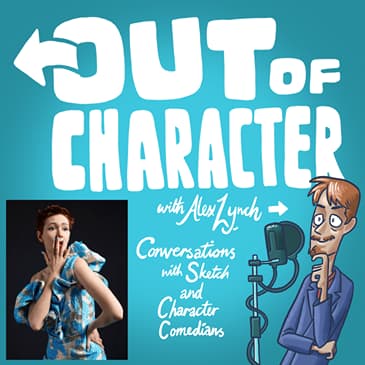

Alex chats to Elf Lyons (The Guardian's 50 Funniest Comedians of the 21st Century) about birds, time, and the Apollo mission.
Elf also create a character on the spot based solely on the made-up name given to her by Alex in our regular section ‘Chain(ge) of Character’. This episode was recorded 2nd July.
You can find more of Elf's work at www.elfylons.com
Insta: @elflyons
Grab tickets to 'Elf Lyons Is… The Woman On The Edge' at www.elflyons.com/gigs
Watch 'The Fly' at https://www.youtube.com/watch?v=HxCUghpZTbs
Presented, recorded, edited and produced by Alex Lynch
Music by Naïve
Artwork by Tom Crowley
A Podomedy Podcast
Follow the podcast at @oocharacterpod on Instagram and BlueSky. Email oocharacterpod@gmail.com
Give £5, £10 or £20 now and help CALM in their fight against suicide: https://www.justgiving.com/page/podomedy-stay-tuned
Hosted on Acast. See acast.com/privacy for more information.
[00:00:11] Hello and welcome to Out Of Character, a podcast about sketch and character comedy. My name is Alex Lynch. In this show I chat to writers and performers from the world of sketch and character comedy. Find out what made them venture into it, talk about their characters, maybe meet some of their characters, and generally just shoot the breeze and, more importantly, have a laugh. My special guest for episode 85 is the comedian Elf Lyons. Hello. Hello, lovely. That was a very nice introduction.
[00:00:41] Oh, thank you. I have to do it every time. You do it very well. Very well. Thank you very much. So lovely to see you. Thank you for doing this. Thanks for having me. I mean, I don't really have to do anything. I was working and then I opened the Zoom meeting and then plugged in my microphone and then I get to talk to you for a little bit. So, bar being creative mentally, it's quite low, low output from me over here.
[00:01:08] Yeah, well, I mean, if it gives you a little bit of respite, that's good because you've been very busy with your new show. Yeah, I mean, I'm always busy. It's that sort of bizarre, today is sort of my only day off, but then also I am working. But I sometimes think you do that thing as an artist or like any type of person, I think. Days off are more like, am I in motion? And today I'm not really in motion.
[00:01:35] Yeah. Yeah. So it's it feels like it feels like a treat, even though my brain is moving a million miles a minute. Do you find it difficult to like switch off from, you know, your from sort of being at work, obviously being freelance like we all are? Do you find it difficult to switch? Yeah, I remember like a couple of years ago, very, very, I remember it vividly. I had a day where I had a day off, I didn't have anything.
[00:02:04] I think it's probably also a sign that maybe me and my the partner I was with at the time weren't meant to be because I had a day off and I actually had an existential, like a proper breakdown. I was in bed and I just didn't know what my purpose was or what to do. Like I had no concept, like it was terrifying. And I could only relax once I was told, well, you need to sort this out and you need to do this and why don't you do this?
[00:02:31] And then suddenly I'm like, OK, I've got I've got a purpose. I find it very hard to not have anything. Holidays are hard. I have to organise to do things. Otherwise, I guess. Yeah, I have to do. I love organised fun. Yeah. Why isn't fun organised? I think fun should be organised. You organise to see your friends because you're going to have fun. That's true. That's organised fun. You organise a holiday if you want a good one. Yeah. Otherwise, yeah. If you suddenly started. Yeah.
[00:03:01] If you started just being fun on the train, that's not fun, actually. You're being disruptive. But if you went onto a train and they were like, this is a fun train. Hmm. You'd be like, I can be fun on the train. That's organised fun. That's true. Bring back destigmatising. Organised fun. Organised fun. Everyone's like, oh, I hate organised fun. Fuck off. Fuck off, actually. Because I bet you've never organised anything fun for anyone else.
[00:03:28] People always say they don't like organised fun, have never had to organise anything fun for anyone else ever. People have had to organise things for them. That's so true. I'm totally with you. I mean, I just came back from holiday and the whole, you know, my girlfriend loves planning, like planning holidays. She loves doing that and I'm terrible at it. But, um, and she planned the most amazing, like, stuff for us to do on holiday.
[00:03:54] And if we just turned up and then just kind of like, ah, let's just, let's just see what gives, like, nothing would have happened probably. Exactly. Yeah. Like, you have to have an idea. It's like that person who says, where do you want to go and eat? I don't mind. No. You know what? I do mind. And you mind. I'm actually upset that you don't mind. Tell me what you don't, because what will happen is you go, okay, I'll pick somewhere. And then they go, yeah, I don't normally like pizza. And you're going, what? Who are you? Yeah.
[00:04:24] Who are you? I hate these people. Yeah. Anyway, right. Let's get started. But I mean, it's, it does kind of go with like the sort of territory of you have to, you have to be organized if you want to craft a show. And also, if you want to craft a show that you want to make look spontaneous.
[00:04:47] Well, in order to be spontaneous, you have to really know, you have to be so disciplined. You have, everything else has to be working seamlessly to be able to be spontaneous. It's like in any situation, if you're going to go on a date or something, you've planned something enough. It's only when you feel safe in this situation and you know, things are working before you could suddenly be like, let's run on the hill barefoot in the rain. Yeah. You can't do that immediately.
[00:05:15] You need to earn your right to be spontaneous in that regard. It's the same with shows. Yeah. I think, yeah. Now with clowning, I'm like the vernacular of it is changed. I think I get frustrated where like a lot of people who started doing clowning, I don't think hugely brilliant or particularly good because they overrun and they don't have any discipline. And because they've gone into clowning first, they haven't done stand up.
[00:05:43] And I'm like, you have to do stand up first because you have to learn to die to time. Oh, that's interesting. Yeah. Like the great thing about stand up is that the one thing that was always brought like drummed into you at the beginning is you do five minutes and you get off. So if you shit for five minutes, you shit for five minutes, but you get off. You're not allowed more and more time until you get a laugh. You get off or you finish early. Yeah. If you overrun, you're never booked again.
[00:06:10] And you learn that people don't like you if you overrun. I'm going like clown nights always overrun because the artists overrun. Yes. And I can say this as someone who has overrun before and I hated how it made me feel. And I hated the fact that other artists looked at me going, well, because you've overrun, I've missed my train home. And I'm like, oh God, I can't believe my ego made me think I had the right for more stage time than someone else.
[00:06:37] It's really interesting hearing about like, because I know obviously like, because when we met you were doing stand up and that was back in 2014. Yeah. That was just before I went to Golia. I was going to say, was that, that was before clowning then? What kind of attracted, attracted you to clowning then? Well, I didn't study clowning. I didn't do clowning at Golia. I did everything else. Really? This is the funny thing. Everyone around you, I always get asked about clowning. I didn't bloody do clowning.
[00:07:07] What did you do then? I sound so miserable when I talk about it. I don't mean it like that. Look, I like, I loved going to Golia. It was an incredible school. But I also think there needs to be a separation from the teaching and the environment because I think people get mistaken between the two. The reason Golia was so spectacular, obviously the teaching was unique. Yes. And he brought to the forefront teaching.
[00:07:33] But it's very rare to have environments like that that exist to enable a space for artists of all different backgrounds, lived experiences, disciplines, ages, ethnicities, different countries, different languages to create work on that level with that little financial risk because it was so affordable to go in comparison to any drama school. It was very cheap to live there.
[00:08:02] And I think actually the mythos and like the joy of Golia, I think you could recreate in the UK if you actually had a space. Sure. That emulated that, but you actually don't. Oh. Because sometimes I'm like the teaching was superb, but is it the teaching I look back on or is it the fact or is it the collection of people I happen to be with at that time who felt so free to make work? Yeah. No, that is interesting. So think of it like that.
[00:08:32] So because obviously you run workshops now, do you try to sort of create that, recreate that space when you do it? No, I don't. Well, because the reality is, is like for my courses, people have paid for two days or like four days. Right. It's not like going out to pass for however many weeks or. And people have traveled often, like people have flown or like hired, like booked a hotel,
[00:09:01] like they've made a great effort or taken time off work. Like I can't dare say, right, you know what? Let's just spend the afternoon just playing about. I'm much more didactic and clear and directorial. Yes. Because the students want, they've all come with something they need to have answered. So my goal when I, when they've come into that space is I need to give you what you need,
[00:09:29] whether that's what you think you need or what you actually need, whatever. Yes. You gauge based on, like I ask every student, what do you want and what do you need? And there's a big difference between those two. Yes. And you can then through both of how they answer those questions, work out what is the most important thing they take away? Because you get people of all different dislike levels as it were. Yes.
[00:09:55] And sometimes one person, the main goal for those four days is they need to feel safe and they really need to laugh these next four days and they need to have a win. So my way of teaching them will be very different to there'll be an artist who's really experienced and you can tell what they need is to get out of this bad habit or be pushed or have their
[00:10:19] ego challenged or they need to get angry and you go, right, well now my teaching style with this person is very different. So it's just a lot of watching, studying, analysing and constantly reformatting like all the time as a teacher. Yeah, absolutely. Did you come to that conclusion yourself of want and need being two different things or did somebody pose that question to you once?
[00:10:48] I think, I think it came naturally but also I, it's one of those things that in conversation we talk about it or like in a relationship or any with my family or my friends like, or when I used to be a teacher. Yeah. You'd look at some kids and they'd be like, I don't want to be in the class. And you realise, they say I don't want to be in the class.
[00:11:13] And you listen, you go, what this child needs is they need to be listened and they need to feel safe and they need to have, they need to sleep. Yeah. You can hear or like this child is like, I want to ruin this lesson. And you're like, this child needs to feel like they have agency. Right, okay. So then you recalculate what, how to, how to meet that kid and, you know, whether it
[00:11:43] be discipline or like education or, you know, whatever it is, to make that kid feel safe to then the want becomes a more healthy want for them or, you know, whatever it is. And that's from an angle that the behaviour is not ideal. No, but it's, it's, it's, it's totally, it's totally valid in what, in what you're doing. I mean, it's interesting thinking about what you were saying about the environment and
[00:12:05] the teaching, because particularly with Gaulier, it seemed this whole thing of almost like breaking you down to build you back up again in the kind of the way he would just blindly tell somebody they were shit or like, you know, the kind of, the kind of rudeness with a view to sort of like, it's kind of cruel to be kind. And that's what I'm sort of getting. Yeah.
[00:12:31] But do you think it's because you are there for a certain, for that long period of time that you're kind of sort of allowed that kind of teaching to sort of be the method? Because obviously if there were only a few days, then you wouldn't be able to really do the same thing. Well, there's two, there's two angles to it. So first of all, Philippe was a performer. And I think anyone would be lying to say that the, his teaching style isn't what intrigues people.
[00:13:01] People go because they want, and it's the fact that you've asked it, like everybody is intrigued by it. We're fascinated by someone who does not census themselves. Hmm. So all his critiques, I would say are very honest critiques, but they're then, and they might be presented as cruel. I don't think they're cruel because they're not dangerous. He uses ridiculous over the top physical imagery that people would say problematic or whatever. But you know what I mean? That it was no holds barred and everyone had the right to leave.
[00:13:31] And I think the fact that class was so like everyone from different walks of life shows that it didn't ostracise necessarily people from joining. It was performative. So there's a performance to it. And I think there's a difference between being nice and being kind.
[00:14:01] Jonathan Oldfield, who's a great clown teacher, he does this thing. He says, how spicy is your feedback? How spicy do you want your feedback? Like, because then you can gauge people have a bit of agency on, you know, if they're feeling vulnerable, they might say coma. If they're like, I want to be pushed full vindaloo. I went to teach at a university recently, quite prestigious university. And I shan't say the name, but a lot of comedians have gone there. And I think I think I've got an idea.
[00:14:30] It was very funny. It was a fascinating experience actually teaching. Yeah. I left me quite dejected at the state of the world, actually, if I'm honest. But I taught this course and I said, how spicy do you want your feedback? And someone said, I'm kind of shocked that you're asking us how cruel you can be. And I said, you are misunderstanding the question. Oh, wow. Because being honest and spicy doesn't mean cruelty.
[00:14:57] I can be really upfront and say, the way you hold yourself on stage does not make you likable or does not make you interesting or the way you perform that text is not enjoyable for the audience. And we are bored. That's not being cruel. That's being honest. And that is kind. There is a way of delivering very, you know, some might say hard hitting feedback. Yes. In a professional kind manner.
[00:15:27] Like obviously doctors telling someone they've got something horrific going on with them. Do you know what I mean? You wouldn't say a doctor's cruel. Yes. You'd say the doctor has to do the job. And I'm not comparing us to doctors, but I'm saying. Right. It's that kind of you. If you are as well, it's constructive. It's useful. Everything that you're kind of offering. Yeah. Like you have to, you have to take the emotions out of it actually. And it's facts. It's just facts. There was a student I taught the other day.
[00:15:57] She was a woman. She was getting very upset because she was reading out loud. She wasn't loud enough. She was reading it in a monotone. She started crying. And she was like, I need to give this to someone else who is better. And I said, no, no. We're going to continue. You have all of the capacity to do this well. Take a deep breath. And we're just going to go through it again. And all I need you to do is read it as loudly as you can. We just focus on one thing at the time.
[00:16:27] But I was like, you have all the ingredients to do this well. We're not going to let you walk off this stage. And we're just going to get it done. And I took any emotion out of it. I wasn't like, you're a queen. Because that's not helpful. No. No. You actually, to an extent, you can't acknowledge that stuff. Because nobody wants to cry on stage, really. No. So you just go, well, this is just a byproduct of the feelings you've got right now, which are fear. And the fear comes from an insecurity.
[00:16:56] But the insecurity we are going to be able to tackle very, very easily. But we just need to follow these exact steps one by one. And I find if you just talk like that. And then she read and she was superb. And then afterwards, she said after. She went, I've not read in public since I was eight. Wow. Because I don't like reading. Now, and I said, thank God you didn't say that before you did the task.
[00:17:22] Because if she'd set it up, everyone goes, oh my goodness, you're amazing. Yeah. Wow, well done. But the person doesn't get better. And the person doesn't actually get through the problem. No. God, that's amazing. So I like, and I don't care if I sound quite brutal. Because the reality is the winner in that situation is the person who's able to walk off stage and now go, I can read loud and clearly. Yeah. It's just discipline, like discipline, rigor and manners and discipline.
[00:17:52] And actually to that university group I taught, one of the students was like, how do you get, how do we get as good as you as a performer? Which is a very sweet question. And I said, well, you just keep gigging and you get, and you have bad shows and then you do good shows and you study why the shows are bad, but you keep working and then you become very good. And then they said, but what if I don't want to do that? And I said, well, don't become. Don't become a performer then, yeah. Yeah.
[00:18:20] If the actual act of the work. Yeah. Is what's stopping you from doing the work. Don't join, don't do the work. Don't, don't enter that profession. People used to come up to me because obviously I used to work in TV production and I still work in audio production and stuff. But I've always been like, I've always had to be sort of like hustling for work and trying to, you know, keep, keep relationships up and, you know, try and network and try and sort of do everything I can and persist is the main thing is persist.
[00:18:50] And I've had people, many people sort of say to me like, oh, you know, how do I get into this? And I'm like, well, you know, write off to these people or whatever. And then I see them again. I'm like, oh, how did it go? And they went, oh, well, I wrote an email to them once, but they didn't, they didn't reply. And I was like, well, did you write to them again? And they were like, oh, nah. And it's like, well, you have, you'll have to. It doesn't, it doesn't work like that.
[00:19:19] Well, this, yeah, this is, and I suppose this is also an example that we've aged, that we've grown up. Yeah. I think, do you know what it is? It's when you're met with people who think they want it and they don't. Yeah. And you look at them with all their naivety and sweetness and you go, you don't actually want this. Because if you did, because I remember, I like, because the people who really wanted it. Yeah. Are still in the biz, like are still doing it. Yeah.
[00:19:44] I remember there's so many, almost all the comedians who are still going or who are professional. Like, I remember what being there when I was going, starting up. And you, and you see each other for ages and you know each other for ages because you always kept on turning up. Yeah. And then there are so many people you just forget because they just disappear. Yeah. And they wanted it just as much. They entered the competitions, but they got a couple of threes and then they just go because they can't hack it. Yeah.
[00:20:13] It absolutely is a kind of, as you say, is a kind of almost like last one standing, but not quite as, not quite as bleak as that. It's just, the reality is it's a very hard job. Yeah.
[00:20:26] It's a really, like every job is hard, but it's a hard in the simple act that your ego and your pride and your identity are constantly being re, remoulded and like tossed in other people's hands. Completely. You're giving your image over a certain, especially now with online. It's a really, like people who choose to put videos and TikToks online for fun. Yeah.
[00:20:55] I find it hard to imagine doing it for fun. I can't see it because everything in it is linked to work for us. Yeah. And everything is met with criticism and cruelty often. Yeah. That's why I don't do, I don't do sort of like online videos because my brain's not really wired in that way of like doing a video or sketch or something every, filming something every day.
[00:21:24] Um, it's, you know, I, I kind of do in a different, different thing. You know, if I come up with something for writing, it'll be, go into a script or it'll be something, some other project, but to actually try and commit to that video thing. Because again, as you say, if you're doing it for fun, like a lot of things, you know, when you do it for, you do it because you enjoy it, you do enjoy it. That comes across.
[00:21:50] But if you immediately set out with a, well, I'm doing this because I want to get more work. I want to get, you know, more known. It's, people can see it's not got the right, the right energy, the right vibe. Yeah. I mean, I've always, I've always been really, I've always really admired how you've with, with all of your work, how you have always pushed sort of further and further. And even when you had your spine injury.
[00:22:21] Yeah. That would be enough to make anyone kind of go, well, shit, like the thing that I really, thing I, I do when I love doing, I now perhaps can't do anymore. But you've, you've still kept going with it. Yeah. And that's incredible. I mean, how, how did you sort of overcome that? I got better and then I just went back to work. Wow. I mean, I was very lucky.
[00:22:46] Like I had a spinal operation, doctors looked after me, but I made a show very, very early. I didn't probably recover a huge amount of time. And I just went straight back into, and then I toured the show. Do you know what? It's very weird. Like our family have got a very different, I think my family, we have a very different way of processing time maybe. Or like, I never understand when people say that a day just got ahead of them.
[00:23:14] Because like, I'm looking at the clock now. It's 2pm. Yeah. And after we finished talking, I'm like, I can get, there's so many things I'll be able to get done today. Obviously, I'm a single woman. I don't have kids. It's a different thing. But like, there's so many hours in the day to achieve and think and feel things. Because like, when a family, when an animal or anyone dies in our family, like, we grieve, you grieve quickly, but you move on. Like, there's a speed to things.
[00:23:42] You don't let things just sit and wallow in the sediment. It's like, my family, like after my breakup happened last year, you know, like my family, we don't really bring it up now. Like, I was meant to get engaged and the marriage didn't happen. And I went through a breakup. But like, we don't really, if I talk about it, it's like, oh, but that happened last year. Really? Like, do you know what I mean? Like, that happened a year ago. Yeah. We crack, what else, what else is going on? Well, you've got the, don't focus on that. We focus on what's coming.
[00:24:13] Don't sit in the negative. Like, if I ever talk about anything negative, it's like, well, why are you doing that? You've got this to focus on. We've got this coming up and we've got this coming up. Wow. So just, just focus on that. And I find that's very helpful. Like, I don't, I don't understand why people just sit in, like, I don't have any regrets because I don't. I was just about to say, do you not, do you not ever kind of have those moments where you go, oh, why didn't I do that?
[00:24:41] Or I wish I'd done that or. No, because there's absolutely no point because you can't do anything. That's very true. I can't look back at any choice I've made in my career and go, oh, I wish I'd done that. Well, what's the point? I've just wasted a minute of my day thinking about something that I absolutely have no agency to change. It's like wasting time thinking about dying, like worrying about dying. And, explaining this to a friend, it's rather imagining sand falling through your fingers.
[00:25:11] You know, time disappearing. I see it more as like I'm surrounded by sands, the sands of time, and I'm swimming through it. Yeah. I'm literally in time right now, getting to live it. Don't focus on what's going away. Look at everything you're moving towards going, wow, it's all around me. I'm submerged. And you don't suffocate in this image. In this image, you can breathe in all the sand. So, obviously, you're always looking forward and stuff and you don't think about the past.
[00:25:41] How do you then sort of, because you take a lot of stuff that's happened and you put it into your shows, where you try to, do you sort of find the shows are quite a therapeutic way of dealing with those traumas and those things that have happened in the past? No. No. Yes, like they're enjoyable, the creation, the creative process and thinking
[00:26:08] and sitting in the philosophy of why you make this and this and this choice. And I purge a lot of feelings when I'm doing it. Yes. Once the show's made, it's for the audience. Right. It's for them. And my goal is to make sure I deliver it for them to receive, because the most important people that matter are them, always. Woman on the Edge takes it out of me because it's the most personal show. Yes. And I've not done it multiple nights. But, yeah, it's for the audience. It can't be about me, me, me, me. I'm the performer.
[00:26:38] My job is to entertain the audience. And I do that. And the audience think they're watching a show about me. But the real thing is I'm making a show for them. Yeah. Smoke and mirrors. It's magic, baby.
[00:27:12] TV comedy character. Who would it be? Um, oh, Mac from Greenwing because I fancied him. Nice. I'd want to get off with Mac from Greenwing. Oh, I really fancy him. Yeah. Yeah. When I got on Motorola Pebble, I took a picture of him on my TV and it was my background. Or Noel Fielding in Mighty Boosh. Like a young Noel Fielding in the Mighty Boosh. Because I think we're probably about the same age now.
[00:27:43] Oh, Vince Noir. Yeah. When, yeah, I probably, yeah. Fancy. God, I fancy the pants off him. Oh, Jesus Christ. So are you going to, are you locking down with both or just, uh. I'm going to lock, you know what? I'm going to Polly, I'm going to Polly the fuck out of that. And I'm going to lock, I'm throupling. I'm throupling. Okay, you are, you are throupling and locking down with, uh, Mac and Vince.
[00:28:09] Is there one that is more of a, more of a sort of friend and one that's more of a fuck buddy? I look, both of them are sort of one of the same for me, my friend. Right. So both. Yeah. We'll go with that. Next question. Because last year you did the bird, bird trilogy. You performed all of them.
[00:28:39] Um, back to back. I mean, how was, how was that? Because obviously, you know, a lot of it's very physical and like emotion, you know, emotional. How did you, I know, as you say, you're, you know, you go out and you do a job and you're doing it for the audience. But how, how did it feel, a returning to those old shows, but also doing kind of doing them all at once?
[00:29:06] And did you have to sort of tap into a certain mind state for each show? So I was only there for two weeks. So this was my headspace at the time. I was going to be the best comedian I was ever going to be because of the actual resilience and adrenaline. It's like doing a tough mudder comedically. So I loved that. Like, I loved the focus. I loved being able, every new show felt exciting. I never got stuck in the rut.
[00:29:34] I was, I was very happy because we were selling so well. So there was a lot of less stress. I knew I didn't have any press in because I didn't need to because I knew the shows were good. So, and I had a lot of audience coming to see the shows, like the same audience I'd recognised three nights in a row. So you build up a different relationship, which changes the way I'm performing. So that was really wonderful. On top of that, I've already made them, but I'm changing them, refining them. Obviously there were days I was a bit hard on myself.
[00:30:04] Rosie and Charlie, the team behind me were really supportive. But also I was in Edinburgh. My ex was there. We'd been meant to get married that year. I'd had, I'd just done a huge tour pretending to be a horse. Because really in order to do those shows as brilliantly as I did, I had to have as much fun as I could while I was there. So I hung out with as many friends. I saw loads of shows. I went out a lot and I basically had an amazing time.
[00:30:35] And in all, you have to balance it. It's like, I have to play harder to work hard, like, or play hard to work hard or whatever it's like, and that for me was how that worked. I wish there was a more interesting way of saying it, but that was effectively... That is interesting. It is interesting how you, it's very important, as you say, to like play hard as much as you work hard.
[00:31:04] But it's how you, you know, you can still, well, get the most out of doing this run, doing like these things. Well, this is it. It is fun. Like, I know I sound very serious, but my life is pretty, like, I'm out a lot. Like, I've got, I hang out with lots of friends. I go and see loads of shows. Yeah. I'm super social. I see loads of comedy in theatre. Like, I'm not wasting my life. I'm not wasting any moment. No.
[00:31:32] But as long as the shows are good, you can only do it if the shows are good. Houston, say again, please. Talking about the woman on the edge, which is your new show, and particularly at the time
[00:31:59] of recording this, you've just written a really beautiful article about your breakup and about the kind of analogies to the Apollo 13 space mission. Yeah. You describe it as possibly the largest, most complex live show you've ever made. Yeah.
[00:32:24] Can you, without giving too much away, can you elaborate on that as to why and how? It's the most personal. It's very recent. I think it's funny, all my other shows I would describe as being personal. But it's the funny thing about our industry is that if it's something from the past, this is really horrific.
[00:32:54] Yeah. People don't quite resonate with it. They want, we are, we're emotional cannibals. We're emotional succubuses. We just want to slick up as much pain from other people as we can. And it's funny because this show is about pain. Yeah. And it's about grief. It's interesting already. People are way more interested in it. Yeah.
[00:33:23] And if it's still quite raw. And because it's raw. So it's a very, I'm finding it intriguing how people are reacting to it already. I love the work. I think it is my best show. Not necessarily because it is personal, but because the personal aspects of it have meant that I've had to really push my techniques and the skills that I usually use in my work
[00:33:52] to offset the personal so that there's a lot of comedic. The writing's good. The soundscape is good. The props are good. It's, it's a very complex show. It requires a lot of me physically. And it requires, and the feelings the audience have are quite wide ranging. And it's quite provocative. And it will probably annoy a lot of people.
[00:34:20] And how does the, obviously you've said in the article how the Apollo mission feeds into the show. Yeah. It's a big part. It's a huge part of the show, the Apollo 13. Like there's a, the best way to describe it is there's a soundscape. The music from Vertigo overlaid, and I've overlaid the interview, the opening Apollo 13, the real recording of Houston.
[00:34:48] And we've had a problem to mission control. Oh, wow. And you've got the discordant emotional violin symphony of Vertigo soundtrack. Yeah. With the calm, controlled interaction about something catastrophic. And I think that conveys to me, just in the juxtaposition, like the conflict of those two over the top. What dissociation, what catastrophe looks like in a person.
[00:35:17] Because your inner world might be violins and a symphony orchestra, and it might be highly emotive. But you have to be calm. Yeah. And we have to function, and we have to get work done. Yeah. Do you feel you have to push yourself further and further, like emotionally and physically with every show you do?
[00:35:44] Or has that just kind of happened naturally? No, absolutely. Yeah, absolutely. Because every year, when you make work, and I've said this to lots of other comics, especially women. It's always, and what's next? It's never, wow, look at what you've done. But what's next? That's the question. What's next? You do something. So when, like, a woman has a baby. So when are you going to go back to work? You're at work, you're succeeding. Yeah.
[00:36:14] So when are you going to have a baby? You know, you make a show. Cool, are you going to make it into a TV show? So you must, you know, something happens. You must be expecting big things to happen. Yeah. Yeah. This, like, they're the unrelenting pursuing of something else, of a topper. It's always a topper. I don't plan to make another show after this for a really long time. Because I can't. I need to have a life. Yes. I need to get a boyfriend. I'd like to have a boyfriend now. Yeah. I don't mean that in a needy way. I just like to have a social life. Well, no, of course.
[00:36:44] And I mean, it's always that really ridiculous thing of the pressure from, and especially from our industry, of the kind of what's next, as you say, is very much. And not sort of taking a moment to step back and just be like, well, I just did this. Yeah. You know, can I not, like, bask in this for a bit? Yeah, totally. I don't really, I don't really, I feast on my life every day before bed.
[00:37:11] Like, when I'm in bed, I feast on my day and all the things. And that helps me fall asleep. But I'm very bad. When people give me compliments, I can't process them. I wish, if there was one thing I wish I could do, is every time anyone's given me a compliment, I wish I could pre-record it and save it in, like, a thing. And then one day be able to sit there as an old lady and just listen and take that in.
[00:37:36] But I can't, I just, the moment someone tells me a compliment, it's like my brain wipes it immediately. Because I can't, I can't perceive it. I can't receive it. Have you always been like that? Do you think? I think so. I think more so now, as I get older. It's also like, I don't know, you get used to a lot of compliments that are real and compliments that aren't real. Oh, what, you mean like the kind of feigned kind of compliment? Yeah, well, like when someone says to you, like, oh my God, I love you.
[00:38:06] And I go, I can hear it. I can see the words that you've said. I can hear the tone. And I can see that you're looking at your phone. Everything in that moment suggests inauthenticity. And then there's a whole way of like, saturation point of words. Yeah. So I just give me a cuddle. I remember cuddles. I like cuddles. Because I'm very like, I like being cuddled. Yeah. I'm basically a child.
[00:38:36] If you like my show, just offer, just ask me if I can have a cuddle. Though I don't always like being touched. But I think that's an autism thing. Are you, you're quite a tactile, you're quite a tactile person. Yes. When people, when people I know I like and when people are kind. And if I think someone is insecure or they need a cuddle or especially if someone comes to my birthday party, I'm very tactile. Because I need them to know that they're safe. And that I'm going to introduce them to nice people. Absolutely.
[00:39:04] And I can vouch for that because I've been to one of your birthday parties. So. And yeah, and you couldn't wait. Did you, you didn't come to this one? Not that I wasn't able to make this this year. But I did in, I did in a previous year because that was when you introduced me to Nicholas. Nicholas is the best. He's great. He's a good man. I love, I love the audio. You did a version of Gorgon. Yeah. And you put as an audio horror and it was absolutely brilliant.
[00:39:32] And really just the soundscape of that is really quite horrific. Thanks mate. Have you always had a fascination with horror? Because I know you did Raven, which is quite a horror. It's quite horror themed. Yeah. I love horror. Have you, have you incorporated horror? Well, I suppose there is horror incorporated into this new show. No horror. No horror. I mean, some people would say there's horror. There are, there is psychological horror. Yeah.
[00:40:01] When you talk about the vertigo music and the, that, that sounds quite unsettling. Yeah. Unsettling. Dope. As soon as we have it, then you'll be the first one to know. So to, um, go a bit non-linear with this interview and going back in time, what was the comedy
[00:40:27] that you grew up with and what kind of got you into the, the style of performing and work that you do now? Where do you reckon it stems? Hmm. Hmm. I don't know. I loved, I mean, I loved all the classics that we grew up with. French and Saunders, I was obsessed with. Yeah. I remember Little Britain. I was 10 when that came out and I thought, obviously now with a bit, you know, a different lens, you watch back and you go, oh, bloody hell.
[00:40:55] But at the time, the characters were very big and outrageous and very silly and they made silly noises. So I thought they were very funny. And when you're a kid, this is something we always forget. When you're a kid, you grow up and everyone you watch, you assume a kind on telly and stuff. You assume this is like appropriate. Um, Ant and Deck, I remember watching. I loved silliness. I loved pranks. I loved, yeah, I think people forget how kids TV is very integral to how you. Yeah.
[00:41:23] I remember watching Ant and Deck all the time and thinking they were the funniest. Was that SMTV Live? Yeah. And I had chums. I had a video of all their best sketches. So did I. Yeah. Yeah, the chums video. Yeah. I loved them and Kat Dealey. I thought they were great. French and Saunders. I remember the scary movie films being really funny. I remember Dead and Loving It, the Mel Brooks film. Leslie Nielsen was huge. I liked big characters.
[00:41:53] I liked physicality. Yeah. I liked silly plays on words. And then I remember being at school and then when YouTube became bigger and things like Flight of the Conchords. I remember Flight of the Conchords. And I remember watching Lee Evans and being blown away by Lee Evans when I was like 13, 14 and going, wow. The physicality of his. The physicality of Lee Evans was just. That was a big thing for me. Yeah.
[00:42:22] Because he'd get through like three suits a show or something with the amount that he swears. Yeah. It's just. And Green Wing. I remember watching Green Wing going this. Amazing. Green Wing, I think, was my big obsession. That was Tamsin Greg. I think I wanted to be Tamsin Greg for most of my young adult life. Yeah. I was obsessed with Tamsin Greg. I watched everything she was in. I thought she was magnificent. Yeah. I mean, Black Books is still one of the best.
[00:42:51] I think it's one of the best sitcoms ever made. Yeah. Oh, that's amazing. And so like, yeah. Say when you did stand up first or did you do any other type of live comedy before you before you did stand up? I did. I did improv. I did stand up and then I did improv at university. But yeah, I don't really think about that stuff too much, to be honest. Sure. Didn't really like time at Bristol. I thought it was all quite cliquey.
[00:43:20] It's really cliquey, actually. You were at Bristol. Yeah, the Bristol of Unions. Yes. Yeah. Very cliquey. Really, it was a bit. I mean, they probably won't realise that, but that was what almost everybody was like. But then it's funny, those groups never realise that they're cliquey. No, they never do. I mean, I imagine all, I imagine a lot of the kind of uni comedy groups are quite cliquey. It's just so lame because you're like, you're fucking 18.
[00:43:49] Well, also I found sometimes with the comedy, I've met so many lovely people on the comedy scene. People like yourself who always just treated me really lovely no matter what, whether I was doing it or I was just a fan or whatever.
[00:44:08] But there were, there was a certain kind of, yeah, clique of people who just kind of, even though I was doing it as well, because I wasn't part of that, they kind of made me feel like I was a bit of a kind of fanboy rather than somebody who did it as well. Yeah. And it was a bit kind of... Those people are so lame. It's so funny. It's so, it makes me laugh now, because especially as you get older, you just don't really give a shit.
[00:44:38] And I look at some of the people and I go like, it's a funny thing. It's like my fame, fame hasn't, I don't care. Just, I couldn't, I could not give fucking talks. And as you get older, you surround yourself with the people that are more, you know, that you want to give more of your time to and who matter more to you. Yeah. Don't you? Yeah. Obviously, you say you didn't really enjoy Bristol.
[00:45:03] Did you find then when you started doing comedy, did you start meeting more like-minded people and that kind of made you go, oh, this is a space I like to, I want to remain in, I want to be in? I didn't find my people till I went to Golia. Yeah. Really? I didn't find my, I didn't find my friends. That's interesting. Took me a long time to find my friends. Like, I think I had lots of friends at Bristol. I did actually. Lots of friends, they weren't in the drama world, like I'm friends with people from drama and Bristol, but. Yeah.
[00:45:31] But also, I was 18 to 21 and I'd gone through some really horrible stuff before I went to Bristol. And I like, I was processing a lot of things. But also, I think you're still living in the shadows of kids being children as secondary at school and being mean to each other. And then you go to a place where you're suddenly 18 as a young woman and you're being hyper-sexualised in a very different way.
[00:45:59] There was a lot of things that went on that I look back on with my time at Bristol that I sort of move away from without. There's lots of things that I like. I'm so thankful I learnt so much about lighting design. I learnt about lighting and specialised in lighting when I was at Bristol. I loved that. I'm so grateful for Rod who taught me how to put things up. And I'm grateful for getting to run Spotlights, which was the Spotlight, which was the new writing society.
[00:46:21] And I'm grateful for being able to do improv and Lizzie Skripiep, who ran the Improv Society, letting me go up that fringe when Matt Ewing's dropped out and filling his space. I'm so thankful for all these little moments and being able to do Mayfest and the Forest Fringe and all these cool things. But do I look back at my time at Bristol with great joy? No. Like, I really... And so I don't think of it. I don't think of it and I don't really go back to Bristol.
[00:46:51] But I think of my time for my Masters at Queen Mary with great joy. And then they gave me an honorary doctorate this year. I'm a Doctor of Letters from Queen Mary. Which is a great honour. No way. Congrats. Thank you. But, like, you know, being a Doctor of Letters and then... It was only when I went to Golia, I went, oh, there is so much kindness in this industry. Yeah.
[00:47:15] And a much better, actually, there was a lot more support towards safeguarding at Golia. I think Golia was one of the places I felt the most safe. Really? Amongst the weirdos and the alternatives. A space where people really took healing and, you know, we really took...
[00:47:36] And especially because people were being personalised, really took time to talk about why we were the way we were or what had led people to come to that school and the journeys. That's really lovely. Yeah. Did it also give you the kind of... The confidence to, for example, like, in your shows where you have got naked on stage, did that kind of help you feel comfortable in yourself and being like that on stage?
[00:48:02] No, I got naked on stage my first year at Bristol University, a Nick Green's show trilogy at the Bristol Old Vic. It was a show where they got 100 women to dance naked on stage and I signed up for it when I was 18 and I danced to the Pixies and to the White. My mum and my grandmother came to see me and I used to do life modelling for Aardman Animations when I was at Bristol. I was a life model when I was at Bristol. I was a life model for most of my... Like, nudity's never...
[00:48:32] It's never been a taboo thing or anything like that. Well, it was taboo, but I think it was in reclaiming because of things that had happened before. And also, I think it came from a sexual aspect of going when something has been polluted and something is so linked to sexual... It's like any time I meet a young person, a young girl who's very overly sexual,
[00:48:58] and you hear people say things, you know, or I remember growing up, I always go, ah, I know what that's in response to. Like, or I feel like... Let that person... Let that person... Where... You know... What's the word? Not let them, but... Look at it with kindness and look at it... Look... It's like that wants and needs thing. What is the want? Yeah. And where's the need from?
[00:49:27] The want is, I want to be sexy and cool, and the need is, I need to be in control of how someone chooses to sexualise me. Yeah. Like, yeah, those things. So, yeah, that was kind of it. Everyone was like, wow, she just loves getting naked. And you're like, yeah, well, I kind of like to, because at least on this, it's always my terms with who gets to take my clothes off.
[00:50:01] This is... It's called Changer of Character. And this name has been gifted to you by Beck and Sam, a.k.a. Bam. And their name they have given you is Henry Patch, patch in inverted commas, Pawson, P-A-W-S-O-N.
[00:50:26] So, who is Henry Patch, Pawson? Henry Patch, Pawson is called Patch because he's got a giant birthmark over his left eye, which, as a child, he's always carried with extreme confidence, as he rightly should. He's from a family quite wealthy, but they're wealthy through absolutely eccentric, slightly illegal means. And he's very well-meaning.
[00:50:56] He loves the colour mauve. Yeah. Only wears mauve. Very, very small. Very small, slender guy. Okay. Um, wiry. How small are we talking, like? Like, I don't know, like, small. Yeah. Like, just a, like, you know what I mean? Like, five foot. Do you know what I mean? He's not going to put his height on his dating profile. Right. But, like, at the same time, he's got no qualms about dating women taller than him. Sure. He climbs trees. He's omnisexual. He's attracted to people's intelligence. Yes.
[00:51:25] And he always turns up with a bottle. Uh-huh. He always turns up with a bottle at a party. He's just inherently, he's that guy that everyone goes, oh, you need to meet Patch. Oh, Patch is great. Is Patch coming? Oh, brilliant. Patch is wicked. I love Patch. And, like, he's one of those guys that if you dare him to climb a tree, you'll just suddenly see him at the top of the tree. Right. And he did, he did something mad. He went to, he studied rocks at university.
[00:51:53] He did geology and then ended up doing a master's and then a PhD in it. But kind of, like, isn't really that interesting. He's just one of those guys that he sort of went with it for the bit. Like, he, on a geography trip, he was like, yeah, I can do something about sandstone. But the thing that he doesn't really tell people about that he's actually good is he can play the trumpet to, like, connect stand. And he doesn't tell people that? He doesn't really tell people that. But unless his close friends will be like, has Patch showed you his trumpet?
[00:52:22] And if he, if you know Patch fancies you if he brings out his trumpet, if he plays you the trumpet, and it's not like you think it's going to be funny, but he can move you to tears through playing the, through the trumpet. And, um, but he doesn't have any siblings. He doesn't have any siblings. So that's his, like, tragedy is, he's very sociable because he didn't really have, didn't, he's not usually got lots of siblings. And, um, but yeah, he's a really good guy.
[00:52:52] Like an actual good guy. Yeah. Yeah. Yeah. And he's got, he hasn't got social media. Oh, okay. Okay. So has he just got the friends from? Yeah. He's got an old school phone. He hasn't got a smartphone and he, he, and he subscribes to the TLS. He reads the TLS. He knows a lot about books and he's really into Afro beats. He's really into Afro beats and he can dance. He can dance. Patch can dance. What kind of dance? Like sort of contemporary dance?
[00:53:21] No, he can just like, when he hits, when he hits the dance floor, he can like, and he can do that thing where he just can jump and just do a flip. And he's a sensitive dancer. He doesn't dominate. Girl, the girls are always up for dancing with Patch. I fancy Patch. I fancy Patch, but Patch isn't interested. Does he have a girlfriend or a partner or is he? No, he's single. He's single and ready to mingle. He's kind of just like, he's in no rush. He's good. He's good at being single. He's good at being single, is he? Yeah, but he's not a bonk boy.
[00:53:51] He's not a bonk boy. I don't want anyone saying he's a bonk boy, Patch. And he doesn't kiss and tell. No. Yeah. He sounds like a proper, proper gent. Yeah. He's a good guy. I really like him. Yeah. What are these? I have to ask, what are these illegal and eccentric means that the family are? What are these? The family are doing. Or we, look, he's not his father, that's for sure. Okay. Patch is not his father.
[00:54:19] His dad, look, they've got a lot of garden. They've got a lot of like, you know, those like plastic garden things in their garden? Yeah. What are they called? You've got a lot of greenhouses. Okay. You've got a lot of greenhouses. They're frequently flying to, I don't know, Granada and flying to, you know, lots of different places. Yeah. One minute, Sierra Leone. Next minute, Reykjavik. Next minute, they're off to Hobart.
[00:54:47] And you're like, what business is going over here? And he's like, oh, I'm in Rotterdam for the next week. Wow. Okay. Yeah. You know, there's a lot of stuff going on. And Patch doesn't get involved in any of that then. He kind of disassociates. Patch, just no interest. Look, Patch. Patch just went to school. He's just done his thing. Oh. And the police, and the police got on with Patch. They've picked him up a few times to talk to him about stuff. And Patch is like, honestly, guys, I'm really, and everyone's like, look, we just leave the kid out of it. Oh.
[00:55:16] I mean, it's understandable when you study something for so long, you kind of lose interest in it. Where does his interest lie after, like now that rocks aren't really, and geology isn't really his thing? Is he kind of, is he discovering a new thing? Or is he just kind of happy as he is? Well, he's recently, so this is it as well. He's actually, he's a registered freediver. And he's got a scuba diving license.
[00:55:46] And like, he will just go out to Thailand to Koh Samu and Katao. And he gets a boat and he does like these bespoke tours of the islands. Yeah. And specializes in the rock formations and then freedives. And because he's quite calm and quite kind, parents find him really good at like, for family day trips out with their kids. And like, he does like a lot of special, like he, you know what I mean? It's a, it's a bizarre life, but he makes a good innings. Yeah.
[00:56:14] You've, you've, you've, you've created this really lovely, lovely human. Which again, is kind of rare because often when I do this, the character always ends up, either it's very tragic because, you know, people like to either watch people fail or they like an underdog or something. And this just sounds like a really, a really good bloke. He's a really nice guy. He's a really good guy. I really like him.
[00:56:43] And he's got wiry red hair. Yes. He's redheaded as well. Give him redheaded. Slightly freckled. Yeah. Slightly freckled. Strong hands. He's got climber's hands. Climber's hands. Yeah. One, when we first met, and I always remember this, one of the first things you, you said, because we were both ginger, you said, oh, she said, you know, we're, we're prop, you're a, you're a proper fox crotch. Is that what I said? Which is hilarious. I always remember that. Oh my God.
[00:57:13] Do you, fox crotch or, I would normally say fire. Flipper crotch. But maybe I said fox crotch. You said, honestly, because I do remember, I do remember it because I thought that was just brilliant. And I've kind of used it ever since. Fox crotch. Fox crotch. I love that. Okay, cool. So that was Henry Patch Pawson. Thank you very much for that. Can you tell me the name you're going to pass on to my next guest?
[00:57:43] Flipper Fox crotch. The third. Flipper Fox crotch the third. Wonderful. So who is Flipper Fox crotch the third? We shall find out on the next episode of Out of Character. In the meantime, Elf Lions, thank you so much for speaking to me. It's been lovely to speak to you again. Lovely to speak to you too, baby. What a delight. I'm going to go and now look at the sea for a little bit.
[00:58:35] Out of Character. It gives me a little less anxiety that I'm not wasting my life with my audio endeavors. Anyway, that's enough from me. Thanks again. Bye.