
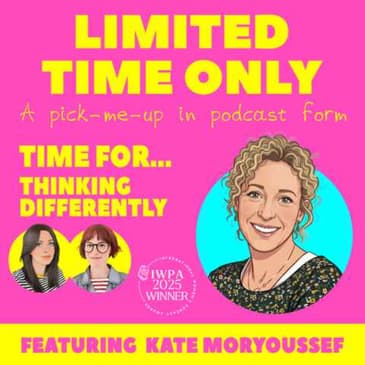


Before we tell you about this week's show, we'd love you to check your diary... Are you free on Thursday 16th July for LTO Live in London?! For an evening of chat, comedy sketches, LTO themed cocktails, and a conversation with writer, actor and member of the Red School, Stephanie Farrell Moore? You are?! Fabulous! Tickets available here:
https://www.tickettailor.com/events/limitedtimeonly/2192881
Now for this week's extravaganza! These shownotes are being written at 12.05am on the day this ep gets released. It's not like they could have been written two weeks ago or anything. Well, actually, they couldn't. There's no dopamine involved in being that organised. As this episode is all about ADHD and how it shows up, this whole scenario is brilliantly apt. So we're taking the sleep-deprivation involved in this high-level procrastination as a win.
Our guest this week is the brilliant, Kate Moryoussef, host of the award-winning ADHD Women’s Wellbeing Podcast.
Kate is an ADHD lifestyle and wellbeing coach and EFT practitioner who helps overwhelmed but unfulfilled women reconnect with their clarity, creativity, calm, and potential. She was herself diagnosed with ADHD later in life, and that experience now shapes the heart of her work. On her podcast, she speaks with global experts, thought leaders, and authors, sharing practical tools and honest conversations to support health, wellbeing, and balance for ADHD women. She’s also the author of The ADHD Women’s Wellbeing Toolkit.
We talk to Kate about the stigma around getting diagnosed later in life, and how that ripples into family life and work. We dive into how she protects her own time and boundaries, coping with neurodivergence day to day, and the role of self-compassion in avoiding burnout. We also explore why self-care and finding balance matter so much, not just for her clients, but for her too.
We hope you enjoy listening to our conversation with Kate as much as we enjoyed chatting to her!
And we hope to see you at the show on 16th July!
Limited Time Only – a pick-me-up in podcast form.
If you enjoy the show, please follow or subscribe wherever you get your podcasts, leave us a quick review, and share this episode with someone who could use a pick-me-up.
Instagram @limitedtimeonlypodcast
Facebook Limited Time Only Podcast
Email: limitedtimepodcast@gmail.com
LTO is created & written by, produced, edited & hosted by:
SUSIE RIDDELL & ESTHER STANFORD
It is a Limited Time Only Production
LOGO designed by: IAN STANFORD
THEME TUNE composed by SMALL PLATES
ADDITIONAL SOUND:
See Limited Time Only LIVE in London at Cheerful Earful Podcast Festival with special guest Angela Barnes! Buy tickets: https://www.tickettailor.com/events/cheerfulearful/2348566
Hosted on Acast. See acast.com/privacy for more information.
[00:00:00] Hello! If you enjoy Limited Time Only in your ears, you can now have the full-body experience at our live show on Thursday the 16th July at the gorgeous Hearth Centre in London. Tickets are available now at the Hearth Centre's website, thehearth.me, and from the link in our Instagram bio. We'll see you there! Welcome to Limited Time Only. I'm Esther. And I'm Susie. Limited Time Only is the podcast for anyone who feels there aren't enough hours in their life.
[00:00:29] And each week, there's a different topic for you to get your ears around. Featuring chat, comedy sketches and interviews with interesting people. Limited Time Only is a pick-me-up in podcast form. The special guest later in the episode is... Kate Morjussef. This week, it's time for... Thinking Differently.
[00:00:52] I need somebody to timetable my life for me, because obviously I'm incapable of doing that. Otherwise, I would be managing my life alright. But I can't decide how much time I need for something. That is a block. And I can't... I can't decide to do something that needs to be done for two weeks' time now. I don't have that ability. I go, well, I'll do it in two... I'll do it in 13 days' time.
[00:01:20] So it's ready for the 14th day. Yeah. Not remembering other things to do. I'm better in some circumstances now, in that I will go... I'll look and go, I know what I've got going on that month. I can't possibly commit to anything else. And so I go... So I'm quite good at saying no stuff. But I struggle with things like... For example, this morning, I've literally timetabled my day. Okay, I'll ask these questions, do this.
[00:01:44] But then I go, I will just look at this or scroll this or watch this. Or I know, I'll put a YouTube video on whilst I'm tidying up the kitchen. And then I stand just watching YouTube video. That's where I fall down. It's like, I have a thought and I have to look it up. Yes, you're adding... And then you add and add and add and add and add. Yeah. And then you don't get to the thing. And when I've got those spoons left. I mean, I actually had a little meltdown yesterday when I was trying to fill a form in. And I got halfway through.
[00:02:13] I thought I'd got quite near the end, then I realised I was only halfway through. And the hardest bit was still to come. And I just sort of burst into tears. I was like, this is terrible. But you are, I'm always surprised with that, with you with forms, because you're so academic. You're such a good and... But you've got to... But it's a... Well, it would depend what the form was. Yes. I do not like figures. Yes. And I don't want to deal with them on a daily basis.
[00:02:43] If it... Yeah. The thing is, it takes me a long time to do something because I want it to be right and good. So filling out any form... Well, not, you know, not sitting at the dentist, your previous medical history, whatever that... That's fine. I like a tick form. Bing, bing, bing. But something that requires a little bit more thought and research is hard. Yeah. And if it's something where you have to write an answer, like for the...
[00:03:12] You know, entering an awards or something, you want it to be really good and you've got to shape it, haven't you? Like a... Yeah, I want an A star for this. Yes. Yeah. That apostrophe is in the... You know. No, I think I could say that in slightly fewer words or if it's got to be 200 words long, for example. That's... I enjoy that challenge, whittling down something. Yes. But it just takes forever.
[00:03:42] And it's interesting, isn't it? Because I am very similar and I want... If I put any form of work out, I want to be really pleased with that. I want to... I want to feel that it's the best work that I can put out. So I kind of stress myself out. But also, if we want that, why the fuck do we leave it till the last minute? Why do we go... I'll do it. Like, I'll do it then. But sometimes life's just busy, so you do. Mm-hmm. But then other times... But what happens to me, and I was talking to my old hairdresser.
[00:04:12] He's not old. He just moved to different hairdressers. He's actually a young man. A young man! But we talked about that once and he said he has to have a deadline and be close to it to get any form of clarity. And that's exactly what I am like. Yes. I will procrastinate and procrastinate and procrastinate. What is required of me? What do people want from me? What am I trying to achieve? Yes. And then you go, you've got half an hour, and I will bang it out and it will be bloody magnificent.
[00:04:39] Because suddenly all the extra noise dissipates. Mm. But is it also that you've been thinking, because it's been percolating, you can then zone in on the absolute kernel of gold? I mean, this is what we should be telling ourselves. Rather than beating ourselves up, we are... Because I think I need to think about... If I'm writing something creative, it needs to sort of be in there. Mind you, I'm saying that. But I've literally written a sketch for today,
[00:05:06] which I had the idea for 40 minutes ago. Yeah. But I had other ideas. Yes. I often have a series of other ideas that sort of get started and then I go, nah. And then suddenly it hones in and goes, ah, that's the one. And I think it's because of the constricts of time, constraints of time. Constricts? Constricts? Constricts. Constricts.
[00:05:36] I don't know if I can... Constricts. Constricts of time. I think that almost shuts all the other voices in my head down. I think I've got a million tabs open and probably a lot of people living inside me. Oh, God, I think you need to go to the doctors for that. Forget it. And that is such a...
[00:06:02] And then suddenly what happens is you go, you've got 10 minutes, half an hour, three hours to do this massive thing and something happens. Well, it's... All of that shuts down and the... Hyperfocus. Hyperfocus kicks in and the very perceptive... Basically, I turn into Bradley Cooper in Limitless, if you've ever seen that film. It's a magnificent film. I think I've mentioned it on here once before. He takes a tablet and then he can do everything. I love that. Where's that tablet from? Home Bargains.
[00:06:33] Oh, my gosh, I love Home Bargains. It is good, isn't it? It's really good. Home Bargains is brilliant. I used to go in there every Christmas week because all of the kids in my family, mainly my cousins' kids and my kids, and actually a couple of other kids as well. No, lots of kids. So many children. Many, many kids. All about the same age who are now in their late teens.
[00:06:57] But I used to go in and buy just like 10 Monster High dolls, done, Christmas, sorted. You know, it was just so good. Yes. And then the thrill of a bargain. I mean, there is some tat in there, but there is some brilliant stuff as well. Well, my favourite thing about Home Bargains, and I'm talking about the one where my mum lives in Birmingham, has a life-size sticker of a police officer on the window. Oh, yes.
[00:07:25] I have seen it so many times. And I never fail to think it's a real police officer for at least two seconds. Yeah. It doesn't matter. I've seen that thousands of times. That man is real to me. I think there's just something wrong with our nervous system. And I think that's what the problem is. We're just permanently on high alert, too many voices in our heads. And then suddenly somebody goes, you've got five seconds to do this.
[00:07:54] And you suddenly whip up a cake and it's magnificent. Well, I won't go that far. I'd whip up a cake and it'd be mediocre. But that is why I'd be good at, we're good in a crisis. Yeah. Do you know what? I'm fucking brilliant in a crisis. Yeah. Yeah. I'm really, I just, again, it's almost like you just get this. It's like, it's a laser. Laser.
[00:08:18] Because our ability to see into the future is quite strong, I think. And you can see exactly. What's that called? Pattern recognition. Pattern recognition. Yes. Pattern recognition is high. So you can preempt things and you can see and you understand and you go, right, okay, this. This is what needs to be done now. So that can happen, that can happen, that can happen. Yes. And I'm, and I have had a few, been in a few crisis, crises in my life.
[00:08:48] Susie, I came off my Easter a couple of weeks ago. I don't know if I can string a sentence together. It's all right. We've covered, we've covered time management, home bargains, crisis management. Yes. We are good in a crisis. Don't give us too long to think about something because we'll funny around and go all over the place. I mean, it makes me wonder whether we should have been paramedics or something. No, absolutely not. No. No. Well, yes. I, I, I, I drove past the dead fox on the road of the day and I cried so much about this dead fox.
[00:09:17] My, my, I've always been a sensitive creature, but my God, someone's peeled another layer of skin off me recently. My nerve endings are like at the surface. I get, because I kept thinking it could have been Pablo because it was this little orange fox. And we'd watched some TikToks about foxes and I was, and they were so cute and they were coming into people's houses. And then there was this little squash fox. And I just, I just, I just, I just went to down what its backstory was. And I just felt immense pain when I saw it.
[00:09:47] And I thought, well, yes, because you see a fox, I see a fox and I think, um, I'm, I'm, I'm, I'm like Disney Robin Hood. I mean, that's, I'm like that guy or gal has been doing some amazing, you know, amazing work for the poor in the back, in the back streets wherever it lives. And now look at what's happened. And I go Bramley Hedge. You go, oh my gosh, Bramley Hedge. Bramley Hedge.
[00:10:14] Bramley Hedge are the most beautiful drawings of any children's book. I think. Yes. They are so exquisite and teeny tiny and detailed. Yeah. I still love those. They are, they are really very nostalgic. They are so beautiful. I had a little set of four. Yes. The autumn, the four seasons in the box, but my daughter, for some reason must've got rid of them at some point, but my daughter has them all in one big book.
[00:10:42] And I remember as a child trailing my finger, like when they lived in the tree house. The trees. And I'd go and you could see all the rooms. All the rooms. And I went ages going, oh, they're upstairs now. And then they come down to, and then they go down to the kitchen. And I would, it captivated me. I would look at it for hours. Tiny little saucepans. Yeah. And my daughter, my daughter's actually still really into Bramley Hedge. And she will send me videos saying, this is the life I want. Like all tucked up like Bramley Hedge.
[00:11:12] It's just. I might have to break it to her. Yes. Yeah. But maybe, maybe we should be building houses that look like enormous trees. Maybe. Maybe. I am. Yes. I saw a t-shirt actually that your daughter would like. Um, it was sort of like, I, it was a little deer and a rainbow. And it was like, I live on whimsy and something else dreams or something. And I was like, yes, whimsy.
[00:11:38] And, and it did make me think about whimsy and, um, kind of more of a fantasy world that it is much more acceptable because obviously we all have fantasies and I'm not talking about those rude ones that you think about at night. I'm thinking about, um, you know, being a borrower or living in a, in a tree like Bramley Hedge, or there's fairies at the bottom of the garden. And it doesn't matter how old you are.
[00:12:08] You could still, you still have those. They're in the back of your mind. And we, of course, remember them from childhood, but it is far more acceptable. And you look at that. You, you go out into the streets and you see, um, particularly girls dressed in very anime style, the Japanese, Japanese anime style. That is a form of whimsy and, and sort of fantasy world. Um, but it's, it's okay to do that. I mean, I think it'd be all right to dress up as the Sylvainian families.
[00:12:35] And when I was talking, we were talking about this the other day, the, the, the pop singer, who's called horse girl. Oh yes. Who's got a horse for a head. Uh, what? A head, a horse's head for a head. Um, but not really, obviously, but she, that's how she, that's how she lived. Yes. And that's okay. I mean, I don't like it, but it's a bit weird that one. I'm with you. I'm with you. I mean, I, we could pretend at home that, I mean, I could turn my house into a Sylvainian cottage.
[00:13:04] You could put, you could have a little, uh, little nose, paint your nose, have little whiskers and you could live there. You could be there and pretend you were living in a little tree. I could hop to the door when my children come home with an apron on. Squeak. Would you like some apple pie? Do you know what? There will be some people living like that. Well, there was a guy, this is the most random conversation. So we've got all of it. This is what happens. But there's a guy I remember reading that he lived like it was 1994 all the time. I was going to mention that.
[00:13:34] It's so weird. And I, cause that, that's, I was thinking about that when I was having this thought yesterday. And it's weird that we're talking about it actually, because I did think it was an interesting phenomenon that's happened that people do. Yeah. He lives as entirely as if, as if it's 90 and what 90? 94 or something. A particular year. So he doesn't listen to anything modern. Yeah. He has cassettes. I mean, does he have recordings of radio shows and stuff like that? Um, I don't know, but I know he had Vicar of Dibby on.
[00:14:03] So I think Vicar of Dibby did start in 94. So maybe, maybe it was slightly later. Maybe it's more like 96 or something, but I know it's the mid nineties and he, he has reruns of Vicar of Dibby and a, and a proper old handset, uh, telephone and a, and a, I was going to say a beta blocker. I need a beta blocker. VHS. Um, and all of those kinds of things. Yeah. And then there's a guy I remember reading that, um, every day was Christmas. So he pretended every day was Christmas day.
[00:14:33] Oh God, that's exhausting. It is exhausting. Does he have arguments with his family and get really drunk and. I think he lives alone. Yes. I think he lives alone. The way you said it. God, I wish it could be Christmas every day. No, I don't. I love, I love Christmas. I do love Christmas. But it can't be, it has to be special. It can't be. It can't be. It can't be every day. No, it can't. It's ridiculous. It's ridiculous. You die really young. And also the money, the cost.
[00:15:02] The cost of buying presents for yourself year on year. Does he open the same gift every day? You can't buy the presents on Christmas day because the shops are closed. So when do you buy the presents? Well, he could actually, couldn't he? Well, he could, but. He's sort of got the advantage there. I mean, I'm, I'm, I need to look this guy up. That's, that's, that's fascinatingly weird. I mean, it's, it's, it's weirder than someone living as if they were in Bramley edge. Yes. Yeah. Which I, I don't know what that's saying about me, but. Yeah.
[00:15:31] I'd rather live as a mouse. Yes. I would rather live as a mouse. I love Christmas. I am a big Christmas fan, but my God, it just seems to come around very quickly. And we're in June now, which is halfway through the year, which means it's a blink and we're back there again. And I don't know. I just feel like I'd like it maybe to be every two years now. That's a good idea. Yeah. Every two years. Yeah. Should we, should we, should we, should we get that going?
[00:15:56] I'm not, I think a capitalist, you know, capitalism would not agree. No. Capitalists would, no, it's not, that wouldn't go down well. It would be thrown out. Well, I do remember seeing a couple of years ago, one of my favorites, Miriam Margulies did a documentary about Christmas and she doesn't like Christmas and she doesn't, she thinks it's bullshit. But actually she was quite sort of swayed towards it by the end.
[00:16:23] But she said, but for the basic stuff, like the coming together, the traditions, not having to spend lots of money, not having to spend a month in the run up and spend thousands of pounds on entertaining and everything. And, and I sort of feel like that's about a lot of things now, like including weddings and as soon as you say you're getting married and it's a wedding bouquet, it goes to the roof. But it's the most, yes, it's capitalism because we've been, we've been sold Christmas. And that's the, yeah, anyway, we shouldn't really talk about Christmas is June.
[00:16:53] But as we were talking about it, I was rustling because I'm wearing what I like to call my kitchen roll. Oh yes. It looks like kitchen roll. I remember the texture of it. Yes. If there was a spillage, I could just fling myself on top of it, soak it up and get on with my day. Yeah. And just, and then you could say you've tie dyed it. Yes.
[00:17:23] Depending on what the spillage was. Yes. I'm thinking of terrible spillages now. I feel a shirt that's similar, although I've just given it to my daughter and it's green and I call it my Alf Stewart shirt. Oh, Alf from home and away. Yeah. I always feel like Alf Stewart. I think it's still in it. Is it? I'm going to Google that. Yeah. I'm back to the beginning of the conversation. I've got things to do, but I'm just going to go and Google whether Alf Stewart is still
[00:17:52] in the home and away. I'm going to go and Google it over and away. You've got Alf Stewart. I'm Googling the guy who lives like it's Christmas every day. And probably some words that we forgot. Yeah. So that's the day full. Day full. Great. Yeah. Have fun guys. Oh, hello. I'm just up the loft with my magazine and a drink. The kids are downstairs playing hide and seek and I've managed to pull the loft hatch up. So hopefully it should take them a few hours to find me.
[00:18:22] Cheers. In 1978, two babies were born to neurotypical families. These women promptly decided to spend their lives as performers living mainly in dark rooms in the theater world. Today, still oversharing and having 500 ideas every minute. They survive as creatives of fortune. If you have a problem, if no one else can help you, and if you can find them, maybe you can hire the ADHD team.
[00:18:54] Good morning. Is it? I'm completely exhausted after last night's assignment. Life threatening mission? Cheese and wine evening to raise money for my kids' school. Ah, my condolences. Thanks. Multiple conversations with people I don't know very well. My life force is almost spent. Well, you'll have to perk up. Our mission today is simple but also one of the hardest we've ever had to face. Oh God, not doing our tax returns again. Emptying the dishwasher and reloading it. No.
[00:19:24] No, I can't. I haven't got the energy for something that mundane. I'm gonna build up to it with a trip to the garden center. Two hours of doom scrolling, a thought through the photo albums I've not looked at since 2010, and a nap. Oh, fine. Sign me up. Although, I've just remembered. I've agreed to help my neighbor in her garden this morning, run the cake sale at school this afternoon, and I need to write a 5,000 word essay on time management for the online course I forgot I'd signed up for. And it's your mom's birthday. Have you posted the card that's been set on the hall table for the last week? No.
[00:19:54] I thought I'd do it today. Makes sense. Now, where are my car keys? Check the fridge. Oh yes. I left them in there when I got the milk out. Makes sense. Oh God! I've just remembered something that happened last night. What? When I was leaving, I said goodbye to the head teacher. But she didn't hear me. So I said it again. Louder. And she still didn't hear me. So I left. And? She obviously thinks I'm an idiot. Or, she didn't hear you, and then you left. Yes.
[00:20:24] Maybe. Oh, I'm an idiot. I must go. I've got two minutes to do a five minute journey. Then you're bang on time. And you need to stare into space for a bit while feeling the crushing sense of inadequacy that comes from not starting what you're meant to be doing. Exactly. I love it when a plan comes together. Oh, I'm an idiot. I love your podcast, by the way. I do. I've been listening to it for ages.
[00:20:54] And so it is a bit weird. I'm making this film up. I know. But it is a weird thing. It's me hearing someone's voice. It's just, yeah, often when I'm jogging, actually. I listen to it when I'm jogging a lot. Oh, that's good. It's nice to know that is motivating enough for you to listen to it while you're jogging. Yeah, it's brilliant. Today's guest is Kate Moyes-Eff, host of the award winning ADHD Women's Wellbeing Podcast.
[00:21:23] Kate is an ADHD lifestyle and wellbeing coach and EFT practitioner who helps overwhelmed and unfulfilled women reconnect with their clarity, creativity, calm and potential. She was diagnosed with ADHD later in life, and that experience now shapes the heart of her work.
[00:21:42] On her podcast, she speaks with global experts, thought leaders and authors sharing practical tools and honest conversations to support health, wellbeing and balance for ADHD women. She is also the author of the ADHD Women's Wellbeing Toolkit. We talk to Kate about the stigma of being diagnosed later in life and how that ripples into family life and work.
[00:22:04] We dive into how she protects her own time and boundaries, coping with neurodivergence day to day, and the role of self-compassion in avoiding burnout. We also explore why self-care and finding balance matters so much, not just for her clients, but for her too. Welcome to the show, Kate Moyes-Eff. You were diagnosed at 40? Yes. What did your life look like growing up and what led to that diagnosis?
[00:22:32] Yeah, so my life looked like undiagnosed ADHD, but I didn't know what that was. So I would just constantly question myself all the time. Why do I do this? Why do I hyper-focus and then become disinterested? Why am I flaky? Why am I disorganized? Why can't I finish anything? Why is that such a struggle for me, but something else I can do with my eyes closed?
[00:23:00] Like I just, my husband was just, he had no answers for me either, but I just wanted him to be like, oh, it's because you're this or because it's that. And I literally couldn't answer it. And the weird thing is, is that I've got two brothers with ADHD and they were diagnosed when they were kids. And so for me, it was just never, I never really thought I had ADHD because it didn't look like my brothers. And I wasn't outwardly hyperactive, even though it is quite obvious that I can't really sit still.
[00:23:29] I don't like sitting in one place. I'm quite restless. I'm much better moving around all of that. But I just wasn't bouncing off the walls. So ADHD just wasn't considered before I'd even looked at it. And the reason why I was looking at it, it was because one of my daughters and it was in the middle of the pandemic and I was homeschooling as she was nine years old. And she'd already been struggling at school anyway, but very similar to me.
[00:23:57] She was, you know, really well behaved and respectful to teachers, no issues with behavior or friendships at that time. And she just couldn't sit on a chair. She couldn't process the information. She got very overwhelmed very quickly. We were looking at things like dyslexia and dyscalculia already and dyspraxia. So there was already this mix of things that we were looking at, but we were not getting any answers.
[00:24:26] And it was when I was homeschooling and myself and both of us trying to sit on a chair, me trying not to lose my rag with her, me trying to be as tolerant and patient as possible. Not easy. And her just wanting to not be anywhere in front of, you know, a comprehension or a computer and not even be wanting to sit on a chair. And I was like, what is going on here? So I just Googled. I mean, this is way before AI, but I was like putting all the symptoms and all the things in.
[00:24:52] And it just kind of came back of like symptoms of girls, you know, with ADHD. And it was, you know, pretty much, you know, tick, tick, tick. Again, you know, she's every profile is quite different, but her ADHD looked very similar to how I then remembered myself with ADHD. And he was quite happy sort of just pootling around and daydreaming and being outside and not liking pressure and just wanting to sort of do their own thing.
[00:25:21] And it just made so much sense there and then it was like, OK, right. We need to go for an assessment for my daughter and I need to go for an assessment as well. And then that was back in 2020. And we both had our assessments and diagnoses within two or three weeks of each other. And, you know, and that was the very beginning. And that was the end of 2020 around November. And from 2021 onwards, I started this podcast.
[00:25:47] And that was purely because I needed someone to answer questions that no one could answer before. And that was when there was so many dots being connected, like it was constellation. It was like we're looking up in the sky and like suddenly being able to know I understand about my grandpa and understand about my mom and I understand about that person. And it was just a constant understanding and reflection and then being able to put things right.
[00:26:14] OK, we've got we've got some answers now. Let's start changing things and putting things into perspective and looking at tools and ways and strategies and self-compassion and all the things that no one was we wouldn't none of us were operating from. So, yeah, that's kind of where it all began. Because women because girls weren't ever thought to have ADHD, weren't they?
[00:26:38] Yeah, because like you say, they present so differently and and I constantly hear, oh, it's an epidemic and everybody's been diagnosed. Everybody's got flipping ADHD now. And Susie and I have had many discussions about this because I have a lot of neurodiversity in my family. And I've asked my daughter if she's OK with this, but my daughter has autism and dyslexia. But I struggle to say that because you wouldn't know she has autism if you met her.
[00:27:05] She is very social, but she has a very low battery. But it's like the volume in her body's being turned up. So she's very sensitive to noise and she can hear the ticking of the clock in the corner of the room. And and and it's weird, isn't it? How those sort of labels like I don't like saying she has autism because people, particularly of a certain generation, have a have an idea of what that looks like.
[00:27:30] And I don't want her to be held back by what that opinion might be. And it doesn't sum her up. But she does have it. And it is important to know and to recognize and then to put those boundaries in place. And when you were diagnosed with ADHD, did what did you feel? Interestingly, it was shame. It was stigma. There was taboo. I didn't want to talk about it again.
[00:27:58] This is, you know, six years ago, nearly no one was talking about ADHD in women and girls. I felt like it was like this this thing to be ashamed of. And people would exactly the same way as you look at it through this lens of, oh, she's chaotic. She's a shit show. She can't get her act together. You know, she's obviously very disorganized and messy.
[00:28:20] And it was just like every negative narrative that I would think about ADHD and that has been put out there in the media and has been sort of perpetuated in conversations about like bad parenting and all these different things. And I was thinking, I don't want to admit to this because this is showing everybody that I'm not coping with life. So it took me a really long time. And that wasn't, you know, part of me was like, I'm going to come out. I'm going to talk about it. I'm going to launch this podcast and I'm going to.
[00:28:49] And then this huge vulnerability came out. And I was thinking, oh, my God, I just want to hide away and not talk about this. So I was kind of navigating two things and wanting to start the podcast and find out all the answers and have these conversations and get curious with incredible experts for not only myself, but for so many other women navigating what I knew. Because I've been reading all the Facebook posts and all just different communities and things like that. It was just so many women out there who were just lost and struggling as well.
[00:29:19] Also navigating your shame, also navigating. Well, what does this mean? You know, as I say, am I doomed for the rest of my life? And I understand what you're saying about your daughter because you don't want her to sort of be. And I'm saying this in verse of comments like labeled. Yeah. But sadly, you know, autism has been just been put in one box of again, generalization like Rain Man or this or that you have you're autistic. Then you have to tick these boxes and you have to show up like this.
[00:29:49] And we understand this. It's a spectrum. And I wonder about language and I wonder how different it would be if there was different ways of discussing this about sensitivities or processing or just all different ways. But just to say my daughter's autistic straight away, I understand people who think, oh, she's not sociable and she's not able to, you know, hold on a conversation and she's not able to do X, Y and Z.
[00:30:18] And that's just wrong. But we've got to find a way for people to understand themselves without the shame, without thinking that they're having to be having put labels on them, but also so they can feel relaxed, authentic, calm with who they are, how they show up in the world, what choices they make. And I've got a daughter very similar to you. And she's not been diagnosed with autism. She's been diagnosed with ADHD.
[00:30:47] But a lot of the traits are what we would say are autistic in girls, but she is like the life and soul of the party. She's hilarious. She's got amazing friends, but her social battery, like when she needs to just go to bed, she needs to go to bed. Noise, people, smells. But why should there be so much shame and stigma around that? Yeah, I agree.
[00:31:10] I read, I don't know if you've read it, but I read Miranda Hart's book about her having Lyme disease, but also recognizing that she is a highly sensitive person. She has a limited social battery. So yes, she can be fun. And yes, she pushes through things. And, and that really resonated with me, the highly sensitive person thing, because, well, I mean, it's been muted to both me and Sue that were ADHD. And actually last year I used chat GPT for something.
[00:31:39] And then we, and then I had quite a long conversation, chat GPT about something. And then I asked it something at the end and we were on holiday. And I said, do you think I might be neurodiverse? And chat GPT said to me, with the greatest of respect and sensitivity, I suspect you're all ADHD. I think you probably have traits of both. Wow. And I burst into tears because it was this feeling of, oh God, my life kind of makes sense. How I operate kind of makes sense.
[00:32:08] There's often like, I don't know if this is quite the right word, but comorbidities with, I have Hashimoto's hypothyroidism. That often goes hand in hand with it because it's the sensitivity to the world. So it's like a, it's like a great skill because you pick up on everything in the room. And I'm, I'm noticing everybody's micro expressions, but, and I can process really quickly. But then if you ask me to do something, I can, it's almost too much.
[00:32:32] And, and I think like you say, the, I think like you say, like the label of, of, of being your autistic or your ADHD, it's sort of, it, it, it presents something outwardly initially. And then people build up this sort of image. And so with the Miranda Hart book, I really liked the idea of sort of identifying as a highly sensitive person felt gentle, but you're right.
[00:32:57] I don't know if you watched the Chris Packham documentary about autism. It's autism. And he said, you know, if you've met one autistic person, you've met one autistic person because there's so much range in that. And I think, so the work you're doing is so brilliant in that you're, you're pushing that conversation out there. Because when I think that I might be neurodiverse, I feel quite emotional about it. I feel a lot of grief.
[00:33:24] And the word I actually wrote down was shame, which is what you, and I wouldn't judge anybody else for it. But this internal thing, like family members, oh, bloody ADHD. It's that, those voices, aren't they? So you think, I don't want to speak up about this. I don't want to tell anybody. And I wonder if COVID, the whole COVID thing, exacerbated things for, for people as well.
[00:33:48] But, but I, yes, there's the idea of the shame, but also that ability to then actually, it's kind of, if you do get a diagnosis, you can step into your life more fully in a way because you understand yourself. Yeah. Yeah. And I think we do, like both of you are sort of alluding to the fact that there's, there's fear of judgment and what people say. And again, it's sort of like, comes back to, well, you can't have ADHD.
[00:34:15] And, you know, with respect to our parents' generation, they may not go into the amount of detail that we've gone into of research and understanding. And, you know, many of us are on social media, are listening to podcasts, we're able to understand the nuances. And they sort of skim it. I'm not saying anyone's a Daily Mail reader, but, you know, very often there will be sort of more negative connotations in that, in the Daily Mail of that ilk, where it is like, it's over diagnosis. It's a pandemic.
[00:34:42] They want to put everyone on like stimulants and they're not understanding the women's identity and experience, lifelong experience of the internalization of not, of feeling like we have to behave or mask in a certain way or show up in a certain way or have relationships, friendships, communicate. We've never been given an alternative before.
[00:35:08] And I think, you know, Susie, what you said about COVID, that was the only time we've ever had a pause button in life. And that pause button allowed a lot of people to reflect, to be at home, to breathe. And it was like an emergence as well of the conversation around neurodivergence. So it was kind of like this collision of internal and external kind of like, you know, whatever you want to call it, introspection or whatever that might be. Yeah, yeah.
[00:35:37] So we were able to give, given that opportunity to say, well, what if, you know, this, this is who I am. And we are able to know what we're sensitive to and what we like and what we don't like, what we've masked, what we've internalized. Like no one can take that away from us. And I've only just begun to be more honest about it, you know, talking about things. Even the other day we were talking about, you know, spray deodorant and roll-on deodorant and smells.
[00:36:03] And normally with family members who'd be very dismissive about anything like that. Like, oh, just get on with it. Stop being so precious. Stop being so sensitive. And there was a conversation around me. Oh, I can't bear perfume. And I can't bear this. And I can't bear being in a room where there's no windows open. And, you know, I try and drop these little nuggets off. You know, that's, you know, sensory processing.
[00:36:23] That's understanding what, you know, what inflames your nervous system and makes you go into that sort of like very hypervigilant stress, you know, you know, sympathetic state in your body. Which causes all this inflammatory stuff, which is why we understand things like autoimmune conditions, gut issues, thyroid issues, mental, more mental health issues. It's all an inflammatory response to not being safe in our bodies and the external world.
[00:36:51] So that is why it's so important to discuss all the different connections. Because when you understand yourself and when you know what those triggers are, you are then able to prepare yourself. And you can't put yourself in this cotton wool and you can't put yourself in a place where it's like, I'm not going to, you know, put myself in any situation. Like we have to, we do have to live in this world if you want to, you know, show up and work and parents and all of that. But we're allowed to make different choices or protect ourselves.
[00:37:19] So our nervous systems can feel safe and we can control that safety now when we know what's going to trigger it. Because it's extra hard for parents, isn't it? Because you're having, you want to protect yourself. But you're, but I mean, I know it should be that you put yourself first, but we all put our children first, you know, without thinking.
[00:37:45] So you're kind of, you're protecting, you're, you're in this protection mode, possibly way more than somebody who is neurotypical. And that's exhausting. Yes. And, and that the exhaustion thing, I find I've, this is where I sort of at the moment, I'm really trying to zone in on, on that personally. Because I know that I've always been, I've always needed a nap since I was, well, I remember being university and needing naps.
[00:38:14] And probably not thinking it was that weird. But as I've gone through life, I've thought, well, I've always, always been the sort of person who needs, I need to have a power nap. And it's only now that I go, well, that's probably why. And this idea that you're either, your window's either open or shut. And it's, and it's, it's either one or the other. And I, I have, my naps are getting longer and longer. Amazing.
[00:38:42] But I now don't berate myself for needing to go to sleep in the middle of the day. Because I know there is no point in just keep going and pushing through. Because nothing's gonna, nothing's gonna get done. I think that's the thing, isn't it? With, once you start to understand these things about yourself, you give yourself permission to then have these experiences. When you're talking about COVID, I remember the first day everybody left the house for the first time.
[00:39:11] And I was on my own for the first time in two years. I sat on the kitchen floor in my pajamas. I had all these things I was going to achieve that day. And I stayed in my pajamas and I sat on the kitchen floor in front of the island on, on the floor. And I cried for three hours. And somebody said to me, I told somebody about it. They were like, what the hell's wrong with you? And it took me a while to understand. It was about, I just didn't have any stimulation for the first time in two years. There was no one else in the house. And it was a release. I felt joy.
[00:39:40] I just, just was sobbing. And it, and it was just felt like it needs to come out of me. And I wasn't sad. I wasn't, it just was just stuff that needs to come out. But now I kind of understand that. And sometimes I'll say, I have to get out of the house. I need to, because my husband works. I just, I, you don't understand. I need, we even turned the fourth, a fourth bedroom into two rooms so that I could have my own space. But sometimes my husband working next door, the noise aggravates me. But now I get that that's probably just the way I'm made. And that's, that's okay.
[00:40:09] So there's sort of, I think sometimes maybe the grief that this is around is, it's okay as well. It's sort of like a, it's almost like permission. And that's part of the tears as well. A hundred percent. Yeah. So many women feel like that. It's this permission slip to finally be who we are. It's not like we're creating someone new. It's not like this persona that suddenly just comes out. It's always who we've been.
[00:40:36] But we've been stifling it, repressing it, pushing it down, not allowing it. Which is why, again, we see so many women, especially with things like chronic fatigue, chronic pain, get back to all the inflammatory autoimmune conditions. I'm not saying everything is caused, but you know, there's a much higher proportion of women suffering with physical and hormonal health conditions when you're neurodivergent. Because if you think about just constantly being repressed and pushing down and not being able
[00:41:05] to be who you are, and you know, it's so great to hear that you have always lent into those naps, you know, those knowing that you need them. But a lot of women have not maybe had that self-awareness or that self-understanding, or maybe I've had like belief systems or conditionings from family members going, that's lazy. Lazy people nap during the day, you know, come on, keep going, keep pushing. And so if you've had that sort of like dialogue in your head to push through and not nap,
[00:41:33] then yes, there's going to be something going on physically for you. And that is what we see. It's this permission slip for women to kind of just go, okay, so I can breathe. It's okay to say no to that arrangement. It's okay to maybe offer another alternative than sitting in a noisy, smelly restaurant. It's okay for me to ask to work from home for a couple of days a week. And that is what women have never had before. They've never had the pain.
[00:42:04] What is it about the being a bit older and, you know, hitting perimenopause, menopause? What's the link? The hormone link for me has been sort of like the foundation of my work. And, you know, within a few weeks of the podcast starting in, you know, in 2021, I was asking the questions.
[00:42:25] And I found one woman, one amazing doctor, Dr. Wasserstein, who was based in New York, who was at the time probably in her late 60s. And she was pretty much the only expert who was making that connection between neurodivergence, ADHD and hormones and the fluctuating hormones, especially around perimenopause.
[00:42:45] And what we know and what we're learning so much more, thank goodness, over the past few years is that, you know, cyclically, we have fluctuations. So we but they're more extreme for neurodivergent women, which is why much hypersensitized struggle with PMDD and postnatal depression. We still don't understand. There's still not enough research as to why these fluctuations are more extreme.
[00:43:13] But then if we are working in a and I don't want to call it a deficit, but a dopamine dysregulation already. And the estrogen is, you know, is sort of like the feedback to the dopamine and the serotonin.
[00:43:29] And we're working on women who are experiencing fluctuating mood, energy, motivation, connection, all of those things and not understanding why they can't trust themselves. So then we've got that cyclically that comes from puberty. And most neurodivergent women will have had an understanding of how maybe their hormones have affected them throughout their life. Perimenopause kicks in. Traits come sooner.
[00:43:58] Traits come harder than neurotypical women. So you could be already experiencing those perimenopausal symptoms from your late 30s, 38, 39, very slowly to a point where you keep gaslighting yourself and thinking there's no way in perimenopause. I'm too young. I'm too young. And then they sort of just ramp up and ramp up. And most of the time we push through, push through until we can't push through anymore.
[00:44:23] And that's when you see most women in their mid 40s uncovering this perimenopausal, ADHD, autistic kind of Pandora's box of all the things that they kind of have been experiencing. But it's like a low level hum. And this is just like full blown kind of like orchestra that's just like hitting you from all, you know, all places. And I thought I was in perimenopause a few years ago. I know I started like probably 39, 40.
[00:44:52] I feel horrendous now with my perimenopause. And I was quite smug about my HRT and managing it and everything. And now I've hit another roller coaster where my sleep is nowhere as good as it used to be. Mood. I never know when my period's coming. And it's really, really hard. And so we have to understand that our hormones are those like scaffolding and the things that hold things together.
[00:45:21] And then when we can't quite rely on the hormones being there when we kind of think they're going to be there or the holding us just, you know, just tight enough to kind of mask the ADHD. When they're not there and they're kind of all over the place, our ADHD just kind of comes out in full pelt and just like hits over the head here, there and everywhere.
[00:45:45] Whether it's, you know, to do with our, you know, our cognition, relationships, career, physical health and libido. Like it's all there. It's amplified with neurodivergence. So, yeah, it's one of the reasons why so many women in midlife kind of go. I kind of suspected there was something going on all my life. But my God, perimenopause is like ripped it all open for me. Yeah. And it really is like a roller coaster, isn't it?
[00:46:14] It's like a horrendous one. Absolutely. And it's weird. And actually, the knowledge is the power, isn't it? Because you saying all that, I go, oh, yeah. Like last week, Susie and I went down to London. We were very lovely. We were up for an award for this podcast. And I was saying to Susie, I don't feel like I've got any words in my head. I don't feel like I can string a sentence together. I don't feel like, I feel incredibly boring and dull. I don't feel like I've got any. She's like, it's not that plot what's coming across.
[00:46:45] But my God, I had to work hard. Yes, exactly. Yeah, I had to work so much harder. And I think once you understand that, and the last few years since I was about 38, I've had to have like a couple of Sundays a month where I just sleep for about 15 hours a day. And it's mad. I literally just can't stay awake. But I went to the loft actually earlier to get something. And I found my school report from, well, it says year two. That would be middle school. So that would probably be year six, seven. And I read through it. Oh, my God.
[00:47:15] Esther is a bit of a dreamer. But when she concentrates, she can do some good work. And then another one, she's really clever, but she just doesn't retain anything for exams. I was like, oh, my God. You know, it's just, it's all there. And that kind of, that kind of, if you'd have known at the time, but we didn't have that knowledge in the 80s. Which is why, as I say, the work you do is so fascinating and so important so that it does
[00:47:43] reduce that shame, increases that knowledge. I read Dr. Gabor Mate's book a few years ago. And obviously, he talks about trauma being one of the triggers for ADHD. What are your thoughts on that? Interestingly, I put a post up today, literally. Oh, okay. So I, listen, he's done very good work in lots of different areas for mental health.
[00:48:07] However, I categorically do not align with his beliefs or theories that ADHD is caused by trauma. And you'll see in the post that I put up was it's ADHD and trauma are interlinked. And because for women especially, but boys and men as well, if you've not had an understanding of who you are and no one's articulated it to you and you've not had validation and you've
[00:48:36] not been able to understand what drives you, how your brain works, how your nervous system works, then you're going to be operating as a, like in a different, like alternate universe and not even, you're sort of showing up as one version, but the world's meeting was another version. And of course, it's going to be trauma. And then we understand with girls and women, especially, you know, many ADHD girls find themselves in vulnerable situations.
[00:49:00] There has been times where they've been people pleasing or trying to fit in and maybe making impulsive decisions or making decisions that have just been because they wanted people to like them. We know that sexual trauma as well is, is higher in neurodivergent girls, addiction, disordered eating, OCD, depression, you know, it, we, there's no way trauma can be not in the mix here.
[00:49:29] So a huge part of my work is educating awareness, trying to help people understand because we don't want that five, six year old version of who all we were. So we want to see these girls going, Oh, okay. I understand myself. Even today, this morning, I've got an 11 year old daughter and she never, ever does this. She woke me up in the middle of the night last night. It was like one in the morning and she's, she's also diagnosed. I can't sleep. And I could see her getting all panicked and all worked up.
[00:49:59] And I got her back to bed and told her it doesn't matter not to worry about sleep. And it's all fine. And we'll wake up when we wake up. And I didn't wake her up until about eight, 39 o'clock, took her into school late. And I said to her, sweetheart, you do know maybe why you struggled last night to fall asleep. And she said, well, my legs were hurting and she played a lot of sport. She didn't have any downtime, downtime yesterday. She had a few play dates and she went to something else.
[00:50:28] And I said, remember what you did yesterday? There was no decompression time. And normally she has time to chill and do nothing. And yesterday was just one of those days where she went from one thing to another thing to another and then went to bed. And I said, now you understand with ADHD, we need a lot of downtime. We need decompression time. She played a lot of sport. I said, did you put your magnesium spray in your legs, which is like a little ritual and just helps her calm down. She goes, no, I forgot. I said, little things like that.
[00:50:56] And you're able to understand how much your nervous system just needed. And maybe you went to bed and you were a bit more heightened than usual. And that's probably why maybe you woke up in the middle of the night and it's all fine. And then tonight we're going to go to bed early, both of you and I, because now I'm tired. And we're going to go to bed early and have a good night's sleep tonight. And that difference between not understanding and thinking there's something wrong and she was spiraling and not being able to reflect back and see how her day then led onto her night.
[00:51:25] And we see this with burnout in women that when they're able to understand it, they're able to look back over the past three months that contributed to their burnout. And then we go, right, okay, well, how do we prevent this from happening? How can we start putting in more buffers, more boundaries, more time for decompression, more time for nature, movement, breath, anything like that. But when you don't have it, then of course you're just going to be in this kind of consistent
[00:51:54] spiral and then questioning why you can't cope with life. Yeah. Because many girls would be able to have coped with her day. Many girls could have, you know, would have been able to bounce from one thing to another to another and then just collapse into bed and fall asleep. She's just not one of those girls. No. And I think knowing that takes the pressure off because I know in my own life, I've thought, oh, come on, why can't you? Why can't you? And then I just, I'm floored. And I suddenly, I've had these days when I've gone to my husband, I can't, I can't
[00:52:24] think how to type and I can't, don't show me a screen. And I've literally had to just go and lie in darkness and not move because my body, it's like a foot's gone on the accelerator and I can't get it off. And I'm stuck and I just can't, I can't get it off. And I think understanding how your system works is so key. And, and I think we're so bombarded with, you must get so many hours sleep. You must do this, that then that can eat. I can't sleep, but I can't sleep. Well, then that's going to knock on.
[00:52:53] It doesn't matter. You holding her and going, doesn't matter. It's so important. Like, that's fine. We'll catch up tomorrow. We don't have to do it in this way. How key do you think, well, this is probably a two part question because we've had Hannah Miller on this podcast a couple of times and I actually went to school with Hannah and I found she, so she does, for people who haven't heard the episode, she does something called the Clifton strength test and you find out what your strengths are, your natural strengths and then the things that you're not so strong at.
[00:53:23] And it was, I think about that every day because it was so illuminating to me and the bottom I bottomed too with discipline and consistency. And she said, to be honest, you fit quite highly with ADHD, but it's made me reframe how I live my life. And it's really helped how I structure my days, how I structure my work, what I say yes and no to. How important do you think it is to know what your boundaries are and set these practices,
[00:53:48] but also to have a purpose and create your world in a way that fits you? Yeah. Listen, so much of it does come from a place of privilege. You know, a lot of women I speak to want to set these boundaries and want to have buffers and want to have time and to breathe and all of that. And it's just not possible. Yeah.
[00:54:12] However, I never believe, I believe that everything is, we can shift and evolve even in tiny, small ways. And so even if you think there's absolutely no movement, there is always movement. And even if it's a five minutes here or an hour there, it is all accumulative and we have to make our lives sustainable because many of us with ADHD have a big purpose or want to
[00:54:38] live with purpose and want to live a fulfilling life and want to live like life is, is, is colorful and full of creativity and joy and connection. But that's also quite exhausting as well. And I think what you, you know, said about Miranda Hart and how, obviously how she talks, you know, she looks like a big ball of amazing energy. And what she, and she obviously gives a huge amount, but then has to retreat. And so we see that a lot.
[00:55:06] We see, and even me, I show up and I'll do this podcast and I'll do another podcast, but then I will be good for nothing. My husband, poor guy comes home from work and he'll want to talk to me and I won't have a huge amount in the tank. I really have to reserve that. And I probably reserve it for my kids. I have to find ways to recharge my battery. And that is often going for a walk quietly on my own in nature with my dog or having a
[00:55:33] bath or just having time just to breathe a car journey or something like that. Because when you want to give a lot and you really are very passionate about things that you do, you can't do that all the time. Right. So there has to be boundaries. And so you have to be really strict with those boundaries. And in my book, I've got a chapter all about burnout. And so much of it is about being on prevention, is being in prevention mode and understanding
[00:56:01] what the triggers are, what lights you up, what, you know, what expands you, but also what kind of depletes you, the people, the situations, where you've been people pleasing and saying yes. And what are the reasons for that? You know, what validation, external validation are you looking for? And what are you able to let go of now? And coming back to the menopausal thing, in a way, it is great that we are going through
[00:56:29] this, even though it's painful and awful with the sleep and the sweating and the mood swings and all of that. But it's stripping away all this kind of like good girl stuff, this identity that we've been told that we've got to show up and constantly be performing for other people. And I just don't have the energy anymore. I don't have the energy. And so I really have to just pick and choose and be like, no, that person I used to make an effort for can't be bothered with.
[00:56:56] If I'm going to socialize, I'm going to socialize and just see those friends that really, really like me up. I don't have the energy to make conversation with other people. So I'm being a lot more refined with my work, in my work and being more kind of like really picking and choosing what is worthwhile for my business, worthwhile for me and trying to be as present as possible for the people that really do matter to me now.
[00:57:24] And sadly, things do fall by the wayside a little bit. We can't do and be everything to all people and all things anymore. And it takes some women, some women aren't ready to hear that. Some women are like, no, no, no, this is my identity. I do things. I help people. I show up. I'm there. I'm the person that organizes. I'm the person that gets everybody together. And they're the people that are also going to bed with migraines.
[00:57:49] And they're the people that are falling apart internally and can't talk about it. And we have to make a choice. You know, it can't be maybe in our 20s, maybe in our 30s, we're able to do it. But I don't think with perimenopause colliding with this understanding of our neurodivergence, we can show up as that person anymore. There's something quite powerful about it, actually, isn't there? Because I do lots of different things.
[00:58:18] But I was offered a job three times, actually, over the last couple of months. And I just said, no, I know that's actually going to take too much from me. And then last year, I was running a weekly acting group. But the way it had been set up, I'd followed on from somebody else who'd run one. And it was every Monday, even bank holidays. And I got to November and I was having December off. And then as soon as I stopped, I was like, I'm absolutely exhausted. I literally haven't had... Because you're thinking about it every week. I think I had two weeks holiday and someone covered. But you can't stop. And as soon as I had Christmas, I was like, I can't do that anymore.
[00:58:47] It takes too much from me. And there's no space for this to grow or to work on other projects. So I'm going to have to say no. And I'm in the position that I can do that. But years ago, I would have taken a long time to make that decision. But now I understand myself a lot better. That there's nothing wrong with me. I've got many gifts and I have limits. And my limits look different to other people's. It was quite empowering to go, do you know what? This doesn't fit for me. And I'm going to have to say, I love these people.
[00:59:16] But I'm going to have to say no to this. So there's something quite... I feel very emotional about the whole thing that I probably am neurodiverse. And a lot of people in my family have had diagnoses in the last few years. Both sides of my family. And so there's something quite emotional about it. But there's also something sort of like, I feel like a bit of a chrysalis. And my wings, my new wings are about to pop out. And I'm going to be a complete fucking badass. You're a DR wrestler. Come on.
[00:59:45] I'm going to be like Samantha Jones from Sex for the City. Or Miriam Margulies. I'm just going to be, no, I'm not doing that. But I'm going to be kind. But I'm also going to be like, no, that doesn't fit. And also, I'm pushing 50. We don't know how many years we have. Let's just get on with this stuff. So there is something quite stripping away those layers of, you know, people pleasing and being ingratiating and all those skills. So there's something quite freeing about that, isn't there? Yeah. Very empowering.
[01:00:15] Yeah. To know our capacity and to know our bandwidth is very, very empowering. Because, like you say, you know, you can't be on the whole time. And to know, you know, again, I think, you know, with ADHD especially, we like to have autonomy. We like to have freedom, flexibility. And then to be contained in, say, the acting class. And your brain, you're going to want to deliver. So every Monday night, you want to, you know, make sure that it's the best it can be.
[01:00:44] A bit of perfectionism going on there. So your brain's always going to be on. Your nervous system is going to know every Monday night, you know, I've got to be there. So it is, it's this combination. And, you know, even just removing that one thing, your nervous system will just be like, oh, okay. So I can breathe now. Yeah. But that version of you, maybe, you know, a decade ago or five years ago or something, would have been like, oh, I'm not going to let everybody down. It's going to be peaceful. I'm going to ruin everyone's lives.
[01:01:13] It's going to be the worst thing that I've ever done. And we create this kind of, like, narrative that we're just going to be the most awful person in the world. And I'm sure people may have been a bit disappointed, but I don't think you probably would have ruined anyone's life. And I'm sure they probably found someone else to fill in. But we overthink, we kind of, you know, put so much pressure on ourselves. You know, I'm in a similar situation with something at the moment with work. And I've made the decision to let something go.
[01:01:42] I think the version of me a few years ago would have been horrified, would have lost sleep over it. And I made the decision and I'm still at peace with it. And I'm just like, yeah, okay, bring it on. That's just the way it is. And it's what my capacity, my bandwidth is right now. And I'm fine with that. Yes, it's taken me a while to get to that point. I mean, I laugh when I think sometimes that I actually moved cities to get out of doing the PTA.
[01:02:13] I'm joking.
[01:02:42] It was in my decision because I was like, I can't let them down by just saying, I can't, I don't want to do this anymore. I will have to have a really good reason. I'm going to have to move my time. Oh, I resonate with that one. I totally get it. Oh, my goodness. Too funny. With your coaching, because you, because obviously you set the podcast up. And so initially that was about your own curiosity and understanding. And then you coach as well now, don't you? So how did all that come about?
[01:03:08] So I don't really do any coaching one-to-one that much anymore. A few clients, but not so much because, again, bandwidth, capacity. So I was doing it. I was training already to do, to be a wellbeing coach. And then obviously all the ADHD stuff. And then there's, it all kind of like evolved. And then I was doing the podcast. Created a community. Wrote a book. There was a lot. Yeah, it's brilliant.
[01:03:37] Typical ADHD style. There was a lot. And the book came out last July, which I was so glad to write and so proud to write. But it's probably taken me nearly a year to get over the promotion of it, the writing of it, the handing it in. Yay, there it is. Fantastic. Everybody should buy it. Because it was a year writing. Then we went into editing. And then within about five months of editing, we went straight into promo.
[01:04:06] And when you're publishing with a publisher, the publisher puts lots of pressure on you to, you know, pre-sales and all of that. And I was just on. I couldn't, I couldn't have a moment off. I couldn't have a moment off the podcast, off Instagram, because it all fed into one. It was just like, it was this sort of knock on effect. And it's only now, you know, a year later that I'm like, oh, I think I've just been sort of like burning out slowly. And so, you know, hence the decision I was just talking about.
[01:04:35] I am really reflecting on my, you know, burnout, boundaries, capacity, all of that. It's my bandwidth right now. And making decisions about how I want to show up while also protecting myself. So for me, having these kind of conversations like great. Okay. I can get out to new audience. I'm helping more people, educating, directing people back to things that I'm already doing, like the podcast. My books are already written.
[01:05:05] But trying not to put too much more on my plate right now because, yeah, because I don't think I've got that in me anymore. And that's okay because I've been really, really busy over the past six years building something. And, you know, you're allowed to have a breather. You're allowed to sort of press pause on things. And I think that's important, especially when it's your health that's involved. And sometimes it is that question of why?
[01:05:34] What, what, why do I want to do this? I had to make a decision not to do something this week. And it's, and what I tend to do is I'll, I'll go, oh, well, I should do it. I should do it. I'll say yes. And then the next day I go, oh crap. I don't, I don't want to do it. And I can't really. And it's going to put loads of pressure on me and my family. And, and now I have to say no. So I go from having an opportunity just to not, you know, not get into complicated situation.
[01:06:02] I nearly always say yes and then have to, to, to disappoint, which is hugely annoying. And I hope one day I will get to the point where I don't say yes in the first place. Because, you know, and I had to sort of, I said, why do I want to do that? Why exactly? Is it something that for me or is it for somebody else? Maybe it's dopamine as well. It's the hit of, because I know when I did that thing with Hannah, one of my top traits
[01:06:29] was, well, it was empathy, positivity, ideas, like overwhelmed with ideas. I want, I have an idea. I have 50,000 ideas a day and I want to execute all of them. And then I have to go, I can't. And sometimes when an offer comes in, it's that, oh yeah. And then the next day you go, oh, actually I can't do that. Do you experience that, Kate? Oh God, all the time. Oh my goodness me. My projects file in ChatGPT. Never ending.
[01:06:58] And I'm like, oh my God. I have ideas all the time. But now my ideas are, and this is how I preface it with chat. I go, please make sure that you understand that I am exhausted, burnt out. And I really don't want to have to do any more, show up anymore. But I really want to help, you know, still build awareness. And that's the preface. But what do you think about this idea? And so, yeah, you can't stop the ideas from flowing.
[01:07:28] And I think it's good to be able to channel them somewhere, whether it's a notebook or Google Docs, whether it's AI. By getting it out, letting it flow, letting it flow, letting it have its moment, you know, create and be imaginative. I love all of that. And have it somewhere. Because we will, at one point, feel ready for whatever the idea is. But you're right, it's knowing. It's like, oh, there's a little dopamine, you know, thing, you know, whether it's I'm just going to Google this thing. I'm going to look at that.
[01:07:57] I'm going to have a little, you know, brainstorm. But knowing what season you're in as well is so important. And, you know, for me, I'm thinking, right, summer's coming up. Kids are going to be breaking up. My daughter's doing her A-levels. Stuff's going on throughout the summer. I'm going to give myself, I'm going to pull back a little bit. And so use that time as to, like, harvest these ideas and really think about how I want to show up come September or October.
[01:08:28] So it's allowing yourself, not, like, repressing, not pushing them down. Let yourself have a bit of fun, but without the pressure to then have to do it. Like, you know, actually execute them. And sometimes we do want to execute them. But sometimes we just like to have the idea and allow that little dopamine kind of, like, you know, buzz to happen. And then we settle down again.
[01:08:50] How would you explain to somebody how they know which season they're in if they don't know? How they can recognize that within themselves? Yeah. And what tricks would you give somebody with ADHD? In general or just with the season? Well, the seasons, I think. Okay. So, again, I think you can look at it from a hormonal perspective. So I definitely see myself as, whether you want to call it this autumn season, I don't know.
[01:09:21] But I'm definitely not feeling as bright and sprightly as I normally do. But I have moments. I have moments where I'm like, oh, you know, let's lean into that. See where you are. Again, you might be, you know, in a burnout cycle. You might have just been coming out of one. You might be recovering. You might be sort of really just trying to, I guess, try not to let one happen.
[01:09:46] Where your energy is, where your excitement is, where your sleep's at, where your mood's at, where your obligations are. Are, you know, people, family members, what's going on? Are you caring for an older parent? Have you got kids with needs that, you know, who need you? Is it the time, you know, you've got parents needing you, kids, financial stuff going on, maybe stuff going on with a partner. Is it a time to launch a whole new business and do something that's really going to be taxing on your brain and your nervous system?
[01:10:15] Or maybe stuff has happened and you're kind of in this like spring season. You might have got, whether it's divorce or maybe you have finished one job. You've gone through, you know, some time off and, you know, whatever that might be. And you might be re-energized, ready to start something new. So it's just being able to have that time just to check in. And again, I say, you know, whether you want to do it on voice notes, journaling, just allow yourself a bit of space to reflect and verbally process.
[01:10:45] I think that a lot of us are very good verbal processors and sometimes it's all going on in our heads and it's all so much. And then when we speak it, it's like, oh, actually, I don't really want to do that thing. Or I'm feeling really like this and I don't know why. And then the shoulds come out and all of that.
[01:11:02] So it's just, I would say, giving ourselves space before we do anything extreme, giving our space to process, to reflect, to get curious, whether that's with a therapist, a friend, however you want to do it. Because we do uncover things about ourselves that we didn't know were there. And when we hear the words should, I should be doing this or need to be doing that or I ought to be doing this, we know there's something going on there.
[01:11:30] And so that's just an indicator in itself. What would you say ADHD burnout looks like for somebody that might not recognize it within themselves? It's quite subtle, actually. I think, yeah, you can have that sort of big crescendo of like just complete paralysis and collapsing physical and mental where you're sort of in this sort of disassociative state. I know it can be very extreme for some people.
[01:11:57] But for many of us, it's just this pushing, pushing, pushing. Then you get the flu or you get tonsillitis or you get a migraine or you're just not sleeping well. And it's just like, like I said, it's like this low hum until it just builds up a little bit more momentum and you're more snappy with people. You don't want to see certain friends that maybe you would have liked to.
[01:12:22] You feel like you've lost a bit of joy or creativity or you don't even know what you like anymore. What fills you up? You suddenly just go, I don't even know. You don't even have the words. So it doesn't have to be this big melodramatic situation. It can just be like you have nothing left to give. You just feel like you're pouring from an empty cup. And that's kind of what it feels like for me.
[01:12:49] I've never really had like a big dramatic burnout, but I can just feel it building, building, building. And whether it's needing just to go and have a day on your own, a week on your own, like you say, go to sleep. But it's also about stripping things back and finding yourself again, I think is probably, you know, what I would try and suggest.
[01:13:15] Just finding the opportunity, finding those moments where you can discover who you are and what lights you up and what feeds you. And many of us, especially midlife women, have just been doing so much for so many other people that we don't even know anymore. We're just on this autopilot. Yeah, that's brilliant.
[01:13:36] I think that it's just been brilliant to take this time to actually talk about things that I suppose some people haven't yet got to thinking about. And maybe this conversation has sparked a little bit of curiosity in somebody listening or given somebody permission to give themselves a little bit of space. I've certainly found it absolutely fascinating.
[01:14:04] And I could literally talk to you all day. I have to go and listen to five hours worth of podcasts now. I would advise that. Can we just finish with a few tips that you would give people with ADHD? See, that I struggle with because I'm just like, oh, there's so many. But I mean, this is not a plug, but I would say like my book, that's what I wrote my book about.
[01:14:33] You know, ADHD Women's Wellbeing Toolkit for that exact reason, because we focus on things like anxiety and the nervous system and burnout and hormones. But we also move to this more sort of spiritual lifestyle well-being place of like understanding your purpose and your potential and creativity and leaning into joy and discovering who you are and your authenticity.
[01:14:57] And so if you want the tips and the hacks, go to TikTok and find somebody that will do all these snazzy videos. But for me, there's nuance, there's processing, there's conversation. And that's why I wrote the book, because there were so many conversations that I'd had on the podcast. I was like, how do I get this to women where they can put this into practical, you know, different things, whether it is.
[01:15:22] I mean, for me, the biggest thing that I lean on every single day without fail is movement, going outside, outdoor movement, walk my dog. I have to have to have a walk every single day. And I lean into my breath. I have to, because I'm one of those people that will do a million things all in one go.
[01:15:42] And before 11 o'clock, I've emailed, done socials, checked podcasts, X, Y and Z, not breathed, had a couple of coffees. And suddenly realize that I've got like tightness in my shoulders. My breath is like short and I'm feeling really sort of activated. And so what I do is I recognize this now and I go into like sort of like some breath work, you know, a couple of minutes every few hours to really try and settle my nervous system.
[01:16:12] Because we don't want to get to the end of the day and then do that. It's almost like, no, it's a little bit too late. Yes, you know, do it. But it's a couple of minutes every few hours just to calm and resettle will make a really big difference to the version of you later on in the day when you've got to deal with parents, you know, kids, family, partners, all of that.
[01:16:35] And so, yes, it is always being aware of your nervous system health and that regulation and calming your your your nervous system, I would say. So you feel more regulated and more settled and grounded because that version of you will will, I guess, thank you for it at the end of the day. Yeah. And I think that's for everybody as well, isn't it? Yes. Especially and and mothers and women.
[01:17:02] And it's giving yourself it's giving yourself permission and it's tiny little things, isn't it? That make a massive difference to how you move through, move through the day and how your body responds and is at the end of every day. So that's brilliant. Yeah. Give yourself those buffers, like try not to book yourself in, you know, back to back to back and recognize your plans in the evening.
[01:17:30] What's that going to contribute? What's that version of you the next day going to need? If you've had a crazy day, many of us do, you know, the next day, what can you do for yourself so you can recover from the day before? Yeah.
[01:18:13] To operate in this world at the moment when it's just so fast paced and doing is celebrated. Yes. Yes. Yes, yes, definitely. Thank you so much. Like Sue said, this isn't just for people with neurodiversity, not just for women. I know my husband will be able to use a lot of what's been said in this conversation as well. Yeah.
[01:18:33] And we'll put links to your podcast, the ADHD Women's Wellbeing podcast and your brilliant book, the ADHD Women's Wellbeing Toolkit on the show notes as well. Yeah. And thank you so much, Kate. It's been brilliant to meet you. Yeah, really. I really enjoyed the conversation. Thank you. You have been listening to limited time only.
[01:18:58] To have listened to Kate so much on her podcast and then to speak to her in person on our screen. It was a bit surreal for me, to be honest, but so, so good to actually have a conversation with us. She is so knowledgeable and so articulate and brilliant. And it was an absolute joy to have her on the podcast. Yeah, it really was. Thank you so much for giving us your time. Because she's super busy as well. She's so busy. She's so busy.
[01:19:26] And so it was amazing that she managed to fit us in. And I hope you all got a lot out of that as well. I'm sure you did. And do check out all her stuff. She's got a fantastic podcast, ADHD Women's Wellbeing Podcast, and the book of the same name. Except it's not called a podcast. It's called a book. And she interviews some brilliant people. And even if you don't think you're neurodiverse or you haven't got a diagnosis or you don't know anybody you think is neurodiverse,
[01:19:56] it's worth listening to because there is great advice in there for everybody, really, about coping with things and how to move through life. In a sort of better way. In a better way. In a better way. In a better way. If you've enjoyed this episode, please do like, subscribe, share, tell your mates. Give us five star views on Apple or whoever you use for your podcast. That would be amazing. It helps us. Send us money.
[01:20:27] Make me a cup of tea. Anything at all is gratefully received. And we'll see you next week with another brief. We will. Ta-ra a bit. Ta-ra a bit. This podcast is part of Podomity, the UK's podcast comedy network. Why not laugh at what else we've got?
[01:20:55] Visit podomity.com.