
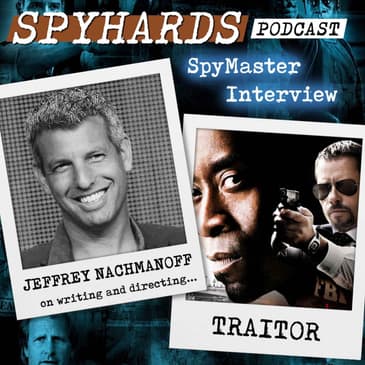


Agents Scott and Cam welcome writer-director Jeffrey Nachmanoff to the show to reveal the secrets behind creating the 2008 spy thriller Traitor. He also shares stories about working on The Day After Tomorrow, and much more!
Become a SpyHards Patron and gain access to top secret "Agents in the Field" bonus episodes, movie commentaries and more!
Make your opinions about the NOC List known. Leave us a voicemail on Speakpipe or send us an email now!
Purchase the latest exclusive SpyHards merch at Redbubble.
Social media: @spyhards
View the NOC List and the Disavowed List at Letterboxd.com/spyhards
Podcast artwork by Hannah Hughes.
Theme music by Doug Astley.
Hosted on Acast. See acast.com/privacy for more information.
[00:00:38] Welcome to SpyHards Podcast, I'm Agent Scott. And I'm Cam the Provocateur, losing at chess every time. I mean, you, the problem is you keep flipping the board over and that's technically a foul. I'm actually having a lot of trouble getting the pieces out of the plastic packaging they came in. And then you keep chewing on them. Well, everyone, every time someone wants to play with me, I can't even get the pieces out. So I automatically lose. You just fumble them everywhere and it's very awkward and people just walk away, look sad at you really.
[00:01:05] They look embarrassed and humiliated to even be in my presence. But fortunately, despite us being an embarrassment, some people do want to be in our presence. Occasionally they do, Scott, and we are very thankful, especially when they bring the power. Like this week's guest, we are talking to writer-director Jeffrey Nachmanoff, who joined us to talk about the film Traitor, which we talked a lot about this week, a movie we found very intriguing, starring Don Cheadle.
[00:01:34] And we had a lot of questions and let's just say he had a lot of answers. Yeah, this is a real spy-hard's deep dive into a movie type interview. It was interesting looking at Traitor and finding out just how little was known about the production of the film. Well, we're about to blow that wide open. So without further ado, let's get to it. Mr. Jeffrey Nachmanoff. Joining us on the show this week, he is a producer. He is a screenwriter. He is a director.
[00:02:02] He's the man behind films like The Day After Tomorrow, Replicas, and this week's film, Traitor. It's the one and only Jeffrey Nachmanoff. Hello, sir. How are you? Nice to see you both. I'm fine. We're glad to have you here. We have just spent half of this week talking about Traitor. So I think it's a night time we spoke to the man behind it. All right. Well, happy to discuss the film.
[00:02:29] But I think the story goes back further than that before Traitor came along. And the question I always ask at beginning of these interviews with people that work in the film industry is kind of the idea of why. How did you end up here? Because it is quite a commitment to give your life over to do something like filmmaking. So what sort of started you on that journey into film? Well, my journey into film came a slightly roundabout way.
[00:02:58] I was in school and I was studying art and photography. And I did this project, which a teacher had kind of turned me on to the idea of doing sort of visual documentary anthropology.
[00:03:15] And I went around and I traveled with a family circus in the United States and took pictures and I took oral histories and I put the whole thing into a book. And that was my project for when I finished it. And they had a guest lecturer come in during the review of the project. And that guest lecturer was a documentary filmmaker. And he's like, pictures, words, pictures, words.
[00:03:44] He's like, why didn't you make a movie? And I remember at the time I thought to myself, I've just spent a year making this book and you're asking me why I didn't make a movie. But to be honest, it's the only thing I remember from the whole academic experience was it planted the seed in my mind that maybe I should really be in movies. Maybe that's what I want to do. So that kind of germinated. And eventually I went back to film school and I got a degree in cinema. And I started out thinking because I'd been in black and white still photography that I'd be a cinematographer.
[00:04:14] So that's where I first started working on other people's student films, taking pictures and sorry, filming, filming other people's films as a cinematographer. And then when I got out of film school, while we were there, I had learned to edit. And my first job was as an editor on these laser discs that were being made. And it was sort of special editions with additional material. And it was a great experience because I got to watch classic films and then cut documentaries about them.
[00:04:44] So I learned, I started with cinematography and then I worked as an editor. And then in my efforts to break in, I started writing. And I kind of thought or hoped to be a director. But in the beginning, people said, well, we're not going to let you direct. But, you know, this writing thing, you got a little bit of a skill at that. Why don't we, we'll hire you to do some writing. And that began my career really in Hollywood. And I started as a writer. Well, I have to ask, you were working on those laser discs and those special features.
[00:05:12] Are there any that popped to mind that were just really cool to put together? Yes. We did one on Amadeus. And it was a re-release, obviously, maybe 15, 20 years after the, I can't remember how many years after the film had been made. And it was great because they went back and they interviewed all of the people, Peter Schaefer, the writer, Milos Forman, Tom Hulse, Murray Abraham. And it was fascinating to hear their different recollections of how the process had come together.
[00:05:40] And often, particularly with actors, sometimes they would have their own ideas of how they had gotten there. And sometimes credit would move around among the interviewees, so to speak. It was pretty fun. And, of course, the other thing was just the immense amount of attention to detail and craft that went into making the film really made me appreciate it. And recognize just how many things, how many people go into making a movie. Well, you'd gone to film school.
[00:06:05] Did, like, working on those documentaries help you in any way or give you advice that maybe you wouldn't have picked up in film school? It's a good question. I think that it did because, you know, in film school, you're experimenting. It's very much about sharing creativity and working with other, you know, young, excited. The world is our oyster. You know, it's a moment in time in your life, usually, where everything seems possible.
[00:06:32] But it's also, you're just beginning to learn the tools of filmmaking. When you do a Laserdisc on something, you know, like a film like Amadeus, you're listening to people who have been doing this for years and years and ended up making something that's really, really memorable. So you glean a lot from the way they approach the material. And it also is sort of humbling because, you know, that level of craft where it's lucky.
[00:07:01] It's a small miracle when any movie gets made. When a movie gets made and it's actually good and let alone great, that's just incredible. Everything has to kind of line up for that to happen. And I'd be remiss if I didn't just dig into that Laserdisc thing a little bit deeper because I actually didn't know that. It's not something that came up in my research about you. Were there any spy movies that jumped out from your time doing it there? I'd be curious to know because that was an interesting time for special features. It was kind of like the first big push. Right. And we stopped for VHS and then came back with DVD.
[00:07:31] You're right. It was sort of that moment when I probably like around late 90s or early 2000s, maybe, when I was doing that, I think. And we didn't I didn't do any spy movies, but I did a couple of Oliver Stone movies who obviously we didn't do JFK, but I or at least I didn't work on it. But listening and watching Oliver Stone talk about his filmmaking process was pretty educational. Later, small.
[00:07:58] I don't know if you turn this one up in your research, but I did work with Oliver Stone years later on a project that never went forward, which was which was which was a hoot. Which project was that? That was a TV pilot that never went forward about a lawyer to the drug cartels. OK, OK. I remember like the I wasn't aware of like your connection with him working on that. But I do remember hearing rumblings of that project. He he had never done TV at the time.
[00:08:27] And so he had his own ideas about how and he's Oliver Stone. He's kind of a legend. So like I remember I turned in the first draft and said, this is really good. We should make this. I was like, OK, so we have a meeting with the studio to talk about it. He's like a meeting. What do they have to say? I was like, oh, this is going to be interesting. And of course, you know, Oliver didn't really want to hear their notes. And the project went sideways. But but it was it was it was pretty cool to just to work with him, sit in a room, talk about script, talk about story.
[00:08:56] And why don't we jump over to Traitor? Now, this is the movie that we've based our week around. We've talked about the movie and now we're going to talk to you about it. We have a lot of questions about it. And one of the key things up front I think people are going to be curious about. It's right at the intro as the story credit by Steve Martin. Now, first of all, I get the sense his involvement on the actual, you know, shoot and everything. That is very minimal. But what is actually there?
[00:09:24] Because when you are joining the project, what is sort of written out in terms of this treatment or this idea? So I'm assuming on this podcast where we don't worry about spoilers, everybody. Right. If you're listening this far right ahead. OK, perfect. So the movies raise on detra really starts with the ending. What happened was Steve Martin was making a comedy, I think was bringing down the house with Queen Latifah.
[00:09:53] And David Hoberman was the producer of that. And 9-11 happened. And I don't know how long after, maybe weeks, months, you know, but it was not it was very much on his mind. And he said to David, I have an idea for a movie. And David said at first, apparently David blew him off because he thought he didn't think it was serious. And the next day, Stephen, you didn't come to my trailer at lunch to hear my idea for the movie. And David said, oh, OK, yes, of course.
[00:10:21] And he sits down and Steve Martin basically came up with what was it. You'll see why it was a Steve Martin idea. He's like, well, instead of all the what if the terrorists because we're all thinking about the terrorists who had taken over the planes. What if you trick them and you put them all on one bus and you blew them up? Now, it's almost like a punchline to a joke, which is how he's a brilliant, brilliant thinker.
[00:10:47] And that was the idea that was the inspiration for the movie. And he said, you know, he didn't have a I think he had come up with the basic idea that there would be an American agent that went. And in his version, I think it was recruited the people from Al Qaeda and brought them to the U.S. and then tricked them into getting on one bus and blew them up. And he said to David, well, I'm not I don't write thrillers. That's not my genre. I'm a comedy writer. But why don't you find somebody?
[00:11:15] So David called me up. I'm not sure how we had known each other, but I was, you know, a writer that he knew of. And he told me the basic idea. I was excited about the idea of getting to work with Steve Martin because I was a fan, you know. And when they told me the idea, I said, well, I don't know. It's not really a movie. And also, I said, I'm not really comfortable making a movie in which the you know, that right now in this moment,
[00:11:43] there was a lot of concerns with Islamophobia, with sort of overreacting. Racial profiling. I said, I'm not really super, you know, excited to write a movie in which sort of the white lantern jawed American hero goes out and then tricks all the brown Arabs into coming over and killing them. Doesn't seem like that would be either a very realistic or plausible. And B, I don't know that that's a message that I think is like the right one to kind of put out there right now. And before I left, David said, well, what would you do?
[00:12:11] And I said, well, to me, trying to deal with this issue right now would be really interesting if we tried to tell the story from the point of view of a Muslim who's actually opposed to terrorism. And for some reason, David said, well, why don't you come up with that? And that was sort of the beginning of the project. And I think I credit, you know, Scott, a lot of this with the fact that I had grown up.
[00:12:36] I as my family moved to London in 1980, I was a teenager and it was sort of peak. It was during the Troubles and there were a lot of movies made that I kind of grew up on, spy movies like, you know, Bloody Sunday, The Long Good Friday, Cal, In the Name of the Father. They all were about this terroristic conflict.
[00:13:00] But because the people's ethnicity looked, everyone looked the same, it was really easy for an audience to watch it and empathize with the goals of the IRA in a way that was really at that time. And when I say the beginning of Traitor was like a little bit like 2002, a little bit after 9-11. And the idea that you could make a movie that would humanize the others, that is the people that were behind the terrorist attack on the United States during that.
[00:13:30] This is you guys may be a little bit younger. You probably don't remember, but the fever pitch of the war on terror was such that there was a tremendous amount of animus in the world. And maybe we're coming back to that. But there was this time when no one wanted to try and tell a story. And I felt both from a dramatic point of view, as well as just a sort of politically interesting point of view.
[00:13:53] If you could make a movie that could somehow get inside the heads of the terrorists the way all those IRA movies that I'd seen did, they weren't, you know, most of them were, they were not agitprop. They weren't advertisements for terrorism, but nor were they complete jingoistic productions made in England that were just to sort of depict the terrorists or the IRA as purely evil. They were interesting, dramatic attempts to kind of look at the conflict and why people do what they do.
[00:14:23] And that to me was the sort of what I wanted to try and achieve in a movie that was going to be about this other conflict in the modern war on terror. And one of the things that was really interesting to me was I was 20 when 9-11 happened. And a lot of the movies that came out afterwards tackling 9-11 were very earnest dramas, right? Like it seemed like that was the real case. And so I was actually kind of surprised that a movie like Traitor happens in 2008.
[00:14:52] It is a few years removed, but it is something that is a little more genre. But it is also very specific when you are actually having characters who are fully fleshed out in the film who are, you know, terrorist bombers. Yeah, that was to me the thing that made it intriguing was how can you do that?
[00:15:10] Because, you know, how do you find a way to imagine yourself in the shoes of someone who has taken a position that is really an anathema to most of us? I mean, I'm not going to this isn't a political conversation, but I wasn't interested in sort of looking at it and trying to because I don't think a movie can do this, analyze the full politics of why they were doing what they're doing.
[00:15:40] But they are fully, but I was interested in trying to make them into fully realized characters. And that led me to just do a lot of reading about the people at the time. Some of it was primary source, you know, I do remember going to scout for the movie. We had to travel, I traveled to Morocco, I traveled to France, traveled a lot of places.
[00:16:02] And I would have these I'd have, you know, the complete works of bin Laden in my bag and the Koran and all these other things I was reading to try and understand sort of the philosophy, the beginnings of the Muslim Brotherhood and the the entire the arc of of how Al Qaeda evolved from a movement that started much earlier. So sometimes I would get some interesting looks at the, you know, at the immigration places.
[00:16:31] But I think that the most interesting movies, the movies we just I just referenced those movies about the IRA conflict. They work so well because they put you in the shoes of people on both sides of the conflict. It's an interesting one because I didn't know the sort of German and the root of cause of the idea in your head basically from the IRA and the troubles in the films from that era. I often think about this is more from the sort of Cold War side of things.
[00:17:00] But the Fourth Protocol is one where you put Pierce Brosnan in the role of the Russian guy, but it's Pierce Brosnan. So there will inevitably be people that are like, I don't mind this Pierce Brosnan guy, even though he is actually trying to nuke England. You kind of tend to forgive a little bit of that. So I can see where that's sort of coming from. It's interesting. Well, to spring from, I think one question I have at this stage before we even get to the conversation about you becoming a director on the film, you're just writing it at this point.
[00:17:29] Is was there ever any pushback? Because I note that it changed hands in terms of distributor or producing producing company. I think it was Buena Vista at some point or Disney at some point. And it moved around a bit. Was there ever any pushback to make this perhaps a bit more of this sort of like like 24 or like those sort of TV and films that were coming out around about that time? Or was it like they said, you've got this, you go run with it? No, it was.
[00:17:57] So the movie, because Steve Martin had been making a Disney movie and David was a Disney producer, it was set up at Buena Vista, which is Disney. Yeah. And I don't think anyone was paying very much attention to it when I wrote it, to be honest. And when I turned it in, I think the executives were kind of like, wow, this is a good script. Disney's not making this script.
[00:18:21] There's no way Disney's making a script with a Muslim protagonist that is tempting to kind of take a two sided look at the war on terror. And I think there was a brief moment where they flirted with the idea of saying, well, maybe at that time it was if Will Smith wants to do it, you know. But it was this is this is the story of how I got to direct it.
[00:18:44] Essentially, it had been bought because back then a star of Steve Martin's level, when he says, I have an idea, it was an easy yes to say, sure, buy it. Yeah. And I wasn't you know, I wrote the script for them. That's a you know, that's not that big a commitment for them to hire someone to write a screenplay. But making a movie is a bigger, bigger chunk of money. So at that point, they're like, there's no way we're doing that.
[00:19:12] So it's sad. And I think because it wasn't going to get made, that provided the opening for me to go to the it was it was also it was really probably I think they had budget is about a 60 million dollar movie. And I ultimately went into the producers first and I said, well. If you let me do this, I'll make it for twenty five million dollars.
[00:19:32] Now, that number was pretty much plucked out of thin air, but it was that's the you know, whatever the hubris of youth and enthusiasm. I just said, trust me. And at the same time, the script, when it hadn't gotten picked up by Will Smith, we were super fortunate.
[00:19:53] It probably because, you know, things that go to Will Smith, every other prominent, you know, black actors agent are thinking, well, if he's not going to do it, maybe we could get it for our client. And I think that's how it ended up in Don Cheadle's hands. And Don Cheadle said he was interested in it. So I had to go and meet with Don and convince him that I could do the movie. And after that, they were like, all right, great. We've got Don Cheadle.
[00:20:19] We've got this ambitious young writer director. Now all we have to do is get someone to pay for it. We found this new company, Overture Films, which fortunately had done a movie. I think they'd been involved in a movie with Cheetah before. So they were fans and that got them interested. And then they said, well, great. Now get us another actor to match with him. That's a big enough star and we'll make the movie.
[00:20:46] And I think they were always hoping for more, you know, a marquee name, someone that would help them sell the movie. Right. But in a weird way, I think the movie benefited from the fact that we ended up casting Guy Pearce. So I have two of these phenomenal actors. I mean, Guy Pearce and Don Cheadle are, you know, tremendously talented actors. And they kind of, I think that they were sort of halfway in and it just sort of happened.
[00:21:16] You know, I don't, it was never officially greenlit. I don't even know that they really ever did all the math on it. And my, David, we hired a producer who's the line producer, a guy named Jeff Silver, who I have to give a lot of credit to because I never could have figured out how to make this movie without the sort of team of people that helped me. Because we were, we were in, you know, three different continents. We were in five countries. It was a real adventure to make the movie.
[00:21:46] We would go to a new place and I would have almost entirely new crew everywhere. So it was, it was a very seat of your pants production. But my goal being inspired by things like the Bourne series was to make a real globetrotting international thriller. And those movies aren't made for this amount of money. It was actually made for 22.5 million in the end. So it was a real lean production.
[00:22:11] And luckily, and I credit, as I say, a lot of the other people involved, Don particularly, this producer, Jeff Silver, my cinematographer, Jimmy Murrow. So they all brought this sort of almost independent sort of spirit to the whole thing, which allowed us to make the movie in a very kind of run and gun fluid style, which, which was the only way to get it done.
[00:22:37] And worked with what I was trying to do in the movie in terms of tell this kind of very kinetic international story. Well, I want to get into perhaps then you taking on the director's chair. And I know you've done some directing before, but this is the big feature film. But you mentioned Don Cheadle. I think that's an important part of the story because he's also a producer on the film. So what is Don bringing into it, apart from his acting prowess, of course?
[00:23:03] And is he, because at this point, I imagine there's still fluidity to the script and to the ideas. So is anything Don's bringing in to sort of change or anything like that? Did it, did it grow or adapt during that process? I would say Don brought a huge amount to the table. It was less about script. The script pretty much stayed pretty solid throughout that period. Obviously, I had not written it necessarily for an African-American or black actor.
[00:23:31] It was, it would have been an Arabic actor originally or Arab American. So we just made a few slight changes to make the character Sudanese, but nothing really had to change in a big way. Once we, you know, once, once Don was cast.
[00:23:47] But his knowledge of filmmaking and his, you know, a lot of it, it's hard to put into words, but there's sort of a tremendous amount of leadership that comes from the number one actor on the call sheet. Everybody takes their kind of cue from that person.
[00:24:04] So some of it is, you know, showing up on time, moving to the next place quickly, not requiring all of the pampering that you might normally want to give an actor. Don was just in it. You know, he was, he was there. He was ready to get it made. And his, that type of like leadership was really important and helpful to me as a relatively, you know, I had, I had some experience.
[00:24:32] I've been to film school, directed nothing of the, you know, small little sort of student film size things. But my experience, I was, I would say I was an extremely experienced rookie director because I had already been, you know, I'd been a cinematographer in film school. I'd been an editor and I had made by this time, the day after tomorrow as a writer with Roland Emmerich. And Roland was an incredibly inclusive director. So I was on set with him almost the whole time.
[00:25:01] I was there with him through the post process. So that was really a masterclass in how you make a bigger film. So I didn't come to the, this project with, with zero experience. That made it, I think that would have been really, really hard. And then Don's help in, I remember, I'll give you an example. We'd been shooting maybe three days and Don came up to me and he sort of said, Jeff, you're doing okay. I'm like, good. That feels good coming from my star.
[00:25:31] And he said, but I got a, I got a note for you. It's a little helpful note. I'm like, okay, Don, what is it? He said, don't be in such a hurry to call cut. And I said, what do you mean? And he said, well, you know, I know you, you, you saw it. You got the scene, you got the lines, you got everything you need and think you need, but just let the camera roll for a minute. You never know what I might do or what one of the other, you know, something else might happen. And I, it's a great piece of advice. I've used it for the rest of my career as a director.
[00:25:58] And sometimes there's a little piece of magic, whether it's a look, whether it's an improvised line that just happens when you let the camera roll just a little longer. And so that was the kind of tip that was very helpful. And I think improve the film because there's, you know, you never know where those little moments come from that, that, that, that help you in the editing room.
[00:26:21] Well, I wanted to ask one of the things I'd read that really impressed the producers with you was the amount of research you'd done. And that your father had worked for the government, which had given you some connections to talk to. Now, is there truth to that? It is true. My father had a really interesting career. He's passed away now. He, everyone thought he was a spy.
[00:26:43] And, but I do not believe he was a spy, even after all these years, but he did work for, he worked, you know, adjacent to the intelligence community when he was a young, he was in the Navy and intelligence. And then he worked for Henry Kissinger and the, and the White House on the National Security Council. And, and then he worked at Treasury and then we, he moved to England where he moved out of government.
[00:27:08] But he had friends that had been in the intelligence community and I would listen to what they had to say. I was always fascinated. And yes, I would sometimes ask him if he could introduce me to anybody that might be able to give me any pointers and tips. Most of that was about the Cold War, to be honest. But I think the spirit of, of bureaucracy is something that I was aware of from watching his career.
[00:27:36] And it's something that I appreciate in, in spy movies when they really get that right. That, you know, yes, you, you know, James Bond needs to have his gun loaded and hidden in the tuxedo, but you must fill out and triplicate the form to get the reimbursement on the Austin Martin you just crashed. You know, there's, there's a lot of things that go into espionage work that are probably not as glamorous.
[00:27:58] And if you can find little ways of bringing them into a movie, I think it gives it an extra sense, texture that the audience feels whether they know it or not about, about how movies work. And we're talking about how spying works. And for this project, a lot of that came from the friction between the intelligence community and the United States, as all your viewers know.
[00:28:23] The CIA handles foreign intelligence gathering and the FBI strangely is tasked with domestic counter surveillance and counterintelligence.
[00:28:32] That uncomfortable division, which originates back in the post-World War II era with the rivalry between Hoover and Allen Dulles, I think, that had a legacy, which has led to mistrust and difficulties between the two organizations culturally and literally for decades.
[00:28:55] And many people believe that the very fact of 9-11 was the result of the lack of cooperation between those two agencies. Because as you probably, again, I don't know if you remember this, but each one had a piece of the puzzle. The CIA had surveilled a meeting of some of the hijackers, which I believe was in Cyprus, maybe a year before.
[00:29:20] And the FBI knew when Muhammad Adda and some of the other suspects or perpetrators came through. But they weren't, they didn't know how important they were. And the CIA hadn't communicated with them about that. So they didn't know they were here. But all of that could have been put together had they been communicating more effectively. Which has its own sort of analogs in your film as well, because you've got like the, is it Jeff Bridges? Yeah. No, no, no.
[00:29:50] Is it Jeff Daniels? Daniels. You mean me? Jeff Daniels. Sorry, it was a Jeff. And yeah, he's doing his own spy game in his own way off to the side whilst you've got the other team working their own story. And until it doesn't, it doesn't really come together until they've got their story straight later on in the film. But that's very much based on, that's very much inspired by some of the research I did. There's a book which I'm on my shelf right now.
[00:30:14] I think it's called Wedge by Mark Riebling, which is a whole history of the split between the CIA and the FBI and how that came about. And yes, I was very interested in trying to sort of put that into the movie so that it would feel realistic. And I think it did. I mean, that's not anything I made up. That's just sort of me repurposing, you know, real things that have happened in the intelligence community.
[00:30:42] And also, it's not the first example of the left hand not knowing what the right hand is doing. It's a tale as old as time, especially in big bureaucracies. Absolutely. And it's true in all countries. But, you know, obviously the U.S. has been probably because it's so big and has been so active over the last, you know, many, many decades. There are probably even more examples of that kind of miscommunication happening.
[00:31:08] Well, I think of on a more local level, Zodiac comes out the year before your film about how the different law agencies couldn't communicate back and forth. And it's interesting the way you have, you know, this film following the next year and just on a bigger scale. Yes. And there are other other I'm sure other films have handled this. I mean, one of the things that was unusual about this film, you have to look it up. But I think it's the you know, when it was one of the as far as I know, is the first studio release to have a Muslim protagonist.
[00:31:39] If you don't count Malcolm X, which is, you know, a historical drama, but as a fictional film. In a mainstream release. So we were also kind of trying to get that part right. Had a lot of consultants on the film, a lot of people we talked to, to try and, you know, find a way to represent that that world and that that tradition. Not in any way with it with an agenda, but just to try and do it honestly. Well, I was going to ask about that because you're right.
[00:32:07] Like that really jumped out to me when I was watching the movie. I just I think we talked about on the show. So one of the things when you tackle spy films week to week, it's a lot of, you know, white protagonists, white male protagonists. Right. That you come across time and time again. And anything that tries to do something different really jumps out and stands out in a very crowded field of spy movies. And that's what Trader really jumped out to for us. But when you are trying to show a character and depict the Muslim faith in a, you know, serious and honest way.
[00:32:37] How much are you worried about just conveying like the reality of that character versus kind of explaining things to the audience and kind of almost turning into that? Here is a lesson on how this works, folks, in case you didn't know. Great question. And it's always a it's a fine line between exposition for the audience. And on the other hand, just making good drama. Sometimes you need to give them a little help, I think.
[00:33:06] And if you can do it in an artful way, great. And it slides in there when it gets too on the nose, it bumps out. Some things age better than others with time, too. I'm sure if I haven't watched it lately, but, you know, I think that probably there'll be things that I would maybe say, oh, do we really need to tell the audience that? There's a little bit of those moments where we're doing some people call them Johnny explainer moments.
[00:33:31] On the flip side, when the film was made, I think we were in an environment where there were just a lot of things the audience doesn't know or didn't know, to be honest. You know, like many Americans, I think there's a line in there where commenting on the fact that Arabs make up only a small minority of the world Muslim population.
[00:33:53] And we used, you know, there's a little bit of a the character played by Neil McDonough, who's a great actor, was used a little bit as playing the sort of ugly American as a way to give Clayton someone to bounce off of. Those are the best ways you can usually do it to sort of slip it in there, to give the audience something to to hold on to. I think if you're making an art film, you can afford to let the audience just they miss it, they miss it.
[00:34:20] This was intended to be a commercial film, so it had to be something that could work for a broad enough audience. So, you know, there are probably places where we're teetering on the edge, but that was that was the balance. You want the audience to understand enough about the Muslim faith, enough about where Arabs fit in the Muslim world, where Wahhabist and Jihadist fit in the Muslim world. These are things that were not widely sort of known or discussed in particular in the wake of 9-11.
[00:34:49] On the flip side, I didn't want to make it an after school special where everything's an explanation of, you know, trying to do a history lesson or a civics lesson on Islam for the audience. I think it's one of the things the film does very successfully is, and I don't think a film should have to do this, but I'll use this as a broader term. Bring humanity to the faith that at this point in time, post 9-11 was basically getting hammered left, right and center through TV, film and everything.
[00:35:17] It's basically just if they weren't the enemy, they were the punchline. It was one of the two things. Whereas you basically go, no, this is a religion that contains multitudes, multiple different people within it. And I think it's just a credit to you, really, that you do get that across in the film. Well, I appreciate that. It was one of the things that weighed on me before starting it, and I think that's why it went the way it went. Because when I first started, I just didn't feel comfortable.
[00:35:45] And I don't judge, there are other films out there that maybe, and other entertainment. I mean, like, I love 24, but it's very much a lantern-jawed white hero, white savior, and the Muslims are the bad guys for most of the show. And it was, some people thought that was great. Some people criticized it. But again, I believe that there's someone out there to consume. Everybody gets to choose what they want to watch. Everybody gets to choose what they want to write.
[00:36:13] And hopefully direct if you're going to get to do that. So I just had to say, well, if I'm going to do this project, I have to feel good about how we're using the subject. Because it is and was a sensitive enough subject that I didn't want to do it flippantly or thoughtlessly. That being said, it's 100% meant to be entertainment. And if people are spending all their time thinking about the political issues, they're not going to be sucked in and enjoy the movie. Which is what I want to have happen.
[00:36:41] I will say that one of the gratifying things was we got flack from people on both sides. There were people that felt, oh, this is too sympathetic to whatever, the perspective of the jihadist terrorists. And there are other people that felt, no, this is too jingoistic. I kind of felt like you don't measure it by who likes it. You measure it by who dislikes it.
[00:37:09] Who have you pissed off in some ways? Well, hey, it's art. If you haven't got a reaction, you're not doing it right. That's a good point. Yes. I think I'll tell you another little story, which you might appreciate since everyone's seen the movie that's listening. When we did the first test screening, sitting next to my editor, and the moment happened, the big moment when the bus blows up. And the audience erupted.
[00:37:34] But it was a combination of laughter and chuckling and clapping and sort of hooting. And my heart sank. I was like, oh, my God. We've made some sort of comedy. This doesn't work at all. My editor, God bless him, put his hand on my arm. He said, no, Jeffrey, that's a good thing. And I didn't understand it. But what he was saying, and I think he was right based on the feedback, is it was catharsis.
[00:38:00] The people, they reacted to the bus blowing up. We had successfully built up the tension such that they needed to let it out. And sometimes that's laughter. I mean, I thought it's not supposed to be funny. This is a big moment. But they weren't reacting. They weren't laughing at what happened. They were sort of letting out the tension that they were experiencing. And that seemed to have been borne out by the fact that that twist from most people worked in the movie and took most people by surprise.
[00:38:30] But I do remember thinking, oh, my God. I've just spent all this time and the whole thing is a disaster. This film is going to be horrible. I mean, it's an absolute genius twist. And we watch a lot of movies with big reveals or, you know, someone turns sides at a certain point. And a lot of it is quite predictable along the road. This one completely took me by complete surprise. I thought it was brilliant.
[00:38:55] And I was wondering if you could talk a little bit about just, you know, you show various participants who are going to take place in this attack. And you use different film styles or different, you know, color coding for each character who's participating. If you could just talk about the mixing of that and making it all work just visually. Sure. So first of all, I'm going to give credit to all. It was Steve Martin's idea to put them on one bus. That was a great idea.
[00:39:18] And that gave us, gave me as a writing to end to, you know, to end towards, move towards, which was super clever. However, the film look and style was a combination of a set of ideas I had in the execution really, really cleverly by the cinematographer, Jimmy Morrow, who introduced the idea of using swing and tilt lenses, which are these lenses where the back focal plane moves. So you get that super sort of twisted, weird.
[00:39:47] Your viewers have seen it before. You may not have known the name of it, but they kind of bend the image a little bit on the sides. And the focal plane moves wherever you move the camera, because it's a handheld camera. So it's, you can't plan it, but he essentially would move it around the people. So maybe a nose, maybe an eye, maybe your glasses is in focus and everything else is sort of soft.
[00:40:10] And that allowed us to also, first of all, we use those lenses always to shoot the terrorists who are coming to the bus. So that was the visual language for them. But it also gave us an extra benefit, which is by the time you're on the bus, you're used to seeing them that way. And you can't really tell where they are because it's only little bits of them, these sort of signifiers that for the audience, it keeps you connected, hopefully both emotionally and mentally, visually from where you've seen, how you've seen them in the past.
[00:40:38] Because all of their shots are done that way. But also it really distracts you from thinking about where they are. So you don't notice that they're on the same bus. And then finally, obviously using the sound design, we were, which Mark Killian, I should also mention was a composer did it. I think he did a great job with the score, but it all is designed to kind of bounce you from one place to the other.
[00:41:03] And, you know, he kind of woven these Middle Eastern themes to sort of suggest the origin of where that sort of that philosophy was coming from with those people. But they're also very much deliberately in kind of prime Americana. You know, it's all over the country. We shot in your country and Canada for some of that. And, yeah, it was really a careful kind of puzzle.
[00:41:30] And the visual palette for the movie was something I worked out before we started. But again, with my department heads, we even, the film was shot on 35 millimeter. Super lucky to have one of the last people that got to shoot that way. And, you know, without having to be, you know, Quentin Tarantino or something. And we processed the film differently for the different areas. So we actually used a chemical bleach bypass technique.
[00:41:59] So all the footage that's in the United States, which is shot, by the way, all over the world, because sometimes practically speaking, we had to be somewhere else to shoot something. But by linking, but when you cut it together, the film that's meant to be US is bleach bypassed. And the film is processed differently for the stuff that's in the Middle East. And it's differently for the work that's in Europe. And as a result, you have sort of these different languages for the places you're going.
[00:42:29] And again, we had to do it in a kind of hopefully clever but cost effective way. And that was one of the techniques we're able to use. And you just have to commit to it. You know, you can't undo it once you make a chemical change to the promise of processing. I mean, I think it's a crackerjack ending. It's for us. We were talking about at the end of the discussion, sort of our favorite twist endings. And I think you are now in our top five of twist endings. And we've seen a lot of twist endings that did not work. I'm very flattered.
[00:42:59] Look, I'm a fan of them, too. I'm a huge fan of Chris Nolan's work. Chris Nolan actually was right up the street from me in a bigger house. But I've always admired his filmmaking. And, you know, I think about some of the twists in his movies. I think of like the prestige, you know, great, great twist ending. So I like you guys. I think I'm a fan of the genre. So for me, I was given this great twist.
[00:43:28] And the challenge was build everything around it. You know, so that's a it's hard to get a great twist. If you get one, you sort of say, all right, let's roll up our sleeves and figure out how to make it all work to get there. Well, I think the credit definitely goes to you on that one as well. And your team, of course, as well, because, yes, you were handed this great twist. But you have put all of the bells and whistles on it. You have like you talk about the lenses you're using, the different color edits and everything that brought it all together, made it feel like something in that film.
[00:43:58] It gave it like a central moment that you can go back to and be like, this is this is where you can hang your hat on the traitor. Well, I think, you know, it's one of those films. It's also it's fun to talk about when you don't have to hide the ending, because for a lot of people, I mean, like I don't believe that there's anything wrong with spoilers. But this is one of those movies that you like to say, do yourself a favor. Just watch it. You know, like there's there are certain movies like another one of the movies, by the way, this brings us back to look at you, Scott, because it's the British story.
[00:44:26] But the crying game, you know, which was also starts as really an IRA story. Right. And the, you know, great, great twist that nobody saw coming in that movie. But it was true, like knowing it, not knowing really. It's a super enjoyable experience to watch a movie and not know the twist. Yeah.
[00:44:49] And it's slightly, you know, you can you still can I can still watch a movie where I know the twist and enjoy it, but you'll never get the same experience you get the first time you're watching Traitor. I think you hopefully that's going to be your your best watch in some ways, because you get that that that emotional hit from from that twist. But then you also queue up like an instant rewatch with Traitor, because then you want to go back and be like, was there any clues I missed along the way?
[00:45:15] Yeah. Yeah. Well, that's fine. You know, and if you're a fan of the genre, hopefully you can watch it again. And, you know, it actually comes together when you see it the second time, you know, in a different way, because there's a bunch of card flips, obviously. Like, you don't know that Samir Clayton's Don's character. You don't know what he's up to. You don't know which side he's on in the beginning. You know, you don't and you don't know, you know, until you see him meet with Jeff Daniels. You don't realize that he's an undercover operative.
[00:45:44] And there's all you know, there's a lot of things that are going on as a step by step. I should also mention, you know, I was super lucky to have Saeed Tagmawi as the opposite number because he's also a terrific performer. And to have him hold the screen the way he does opposite Don is that's it's not easy. Well, I want to actually ask about that because their dynamic is really the heart of the film.
[00:46:08] And I feel like, you know, Saeed's character is maybe the toughest balancing act for an audience because you want to feel like the intimacy and why this relationship matters. But at the same time, audiences aren't necessarily predisposed to have any real sympathies towards the character who is plotting a big terrorist bombing. Yeah. I mean, you know, it's interesting. Riz Ahmed auditioned for that part, but he was too young back then. But I saw, you know, I saw a lot of people.
[00:46:35] But when I saw Saeed with Don, it was just immediately clear that he could he has a tremendous charisma to him. And I think that was required for that part because the character has to be very tough, ideologically driven, you know, ruthless. But at the same time, he's there's a there's a there's a softness inside still, which Saeed is able to kind of bring out.
[00:47:05] And I remembered I'd seen him obviously in La En, which you guys probably know that movie, the French movie, Hate. You know, he and a lot of people had seen him before in the George Clooney and Mark Wahlberg movie. Three Kings. Three Kings. Three Kings. Yeah. And he kind of steals a scene, a great interrogation scene. So I knew what he was you know, I knew he was a really, really capable actor.
[00:47:32] And then a lot of it, you let the two actors kind of find that dynamic between the between the two characters. And I felt that their their chemistry was really was really great. And I find him a sad character, too. You know, he said it's a it's a you could look at the whole thing as a spy movie, but it's also sort of a tragic love story. You know, in that sense, because they develop this super strong bond. But in the end, he's the enemy.
[00:48:00] The other movie that I was inspired by, of course, was Donnie Brasco. And which, you know. The Johnny Depp character, you know, he's he's really, really falling in sort of a bromance, you know, with with his target. But at the end of the day, you know, the feelings are real. But the whole reality is he's in is is false for the purpose of making the arrest.
[00:48:26] Well, everything you're saying about Traitor makes it sound like you are. This is your 20th feature film. You're a very accomplished director. You knew exactly what you were doing on day one. But I'm curious. No, this is the big feature film for you. How were you dealing with that pressure on set? Did you feel the pressure of being in that seat? And how did that sort of influence the shoot? It's a little hard to remember.
[00:48:50] I certainly must have felt a certain amount of nervousness about doing doing something like that. It's a lot. You know, you get one chance sometimes sort of on the flip side. It was very natural. I really knew the story and I knew exactly what I wanted to shoot. I had kind of it came, as I think we mentioned earlier, I came from a photography and a painting and drawing background. So I do all my own storyboards and I had a pretty good plan.
[00:49:18] And because I'd done editing before, I really understood what I thought the pieces were that I needed to tell the story. So it was a very, very well planned out shoot. My main learning experience, and there were many things I learned along the way, but my specific biggest thing was to learn, which Don helped me with, was to relax and say, you have a great plan, Jeffrey. That's fine. But be open to the things you didn't plan for.
[00:49:47] And I think I became much more. I learned that along the way and I learned it from Don. And I learned it's like it's great. And I still believe that when I go to prepare, whether I'm shooting an episode of TV, it doesn't matter. I prepare very, very extensively. I usually have a shooting plan and mentally a layout for how I want to do it all.
[00:50:05] But I did learn from him that the best possible scenario is to have both the sort of the rigidity of a plan and the flexibility mentally to take advantage of things that happen on the spot.
[00:50:19] And when everything is working really well in a film, and I think all directors probably tell you different stories, but one thing I think would be in common is there's a moment when it becomes a little bit of a flow state and your good plan ends up becoming better because of the partners, the other people. Whether it's a cameraman saying, what if we do this? Whether it's an actor suggesting, what if I tried this line or this change? You know, and you're open to it. Then you get even more than what you had.
[00:50:46] And it's the safety net of knowing, oh, I have a plan today. I know how the movie goes together. I know it's going to work. So all I can do is make it better now. Right. And this was a pretty constrained shoot in a lot of ways. The budget is lower. You have to shoot fast. Was there any changes that pop out to you that were made along the way that you were really kind of those happy accident kind of moments? Yeah, that's a good question.
[00:51:12] I'd have to go back and remember, but I'll tell you one little mini one, which is my line producer, producer, Jeff Silver, had this great idea, which is we didn't quite have enough money to shoot the. Remember the scene on the beach where the young guy kind of chickens out? Yeah. Ideal. The actor is a great actor. I've seen him in things over the years many times now. He it was supposed to be on the it's on the beach in Spain.
[00:51:40] And we had something like we were budgeted at like. Forty seven days and that would have been forty eight and a half or forty nine or something like that. And what he did was he said, well, every day we're going to look at our costs, running costs, and it's around day thirty two of the shoot. And if we have saved enough, we'll add those two days and we'll do it. And if we haven't, we're going to skip that, save those two days. And you have us in the script. You just dismiss it with a line on the phone.
[00:52:09] And it was one of those cases where we saved enough and we're able to shoot the scene. And we didn't have the weather we wanted. We didn't. You know, it was very, very limited, but we were able to do it. And that was that one of those like like that's one of those crazy things in movie making where it's like, well, the story will either be a or B. Choose your adventure, depending on how much is in the piggy bank at that moment in time.
[00:52:30] You know, and there were a lot of things like that in the movie where we managed to do things, but we did them either a little bit less because we found a way to do them for less money or we did them more quickly. You know, there's someone once asked me after the movie. I remember they said, oh, it must be there's a scene of Don Cheadle on the London on the tube in London. And I said, it must have been it must be really hard to get permission to shoot on the tube in London and London.
[00:52:56] And I said, it must be because we didn't. It was literally me, Don and the cameraman. We we got on in Waterloo and we were and it was this is also this is like we go through. We just filmed on the tube. We got up and we walked and we're just filming as we're walking through the station. And I was trailing with a little clamshell monitor. And I hear these there's two British policemen with the, you know, the vests and the caps and everything. They were like metropolitan. They're like, is that a film camera?
[00:53:26] And we just kept walking, you know. So we did do things a little bit on the fly sometimes to get it done. I will never watch that scene the same now. No, you were just you just tapped your Oyster card on and you just got on the train and just just did it for real. I like that. And by the way, we would never have been a lot. Yeah, I'm sure now it's been I'm not worried about anymore. But, you know, the studio would have been furious. They wouldn't we couldn't have used the footage. They said, you can't do that.
[00:53:53] You know, there's there are a lot of regulations that go along with doing movies, as you both know. And it's sort of like we were in another one. It's a little bit bittersweet thinking of the movie because it's not the kind of movie I could get made today. No one. That's very tough to make a, let's say, twenty two million dollar commercial movie. Very rare. You're either in the big, big scale, you know, where you're making, you know, the gray man for two hundred fifty million dollars or you're making micro budget, you know, one or two million. And then no one cares what you're doing.
[00:54:24] Well, I was going to start sort of wrapping this up on Traitor. But and that was one of my final questions was like, do you think this is a film you could make now? Wow. And that being one of the reasons not to, but also like geopolitically, things have changed in the near 20 years since you made that film. Do you think you would perhaps treat the source material the same now if you were to try and make it again?
[00:54:47] Yeah, well, that's a that's a tricky question, which we probably need an entirely different podcast for about the state of Hollywood and corporate capture by certain interests, particularly where I'm sitting.
[00:55:08] There is a lot of pressure not to I mean, not to make things that are politically provocative, particularly when it comes to sort of mainstream entertainment. I think there are certain individuals with so much power, they can still get things made. You know, I mean, I'll be fast. You know, one battle after another. Does that get made next after the merger or not? Right. You know, yeah.
[00:55:37] Everybody's wondering, like, you know, what kind of political pressure makes its way down to the creative side? Now, we did get some pressure when I made the movie. I remember that the studio at the time asked us to do a new ending and they wanted it. They said, can't you make it more like Jack Ryan, where he's like getting a medal at the White House? And I just sort of pushed back and said, I just don't see that as really what's the story here. This is about a man and his personal journey. And I think it would look really false. Yes.
[00:56:04] And luckily, I had I wasn't that I had the power to say now. It was more that I said, let me think about it. I just never wrote that scene for you know, I just never did it. But it wasn't like I was able they weren't because it was a negative. I was able to resist that pressure for that idea. But had they had it been something they wanted to take out, that would have been harder because they're in charge. But we didn't have a huge amount of interference on this one. Relatively speaking, it was kind of this is the movie.
[00:56:32] But today, to your question, Scott, I don't know. I mean, I throw that back to you guys because you talk to a lot of other filmmakers. You know, where are the limits? What can you do that's provocative? What can you do within the mainstream system? I think you can still do anything sideways around independent European. There's there's always a way to make because we'll see movies and stories that will be critical of U.S. foreign policy or of anti-terrorist, you know, techniques and this, that and the other. The question is.
[00:57:03] In the context of mainstream entertainment, what are the what are the restrictions? I mean, if I'm going to weigh in as you post the question at me, I'm not in the film industry at all. So I probably anything I say here is moot. But I think that the thing that would intrigue me about it is the core theme of of dealing with the religion and sort of the humanity behind everything.
[00:57:26] And, you know, you we haven't really spoken much about the sort of the Guy Pearce character and his sort of Catholicism, which is also part of this, too. And he's dealing with that background and his faith growing up. And that's sort of like a mirror image going on. You've got there. Maybe there's some more in that character as well that can be brought out now because we're perhaps shining a lens on other groups. And maybe that's an area that can be explored in the future if it were ever to be revisited.
[00:57:56] But then again, I don't know. Yeah. No, look, I'm fascinated by religion. I'm, you know, I sort of a student of it. I don't I don't I'm not consider myself a religious person personally, but I do. I think so many so many. So much of our civilization, our culture has been driven by religious belief that it's always there in the background. So it's really worth investigating and making a part of the stories we tell if there's a natural way to do it.
[00:58:25] I suppose that my final question would be because there are you've gone on to work on many other films, TV shows since Traitor. Is Traitor like a special film to you? What does that mean to you? What does the film mean to you? Oh, absolutely. It's. I mean, I've loved working on many different things, many different people, but Traitor is certainly my favorite of the things I've ever made.
[00:58:50] And it has it would have a special place anyway, because it's my first film that I wrote and directed and only full feature film I wrote and directed. Everything else I've done one job or the other. I've sat in both chairs sometimes. And it was a you know, it was I was super privileged and grateful that I got a chance to make something that I that was something I would have wanted to watch.
[00:59:16] And and frankly, to do it with such in retrospect, tremendous partners and tremendous freedom. And I was aware, but I'm only become more aware as time goes on how rare that is and how lucky I was to get to do that. At one point in my career, I think most people are lucky if they ever get to, you know, think about it. But getting to make one movie is amazing.
[00:59:40] Getting to make a movie that you care about and that you, you know, is the kind of movie you want to watch. That's a that's an even a bigger kind of gift to have. Well, I had a question. I was going to ask about like the movie's been around for quite a long time now, almost 20 years. Don Cheadle, after this movie, goes on and does obviously all the Marvel films. And he was a known quantity when you have him in this movie.
[01:00:06] But he becomes someone who's just globally recognized at a level that previously was not the case. When you have a movie like Traitor out there on streaming, a tile showing his face. Have you noticed this movie getting more attention over the years and people hitting play on it? That's a really interesting question. I don't know the, you know, the kind of the metrics or the number. And of course, there's so much so so many films and TV shows out there that they get buried a little bit. But it is one that comes up as, you know, of all the things I've done.
[01:00:36] It has seems to hit a chord for a lot of people and a lot of people maybe like yourselves who are fans of the genre. In other words, people that know and watch sort of spy thrillers and international spy thrillers. And this is always gratifying to me. They seem to be the ones that are most passionately affectionate towards the movie, I guess I should say. You know, the biggest fans of the movie are people who like this kind of movie.
[01:01:03] And maybe what's happened is, is over time with Don Cheadle, maybe growing a little more in renown, maybe more people find it. But I don't know. It depends on where it lives on different servers, you know, because the one only good thing about it not being with one of those, you know, wasn't made for Apple or Netflix or whatever means. Presumably it's in someone must be the library of, you know, Lionsgate or somebody who must have bought Overture.
[01:01:30] So it kind of gets, pops up different places, you know, so new people get to discover it. It's super gratifying when anybody gets to see the work you've done and get some enjoyment out of it. So I hope people keep discovering it as time goes on. And I have to ask this question because when I was doing the research for the episode and then for this interview, there is an Indian film called Anwar that came out in 2010 that is considered a quasi remake of this movie. Have you ever seen that movie?
[01:02:00] I have never seen it. And you're the second person that told me that now I got to go track it down. But somebody said, hey, did you know that there's an Indian version of Trader? And I'm like, what? And I saw and I looked it up online and it did say, I don't know whether it said inspired by or remake. I mean, I don't know what legal procedures went on. I was never told. There's no residuals going to you for this one. No residuals going to me, but I'd be fascinated to see it. I would love to see the Indian version of Trader.
[01:02:29] I don't even know how they would do it exactly. But maybe they could put them all in one bus or something. Yeah. I mean, Kashmiri conflict. They certainly have plenty of stories of terrorism that could be repurposed. But do they have songs? Is it that kind of Indian movie? Do you know? I'm not exactly sure. I think so. It's listed. I was just looking up to see how you're credited on it because you're not credited as a writer on the film.
[01:02:59] I'll just see if it's like an inspired by. But I think it's a straight up drama. I don't think it's... Oh, no. It has a lyricist. There you go. So there you go. I think there's a music area in there, certainly. Well, you know, imitation is the highest form of flattery. So if somebody copied the movie, God bless them, you know. Well, now that's everyone's homework is to go and track down Amwar and see how it holds up. If you guys find it, email...
[01:03:26] If you find it and get somewhere a bootleg copy, email me a link. I'd love to see it. We'll sort that out. We are spies after all. And I did just want to add, you were saying about like you're happy people are discovering it. I was just trying to find the list so I could send it to you. But I was literally looking at a list of underrated 2000s spy movies the other day. And Traitor was number one. I'll take it. I'll take it. There you go. Only thing would be better would be if it were the number one movie and it made like bazillions of dollars because everyone had seen it.
[01:03:54] But instead, underrated, I'll take that better than overrated. It's better to have a legacy than no legacy whatsoever. Exactly. There you go. There you go. We interrupt this program to bring you a special report. Agents, where are you? Why do you hide? Follow that Patreon trail and make SpyHards your guide. That's right.
[01:04:18] From spy TV reviews covering the antics of George Smiley, Jack Bauer and the slow horses to reviews of non-spy movies from your favorite spy actors. There's no more secrets over on our Patreon. But Cam, tell the listeners about this week's top secret broadcast. Not all superheroes wear capes and not all superheroes have a good attitude. As evidenced in this week's film we'll be talking about over on the Patreon, Hancock starring Will Smith.
[01:04:46] How does this box office hit released in the mega superhero summer of 2008 opposite the Dark Knight and Iron Man hold up? Will it fly or will it crash to Earth? Tune in and find out. So, Tartune your dial to patreon.com slash spyhards and spice up your podcast feed. But before Nick Nack runs out of Tabasco! Resume the spy jinx.
[01:05:13] I can't let this conversation go by without talking a little bit about The Day After Tomorrow. Because that is a film that somehow had an impact on me as the 17 year old who saw it in theaters. I just like disaster films. So I think it's one of the first ones I got to go and see in pictures by myself. I mean, looking at it is sort of one of the, I think it's your first big writing job in terms of studio films.
[01:05:42] And you said, I mean, one of the questions I always have for screenwriters is, are you kept on? A lot of the time it's like you do the script and then thank you, handshake, and the filmmaker takes it away and does their thing with it. But as you said, Roland kept you around for the production. So just tell us a little bit about Making The Day After Tomorrow. What was that process like? So that one was also sort of a charmed experience. Roland had the idea. And, you know, he had, I don't know if you remember, but his career, for most of his career, he had worked with Dean Devlin.
[01:06:12] They did Independence Day together. So he was used to having a partner. And those two had split. And then he had made The Patriot. Yeah. And then he had this idea. And I was introduced to him. And I pitched my version of what we would do. And he's like, I like it. And it became our first meeting, which was like our introductory meeting lasted like six hours. I wrote the script for him.
[01:06:39] And he turned around and sold it for an ungodly amount of money and set up the movie. And when, because I think it's just the way he works, he never, I was just there the whole time. I was like, there were times when I would walk along, you know, he'd be like, come on, Jeffrey. And I was like, wait, but you sure I'm supposed to be here? I remember once we, this was through the whole production, through post.
[01:07:06] We went to a meeting at Fox, which was the studio. And there was a little test screening. And then they're like, everyone out of the room. And it's like Roland, the producer, Mark Gordon, me sitting there. And it's the head of the studio. It's like the guy below Rupert Murdoch was Peter Chernis. And he's like literally, and there are like six people in the room. And I'm getting up to leave because I, you know, and Roland's, Jeff, you sit there. He has a strong German accent. And I sit down and I can see the eyes of the big boss.
[01:07:35] He's like, good to see you. Good to see you. Who's, who's this? And I think Roland might have said like, that's my writer. Don't you like, but it was like, okay, you know, I guess you're allowed to stay. So I got to stay and see how the really, how the sausage is put together, you know, and the, cause they weren't, that was a very large, you know, a hundred million plus movie and the forces at work. That's a, that's a subject, you don't, I don't know if it fits your podcast, but I can tell
[01:08:04] you stories about that. It was a great experience. I'm super proud that I was a part of it. And it certainly launched my career because obviously that movie was a, was a much big, much bigger movie than Trader. And reached a lot of people. Well, I mean, I'll, I'll answer the question you just posed. It's our podcast. So you can talk about whatever you'd like. So if you have some stories, we want to hear them. Everyone listens to the show of film fans. So this is talking about film. Okay. I'll just say just one story. The front week.
[01:08:34] So Roland on the strength of his reputation as a disaster filmmaker, the strength of the script I'd written for him. He's it's a big bidding war and he sells it to Fox ultimately. And so Fox is going to make this movie. And the first meeting we have, there's got to be like 50 people around some giant, like almost cartoonishly long conference table. And the head of the marketing team at Fox is, well, just sort of you're clear.
[01:09:02] We don't want to use the words global warming in any of the promotional materials for this movie. And I just about spit out my free Perrier there since the whole movie is about how global warming, which we now call climate change, but back then it was sort of in between, you know, interchangeable, you know, destroys the world. And, you know, it was a journey from there to, to the movie being released.
[01:09:25] And, but the American campaign really ignored the climate message because that was not really in line with Fox's, you know, overall political worldview. But the European campaign was plated up completely because that was a, that worked for, for, for the rest. The rest of the world apparently has, you know, climate change, but the U S is immune.
[01:09:52] And so it didn't, you know, you have to treat the places differently. Yeah. I remember I saw it in Australia when I was backpacking and that was, and I was following kind of film press in the area and they were acknowledging the global warming thing right up front there. So, yeah. You know, the funny, the crazy thing about that movie, and I've talked about that movie on podcasts and things for years is, you know, it was less that the movie was prescient than the movie was current.
[01:10:22] The movie was all using kind of current science and science fiction to talk about the dangers of abrupt and irreversible and catastrophic consequences of changing our climate. And now it's been what, 20, 25 years. We've actually gone backwards in the public messaging. Like at the time the movie was made, it was like 50, 50 in the American sort of public
[01:10:51] opinion of who people, people being concerned or not concerned about climate change. And I think it, you know, the movie that there was a little bump after the movie, they did some studies, you know, people being a little more aware, a little more concerned about it. But in the United States, I think currently we actually are less concerned about climate change. And there are more people that don't believe, that believe it's not, you know, that believe it's a hoax. So we've somehow gone the wrong direction on our side of the pond.
[01:11:19] Scott, over there, you're a little bit more aware. And up in Canada, I think you're probably a little bit more on top of it. But I mean, all I have, I'm not a scientist. I don't profess to be an expert on practically anything. But anecdotally, I can say that since I was a child, the climate has changed in England. We don't have winter in the sense of the same thing anymore. We don't have snow around December, January anymore. It's more just rain and a bit warmer. But hey, I don't know.
[01:11:47] Maybe that means that it could be absolutely nothing. Don't at me, folks. It's hard to know. But as you mentioned, I've sort of made up some of my career anyway about doing deep dive research for the things I write. And I obviously did that for Traitor. I also did it for Day After Tomorrow. Although when I talk to people about the movie, I say, you know, don't think that because we made things up for science fiction that we don't know what we made up and don't, you know, we know the difference.
[01:12:17] There's no such thing as a super freeze that's going to kind of get you in a second like that. But, you know, everything like all good science fiction. You talk to a bunch of experts. You ask them, well, what if, what if, what if, what if? And you look for the scenarios that are the most dramatic, even if they are the least likely, usually. And yeah, but that's a tough one to talk about because unlike other subjects, people seem
[01:12:42] to have opinions on climate change, even if they have no subject matter expertise. You know, I like to compare it to, you know, if you have a heart attack, you don't usually go and say your cardiologist. Yeah, well, I know you got this theory about the, you know, the plaque building up and the arterial passageways. But my uncle says that's not really what causes it. It's too much orange juice. Right. Okay.
[01:13:08] You know, whereas when it comes to climate change, anyone and his brother seems to have that people have an opinion about whether, you know, this is real. It's like I say, don't talk to me. Talk to all this. You know, there are there are people who do this for a living that have given us a pretty good idea of what they think. So, hey, facts are overrated at this point. And remember, there are good people on both sides. So, I mean, you know, whatever. Exactly.
[01:13:33] I mean, the one thing I'll just say about writing for the day after tomorrow, we've spoken to, as you said, we've spoken to a lot of people on the show, a lot of screenwriters, and oftentimes they'll write something spectacular and then they'll be pulled in by the director or the producer because there's not enough money to bring it to life. I almost feel like you would have had carte blanche to be like, let's do the biggest wave I can do ever. Or like, how much destruction can I cause on the script? And it was basically, I must have been like this kid in a candy store. Yes.
[01:14:03] Well, and that's that, you know, that was the beauty of partnering with Roland, because if I came up with an idea, he would usually top it. You know, what if we, you know, if I said, what if what if we send a wave over all of lower Manhattan? He said, what if we send a wave over all of the eastern seaboard? What if we, you know, like, what if we drop a helicopter out of the sky? What if we drop four? You know, he's his imagination is and he's very joyful. He's a he was wonderful to work for with.
[01:14:31] You know, he's just a, you know, the toys of the of cinema are things that give him great delight. And he loves using them to demonstrate and create giant havoc in the in his films. As as he is want to do. Yeah. Well, we're going to go to the quickfire round now. We're building up to a big question. I don't know if you've prepared yourself for it, but we do not give anyone the heads up. So it is coming your way.
[01:14:58] But before we get there, and I want to I mean, Traitor could be the answer to this question. And I absolutely understand if it is. But is there like what's your piece of work that you are most proud of in your career thus far? And is that Traitor or is that something else you've done? I would still say it's Traitor. I have unproduced scripts that I would love to say, like, I would love to make that. But, you know, I would say that Traitor, if something anyone could find, that's probably
[01:15:25] my most fully realized thing that I've had the pleasure of doing. And on the flip side of that, what are you working on at the moment? What can you tease? I have a couple of things. One of them is a story set on the U.S.-Mexico border, and it is a crime drama in which we have two policemen, one on either side, trying to solve something.
[01:15:54] Only one of them is married to the other one's ex. Oh, wow. And that comes between them. Interesting. Okay. That's it. I'm working on that. I have a partner that I'm writing it with, and he is a journalist who's covered that region for 20 years. Right. So it's been really fun. Again, the research portion has already been tremendous load there, but I'm learning from him, and we're excited about it if we can get it going. Well, that just plays into what you were telling us about all the research you've done before.
[01:16:24] There you go. You're partnering with someone who knows it, so that's perfect. Yeah, you just keep looking for, you know, I can't think of things on my own. I have to find things in the real world and then sort of disassemble the puzzle pieces and put them back together. You need like another Steve Martin to turn up and just drop a banger of a twist, and then you can just build. A banger of a twist. Exactly. Send them my way. If you get a great twist, I'm happy to take it. All right. Well, we've got loads of them, but I'm sure they'll never be produced.
[01:16:52] Well, then, but I will just top that with more of a spy-related question. I mean, you've jumped into that world with Traitor. A couple of TV shows you've worked on in the spy realm as well. But is there any cooking in the espionage sector for you? I do have, I have a story that I don't know where it's going to go, but it's a true espionage story from World War II that's never been told that a friend of mine as a producer brought to me. And we are looking for a home for that.
[01:17:22] Well, if you need names for people that are going to get blown up in the background, Cam and Scott are great. Just really inept soldiers. Perhaps they step on a mine or something. That's perfect for us. Right. Cam, don't please up. I think I quite like this version of the story because Cam is the one being blown up. So that works for me. Yeah. The next cut is his body armor flies into you. We're really doing the role of Nemeric here, aren't we?
[01:17:51] We're just building and building and building. Make him bigger. Exactly. Exactly. Well, the final question then, no pressure, but you're in the hot seat. And this question has been asked to every single person we've ever had on the show. We love spy movies. You know we do. Jeffrey, I want to hear from you. What is your favorite spy movie of all time? Well, it's funny because when I heard the David Farr interview, he picked the same one that I would pick, which is The Third Man. Okay. Yeah. Maybe it's just one of my favorite movies.
[01:18:21] But I thought your listeners know probably everything about the spy world, but I would direct those who haven't watched it to, it's not a movie, but it's a French series called Le Bureau de Legend. The Bureau. Yeah. It is, I think, one of the best spy series I've ever seen. I think it's only five seasons. And it stars Matthew Kasavitz. And I would point people to check that out. The Bureau. Okay. Yeah.
[01:18:51] It's actually one we've received quite a few emails about to try and find a place to tackle. Let's take a look at. Yeah. The guy, I just, I didn't, I've never met him or I don't know who he is. His name is Eric Rochon created it. Um, but he, he's a great writer, whoever he is. So you should, you should talk to him. We'll see if we can make that happen. But I, you know, the Bureau and The Third Man, I don't think anyone is going to quibble with that. Right.
[01:19:19] One well-known, maybe one a little less well-known. The other, you know, it's funny just thinking of TV shows. I don't know why this popped into my head, but another one that I thought was, um, really did a good job with the spy genre was The Americans. If you watch that show. Mm-hmm. Yep. Is that the Kerry Russell one? Yeah. Yeah. Yeah. Yeah, yeah, yeah. It's one that's a little, I was just thinking of it because earlier you were saying, you know, making the Russians the kind of the protagonists and they did that quite effectively there where you, I mean, you should be rooting against them.
[01:19:48] They're working against the West. They're killing people, but because of the structure of the way they've done it, they, they, they suck you into their, their point of view. There's, um, there's a 1980s film with River Phoenix and Sidney Poitier called Little Nikita. That's somewhat the basis of, of that, uh, TV show. Um, and that's actually a really good watch too. Yeah. I should, I've never seen that one, but I've heard that's a good one. It's, and it's like them two pairing together before they pair together in sneakers a few years later.
[01:20:18] So it's, uh, it's quite nice. Um, but Jeffrey, it's been an absolute blast talking to you. Thank you for everything you've done. Thank you for traitor. Thank you for the day after tomorrow. And, um, it's been an absolute pleasure. Lovely talking to you both as well. And happy spying. Uh, I look forward to the report on your efforts in India to track down the, the true traitor. We'll get it to you. Don't worry. Okay. Thanks buddy. All right. Have a good one. Bye-bye. Take care.
[01:20:49] There you go, folks. That was our chat with Mr. Jeffrey Nakmanov. All about traitor. I want to thank Jeffrey for taking the time to sit down with us. Cam, what did you think? I really enjoyed this interview, Scott. Like I love when we sit down with, I mean, directors are awesome, but I love when we sit down with writers and Jeffrey was the co-writer of this film and could really take us through beat by beat through the entire production of the film. And so we got both points of view in really fantastic detail.
[01:21:16] You can tell that Jeffrey is a fantastic storyteller and just like the way he laid out all the pieces. One of the most interesting ones to me was there was clearly a lot of research done on this movie. There was, I mean, basically a thorny subject, especially at the time, you know, making your lead character like a Muslim character, looking at the point of view of terrorist bombers.
[01:21:39] There's a lot of, you know, barbed wire hazards that a lot of filmmakers would not go near, right? Like they feel very like, oh, this is not going to go well for me. This is not commercial. Exactly. Not only is it not commercial and Jeffrey talked about how they got it made because the budget was so low. Although you don't really, you can't tell that when you watch the movie, it actually looks fantastic. But just the sheer amount of detail and research and how seriously he took this project and how
[01:22:07] he wanted to do it to the best of his possible ability and invested a great deal of time into, you know, talking to friends of his father who'd worked in intelligence, reading countless books. I think that that is really clear when you watch the film, but not in a way where it feels like overly detailed to the point of being stagnant. It just feels like it's very well informed. Yeah, I definitely agree with that about the film.
[01:22:34] And I think it goes to show like you could say, oh, a lot of directors do a lot of research for films. And I'm sure a lot of directors do do a lot of research for films. But where you're tackling content that has the potential to be this inflammatory, a time where things were far more inflammatory, at least in that regard. So these days anything's a powder keg. But it takes that level of knowledge to pull it off with such finesse. Exactly. Yeah.
[01:23:04] I mean, that's something that, you know, you and I have seen a lot of films where you can tell that that research wasn't as present. And it just comes across in the authenticity of the storytelling. Yeah. I mean, Remo Williams' The Adventure Begins clearly didn't do the research. I have a lot of theories about Moonraker, which, you know, like... It's science fact, Cam. Come on. You got me. You got me. Sorry. I apologize. Cubby Broccoli said it, and it is therefore the gospel. That's true. That's true.
[01:23:32] I mean, for me, the thing that jumped out was more the Steve Martin story. And getting really... Because we did talk about it in the review, and it's sort of a fascinating nugget of this film's history. But it is really just a line on its IMDb and a line on its Wikipedia page. But now we got to learn exactly what Steve Martin's pitch was. And his pitch was the best scene in the film, which is the bus scene. Right. And it's not played comedic in the film at all. No. It's, like, incredibly effective.
[01:24:02] But you can see how it would come from someone who has a comic sensibility. The idea that all these people... The farce. Yeah, the farce of it. That all these people wind up on the same bus with each other. Like, that feels like, you know, someone who is so heavily schooled in comedy like Steve Martin. Just, like, the setup and the payoff of that concept feels, like, very, like, comic. It's something that occurred to me after the fact. But in its sort of, like, if you're taking it as a scene by itself, stripping it away
[01:24:30] from the film, it feels like a comic strip in a newspaper. Like a New York Times comic. Like, you have four panels and that's the story. And exactly that sort of, like, quite morose joke. Yeah. But it also provided the best scene in the film. So we can only tip our hat to Steve Martin for making this a reality. He's no traitor when it comes to us. No. Clearly not. No. I mean, I wish we had more Steve Martin in the future on the podcast. Yeah.
[01:24:58] Because I always like when people who you don't expect to be, you know, writing these sorts of things are coming up with concepts for these sorts of movies do that. Because it often is, like, kind of an outsider's take on the material. And, you know, it would be nice every now and again to get more of those kind of very recognizable personalities injecting themselves into the genre. Yeah. I mean, I would appreciate some outside voices. He says, I'm not sure I want to see Carrot Top's spy movie.
[01:25:27] Chairman of the Board 005. Oh, God. Have you ever seen Carrot Top? No. Never. No. I've seen, like, clips of him. I think I've seen enough. Yeah. Weirdly, having been to Vegas for so many years, we've been to so few comedy shows. I've been to, I went and saw Brad Garrett on stage back in the day. He was fantastic. But I think that's the only comedian I've seen in Vegas, I think. We've been in town when Jerry Seinfeld's been in town, and we haven't. Well, look at those prices. Yeah.
[01:25:56] Then again, we're talking about going to see the Wizard of Oz at the Sphere this year. So we're not, we're a sucker when it counts. That's cheaper than Jerry Seinfeld. Oh, okay. What's the deal with ticket prices? This was a sidetrack. You know, I like to, but coming back to the point, I think it's been an interesting week looking at a film that I think deserves more eyeballs on it. It wasn't a knock list winning film, but it's one of those rare moments where we discover
[01:26:25] something that has something to say. And we've watched a lot of like disposable spy movies in our time. And I feel like Traitor may not be the heady heights of, you know, North by Northwest or Goldfinger, but it doesn't, it doesn't need to be. But what it is doing is offering and adding to the canon as opposed to just riffing on it. Yeah. And I mean, I think it's really interesting this month, we talked about two films that
[01:26:55] both I think are underrepresented in terms of just being mentioned. And I think Traitor is one that definitely deserves way more eyeballs on it. But Brenda Starr, a movie that like for people that like campy cinema and B-movie kind of joys, there's a lot there. And it feels like both of these movies in very different ways should be talked about more. I mean, my end goal is to slowly take over Letterboxd with people's reviews saying I was sent here by the spy arts.
[01:27:24] So if you're stepping off this Traitor bus and you're looking to move on to the next story before you do, go onto Letterboxd and leave a review and just say that we sent you. Exactly. Please. Please do that. We're taking over. Yeah. It's the worst form of viral marketing I can think of in terms of actually growing the audience's podcast. But we've never been very good at that anyway. Very true. Yeah. But there you go, folks. That was Traitor. Hope you had a good time with Don Shadle's 2008 spy thriller.
[01:27:54] But Cam, what are we talking about next week? We have a big one on deck. We are taking on the 1977 John Frankenheimer thriller Black Sunday starring Robert Shaw and a blimp. That's it. That's the cast. That's the cast. Yeah. Blimp me up, baby. The last time there was a blimp on this show, Timothy Dalton was being immolated next to it. And actually, after that, we tackled British intelligence in which blimps were like bombing London. Oh, no. I. Oh.
[01:28:23] Okay. Fine. We've yet to tackle the real spy blimp movie there. Are you thinking of Last Crusade? No. Oh, okay. Because that is the big blimp sequence. Due to a kill. Due to a kill. Of course. Of course. Why would I ever think Last Crusade over that? Yeah. Yeah. I don't know. But that just says maybe you're in more of an indie mode than a Bond mode today. Or a quality mode. Oh. But, you know. Oh, well. You know. Okay. Well, folks.
[01:28:51] Your mission, should you choose to accept it, is join us next week as we fly high in a blimp to take a look at Black Sunday. If you like what you heard in this episode, please consider joining us over on the Patreon. I'm going to do the rest of this plug. As a posh sounding man, join us over on the Patreon where you can find a plethora of bonus episodes that you have to pay for. Because you don't get an accent like this without money. One million dollars.
[01:29:21] Am I right, Scott? No, but seriously. Come and join us over on Patreon. It's a ton of fun. Over 100 bonus episodes. And you're supporting the show, which is the keen thing to do these days. Because every single day that goes by, there are more AI podcasts out there that are generated by slop heads who couldn't be a creative person if they tried. And this is perhaps one of the last bastions of actual real human ingenuity and creativity.
[01:29:48] Maybe not the last, but they're certainly dying off. Sure. Yes, yes. That's a very bleak way to end this podcast. But yes. Well, we're pivoting into Black Sunday. So it has to be like... That's true. This is not a happy affair, Cam. It's a black affair. It's a dark day. True. True. And if you want more dark days, come and join us over on social media at SpyHards. Specifically, over on Twitter, if you want the worst of times. I mean, that is dystopian. Yeah.
[01:30:16] I have genuinely, at this point, stopped reading anything on Twitter apart from what we post and the replies. Right. Yeah. Literally, I don't bother anymore. Instagram, I'll get involved. Facebook even sometimes, but that place. Oy vey. Come and join us over there, though, if you're already on it. Why not? Life too good? Head on over to X. Yeah. Want to feel more depressed? You know where to go. Don't worry about Black Sunday. Have a black every day. It's on Twitter. Just download it on your phones right now.
[01:30:46] It's in the iOS store, folks. And don't forget to grok it. Mm. Indeed. Indeed. At grok, are we cooked? Potentially. But that's just because of the heat wave I'm currently recording this in. Yeah. I mean, we're both recording the heat wave right now. So it's something. Oh, look. I'm not going to compare temperatures, Cam. Mine's worse. Anyway. So, yeah. Join us next week as we take a look at Black Sunday. Join us over on social media. Join us on the Patreon. But until next time, folks, I'll be pondering a particularly difficult question.
[01:31:12] Would the outcome of Traitor on the Noclip have fared better if Steve Martin's original picture of a banjo solo during the bus sequence had remained in the film? This podcast is part of Podomity, the UK's podcast comedy network. Why not laugh at what else we've got? Visit Podomity.com.