
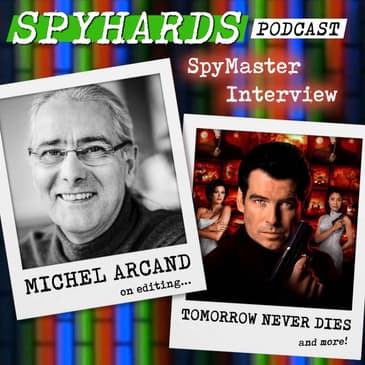


Agents Scott and Cam welcome editor Michel Arcand to the show to reveal top secret intel about his experience cutting 1997's Tomorrow Never Dies. He also shares stories about working on The Art of War, The 6th Day, and much more!
Become a SpyHards Patron and gain access to top secret "Agents in the Field" bonus episodes, movie commentaries and more!
Make your opinions about the NOC List known. Leave us a voicemail on Speakpipe or send us an email now!
Purchase the latest exclusive SpyHards merch at Redbubble.
Social media: @spyhards
View the NOC List and the Disavowed List at Letterboxd.com/spyhards
Podcast artwork by Hannah Hughes.
Theme music by Doug Astley.
Hosted on Acast. See acast.com/privacy for more information.
[00:00:38] Welcome to SpyHards Podcast, I'm Agent Scott. And I'm Cam the Provocateur, on a screen behind Jonathan Price. You're best on a screen away from Jonathan Price I find. The power button is often pressed when I'm on a screen. Yeah, I mean, or I just switch channels. That too, that too. Yeah, and that's where the mute button comes in too. And the fast forward strangely enough even though it's live. Yeah, I find
[00:01:03] a way to make it happen Cam, don't worry. And speaking of finding a way to make it happen, a lot of you will know that I'm particularly personally a big fan of a film called Tomorrow Never Dies. Cam is also a fan of that film. And it's been a while since we've done an interview for it. Yeah, it's been I think quite a while actually. And we are here this week joined by Michel Arcand,
[00:01:27] who's an editor who co-edited Tomorrow Never Dies, as well as films like Art of War and The Sixth Day. Yeah, and this is not, it seems almost inauspicious in a sense. Like, yeah, he edited a Bond film. Like, what stories can be within this? And we kind of pumped it up at the end of last week's episode. Folks, what you're about to listen to could be some revelatory material. There are stories about the
[00:01:54] making of Tomorrow Never Dies that I've never read before. I've never seen before. Truly, we have been eagerly anticipating putting this one out and we're so happy it's finally here. So without further ado, let's get to it. The editor of Tomorrow Never Dies, Mr. Michel Arcand. Here we go. Joining us on the show this week, he's an award-winning editor known for films like
[00:02:21] Night Zoo, The Art of War, The Sixth Day, and of course, Tomorrow Never Dies. It's editor extraordinaire Michel Arcand. Hello, Michel, how are you? Hi, Scott. I'm fine. And you? Yeah, I'm very well, thank you. I'm looking forward to talking Tomorrow Never Dies and maybe a little bit of The Art of War if we can get it in too. Yeah, sure. But before we get into Bond and beyond,
[00:02:46] let's go back to the beginning of your story. I'm always keen to know why people choose the path of getting into filmmaking because it can be quite a tumultuous career for anyone. Why did you choose to get into film? What inspired you to do so? Well, actually, I was more into music than into film when I was a teenager and a young adult, but I wasn't making money out of it. And then people
[00:03:13] started hiring me to cut commercial and to do editing. So I started making a living out of it. And then I realized that editing was a bit like making music. It was making music with picture and sound. So I just went into it like a deep dive and just kept on scuba diving. Well, was it an adjustment learning to edit film versus what you've been doing?
[00:03:40] Well, actually, I started on commercial and then started on documentary, which was sort of a real lesson of how you edit. Because when you're an editor in a documentary film, you're actually doing the whole film. You're actually finding a structure and finding out what's good and what's bad about the subject and making some sort of a story out of it. So from then, that point on,
[00:04:07] I realized that what I really liked was dealing with actors and dealing with people that had an idea before. So that way, I could actually improve on that idea by actually putting in my little feeling about what everything that's been shot is sort of a relationship between the director and
[00:04:33] the spectator at one point. As I always said, the editor is the first spectator that looks at the film, but actually has nothing to do with the difficulty of making a film and is also the first fan or the biggest fan of the director. So you're trying to put what the director wants inside the storytelling,
[00:04:55] which is sometimes a bit how sort of difficulty arrives while you try to shoot something. You know, getting an idea into reality is not that simple, even on on big budget. It's always the same thing. Big budget gives you bigger problem. Small budget gives you problem as well. But it's the same thing in the cutting room. You try to solve those problems in order to get back to the original idea
[00:05:23] and to have an emotional link with the people who are going to look at the film. So I really enjoyed sort of getting the feeling of everybody working on a story that has already been sort of script. So that way it's like a musician, you know, you can actually play your own music or you can actually
[00:05:50] play the music that's been there. And by playing it with a lot of emotion and trying to give it what you feel about it, it gives another level of it. And this is what I like about editing. Were there any directors early on that you got to work with that maybe helped, like what you look at as sort of like helping shape your direction? Yeah, well, I had a friend, a very close friend,
[00:06:13] a director and we had a film that was called Un Zoo La Nuit. And the first time I read the script, I was completely sort of involved in that script because I said to myself, I could have written that script. It was so close to me and to what I had as a feeling at that moment of what the film could be,
[00:06:38] you know, half action and half emotion and a bit of everything in it. And it was about a musician that had deal coke and was sort of coming out of jail. And it was very sort of emotional relationship between his father and him.
[00:06:59] And anyway, so I met that director, which was sort of a bum that had made it up to making a film. And I was sort of a freak coming out from India with long hair and, you know, like a little bit of a hippie. So we sort of challenged one another. And at the end, that film just got so big review in Quebec.
[00:07:23] It was just awesome. And from that point on, we became the most close friend that I ever had. And during the Bond film, he actually died in an airplane crash with one of a girlfriend, which I knew very well, a week before Lady died. So I flew back to Montreal for the... and all of Quebec was in tears
[00:07:51] because he was a well-known director. But the girl who was with him in the airplane was actually a little sort of star in Quebec. And so everybody was mourning them. So I went back to England and nobody knew them. So I was just alone in my cutting room, cutting dogfight, airplane dogfight.
[00:08:24] And then a week later, a lady died. And everybody in England was crying. It was just awesome. And I was... it was strange because I was living in Chelsea at that point. And the funeral car that had the
[00:08:48] lady died went exactly the same road as we took every morning to go to the Bond film in St. Alban, which was the place where we were shooting it. And it was really weird to listen to London being completely quiet. It was just very, very strange. Anyway, so for me, it was sort of... Bond was sort of a turning point in which I was...
[00:09:14] I was renting the house of the director that I really actually love, which was John Borman, who was one of my favorite director at that time. He had done Deliverance, which was for me, one of the greatest film. And so being in his house in Chelsea was like, you know, a dream come true. And in the same year, I mean, I lost my two best friends. And it was just so, you know, as high as you can get,
[00:09:45] it's... you can... you don't know what's going to happen in your life. And it was one of the biggest sort of reality check that I ever got. And so Bond is sort of an unescapable adventure for me. It's a turning point in my life. I mean, I can certainly speak to the vibe in England at the time when Lady Di passed away. It was my birthday. Oh, my God.
[00:10:11] I remember waking up. I was only 10, I think, at the time, and seeing the television news saying, please turn to Sky News for an important update. And I just remember, like, my parents fell silent. It was just like, everyone stopped. Yeah, it was just amazing. It was just, yeah, the huge, huge wall of flower in front of the... Buckingham Palace. Yeah, Buckingham. But the other one also, the... what's the other palace?
[00:10:40] I can't remember. Windsor? That's a castle. No. Anyway, it's not a big deal. But I saw people, you know, crying because everybody was actually mourning somebody they actually had in their life. It was not just Lady Di. It was sort of a collective
[00:11:03] mourning of personal grief. It was just awesome. It was an experience that I never sort of lost or... it really changed me. It's an interesting thing because a lot of people we have on the show, have had over the years, will talk about doing a Bond film and it's just sort of a thing they did for six months and they moved
[00:11:28] on to the next job and they didn't think too much about it. But there are times where life happens around it and it sort of instills those and ingrains those memories. So clearly you were obviously going through tragedy at the time you were working on Tomorrow Never Dies. It's probably still quite a raw and live moment in your mind. Oh yeah. And definitely because the producer Barbara Broccoli at that point, Cubby Broccoli was... died the year before. So that was the first time that they were actually
[00:11:54] producing a Bond film without copy. And so Michael Wilson and Barbara Broccoli. But Barbara, her best friend or sort of... was actually Fayyad, the boyfriend of Lady Di. And they were supposed to come in our cutting room on the Monday. They were actually leaving from Paris to come to her in the cutting room with the
[00:12:19] two boys. And so it was such a shock. It was just the whole set of Bond was sort of shaped by that news. It was just incredible. I remember people that, you know, young people in the cutting room like the assistant, they really joked about the majesty and the king and the queen and all this sort of
[00:12:48] hierarchy which is still in England. But when that happened, when the finally the queen addressed the people, everybody was standing like still. It was just like, you know, like an army. It was just amazing. It was amazing.
[00:13:11] I remember that recently, just a couple of years ago when the queen, our last queen, passed away. I was literally in the cinema watching a film. I got a notification blast through my phone. Everyone's phone went off at the same time, basically. Not like a loud, but buzz, a vibrate notification saying what had happened. The entire cinema cleared out. No one finished their film. Everyone just went home. Yeah. Because it's just, what do you do?
[00:13:36] Yeah. Now there's a, there's a bounding in England, especially, but I mean, if something happens, it's a bit like when the first man won on the moon. I remember that because I'm quite old. But it was just amazing how the whole earth was actually bounded together. And when something happens, you can feel that the people are just sort of one. You know, we all think that we're alone and then
[00:14:04] we're doing our things and trying to survive and everything, but it's not really true. And this is something which I feel when, when you have a film that actually sort of touches people, you can actually feel that you're, you go in a, I actually don't like premiere, but I go in the cinema afterwards just to feel what the people are, you know, living through the cut that I made.
[00:14:31] And when it works, you can feel the link between the story and the people in the, in the screening room. And you, there is something magical about the transmission of emotion. And this is something about the editing that I always said, you know, what the difference in the art of
[00:14:55] cinema is the fact that you can, can actually live the, the beginning of emotion. You know, you see a picture, it's already there. The emotion is there. You see a painting, it's always there. But in a, in a film, you can actually start with one emotion and, and with another emotion. It's like, it's the naissance of emotion.
[00:15:22] And that's what makes the whole difference. And this was always what I'm trying to cut, even in a, in an action film, I try to get to, you know, what started all. Wow. Well, I mean, there's already like a level of profound we're dealing with when we talk about tomorrow never dies, but I guess I have to back us up and just, you know, how did you join this project? It's kind of a silly question to ask after kind of going into heavy subjects like, you know, the passing of Lady Di, but just how did Bond happen for you?
[00:15:52] That was really a weird, weird coincidence. I was working in Montreal and Roger Spottiswood, who was the director of Bond film was actually doing a, a mini-serie about 50 years of Hiroshima. So he was, he was in Montreal, it was a co-production with Japan. And because Roger is actually a Canadian,
[00:16:15] his father came in Canada in order to create the National Film Board. And Roger was born in Ottawa, in Ottawa, but he lived all his life either in LA or in England. But, but still he had sort of a Canadian passport. So he came to Montreal on this co-production to do this Hiroshima. And at that point, because it was a
[00:16:41] co-production, his editor was not able to be editing. So he tried to hire people here in Montreal and really couldn't find people. And everybody was trying to get me into that, that project. But I was already working and it was just not possible. And I was not going to leave my project to go on another one. Anyway, it ended up that we never worked, but we heard a lot of one another.
[00:17:07] At one point, he started working with a young girl here in Montreal, who was a junior editor, but he, he sort of clicked with her, Dominique Fortin. And after the Hiroshima adventure, she went, Roger went back to LA and was doing a pilot. So she phoned him and said, listen, Roger, I would like to go and work in LA if possible. So he said, if you come in and be as a local, well, yeah, sure, you can, I can hire you.
[00:17:36] So she went there as a local. But at that point, we started, we fell in love, Dominique Fortin and me fell in love. So I went on a motorcycle ride right down to LA to, you know, to see her on our birthday, which was the 22nd of April. And so I arrived in LA, she was working on the FGM lot. It was just incredible, sort of a film scene.
[00:18:04] Me on my Harley Davidson and her on a, so, rented car, you know, like, anyway, it was just, just like a film. So we, I ended up being in LA for 10 days. And I met Roger, finally, I met Roger. So he says, oh, you are the guy. Anyway, so we just like, you know, he was a very enjoyable man.
[00:18:33] And I, we had a lot in common in a way. And I went back to Montreal. And by that time, Barbara and Michael asked Roger to do a Bond film. And so he, he asked Mark Comte, who was his sort of editor in LA. And, but Mark at that point had come to Montreal,
[00:18:56] he called to the, the Hiroshima and really didn't like to be far from LA. So he said to Roger, listen, I can't go for a year in, in London. I have a family here and it's like, it's not possible. So Roger turned around and said to Dominique, do you want to come? And Dominique says, well, I can't go there alone. I have a boyfriend. I'm just, we're just starting something.
[00:19:23] So, so he said, well, why don't you ask Michel if he wants to come? So at one point I was asked to go to, to a Bond film while, while I was working on a series in Quebec. And, and, you know, I had, I didn't know if it was going to work because we didn't have a working permit.
[00:19:44] But, uh, it ended up that I went to edit a Bond film where that ship my motorcycle over, overseas in order to, because it was only a contract for two weeks because the studio didn't know us at all. We were too junior for them. So, uh, they just signed us a contract for two weeks and, uh, I was on, on trial and Roger was on trial also because he had never done a huge movie.
[00:20:12] And, uh, he had difficulty with, uh, with producer generally. Generally, Roger is a very weird person. Like when he doesn't like something, he doesn't like something. And, uh, but we managed to, to sort of secure him in a way like, uh, he liked Dominique quite a bit.
[00:20:36] And he actually, I was, Dominique was taking care of all the, the, the PR and, or the, the general, um, relationship that you have on a big film. There's always a lot of people that comes in the cutting room in order to check things, either the, the, the costume designer, the, the agent of the actors or everybody comes in the cutting room.
[00:20:59] And, uh, and, uh, so you can't edit really. So, uh, so I was cutting and Dominique was taking care of all that shit. And, uh, so it was great. So we had this kind of team that Roger really enjoyed. He would come in the cutting room and cutting room and just crash because he was, he would be exhausted and just crashed.
[00:21:19] And it was just, so we had a lot of fun doing it. And, uh, there's one thing that I was thinking about when I, I was, uh, thinking about the Bond film is that it was the first time that we tried to do a film. Roger at that point wanted to do a film without any kind of, of, uh, he wanted to do a digital film.
[00:21:43] And, uh, it was starting, we, we were starting to have, uh, digitize, uh, negative into, uh, Avid. But at that point, uh, the hard disks were 4.5 gigabytes. And, uh, it was really, really sort of the beginning of it all.
[00:22:02] And, uh, so we decided that Roger wanted to have a, uh, completely free, uh, uh, uh, working copy, uh, film. So in order to cut the film only in digital, like with the Avid. So we had, uh, we reformat, we had, uh, somebody doing a program to format the disk to nine gigabytes. So that way we could have enough space to put all the material on it.
[00:22:32] But more, our major problem was, was a projector. In those days, there was only a barcode which was, which was, which was three light. And it was never very sort of sharp on the, on the side. And, and it was always grainy and a little bit out of focus. So we couldn't really screen the dailies. We started at the beginning and tried it, but it was too, it was not, it was not good enough.
[00:23:00] So we went back and had a cutting copy made in order to screen the dailies. And then it was digitized and then we would cut it and then put it back on film. So we had two sort of set of, of cutting room, one on film and one on digital.
[00:23:16] And at one point, two guys came up to the, the production and said, we have this prototype, uh, projector that we would like to show you in order to get a sort of the approval of bond on our prototype. So that way we can sell it.
[00:23:36] And then, um, we had a, uh, uh, the, uh, the, uh, the, uh, the, uh, the, the, the, the theater, uh, and, um, they started shooting.
[00:24:01] They started showing us, uh, sort of a real. And I was looking at my little reference screen and the screen in front of me. And I was just saying, wow, this is the end of film. This, this is incredible. This is so sharp and it's, it's so steady. And it's like, wow, this is it. So I went back and said to Roger, Roger, this is the projector we were looking for. Like, uh, so Roger said, but I said, yeah, yeah.
[00:24:31] And he said, there's only two of them, you know, and they won't let it, they won't let lend it to us. So Roger said, don't, don't bother. And the production actually got that projector. And we were the first to do a, uh, uh, screening, a public screening, a test screening, in fact, with a digital projector. And, uh, from that point on, uh, well, there's no film being projected nowadays.
[00:24:59] So we saw the birth of it all. That was quite, quite impressive. It's funny. Cause like, I feel like there's two very under reported stories in terms of the production of tomorrow never dies. You know, we talked about the passive lady die, die and the impact sort of on the atmosphere. I've never really heard that mentioned in terms of the connection between the film and what's going on. And so often with movies, they talk about events that were happening at the time.
[00:25:24] I mean, you look up any movie shot in 2001, when they talk about 9-11 and the impact that had on, you know, the crew and the morale. And it's interesting that that's not something that's come up very much when I read about tomorrow never dies. And that's the second story you talk about the digital projector. That's not something that's heavily promoted when they talk about just the events that were happening in the industry at the time of that movie. Well, you know, as I said, Roger is a very special character.
[00:25:52] And at one point he got really sort of at war with Barbara and she boycott Roger quite a bit afterwards. And at one point when we did that projection, it was the director's cut 14 weeks after the shoot. And Roger was going to be thrown out. It was like they didn't want him anymore.
[00:26:17] And but the project that screening went so well, we got 97 percent of approval and people just love the film at that point. So he stayed on on it. But Barbara wouldn't talk to him anymore. It was just Michael Wilson. And Roger wanted to have some close up of things.
[00:26:41] And so Michael deal with him and said, yes, we'll have them. And so Roger finished the film and it was, you know, sort of what Roger wanted. But as far as the producer were concerned, I don't think that Barbara ever sort of decided that Roger was a good man for her or anyway.
[00:27:09] And she sort of hated him with a passion in a way. He made fun of her in a public place and she never actually, you know, took it. So Roger is, you know, he can be very, very mean at some point. He's a very great guy. As far as I'm concerned, I never had any kind of difficulty with characters, but he is a character.
[00:27:36] And so this is probably why, because it was sort of, you know, obscured. Every time they came up with different collection of film for years, there was never Tomorrow Never Dies in those. It was sort of, you know, just put a push back.
[00:27:56] And so when you read about like a lot of the narrative about the making of Tomorrow Never Dies, a lot of it is about how it was on a very, you know, fast production schedule because of wanting to follow up GoldenEye. And that there was a lot of time constraints. It was like a much faster production than even the Broccoli's were, you know, had really experienced very much in the past. And is that something you felt as the editor? Like, was there a sense of time constraints?
[00:28:24] Well, actually, there was this pre-sequel. In every Bond film, there's a pre-sequel that you do. So we were on test for doing the pre-sequel scene. And because Roger was sort of, you know, not really known by the major and they were testing him.
[00:28:47] We weren't known as, and so everybody was sort of, you know, the producer were not known. It was just a new team for Bond. So everybody was on a bit of an edge until they saw the pre-sequel and everybody agreed it was going to be a good film and everything.
[00:29:05] But then again, at that point, Universal Studio, there was only one thing. That Bond film was for me, the only film on which I worked, there was no budget limit. Whatever we asked, we had. The only thing that we couldn't do is change the date of when it was coming out.
[00:29:29] That we couldn't change. And I was always wondering why, why can't we change that date? And at one point, Mike Madovoy, who was the president of United Artists, I met him a couple of times, but at the premiere, I asked him, you know, why, what was that with that date?
[00:29:53] And he said, well, you know, we had a financing of four billion dollars for United Artists. And we were coming out with the Bond film was our card to bring everybody in a couple of days before the premiere in order to get the courtier,
[00:30:18] to sell our bond, to sell our bond, to build up that four billion dollars that they needed. So, so they couldn't change that because that was the date that they had to come out with some sort of a plan and trying to sell parts of that money they wanted to have.
[00:30:46] So that was the only sort of point that we could move. But it was a fast sort of, you know, because of the difficulty that we met, you know, like on the pre-sequel, they were delivering a mock missile to France.
[00:31:11] And at that point, there was this sort of embargo on all the, they didn't want to let it come in. And so there was a lot of problems just to get the set in France and in the Pyrénées.
[00:31:28] And at another point, there was this sandstorm from the Sahara that actually covered the Pyrénées with sand on one side of the ice shield. So everything was pink and the other side was white.
[00:31:44] And, you know, at one point that the whole crew was leaving to go to Vietnam. They were supposed to go to Hanoi. And suddenly they're at the airport and the mayor of Hanoi says no. And although they had all the permission and everything was done, there was all a done deal. There was a boat leaving with all the scaffolding and it was already going there.
[00:32:12] And suddenly you have to change plan. So they decided to go to Thailand and in Thailand, it was the beginning of the rain season. So, you know, there's always something in a big production that you can't cope with. You just have to turn around and try to do the best with what you have.
[00:32:32] So in a way it was a short schedule for all the problems that they had, but it was still a year, you know, from the first day that we arrived in London and the day that we had the premiere, that was 19 December. Sort of. I read earlier today that the finished script was delivered in July of that year. It was always in progress. There was loads of pages changing every day and stuff like that. Yeah, exactly.
[00:33:01] How is that affecting you as an editor? Well, I was, you know, because we came from Quebec and in Quebec, we don't have a lot of money. And when we do a film, we don't have time to go around and shoot again. So, you know, you deal with what you have and you try to make it work. So even on, we came into that big production. I had never worked on a big production at that point.
[00:33:28] And I just dealt with it as a small film. For me and for Dominique, it was quite easy to make decisions. But usually people don't make decisions in those films because everybody is afraid of their career of some sort. Everybody has an agenda. You know, they worked on this film in order to get to the next film or to work on, you know, they deal. Everybody has an agenda.
[00:33:57] But Dominique and I didn't have an agenda. We were just happy to work on a Bond film. It was just incredible. So we were coping with the difficulty with just like anything else. We didn't care about how difficult it was. It was just another day at the job trying to get the emotion inside this storytelling. And we had so much. I mean, I would say to Roger, I need a shot for this. And he would say, well, go and shoot it.
[00:34:26] And I said, excuse me. So he said, yes, you know, we don't have a team. So shoot that shot. So I went for a day being a director on this, the shooting the screen in that, in the pre-sequel, you have this, you know, they're all into the control room looking at the screen. So we didn't have any close up of the screen. So I went there and shot the screen.
[00:34:55] But at one point, I was unhappy. So Roger asked me, you know, it's noon. And he says to me, so how does it go? I said, well, not really. The crew doesn't really listen to me. I mean, they joke about me because I was sort of a young kid. And then, you know, so he said, okay. So he came there and started yelling at everybody and saying, you do what this guy says. And you don't, if you don't do it, you're out. You're going out. This is it.
[00:35:25] So on the afternoon, I was sort of really respected. And then at night, we screened the shot and I said, oh, fuck. I don't have the shot that I, because, you know, when you shoot things, I learned a lot that day because when you shoot something, it seems like going for hours, that shot.
[00:35:47] But when you're in your cutting room, you say, oh, fuck, you know, I should have done it much closer or waited longer in order to get to that point. So I said to Roger, I'm not really satisfied. He said, okay, well, reshoot. So the next day I had a reshoot. So that was my experience with the bomb. So, you know, it was so, so sort of a magical atmosphere. It was just incredible.
[00:36:20] Yeah. Wow. Like, it seems like there's almost like an experimental vibe in the editing room for Tomorrow Never Dies, which you wouldn't expect with a production like that at all. I was curious with like the broccolis, you know, with Barbara and Michael. Was there certain things like, you know, when you're going in that they're like, we have to have this, like this needs to be presented, like kind of almost like a list of like, this is a Bond film. There's certain rules you have to follow. No, they were never like that.
[00:36:49] But the point was for them, they had a very sort of bad adventure with what's his name again? The composer, French composer of GoldenEye. And Sarah. Exactly. So he, he would, he didn't want to do the Bond team. So for them, it was just like a sort of a scandal, you know, like, so they, they were sort of very, very keen on having the Bond team brought back into the franchise.
[00:37:20] And at that point, they were really into it and trying to find somebody that would do it. And more than invest into what the, the, the whole film was, was going on, you know, they were learning as much as we were sort of in a way. So they were focusing more on the music.
[00:37:40] And so, you know, they were sort of always on our side, trying things and not very directive, you know, until this sort of seizure came with Barbara. Then it sort of became a little more tense, but not for what the film was all about, more about relationship between people. And, and Michael just like handled it very, very gentleman.
[00:38:10] He's a very, very gentleman. That, that man is incredible. Well, I want to jump into the, to the chat about music. I think that's an interesting subject, especially from an editing point of view, but I'd be remiss if I didn't just follow up the, the Barbara Broccoli story a little bit there. Were you around when that sort of fracture happened? Was it like a, an argument on set? What sort of caused that antagonism? No, it was in a restaurant.
[00:38:37] Nobody was there, Bob Barbara and Michael, and I don't know who, but we heard it about the next morning. It was just like, it was really, really, very tense. And, and from that point on, it was sort of, you know, because Barbara was very sort of, not close, but she was sort of, you know, about our age. And it was just like fun.
[00:39:03] And she was having her first real producer's experience. And as we were having our first editing experience. And at one point when I, I actually flew my motorcycle to London, you know, and so I had my Harley there. And Barbara at one point said, Oh no, I, if I had known, I would have not permitted you to have your motorcycle here. It's too dangerous and everything.
[00:39:32] But then again, Lady Di died in the most secure car you can imagine. And so she, you know, it's not, it's not because you have the, the tank that you're not going to die. And it's not because you're on a bicycle that you're going to die. Yeah. And I suppose that makes sense from Barbara's perspective, as you mentioned before, it's the first film her and Michael are handling themselves without Cubby or his wisdom.
[00:40:01] He's not particularly there for GoldenEye, but he's around. Yeah. So there's a lot of pressure on them. So I can understand why it was a bit of a sort of a pressure pot, you know, on that set. Yeah. She, she was really involved much more than, than Michael. Michael was sort of, you know, a bit like he, I guess he was in the other film, like he was sort of co-producing, but it was Barbara that was actually the, the, the, the real producer in a way on that film.
[00:40:29] So having this sort of rupture with the director was quite a difficult experience, I guess, for her. And, uh, it turned out to be a very sad experience for Roger, uh, because he, he took a long time before he actually got another big production. Um, because of that. And that other big production didn't work well. So that was it for him. You're only as good as your last film.
[00:40:59] Okay. Was that more as in just talking to the point you've raised there, was that more Roger having sort of self doubts based on what happened with Bond or was that, you know, behind the scenes shenanigans? No, it's behind the scenes. Mm. Yeah. He was supposed to do a film, uh, that film with, uh, Stallone, uh, climbing, uh, I can't remember. He, he was supposed to do it. He had gone around the world with, with his director and, and, and choosing location.
[00:41:28] And then suddenly they pulled out the, the, they said, no, we're going to hire a younger kid. So, and they always thought that it came out from the broccoli anyway. So there is always this sort of, you never know who it is and what it is, but it still ends up that you're sort of blackmailing away or, or put on a sort of blacklist. All it takes is one conversation with a producer and. Yeah.
[00:41:58] You know, yeah, exactly. Yeah. Oh, well, I mentioned music and you, you, you brought up music. So I'd be remiss if we didn't dive in. Obviously they did find a composer in David Arnold. Um, but because of the sort of rushed production of the film, were you scoring? I mean, so were you putting temp tracks to tomorrow never dies or was, was David Arnold providing the music as they went along? What was that process like with David?
[00:42:22] That was, it was really fun because David actually had done a, a CD were actually finishing a CD on, on the teams of, of Bond. This is why they actually had him brought on in the film. But when he came in, he says, uh, no, so what am I going to do with this? You know, it was really very honest and very simple. And, uh, and, uh, so, uh, I said, well, give me some tracks that you're working on.
[00:42:48] Give me something that you, and I'll try to put these in because I always tend to put the tracks that, uh, if a composer is already sort of on a film. If you put another music than what the composer has done, it's, it's difficult to sort of do the same thing or not. And, and being sort of influenced by what you've put in.
[00:43:13] And sometimes they don't have the budget to do what you've put in, you know, from a CD that costs $200,000. While the guy has, you know, on a big production, it's not the problem, but on a small budget film, it's quite difficult to, to blend the two of them. So what I usually do is I ask the composer if he's on the, the project before the end, because sometimes he's just hired at the end of the post-production almost.
[00:43:40] But, uh, if he's hired before I asked the, the, the, the, the composer to give me some tracks on which he's working on. So that way he's not sort of out of the blue and trying to imagine something else. And I'm, I'm, I try to find out places where I could put his music and try to cut it in a way that it, it becomes a piece.
[00:44:05] So that way he, he listens to his music and feels the, the, the, the, the intention of what the music should be doing in his own words. So it, it, it's always a, it always worked well. And I've done quite a few film in that, that way. And it's always a, a winner. And because I, I love music, for me, it's just fun to do. It's like composing in a way.
[00:44:33] And then they come back because I mean, the Bond film was also one of the film in which we had so much sort of change over and cutting on right until the end that, uh, they couldn't follow. We had recorded the music with 88, uh, piece, uh, uh, orchestra. And, uh, at the Lynnhurst studio, which was, uh, I mean, for me, it was an experience, an unforgivable experience.
[00:45:02] I can say it's like, I was just incredible to be over the, the, the, the, the maestro right, right on top because there's a sort of a balcony. So I would stand there right over the orchestra and I could hear what the maestro was actually hearing. And I couldn't believe my ears. It was just like velvet. It was just incredible. Anyway.
[00:45:24] So, and people, you know, playing music on the cut that you made with such a big orchestra, it's just an adventure that, you know, it's once in a lifetime sort of experience. Anyway, uh, we had to cut the music again and again, again, and still I can hear places where we've cut the music. And because the record, the recording was already done, we, we had to manage with what we had and do a blend.
[00:45:52] So I would put a jet or something on it. So in order not to hear that cut, but if you listen well to the music, you can hear cut in the, in the music. But David was really great. He was just, you know, do whatever you can with the music. And he was, he was, yeah, a great guy. Yeah. I mean, cause you put together some crackerjack sequences, the, the, the backseat driver sequence in the car park when you, the rockets and everything he's driving in the back that the music editing, it's just flawless in that moment.
[00:46:21] It's like you're, if you, if you're speaking of music, it's like a symphony, you're all working together there. It's, it's great. Yeah. Yeah. Well, that's one, one scene in which I had cut with the music and, and recut with the music being recorded and, you know, blend the two of them. And it's, it's not often that you get that opportunity to, to, to cut something and then rework it with, with the music.
[00:46:45] You know, generally you cut or the music has been done or you, you know, the music is going to be done afterwards. And that's it. Yeah. But this was sort of a, a blended work, uh, with, uh, actually it was also the, uh, I can't remember the name of the girl that was the editor, the music editor in which she was great also.
[00:47:06] And, uh, yeah, I've worked on another film in which she was also, it was, uh, the, um, sunshine film by, uh, Yeah. With refines. Yeah. Yeah, exactly. And she was the, uh, the music editor and, uh, the music, the, the composer was, uh, uh, Oh Jesus. Is that, uh, Dina Eaton? Yeah, exactly. Dina. Yeah. And, uh, she was a great music editor, really.
[00:47:36] And, um, yeah, on that, uh, sunshine film, it was, uh, uh, a great composer that, that actually did the, the LARF team on the, uh, Chivago, Chivago, not their Chivago. And, uh, uh, anyway. Oh, it wasn't Maurice Jarre, was it? Yeah, exactly. Oh, wow. Okay. Yeah. Yeah. Wow. Yeah. Yeah.
[00:48:00] And that was, that was strange to, to work with, uh, such a, uh, I, I'm, I was a fan of his son and a fan of him, but it was like sort of, uh, somebody that, uh, was from, uh, another generation sort of. And, uh, but, uh, he was, he was great. He was, uh, he was a bit lost. It was strange because at one point he would call in the cutting room and say, what the hell am I doing? What am I going to do for music on this?
[00:48:27] And I said, just because the director just loved Schubert and, uh, you know, didn't want anything else than Schubert. So I said, well, just orchestra, orchestra, do something with the Schubert team. But that was strange to have Maurice Jarre calling in the cutting room and asking, you know, what, what should I do? But isn't that great to know that like the, even the geniuses have those creative doubts at times. Oh, definitely. Everybody. I mean, everybody is just a simple man.
[00:48:57] I mean, this, even the biggest star is just, you know, you and me. I remember going out on the restaurant with Pierce Brosnan and coming out of the restaurant, these two girls almost fainted seeing it. And they said, Oh my God. You know, and you say, Hey baby, take a Valium. I'm old. It's only me. And it was so, so real. Yeah. Yeah.
[00:49:24] Well, I wanted to ask about like, you know, Scott brought up the backseat driving sequence in the film, but like the Bond films are famous for their huge set pieces. Was there any in particular that from the point of view of the editor were like maybe the most difficult or the most challenging to put together and make work? Well, probably that scene was probably the most difficult because it was all shot in different time and with a lot of material. It was just seven.
[00:49:53] There were sort of seven team that would shoot. There are 44, no 42 cars that were actually used to do that scene. It was just like a big, huge puzzle, you know, in a way. And right up to the end, you don't really know if it's going to work.
[00:50:14] And because I'm a bit sort of, because I come from an editing world in which you don't have that much footage, you tend to use everything that's been shot. And it's like, you know, they did an effort to shoot that. I should do an effort to try to put it into the story. This is always what I think. And until the end, I will, it will take me a lot to take out a shot.
[00:50:41] So, and because I started working on film before digital film, I have this tendency on doing a very large first editing. And then as I go, I shorten every time a little more. I take out things because in film, it was difficult to put back things because everything was in rolls and everywhere.
[00:51:09] So you would choose almost everything that you'd like, put it into a reel and then do another pass and bring it down and down and down in order to have the less splice possible when you do a screening. And so you don't have that problem with digital. But in our days, we would do a lot of editing in our head. And so I would bring down the film.
[00:51:35] So, so I started doing digital cut the same way. So I would put everything in and slowly go to the most sort of powerful scene, I would say, or most fun or, you know, most action, whatever it is you're editing in a scene.
[00:52:00] It's try, try to get to the maximum of what that scene can give, but it's always a sort of downsizing something. So for that particular scene, I think it took me a month and a half in order to get to that point of work and not, not just sort of long days. It was an endless story.
[00:52:27] So it was a film on its own, a bit like the pre-sequel scene was, was a film on its own. Well, like there's a real sense of like building tension in a number of the sequences in that film. Cause I think of, you mentioned like the pre-sequel, the, you know, pre-credit sequence with like the countdown clock. I think of, you know, the backseat driver. I think of some of the stuff with the motorcycle chase and the helicopter pursuing them.
[00:52:52] But even a small moment, one that always jumps out to me is the moment after the Terry Hatcher character is dead and Bond is with her. And there's the assassin sitting opposite them planning how he's going to kill them. That's a small scene. It's three actors in a room, but the way it's like cut, you really feel that rising tension just in that smaller moment. And that's something like Bond movies. You know, you don't often look at them and say, I love the small moments in these movies, but that's a key moment that I think sticks with a lot of fans.
[00:53:22] Yeah, probably. It's one of the sentence that I could shoot you from, whatever the, you know, it's a sentence that kept on growing on us in the cutting room afterwards. And, and, but because also we were two editors and we would, you know, pass one scene to another, you know, we were without any kind of ego involved.
[00:53:48] It was just trying to figure out the best way to cut it, that we ended up being sort of able to treat every scene a bit with the same intention, the same sort of pace, the same sort of, well, depending on the scene, but with the same intensity, I would say.
[00:54:07] And so, because Dominic cut part of the scenes and other parts of the, we would, you know, we ended up finishing the Bond film without actually, we were finishing because it was such a close, tight schedule that we were, we had to finish reels before we actually finished the whole film. And so it was just insane.
[00:54:36] We would finish reel two before reel five. And then, you know, because there were thousands of cuts in those reels. And it was just, and the assistant would keep on working all night long in order to get those copies, the film copy ready for the morning to screen it.
[00:54:56] And it was just a huge job of just following up the editing we were doing on digital because we were cutting on the Avid at that point. And we were screening, still screening on film until the end. And it's just, it's just when we had that first projector, the screening that from that point on, we started screening regularly on digital.
[00:55:25] But before of that, before that, it wasn't, it was impossible. So we ended up cutting the film in sequence and trying to figure the whole beat of the film in our head. But because Dominique and I had worked on film, real film, we had that capability of seeing the film in our head before we actually did do it.
[00:55:53] Nowadays, you know, it's so easy to assemble pieces of pictures that you actually just put them together as you screen some material. And then you have a first cut. It wasn't that easy before. So we had to work in our head much more.
[00:56:15] Now we tend to, you know, take for granted that their first cut is almost the right cut, which was not the case. And is not still not the case for me. I would keep on working and working and working on scenes, which already works for a lot of people. But because you know that you can push it a little further. The last film I did, we had a screening. Everybody was okay. The producer, we're all fine.
[00:56:43] And then I went into the cutting room and called everybody back. The script writer, the director, the producer. And I said, I have this little thing I would like to change. And everybody's looked at themselves and says, what the fuck? Why are you doing this to us? Everything worked well. Now we have to choose again. But it ended up that it was a little better.
[00:57:10] I think we've had an editor on in the past and they said something similar to an editor's work is never actually done. No, it's just a time that I actually always say that the work of an editor is making a decision between two shot. But you always put yourself back into the right one. It shouldn't be this one and that one and that one. And it's only because there's a time limit that you actually make a decision.
[00:57:39] But you would keep on doing it for years and years. There's no end. I guess that makes the title of the film quite apt in this case. But I would be remiss if I didn't dive into the sort of editing. And one thing I know to do my research for this is there is a lot of deleted scenes for Tomorrow Never Dies. And it is actually one of the shortest James Bond films in history. I think third shortest.
[00:58:05] Was there any particular moment or scene that you were really passionate about that you wanted to keep in the film, but just for time reasons or Roger didn't want it or the producers didn't want it, you had to leave out? No, no. It was obvious at a certain point that we didn't need that in the storytelling. And we wanted to have a film that was moving on. And, you know, for me, there's two types of storytelling.
[00:58:30] There's one type in which you take your time in order to give the spectator the real time in order to live the emotion inside their own recollection of what they lived. And there's another type, which is much more action kind of. You take somebody from the start and you bring them to the end of the film, which I call an action film. You don't give time to think.
[00:58:58] You just bring them to the story at full pace. And there you go. You're at the end and you say, wow, maybe I'll look that film again. You know, it's that kind. But the two are as good for me. And I love to edit both ways. But it's different, very two different way of storytelling as far as I'm concerned. You've mentioned all these things like were somewhat working against you. You've got the time pressures.
[00:59:26] You've got a little bit of infighting between producers and director here. Was there ever a moment during your editing process for Tomorrow Never Dies where you thought you just couldn't get it together in time for that release date? No, the biggest problem was that we had a way of working in Montreal at that point. And we would put, you know, we would synchronize the dailies that were on film. And we would digitize them into the Avid in a certain manner.
[00:59:54] And to make sure that everything was on sync, we would punch the negative, you know, real punch in order to have a real sort of synchronized place. And then we would have another punch at the end. So that way we would make sure that everything was kosher and in sync. And because at that point, the Avid would tend to give you a different sort of cut, not cut, but a different frame.
[01:00:26] Because it was not sort of frame accurate with the negative. So to make sure we would have that process going in.
[01:00:34] But we ended up in Bonn with a post-production director that was actually much more into trying to get the digital aspect of the film by transferring dailies from Vietnam or whatever the place we would shoot up to the cutting room through satellite. And, you know, that kind of things that he would be involved into trying to solve all these problems.
[01:01:03] While in the cutting room, we would have a lot of problems and nothing was solved. So at one point, Dominique and me actually asked a friend who was a post-production director with whom we had worked quite a bit and whom had actually established this kind of protocol.
[01:01:25] So we asked him to come, pay his ticket, had him stay at our place and have him investigate how the post-production was going. And he came up with a result that there was this discrepancy between, you know, everything going on and we were going right into a wall.
[01:01:46] And because there was no reference whatsoever for the sink and the frame accurate sort of relationship between the negative and the cut we were making on Avid. So he established, you know, putting a start and an end point. And this saved our life.
[01:02:14] And actually, once he made this report, the producer actually said to him, well, you stay and you sort everything out. And they paid for his stay. But that was our main, main sort of difficulty because we were sort of junior in big production. We didn't really know. We were in London and this was not our sort of, we didn't know anybody in London from post and everything.
[01:02:44] So we took for granted that people that were there were the people that were supposed to be there. But at one point we realized that it wasn't working. And so we took on us to solve the problem. And this is what was so different for a major production like that was that we would take decision that nobody would take. Normally, we'd ask the producer in order to get things done.
[01:03:14] There would be a committee, you know, a reunion. And but because we were sort of a team, Dominique and I, and because we knew Roger, it was sort of we would make a decision and didn't care about, you know, we thought it was a good decision. We would do it even though it was not approved. And everybody would say, well, it's not approved. And we say, no, it's OK. It's going to be approved. And we would go on and it worked well.
[01:03:44] So, you know, that was our main difficulty. And another difficulty was one day we came into the cutting room and we had a full. So, because the disc were so small in those days, we had a room of hard disc.
[01:04:04] And one morning we came in and there was this water because there was a fire extinguisher valve that actually went on in the night and everything was in water. So, we were like freaking out everybody because we didn't know if the hard discs were being touched. And that was months of digitizing that was involved.
[01:04:30] And but apart from that, you know, it went OK. We interrupt this program to bring you a special report. Agents, we don't expect you to talk. We expect you to buy a subscription to our Patreon. Eee, that's right. Over on the SpyHards Patreon, we're covering all your favorite spy TV shows, as well as popular films from the most iconic secret agent actors of all time.
[01:04:58] Cam, why don't you share some intel on our latest assignment? Scott, imagine that you found a portal back to a pub in World War II. How much spy jinx would you get up to? Well, that's also the premise of the 1990s comedy sci-fi series Goodnight Sweetheart starring Nicholas Linhurst. Does this quirky comedy still hold up? And how does it play for those outside of the UK? Tune in and find out those answers and so much more.
[01:05:27] So accept your mission and help support your favorite spy movie podcast at patreon.com slash spyhards. But before we activate the fourth protocol, let's get back to the spy jinx. I mean, I'm surprised we actually didn't ask this up front, but it is relevant to your job on the film, which is how big a Bond fan were you?
[01:05:54] Because then that kind of lends itself to how much pressure you feel taking on a Bond film for yourself. Well, to be honest, I was never a Bond fan. I watched Goldfinger when I was a kid and I liked it, but that was it. I was more like a freak and I would like Fellini and Bergman and films like that.
[01:06:24] I wasn't too, you know, action film was not really my trend and I was more into poetic kind of storytelling and music. And then suddenly I'm on a Bond film and I didn't really realize everything. And, you know, I had a contract of two weeks. I had brought my motorcycle saying to myself, if it doesn't work, I'll just go across Europe and fuck it all. And I'm with my girlfriend, you know, it's like I'm in love and that's it.
[01:06:55] But when I cut the first pre-sequel and I put the music, the Bond music on it with the opening scene of the gun and everything, then I felt a little sort of, you know, a little tremor in my arms. And I was just like, whoa, my God, this is real. So this is United Artists and this is big.
[01:07:18] And I remember when we pushed the recorder on the end before we went screening, I pushed the recorder on the output of the Avid. We didn't know if it was going to work until the end because usually it would stop at one point for an unknown reason. And then I said, everybody, we quit every computer. We just do one computer will render and we will know.
[01:07:47] And so we watched the film as it was rendered in real time. And I told everybody, you know, this is the first time that we're watching this Bond film before at least a million people. So it's like, you know, it's sort of a little nerve wracking moment. A very special moment because you realize that, you know, this is going to be screened by a lot of people.
[01:08:17] Yeah. Good or bad. It's on top of the chain and it's going to go down. It's going to ripple down. You know, when you do a film in Quebec, it's like you're down that mountain and you try to push it up. But when you're on these huge production that goes wild, wild distribution, it's like on top and it just goes down, you know, it's going to end up that somebody is going to see it that, you know. Yeah.
[01:08:44] It's less the question of will they see it versus will they like it? Yeah, exactly. But the other way, the other thing also is that I realized that making a film is something, but the power of mise en marché, of selling it is also something very, very important.
[01:09:14] I mean, we had the screening for the cast and crew at Leicester Square and this, we had three cinema. And one of the cinema was for the real cast and crew. The two other ones were actually for all the people working on product management, you know, but mise en marché. I don't know how to say it, but the publicity of it.
[01:09:44] Yeah. And there was more people on the publicity of the film than on doing the film. I was really impressed. And I realized that in those productions, the critics don't have that much to say. Because, I mean, the Bond film was on TV sets that people wanted to sell a TV. Well, there was this Bond in the TV set. It was just everywhere. It was on bus stop. It was everywhere.
[01:10:13] And it was just amazing how much publicity is done in order to have people. You can't just walk away from a major film coming out worldwide. It's like either you're going to hear about it. People are going to talk about it. Your friends are going to talk about it. And you're finally going to see it anyway. You love it or you hate it, but you're going to see it. It's not a question of is it bad, is it good?
[01:10:42] It's a question that it's an event. So they create the event. Yeah. And I remember, you know, that's the season where you have Tomorrow Never Dies opening. And Titanic opening pretty much the same time. Oh, yeah. It was a great sort of question. Everybody was freaking out when they heard that Titanic was coming out. And then everybody said, oh, yeah, but it's not the same story at all.
[01:11:11] It's not the same public sort of. And actually, yes, that Bond made very well. And Titanic just went Titanic. Yeah. Yeah. But it's funny because like Tomorrow Never Dies seemed noisier coming out of the gate. And Titanic's noise came a lot like kind of over the weeks after people discovered how much they loved that movie. Yeah. Yeah. Well, it was a very big sort of challenge for James Cameron.
[01:11:37] I remember reading about James Cameron saying, listen, I want to have this pool with this sort of horizon. And the producer said, no, it's too expensive. And he says, I'll give you my residual. And they didn't take it. You know, he made a fortune because they didn't take it. Because they didn't think that he was going to make money. Yeah. Yeah. Yeah. No one did at the time. Only James Cameron. Yeah, exactly. Well, you sure did a lot. Boy.
[01:12:07] Speaking of the Titanic and perhaps disasters a little bit, there was one story that has followed Tomorrow Never Dies for years, which is a little bit of antagonism between two of its leads, which is Pierce Brosnan and Terry Hatcher had some squabbles on set. Did you ever get any vision on that? Any sense of that when you were in the editing room? No, not really. But we knew there was something going on.
[01:12:31] But as far as we were screening the dailies and there was nothing on what they were playing, actually. So it was sort of convincing that they were sort of in a relationship without any trouble in it. So, but no, as far as I was concerned, I never, actually, I never went into much of the gossip that was going on.
[01:12:56] Or this is what I like about editing is that you're doing the story. You're not dealing with story of people in the set. There's so many things that can go wrong because of relationship between one another and things going on. And there's so much to, I always say that a director has a, you know, to manage the characters more than the character.
[01:13:27] Well, we in the cutting room only deal with the characters of the film. Well, then on that sort of Tomorrow Never Dies note, as we're starting to wrap up on the film, I want to ask a little bit about its legacy. But is there, thinking back on your time editing the film, is there a particular moment or a decision that you made that perhaps people haven't noticed or don't notice all that much that you're particularly proud of? Like a small edit that you, when you go back and you say, oh, that was me, that was a, I definitely got that right.
[01:13:56] No, I, no, not really. I don't go, you know, for me, when I close a film, one of the biggest moments that I remember is that after Bond, which was sort of, you know, seven crew all over the world. And, and, and, you know, tremendous, a million feet of film and, you know, a lot of footage that are over our head. And, and then I come to Quebec and I work with the director that I loved and I've, I've done, you know, 14 films with.
[01:14:26] And she was doing a film. So I come back to Quebec and I do a film and there I sit in the cutting room and there's two takes, one camera. And it's like, oh my God, what am I going to do with that? It was like a decent talks, you know, like, you know, you go into detox. It was just, oh, wow. We, that, that moment I remember, but, you know, what I, did I do well or didn't do?
[01:14:54] I always try to do the best as I can and that's it, you know, and there's always a limit on what you can do because of the time, because of the budget, because of the story, because of this and that. But most of all, you try to do the best in order to get the most of what the director is, is wanting to see and give him more and trying to get the best of what every department is putting on as an effort.
[01:15:20] And, you know, if I have to choose, I will choose whatever the actors are doing and then I will choose the best sort of frame. But nowadays you can always change all of that. But before you would, you know, you would go with what is the most important. What brings people inside a theater is the star.
[01:15:47] It's either the director or the actors, but it's something that pulls you in and this is what, stick with the money. This is what you go for when you're editing because this is what people want to come to see. You know, a Charlie Chaplin film is a Charlie Chaplin film. You don't start looking at the other guy. It's Charlie Chaplin. So, you know, I wouldn't say that there was things that I regret or not.
[01:16:16] I always try to do the best I can on every film. I suppose that my final question for Tomorrow Never Dies, and I think Cam's going to move us on afterwards, is looking back on the experience you had. And I note the sort of, we started talking about quite profound moments, you know, with Lady Dice passing on the set and things like that, that will, of course, be ingrained in your memory. But is there a moment when you think back to editing Tomorrow Never Dies that always sticks with you? Yeah. Yeah.
[01:16:46] The fact that we were, I was sort of on top of the world in a way, living in, having Eric Lapland playing guitar in the next porch, sort of next to our place. And, you know, being in the next to King's Road, which was sort of the Mecca of the 60s, 70s, you know, it's like, and I was there having more money in my pocket that I could have dreamed of.
[01:17:16] And, you know, with the girl I was in love with, it's, it was just an amazing moment. You know, I had my parents flew in from Montreal. My sister was in South Africa. She came in also. And my brother came in for the 50th anniversary of a wedding for my parents.
[01:17:34] And there's, it was just, you know, huge moment, huge souvenir, personal souvenir, and a lot of premiere as far as a big production and all that sort of career moment. It was just incredible. So to pinpoint one in particular would be a little sort of very difficult in a way. Well, you say like it's a personal souvenir.
[01:18:04] And obviously the stories you mentioned that you evoked just there were personal stories. But I imagine also quite a professional souvenir in a sense as well, because you're going from working on productions in Quebec to Tomorrow Never Dies, which is quite a jump. And I imagine that's something that looks good on a curriculum vitae in a sense, where like that's something that's a badge of honor. You've worked on Bond. Yeah, yeah. It opened up for years. I worked sort of internationally.
[01:18:29] You know, I went to, after Bond, I went to Budapest for a year, working on Aish Van Zabo on Sunshine with Ray Fine. And, you know, I got super contracts that were really fun to do. But then again, I ended up having a small girl, a small child. And at a certain point, it was difficult to travel with her. Right.
[01:18:54] And so we, and it became more and more sort of casual to work from Montreal with, you know, all the internet being the more and more available and everything. So I, for about five, from 97 until 2006, maybe. I worked sort of everywhere.
[01:19:20] Went to England a couple of times at Shepperton and, you know, worked in Paris, worked in Munich, sort of, you know, a bit everywhere. So in LA also on the, what's it called again? The sixth day.
[01:19:44] Well, actually, you know, I was going to pivot to the sixth day because you talked about going from like the scale of filmmaking of Tomorrow Never Dies to going back and doing something much smaller and being kind of thrown off. Did working on an Arnold Schwarzenegger movie give you kind of that sense of scale again? Yeah, definitely. Yeah, yeah, yeah. It was a huge production. Very, very big. And we were actually three editors on that one. Yeah. Mark Conti was back with Roger. Dominique was there.
[01:20:12] And I started, I was hired afterwards because I was working on a film and Roger wanted to have me on board as well. So he convinced the producer to hire me for the sort of a pre-sequel of a football scene at the beginning, which was, you know, almost as big as doing a film in Quebec. It was like, it was just amazing the amount of film that I had to do a 10 minute film, sort of a short film.
[01:20:42] And from that point on, I stayed on the production. So we had fun working three editors plus Roger that was always an editor himself, sort of. He starred as an editor and with Sam Pinkett. And so it's, you know, it was, it was not a great film. It didn't come out as we expected.
[01:21:06] It just didn't work out because it, at the beginning, it was supposed to be a film of about $40 million with a sort of unknown star. And then because Arnold wanted to, to work on a film, which he could actually act. And because it was sort of him against himself.
[01:21:30] And he wanted, actually wanted to play, to, to, to be part of the, of that film. So from $42 million, it went up to $200 million. So it's, it became such a huge production and it was never meant to be an action film. It was meant to be sort of a, a very sort of a dark kind of movie.
[01:21:53] A guy coming back home and, and seeing that there, there's a clone at his place and just trying to figure out what's going on. But suddenly, you know, if it's Arnold Schwarzenegger, well, it's definitely not simple and it's going to be something that everybody expects to have a huge action in it. So the first screening was very sort of bad.
[01:22:15] It was sort of 72% because everybody was expecting to have a, so they started trying to re-script the end and, and, and build a huge, I mean, when something is not working well, it will not work well. And, and this did not end up being, you know, the film that was expected at the beginning.
[01:22:39] So in a sense, then like your job becomes even more so a problem solving because the movie is actually evolving and changing over the course of production based on the demands and expectations of a, you know, Schwarzenegger audience. Yeah. Yeah. And it was, yeah. And we would, we would try, like everybody would, would go on a scene and, and end up, you know, and see, it's not exactly that because now it's part of a different storytelling.
[01:23:05] And, and so Mark would, you would try a cut and then I would say, Oh, I'll try it. You know, and I tried and tried to figure a way of putting it more inside this storytelling. And, but it was a very good, sort of very, um, nourishing, uh, experience as far as editing was concerned, because I realized that every editor has his way of looking at things and bringing it to a certain point. Right.
[01:23:34] But everybody has his own way. But at the end, we're all looking to get to that same point. If there's a, there's a connection that goes exactly on the same direction, whatever the way you look at it and try to figure a way to get there. This is your individual way of editing. But at the end, you're trying to get the best film that you can. And, and, and this is right for every one of us.
[01:24:00] You know, it's a, this is what an editor is all about, you know, trying to get to the, the closest of the intention that you can get. Yeah. Yeah. I mean, with this film, you and your editing colleagues are pulling off probably the most impressive magic trick of the movie. And the thing people talk about, which is having two Arnolds together on screen. Yeah. And making that work. Yeah. But then again, when I look at, uh, uh, Sinners. Sure. I realized that we were, we were really, really off.
[01:24:29] Well, you know, there's a 25 year difference. Yeah, I know. But still, I was so impressed with Sinners. I was, I couldn't believe it. But I, because they managed to have, I, even watching it, I had doubt about being the same guy. It was so incredibly well played. It's just, oh, no, it's an incredible film. And the music is just, wow, so, so tremendously good. This link between all the generation of, I mean, it's a, it's a beautiful.
[01:24:59] I'm not a fan of, of, of horror film at all. And I, I, I, you know, I watched it really because it was a nomination and because there was a lot of, of, of, of talked about it. And I said, oh, I still, I have to give it a chance. And I was so, so impressed. So it was just very, so very good. Well, it's also, I mean, and I love Arnold Schwarzenegger to death. He's one of the defining movie stars of my young life.
[01:25:25] But Michael B. Jordan, Arnold Schwarzenegger, in terms of who's going to give more nuance to maybe the twin performance. Well, well, one has an Oscar, one doesn't. Exactly. No. Yeah. One is a robot and the other one. Sort of. Yeah. Arnold is a special guy, though. You know, he would walk on set and shake hands with everyone and, you know, takes hours just to be in place and then fly off. Just incredible personnage.
[01:25:55] Yeah. Yeah. Well, like, I mean, you had interactions with him, I would guess, at least a few. Like, does that larger than life persona, what is that like when you're actually meeting him? Well, I don't go for that kind of emotion. For me, it's just a guy. He has a difficulty in walking and he makes jokes that are not always fun.
[01:26:22] And, you know, he's just an ordinary guy with a lot of money and a lot of power. And everybody just, like, faints in front of him. But apart from that, it's just an ordinary guy. You know, it's a... I had more pleasure talking with the cook that he would bring everywhere. You know, he would bring his cook in his airplane. And it was more like a real relationship because Arnold is always actually... He was actually preparing during that shoot.
[01:26:52] He was preparing his candidature for being a governor, you know. Yeah. So, he was already in pre-election sort of... Politician mode. Yeah, exactly. So, but he was a nice guy. A very nice guy, you know. Right. Making sexist jokes. Yeah, yeah, yeah.
[01:27:18] And, you know, Roger Spott is what is directing The Sixth Day as well as, obviously, Tomorrow Never Dies. But you jump over to another action film with a different director, The Art of War. One we tackled on the show starring Wesley Snipes. How did you get attached to that project? Well, that was a... More of a smaller project in a way. It was a lot of money but very little below the line, sort of.
[01:27:44] You know, see, there's always that kind of dealing when you have a star in a very sort of middle production. The star gets all the money. And there was sort of a lot of restraint. Like at one point I asked Christian Duguay, I would need a close-up of the actor. And he said... Wesley Snipes. Wesley Snipes. And he said, Michelle, don't even try it. And I said, why? It's only a close-up.
[01:28:15] I need a close-up. And you can have any kind of background. I just need a close-up for this scene. He said, no, you don't realize what it is. It's like I have to park five vans. One for his gym. One for his diner lounge. One for his coach. It's like... It's incredible. It's like a circus going around. So at that point, it's like the star is more important than the film.
[01:28:40] So you have to cope with what you have in those situations. It's more like a small budget film. You don't ask for a shot. You deal with what you have. So... But I remember cutting the scene in which they fight and sort of at the end. Yeah. And that was fun. That was fun to cut. That was fun. It was always a... I can't remember the name of the guy that did the choreography, but it was really well made.
[01:29:09] It was really fun to do. And because Christian was also shooting, we had two cameras going on. And so I had enough material in order to jazz everything. It was just... It was fun to do. Well, like when you're talking about like a Bond film, it sounds like you're able to have all the resources to get what you need to make an action scene really fly on screen.
[01:29:33] When you're doing something like The Art of War, which has, as you said, like a lower budget and maybe more constraints, how does that impact your ability to actually convey action on screen? Well, you have to be creative. You have to find a solution and try to figure out a way of putting it into a way that, you know, it will move in a good direction.
[01:29:58] And it's, yes, you have to find solution much more than asking for a shot and having somebody come in and sort of draw the picture of the shot that you need and then have the close-up director come in and shoot that hand inside the car or whatever. It's like this... On a Bond film, there's no money problem whatsoever.
[01:30:27] It's like, you know, it's never an objection. The only thing is the date that it's coming out. That's about it. On a small budget film, just no, not really a date. It's not that kind of restriction. The restriction is that the material you have is what the material you'll get. That's it. So, but it's more creative in a way.
[01:30:56] So, it's always fun. And you find solution. You sort of work your way around and get to the point where you actually say, well, that's it. That's the best I can do. And unless you give me two weeks more. And at a certain point, as I say, it's like the effort to get sort of two frames less in a sequence is not worth it.
[01:31:26] It's like it's going to take me two days to cut two frames. So, you know, at one point, it's just too much effort to change so little. And that's where I say this is the end. As far as I'm concerned. And another sort of if I start all over again, then maybe I end up in a different direction. But, you know, you start a film at one point and you're there with your mind and your knowledge and everything. And there's the material and you bring it all to life.
[01:31:56] But that's only a point of view. Somebody else will do it in a different manner later on in time or earlier in time. Or it's just where you are and who you are and what is the project. And you do your best. I was going to actually ask because you've done a few action films.
[01:32:19] Do you watch other action films to kind of get a sense of, I don't know, like what's kind of popular in editing or is it just your own instincts? No, I generally don't watch other films that treat the same subject when I'm working on one. But when I'm not working on a film, like I always remember watching the Terminator 2 or Terminator 1. I can't remember. Without sound.
[01:32:45] Just to figure out how sound can be an impact in an action movie. Because everything is sort of on jump cut generally. You know, like you have a close-up. I mean, on Terminator, there's this scene where two cars are bumping on one another outside of a tunnel sort of. And, you know, when you watch it with the music, you don't realize that it's only two shots.
[01:33:15] I mean, a wide shot and a medium close-up. And that's it. But because the editor actually cut it and really jump cut, sort of gives you the sense that there's a lot of shots. And I always wondered, you know, because when we were editing on Steenbeck, we didn't have music going on.
[01:33:36] And to have the producer accept a sequence in which you were all on jump cut would have been a challenge on its own, sort of. Because you would have to imagine that it was going to work. So, you know, it was quite an achievement just to do that. And it's one of the first films, actually, that actually did these kind of jump cut in the same sort of acts.
[01:34:04] And, you know, almost the same shot, but not the same shot. And it was great. Now, I feel like I'm going to start to sort of wind up the chat now. And I think the first thing I want to just quickly talk about in our sort of quick fire round. And I think we're remiss in a way. We've talked about some of the big tentpole films you've worked on, you know, from Tomorrow Over Dies to Six Day, Half War, things like that. Hollywood blockbusters.
[01:34:34] Your IMDb is huge. You've got a lot of films to your name and TV shows, too. And so I think the question I want to ask is, what is something you'd recommend people go and check out from your back catalogue that perhaps isn't the tentpole that you're particularly proud of? The film that I sort of identify myself the most with is called Léolot. And it's one from Jean-Claude Lauzon.
[01:35:00] And the only thing that I'm not sort of too keen about is the fact that there's a lot about sort of shit involving a family with dysfunctional. And there's, you know, it's a bit scatological anyway.
[01:35:18] But apart from that, it's probably the most closest to me as far as poesy and music and the way to tell a story with a lot of imagination is concerned. And this is what I like about cinema. It gives you more than life. It brings you into a reality that is sort of dream come true, sort of. And I love that kind of cinema.
[01:35:49] And you don't need to have a storytelling like it goes to A, to B, to C. It goes from an emotion to another emotion. And this is what I love about that film. It's a bit like a patchwork, but a patchwork of different sort of blending of different emotion. And yeah, it's probably my favorite. I quite relate to that film.
[01:36:18] Probably because it's also the director, which was my best friend, that died in that. But we had this discussion in motels about what art is all about and, you know, riding motorcycle together across the states. And, you know, a lot of memories. But still, it's really, I would say that would be the film that corresponds the most for me.
[01:36:46] We will track that down, put a link in the show notes for everyone to go and see if they can find it online and have a watch. Obviously, it meant a lot to you. I note that you're currently in pre-production, so post-production on a film at the moment. But is there anything else you're working on you can tease? Or what are you up to at the moment? Actually, I finished the film that I was working on. And now I'm sort of retiring slowly. My body is getting old.
[01:37:15] And I've come back to my roots. I play music with one of my friends who's a saxophonist. And we play music every week. And I record that. And I sort of build up. I do editing. And I do small sort of piece of music. And I do sound editing. I put sound on it.
[01:37:41] And sort of having fun in my own little studio. And yeah, that's this. I'm looking forward to it. I'm not saying no to a project. But this year, I took it all for myself. I had a big sort of sad moment in a way. That I had to say no to a production that would bring me back to Budapest with the director that I worked with.
[01:38:10] With Ray Fine, which I say for me is a great, great actor. I mean, so versatile. It's incredible. I mean, he goes from conclave to 28 years after. Sort of, you know, it's like, how the hell does he does that? I don't know. But he's an incredible actor. Anyway. So I had to say no. And because I feel that the time that I have left is much more for me than anything else. And expatriating myself.
[01:38:38] Well, you know, I still have a young girl, 26 years old. And then, you know, I'm also a granddad. And, you know, I did my share of things. And it's probably time to say, okay, okay, slow down, man. So I've done a couple of films that brought me to Luxembourg and Geneva. And it's like, you know, I have friends in Genève.
[01:39:06] And, you know, a lot of nice memories that I have to take time to look back on. Because when you work, you just don't see time goes and that's it. So. Well, it's time to sort of reap your reward in a way. You've worked for so long. It's time to enjoy that bit. And making music or making art in general is always a wonderfully fulfilling thing. I'd be remiss if I didn't ask.
[01:39:36] What instruments do you play? Because I also am a musician. Keyboard. Sometimes. Keyboard. Okay. I started with guitar, but then ended up with keyboards and then play all sort of synthesizer. I started with guitar and ended up with the bass. So, yeah. I understand the pipeline away from guitar. It's like, yeah, okay. I get it. But, yeah, let's do something else. Well, then the final question I have for you, Michelle, and this has been asked to every single person we've ever had on the show. So there's no pressure.
[01:40:05] But everyone tunes into the end to hear this question get asked. So we're all looking at you now. We love spy movies here on SpyHards, not just James Bond. We love all spy movies. And so we want to hear from you, Michelle. What is your favorite spy movie of all time? Hmm. I'm not sort of in that mood. I can't sort of remember a spy movie in particular.
[01:40:33] But I don't know. I'm not a fan of spy movie. I'm more a fan of real great storytelling and actors. Spy movie is not a question of genre. It's a question of how an actor or a story brings life to me.
[01:40:58] But let's say that I just finished a série, a mini-serie that was on TV5+, a French série, which was called La Maison des Légendes. And it's about sort of spies with their own stories, which I really loved. It's a different way of telling story. Very slow-paced compared to American kind of.
[01:41:23] And it's just, you know, but I'm thinking of that because I just finished that. Sure. So, but, you know, I read a lot of Polo. But I don't, you know, sort of, it's a fast-track sort of consumption. I would...
[01:41:50] I think you'd be surprised in some of the ones you have seen and enjoyed over the years. I mean, if you go away from sort of the rah-rah of Bond and Bourne and Mission Impossible, all that sort of stuff. You step back to Hitchcock. You step back to, you know, just, you know, the pre-sound era, all sorts of stuff. There's been spy films since the 20s. Well, I was actually going to ask because you were saying when you were younger, like, what you were really into was, like, French New Wave films. And I was curious if you'd ever seen Alphaville that Godard did.
[01:42:20] Yeah, sure, sure, sure. But to say that I liked it because it was a spy film, that wouldn't be true. That's what I'm trying to say. It's like a film for me is not a genre. Yeah. It's a good film and it could be an horror film, like I just, you know, said about Sinners, which I was not a fan. And you would ask me, you know, what was your best horror film that you've seen? And I would say, well, I don't know.
[01:42:47] But, you know, ask me which film that influenced me in my life. I would tell you, Chien d'Alu, you know, for instance, which is a short film made by Salvatore Dali and Buñuel. And it's completely insane. It's like irrational and sort of, but this.
[01:43:10] And also, you know, a documentary on, what was his name, Peter Brook, I think, that did a film about the atomic bomb on London. And he did that in the 60s something. And that shaped me completely about, you know, the consequences.
[01:43:35] It's day one and, you know, first when the bomb falls down and then all the consequences of an atomic bomb. And my favorite film is actually Johnny got his gear as a gun, which is for me the most important film that you can actually see because it's a film that actually describes what war does. And everybody tries to avoid that. You know, it's all collateral.
[01:44:03] You know, it's like, you know, the effect on people. But when you don't have any face or arms or legs, what else do you have? You know, you have your mind. I remember watching that in my late teens and being quite shaken to my core on that one. That was a bit of a hard watch, that film. Yes, it is. It is. It is a very, very hard film. I fainted. There's two films that actually had me fainted while I watched. The other one is The Piano.
[01:44:32] You know, when the husband cuts the finger of the girl. For me, not being able to transmit the pain that you have to the exterior world is the most challenging pain that you can actually live. Because it's unbearable.
[01:44:50] If you can't even yell when you're hurt or you can't even say to people that you want to die, it's unbearable. Well, I think for the people who are diehard listeners to the show that will want some sort of closure on the question, I'm going to automatically assign Tomorrow Never Dies as your answer because you worked on that film. So you have some connection to it. Yeah, in a way, yes.
[01:45:20] There we go. For the people who need the completion status, they can go, okay, there we go. I feel happy about it. Michelle, thank you so much for spending the time with us. It's been a pleasure. I can't speak highly enough of the last hour and a bit. Thank you so much. Yeah. Thank you. Thank you. There you go, folks. That was our interview with Michelle Arcand. And I will say, just jumping off, and firstly, thank you to Michelle for joining us.
[01:45:48] I said at the start of the show, we haven't done a Tomorrow Never Dies interview in a while. Technically incorrect. Oh, well, we did talk to Nicholas Meyer when we did Star Trek VI, and he worked on Tomorrow Never Dies. Oh, you're shaking your head. That's not it? That's not it. We, and this is actually hot off the presses, we were just nominated for a Golden Bullet Award for our interview with the screenwriter of the film, Bruce Feierstein. That's right. Yes, yes, yes.
[01:46:17] Yeah, so that's an award-nominated episode now. Hopefully, we can make it an award-winning episode. When we have more details about how you can vote for us in that, we'll let you know. But in terms of other interviews that might be doing quite well, I hope this one does too. Yeah, this one was a real bombshell in a lot of ways. First off, Michelle, just on the point of view of a podcaster who's interviewing someone on the show, great storyteller. Yeah, one of the great ones we've had on the show.
[01:46:46] So, just want to thank him again for coming on and being so candid and revealing in a lot of these stories. And I gotta be honest, when we were sitting down to do this one, you go in thinking, okay, we're going to talk about, you know, the backseat car chase sequence. We're going to talk about the helicopter fight. You know, these key moments in Tomorrow Never Dies. We'll just look at the set pieces, and, you know, that'll be a fun interview for the listeners. And then you wind up with stories about battles between Roger Spottiswood, the director, and Barbara Broccoli.
[01:47:15] About how he, you know, made jokes she did not appreciate, and it led to him being pretty much, you know, shut out of the film at times. And he was there till the end, but it was a very bumpy journey with Michael G. Wilson sort of playing Peacemaker. And I gotta be honest, I did not expect stories like that when I sat down to do this interview, and they were riveting to hear. Yeah, and it's also like, me and you are pretty well-versed at interviewing people like directors and screenwriters. We've done a lot of those.
[01:47:44] We kind of feel confident and comfortable with those interviews. We know the questions to ask. We know the sort of best way to get those sort of stories out of people. We've only ever interviewed, I think, now two editors? Three, maybe? Three. Three. We talked to the editor of The Professional. We talked to the editor of Mission Impossible and Mission Impossible Ghost Protocol. And now, yeah, Michelle, Tomorrow Never Dies. I think that's it. I think that's it.
[01:48:11] And it's a bit of a trickier thing to plan for because, you know, it's a very visual mediums film. And now, obviously, this interview is on YouTube as well. You can watch the video version now over on our YouTube page. But if you listen to the audio, we can't really play clips of the film. So we have to just sort of tell stories about the process of editing together a sequence. And that can seem quite dry when you just look at it in an academic sense. But then you get someone like Michelle turn up. And you use the word candid.
[01:48:40] And I think that's spot on the money. Michelle turned up and said, no, I'm going to tell you exactly what happened. And he did not pull any punches. And, you know, maybe you can go back into talking a little bit about the Spottiswood broccoli divide in a second. But for me, one of the standout moments, five minutes into the interview, I think. Yeah. When he just talks about Princess Diana passing away and that affecting the filming of the film.
[01:49:07] And logically, yes, of course, it would make sense that around the time they were shooting this film. And that's when she was in her tragic car accident. But no one's ever put that together or spoken about it. And, yeah, it stopped production and really shook the team. And I'd never thought about that. I had no questions prepared for it. I mean, you were just sort of in stunned silence for a lot of it. If you watch the video version of this, I'm sure you'll just see you and I mouth agape. Yeah. Yeah.
[01:49:35] Well, I remember, you know, in the interview, we talked about that. The fact that this movie was shown digitally. It was like one of the first movies shown that way with a very special projector. There was only two existing at the time. And I noted that, like, it feels like there's these two very underrepresented stories with Tomorrow Never Dies. Because when you read, like, behind the scenes, it's a lot of stories about they wanted to make a solid Bond film. They, you know, were rushed. They didn't have a lot of time.
[01:50:04] They struggled coming up with, like, who the villain was and what his motivation was. That sort of thing. Yeah. You don't tend to get these kinds of stories. And also there's the fact that, like, also this conflict between Spotterswood and Barbara Broccoli. That stuff is clearly not going to be represented when you pick up the James Bond vault. Yeah. But it's something that, like, isn't really written to the narrative of what the production of Tomorrow Never Dies was. For that kind of reason of that's not the kind of thing they want to put out there too much.
[01:50:34] No, you wouldn't want to spotlight things not working.
[01:51:07] No. Roger Spott is would. No, no. And they're still with us, still working. Yeah. But just won't talk about it and I don't think they're really allowed to. And so it was a breath of fresh air having Michelle on and sort of taking us behind it, but also like getting into the detail. Like you talk about this as the first film to be shown on digital, all that sort of stuff. Groundbreaking work that went into Tomorrow Never Die is a film that people often will just sort of go, which one came out that year?
[01:51:37] Including Brosnan. Yeah, like him, in interviews, Brosnan will say, oh, Tomorrow Never Dies and the world's not enough. I always mix those up. And for many, they lack identity. And I think it's because maybe we've been taught to think that a little bit because they do have signature moments to them, signature characters, all sorts of stuff. And it's these sort of stories that we learn from this that give it more flavor. Yeah. And just the fact too, I think the movie opened, obviously, opposite Titanic.
[01:52:08] had a little bit of this kind of dulling effect on its legacy is really standing out. It didn't get to stand out and be special during its theatrical window the way that, say, other films were. Uh-huh. And so I think that's something that also ties into it. So I'm always happy when we can, you know, shine a little more light on any spy film. Sure. But in the cases of some of these Bond films that maybe don't have the rich narrative surrounding them that others do, like something like Thunderball, those stories are pretty well known. Yeah. But something like
[01:52:37] Tomorrow Never Dies, I feel like there's still ground to cover. Yeah, I think there's ground to cover. And this episode was not a sort of love fest for Tomorrow Never Dies. It's a flawed film. It's not perfect by any stretch of the imagination. But I think those flaws make it more interesting. Mm-hmm. And when you try and whitewash history, and whitewash is perhaps a bit of a strong term, but when you try like AstroTurf history by saying everything was fine, don't question it, well, that's not interesting. Yeah.
[01:53:07] And this is why I'm so glad we had this opportunity. And also, don't be surprised, listeners, if you start to hear more stories like this in the wake of Amazon taking over creative control. Because, you know, things are a little different now, and you might have suddenly people being more willing to go on the record when they wouldn't have been in the past. Yeah, I think this might have been, I mean, this could just be completely coincidental, and it's not something we're going to experience. We've recorded some other interviews recently,
[01:53:36] and I'd say they're about the same. But, yeah, this one felt special, and I hope you all thought it was special too. Mm-hmm. But that was our time with Tomorrow Never Dies. It was great to go back to a film I find entirely delicious, to spend a little bit more time with Jonathan Pryce's typing skills. But Cam, give the people what they want. What are we talking about next week? We're taking on the 2008 spy film Traitor, starring Don Cheadle.
[01:54:05] This is one that I think really kind of slipped through the cracks at the time of its release, but Scott and I have both watched it this time of recording, and it is a really interesting spy movie that maybe doesn't have a lot of fanfare around it, but it's definitely worth checking out before you tune into next week's episode. I agree. There's perhaps a bit more to it than it seems. On the cover, it kind of looks like one of those generic 2000s spy thrillers sort of post-9-11 storytelling,
[01:54:34] but there's some things there that I think will intrigue you. So yeah, I would suggest taking a look at it. Let's put it this way. Story credit by Steve Martin. That is not going to be generic. And it's that Steve Martin that you're thinking of. Yeah, yeah. So your mission, folks, should you choose to accept it, is to join us next week as we take a look at 2008's Traitor with Don Chedil, and we might just have another interview for you as well.
[01:55:05] Yes, perhaps another great interview even. Well, we're just lining them up. It's summertime, Cam. We're giving the people all the good stuff. They're out and about. Everyone's dressed really nicely. The sun's out. Podcasts are out, man. Exactly. Exactly. Exactly. So join us next week, and if you like what you heard on this interview, please consider joining us over on our Patreon. Please, please, please. I'm begging down on my knees, knees, knees. Come and join us on patreon.com slash spyhards where you can get over 100 bonus episodes, which is great. I mean,
[01:55:34] who wouldn't want that as a starting point? But you also get the moral smugness that you would get because you're supporting us on Patreon. If someone else says to you, oh, I like spyhards, you can go, well, yeah, I like spyhards and I support them on Patreon. That's a level above, folks. And of course, if you want to continue the Brosnan love, we've tackled some Brosnan films over on the Patreon. We took a look at both Mars Attacks and his version of the Thomas Crown Affair, which is especially relevant
[01:56:03] because there's a new version of that story coming out with Michael B. Jordan relatively soon. So check out those episodes. They're both a lot of fun. And I was going to do the rest of this outro in acts, but Cam said I can't. Yes, exactly. Ak, ak, ak. But if you don't want to join us on the Patreon, come and find us over on social media at spyhards, S-P-Y-H-A-R-D-S wherever you get your social media. And if you want to watch the video version of this interview, the one I'm telling you right at the end, but if you do, you can catch it over on YouTube. We're trying to put
[01:56:33] videos of our interviews out whenever we can now. YouTube.com slash spyhards and you'll find us there too. But you'll find me once again losing in a typing contest to the one and only Elliot Carver. This podcast is part of Podomity, the UK's podcast comedy network. Why not laugh at what else we've got?
[01:57:03] Visit podomity.com.