
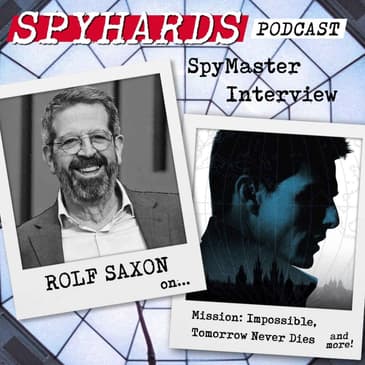


Agents Scott and Cam welcome actor Rolf Saxon to the show to talk about the journey of his character Donloe from Mission: Impossible to The Final Reckoning. He also shares stories about working on Tomorrow Never Dies, Saving Private Ryan, Curse of the Pink Panther and much more!
You can learn more about The Mitzvah Project at their website.
Become a SpyHards Patron and gain access to top secret "Agents in the Field" bonus episodes, movie commentaries and more!
Make your opinions about the NOC List known. Leave us a voicemail on Speakpipe or send us an email now!
Purchase the latest exclusive SpyHards merch at Redbubble.
Social media: @spyhards
View the NOC List and the Disavowed List at Letterboxd.com/spyhards
Podcast artwork by Hannah Hughes.
Theme music by Doug Astley.
Hosted on Acast. See acast.com/privacy for more information.
[00:00:00] This show is nominated for a 2026 Golden Lobes Podcast Award. Get in!
[00:00:45] SpyHards Podcast, I'm Agent Scott. And I'm Cam the Provocateur, racing for the trash can. Yeah, don't take too long Cam, we have a mission to get to. Well then stop pouring things in my drink. You seem to enjoy it though, you keep drinking them. Well you keep putting them in Coke Zero, what am I supposed to do? Throw it out? I don't know. I can't, I can't, it's my only love. Wait, that's quite sad. Well, I know, I know.
[00:01:12] Let's not delve too much into my very sad private life. No, but let's delve once again into Mission Impossible. Yes, yes, and this is a very exciting interview we have folks. We are going to talk to Rolf Saxon who played Dunlow in the first Mission Impossible in the big heist sequence.
[00:01:33] And then returned many years later in last year's The Final Reckoning, paying off something of a tragic character. Yeah, absolutely. And this feels like an interview we've been chasing for years. And of course we're at the time now of the 30th anniversary of Brian De Palma's Mission Impossible from 1996. It all came together like a good heist. It did indeed.
[00:01:59] And I think this is a perfect way to celebrate the franchise on its 30th anniversary of the first film because we're talking not just about the start, but also where we're at now. So we're kind of like having bookends here on the celebration. Absolutely. Absolutely. And of course, if you're listening to the audio version of this, we are now putting out as many as we can video versions of these interviews. You can go catch that on our YouTube feed. You can go find us on youtube.com slash spyhars.
[00:02:27] But without further ado, Cam, light the fuse. Joining us on the show is a man of multiple talents and multiple spy franchises from Tomorrow Never Dies to Mission Impossible. It's actor extraordinaire, Mr. Rolf Saxon. Hello, sir. How are you? Very well, thank you. Very well. We've got a lot to live up to with that introduction. It's all downhill from here. Don't worry. Okay, fair enough. There's no expectations.
[00:02:54] I'm sure I'll stumble on some words and you'll look like a million dollars. Well, let's start the journey where you started your journey. Yeah. What gave you that bug to get into acting in the first place? What was it? Something you watched or a performance you saw? It was a girl named Deborah. I won't give her a surname. In junior high school, who I thought was drop dead gorgeous. And she said, you know, you're a real clown.
[00:03:23] You're a real class cut up. Why don't you take the drama class? And I thought she was saying she's going to be in the drama class. So I signed up for it immediately. And no Deborah, but I loved the class. I actually just really liked it a lot. And then a friend of mine who I knew in the class told me about the American Conservatory
[00:03:51] Theater had just started a youth training for high school, under 18s, which I was. And I went into the first class of that and spent two and a half years there and then decided to try it professionally, sort of. And was in with the embryonic Cal Shakes, was one of the original members there. And then decided to train, came and auditioned for Guildhall and was accepted.
[00:04:21] I was going to ask, do you remember some of your first performances, like some of the plays you would have done earlier on that maybe connected with you? The very first performance I did in school was the grass harp. I had one line. And I was on stage. And suddenly everybody stopped talking. And I thought, boy, I'm sure and glad I've only got one line. That's not me.
[00:04:52] And then I started seeing everybody on stage looking at me like. And I thought, oh, that's my line. And I said my line. And we carried on with the play. And yeah, that was that was an interesting introduction to acting. But that wasn't so much a connection, I suppose, just a silly story. I loved Shakespeare, oddly, for an American, a young American.
[00:05:20] And the Cal Shakes we do is called the Emeryville Shakespeare Company at the time. The first thing I ever did was Ferdinand in The Tempest. And I loved it. I just I was enthralled. I had no nerves. I had no I didn't care. It wasn't I had nothing to lose, I guess. I don't know. I hadn't thought about it. But yeah, I just just had a wonderful time. Did that as you like it. Richard the third Richard the second rather, where I played the Bishop of Carlisle.
[00:05:50] At 19, I played a 70 year old man, which was interesting. Gives you an idea of the level of the standard we were at at that time. But it was good fun. I love doing it. Yeah. Was there any challenges early on memorizing Shakespearean dialogue? Or did it click with you quite quickly? It was it wasn't so much memory. It was it was figuring out once I realized what was being said, which was the real puzzle. It was very easy.
[00:06:19] And it was one of the great things about the company was that there was no pretensions about it. It was like whatever you wanted to do, give it a shot. Try it. If it works, it works. If it doesn't, we'll find something else. And it was just a very was a wonderful approach. And I was very lucky, very lucky to start out with that group of folks. It's probably something that did you in good stead, especially in Final Reckoning, when you're a little bit of techno babbling jargon stuff that comes out.
[00:06:47] It's that Shakespearean that process, especially if you think about like Star Trek actors always talk about this, about how it's Shakespearean and it helps them with the techno babble. And maybe that put you in good stead when you were explaining the mission. Well, I have to say anybody who knows me, particularly my family and close friends, they've all said at various times the best acting job I have ever done in my life was in Mission 8 because it actually sounded like I knew what I was saying.
[00:07:19] That's that family stamp of approval right there, isn't it? It's like I am the most incompetent technician on the planet. I can barely use a phone. And for me to be saving the world with amazing concepts and ideas and technological knowledge was just they were in hilarity. Well, we're starting to talk about mission. Let's head towards that 1996 destination, 30 years this year. Scary. No kidding.
[00:07:49] What was the because I was looking at your. You guys weren't even born yet. That's very polite of you. I like you even more now. It's not true. Yeah, not true. By a year or two off maybe. Oh, come on. Almost 20. The leaves have fallen off of this tree now. It's, you know. I was looking at your IMDb and of course, you know, you came over to the UK and were here for many years and you sort of did a lot of work in British television before Mission came along.
[00:08:19] Indeed, yeah, yeah. And what was sort of the big role that got your name about town when before Mission happened? Um, I, I, I was very lucky. I didn't know how lucky I was. In fact, I, I was scouted by the Royal Shakespeare Company before I left Guildhall. And when I left Guildhall, I had the RSC. I had a film contract offered and a television series. I had an agent.
[00:08:48] Um, I, I had work lined up, which there were a number of us from Guildhall that did, but that was just, I had no idea. But, but the thing that really broke for me, I think was Capital City was the first. I did a series Pulaski, then Capital City. That was the thing that broke me out sort of in England where, where, yeah, I became sort of a household base for a while. I mean, not, not for a couple of years. And is that, I mean, that's in 89 to 90.
[00:09:18] Is that, is that pushing you on the way towards Mission? Is that something that played into you getting the role in Mission? Because that's still like five years early before that casting process took place. Yeah, no, Mission, Mission was a weird one. Uh, I was doing, um, a play, uh, David Mamet's Oleana in Wales Fluid, which, uh, uh, it's a two-hander. It was a big thing.
[00:09:42] Um, and, uh, I came up to Buckingham, sort of Paramount Studios, uh, Pinewood Studios, and, uh, for this audition. And I had, like, a window. I had to turn around literally and go back three and a half, four hours for the seven o'clock, uh, half hour for the curtain. So it was like a real sort of chiseling it in. And I was in, uh, Mr. De Palma, Brian De Palma was the, was the director.
[00:10:11] He, uh, he asked me, uh, could I please wait? Or I was asked on his bat, could I please wait, uh, for an hour or so? And I said, I really, I can't, I literally have a 40 minute window and then I have to be back to the train station. So he came in, I thought begrudgingly, uh, he looked pretty ticked off. Um, I was in and out in about three minutes, four minutes. And I thought, well, that was a waste of bloody time.
[00:10:40] And I came out and Patsy Pollack said, well done. I said, no, no, great. You were in there longer than anybody's been in there. And I thought, okay, she's just BSing me. She's just trying to be nice. And by the time I got back to, uh, Wales, Cluid, uh, this before cell phones, uh, I had a message saying, call the agent. I did. Um, and they said, it's an offer. And I thought, no way, no way.
[00:11:10] But that was the beginning of a very interesting journey with mission. Um, it had no lines and I wasn't that keen on doing it, but I had a brand new agent who said, no, we really want you to do this. So I thought, okay, fair enough. You're the agent. I'll do it. Um, another job came up conflicted. And I said, I really want to do the one with the, the, a better part, which has completely disappeared. No, one's ever seen it.
[00:11:38] Uh, and, uh, my agent spoke to one of the producers at, uh, the studio and said, you know, does he not know who this is? And he said, yes, yes, but this is a wonderful part that he's being offered. And if we can adjust the scheduling and the guy literally told my agent to F off and hung up on it. Whoa. And I thought when he told me that, I said, right, well, we're done. I mean, that's not good.
[00:12:04] Um, and the next day that same gentleman phoned up my agent with an apology and saying, Mr. De Palma wants Rolf. So we're going to work the schedule around. And I thought, really? Seriously? So that I spent three weeks doing both jobs, not a day off, seven days a week for three weeks. It wasn't tough. I mean, you know, it's a wonderful thing. Terrible, you know, circumstance to be in. Boo me.
[00:12:33] But it was, uh, it was wonderful. I had a, I had a great time doing it. Great time. In terms of that audition, because I didn't know that story. And it's, it's fascinating that they went to that link. They obviously saw something in you during that audition. Did you ever get to the bottom? Maybe speaking with Brian as to what he saw in that moment? No, Mr. De Palma, uh, is not a people person. He's a genius.
[00:13:00] Uh, but he is not someone you sort of chat to. Um, and you know, I was nobody. So I have no idea. I have no idea what it was about. Um, and in fact, part of it, which I've told this before, um, I was messing around on set one day. And I was told by the first assistant, Chris Saldo, who's still a friend. Um, listen, uh, Mr. De Palma wants to see you. You should, uh, come over. And I thought, oh no.
[00:13:30] Now a number of people have been fired on the film. And I thought, oh shit, this is me. So I came over and Chris had said, I'm going to stand behind Brian. And if I do this or this, shut the heck up. So I said, okay. So he said, you were messing around just there. I said, yeah, Mr. De Palma, I'm very sorry. You know, if, if, if I bothered or if I intruded in the film and I did that something. He said, no, no, no, it's fine. It's fine. It's fine.
[00:14:00] Uh, can you do that again? I said, uh, I beg your pardon? He said, yeah, people were laughing. I want to, I want some funny. Can you do that again? I said, well, uh, Chris was behind Brian going. So I said, uh, yeah, sure. Sure. Yeah, absolutely. And the whole bathroom scene back and forth and the wastebid, that was all improvised stuff
[00:14:24] that we shot for, for two days doing, I mean, there was a hard minute left, but he, we shot that for a couple of days just messing around. So that was, as I say, it was very interesting. Very interesting. And to come back 25 years later, or what's now 30 years later to do number eight, to finish up the series. It's like, I, I've never heard of that happening before. That was, it's been an interesting ride.
[00:14:54] Well, you're talking about, you know, how a lot of this was like improv and figure out on set in terms of these really memorable moments over the course of that sequence. What was like on the page originally? Nothing. Nothing. That wasn't there. Wow. That wasn't there. So it was basically, you were pulled out of the room and we don't see any of the effect. And it was just, the whole, the whole thing about her putting that stuff in my coffee. That wasn't there. It was a different, it was a different story. It was a different. Yeah.
[00:15:24] I, I, I didn't, I genuinely, another thing I genuinely didn't know. And it just goes to show how sometimes you just get a good idea in the moment and that, and that you just stick in this lightning in a bottle, you know? Yeah. And, and it was, you know, Brian saying that that's what he wanted, seeing me do it, not getting ticked off and just sort of saying, well, let's go with this. Yeah. And, you know, when a filmmaker of his caliber says, that's what I want you to do, you kind of go, yes, sir. Of course, I'll do my very best.
[00:15:53] Um, but yeah, that was, that was, I was messing around and it was his idea. That was, that was all him. Yeah. Cause I was going to ask, I mean, De Palma is so much known for his meticulous sequences and whether there was like room to play within that, but it sounds like there really was, which is not what I would have necessarily expected. Um, I've never, I had never worked with him before. I, I met with him once to do another part in a, in a later film.
[00:16:20] But I, I, I don't know him. I, the only knowledge I have of, of him is that, uh, three week period on mission. And most of which was, uh, you know, I was very much incidental. Well, then let's, let's change tracks a little bit with mission as someone who you'll reunite with in 25 slash 30 years, which is Tom Cruise.
[00:16:48] Of course, he's a producer on the film and the lead. What point did you get a chance to, to have a chat with him, uh, interact and, and spend some time with Tom? In number eight. So there wasn't much, I mean, I know you're not really in a scene together in one, you're kind of in the same room very briefly, but it was worlds apart, was it? Oh yeah. Well, yes and no. I mean, you know, he, he was a producer on number one as well as, as no. Um, and it was his first major production deal.
[00:17:18] And, and, um, there was a lot riding on it, uh, for him and for Brian, apparently, which I didn't know. Um, but, um, yeah, I, I was, we had the, we, at the studio, we were in a room and Tom had the room and I was also in that room at the other side being made up. And, and something happened, which I've, I've, I've told the story before, but I'll, I'll tell it again.
[00:17:45] And it's, it's, it's, um, he, his makeup woman wasn't there one morning and he quite rightly said, what the heck? And someone said, there's been an accident with her son. We've driven her to the school. And it turns out that her little boy had come off a swing or a slide and hit his head and not was knocked out. Do you know this? Have I heard this? No, no, no. Um, and, um, Tom immediately.
[00:18:15] Picked up a phone. There was no cell phones. And I was, picked up a phone and dialed the number, which was his private doctor in London and had him flown out to the hospital where the little boy had been taken. And he was whatever the little boy needed. He said on the phone, get it done, take care of it. And he had first told someone to lock the door to the, to the room. And then he hung up the phone and he said, right.
[00:18:42] Anybody who says anything about this, you'll be fired from the film. No one is to know this at all. So it took me three years before I would say that story. Um, and no one knew about it. It was not publicity. There was nothing. And then the next day she came back. He had a mild concussion. He was fine. The boy was fine. Next day was a huge bouquet of flowers. Biggest bouquet I'd ever seen before.
[00:19:08] And it was to her from Tom, uh, saying, welcome back. It's nice to see you. And I just thought, okay, this is a great guy. This is genuinely a nice human. And, uh, uh, so for me, he was golden. I thought he was great. After we did all the stuff that he came up to me and he said, uh, I want to thank you very much for all the work you did on my film.
[00:19:37] And, uh, I really appreciate it. And I was waiting for the punchline. I didn't, I didn't think, really? And, and, uh, we shook hands and he patted me on the shoulder and off he went. Wow. But yeah, he's a guy, but he's a, he works. He's a workaholic. I mean, this guy doesn't stop. I mean, we've been fortunate enough to interview a few people that have worked with him over the years. We've not had the pleasure of talking to him yet. Right. I'll put that out there into the universe.
[00:20:06] It will happen one day. Um, he's a great guy. Yeah. That's, that's exactly what I'm getting to. I've heard a lot of stories similar to that, where Tom has gone out of his way to make other people's lives better when he doesn't have to do that. Um, he could have easily been like, oh, another makeup lady. Yeah, whatever. Let's get on with it. But it's, it's about the person. And I've worked with a number of people who are the absolute opposite.
[00:20:32] So to see someone like that, who is in that position of authority and whatever fame, still behave. Like a human being is, is a wonderful thing. Yeah. I want to bring us towards the more recent mission, but I do have a follow-up about, uh, 1996's Mission Impossible. Is that the film from your career thus far that you are asked about the most? No. No. No.
[00:21:03] Interesting. I wonder what that might be now. Okay. Um, I've got some theories. We'll come back to that. And, um, I, I, I had this question written down. I don't think you did because you seem like you wouldn't do that, but did you keep anything from the, a little, a little prop or something just to remember the mission one? Uh, no, uh, I, I wasn't allowed to take anything. I mean, none of us were. That was in the days. And, um, I mean, things were for props and costume.
[00:21:33] You weren't sure if you're going to be called back again for whatever reason. So everything was locked away and kept. Um, nowadays, um, yeah. I mean, what I asked them for when I came back to number eight was the, they had a lens that they still used in mission eight that they had used in mission one. And he said, they're bringing it out. He said, we got a couple of them. I said, listen, if there's next one going, I would love that lens to, to, you know, with you guys signing it. And they all laughed and everything like that never happened. Bastards.
[00:22:03] But, uh, the, the, the other thing was the knife. Sure. Which, uh, I have a replica of that I was given, which I thought that was pretty cool. Yeah. I think that's pretty cool. That's a, that's nice. And obviously you've mentioned it in, when you're returning in eight, that is a, you hand it back in a way. Yeah. Basically. Well, then let's, let's, let's get to that story, you know, come say 25 years. Were you ever expecting to have a phone call about another mission?
[00:22:33] No. And I certainly have told this story. Uh, I've got a friend in Scotland, Canadian guy, uh, who lives in Scotland now. And, uh, Bill and I, we were at the RSE together. That's, we've done a film together and we've stayed friends throughout the decades. And we joke around with each other quite a bit. So I got a message from an agent saying, um, there's a European film company that wants to be in touch. Uh, is it okay if I give them your contact? And I said, who are they? And they said, well, they're not saying yet.
[00:23:03] And I said, is it legit? And she said, yeah, absolutely. As far as we can say, this is straight up. And, uh, the, the, the contact won't be a personal, it would be like an email. It was not going to be. So I said, okay, yeah, cool. So one thing led to another. I thought, then they said, next community. I can't remember exactly, but basically I found out it was Skydance. And I said, Skydance? Seriously? Seriously. And, and said, yes. And I said, okay.
[00:23:33] And then it was, we think it's mission impossible. And I thought, Bill, you son of a, I thought it was Frank. I thought he was winding me up. And so then I get this message, the, the, the, the, the address, the zoom message to, you know, this is where I'm going to speak to Christopher McQuarrie. And I thought, yeah, right. I thought, Bill, that's great. That's, that's good. You've got, uh, you've got the address and everything McHugh and dah, dah, dah, dah, fair, fair. That's, that's good.
[00:24:00] So I'm sitting there with a t-shirt and a glass of wine and up comes Christopher McQuarrie and going, oh shit. Wait, uh, uh, hi. That's when I knew it was real. I had no idea. No idea. No, I didn't expect it at all. Uh, as I say, you know, you've got a, a very tiny little part in a major motion picture. 30 years later, they're going to bring you back. Never, not in a million years.
[00:24:28] Did you have a sense of how legendary that sequence was kind of seen within the franchise and with fans? No, not at all. No, I mean, I was told this by McHugh in that phone call, in that initial phone call. And then he told me a couple of things about it. And I just thought, okay, he just really wants me to do this. But then why does he want, I wasn't making sense.
[00:24:53] Um, I, I met Tarzan Davis, uh, and, uh, in an elevator at the hotel in London a day or two before I started filming. He was already there. We sort of held and said hello. I didn't recognize him. He didn't really recognize me. And, and we went to our floors and that was it.
[00:25:18] Two days later, I was on set and he walked in and went, oh my God, you, that you're Bill Donlow. You're William Donlow. And I thought, yeah. And McHugh looked at me and he said, see, he had no idea. No one knows you're here. This has all been secret. And so that's when I started realizing that actually maybe there was something about that that I really didn't get that. But yeah, I had no idea this was what I still find it difficult to believe, to be honest,
[00:25:47] that, that, that it's such a famous scene. And if the fame is to do with Tom swinging down, it's not me. I mean, I'm, I'm along for the ride kind of thing. I mean, you might be the full guy in that scene particularly, but you're also the whole other part of that scene. It's you're the ticking time bomb under the table. Yes. Yes. Again. Yeah. I mean, that's cool. I'd love to say, you know what? Yeah, I know. That was all me. I did that.
[00:26:15] It wouldn't have been the same without me, you know, and God bless him. But it was, it was a sequence of events. It was, it was wonderful to be a part of. I loved it at the time. I loved coming back to it. And I'm a very lucky guy. So, so what's that pitch then? What's, what's Christopher McQuarrie saying to you on that Zoom phone call once you've thrown the wine out of the shop? Yeah. I casually guess. Oh, I'll just move that there. Yeah.
[00:26:41] The pitch was, we want to bring Don Lowe back. And I said, okay, great. Uh, uh, I was going to joke in the back of my nose. I'll think about it. I couldn't even begin to say that. Uh, uh, fantastic. And he said that he, he and Tom have worked together for about 15 years at that point. And they've done a lot of things.
[00:27:09] And one of the things that always, one of the issues that always comes up about mission is Don Lowe got screwed. The one thing in the whole story arc that he was saying that hadn't ever been resolved properly was Don Lowe. He got shipped out to Alaska and that was it. Uh, and he did everything right. It wasn't his fault. And so we want to rectify that. So I said, okay, is he going to be a bad guy? They said, no, we thought about that, you know, getting angry and ticked off, but we'd
[00:27:39] rather have it that his life transformed for the better. Make it as sort of a positive thing. I said, cool. You know, that's, so we talked about it. Um, almost an hour. We were on the phone with that first phone call. Um, and yeah, that we, we, I thought it was going to be a couple of months, maybe six months tops.
[00:28:03] It was two and a half years and they rewrote a huge amount of what happened. Um, we, we shot for over a week, uh, 14 pages of scene and it was all taken out. They rewrote, they changed a plot line and it became something else. And then I wasn't originally going to be in the last third of the film, the third act, which they put me.
[00:28:31] So it was something that was evolving as, as we went along as well. Yeah. Well, it's, it's one thing that jumped out to Cam and I when we were doing the research for this is you appear in one of the trailers for dead reckoning. So there was originally, you were going to be in seven. Uh, or it felt that way. Yeah. No, uh, one of the trailers as from number one. No, there was genuinely a shot of you as now. Oh really? In one of the trailers.
[00:29:00] And it did confuse some people that they thought you would be back in what was dead reckoning part one at the time. And then. Fascinating. Um, okay. Dead reckoning was, dead reckoning was virtually finished by the time I was hired. I mean, there were a couple of little things to do here and there, but the film was basically in the can. Okay. Yeah. So that was, that was never. Well, that clears that up. It was never the pitch. It was always the. No, no. It was always the final one. First and last. That was, that was going to be it.
[00:29:30] And from an acting standpoint, what obviously getting that call, of course, you're going to say yes. It makes complete sense. What's the interesting thing for you as an actor to come back to the character? What are you looking to do? Uh, that's a great question. Um, to be honest, I wanted to know what they wanted out of it. Uh, and then because the way McHugh works, uh, he very much uses the people that he's got. Um, he, he's a very collaborative.
[00:29:59] He's a very collaborative director and writer. Not everybody is. He definitely is. So he, and I saw this with others on set as well. Um, so we talked a lot about what he thought, what he wanted. I would bring things in, uh, some of which he liked, some of which he didn't. Uh, and we just, we would work that way. Well, what were some of the details that you brought forth that ended up happening in the film?
[00:30:28] The, the fundamental shift for me from him was my wife. Mm. Mm. Mm. And we originally thought that there should be children. There was a dog, a huge, beautiful dog. Uh, but it, that was part of the thing that had been rewritten. Uh, so, uh, that lost the, the, the family was gone. It was going to be just her and I, uh, Lucy and I.
[00:30:55] And, uh, I suppose the, the feeling that it was all worthwhile, that I, there was the shift from being exiled and turning that into something of a positive that, that Donna was able to do that. And that was, took a lot of thinking about and working through and you can't just go bing and suddenly a great person, you know? Mm.
[00:31:22] Um, and what, what kind of scars did that leave? If any, how long did it take to get a lot of people? If any, how long did it take to get over it? Um, and the idea that he was involved with the entity for some time, this wasn't a new thing to him. That was McHugh, which when we had spoken, uh, that was something he said, and I thought it was a brilliant idea that he was actually keeping track of it. So that takes away the whole onus of them proving themselves.
[00:31:51] He knows what's going on and they come in and little things like that, which, which they're fascinating to work on, especially when you have the time and the people that are involved, that were involved. Some of the best in the world. I mean, I think it's a privilege to be a part of that.
[00:32:14] Uh, I, I, I keep saying, um, but the best thing for me is when I wanted to bring something in, uh, like something about with Lucy and I, which actually didn't make the film, but we did it. And it was like, yeah, no, that's a great idea. And, and I won't go too far to that, but, but it, it, it, having that kind of freedom, uh, is very, very cool. It's great.
[00:32:44] And can you talk a little bit about creating the dynamic with Lucy? Because that is a surprise to the audience that you have a wife, but also that like you two are so interesting as a couple on screen. Uh, yeah, we, um, oddly, I mean, we're friendly, but there was never any kind of, you know, solid for, I I've known Simon Pegg for 30 years. Um, uh, we did a, uh, he did a series where I came in as a guest star one and it was really a lot of fun.
[00:33:14] Um, Tarzan and I have remained pals, Henry Chirney. And I, I mean, we got over Lucy is, is, uh, very involved with work at home and, and is, is very keen on keeping that going. Um, so when we spoke, it was only on set.
[00:33:41] It was, you know, uh, working through character ideas and lines. Uh, and if, yeah, it was just, it was just sort of, there was a, there was a great deal of trust between us. So there was never, I mean, sometimes, unfortunately you work with actors where there's other agenda, there's another agenda going on somewhere for something else. And that was never the case with us at all.
[00:34:08] And so that makes it very easy to sit down and do a scene together. And she's a hundred percent focused on set, which is great. That, that, that made everybody, uh, uh, I mean, everybody was like that. So yeah, I don't, well, it's interesting. Like when you watch like, you know, a mission impossible film or another big franchise film, like the emotional moments tend to be very big and that's what often works. That's what really makes the audience connect.
[00:34:37] But I liked it with yours, with like the relationship you have with Lucy, it's like a very organic warmth. It almost feels like it could happen within like a small independent drama. And it's being carried into this much bigger film where the other emotional moments are big, you know, blaring moments. Right. Um, I think that's, that's sort of something that Lucy and I are both actors who deal in that much more so than, than, uh, than otherwise.
[00:35:03] And, and I, that was a, a, a similar similarity between us that worked really well. You know, we would have looks with each other, which they use some of, but there were a lot of them were just the two of us looking at each other and smiling or just a nod. And that says a lot right there. You don't need a lot of music and fanfare. And it's a nice juxtaposition to all the other adventure and excitement that's going on.
[00:35:28] It, I think I'll echo what Cam says. It feels like it's a very human thing inside a film that has the entity and things like that. There's a, there's a humanity in your relationship that I just think is quite like soft and nice. There's a moment when you're defusing the nuclear bomb, which you just think about like defusing a nuclear bomb. And then you as a couple of this, like shacked up in the, uh, you know, in, in Alaska, it's completely different, but you just like hold hands or something. Yeah.
[00:35:55] And it's just like, that means a lot. You're like, we're facing this together and you don't have, it's what you say without the words. It's the, it's the physicality. I just think that's a wonderful bit that, that comes from your character. And you wouldn't have thought back in 96 that Dunlow would do this. Um, I, it's just wonderful. I, what I want to ask about eight is with 1996, it was just you, um, some other people, the great crew and maybe a little bit of Tom Cruise.
[00:36:22] In eight, you've got a whole ensemble cast, especially in the, in the house. And you're first sort of introduced back into the film. Um, the whole team is there more or less. What was it like working with, you mentioned you've been a friend with Simon Pegg for a long time, but yeah, Hayley Atwell and the rest of the team. I think one of the, one of the wonderful things about the, about the picture was, um, Tom's a good guy. And, and, and I don't think he works with people who aren't.
[00:36:51] I, I, I think he's in a position where he can figure that out pretty quickly. Um, and before the film starts, if you're a jerk, you're not going to work well there as they recast or they go elsewhere. Um, so everybody, it sounds like, you know, you know, he's going on and on about these guys again. It was just a great time. There's good folks. And I'm not saying that work, you know, uh, uh, moments of friction.
[00:37:16] Sure. Two and a half years is a long time, but it was never sulky or petulant or, you know, it didn't last for weeks. You know, you next day you're fine. You, you, you work it out and then you, you go on. Um, but yeah, everybody, everybody respected each other. I mean, that was something, you know, I'm the guy coming in from nowhere. You know, these guys are all big stars. I'm not. And, and I wasn't treated any differently than anybody else.
[00:37:43] I mean, it was, it was just, it was very cool. It was very cool. Well, you mentioned two and a half years and this movie was famously shot during the pandemic, which was very difficult. If you have anything you could say about just the experience of shooting a movie during very difficult circumstances. Uh, yeah, there was, um, there were a number of hiatuses throughout the filming months at a time. And that was difficult that, um, for a number of reasons.
[00:38:11] Um, first and foremost, you suddenly, you're going to come back and then suddenly that week is turning into six weeks and you think, okay, well that, okay, I've got to stay, you know, focused. Uh, also you can't do other jobs. You can't do other work. No, one's going to hire you to do something. When you have first call with a major motion picture, that's just not going to happen. So a little bit of voice here and there, but nothing, nothing else. So that was kind of frustrating.
[00:38:38] Um, but the actual, that was the worst part for me was suddenly being away, not knowing when we're coming back, knowing we are coming back, but not when. Um, so as I say, what I thought was going to be, you know, three to six months turned into, you know, two and a half years, which was a lot. It was a long time.
[00:39:03] I mean, it's, uh, it's certainly delayed a lot of productions and I feel like, especially with Tom leading the charge and, you know, he, he was definitely leading the charge during seven as well with the COVID shoots. Um, it must've been great to have him and Christopher McQuarrie at the helm of these films because Tom leads from the front from what I've been told.
[00:39:23] It certainly does. Yeah. Yeah. Yeah. Um, being able, you, you're in a unique position because you saw him in sort of his first big producing role back in 96 and now seeing him basically second to most recent film. Tom, how has he grown and, and have, I should have a follow up Tom Cruise, but how have you noticed he's grown as a producer and how has his presence on set perhaps changed over the years?
[00:39:47] Um, it's very similar. It's very similar. Uh, uh, he, he knows he's there to work. He's there to have a, you know, a good working environment, but he wastes no time. And the only time on both films I ever saw him a little bit fractious is when he felt time was being wasted. That, that is not something he appreciates at all.
[00:40:12] Um, understandably, um, I know there were some issues with, there were some political issues up, up the chain that had nothing to do with anybody on set.
[00:40:25] And that was, that was not there in number one that I was aware of anyway. Um, I think one of the things that surprised me about number one is that he was so involved with the setting of a camera shots, which he pretty much was with this as well. I mean, Chunky, the operator and, and McHugh were, they were doing the, the, the, the, the, the lighting guy, everybody.
[00:40:53] But Tom, if he wanted to say something, he would say something. Tom would direct every once in a while, which is not something he did in the first one that I was aware of. Yeah. Um, and it was all cool. It would, you know, everybody kind of went, Oh, okay. I mean, it was a surprise to me at first when I got a direction from my fellow actor.
[00:41:09] Oh, oh, okay. Sure. Uh, that seems to be normal. No one's batting an eyelid. And then I was told, yes, that does happen. And just, you did fine. Just go with it. And he knows what he's talking about. Yeah, he does. Um, but he was surprisingly similar in both.
[00:41:26] Mm-hmm. He was in charge and that's something that comes very easily to him. And, and as I say, sometimes people get abusive with it. That was never the case in my experience with him ever. And what was it like to get that sequence with him? It's sort of explaining where Dunlow ended up and you, you get that lovely sequence in the aircraft carrier. You hand the knife back. I think it's, it's a beautiful little moment, little tableau within the film.
[00:41:55] What was getting to shoot that like with the lead actor of the film and maybe getting a little bit of perhaps closure on the character in a way? Yeah. Um, there was more than made it in the final edit. So it, it was, it was a good couple of days where just working back and forth and doing stuff differently. And with the other folks as well, there was more of them in that.
[00:42:23] At this point, I think if I'm remembering correctly, it's just Lucy and I have a look. There's no other looks between the rest of us that were happening. Um, that was all taken. So yeah, it's fun. It's, it's, um, you can't, you can't sort of, um, um, working with Tom or working with Haley or Simon or any of the, or McHugh, you can't think like that when you're on set.
[00:42:49] That's something before or after perhaps, but not when you're on, you've got a job to do. And if you start going, Oh my God, it's Tom Cruise or, or whatever. It kind of gets in the way. Uh, that's not a, that's not a, that's not conducive to, to, to, uh, uh, good work, but yeah, to work with him was pretty cool. As I've said many times, uh, it, it's, it's, it's the story was fluid throughout.
[00:43:17] And so there was always, is this going to be part of it? I didn't see the entire script until my last day on set. Wow. That's crazy. So I had no idea what was happening before or after a scene I was in. I had no idea what was going to happen at the end of the film. I didn't even know for the first year that I was going to be in act three.
[00:43:46] So yeah, I'm working with this. I'm doing that. Is it going to last? We did 14 pages, 12 to 14 pages of dialogue, which was completely exited. Yeah. So I, it was sort of a day at a time kind of thing. I've never worked on a job like that before. It, it does sound like a unique beast. Yeah. Um, I know for the mission impossible mega fans, such as myself listening, I be remiss if I didn't ask this question.
[00:44:13] Of course you don't have to answer it, but the stuff that you shot, is there anything you can tell us about it that didn't make the film? No. Fair enough. Sorry. No, I, I, I have to ask at least. No, no, no. Fair enough. Absolutely. Absolutely. But no, um, I, that's not, it, it, it, yeah, that's, that's probably not something I should discuss at all.
[00:44:36] Yeah. That's fair. Um, I was going to ask, this is a bit of a playful question, but, um, when you walked away from the first mission impossible, you had a sense of, okay, well that job's done onto the next. Yeah. When you walked away from the final reckoning, did you think, you know, I might be back again? Uh, as far as I'm aware, this was the last one, but there were rumors saying, yeah, they'd always say that. Yeah.
[00:45:05] But I know there's a couple of films planned for McHugh and Tom, both separately and together that have absolutely nothing to do with this franchise. Mm-hmm. So I also know that Tom does all those stunts and that, that's just something I still, I say that out loud and I just think, how in the heck does that happen? You know, I, I, I think there's going to come a point when he just can't do them anymore. Mm-hmm. Mm-hmm.
[00:45:33] And that's a huge part of this film or this franchise is the stunts, are the stunts. I mean, that, that biplane sequence, I watched it again last night. It's phenomenal. I think there's no other words that can describe it really. It, the fact that he's just, that's a man on a plane. It's, it's Buster Keaton levels of taking your life into your own hands. And yes, you know, I, I, I will defend this film until the last, but, um, I have a.
[00:46:03] Absolutely right about comparing him to Buster Keaton, by the way. Those are amazing things he did and they were definitely life-threatening. Yeah. For me, for me, the, the, the motorcycle jump. I saw that before the CGI. Yeah. Yeah. So I saw the platform, which I think is out now on a, on a reel. Yeah. You can see how it was made now. Yeah. Right. When I, that was my first day on the set. That's what I saw. Lucy and I were sitting there watching it and I just went, oh, when he took off, he
[00:46:32] did that nine times that day, nine times to make sure they got it right. I wouldn't have done it. I, you couldn't pay me. I'm not even an actor. I certainly wouldn't do it. No way, man. That's, that's not happening. Just not happening. Agreed. Um, final question for me on mission. Now I want to move us over to Bond. Okay. What was going to be a few weeks turned into two and a half years, a very long process.
[00:46:59] The film is now out looking back on mission eight, perhaps the final mission for many. What was the most impactful, important day for you on that set, making that film? There were, there were a number. Day one was fantastic. That was personally, that was probably one of my favorite days on a film set. Um, there were a couple of my first day in Svalbard.
[00:47:29] Uh, when we actually went out on the ship, it's about a six, seven hour ride or sail up to the glacier where we filmed. The first morning on that glacier was like living, was like being in David Attenborough film, National Geographic. It was just stunningly beautiful. I've never seen anything like it before in my life.
[00:47:53] And to be able to spend 10 days there to be paid to work in this environment is like, yeah, okay. Yeah. Okay. I'll do that. Yeah. Um, but. I, those are the things that really stick out to me. Uh, and there, there were, it was, it was genuinely freezing cold. Uh, I'd never heard of frost nip before. And that's pre frostbite.
[00:48:23] It's a legitimate term. And a couple of people, including Palm, uh, developed it and had to be taken away right away. And you can't, you have to warm up very slowly because otherwise the nerve damage happens. So working in an environment, I've never been as cold in my life. We, we hit at one point, a scene that wasn't in the film, they put on the wind machines and through snow for a blizzard and it hit 50 below. Whoa.
[00:48:51] And I've never, it was so cold. All I wanted to do is get warm. And that was, I didn't care about the words. I didn't care about the acting. I didn't care about anything. My, I, I had to be taken in at one point from my hand, uh, cause it was freezing and, and I couldn't move it properly. So that, but it wasn't, it's things like that that I remember. And, uh, and, and at the end, it was fine. Everybody's fine. Nobody got hurt.
[00:49:21] You know, the, the, the, the medical people were 100% on it. Filming stopped immediately when somebody had to be taken out, which happened a couple of times. there was no you know come on none of that it was all just get you set take care of then we'll come back and do it again but it was yeah it's kind of there's a lot of things like that throughout wow the life of an actor those are the good times there's some bad times too
[00:49:51] but no that's yeah that's yeah this is pretty amazing as I say lucky guy we interrupt this program to bring you a special report agents we don't expect you to talk we expect you to buy a subscription to our patreon eee that's right over on the spyhards patreon we're covering all your favorite spy tv shows as well as popular films from the most iconic secret agent actors
[00:50:20] of all time cam why don't you share some intel on our latest assignment scott shields up red alert because this week we are setting our course for the romulan neutral zone to take a look at the 2002 box office dud star trek nemesis the 10th entry in the long running franchise and the final film featuring the tng cast did picard and crew get the big screen goodbye they deserved or is this mission best left forgotten
[00:50:48] tune in and find out so deactivate ghost protocol and visit patreon.com slash spyhards to truly do things angel style but before we close channel d on with the spy jinx well why don't we jump on over to the james bond franchise okay and you have a small part in tomorrow never dies the second pierce brosnan film how did that come to happen
[00:51:17] uh that again i was doing something else they asked if i would come in for this i said sure um i got it immediately um it was one day's filming uh we did that thing a couple of times three four five times i don't remember and that was it i was in and out that was it i i knew uh i'd worked with pierce before on something else
[00:51:48] it was before he did bond oh another film was it um detonator or is it uh there's the other title for it um detonator 2 night watch um it's also called night watch night watch yeah night watch night watch that was it and uh we we i worked together with him on that uh and he was being prepared for bond he'd already been
[00:52:17] i mean he didn't say about that then i found that out later but uh uh this was putting him in a lead role where he was going to be carrying a whole ton of work and you know weight of the film and they wanted to give him before he hit bond um so yeah nice guy we got on really well and then i thought it was going to be more of that with him but i didn't even see him on that day mm-hmm and who was actually directing that sequence were you working with roger spot is wood on that
[00:52:47] or was that someone else uh it was it was him uh briefly um as i say it was i thought it was going to be i didn't realize it was going to be a film screen with six of us or whatever it was i thought it was an individual thing so when i saw it i was kind of like oh damn really okay so it was sort of in and out of my mind i don't have a lot of recollections about that at all right okay well what were the circumstances when they were filming you though
[00:53:17] if you were thinking you were maybe in like a larger scene oh uh it was uh i was sitting in an office you know what you see in the background was a set and i was on it and i was speaking to someone who was reading off a script it was going to be a dialogue back and forth i thought it was just this person and myself i didn't realize it was james bond on on a panoramic screen a variety of screens on a huge
[00:53:47] wall i had no concept that that's what it was right okay i mean that brings up a lot of questions in my head but i guess it's more of a case of getting you to do that scene and then they just chose to use it in that way down the line just showing you know films evolving much like mission eight did yeah i think that's probably exactly what happened i don't think they were in any way trying to pull the wool over anybody's eyes there's no point in doing that yeah
[00:54:16] that there would be no necessity i think it really literally was just oh you know what's going to work even better boom boom boom let's do it this way yeah exactly um i've got a couple of little like things that you've worked on that when i was reading for your imdb blew my mind so i will be we'll be jumping all over the place now this will be i know cam has a question about saving private ryan which we'll get to one i feel compelled to ask and you may not remember this at all but this is going back to 1983
[00:54:45] and the curse of the pink panther oh my gosh yes yes second speedboat man what a title yes that's it dun low who don't worry about it second speedboat man exactly that's our guy um i won't get into like how that happened but just what was it like to be part of the pink panther film i mean that's a blake edwards film working with blake edwards and being part of that universe i know peter sellers isn't in the film because it's it's one of the post peter sellers films but yeah
[00:55:15] yeah like what was it david niven was indeed david niven was yes and david niven what a gent what a sweetheart what a great guy he was yeah i mean i was nobody i was two years three years out of drama school and uh i'm doing this little tiny part and uh it it i was excited about it it was the first time i'd been out of the country to film i was in the south of france for a week or 10 days with um
[00:55:44] i believe that was with matt frewer and bill hope that was the first of about three or four times we worked together three of us uh and um we had a blast it was good it was great fun i was out there uh i was in a blue suit that was a job literally they paid more money for my costume than they paid for me that's yeah um and uh then then they had to redress me because
[00:56:14] who was the okay this is embarrassing who was the lead was it ted was ted was i looked like his brother i had the blue suit my hair was very similar to his and i was american and i was walking out and people went hey hi hi i'm going oh hi hi everybody thought i was ted was so they changed the suit they doubled the the wardrobe bill and
[00:56:44] paid even more money for the ward of them than for me um and then i literally the stuff i had a couple of lines in that which didn't happen because uh yeah that that day i looked too much like ted ted did wow and you and you've shared three films with bond actors now because you've got pierce brosnan roger moore's in curse of the pink panther and then sean connery in entrapment yes sean connery yeah uh again i never worked with
[00:57:13] i never saw him on the day uh i i know his son jason uh uh and uh yeah we're pals but uh never had the pleasure of working with uh with sean connery no well you're also missing out cam you forgot david niven himself of course james bond you know casino royale indeed yes yes that's right that's right yes yeah yeah yeah yeah and you blink and you miss me and all of them well
[00:57:44] um you're in one of the most famous sequences of all time in mission impossible well that's very we're also in another one of the most famous sequences in saving private ryan a movie that's one of the most impactful experiences i've ever had in a theater um but you're in the opening d-day sequence and i would just love to know about the experience of training for that sequence and and also just i mean spielberg directing that it must have been absolutely incredible just to even be there yeah yeah it was um
[00:58:13] it was it was mixed it was a very mixed time for me uh uh it was extraordinary i mean to be uh involved in that shoot was fantastic um uh uh it was very exciting uh i worked with vin diesel before he was vin diesel i worked you know all these guys it was it was fantastic um unfortunately for me uh uh i was cut i had a much
[00:58:43] more substantial part um and the first 20 minutes was completely rewritten uh the the beach scene was uh steven spielberg had asked the british crew if any of their family had been in the d-day landings and the the um makeup woman i can't remember her name uh she won the academy award for brave heart makeup uh lovely lady uh her father had been
[00:59:12] i believe in sword on sword the sword landing uh spielberg met with him spoke with him there was a whole story that was fascinating uh and they rewrote the whole opening sequence using his story right uh and three of us lost uh the scenes uh i was the bad guy uh tom hanks was the good guy i was the bad lieutenant briggs
[00:59:41] the jerk that everybody hated it and then i get blown up yay right and so it's sort of like i'm in the background i get blown up and it's like meh but it's an amazing first 20 minutes that film and it was it was great to be on it and to go through all the i had never been landing crap before those are uncomfortable man especially when they start hitting waves that that hurts
[01:00:10] that hurts and stories from people about what that was like when the landing actually happened and how many people didn't survive and what that was about that was yeah that was that was a a good experience to be a part of but just to i think it was louise burwell or lewis burwell you were talking about in terms of makeup artist she won the award for braveheart that's the one
[01:00:41] yeah that's right thank you yeah i thought i'd check just to get it right incredible that you were even part of it maybe that there was more that you did but the fact that remains that perhaps one of spielberg's greatest films of all time you are right there in the fray at the beginning you're part of cinema history another franchise well it's not really a franchise but you know what i mean like another big tentpole moment yeah rolf saxon lucky wow
[01:01:10] from big tentpole moments to a something i was not prepared for when i looked you up on imdb for things outside of britain and you are the voice of teletubbies in the united states i was not prepared for this no i have a million questions i'll perhaps streamline it down to what was it like being the voice of teletubbies one day in teletubby land yeah that was that was
[01:01:44] such a gas that was that was a lot of fun that was a lot of fun uh yeah there'd never been anything like it before i didn't do a lot of voice work and i was asked if i would come along to try out for this and um i said yeah sure yeah yeah well of course uh and then did it and um uh yeah i was i did it for gosh a year year and a half off and on yeah it was uh yeah you were quite a few credits
[01:02:14] for like different things you've done with the teletubbies yeah we did 365 one a day wow for a year to fill a year um and then there were some videos and stuff but it was basically ann wood who was the producer uh she and the writer whose name is skatesman right now i'm sorry about that um um they they they did something that they've never that had never been done before up to that point and they
[01:02:44] they put a television in a room with a bunch of preschoolers who is the target audience and they put a camera on the television so that they could um they could watch the child children's reactions and that's where you get the story repetition two times or three times in each sequence because the kids as soon as the story by the time the second or the third i don't remember now what it was they they knew the story really well right
[01:03:14] and things like that um there's no dialogue everything is very calm there's no major excitement there's happiness but they're very very you have to they they were very specific about the parameters the vocal parameters that we could use um and they knew exactly what they wanted to do with it they did they'd spent about two years experimenting playing around with it and then put it together and it
[01:03:44] was hugely successful but not so much financially here's something else about uh about uh ragdoll um each country that it played in they got nationals so that it was not accented so yeah i did north america uh there's a german there's a french there's you know all kinds um but there were a lot of eastern european nations that got the teletubbies
[01:04:14] had someone voice it but without a contract with ragdoll and so technically they could have been sued and for a lot of money or whatever and ragdoll never did that what they did is said listen it's for the kids it's good for the kids that's fine but if you continue to do this you do need to talk to us so i thought that was kind of amazing and they never as far as i know
[01:04:43] and they were copyright was broken many many times around the world and they just went to each one individually and said listen you've done it fine but going forward this is what we need to do and everybody said yes putting the kids first yeah exactly boy yeah that that that was unique then and i think it is now still i it was andrew davenport i think was the writer you were
[01:05:12] looking for andrew davenport that's exactly andrew yes thank you this is not a good memory this is just imdb yeah i wish i could take credit for knowing the telly tubbies writer he's a really nice guy he's a very nice guy i my younger brothers had a tinky winky in the poe i remember growing up so it's even in our house they came out to play i tell you what they uh poe who's the shortest of the the
[01:05:42] telly tubbies in costume is six foot wow yeah tinky winky is almost nine foot so when they decided at one point to bring the telly tubbies out to a bunch of children who were at the telly tubby farm they had many accidents kids terrified
[01:06:09] running away just in in in in terror they did it once never did it again they never brought the telly tubbies in front of children again it's like a godzilla movie just kicking down like buildings tinky winky hello dudes well i know a nine foot tinky winky is gonna haunt my dreams tonight
[01:06:38] but that's that's a whole other issue for my therapy to deal with yeah and yeah glad to have been assistance thank you for that you've you've affected me again in a different way uh rolf now we're gonna go to the quickfire round as we promised you we'd wrap it up um first of all mostly and i like asking this question specifically to actors um because we've seen you in some of these franchise films we've mentioned say private ryan things like that smaller parts you have done a ton of things during your
[01:07:08] career thus far what is something you could recommend people listen to this to go check out of your work to give a little bit more of rolf than perhaps they would have seen in mission or or or tomorrow over dies no no that's gonna sound like oh you know what you should do no no no no just i mean look up see what see what i'm in and if you want to see it do if you don't don't go watch detonator 2 he's with pierce brosley go watch detonator 2 night watch there you go night watch oh actually did was it changed to detonator 2 it's called detonator 2 night watch
[01:07:38] in um the uk and it's night watch in the states oh got it okay i don't know why because it is detonator 2 it is a follow-up from the first one but right but yeah you know there's a play that they turned a movie into the madness of george the third and the way it was written in britain is the madness of george and then three roman numerals yeah and when they were to make it uh in america they had to change it to the madness of king george
[01:08:07] the third because if they didn't if they just put the three they said well that's number three i didn't see one or two so it's gonna be crap uh i i completely buy that and i'll i'll trade you a story i'll trade you a story yes do you know about the original title for license to kill the second timothy dalton film no it was originally titled license revoked but they tested it and americans
[01:08:37] didn't understand the word revoked no i i'm not making this up no license to kill it was and you know there it is um well then i understand you're not answering that question we'll put some recommendations in for sure very very humble of you and i appreciate that but what i want to know then is what are you up to now your mission is done what's on the calendar for rolf at the moment what are you working on i'm working on a couple
[01:09:07] one thing i'm doing is a one-man show called the mitzvah project by a gentleman the name of roger grimwald and it's for high school to university students about the holocaust and the ramifications of what's happening today and in various parts of the world in various guises um uh that's theatrically uh there's a film which i can't speak about that looks like
[01:09:37] it was postponed from november to it now looks like march uh so but we'll see uh if that's gonna go and just little bits and pieces here and there but yeah that's just keeping my fingers in that's all you can do keep busy yeah doing the best yeah and the last question that's been asked to every single person that's ever been on the show so there is no pressure okay but you're being measured up against a lot of people right now
[01:10:07] exactly exactly yeah by real people yeah okay well well real or not we'll leave that to them but yeah we talk about spy movies here that is our speciality but we want to know from you Rolf what is your favorite spy movie of all time wow my favorite spy movie of all time I'm not sure
[01:10:37] if this would qualify but it does for me the Manchurian Candidate that counts yes sure yeah okay which one uh the Frank Sinatra one the original what I'm thinking is the original yeah the 62 Frankenheimer film yeah yeah that's uh yeah that's that's a pretty spectacular piece of filmmaking that is a great pick I think that might be the first time
[01:11:06] anyone's ever said the Manchurian Candidate I think oh really yeah I'm that old well it's not an age thing no it's just a taste thing surprisingly a lot of people do say like Hitchcock films will get mentioned and they're often 30s 40s 50s yeah yeah Ipcris File Ipcris Gets mentioned um yeah yeah Third Man yeah what's your what's your favorite Scott that's a toughie I will default to the I'd say I'd say the best spy movie of all time
[01:11:36] objectively is North by Northwest oh okay okay my favorite is the poster that sat directly behind me which is hard to see on camera I it's Cary Grant Ingram notorious yeah bingo okay that is for me quintessential spy cinema I'm writing it down it's a Hitchcock film so you know you're in for a treat and and and Cam what about you I mean
[01:12:07] I tend to default to North by Northwest as well um but if I were to you know if it's kind of like what is your like your favorites I tend to go James Bond and right it's going to be either the 2006 Casino Royale with Daniel Craig or the Spy Who Loved Me with Roger Moore those are kind of my two comfort food uh Bond movies no that's cool that's cool yeah yeah Daniel Craig is yeah did you I mean we didn't really talk about Bond
[01:12:36] that much apart from your time with Bond was it a particularly profound franchise to you growing up and no not really no not not really uh um yes spy movies were not my thing growing up that's something I started liking a little bit more later on uh just just um yeah I was I was very politically minded
[01:13:06] for quite some time and and uh yeah the I yeah the the the the the genre was not something it's something I learned to appreciate later yeah for sure I think one thing that's helpful with Bond is enjoying it from a young age even if you want to call it indoctrination but it's uh you know it's if it's in that household you will just look to it as a form of nostalgia so it absolutely yeah no no and you know I can
[01:13:35] I sit back and look I mean mission I've seen them all and it's fun they are they are good and every once in a while you kind of go wow that was good I mean that that's really you know that that worked oh you've just given me a great question and I have to throw it at you now I usually wrap up with that question before but sorry now it's here oh I'm taking away mission one I'm taking away mission eight yeah what's your favorite mission movie without those two that's tough because those are my
[01:14:05] two favorite what one one not because of me at all one because the way it starts the whole team is killed yeah I've never seen a movie start that way before that was fantastic and then the whole thing with Henry and Tom good guy bad guy what's actually going on and of course the John Voight who also is a really nice guy I'm going to say
[01:14:36] I like seven dead reckoning part one or just dead reckoning as it's called yeah six it's between I don't see there's things I'm going to say seven yeah I think it's a phenomenal pick yeah if I'm going to like I mean Manchurian Candidate was your pick for favorite spy movie of all time I will just say like a subset Mission Impossible Dead Reckoning as well and what a juxtaposition between the two
[01:15:06] oh yeah very different films but scratching a similar itch in their own way yes yes interestingly yes yeah well it's been beautiful speaking with you Rolf I've I mean relish this I've been wanting to talk to you for years frankly and I'm glad we can make this happen it's a pleasure for me I'm sure it's a pleasure for Cam and I'm sure it's a pleasure for everyone listening yeah well thank you very much man it's it's it's been a treat for me as well
[01:15:35] and thank you very much for reaching out and thanks for being such great hosts thank you it's been glad thank you very much Rolf yes this has been incredible thank you take good care all the very best thanks mate thank you there you go folks mission accomplished hell yes this was a lot of fun and one of the big bombshells for me talking to Rolf was the Teletubbies
[01:16:04] was a big one for sure you know Tinky Winky Spirit Animal right there but no it was the fact when we were talking about Brian De Palma's Mission Impossible and in my mind like Brian De Palma is the most exact like precise filmmaker I think of right like I think of his sequences in all of his movies movies and how detailed they are and how they feel like they are completely storyboarded to perfection the way that Hitchcock his idol
[01:16:34] would put together sequences he is the he is the you of directing sure yes yes but when I hear Rolf talk about like how much room there was for improv how they were having to make up a lot of the elements of his character on the fly doing that first Mission Impossible that was to me just like a staggering reveal I had no idea yeah it's not like we hadn't done our research it's just not particularly a story that's out there as far as I can see that this whole extended
[01:17:03] life of Dunlow of Rolf's character I mean of course you would have had the sort of him being in the Langley heist vault and then coming back into it but all of this stuff about the drink back and forth in the toilets all just came from Rolf messing around on set I mean what a fortuitous way to get an extended screen time and then revisit 30 years later but it also shows that like Brian De Palma who he mentions in this is not really a people person someone who has a certain vision that he wants to achieve
[01:17:32] behind the camera but also is someone who while he may not be Mr. Cuddly is someone who is open to suggestions or sees good ideas and is willing to pivot in that moment and it's funny because you know he's in that friend group of you know Spielberg and Lucas and Ron Howard and those guys Scorsese and I you know whenever I hear about Spielberg you hear about how he'll take ideas from anywhere he'll sometimes turn to like a grip on the set and be like is this scene funny like what
[01:18:02] can we do to maybe make it funnier something like that and he'll get ideas from everywhere because his belief is the final product is what matters good ideas come from everywhere and while that's not the kind of thing you hear associated with Brian De Palma when I hear a story like this I go he has a similar mentality just in maybe a more low-key way yeah it is sort of a actually I'll come back on that point I even in our discussion last week said I'm not the biggest Brian De Palma nerd I don't know enough about the guy to have that sort
[01:18:46] of as far as I'm aware kind of a make or break film for him yeah I mean this is a huge budget movie it's Tom Cruise's first production as a producer you know with his partner on the movie and it's like you would think there would be more of a sense of don't F around like this needs to go perfectly and I know what I'm doing but it's clear that like while the sequence through De Palma's original intentions may have been also incredible he also saw like there was some value to what
[01:19:16] Rolf could bring to it yeah the guy is a Shakespearean actor like there is a pedigree there you might not think about it too much when you see that first scene but then you see it a lot more in the final reckoning yeah for sure yeah and it was great to hear him just talk about the return the difference just in terms of auteurs talk about the differences between De Palma and Christopher McQuarrie and the fact that like you know Tom Cruise and Christopher McQuarrie it's a little more
[01:19:45] less defined relationship than producer director it's like as he talked about how Tom Cruise would sometimes direct moments along the way or like they were always kind of like a pair making those movies very fluid yeah yeah much much like the stuff that's coming out of you now you've had that drink help help but like it also was interesting to hear just sort of like the two and a half year journey it took to make the final reckoning now a film that went through its behind the scenes
[01:20:15] machinations and troubles some of which have been broadcast some of which will come out in the years to come I'm sure some that were mildly alluded to in this conversation here you know obviously not you know films are a collaborative process and can be quite fraught and obviously there were moments of final reckoning that were straining on people that made it that could be from covid could be from personalities could be from anything I'm just extrapolating but what I find interesting is like there's no reason for him to come back yeah he didn't have to come
[01:20:45] back he wanted to come back and I like that Rolf was like no I want to because he wasn't looking at the character of Dunlow as this like lost cause I always think about actors who like petitioned to come back in like the remakes and the sequels and stuff it's like that's a bit sad you don't need that and Rolf wasn't pitching to come back as Dunlow he was approached and they said that the loose thread in a tapestry of the mission films was Dunlow and I to somewhat
[01:21:15] agree I mean I'm still wondering what's happening to that Australian guy in Mission Impossible 3 or 4 was it 2 Mission Impossible 2 2 yeah cause it was in Melbourne cause it was in Sydney I should say yeah where's that guy gone and also where's Jeremy Renner Paula Patton yeah where's she she's probably on a submarine somewhere yeah or Jonathan Rhys Myers and Maggie Q they're all in their own little IMF team somewhere that's right that's right they're doing great folks they're doing great they're just fine don't worry about them but we do worry about Dunlow and it was nice to see
[01:21:44] him come back and that he had sort of taken that shift as a character I mean and into a positive and the scene that he has with Tom I think is quite affecting and it's a nice moment in a film that feels somewhat at times a bit inhuman and I think the stuff that Rolf brings to it along with his co-star Lucy adds a lot of human to a film as I said that can feel quite robotic and heavy at times well it's a lot of moving parts this has to wrap up
[01:22:15] not just this set up in Dead Reckoning but also in a sense the franchise and that can be very cumbersome and so I think there's a reason when you have that material between Rolf's character and his wife it feels human it feels organic and it's the kind of thing that gives the movie I think a bit more of a sense of identity I feel much more about that movie because of their relationship and I'm not just saying that because he was on the show I mean that honestly and it's the way I felt when I saw the movie the first time
[01:22:45] which was like that was one of the big highlights of the movie for me yeah for sure and on the other side of the coin stepping away from Mission another moment I think was just interesting was to get a little bit of information about Tomorrow Never Dies a film I'm a big fan of and I tend to support online as much as I can he's a blink and you'll miss it cameo in a sense I even forget what the character Peter Jones or something is his character's name it's gone from my head but I'm sure you're all screaming at me down your headsets now
[01:23:14] but the idea that he filmed it as if he was doing like a talking head segment but not it was not meant to be on a television and that's how it was filmed and it was propped and it was set behind him and everything and then it ends up on a screen in front of Jonathan Price furiously tapping away at a keyboard that's right yeah and how he was just there for one day and it was this kind of whirlwind experience that you know it's the life of an actor you do spots like that and as he said like I don't know how
[01:23:43] much more there is to say about it or that he really remembers because it's a one day assignment and yet that one day assignment turns up in a movie that is something that has been talked about ever since it was released in 1997 like people are gonna be talking about tomorrow never dies for a long long time and it's always funny how you know sometimes an actor can wind up in a movie like that that has this long legacy even though they were like I don't know this was just like a day job it's like Jared Butler
[01:24:13] in the same film yeah exactly exactly and you know if we had him on the show we'd be asking him about that he'd be like you know guys like I've done a lot of other movies do you want to ask about anything no tomorrow never dies please you know den of thieves is pretty awesome guys let's get back get back tomorrow never dies back on that submarine just get back to being that yeah tell me what it was like to work those dials yeah of course you would because we're a spy movie podcast uh I wouldn't really be asking about Kanderhar though
[01:24:43] no no a movie that's pretty much erased from my mind yeah sponsored by the UAE uh but yeah it was an absolute blast to have Rolf on to help us celebrate the 30th anniversary of Mission Impossible alongside our roundtable last week I hope you enjoyed that discussion I hope you enjoyed this interview that's our mission complete for now yes it is but there's always more that fuse is very long I've got a whole reel of fuses
[01:25:14] and a lot of matches Scott's been buying a lot of fuses on ebay and it's raising flags what no they've come to take me away folks but not for what Cam said I'm also insane it's for putting things in people's drinks notably mine uh well I know you can't turn
[01:25:43] down a coke zero but thank you all for tuning in I hope you had a good time uh the mission does continue though and I mean the spy hards mission Cam what are we doing next week well the final reckoning was the last chapter of the mission impossible saga we are gonna jump over to what could possibly be the last chapter in the jack ryan amazon saga we will see but we are gonna take a look at the new streaming film jack ryan ghost war
[01:26:13] i'm just thinking of that uh what's the kid's name in toy story andy andy and it's like that meme of andy dropping woody and walking off with buzz but it's jack ryan and bond right right right so this is gonna be interesting because scott and i have not watched the jack ryan tv series um so we're going into ghost war with more of a sense of like how does this work for people who are interested in spy films we're the ghosts we are
[01:26:44] spooky oh so join us next week folks as we take a look at the new amazon prime jack ryan film aptly named jack ryan ghost war if you like what you heard on this episode and you want to support us because why the hell wouldn't you the amount of time we put into it and you're just sat there listening do something get off your chair go for a
[01:27:14] walk kiss your family say thanks but then come and join us over on patreon patreon.com slash spy hearts you can get a bunch of bonus episodes a ton a megaton a gigaton of bonus episodes yes we had an episode on ghost busters too i ain't afraid of those ghosts how did this ad lose patrons i don't know i don't oh boy uh well busting might make
[01:27:43] you feel good come and join us on patreon if you uh want to get busted you like slimer i don't know we've probably got that too we do indeed we do we do we do and uh join us over on social media we'll be talking about the rolf saxon interview all this week tell us what your favorite dunlow moment is or perhaps why you think mission impossible 1996 is the best in the franchise question mark indeed indeed but until next time folks it's time for
[01:28:13] tubby bye-bye this podcast is part of podomity the uk's podcast comedy network why not laugh at what else we've got visit podomity dot com dot com dot com dot com dot com dot com