
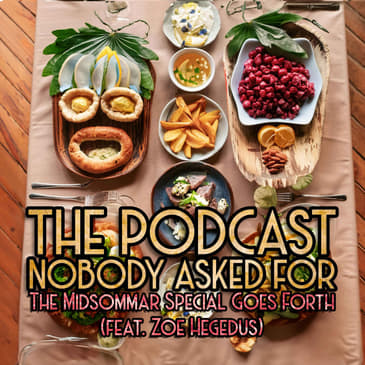


We’re heading back into the daylight nightmare to revisit grief, cults, questionable relationships, and one of the most uncomfortable group holidays ever committed to film. If you missed them first time, now’s your chance. If you’ve heard them already, you probably need the closure.
Originally released 27/6/24
Not that anybody asked but this week we preheated the aga and started to ferment some herring because we're once again talking about Midsommar. This year our special takes on a culinary twist as we look into the food of the film as well as interview the incredible Food Stylist Zoe Hegedus who's work has appeared in films such as Dune, Poor Things and our favourite folk horror movie. Expect menstruation cocktail humour, a porridge pie for second breakfast and 10,000 hours of gnocchi
You can find the trailers for our choices, and other things referenced, on this youtube playlist.
You can find out more about Zoe and her incredible work at here website www.zoehegedus.com
Our episode on our Top 3 Movie Meals can be found wherever you get your podcasts.
Get bonus episode and swag on Patreon
Buy merch on Teepublic
Follow us on Instagram, Threads and TikTok
Hosted on Acast. See acast.com/privacy for more information.
[00:00:00] Not to stage a cold open or anything, by the way, but usually for these episodes I do a proper supercut of all the times that we have said Midsommar over the past year. And it's always fun, but it also takes forever and my laptop can barely cope with doing it, so I don't think I'm going to do it this time.
[00:00:29] So should we just say Midsommar? Midsommar. Midsommar. Midsommar. Midsommar. Midsommar. Midsommar. There we go. That can, that should appease people for a while. You guys are making a podcast. No one asked for this.
[00:00:58] Welcome to The Podcast Nobody Asked For with me, Ian Harries. And me, Graham Jones. This is usually the podcast where we argue about our top three list of a topic that nobody asked us to talk about. But this week, as is now tradition, we are once again continuing our deep dive into the Arias to folk horror grief-stricken masterpiece, Midsommar. Yeah, it's fucking great. I did have more to say, but I... Fourth annual? Fourth annual? Fourth annual. Fourth annual.
[00:01:28] You said morph annual like that was a person. It was like, yeah, you've known me too long to think my name is morph annual. Which, uh... Ian for short. Ian for short. No, no, no. As in fourth annual, I believe. Is it? Yes. It is the fourth annual Midsommar special.
[00:01:48] So, in our first episode, we dove into scenes from Midsommar that stuck out to us or stuck with us. Mm-hmm. Which was fun. There was a lot of Blood Angel talk, I believe. Uh, it was the longest episode. Still the longest episode, I believe, of the podcast. At a towering over two hours long. Uh, and also one of the most downloaded. Which goes...
[00:02:15] Just goes to show that people love Midsommar and they love us talking. Isn't it... Aren't all of them up there? All the Midsommar ones? So, the second... The second Midsommar special was Pavel Pogacielski and we talked about films to double bill with Midsommar. Yep. Which was, I believe, also just over two hours long. Uh, I just realised I can't just check because that's something we're able to do. Here we go. Yes.
[00:02:45] So, oh! Tell a lie. The original The Midsommar special was two hours and two minutes long. Okay. The second Midsommar special was two hours and nine minutes long. So, I got to talk to Pavel Pogacielski via Zoom from, I believe, an airport... Airport terminal because he was waiting for a flight back from Puerto Rico, I think. Um, where he'd been working on... Yes, he was filming something out there, right? Scouting for Blue Beetle. Girls.
[00:03:15] Oh, Blue Beetle. No, he wasn't in that band. He has nothing to do with the, uh, pop rock band from Ryslip. He does not. Uh, and then the third Midsommar special was a relatively sprightly Hour and 51 where we talked about art and Midsommar with Neila Svensson. Uh, and the entire episode was an interview and I fucking love it because Neila is incredible. It was, it was brilliant.
[00:03:41] And much like a song by the Scouting for Girls, he's so lovely. Ha! Well, we, I remember, I remember, uh, I guess we asked, asked if he was up for it. He was, we didn't really agree on a duration and I remember we joined it. It's like, oh, so how long do we have? And he was like, oh, I'm free all evening. Like, is that cool? It was, it was the perfect amount of like, um, gung ho, fuck it, let's go, I'm game.
[00:04:10] Combined with complete and utter chaotic abandon. And, um, it came together and coalesced into something that was, was, was quite beautiful. Brings it to the time. And we kept, we kept messaging each other during it just to, you know, pick behind the curtain there. Again, another, another, another pick behind the curtain. Picking behind the curtain, behind the curtain. Again. What's there?
[00:04:36] Of, um, making sure that we were, the flow was going, we had our questions. Uh, and most of those messages just descended into, I love Neila. Yeah. This is, this is insane. Um, this year though, uh, so for the Midsummer special goes forth, which is obviously a Black Adder reference and a joke four years in the making. We're talking about food. Glorious food.
[00:05:01] And we were able to talk to Zoe Hegedouche, the food stylist who worked on Midsummer, which is really fucking cool. Yeah. I think I mentioned it kind of quite early on in the episode, but it's one of the, in the episode, in the interview, not in the episode, because earlier on in the episode would be before that. And I haven't mentioned this. So what are you talking about? So later, later on in the episode, earlier on in the interview. Exactly.
[00:05:25] And previously on a time where we interviewed her, um, because this is in the present future past. Don't know. I've not had enough sleep to, um, to, to try and, to try and Nolan this. Um, but, uh, yeah, the food stylist is obviously a job because it makes sense. But also it's one of those things that you, I'd never really considered was something that
[00:05:54] you could make a living out of or would be something that's, that's, uh, needed. But yeah. And I think there's quite a few of those. And if you look through the credits in Midsummer, including, I think one of the ones that you picked out when we were looking for people to interview, uh, Bear Wrangler, I think was, yeah, there's a Bear Wrangler, which yes, we will, I will do, you know what, for our Patreon listeners, I will record a short behind the scenes Midsummer special episode
[00:06:19] just talking through all of the people we have reached out to over the last 12 months trying to get to cover the episode. Nice. Because there are some like proper left field people we try to get in touch with. Thus far, if you're listening to our fourth, the fact that this is called the fourth Midsummer special, obviously, you know, that we like the film Midsummer to say it lightly. Um, how many times do you think we have recommended Midsummer on this podcast?
[00:06:49] Oh, um, 172. 191. Oof. Or 192, if you count Daryl of, uh, Cage Rage and now getting to Foyue saying you should watch Midsummer, but imagining that it's Nicolas Cage in it. So 192. Yeah. And there were, there were a couple of, you know, I think one of them was watching it 69 times. Yeah.
[00:07:17] As a Midsummer of 69 joke, there was, uh, specifically the director's cut and specifically the director's cut at Prince Charles cinema were thrown out there. This is, this is going to be coming out post Midsummer. So Midsummer, the 24th of June. Uh, so it already would have had Midsummer on Midsummer at the Prince Charles. Uh, daytime showing, which suits it kind of because it will be in the daylight.
[00:07:43] It will and it won't because technically yes, but also no, because you're inside. Yeah. True. But if you were able to go good for you, it's a great cinema. I love it. Yeah. I was a little bit peeved by the 2 PM showing time on a Monday, but there we go. We can't have it all in. Oh no. I mean, I did, I did consider taking the day off for it. I'm not going to lie, but also like, because we, that would be the third time I would have
[00:08:12] watched Midsummer twice in the space of about two weeks. Yes. Cause you, uh, you've done your, I, this is actually the longest I've gone without watching Midsummer, I think. Since pre Midsummer, obviously. Well, yeah, obviously. Cause there was, there was a time I, my, my, my Midsummer, my Midsummer-less streak, I think is 30 years. So I managed to go 30 years without watching Midsummer and now it is an annual event.
[00:08:42] When like, you know, many years past your untimely demise, which we hope won't be for a long time. Would you suggest that you also have then therefore gone such amount of time without watching Midsummer? Yeah, no, no, I think so. And I hope someone remembers and honors that. What about if I put, this is again, presuming that you perished before me, which I hope doesn't happen in. No, no, no, no, but not, not just that.
[00:09:10] Like, obviously, like if I have a massive falling out with Midsummer, like, and haven't watched it for a while before my death, but you're assuming you're like, the implication there is you're dying 30 years after me. Minimum. Minimum. Well, I was going to say, I mean, would you like me to, you know, place you on an urn? In an urn, you will be in an urn. Or maybe you won't, I don't know. I haven't seen your will.
[00:09:34] But like, wherever you may reside at this point, just prop you up in front of the TV or take you along to the Prince Charles? No, what I want you to do is I want you to make an effigy of me. Okay. Throw it off a cliff and then smash the effigy with a hammer. Perfect. I will do. The full Midsummer honors.
[00:09:58] Speaking of, so we're, we've just booked a, not me and Ian, just booked a date for our wedding next year. Me and my fiance. And it's going to be largely outside. It's kind of like a woodlandy kind of area, big meadow for the wedding breakfast, all that kind of stuff. And in quite a well-meaning way, knowing that I love Midsummer, I got texts from my fiancee after we'd booked it.
[00:10:26] She was like, oh, you know, maybe we could bring some kind of like Midsummer-y vibes to the, to the wedding. And I was like, I mean, maybe not. Like, I like the idea, but also the implication of the fact that the, the male love interest in the movie gets stuffed inside a bear and burned alive. Kind of doesn't want to be what I want to be doing on my wedding day.
[00:10:53] So yeah, it was, it was a, it was a nice sentiment, but one that I think would probably, probably swerve. Yeah. I mean, there's ways to do it that don't necessarily involve burning people alive. Yeah. But yeah, I mean like. Get a bear. We'll, we'll see. It's going to be referenced at the wedding. Let's, let's not pretend it won't. I, I actually found, I didn't find, someone on the internet found where the film was actually shot.
[00:11:23] So it's all. Other than Hungary, right? Yeah. So it's literally just outside of Budapest. Oh, really? And yeah, I didn't, the cliffs are there as well. Like the whole, the whole thing I think is filmed in like a kilometer of land, basically. Whoever did that location scouting got fucking bang on, didn't they? Bang on. But I did look into it and unfortunately it is now private property.
[00:11:46] So a pilgrimage would involve either trespassing or a polite email in Hungarian. Or, I wonder if Ari now lives there, just living out of his days, writing movies about how much he hates his family. Yeah, potentially. But apparently there's like barbed wire up around it and everything. Oh wow, fair enough. So it's all barbed wire and then Ari Aster just in the middle crying while writing. Yeah. Yeah. But yes, today we are talking about the food of Midsommar. Yes.
[00:12:15] There is a lot of very beautifully shot food, to be fair. And I think it also, it's easy for it to blend into the background, which I think is a testament to how well it was done, if that makes sense. Yeah. Because it is very front and centre through a lot of the scenes, but it never draws focus, even though it looks really nice. Yeah. But also like there's parts of it that are quite pivotal to the story, right?
[00:12:44] Like when we realise certain people have gone missing or when we realise that maybe we don't want to drink that pink lemonade. Yes. So there's parts of it that are kind of interwoven into, and also when everyone's making the pies as well. Yeah. Are you sure it was pink lemonade and not a blood orange? You could have gone with Bloody Mary. Ah, I could have, couldn't I? Bit of menstruation cocktail humour there.
[00:13:09] But yeah, so I did put out on our socials, asking our loyal listeners and fans what they think the best presented food in cinema was. Just for us to get, get a feeling of what was going on. And I think a lot of these will not come as a surprise. Yeah. So DiabolicalPod said Ratatouille. So we've already talked at length about how food is presented in that.
[00:13:38] Yeah, it's one that comes up again and again. Yeah. Martin, in something we've talked about, I can't remember if we talked about this on the podcast, because I think it came out after our actual food episode. The cheeseburger from the menu. Ah, yes. Yeah. I'm horrified at how much I wanted a burger after that. Yeah, but I think like, because I literally went home and ordered the ingredients to make smash burgers the next day. Same, same. I bought a smash press thing after watching the menu. Nice. That was my takeaway from the film.
[00:14:07] Turns out you are susceptible to product placement. I really am. Believe me, podcast, podcast favourite chef. Yeah. Yeah. Obviously. But not necessarily the Cubanos. They said they went home and immediately made the grilled cheese. The grilled cheese is one. And also the pasta that makes you believe that Scott Johansson would want to sleep with Jon Favreau. I think that's its official name. I think so. And it does. I get it. I get it.
[00:14:34] Yeah, I also, ever since doing that, I always use the meat fork to plate my pasta. Ah, interesting. The Infinity Bros podcast, basically any anime food, which again, 100% behind. Yeah. The Popcorn Bucket podcast also specifically said Studio Ghibli films, but also added in their worst presentation of food is the tomatoes in Return of the King. I don't know if we'll have... I don't know if I can recall that. I don't know.
[00:15:03] Oh, you must remember. When Denethor's eating the tomatoes and Pippin is singing while Faramir rides off into certain death. It's been a long time since I've watched it. I'm just going to... Oh, it's glorious. I'll put... Oh. Oh, yes. No, I do. I do recall it now. Underneath this, I'll put Pippin singing or me singing in a Pippinesque voice for copyright reasons. But it's... It's impressive. Yeah, that's horrific. Yeah.
[00:15:32] So I've just... There is a petition on change.org. Get John Noble to apologise for the tomato soup. I mean, fair enough. Watch if you can, said Paddington and Marmalade Sandwiches. Which, that film does make Marmalade Sandwiches look incredible and I am not a fan. Marmalade's... Like, who likes... Also, let's be real people. It's Orange Jam. Like, why are we putting on a pedestal and calling it Marmalade? What? There is a reason for that, right?
[00:16:02] But it's just... It is literally just Orange Jam. It's Orange Jam. Yeah. Stupid bear. Adam... Both Adam and Bed Sit Cinema said hook. Which I get. Yep. I get. Joe said... And this is a good one because I don't... I wouldn't have thought of this, but the chocolate bars in Willy Wonka. Because they are done in a way that makes them seem like super desirable and super nice. So I get that.
[00:16:29] And has to be one of the few foods that have been... Reverse product placement. ...special from TV. Yeah. They came out as an actual chocolate bar. What? An actual company? Which is the... Yeah, but their own by... Oh, they're a subsidiary, but still. Yeah. And then Carmelo said the Mubi Burger from the Viewer's Universe. I think Clerks 2 is set in the Mubi Burger. I get it. But, like, I...
[00:16:58] We've talked about this at length before. All of my off-menu choices, which we did. I'll put in the episode notes of our actual episode on food. But we did an off-menu thing. And all of my choices now, I think, aren't available. Or have flat out closed down. Which is nice. Yeah, that's depressing, isn't it? Yeah. But I think... I'm trying to think... What I think the best food in cinema is. I think it is... I mean... Would you... Like... No, you wouldn't. Because it's not the same at all.
[00:17:28] Honourable mention to Jiro Dreams of Sushi, which is a documentary. So no food styling involved there at all. Because it's actual real sushi. But the way it shot food in that film made me want to try sushi. Because I hadn't eaten it at the time. Yeah. I love sushi. The first... I think we've talked about this before. But the first time I had sushi, it was awful. And I kind of tarred fish with the same brush. Which is something you should never do. Did you do the whole... I mean, Shell did it a lot. But they didn't use a brush.
[00:17:58] They just used an exploding... Exactly. Yeah. So I was less deep water... Film station. Less deep water horizon. And they're more just kind of a bit judgmental. Yeah. So did you... Was it shit supermarket sushi you had? Yeah. So it's the... I've probably made this... When we've... If we have spoken about it before, I've probably made the exact same comparison. But it's like when people start drinking coffee and you have the red-topped Nescafe... Yeah. Instant stuff. And it tastes like dirt.
[00:18:27] And you just assume that coffee's horrible. But actually, there's a whole world out there. Well... Same with whiskey. Same with it. Same... I think, to be fair, probably same with everything. Well, same with a lot of... Same with whiskey, I agree. Same with a lot of things, anyway. Same with a lot of things that have that level of complexity, I think. Like bread's crud. But there's really good bread. But like... Base of bread. Like pizza. Good... Even shit pizza's okay pizza. Bread is a good shout.
[00:18:54] Which I think we could talk more about than the same concept with cheese. But you also have a thing with food where sometimes the cheaper the better. Like proper disgusting white sugary bread. Yeah, yeah. Is incredible with like a bacon sandwich or something. Proper bread. Yeah. Yeah, yeah. And if you're making a burger, the cheapest cheese possible is the best cheese for a burger. Like the kind of cheese that legally it's questionable if you could call it cheese.
[00:19:23] Yeah, there are definitely elements. These things have a time and a place. Exactly. They have a time and a place. So, away from... Given we're talking midsummer food, we've talked a bit about movies and food. So I think we should also talk a little bit about Nordic cuisine. Which, thanks to ChatGPT, which we have a jingle for.
[00:19:50] We used AI to research this part because we are lazy. Hail to our AI overworlds. I researched because it was easier to do it like that. Because I am a horrible person and part of the problem. What's your experience of Nordic food? Have you been out to... I've never been to Norway or any parts of... I don't know why I said Norway because you said Nordic, but that's not the... Never been to Scandinavia.
[00:20:20] So the closest I would probably go is some... And I think the closest crossover is I've had the pickled herring... Oh, really? ...in Amsterdam. Because that's kind of... It's a big thing in Holland. And I guess that, you know, they're not separated by a huge amount. I actually love it. I think it's amazing. You just can't eat it indoors. It's... Why not? Because it stinks, doesn't it? No, it's not that bad.
[00:20:46] I think it stunk on the set of Midsommar because of the sun, I believe. I don't know. I don't remember it as stinking particularly. But it's basically like, yeah, pickled herring that's raw with onions on it. Yeah. And you just... You know how they could try and obviously kind of force feed it to Florence Pugh in the movie? That's basically how you eat it. You put on a little cocktail stick and kind of... I'm thinking of fermented herring, which is also a thing. Ah, yeah.
[00:21:14] Fermented herring famously sells. Pickled herring is just... I can imagine. Pickled herrings. I apologise to you and all herring enthusiasts out there. Fish, not Richard. No worries. I forgive you. And then I guess, yeah, outside of that, it's probably like the meatballs at Ikea. I do love meatballs. I don't know why I said that so low. Oh, I do love meatballs. Oh, God, meatballs are so good.
[00:21:44] Yeah, so I've done Denmark. I was in Denmark recently in an area of the country which is referred to by locals as the Danish word for fertiliser, which says a lot about the smell. I've done Copenhagen. I've done Oslo. I haven't done Sweden yet. It is on my list. My wife has been and fucking loves it. But yeah, so... The key characteristics of Nordic food is seasonal ingredients.
[00:22:11] So there's always an emphasis on using ingredients that are in season. Locally sourcing. So everything local, kind of foraged, that kind of thing. Minimalist. So it's all very simple. Trying to get the actual flavours of the food coming out rather than mixing up things too much. There's a lot of preservation techniques. So like you said, pickling, like I said, fermenting, but also like curing, smoking.
[00:22:40] Lots of ways to try and extend this food, which is obviously going to come from the fact that harsh winters and everything like that. And it's not particularly, in some of these areas, farmable. So what you have, you've got to make sure lasts. And sustainability is also a big thing. So sustainable practices, reducing food waste, that kind of stuff. So that is kind of the core of what classic Nordic cuisine would be.
[00:23:08] And anything that has smoking as a cornerstone of their meals has my backing 100%. Yeah. But I guess that a lot of that's like cold smoking, isn't it? Because like when you smoke to preserve, it's like with smoked salmon and things like that. It's a cold smoke, but I think 45-ish degrees. Yeah. Because I was looking at it for, I was going to make some smoked garlic, but that needs to be cold smoked.
[00:23:35] And that's like a real kind of temperature control thing. I don't think I can probably maintain 45 degrees on a grill outside. You probably need one of the smoking cabinet kind of things to set up slightly differently. But yeah, I think it's, from what I've had, and I've only had like basically British versions or Dutch versions. It's all quite tasty.
[00:24:03] I also quite like, and again, this is a very Dutch thing, but it seems to be a Scandi thing as well. But the open-faced sandwiches is a big thing as well. When I was in fertilizer country in Denmark, the company we were visiting, the lunch they provided were those open-top sandwiches. And they were the nicest food I have had supplied at something like this before. They were so fucking nice. I like you calling them open-top sandwiches as if it's like a bus call.
[00:24:32] A car, yeah. They had the top-down of the sandwiches. But yeah, they were so good. It's like proper, like, stodgy thick bread as well. Yeah, it's like rye bread, isn't it, usually? Oh, God. Food is great, isn't it? It is, yeah. But yeah, no, I really want to, similar Swedens up there and just in general to go to the Nordics. And I mean, it's, I think the dream is probably over now because of the fact that it's closing down.
[00:25:00] But Noma would have been a, would have been on the list as well. I know it's like a small fortune to go, but I'd like to experience it. He's doing something else though, right? He's got this kind of like, he's got this club that you can sign up to and they'll send you out all of these different experimental things that they're doing. And I think the plan is to do other restaurants elsewhere. Yeah, but more like pop-up kind of stuff, right? Yeah, exactly.
[00:25:26] But Noma as it is today, I think is closing end of this year, maybe? Yeah, which is, I would have loved to have gone. But again, by the time I could have even humoured the idea, they had announced it was closing and then suddenly you could never get a table ever again. Because those booked up quickly. I wonder how, I've never looked into it, but I wonder how much they're going for. Because there's this big thing in New York City at the moment of like, there's a black market for table reservations. Oh really?
[00:25:55] Yeah, like for any fancy bougie place, people are paying upwards of $300 just to get the reservation. I don't... Other people have booked. I think this would be different just because it is so set. It's set, right? It's not... You don't go in and say, right, can I have the duck brain souffle and the boar testicles or whatever. Yeah. It's a set menu. So that might be harder to do.
[00:26:25] But where there's a will, there's a load of rich people who are going to be willing to pay. Absolutely. Yeah. I would have loved to have gone. But yeah, I love... I love food. I love Nordic food. I'm yet to have something that would be classed as Nordic cuisine that I didn't like. Like, it is just very...
[00:26:48] It sounds hugely contradictory, but it's either really fresh or smoked or pickled, which is exactly kind of my taste palette, I think. Like... Yeah, but I guess that's what you need to do, right? Because if you're... If everything is fresh... It's why I like a Reuben. If everything is fresh, if you don't then pickle it immediately, then it's going to... Like, if that's your main source of things, right? That's... Your shelf life is really limited.
[00:27:16] Also, I also like a Reuben, particularly the song Freddy Krueger. Previous podcast guest, Jamie Ledman. We never asked him about... Yeah, but also... Reuben or Reuben, which is best. We didn't, no. 100% a question he would have been asked before. An actual Reuben. Yeah. But yeah, that's a very good point. Russian dressing, is it, that they put on it? Yes. And it's sauerkraut. Is it Russian? I think they call it Russian dressing. It's...
[00:27:46] Not our corn beans. Oh, no. It's... I fucking... I got obsessed with them. I just kept making them over and over. I love it. It was... Yeah, it became a compulsion. It was odd. But I think it's also worth saying, like, not that this is a culinary podcast, even though we're going to be talking about food for probably about two hours. Um, pickling and fermenting is actually quite easy. Like, I think it's one of those things that people don't think about, but you can very
[00:28:12] cheaply get, uh, like, fermenting jars and stuff from, like, Amazon and pickling. You really just need a jar. And it's definitely, definitely worth doing, because the weird... We made some gherkins, which have ruined store-bought gherkins for me. Because they are just nice. So, interestingly, I was... I was having this thought the other day of, in the UK, store-bought gherkins are all shit.
[00:28:40] And they're also really, really sweet, a lot of them. Um, so I was like, oh, I should probably... I might... Why not? I would just do it myself, because I like them. And... And I was looking into exactly what you're saying. What is the setup? Something like that. And it's basically nothing, other than a jar of vinegar and then the ingredients. You're kind of set... Fermenting is a little bit different, because you need to burp it. You need the right jars and things. And there is a... I guess an element of food safety risk with fermenting. Yeah, fermenting can go wrong. Pickling...
[00:29:11] I think it's harder to get wrong than get right. But, yeah. Fermenting... Yeah, I would say so. I tried to make kimchi once, and I... It scares me. Because the problem... I love kimchi. It is so good. But the problem is, when it goes right, it smells like it's gone wrong. And you're never 100% sure. But I did... I've done fermented hot sauces. And they are so nice. And because they're fermented, they keep for fucking ever.
[00:29:42] But, yeah. Fermented peaches, which were insane, because those just... You didn't even have to add water to that one. They just vaporized. Nice. I would strongly recommend it. And also, like, weirdly good for you, isn't it? Like having... It's like gut health bollocks, right? Because of the gut health stuff, yeah. Not bollock health, just gut health. Not bollock health, no. Which I am somewhat of an expert on, given my unfortunately twisted past. But, yeah. I would strongly recommend it.
[00:30:09] I'm happy to offer any advice I have as a cereal pickler. Not that I pickle cereal. Why would you pickle your cereal? Okay, so as a picklist, happy to give advice. But it's easy. You just shove stuff into a jar and hope for the best. But the parts unknown that was in Copenhagen, which was all Noma,
[00:30:34] they've got that canal boat that's full of stuff they've tried fermenting just to see what happens. Nice. Which is like... I don't think I've seen that. It's like a mad scientist lab. It's insane. So we tried to do this. We went to see if we could ferment flowers, where you've pickled these, which you don't usually pickle. I think there's pickled strawberries in there. Interesting. They had on the Noma thing the other day, because they've got this new club thing I saw on their
[00:31:00] Instagram that they were basically trying to create some kind of fungus on a chair. Oh, yeah. To serve up. But yeah. I mean, it's... The stuff is... Yeah. It always... I always find it fascinating that people can get that into an individual thing. And I think that might be the reason why I've never got particularly good at...
[00:31:27] Well, not particularly good, I am good at things, but particularly excelled at something, because I'm interested in lots of things that may be slightly deeper than surface, but surface level. Whereas the guys at Noma, for example, are just like... Fomenting is their shit. And I'm actually... So this is a Keith Haring thing, and I was reading a book about him at the moment.
[00:31:53] And the idea that he was just so focused on his way of doing... Like, he went to art school, and people are asking him to, like, draw live pictures. And he just did it in his style. And it didn't matter, because he was like, well, no, I'm not interested in learning how to draw realism. This is how I see things, and this is it. And having that... I don't know. I just don't understand how people have that. And there's absolutely nothing to do with food, or Midsommar, or anything. I'm just maybe having a bit of a midlife crisis. Oh, no. I've thought about that as well. Of...
[00:32:22] Like, I am in... And it has been noted by people. I am in to so many different things. Like, usually the answer, like, what you're into, like, what your hobbies, what you're passionate about, is usually, like, two things. And I'm like, right. I've got this. I've got this. I've got this. I've decided my... Well, I wouldn't say midlife crisis, because I kind of feel like... Actually, no. That sentence is even more midlife crisis-y.
[00:32:51] I don't think it's a midlife crisis. I just think it's what I always should have been doing. That's a midlife crisis. Start trying to write a screenplay? Yeah. I would say every six weeks, I think about starting a band. Yeah, that's fair. I've always wanted to start a band, but have zero musical talent, so I can't. Never stop Sid Vicious. True, but I will say not... Two podcasts. There's a podcast network. There's editing.
[00:33:20] There's rugby. There's fantasy sport. There's films in general. There's D&D, but not actually playing it, just watching other people play it, which is kind of a weird thing in itself, but, you know, I'll get there eventually. Like, that's ten. Off the top of my head, Graham. That's too many things to become a genius at anything. And that is why I'm not a genius. It's 10,000 hours, right? Oh, well. We do. Something like that, yeah. 10,000 hours to be an expert, but I'm...
[00:33:47] Or if you ask Alanis Morissette, I think it's 10,000 spoons. Well, one or the other. Yes. I went to... You look like you're having an absent seizure. No. My brain went, wasn't that Bicycles in Beijing? And there was a lot more. It's like, nope, that was Katie Melua, I believe. Yes, and the only reason I know that is because of the Bill Bailey joke where he talks about
[00:34:12] Katie Melua and saying, isn't there's six million bicycles in Beijing, but don't worry about that because I still love you. And he says that it's just such a random lyric that makes no actual sense whatsoever. Yeah. Similar to, I've got ham, but I'm not a hamster. Didn't Brian Cox re-record that song? I have no idea. I'm assuming you mean the... Actually, I don't know which one you mean. The physicist or the actor? Brian Cox. I am going to Google this jingle. Time to Google.
[00:34:46] But he was in Deacon Blue? Sure. He had a pop career before he was a physicist. Oh, really? I mean, that makes sense. Yeah. There are nine million bicycles in Beijing. Oh, it was out by three. Oh, no. It was writer and scientist Simon Singh. Okay. Rewrite some of the lyrics to be scientifically accurate because there's a line, we are 12 billion light years from the edge.
[00:35:15] That's a guess. No one can ever say it's true. And he said the lyrics should really be, we are 13.7 billion light years from the edge of the observable universe. That's a good estimate with well-defined error bars. And with the available information, I predict that I will always be with you. Brilliant. Which, a lot of time for. Anyway, back to Midsummer and Food. Oh, he was... Sorry, it wasn't Deacon Blue. He was in D-Ream. D-Ream? Yeah. What was their song? Things Can Only Get Better?
[00:35:45] Yes. No. Brian Cox was in the band that sung Things Can Only Get Better? Yes. Cool. You learn something every day. And that's why you guys are listening. Anyway, Midsummer. So, traditional Midsummer food. New potatoes. Yeah. Which I'm all on. Yeah. Often served with butter and a sprinkle of salt.
[00:36:14] The aforementioned pickled herring. So pickled herring, lots of mustard, onions, dill. Dill, served with boiled potatoes, sour cream, chives, and sometimes hard-boiled eggs. Gravlax. Which, as a society, we all now know, thanks to that three advert. Yeah. Which is just basically a version of smoked salmon. Cured salmon. With a mixture of sugar, salt, and dill. Meatballs.
[00:36:44] Which I'm all for. Small sausages. Which is Prince Corv? Sometimes included as part of the mixed platter. All celebrations should have a mixed platter. Let's be real. Crisp bread. Which my wife is obsessed with. I think isn't... Isn't it in Sweden? It would be a smorgasbord. A smorgasbord. Yes. More festivities need smorgasbords. They do.
[00:37:13] Eggs with shrimp and mayonnaise. Strawberries is a big thing. There's a... Fuck. I'm not even going to try, but a type of creamy salad made with shrimp mayonnaise dill. And sometimes served with toast or crisp bread. There's a lot of beets. So beet salads. Green salads. And then most importantly, I think for us, beer. Beer. Schnapps. I believe. Schnapps.
[00:37:41] And non-alcoholic options like cider. Because I forget cider isn't always an alcoholic drink in some cultures. No. Like, America's, it's a big thing. It's like, apple cider isn't actually... I mean, it can be, obviously, but it's typically not. Yeah. I think. And then for dessert, a strawberry cake. Which there is a story about the film Midsummer on a strawberry cake, which we will mention later, if I remember. So I'll just mention it now. They did try to make a strawberry cake for it, but it looked too modern, so they threw it away. Yeah.
[00:38:11] I like to think they was at least eaten by people rather than full-on thrown away. Yeah. And then rhubarb pie. I have a lot of time for a rhubarb pie. A lot of bit of rhubarb. Rhubarb's great. It's the most metal of foods, right, as well, because when it's growing, when you grow it, it literally screams. Oh, because it's growing so quickly or something, right? Yeah, yeah.
[00:38:36] It's forced because you grow it in the dark and it makes a screaming sound as it goes. Screaming rhubarb is a great kids thing designed to get them into metal. I mean, if you haven't had a thought of starting a band in the last six weeks, now's the chance to ting that up. I have, and I can be even more specific about this, a satirical Tory punk band. Nice. So like Tarquin and the Foxhunters or something like that.
[00:39:06] And just sing songs that are clearly. But there's a very, the issue is it's a very fine line between people realizing it's satire and people actually thinking you're a Tory punk band. Yeah. There's a good Seb Lowe, who you may have seen pop up on a few Instagram things and stuff. He kind of does that. It's not so much punk, but it's definitely lots of like taking this out of Tory's, but from the first person kind of viewpoint. It's good. Interesting.
[00:39:36] Interesting. But yeah, away from my future musical endeavors. That is generally like the core of what like a Midsummer Feast would be. And that feels right up our alley. Yeah, I'd be quite, be quite happy with that. I think, and the interesting thing is, and obviously we talk about this with Zoe a lot, but it's, it is just so, it's so well represented in the film on a number of levels.
[00:40:03] You mentioned the kind of bit around the, the fact that it almost blends into the background, but also what it does is you're, you're very aware of where you are. There's no mistaking that this is, I mean, even though it's filmed in Hungary, that this is Sweden, right? And this is a very kind of traditional Nordic kind of vibe to things. And also the interesting thing as well is I, I'm trying to remember because I haven't seen
[00:40:29] it in about a year or so, but there is, there's the scene when Danny's trying to get hold of, I forget his actual name of the film, Jack Rayner, let's say. Christian. And they're out, Christian, and they're all out at like a diner or something. Yeah. And I can't remember if there was any food actually shown in that, but it is all very kind of,
[00:40:57] the colour part's like dark and it's greys and everything. And that kind of with the whole American lifestyle versus the food in Sweden is very much, you know, it kind of, a lot of things you spoke about as well with all like the local things, the forage things, the fact that, and I know it kind of goes hand in hand with the fact that it's a commune, but like the really communal way that they make all of these things with the pies and there's the whole kind of, you know, all of the people, there's like a whole
[00:41:25] hut full of people that are making pies out of American people. But yeah, it's, it's, there's just, it, it's, it's in such a way that it's so, you don't realise how important it is to the movie. Do you think they ate people? They bake, what's his chops into a pie? Do they? I'm sure they do. Who goes missing? Oh no, I'm not, I'm not sure if it is implied or confirmed, but. It's implied. My reading was so much just nice pies.
[00:41:53] I'm fairly confident that he ended up in the pie. Interesting. See, we're still taking new things from it. Sorry, I interrupted your, your, your pie string. I could be wrong. Oh, that's my interpretation. But like, it's not, yeah, it, it wouldn't be wrong. It would be an interpretation of it. It's definitely. Yeah. Because I, I was, I was reading around stuff and there's so many different like theories
[00:42:21] and things like that, that I have never thought about. Which is, or like, Pella talks about how his parents died in a fire. Never thought about that. And then it was, it's a whole theory that they were victims of the cult as well. Pyramid. Yeah. But anyway, sorry, pies. Pies. Yeah. I've lost my train of thought, but my overarching point was basically that it's such an important part of the movie, but you don't really realize it, but I think you would notice it if it wasn't there.
[00:42:51] And it's also, food's also a big part of the, like the mythology of the cult that you're fed through the film. So like you said, the, technically I don't think it's a tapestry, but kind of is of the pictures showing. At the beginning. No. So when they're there, it's the pictures that show a girl looking at a man, the man spurning her. So she cuts off her pubes, cooks it into a pie or cooks it into food.
[00:43:21] Yeah. Blood into a glass. And then suddenly they're hugging and she's pregnant. And that's all done wordlessly. It's the whole idea. Just with the background of what this cult kind of is. And it does really. A love for potion. It's why it feels like such a lived in. World. Right. Because everything has been. Yeah. Everything has been thought out to the nth degree. But I feel like we're, we're, we're. Segwaying into talking about Midsommar. So I think before we do that.
[00:43:51] Yes. As we said, we were, we were delighted to be joined by Zoe Hegedouche, who is the food stylist for amongst an array of things. So she's worked on recently on poor things. She was the food stylist on Dune part one and part two, which we talk about. Um, the TV series, um, the TV series, Shard Lake, um, the Continental, which is the John
[00:44:16] Wick TV series, uh, Gran Turismo, which is a, uh, Neil Blomkamp movie. Vampire movie, The Invitation, which would have been better if people didn't know it was a vampire movie, but they marketed it as a vampire movie and it was really fucking annoying. Um, and obviously, uh, Midsommar. So without further ado, over to past us and Zoe. Yes.
[00:44:43] We have our, uh, fourth annual Midsommar episode now of our third special with a guest. This time we're joined by the, uh, brilliant Zoe Hegedouche. He was the food stylist on, on Midsommar. And I think we're going to just delve into what that entailed, what it was like working on Midsommar, what it's like being a food stylist, because it's one of those jobs I think
[00:45:07] Ian and I discussed when, when we kind of first, uh, spoke with you that it's obviously a job, but it's the kind of job that you never really think about, even though food is so central to so, so many movies. Yeah, that's a really good point, Graham. I mean, like, how do you, how do you even start approaching a project like Midsommar? Like where does, where does like the food stylist point begin?
[00:45:31] It, it starts actually with research and, uh, and doing a lot of learning about different, uh, periods and, and going to museums and, uh, read lots of cookbooks and albums and, and actually discover paint things and painters from different eras. And, and yeah, and I have to reconstruct images from sometimes cookbooks that doesn't have any image in it.
[00:45:58] So it's kind of a exciting challenge to really recreate, uh, different times. For example, Midsommar, definitely that's more like, uh, more like, uh, not that specific time, but, but, um, but still had to do researches and, and go into the Scandinavian history and, and, uh, how they cook and how they, yeah, all this stuff.
[00:46:26] And, uh, so yeah, I start with the research and then I have to create a mood board that, that describes, uh, the image that I have in my mind to, to, to then show the director, the art director and the art department to discuss and, and see if it works for them as well.
[00:46:50] And then I can test it and do experiments and, and really just to have it real because it's, it's really different from what we see on an image or in a cookbook that what we can dance and on the screen. So would you have worked really closely with Nila then, um, on Midsommar? Yeah, I worked with the whole art team. Um, yeah, actually it was Henry, but yeah, there wasn't. Yeah.
[00:47:21] With Midsommar especially, and I'm guessing on kind of other projects as well, like I know some of the food was written explicitly into the script. Yeah. Again, I mentioned before we started recording the Insider video that you were featured on and they talked about how you had to try and find herring in Budapest. Yeah. In a very, very hot summer. How much freedom do you have outside of stuff that's kind of not in the script?
[00:47:49] Is it entirely up to you or is there guidance given like from the outset? Yeah. So I, I, I get a lot of inspiration from the script to design the food. And as you said, sometimes it's really detailedly scripted. So that's like clear. And then for example, only the, it's described that they are sitting around the table and they are chatting about something.
[00:48:14] So I got the vibe and, and, uh, I know what the message that the movie, the director wants to deliver to the audience. So sometimes I just want to indicate that something horrifying in mid summer is going to happen. And I want to, to use food to indicate that.
[00:48:38] So I come up with ideas and then, as I said, I discuss with the art director or, or with the director and then it, or it gets accepted or not. And then we go on and that if it's, it wasn't accepted, I come up with new ideas. But I, I usually, I got, I got free, free hand in the beginning. Yeah. Talking of horrifying, what was it like with, particularly with Midsommar being asked to
[00:49:07] kind of do some of the more gruesome pieces that making hair into food and blood into drinks? I mean, it's exciting, always exciting to, to get into different, uh, words and, and, and be part of that. Uh, it depends a lot on each director, actually. I think how much he focuses on, on the details.
[00:49:32] So it depends on a little bit on that, that how much I really go into details as well. It was fun, actually. I don't know. I discovered new, new things and new ways of cooking things also. Yeah. I know there was a lot of, a lot of pies. In terms of actually kind of the, I guess the practical side of food styling then, like,
[00:49:59] obviously there's scenes in films where things actually have to be eaten. So, you know, Midsommar aside, across the board in cinema, people are eating food on screen. But how important is it being edible? If that makes sense. Like, is it more important that it looks good? Is it more important that it, you know, what's the priority with that? I mean, for me, I, I'm also, I mean, I, I studied culinary arts, so I'm a chef also.
[00:50:27] For me, it's really important to make almost everything edible. I mean, the things that they will eat for sure. And for me, it's important to be good also that they are enjoying it or they are hating it or whatever, but usually try to be on the good part. And if they have to act that it's not that good, then they will do it. But for example, Midsommar, I think most of the things had to be edible.
[00:50:54] So I, we were like preparing everything on a daily basis. And, uh, I work with, I work with cooks and actually fine artists to make everything happen on the big tables. And, um, but the, for example, what you see in Midsommar in the May feast queen in the middle of the table, there are some things that, for example, towers and like structural
[00:51:20] stuff that I, in the middle, I'm using not edible things to create the shape. But, but usually if it's, it's usually everything edible that I use. Yeah. And how many, um, how many people did it take with Midsommar to kind of, because there's a hell of a lot of food. Yeah. I, there was, I remember there was for the other feast where they were with the two old older people sitting there.
[00:51:50] We had like a really long table set up to, to make all this 80 or more sun-eyed dishes. Yes. Yeah. I think we were seven or eight people doing that and somebody with the eggs and somebody, yeah, with the old stuff cutting and it was fresh. And then of course it got bright and went away with the wind and there was everything that could happen.
[00:52:17] And what, what happens to all of the, uh, the food? I mean, is it just, is it just purely waste? Is it gated by the, the, uh, cast and crew or? I mean, if, if, if the food stands on the table all day under the sun, it usually, and if it's not fruits or, or, or veggies or something that for example, animals can eat.
[00:52:42] I, I try to organize after each shooting a way to, to use the food VR that it doesn't go to waste. But if it's something kind of rotting already on the table, because I can't do anything because it's 40 Celsius degrees. And, and so, yeah, it depends.
[00:53:04] But I, I, I try to also bring food that leftovers for shelters or if it's more like, okay, it was on the sun, but still can be eaten more for animals or something like that. Yeah. Yeah. As nice as it looked, I wouldn't want to eat a seafood tower that had been sitting in a Hungarian summer all, all day.
[00:53:29] How often we, especially with the, uh, the dishes you just talked about, how often would you have to, like, I'm guessing you'd have to have people running in between takes, replacing things. And because I think the egg yolk is a big part of that and I can't see that handling just kind of sitting there for very long. Yeah. I mean, I, I also, there was fake egg yolks as well.
[00:53:54] I mean, honestly, there are many people not really eating because they just, I mean, that would be just too much for everybody that if we have to really change the 80 people's, uh, place, it's more like, okay, just make it nice that it stays the same and really changing for the actors. That's always the main, main task to do and, and for them keep it fresh and, and make it
[00:54:23] easily, uh, edible. Yeah. Yeah. I think, um, I think it's, it's really interesting. The, um, yeah, I guess that this, the scale of it and how I guess just logistically, right? It's such a, it's such a challenge. Um, and I, I'm interested, I guess that in the kind of wider world of film, we've spoken
[00:54:49] about food on a few of our podcasts and we often default to some favorites like, uh, the movie chef, we thought was quite good portrayal of kind of like the street food kind of thing. And also the studio Ghibli movies, whilst they're not real life food is also always looks really amazing. I just wondered if you had any kind of outside of the work that you've done, any big sort of inspirations or instances where you've thought other movies have really nailed the
[00:55:18] food styling aspect of things. Ratatouille. I like that. Ratatouille. Yeah. Okay. That's a good shout. Very good shout at the end with the actual Ratatouille. Yeah. Yeah. That's nice. But, uh, I mean, there is this new movie that I actually forgot the name, but I will look for it for you. I mean, I don't know if you can cut that in, but it's, it's just beautiful. I don't know. It's a French movie. It just came out.
[00:55:48] I think that's, that's, do you know the name? Do you know what? I think, I think I know the one you're talking about, but I can't remember the name of it either. I'll, um, we always edit in, uh, future Ian, which is me having actually researched stuff and interjecting back into it. So we'll, we'll, uh, cut that back in. Yeah. I love that. Yeah. I love it. Hey guys, future Ian here. Uh, in what I think is our first guest invoked, uh, future interjection.
[00:56:18] So the film Zoe was thinking of was The Taste of Things, which came out in 2023. So it's a French film, uh, directed by Vietnamese born Tran Anh Hung, which I've probably absolutely butchered. And speaking of absolutely butchered, I'm not going to attempt the actual title of the film in French. So I'm just going to stick with the translation of The Taste of Things. Uh, it was the French entry for best international feature film, uh, at the Oscars. So, you know, good stuff. I've had a look.
[00:56:46] I haven't watched it, but I've seen trailers and images and things like that. And the food looks fucking amazing. I mean, that's just really like painting. Like, like you see, like really that I love to really do is, is to, to unite food with different other art forms, painting, sculpture. I don't know. And, and that movie actually really, for me, like to do that, like really, um, present
[00:57:14] food in a really artistic and beautiful way. But obviously, Midsommar is not the only film that you have, uh, lent your culinary expertise to. So how does your approach change depending on what you're working on? For example, for Dune and other movies, the design is, is different than, for example, a period movie, period movie. And, uh, then, then it's really start with, with the discussing with the art director
[00:57:44] and with the art team, like what they want to see and how this whole thing will, will be present in the scene. And then I, I, I kind of already start with testing things like doing ideas, textures and stuff, and not that much researching, researching also always about the, the, the trend and what's going on right now and more maybe futuristic stuff, but it's not that much going into research.
[00:58:11] It's more like going into the kitchen and testing textures and things and come up with ideas for that special, uh, specific scene. Obviously with Midsommar where there is a very, though, though it's really surreal and weird, it's a very grounded actual setting of rural Sweden, which has its own like food history. And like you said, there's Nordic cookbooks and a very set style of stuff when it comes
[00:58:39] to Dune, which is set, I think 8,000 years in the future, when you're approaching that, do they come with a set idea of what, like how much detail do you need to kind of be able to produce food? Like we usually come with an idea, but it's not really that sometimes it's an idea that I have to, I have to create and then we, we can see what the idea is. So I can change still the idea.
[00:59:08] And I'm, I usually do it because I have this idea and maybe we can put this on and this and in, so that the final product will always be like what I, I imagine also, but in Dune, for example, they kind of had a really clear idea what they want. I mean, clear idea in the way that colors and textures and, and shapes and then working in those, I, I come up with what is it really?
[00:59:37] I get, I mean, a lot of Villeneuve's films, I think are very set in a look at how he wants things to work. So I think that makes a lot of sense, but it's, it's fascinating going through the, having a look through the projects you've worked on and just the variety of, I mean, you've fed hit men, vampires, racing drivers, whatever they are in Shard Lake, because I haven't watched it yet, even though Disney plus keeps telling me to watch it, but I know it's a fantasy-ish thing.
[01:00:08] It's just, it's, yeah, it's really interesting. And I really liked the, there's a quote on your website, which is, which I did have in bold and it's now just randomly disappeared. There we go. The quote from your website, which is food enhancing storytelling on screen, which I think is really interesting. And you touched on before. And I think, yeah, I think in everything that I've seen, you've worked on, you can definitely see that through the food.
[01:00:34] I mean, for me, one of the most important thing is to be able to evoke emotions and tell a story or help the story with the food I designed. So I, so yeah, it's important. I mean, you know, I mean, food is something included in the art, art word, art department. And sometimes it's just something on the table that you can't really see, but still
[01:01:00] it adds to the atmosphere and still it adds to the colors and the word you are, the actors are in and, and also helps them to act. But that's, that's the thing. Yeah. Yeah. Sorry, excuse me. And how about the, what, what do you prefer? Because you mentioned at the top, you've kind of got this culinary background and stuff. And I noticed from your website, you still do kind of like pop-up events and things like that.
[01:01:27] Is it, are you much more leaning into the food stylist side of things or is it really kind of, you know, but both worlds are still very front and center of what you do? I mean, I think both, but, but I, and as I said, the last couple of years, I've really focused on movies and food styling for movies. I really like it. And each project is just really a challenge, but I like challenges.
[01:01:53] And I think that's why I'm keep doing it because I really like always working on different projects and different styles. As you said, it's really different styles of movies, but I'm always learning as well. And I'm always like, yeah, I like, like always being in a different world and, and go to sets and just wow, what they also created around, around the movie. Yeah.
[01:02:23] Yeah. Cause it wouldn't get, especially with like, I mean, Dune, Midsommar, poor things as well. Like they're set in very intricate, detailed worlds. And if the food was wrong, the whole thing would feel off. And in a way I don't think people could quite put their finger on, but it all brings everything together. Cause food is, well, I mean, look at me, obviously I think food is important.
[01:02:48] Um, it's a big part of, um, uh, everything. Yeah. I think it's, it's really important because people can relate to, you know, like, like, I mean, we could sit around the table. I mean, with people who you don't understand the language and still with food, you can share the moment and you can share what's going on. And I think it's, it's a common thing and it's, it's, it's just unite people and it's always important. Yeah.
[01:03:17] And I think that's, that's really apparent in Midsommar, right? Cause you've got all of these outsiders coming into a new community, trying to understand it and integrate. And yeah, there's obviously these kinds of communal feasts are such a big part of that. And it's, I was, uh, I can't remember if there's an article I was reading, but there was a talk about also the trust that people put in to sitting around and eating with with people. And then you've got the kind of the fact that certainly in Midsommar, that even though
[01:03:45] they're putting this trust in, in this community, there's a kind of things lurking underneath the surface that, um, and it's, I guess that juxtaposition of this welcoming is a feast, but actually, you know, maybe not all as quiet as it seems. So, um, yeah, it's an interesting, um, I just, I just think it's so important, particularly in Midsommar, it is in a lot of films, but the food, like you kind of say, is just front and center.
[01:04:13] And also with so much of these kind of big celebrations, right? It moves through not only the ritual preceding the old couple who, uh, meet an untimely end at the bottom of a cliff, but then also throughout the May Queen kind of feast and everything. It's clearly, you know, a, uh, part of the overall rituals. Um, but yeah, it's, it's, it's just, it truly is, truly is fascinating. And I, you know, I obviously spent a lot of, I've, I've watched Midsommar more times than
[01:04:42] I'd care to, uh, care to admit, but it's obviously always, um, it's always obvious that food is, is an important part of it, but certainly knowing that we were speaking to you and really delving into it, it's fascinating to see. And understand the process behind it, because I don't think I've ever really paid, uh, paid as much attention to it. And it's clearly, clearly a big task. You've worked with a lot of very, I think, visionary directors to, to put it lightly.
[01:05:11] How important is it when designing these meals that obviously they don't just look good and fresh, especially with Midsommar where it's all supposed to be quite rustic, which means it's supposed to look very natural and, you know, straight from the ground. But how much thought goes into how everything's actually going to be shot and filmed through the day? Actually, I think it, it depends on the director, like for sure.
[01:05:39] But, um, for example, Ari, for sure a lot, but then there are other directors. There's, I mean, I think in general, they put a lot of thoughts of how, I mean, not the food, but the scene, how, depends on the, how, how important the food is in the scene, but like how the table or how the, I think there are, they, they think a lot about that.
[01:06:02] With Yorgos also, I mean, he worked with different films and different cameras and he had it really, I think, clear what he wants. And it was really good to work with, with a director like that, that they really know what they want actually. Yeah. Yeah. And then would that change what you decide to make or produce? Yeah, definitely.
[01:06:27] I mean, if I honestly, not always, it's so obvious. I mean, so, so they don't always tell us, tell the crew what, how they want to shoot it just like a day before. So I have to plan before a day before the shooting. So definitely I like to see the whole thing together.
[01:06:51] So if I know the different angles and stuff, I, if it's not the design, but definitely I, I place things differently when I know the angle and like create other stuff in it, if it needs, still needs to change. For example, the, if you go from the top, definitely that's an important angle that I need to know because I can design this way or that way.
[01:07:21] If, if it's, if that, that like, yeah. I get there's, there's quite a few of those aerial shots in midsummer right over the long tables. And I guess everything needs to, to look good from, from that angle. Yeah. But for example, there was a few months ago, I, I was, um, shooting a medieval movie and
[01:07:42] there was a lot of also, uh, top from the camera went up and, um, and yeah, I, I didn't know it was, it was going to happen, but still I could like create things that look good for that scene. Yeah. For midsummer, for example, as the, all the, the tables were, had a shape of a room. I don't know if you noticed at all the tables.
[01:08:09] So for example, there was kind of obvious that they will show it from above also because they wanted to show, because each room had them symbolizes something. So that was also important in each scene. And so I could also like use the shape of the rooms also to, to like create or like in my head, at least see the, what, yeah. From above and how it would look. Yeah. Yeah. I'm getting, yeah.
[01:08:37] I'm guessing it's easy to assume how they would have shot some of the scenes based on that. And with, um, like we we've spoken about obviously midsummer at length and June, you've worked on some pretty high profile films and some really interesting foodstuffs, but I guess with, with your kind of career going forward, is there anything that you've not had the opportunity to do yet, but you'd really like to experiment with, or is it all more kind of, let's see what
[01:09:05] the director has in store and how you can kind of influence it. So in movies, like there is so many things that they are changing last minute. So always like always the more information I can know before that that's the best thing. That's what you want to have. But so many things are happening really last minute and changes that I have to be, and everybody
[01:09:31] I think has to be, have to be really flexible and, and just solve problems and do what we can do there also to, yeah. So, but, but the, in a perfect word, I would like to know everything two months before. And so I am able to really create all the design for that scene. It's not always like that. No, it sounds like you definitely have to think on your feet quite a lot. Yeah. Yeah.
[01:09:59] I, I, I, I just think it's, it's, it's fascinating. I, I, I just like the idea of, again, just kind of the, the, the range of the projects and the range of the food, and then still not really being able to plan too far ahead, just, just in case things change. Is there anything you've done? I mean, it's a lazy question, but I'll ask it anyway. But what is the favorite, like the favorite dish you've made for a film?
[01:10:27] Whether that's just how it looks or big question, I know. Yeah, big question. Like an exact dish. I think it was, it was poor things that I created things. I don't know if sometimes it's not that in the middle of the scene, but in the background or on the corner, but definitely I made some things I, I really liked. And I, yeah.
[01:10:54] Well, I think any, anything that blends in with what Yorgos does on screen is going to be impressive. So I think that's fair. Yeah. So, I mean, I think we're, we're closing in on half an hour. So I think all that's really left for us to say is we really appreciate you joining us and thanks for talking midsummer. Midsummer. Yeah, absolutely. Thank you. Thank you for having me. And we're back. And we are back.
[01:11:23] What a delightful half hour or so we had with Zoe the other week. Really interesting to delve into that aspect. And as I mentioned earlier, like it's something that really I'd never paid much mind to, but it is clearly a huge part of cinema and yeah, really, really interesting kind of take on how different things are represented through film and through food. Yeah.
[01:11:50] And we mentioned it in the interview as well, but her website mentioned that she sees food as a way to enhance storytelling, which isn't something I'd thought about. It makes so much sense. And I think really comes through in this. And it's, it's a really good point as well, right? Because there's so many, there's so many famous scenes in movies that actually revolve around food, right? So you've got the garlic in Goodfellas, you've got, there's a couple in Pulp Fiction, that's
[01:12:20] a tasty burger, $5 milkshake. Like it's, it is something that is so central to so many of these iconic scenes, but I guess it kind of plays out where it's a secondary feature to it. But you know, the $5 milkshake thing is talking about, I guess, like kind of the insanity of inflation at the time and, and, you know, and everything else. The tasty burger is just pure intimidation through the use of eating someone's burger. Yeah.
[01:12:48] But then like that, then makes you think about how many of those $5 shakes did they have to make? Because this is true. In chef that they had to make 800 Cubanos. And I think there was another example. To be fair, I reckon I could do about 200 myself. I think I could, but then like, it's just the, there is so much like nuance and things like that, that I'd never thought about. So, yeah.
[01:13:17] So for Midsommar, and we did mention that she baked over a hundred pies, prepared 50 fake yolks and 200 real yolks for the, those Sun's Eye dishes. We'll go into it a bit more because I think those are probably the more famous thing people think of. Yeah. The, the pies are all like, they're like filled with oatmeal in a lot of cases. So you couldn't. Oatmeal and chocolate. Because it was like the hottest summer on record.
[01:13:45] You couldn't just have meat pies hanging around for 12 hours and you couldn't have just pastry because then the pies wouldn't, they would collapse or you would tell them something's off. So yeah, it was a mix of oatmeal and cocoa powder, which apparently just looks like ground meat. Sounds quite nice as well. Like a porridge pie, which definitely sounds like something from Lord of the Rings. Yeah. Oh, a porridge pie is definitely like a second breakfast kind of Hobbit thing, isn't it? Absolutely.
[01:14:12] I'll put the, I'll put the Piffin music back underneath now. Nice. But yeah. So like, yes, you just took a hundred of these pies. And I think that oatmeal mixture in that communal scene you talked about, they used to make the pies in the background. Yeah. But again, I think that's all, there is so much, given the film is all about basically, to make it sound like a romantic comedy is about someone finding their family.
[01:14:41] That kind of thing really plays into that, right? It is the communal, we're all in this together, we're all helping each other, we're all, you know, like a team and like a unit. And I don't think anything shows that quite as easily as showing everyone cooking together. And eating together, actually. Yeah. It's very, especially at that scale, right?
[01:15:05] Because, and also with the, there is purpose to how like the tables are set out, for example, and the runic shapes and things like that. There's, there is nothing, and this is probably not just a comment on the way that the food styling is done, but just probably a comment on Ari Aster in general is there's nothing in this film really that's done without purpose. Yeah. Like, there is, there is a reason for everything and everything's been thought out.
[01:15:33] And we learned that a lot with the, when we spoke to Nila, right? When they were, when he was talking about how every centimeter of the, the dormitories would, even if they weren't ever going to be seen by camera, every centimeter was covered with the artwork. So you could, you know, it could be done. Yeah. You could do things from different angles if you decide to. Yeah. But yeah, I think the, you know, it's a testament to Zoe as well, that the food, she clearly
[01:16:02] put a lot of thought into how the food was going to be shot, that kind of thing. So like you said, the first big meal scene that doesn't involve them doing mushrooms or something like that is the table. It is pre-Atta Stupa. And like you said, the table set up as a, is a, is a big rune. And they're all sitting there and they've got what they've called the sun's eye, which is an egg yolk on top of beetroot.
[01:16:32] I think there's cheese on it. That's then on egg whites and chives. And it looks so fucking nice. But these are dishes that had to sit out in the open for 10 to 12 hours at a time. And the way that they made that happen is, you know, it's showing how the sausage is made, right? Like it's fascinating. So they sprayed to make things look good. There's no sausages. Well, I mean, it is a midsummer thing.
[01:16:58] I think there might have been some small sausages at the May Day, May Queen feast. But they had to spray the chives with a mix of water and oil. One, to make sure they looked fresh. And two, to make sure they didn't blow away. Which is never something I would have factored into you having to do. And then the same with the egg yolks. The egg yolks apparently could sit there for 15 minutes in that heat before they would break. Which is wild.
[01:17:24] I also think, I know you said it looks nice, but like the idea of raw egg yolk with beetroot is kind of repulsive to me. Like I don't mind raw egg yolk in like a beef ta-ta. I don't know. I don't know.
[01:17:49] I don't know. Like when used correctly is really nice. It's basically a sauce. Yeah. Yeah. Well, and also like weirdly egg white as well. And like, I don't know if you've listened to the most recent off menu cast. Like the Mandzukas one. Jason Mandzukas. Yeah.
[01:18:14] Jason Mandzukas, who would be high on a dream guest list, which we do have to do at some point. Absolutely. He's like deathly allergic to eggs, isn't he? Yes, of course he is. They ended up going into that conversation about how egg white is used in a lot of cocktails and he basically had kissed a girl after a date and it turned out that she had a cocktail that had egg white in it. And instead of being able to go back home with her, he had to go to the emergency room, which is a fantastic anecdote.
[01:18:43] But yeah, just my point there is the versatility of eggs in the sense that they can be used in cocktails, not that they can be used to hospitalise Jason Mandzukas. However, they also can be. So one thing on that. Do you know that came out on the same day as a three bean salad episode on eggs? Yes, it did. I didn't put two and two together. And they were next to each other in a lot of people's podcast players. It's like, ooh, this is dangerous.
[01:19:12] Two, what is the more versatile food? Is it an egg or a potato? Oh, that is possibly, and I'm not going to, this is no overstatement here, possibly the best question you've ever asked on this podcast. And you're saying that on an episode that explicitly features an interview. Yeah. Because you can do a lot with potatoes.
[01:19:41] Like, potatoes don't always get the benefit they do. Crisps, chips, waffles. Rusty. A rusty is fucking amazing. A rusty does not get enough love. I do like a rusty. Mash, obviously. Hash brown. Fried. Hasselbeck. Dauphinoise. Yeah. Yeah. But I would say that in a lot of these, there are additional things that need to be added. Whereas there is a versatility of eggs that maybe the egg is the addition that brings things out.
[01:20:10] Whereas the potato is the base. And I do love an egg. Had two basted eggs on bagels with chili crunch on them for breakfast this morning, which was very nice. A basted egg? Yeah, basted egg. So you butter in the pan. Okay. Crack the egg as if you're frying it. As it starts to go, like, white, you pour a tiny bit of water into either side of the
[01:20:39] pan and then cover it with a lid or some foil or something. And because of the way that the steam's trapped, it kind of bastes the egg and you get like a really nice kind of white colouring over the top of the yolk and it kind of makes it all. Okay. Yeah. It's really nice. So it's like a fried poached egg? Yeah, basically. I did get really good at poaching eggs at one point, which like I said, one of my many hobbies. Yeah.
[01:21:08] And genuinely, don't know the answer to your question. I guess the one thing with potatoes is you can't whisk up a potato and bathe its parents in it like you can with a leg and chicken. I mean, true, true. But like, that's not far from a croquette. Yeah. I mean, that's a... There's potato buns are really good with burgers. They are. Yeah. But again, there's a lot of additional pieces there, right? Oh, yeah. No, that's fair. That's fair.
[01:21:38] Oh, but also Noki or as Ian calls it, Cloudpasta. I'm an adorable boy. What can I say? I had Noki at the weekend. We went to Ginger Wings in Marlow and they had Noki as a side. And there was a guy there that I... You know when you recognise someone but you don't know why? Yeah. There was a guy there that was like, I'm sure I know him. It turns out I didn't. But it's that he was Heston Blumenthal's son. Oh, yeah. He owns Ginger's. Did not realise that. Yeah, yeah.
[01:22:07] That's why they're so... I mean, I hear they're very good anyway, but like one of the reasons they've... 100% need to go. ...got so massive. Yeah. Yeah, it's because it is his son. I was going to make another point about... Oh, yeah. So, idea for a business. Open up a Noki restaurant in the Red Light District and call it the Noki Shop. Nice. Red Light Noki. Red Light Noki. That sounds like an anime. Noki Shop, Noki Shop.
[01:22:37] Yeah. No, no, no. Like, I get it. The lack of laugh wasn't because I didn't get it. I just... I was concerned. So, I thought I'd explain. No, that's fair. No, I appreciate that. I've always wanted to try Noki. Like, try to make Noki. But I'm worried that if that becomes part of my skill set, that's all I will... Well, like you were saying about becoming laser focused on stuff. Like, the podcast will end.
[01:23:06] The future bands will end. The screenplay will lay half written. It will just be me making Noki. Solidly. Like, every... You'll get a call from my wife going, Graham, Ian needs help. But he's still making Noki. I'd like to read your memoir, 10,000 hours of Noki. 10,000 hours of Noki. Sometimes... Like, I'm very proud of our episode descriptions with the...
[01:23:34] Each one will end with three random things that we have said or referenced during that episode. And sometimes I end up with... So, for example, for potential worst product placements, right? I had to pick from this list. The Lion King 386 times. Gay Paul Rudd's glasses. Seeing how the squash she is made. Space Jam's use of onion rings. The middle class bell of the bell curve. A mob cunceurge.
[01:24:02] Playing by worm in the outhouse rules. The benefits of bulking by eating beaver. The morality of loving an Ewok. Scream-powered planes. And the fallow years of Ringo Starr after King Herod. And it's often... The worst part about that is, like, I don't remember what some of those... But, like, I know we spoke about some insane things. But, like, the worm in the outhouse, I really can't remember what that was about. Oh, and the cunt mug from under the stairs. But, yeah, I...
[01:24:32] It's sometimes really difficult to whittle that down. But 10,000 hours of Gnocchi. Straight in. Straight in. I like it. But I don't think there's any Gnocchi in Midsommar, unfortunately. It's one of the few things about the film I dislike. But they do have a lot of other things. So, the other big food scene... At least communal eating scene is the May Queen feast. So, less runic and more long table with this one.
[01:25:02] Everyone's on a high. Some people are literally high. And it is very, very rustic, traditional, grown locally. And I think Zoe would have mentioned that. They were basically given free reign. The only thing that was written into the script was she had to eat a herring. But everything else, they could just kind of do what they want. And this is where they tried to make that cake that appeared too modern. So, they had to bin the idea.
[01:25:32] Yeah. And I like the approach from Ari and the team. And I think the art direction team as well with that. Because the only part that was central to the story was the herring, right? So, yeah. Also, sorry, just while you were talking. Brainwave for the sister shop to the Noki shop. Have one ascot. It's the Noki for your jockey. Now, that's funny. Apparently, I like rhymes.
[01:26:02] I like rhymes more than wordplay today. Noki for your jockey. Yeah. Yeah, I like it. I like it. Like, gazpacho kind of. Like, Noki meets gazpacho at an NHL stadium. Ice Noki. That's... You're getting there. I like how you've got... He said he likes rhymes. I'm going to go for it. Alice in Wonderland tie-in shop. Yeah. Jabba Noki. Nice. I like it.
[01:26:30] Obviously, the Minecraft version is blocky Noki. I like how I'm laughing to not just sit here going, Noki. Cocky. Cocky. Cocky Noki. There's got to be something in Cocky Noki. Well, you have it in East London. You can have Cockney Noki. Cocky Noki. Noki for sailors when they return home, which is obviously served at the Docky Noki.
[01:27:00] Okay. Right. Moving on. Moving on. Back to... Back to the task at hand. So, the May Queen feast is full of... To be fair... Cross over with those little breadsticks with chocolate on them. Pocky Noki. Sorry, I'll stop. That was quite good. That was quite good. Attitude era wrestling Noki. Obviously, Rocky Noki. But at this May Queen feast... In the middle of a bunch of sheep.
[01:27:30] Locky Noki. Rock... Socky. Socky. I think it ought to be something socky. Oh, well, I mean... That was served by mankind. I was going to say, yeah. The rock... The rock... Rock and socky Noki connection. Anyway. If I say this quickly, maybe we won't get another one in. The May Queen feast. Obviously, it's really rustic and they were given a completely open plan for what they were able to do with it.
[01:27:57] So that included a centerpiece made out of a goat carcass. As you do. An asparagus tower that took them five hours to make because apparently asparagus is like a special occasion thing. An asparagus tower made out of meatball. Or made as... Asparagus tower surrounded by meatballs. Which is, again, something I could 100% get behind. And, as your fiancé said, if you want a bit of Midsummer at the wedding,
[01:28:25] maybe you go for asparagus and meatballs. Maybe. Maybe asparagus towers are the centerpieces. I think so. I think so. Another centerpiece was a crayfish tower, which took them six hours. Which looks really nice, but then you see some behind-the-scenes stuff and they're painting red onto everything, which kind of makes sense. But that also looked really nice, to be fair. Yeah, initially it apparently didn't look great, but they managed to claw it back. Because, well, obviously none of them were shellfish. No.
[01:28:55] No. Neither are... Are they shellfish? Correct. Cool. Right. Great. I think they like to help each other out. There's also a pie shaped like a man surrounded by apples that looks, frankly, fucking lovely. Because I just like pie. Yeah. Well, it's got a name, I forget. Is it just called like the... It's the Hargaman. Hargaman. It's the Hargaman pie. Yeah.
[01:29:25] And, yeah, it just looks... Again, it's one of those scenes where outside of the herring they force Danny to eat during it. Kind of does sit in the background. But, again, it adds to the whole aesthetic of everything. Like you said, making... At the very least, it makes Hungary seem like Sweden. Which... Yeah. A hottest summer on record, Hungary, isn't that close to Sweden. But they do really make it work. Yeah.
[01:29:55] And the good thing is, is that as everyone eats, obviously, they all become less hungry. Yay! Less hungry and more Swedish? Ish. But it's great. Like, it does add... Yeah, it adds, I think, a lot to the scene. And it also looks so fucking good. And I think Zoe mentioned the sheer size of the team. They needed to keep running things in and refreshing things and making...
[01:30:24] Making it look like it was just made rather than sitting out in the sun for 10 hours. Yeah. No, absolutely. And hats off to her and the team because it's... Yeah, I think an unsung kind of heroic of the movie is how good the food styling is and how it adds to everything. And yeah, I'm glad we got the opportunity to really delve into it with her and kind of understand a lot more about
[01:30:54] a universe that I have previously had zero kind of exposure to. So, yeah. Good. Good going for the fourth time around the sun with Midsommar. Who knows where we will end up next year. And like I said, there will be... I will do a short Patreon episode on our journeys through trying to get guests on. Zoe,
[01:31:22] I am very glad we got Zoe this year because it was fascinating. And like you said, a part of cinema I hadn't necessarily thought about before. Absolutely. And it does... I mean, I am hungry. As, you know, which is obviously tied to Midsommar now. I am Sweden. I am Sweden. But, Graham. Yes. Before we wrap up after this mammoth Midsommar episode,
[01:31:52] I think it was a bear. Yeah. Yeah. I think it's time for a movie recommendation nobody asked for. I, uh, I assume you guys are here for a movie recommendation. No, thank you. Nah. I'm fine. Nah. I'm fine. I'm alright, actually. Thanks a lot. Nah. I'm fine. It's alright. I'm fine. Yeah, that's alright. Fuck off. Ha ha ha. Did this mean that everything up until now has been the intro? Yeah, no, we're going to dive into
[01:32:21] everything properly in a minute. But, obviously, I mean, we can do, we can do a joint one for this. Obviously, it's Midsommar. Go and watch Midsommar and keep an eye out for all of the work Zoe and her team did. And, it's, it's, frankly, delicious. Ha ha ha. Absolutely. And now, your first choice. Ha ha ha. Don't worry, we're not really going to drag this out for three hours. It's a special episode.
[01:32:50] We're just having fun. I mean, wait until we, if we do ever get Florence P on it, that is going to be a long episode. I'm assuming it would be like a ten minute interview. Yeah. And then three hours of us just completely losing our shit over managing to get her on. But, one day. Speaking of, her dad has a restaurant in Oxford? Yes, I think so. Based on the Off Menu episode. So, maybe that's where, maybe that's where we start our,
[01:33:19] start recruiting for next year. Yeah, which is also a great episode of Off Menu. Very good episode. But yeah, I mean, any, any closing remarks on food, Nordic cuisine, midsummer, all that good stuff? Yeah, I'm particularly hungry. I realise that I actually like a lot of Nordic cuisine, haven't never been to the Nordic, so need to fix that fairly soon.
[01:33:49] And yeah, as I say, it's given me a new perspective on the lens of which I view certain aspects of cinema through. And for that, I am grateful. So, more than anything, thank you, Zoe, for giving up your time to talk to us two fools and entertaining our questions and yeah, just being a wonderful guest. Yeah,
[01:34:19] and we will be back in two weeks, back to our regular scheduled programming, which I believe is also going to be food related. Yes. But before, before we sign off, if you enjoyed this episode, if you liked the interview, if you've watched Midsummer, all of that good stuff, you can find us on Instagram at the podcast nobody asked for, and you can also become a friend of the podcast and a friend of the horger over on Patreon at the podcast nobody asked for,
[01:34:49] where you can get t-shirts, you can get a copy of Midsummer and Blu-ray at the top tier, you can give us episode ideas, you can throw stuff in to our undrafted episodes. There's a lot of really good stuff and we would really appreciate it because it really helps us out. Absolutely. If you want to send us, if you want to tweet us pictures of your Nordic food, because that's when Twitter was just taking pictures of your food and sharing it rather than it being controlled by Elon Musk and everyone being horrible to each other.
[01:35:18] You could do that at nobody else for pod with the number four. You can find us at the same place on Facebook and we have a website podcast.novyoffseball.co.uk which has all of the links we've described, discussed and more. And wherever you listen to this podcast, please leave us a review and if you're able to write something in your review, put any future episode ideas you have and we will try to do our favourite ones. So that is another year past. We are now out of Blackadder
[01:35:48] seasons, so I'm not sure what the naming convention for next year will be. But we've got 12 months to figure it out. And that is just enough time for us. Just enough. And stay tuned in that episode for what will become an annual knocky update. Guy Ritchie themed knocky. Yeah. Lockstocky knocky.
[01:36:17] But no one asked for this. This podcast is part of Podomity, the UK's podcast comedy network. Why not laugh at what else we've got? Visit podomity.com.